Listed from the MCP registry; nobody on Odel publishes it.

memalyze
Self-hosted agent memory: redaction before write, append-only audit, local embeddings.
Runs on your machine from its package; the steps are below.
What it does
- Reads
- Writes
- High impact
At most: creates or changes data: records, files, settings.
What it costs
FreeOdel charges nothing per call. The publisher may charge for its own service.
Runs locally over stdio
This server isn't hosted — your MCP client launches it from a package registry. Use one of the commands below, or drop the config into your client (e.g. Claude Desktop).
Distributed as an MCP bundle (`https://github.com/mahaoboy/memalyze/releases/download/v0.2.0/memalyze-0.2.0-darwin-arm64.mcpb`) — download it and import the bundle in your MCP client.
Distributed as an MCP bundle (`https://github.com/mahaoboy/memalyze/releases/download/v0.2.0/memalyze-0.2.0-darwin-amd64.mcpb`) — download it and import the bundle in your MCP client.
Distributed as an MCP bundle (`https://github.com/mahaoboy/memalyze/releases/download/v0.2.0/memalyze-0.2.0-windows-amd64.mcpb`) — download it and import the bundle in your MCP client.
Distributed as an MCP bundle (`https://github.com/mahaoboy/memalyze/releases/download/v0.2.0/memalyze-0.2.0-linux-amd64.mcpb`) — download it and import the bundle in your MCP client.
MCP-native, self-hosted memory for AI agents — with the governance an enterprise will actually ask for.
One static binary. Local embeddings. No cloud, no graph database, no Python stack. Redaction happens before anything is written; every read is audited.
Website · MCP Registry · v0.2.0
./memalyze # MCP over stdio, for Claude Code / Cline / any harness
v0.2.0 is out — static binaries for linux/darwin/windows, checksums, hash-chained audit verification, backup checkpoints, and local HTML/JSON governance reports.
Video
60-second product overview — what memalyze does and how the redaction + audit loop works:
📺 Watch the 60s demo video — click to stream or download the MP4.
The problem
Every agent framework ships its own memory: a vector table here, a JSON file there, a "notes" folder somewhere else. Three things follow, and all three hurt in production:
- You cannot audit it. "Which customer's data did the agent read last Tuesday?" has no answer, so security review stops the project.
- You cannot deploy it offline. Most options either call a cloud API or download model weights from HuggingFace at runtime — both fail inside a bank, a hospital, or a factory.
- You cannot keep it small. Twenty-three tools, a graph database, and a Python dependency tree later, the "memory feature" is a second product to operate.
memalyze is the middleware that fixes those three, and nothing else.
What is different
| Cloud memory APIs | Framework built-ins | Personal note apps | memalyze | |
|---|---|---|---|---|
| Where data lives | vendor cloud | inside the framework | local Markdown | your server / your laptop |
| How to connect | proprietary API | tied to one framework | MCP | MCP, any harness, stdio or HTTP |
| Redaction before write | ❌ | ❌ | ❌ | ✅ 8 rule families, configurable, irreversible by default |
| Read audit | partial | ❌ | ❌ | ✅ append-only*, per-actor, exportable |
| Offline | ❌ | partial | ⚠️ model download needed | ✅ local embeddings, no network |
| Deployment | SaaS | with the framework | 173 Python packages | ✅ one static binary / one compose file |
| Tool surface | — | — | 23 tools | 4 tools |
* Triggers reject both UPDATE and DELETE; a SHA-256 hash chain makes later edits visible.
This is not WORM: use audit verify with a checkpoint stored independently from the database
to detect tail truncation. Anyone who can rewrite both can still fabricate a chain
(SECURITY.md).
Not another mem0, and not Basic Memory either: those are good at remembering. memalyze assumes remembering is becoming a commodity and competes on governance, offline operation, and a deliberately small surface.
30-second demo
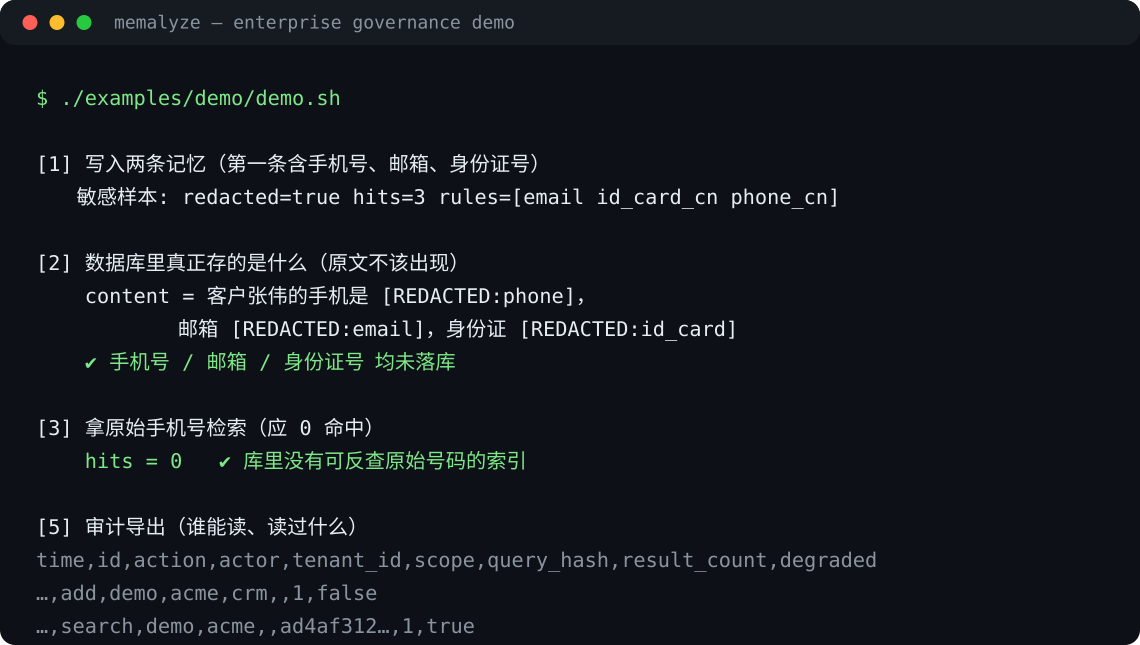
No Ollama, no network, no MCP client:
./examples/demo/demo.sh
# or: go run ./cmd/memalyze demo
It writes a memory containing a phone number, an e-mail and a resident ID, then shows:
- what is actually stored (
[REDACTED:phone], not13800138000); - that searching for the original number returns 0 hits;
- that a business-word search still hits, returning the redacted text;
- the audit rows for the two writes and the two reads.
Details and transcripts: docs/s15-redaction-audit.md.
Quick start
Ollama is optional. Without it memalyze still stores and searches memories: adds
succeed with embedding_failed: true and search falls back to keyword/FTS with
degraded: true. Add Ollama when you want semantic recall.
1. Binary + local embedding model
Prebuilt, checksum-verified (Linux/macOS; Windows: take the .exe from the release page):
curl -fsSL https://raw.githubusercontent.com/mahaoboy/memalyze/main/scripts/install.sh | sh
memalyze --version
ollama pull qwen3-embedding:0.6b      # optional: ~640 MB, 1024-dim, strong on Chinese
From source (Go 1.27+): make build, then ./memalyze --version.
2. Wire it into a harness
Claude Code (project scope):
claude mcp add --scope project memalyze -- "$(pwd)/memalyze"
cp examples/claude-code/CLAUDE.md ./CLAUDE.md   # makes Claude search before answering
Cline: copy examples/cline/cline_mcp_settings.json and .clinerules.
DeepSeek Harness — one command, no separate binary install (the plugin copies a static
binary to ~/.memalyze/bin at boot and registers the agent skill):
dsh plugin --profile web add dsh-plugin-memalyze
# restart DSH; data lives in ~/.memalyze/memalyze.db
The plugin is packaging only: the same Go binary and the same four MCP tools serve
Claude Code, Cline and HTTP deployments; only the install path and the tool prefix differ.
The agent instructions for every harness are rendered from one
docs/agent-contract.md, so "when to search" cannot drift
between them. Details: integrations/dsh/ and
docs/s25-dsh-plugin.md.
Generic harness: examples/custom-harness/ — one prompt contract
plus pseudocode. All options: examples/README.md.
3. Or one-click in Claude Desktop (MCPB)
Download the bundle for your platform from the
v0.2.0 release and open it.
Claude Desktop shows an install sheet and asks where to keep memalyze.db.
| Platform | File |
|---|---|
| macOS Apple Silicon | memalyze-0.2.0-darwin-arm64.mcpb |
| macOS Intel | memalyze-0.2.0-darwin-amd64.mcpb |
| Windows x64 | memalyze-0.2.0-windows-amd64.mcpb |
| Linux x64 | memalyze-0.2.0-linux-amd64.mcpb |
The binary inside is the same v0.2.0 build as above. These bundles are new and have not
been opened on a real macOS/Windows desktop yet — if the install sheet does not appear,
use the plain binary. The server is also listed in the
MCP Registry.
4. Or run it in Docker (memalyze + Ollama + model pull)
printf 'MEMALYZE_HTTP_TOKEN=%s\n' "$(openssl rand -hex 24)" > .env
docker compose up -d --build
curl -s http://127.0.0.1:8080/healthz     # {"status":"ok","version":"dev"}
Point a Streamable-HTTP MCP client at http://127.0.0.1:8080/mcp with
Authorization: Bearer $MEMALYZE_HTTP_TOKEN. See docs/s16-docker.md.
Tools
Four, on purpose. Every extra tool is a decision the model has to make.
| Tool | What it does | Notable semantics |
|---|---|---|
memory_add | store a memory | duplicates return the existing id; embedding failure keeps the memory (embedding_failed=true); returns redacted + rule names |
memory_search | retrieve | vector first, keyword backfill, degraded + degrade_reason when the vector path is unavailable; empty query lists recent |
memory_delete | soft delete | idempotent for already-deleted ids; unknown id returns a tool error |
echo | wiring check | proves the MCP link works; no business logic |
There is no memory_context tool: memory_search already returns text you can paste
into a prompt, and two overlapping tools make model choice worse (D-017).
Governance
Redaction (write path). Rules run in memory.Service.Add before dedup, FTS and
embedding — so plaintext never reaches the main table, the full-text index or a vector.
| Rule | Example input | Stored as |
|---|---|---|
private_key_block | -----BEGIN RSA PRIVATE KEY-----… | [REDACTED:private_key] |
id_card_cn | 110101199003071234 | [REDACTED:id_card] |
bank_card | 6222021234567890123 | [REDACTED:bank_card] |
jwt | eyJhbGciOi… | [REDACTED:jwt] |
api_key_known_prefix | sk-…, ghp_…, AKIA… | [REDACTED:api_key] |
credential_assignment | api_key=abcdef123456 | api_key=[REDACTED:credential] |
email | a@b.com | [REDACTED:email] |
phone_cn | +86 13800138000 | [REDACTED:phone] |
Modes: enforce (default), dry-run (count only, for tuning), off (debugging).
Custom rule packs are JSON: examples/redaction-rules.json.
Audit (read path). Schema-v3 audit_log records actor, tenant, scope, action, memory id,
timestamp, result count, degraded, and redaction count. UPDATE and DELETE triggers plus a
SHA-256 hash chain provide tamper evidence. Search text is stored as SHA-256 + length unless
you explicitly set MEMALYZE_AUDIT_QUERY_PLAIN=1.
memalyze audit export --from 2026-10-01 --to 2026-10-31 --format csv --out audit.csv
memalyze audit verify --write-checkpoint ./memalyze.audit.json
memalyze audit verify --checkpoint ./memalyze.audit.json
memalyze audit report --tenant acme --format html --out governance.html
verify without a checkpoint checks internal consistency only. Exact checkpoint comparison also
detects a deleted (or newly advanced) tail; keep the unsigned checkpoint in an independent trust
domain. backup writes a matching <snapshot>.audit.json sidecar. Static reports contain only
aggregates and verification state—not memory IDs/content, query text/hash/length, or audit detail.
Set MEMALYZE_AUDIT_STRICT=on to return an error when audit append fails. Search then returns no
hits on audit failure; add/delete/reembed side effects are not rolled back. See
docs/audit-verification.md.
What is not here yet: per-user authentication (one token per process, actor from
env), audit retention/purge, reversible redaction, or an interactive audit UI.
Retrieval, measured
Numbers from S8 on a 60-memory Chinese corpus, 16 queries, measured not assumed
(docs/s8-retrieval-report.md):
| Approach | recall@3 | MRR |
|---|---|---|
qwen3-embedding:0.6b (default) | 0.94 | 0.92 |
| CJK bigram FTS5 (keyword backfill) | 0.88 | — |
nomic-embed-text | 0.47 | — |
Two counter-intuitive findings that shaped the design: SQLite FTS5's default tokenizer cannot search Chinese at all (0.19 recall until we stored bigram text), and RRF fusion scored worse than vector-only, so v0.1 does not fuse. See D-012.
Latency (S14, cold start fixed): warmup 37.8 s in background, then search 1.14 s with
degraded=false; after five idle minutes a fresh process answers in 1.52 s. If the vector
path is unavailable, search degrades to keyword in ≤3 s instead of hanging (D-015/D-018).
How it works
harness (Claude Code / Cline / your agent)
   │  MCP: stdio or Streamable HTTP
   ▼
internal/mcp     4 tools, argument conversion only
   ▼
internal/memory  redact → dedup → store → embed; search: vector → keyword → degraded
   ├── internal/govern     rule engine (8 families, JSON configurable)
   ├── internal/store      interface; sqlite impl (memories, embeddings, audit_log)
   ├── internal/embed      float32 BLOB codec, cosine; Ollama client
   └── internal/search     CJK bigram tokenizer + FTS5 MATCH builder
- SQLite (WAL) with ULID ids, partial unique index for dedup, soft delete, TTL.
- Vectors are
float32little-endian BLOBs; search is brute-force cosine (fine under ~10k memories, and the honest limit of a single-binary design). - Schema migrations are versioned via
PRAGMA user_version(v2 → v3 backfills the audit hash chain and installs both append-only triggers).
Operations
memalyze audit export --from 2026-10-01 --format csv --out audit.csv   # who read what
memalyze backup --out /var/backups/memalyze-$(date +%F).db             # snapshot + .audit.json checkpoint
memalyze audit verify --checkpoint /var/backups/memalyze-$(date +%F).db.audit.json --db /var/backups/memalyze-$(date +%F).db
memalyze health --url http://127.0.0.1:8080/healthz                    # probe
- systemd:
deploy/systemd/memalyze.service+docs/s16-systemd.md(hardened unit, env file, backup timer). - Docker:
docs/s16-docker.md. backupusesVACUUM INTO, so snapshots are consistent under WAL and include the audit table; it refuses to overwrite an existing file. It verifies the completed snapshot and writes a separate mode-0600.audit.jsoncheckpoint for restore-time verification.
Configuration
All through environment variables; defaults work out of the box.
| Variable | Default | Meaning |
|---|---|---|
MEMALYZE_DB | ./memalyze.db | SQLite path |
MEMALYZE_TENANT | default | default tenant for tool calls |
MEMALYZE_OLLAMA_URL | http://127.0.0.1:11434 | local embedding endpoint |
MEMALYZE_EMBED_MODEL | qwen3-embedding:0.6b | embedding model |
MEMALYZE_QUERY_TIMEOUT | 3s | vector-path budget before degrading |
MEMALYZE_KEEP_ALIVE | 30m | Ollama model residency |
MEMALYZE_REDACT_MODE | enforce | enforce / dry-run / off |
MEMALYZE_REDACT_RULES | (built-in) | path to a JSON rule pack |
MEMALYZE_AUDIT | on | append audit rows |
MEMALYZE_ACTOR | local | actor recorded in audit |
MEMALYZE_AUDIT_QUERY_PLAIN | off | store query text (default: hash only) |
MEMALYZE_AUDIT_STRICT | off | fail the response when audit append fails; not a mutation rollback |
MEMALYZE_HTTP_ADDR | (empty = stdio) | e.g. :8080 for Streamable HTTP |
MEMALYZE_HTTP_TOKEN | (empty) | Bearer token; required when binding off-loopback |
Status
Honest snapshot — this is an early-stage project, not a 1.0.
| Milestone | State |
|---|---|
| M0 立项与定位 (S1–S4) | ✅ |
| M1 备料与技术验证 (S5–S8) | ✅ |
| M2 核心链路 (S9–S14) | ✅ |
| M3 打磨与文档 (S15–S19) | ✅ S15 governance, S16 Docker, S17 docs, S18 tests+CI, S19 examples |
| M4 发布 (S20–S23) | 🟡 S20 ✅, S21 ✅ (v0.2.0 public), S22 GitHub ✅ / HN·Reddit·V2EX pending, S23 ⬜ |
| M5 复盘 (S24) | ⬜ needs real users |
| M5 复盘 (S24) | ⬜ |
Known gaps: no per-user auth, no audit retention, the Docker image has not been built in CI (no daemon in the dev environment), brute-force vector scan, Chinese-first defaults (English works, but the tokenizer is tuned for CJK).
Docs
| Doc | What it covers |
|---|---|
docs/audit-verification.md | hash format, checkpoints, strict mode, backup/restore, report privacy |
docs/release-notes-v0.2.0.md | v0.2.0 features, upgrade, limits, verification |
docs/s15-redaction-audit.md | rules, modes, audit schema, demo transcript |
docs/s16-docker.md | compose stack, token policy, verification status |
docs/s16-systemd.md | hardened systemd unit, env file, backup/restore |
docs/s8-retrieval-report.md | the 11 retrieval approaches and why this one won |
docs/s13-context-injection.md | the prompt contract that makes models search |
docs/s14-end-to-end.md | real harness, two sessions, cold-start numbers |
docs/s21-distribution.md | release artifacts, channels, post-release checklist |
docs/s21-submissions.md | copy-paste entries for MCP directories, DSH and ClawHub |
docs/s25-dsh-plugin.md | DSH plugin design, verification results, known gaps |
docs/agent-contract.md | one agent contract rendered into CLAUDE.md, .clinerules, DSH and ClawHub skills |
docs/s23-feedback-log.md | live feedback log (currently empty, honestly) |
docs/s24-review.md | the milestone review template (not yet filled) |
SECURITY.md | threat model: what is defended, what is out of scope |
Pilot
Two-week pilot: we install memalyze in your environment, tune the redaction rules to your data, review the audit export with you, and write down the threat-model gaps we find. No fee; you keep the deployment and the notes.
Request a pilot · Integration notes
Non-goals
- Not a SaaS: you self-host, we do not hold your data.
- Not an agent framework: it never takes over the harness.
- Not a knowledge graph: no entity extraction pipeline, no graph database.
- Not feature-maximal: four tools, one binary, and a hard "no" to anything that needs an operator.
License
AGPL-3.0-or-later (LICENSE). Commercial licensing for embedding in closed products:
open an issue titled commercial license.
Contributions: see CONTRIBUTING.md. Security reports: see
SECURITY.md.







