
mailmcp
Your mailboxes in ChatGPT and Claude: Gmail, iCloud, Fastmail, any IMAP. Passwords stay yours.
One address for any MCP client. You sign in at mailmcp.ai once, after adding it.
What it does
- Reads
- Writes
- High impact
At most: moves money, runs code or commands, deletes data, or sends messages for you.
What it costs
FreeOdel charges nothing per call. The publisher may charge for its own service.
What it asks for at sign-in
| Access to | Read | Change |
|---|---|---|
| Not stated: mail | ||
From the sign-in at mailmcp.ai, as the endpoint publishes it. You approve it there.
Tools
None listed · checked 9 Oct 2026Odel could not list its tools without signing in.
mailmcp
All your mailboxes in ChatGPT and Claude. Passwords stay yours.



mailmcp is a self-hosted MCP server that gives ChatGPT, Claude and other MCP clients access to your e-mail over IMAP and SMTP: several mailboxes at once, any provider, attachments in both directions. This repository is the prebuilt distribution (minified bundles in dist/, no build step) under a commercial licence; it runs as a free tier without a key. The source code is not provided.
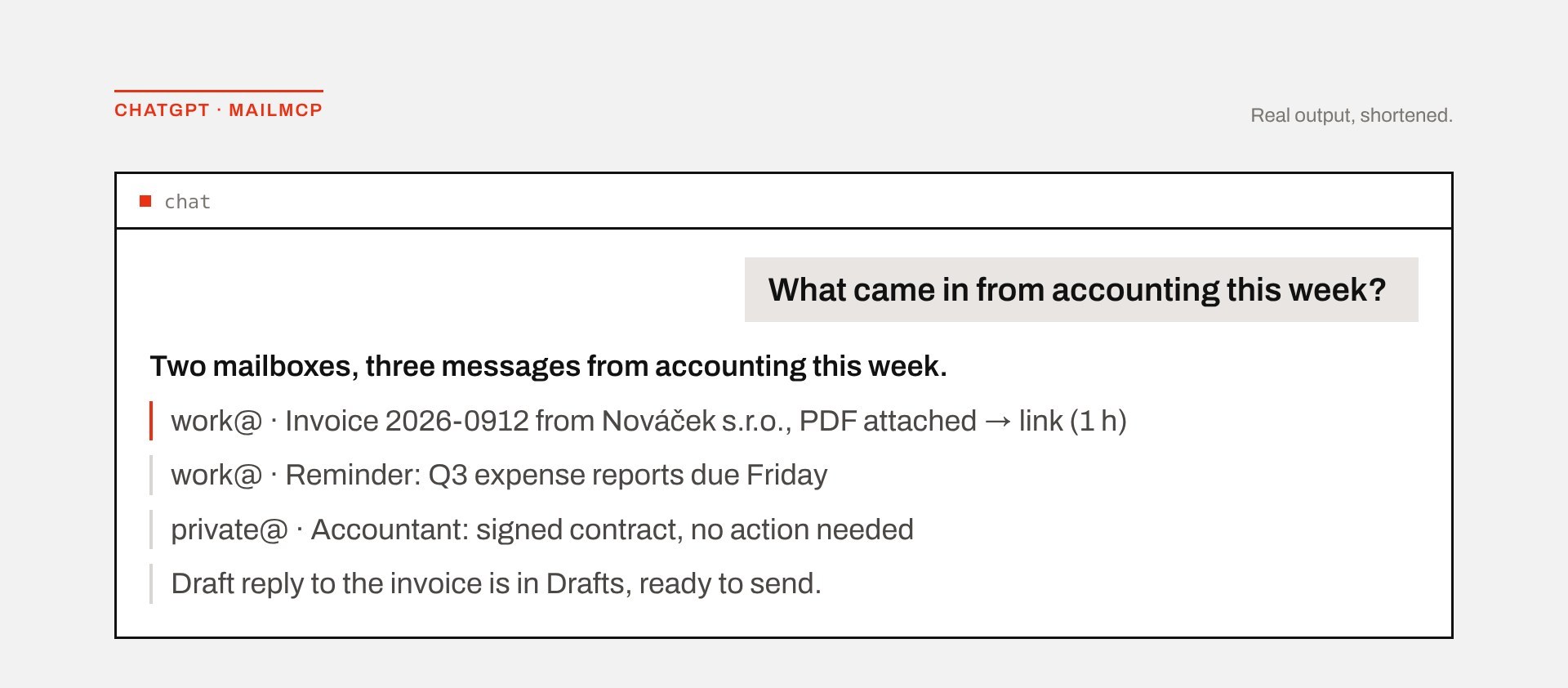
Ask "What came in from accounting this week?" and get one answer across Gmail, iCloud and the company mail server: the invoice as a download link, a reply already drafted.
When to use it
Use mailmcp when you have more than one mailbox, a provider without an official connector, or you need attachments. As of September 2026 the official Gmail and Outlook connectors in ChatGPT and Claude handle one mailbox each and cannot send attachments.
| Official connectors | mailmcp | |
|---|---|---|
| Mailboxes | one per connector | several at once, one token |
| Providers | Gmail, Outlook | Gmail, Outlook.com, Microsoft 365, iCloud, Fastmail, Yahoo, Zoho, Seznam.cz and any IMAP/SMTP server with password sign-in, including your own domain |
| Attachments | read some, send none | one-hour download links; sending from the mailbox, from a file the assistant uploads, or by forwarding |
| Authentication | OAuth grant held by the AI vendor | an app password, encrypted in your browser into a token; the server keeps one master key and no database |
| Hosting | the vendor's | yours: Vercel, Docker, any Node 22 host, or Claude Desktop without a server |
| Cost | included in the assistant's plan | free with a signature in sent mail, or one payment (€19 / €149) |
Quickstart
Requirements. Node 22 (or Vercel, or Docker), an HTTPS address (ChatGPT and Claude only connect over HTTPS), and an app password for each mailbox. Gmail: turn on 2-Step Verification first, otherwise Google hides the app-passwords page (organisation policies or Advanced Protection can hide it too). Outlook.com and Microsoft 365 need no password: the user signs in at Microsoft on the setup page (see "Outlook and Microsoft 365" below).
-
Set an invite code. A server that issues user tokens must say who may create one, otherwise anyone who knows the address can spend your quota. Pick
MAILMCP_INVITE_CODE(at least 8 characters) and hand it to the people who may create a token; without it the server issues no tokens and the setup page shows a notice for you. Forgot the code? Read it in your Vercel or Docker environment, or set a new one and redeploy: tokens already issued keep working. A deliberately public server setsMAILMCP_OPEN_SIGNUP=1instead. -
Deploy. Click the Vercel button above; it asks for
MAILMCP_KEY(32 random bytes as base64url,node -e "console.log(require('crypto').randomBytes(32).toString('base64url'))"),MAILMCP_LICENSE(your key, or empty for the free tier) and the invite code from step 1. Or run it yourself:bashdocker build -t mailmcp . && docker run -d -p 8080:8080 \ -e MAILMCP_KEY=… -e MAILMCP_LICENSE=… -e MAILMCP_INVITE_CODE=… \ -e MAILMCP_PUBLIC_URL=https://mail.example.com mailmcp # without Docker: node dist/node.js with the same variables -
Open
https://<your-server>/startand follow it: on the setup page pick the provider, paste the e-mail and the app password, tick what the assistant may do (reading is on by default; drafts are a good second step; sending only with an allowlist of recipients). The page encrypts the password in your browser and hands you one token. -
Connect. ChatGPT → Settings → Apps → Create → URL
https://<your-server>/mcp; claude.ai → Settings → Connectors → Add custom connector. Sign in with the token. Then ask: "List my mail accounts."
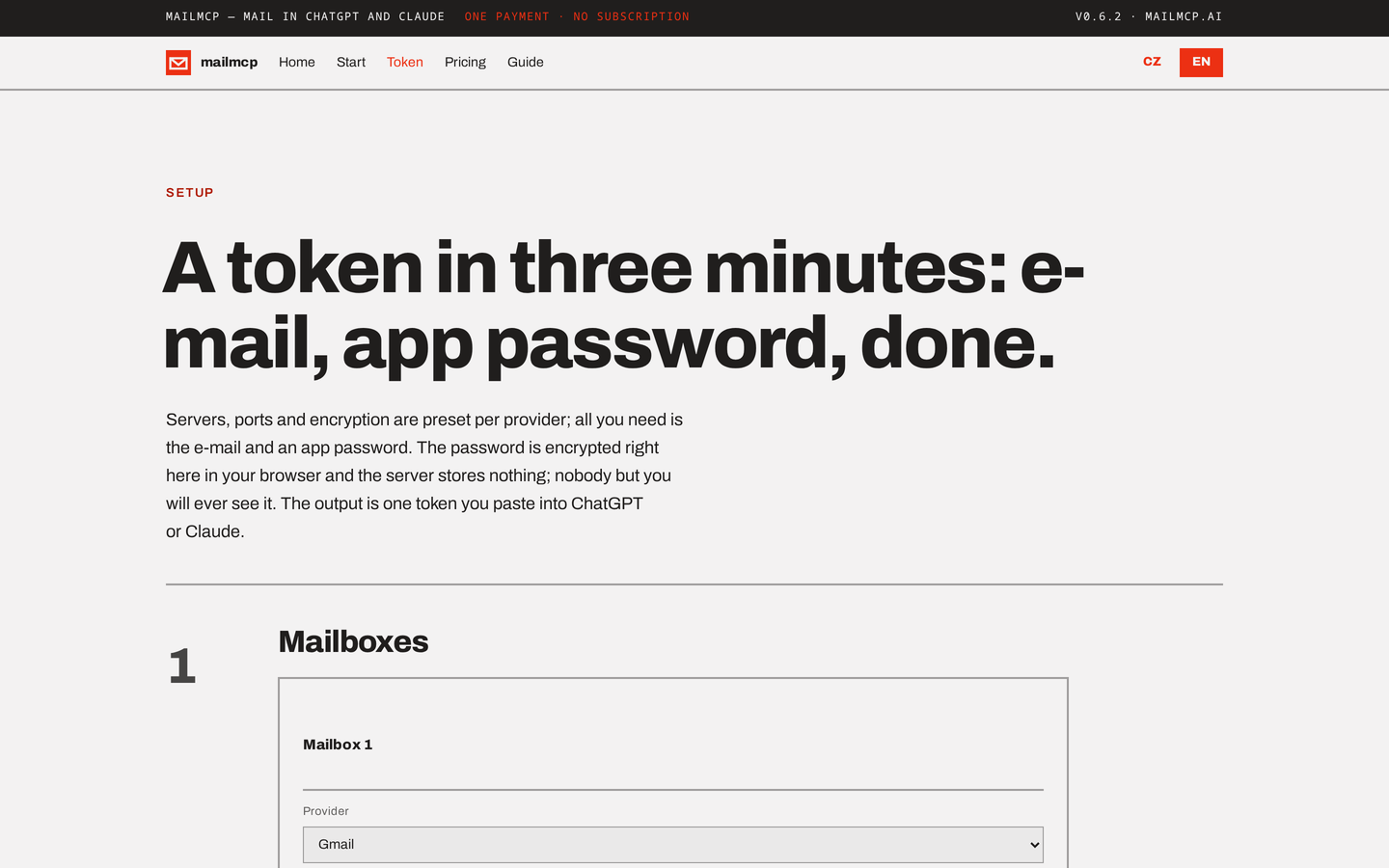
Try it without deploying. The shared server at mailmcp.ai/setup runs this same code; create a token there and connect. The operator of any shared server can technically see your configuration while it serves your requests, which is why companies run their own.
Claude Desktop, no server. Download mailmcp.mcpb from the latest release, open it in Claude Desktop, paste the configuration from /setup → "Values for your own deployment".
Behind a reverse proxy set MAILMCP_PUBLIC_URL or MAILMCP_TRUST_PROXY=1. Company mail servers on private addresses need MAILMCP_ALLOW_PRIVATE_MAIL_HOSTS=1. Changing MAILMCP_KEY invalidates every token. All variables: .env.example.
| Variable | What it does |
|---|---|
MAILMCP_KEY | The one master key; seals user tokens and signs OAuth artifacts. Changing it invalidates every token. |
MAILMCP_LICENSE | Your licence key. Empty runs the free tier. |
MAILMCP_INVITE_CODE | Required on a token-issuing server: the code your users type on /setup, at least 8 characters. |
MAILMCP_OPEN_SIGNUP | 1 on a deliberately public server, in place of an invite code. |
MAILMCP_MS_CLIENT_ID | Your own Entra app registration id for the Microsoft sign-in. Required for any Microsoft sign-in on your server (the vendor's app is used on mailmcp.ai only). |
MAILMCP_MS_REDIRECT | 1 when this origin is registered as a redirect URI (https://<host>/api/ms/callback) in that app: the setup page then signs in through a popup instead of a device code. |
MAILMCP_MS_DISABLED | 1 hides the Microsoft sign-in and answers 404 on every /api/ms/* route. |
MAILMCP_DISABLE_GRAPH | 1 refuses Outlook mailboxes at runtime, including in tokens already issued. |
MAILMCP_ATTACHMENT_DIRS | stdio only: folders (separated by : on macOS/Linux, ; on Windows) where attachments may be saved and read, in addition to policy.attachment_dirs. Claude Desktop sets them in the extension settings. |
MAILMCP_NO_STATS | 1 switches the usage statistics off; the daily update check stays (a GET /api/version without content). |
MAILMCP_STATS | Server copies: 0/false/off/no switches the statistics off, like MAILMCP_NO_STATS=1. Claude Desktop and other desktop (stdio) copies: 1/true/on/yes switches them on (the extension setting "Anonymous usage statistics" writes it); empty or unset leaves them off. |
MAILMCP_NO_UPDATE_CHECK | 1 sends no request to mailmcp.ai at all: no update check and no statistics. |
DO_NOT_TRACK | 1/true switches the statistics off, like MAILMCP_NO_STATS=1. |
MAILMCP_PUBLIC_URL | The public address, when the server is behind your own reverse proxy. |
MAILMCP_ALLOW_PRIVATE_MAIL_HOSTS | 1 lets user tokens name mail servers on private addresses. |
Outlook and Microsoft 365
These mailboxes have no password: Microsoft rejects password sign-in on most accounts. The user picks the provider Outlook / Microsoft 365 on /setup and clicks Sign in with Microsoft. This needs your own Entra app registration (MAILMCP_MS_CLIENT_ID, steps below); without it the setup page offers no Microsoft sign-in. When your server's origin is a registered redirect URI (MAILMCP_MS_REDIRECT=1) the button opens a popup with the account picker; otherwise the page asks whether the user signs in with a personal account (Outlook.com, Hotmail) or a work or school account (Microsoft 365) and shows a short code to type at microsoft.com/link or login.microsoft.com/device respectively. Either way the sign-in sits behind your invite code (the device-code relay requires one even with MAILMCP_OPEN_SIGNUP=1), and your users see your app's name on the consent screen. No token reaches the vendor: your server runs the sign-in.
What to tell your users: at most three Outlook mailboxes per token; the consented Microsoft permissions follow the capabilities they tick (Mail.Read for read-only, otherwise Mail.ReadWrite and Mail.Send), so widening them later needs a new sign-in; a sign-in lasts about 90 days (the date is on /setup and in list_accounts as reauth_by, and clients that refresh through our OAuth have it rolled automatically); changing the mailbox password does not end it, revoking the app at Microsoft does, for every token that used that account. Tenants that leave consent to administrators need a one-off approval at https://login.microsoftonline.com/organizations/adminconsent?client_id=<your client id>. Mail then flows over Microsoft Graph, so message ids are strings rather than numbers and labels are Outlook categories. Full guide: mailmcp.ai/docs.
Your own Microsoft app registration
Microsoft sign-in on your server needs an app registration of your own (the vendor's registration is used on mailmcp.ai only). Register it and use the popup flow, which works for personal and work accounts alike; new Microsoft 365 tenants block sign-in with a code (security defaults, AADSTS530035):
- Microsoft Entra → App registrations → New registration; supported account types: Accounts in any organizational directory and personal Microsoft accounts.
- Authentication → add the platform Mobile and desktop applications (not Web) with the redirect URI
https://<your host>/api/ms/callback. mailmcp is a public client with no secret; under the Web platform Microsoft demands one and the sign-in fails with AADSTS7000218. - Authentication → Allow public client flows: Yes.
- API permissions → delegated Microsoft Graph
Mail.Read,Mail.ReadWrite,Mail.Send,User.Read,offline_access. - Set
MAILMCP_MS_CLIENT_ID=<Application (client) ID>andMAILMCP_MS_REDIRECT=1, redeploy.
Tenants that allow user consent only for verified publishers additionally need publisher verification on your registration (Microsoft AI Cloud Partner Program), or an admin's consent for the whole tenant.
What the assistant can do
Every tool is gated by the permissions in the token, per mailbox:
| Permission | Tools |
|---|---|
| read (default) | list_accounts, list_folders, search_messages (Gmail syntax on Gmail), get_message, get_thread, get_attachment (one-hour download link), ChatGPT search/fetch, triage, awaiting_replies, digest, list_followups, list_templates, unsubscribe (dry run; sending the one-click request needs the separate unsubscribe permission, off by default) |
| draft | create_draft, reply_draft, save_template, set_signature, upload_attachment, request_upload (a one-hour upload link the assistant fills itself) |
| send | send_message, reply_send, send_draft, forward_message, only to addresses on your allowlist; optionally only after you confirm in your app's dialog |
| modify | modify_message (flags, folders), bulk_preview / bulk_apply (bulk archive, mark read, label, move; a preview first, then exactly those messages), set_followup, snooze, wake_snoozed |
| delete | trash_message and bulk trash; nothing is ever deleted permanently |
Each mailbox also has a protection level for verification emails (Off, Basic, Standard, Strict, Custom; new mailboxes start at Standard): hidden mail stays out of every answer, and from Standard up codes and sign-in links in other mail are removed. It catches typical verification emails, not every possible one. Where your app supports MCP Apps, triage, digest, the draft tools and bulk_preview also show a clickable panel; switch the panels off per token on the setup page (or MAILMCP_UI=off over stdio).
Every tool is listed to the client; a call the token does not permit fails with an error naming the missing permission.
Security and data flow
- Credentials. The setup page encrypts mailbox passwords in your browser into a split-key token. The server holds one master key, decrypts the configuration only while serving your request, keeps it in memory for at most 15 minutes after the last one, and has no database and no copy of your mail.
- What leaves the server. IMAP/SMTP traffic to your mail provider and tool results to your assistant (so the AI vendor sees the results of every tool call, never the passwords). Licence verification is offline. The only request to the vendor is the daily update check with the usage statistics described below, and the Buy buttons link to the vendor.
- Prompt injection. Message bodies are marked as untrusted data, hidden text is stripped and header fields are sanitized, which reduces the risk of instructions planted in an e-mail; it cannot make a model immune.
- Protocol. OAuth 2.1 with PKCE, dynamic client registration and client metadata documents, encrypted tokens with replay guards, login throttling. Read-only defaults, send allowlists, no permanent deletion.
- Revocation. Delete the app password at your provider; the token is then useless no matter who holds it. Outlook mailboxes carry a Microsoft refresh token instead of a password: revoke the app at account.live.com/consent/Manage or in My Apps for work accounts. Rotating
MAILMCP_KEYinvalidates all tokens on a server. - Review. An internal, AI-assisted security review of version 0.4.1 (September 2026) with every finding, fix and accepted trade-off is public: mailmcp.ai/audit.
Usage statistics
Once a day (at most) every copy asks mailmcp.ai whether a newer version exists; Claude Desktop asks at each start. Server copies (Vercel production, Docker, Node) also send usage statistics with that request unless you switch them off; Claude Desktop and other desktop (stdio) copies send them only if you turn them on, and at most once a day however often they start. The whole body is:
{"s":1,"v":"0.13","r":"docker","d":"…"}
s is the schema, v the version as major.minor, r the runtime (vercel, docker, node, claude-desktop or stdio), and d a number that stays the same for one calendar month, computed from values that never leave your server (the Vercel project id, elsewhere the machine id or a random salt the copy writes once to ~/.mailmcp/stats-salt, mixed with MAILMCP_KEY when it is set; ~/.mailmcp/stats-sent-* holds the day of each instance's last ping). No licence key, configuration, address, mailbox or content is sent. mailmcp.ai keeps only daily and monthly counts per version and per runtime; from what it stores it cannot tell which installation sent a request. Our host Vercel logs the IP address of every request for 1 day, as for any website; our code never stores it. Vercel preview deployments send only the update check; CI runs and builds from source send nothing. Every copy logs one line at start saying whether statistics are ON or OFF.
Switches (1, true, yes or on): MAILMCP_NO_STATS=1 or MAILMCP_STATS=0 (statistics off, the update check stays), MAILMCP_NO_UPDATE_CHECK=1 (no request at all), DO_NOT_TRACK=1 (statistics off). In Claude Desktop: the extension settings “Anonymous usage statistics” (off by default) and “Check for updates” (unticked, nothing is sent). Everything collected and the totals are public at mailmcp.ai/stats.
Pricing
| Free | Personal, €19 once | Unlimited, €149 once |
|---|---|---|
| All tools included, up to 2 mailboxes in total per person (the server checks 2 per token; tokens created before 0.7.0 keep 5). Every message the assistant composes (drafts, sends, forwards) ends with "Sent with mailmcp.ai". | One user, up to 5 mailboxes in total whoever owns them, no signature, on your own server or in Claude Desktop. | One server for one organization (a company or a sole trader and its employees), unlimited users and mailboxes. |
All 0.x updates are included; a 1.0 upgrade may carry a fee, and 0.x keeps working. 14-day refund, no questions asked. Company deployment, €990: two hours of online onboarding on your Vercel or cloud, Unlimited licence included. Buy at mailmcp.ai/pricing: the key appears right after payment and Stripe e-mails the invoice.
Updating
Upgrading to 0.8. Token-mode servers now need MAILMCP_INVITE_CODE (at least 8 characters), or MAILMCP_OPEN_SIGNUP=1 for a deliberately public server. Set one of the two before you deploy 0.8 (Vercel: Settings → Environment Variables → Production, then redeploy), otherwise /setup stops issuing tokens and shows a notice for you. Tokens already issued keep working either way; the full list is in CHANGELOG.md under 0.8.0. 0.8 also adds Outlook and Microsoft 365 mailboxes through a Microsoft sign-in; nothing has to be configured for that unless you want your own Entra registration or the kill switches above.
Upgrading to 0.13. Nothing has to be configured. Server copies now send the daily usage statistics described above unless you set MAILMCP_NO_STATS=1. Existing tokens keep protection Off until you pick a level on the setup page and replace the token in every assistant. In ChatGPT, refresh the connector (Settings → Connectors → mailmcp → Refresh) to see the new tools; in Claude Desktop, install the new mailmcp.mcpb. IMAP servers that support neither MOVE nor UIDPLUS now refuse moves instead of risking other messages. The full list is in CHANGELOG.md under 0.13.0.
Releases are tagged here and listed in CHANGELOG.md. If you deployed with the Vercel button, Vercel created your own copy of this repository: pull the new tag into it (git pull https://github.com/kojott/mailmcp-dist.git main and push), and Vercel deploys the push. Docker and Node: pull, rebuild or restart. To roll back, deploy the previous tag. Your tokens keep working across versions as long as MAILMCP_KEY stays the same.
Questions people ask
Google says the app-passwords setting "is not available for your account". Turn on 2-Step Verification and reload; if it is still missing, an organisation policy or Advanced Protection is blocking app passwords.
I lost my token. Tokens cannot be recovered. Create a new one on the setup page (with an edit password this time, so you can load and change it later) and swap it in your assistant.
Can the assistant send mail on its own? Only if you enabled sending, and only to addresses on the allowlist. Drafts are the safer default.
Attachment links. Download and upload links are valid for one hour and carry the token in encrypted form; anyone with the link can use it during that hour.
Licence, support, reporting problems
The licence agreement is in LICENSE (English translation first, the Czech original governs): one key, one running installation, no redistribution, no serving other people's mailboxes or running mailmcp as a hosted service without a separate agreement; removing the licence check or the free-tier signature is prohibited. This is closed-source software, so pull requests are not accepted, but bug reports in Issues are welcome. Security problems: write to info@swingingdogs.com instead of opening an issue. Privacy policy: https://mailmcp.ai/privacy, terms: https://mailmcp.ai/terms.
Guide for people: mailmcp.ai/docs. Guide for assistants, paste the link into ChatGPT or Claude and let it walk you through: mailmcp.ai/llms.txt. Support: jiridolejs.cz/kontakt.
Version 0.13.11. Made in Prague by Jiří Dolejš.