Listed from the MCP registry; nobody on Odel publishes it.
Is this yours? Claim it
Sessy — Amazon SES observability
Read-only Amazon SES observability: search events, inspect bounces, pull delivery stats.
One address for any MCP client. Your key stays in your Odel vault.
What it does
- Reads
- Writes
- High impact
At most: only reads or looks up information.
What it costs
FreeOdel charges nothing per call. The publisher may charge for its own service.
Tools
None listed · checked 21 Nov 2026Odel could not list its tools without signing in.

Sessy
Open-source email observability for AWS SES by Marc Köhlbrugge.
What is Sessy?
Amazon SES is a fantastic email service: cost-effective, reliable, and great deliverability. But it's frustratingly difficult to see what's actually happening with your emails.
That's why many people turn to overpriced email services that are often just glorified SES wrappers with a nice UI. You end up paying a lot for something you could do yourself.
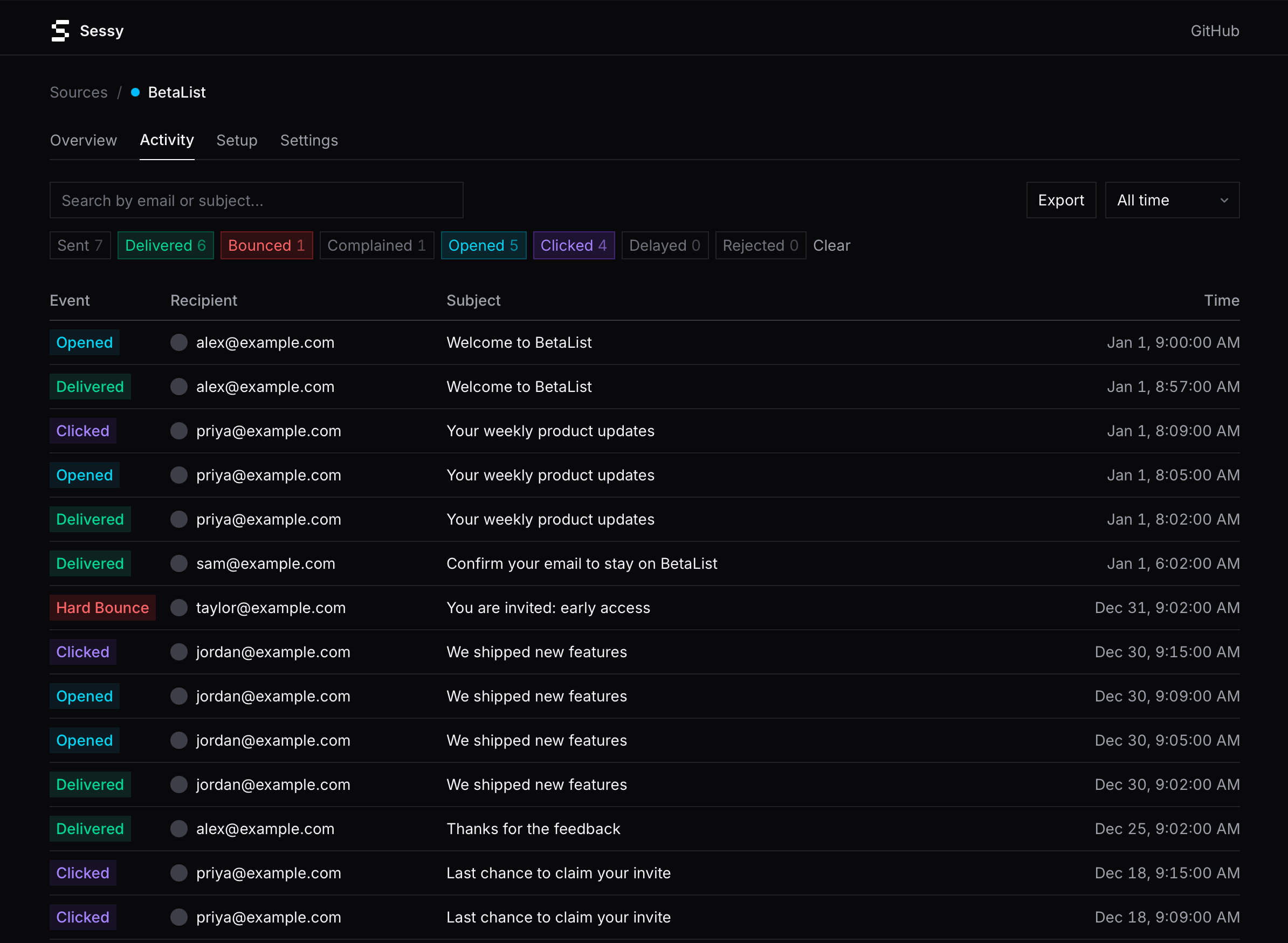
Sessy is the open-source alternative. Use raw SES and still get a beautiful interface to see what happens after you hit send: deliveries, bounces, complaints, opens, clicks, and more.
How it works
Your app ──► Amazon SES ──► SNS topic ──► Sessy webhook ──► Dashboard, CSV, MCP
           (configuration set)       (signed HTTPS push)
SES publishes an event for every send, delivery, bounce, complaint, open and click. SNS pushes each one to the webhook URL of a Sessy source. Sessy verifies the SNS signature, stores the event per recipient and ignores duplicates. Your app keeps sending through SES directly, so Sessy is never in the sending path.
What that means in practice:
- No AWS credentials. AWS pushes events to Sessy. Sessy holds no access keys and needs no IAM user or role.
- One click on the AWS side. Each source opens a pre-filled CloudFormation stack that creates the configuration set, SNS topic, subscription and event destination. CLI commands and copyable instructions for a coding agent are there too.
- One container. SQLite by default, PostgreSQL optional. No Redis, no message queue, no separate worker.
- Many sources, one dashboard. One source per app, environment or mail stream, each with its own webhook URL, stats and retention period. Sources can live in different AWS accounts and regions.
- Detail per recipient. Every recipient of a message gets its own events, with bounce type, subtype and the receiving server's diagnostic.
The trade-off: a webhook needs a public HTTPS endpoint, and SNS only retries for a limited time while Sessy is unreachable. If your dashboard has to stay on a private network, a tool that polls an SQS queue fits better. How Sessy compares to other approaches.
Running your own Sessy instance
The easiest way to run Sessy is with Docker:
docker run -p 80:80 \
  -e SECRET_KEY_BASE=$(openssl rand -hex 64) \
  -e DISABLE_SSL=true \
  -v sessy:/rails/storage \
  ghcr.io/marckohlbrugge/sessy:main
See Docker deployment docs for full configuration options.
Want to deploy your own modified version? See Kamal deployment docs for deploying from a fork.
Using Dokku? See Dokku deployment docs.
Need help configuring AWS SES itself? See AWS SES setup guide.
For hardening recommendations, see SES security and deliverability best practices.
MCP server for AI agents
Sessy ships an MCP server at /mcp, so AI coding agents (Claude Code, Cursor, Codex) can query your email data: search events, inspect a message's full delivery timeline with bounce diagnostics, and pull aggregate stats. Agents can also create and rename sources and fetch the SES wiring details (webhook URL, configuration set and topic names) to set up a new app end to end. Email data is read-only; retention settings and deleting sources stay in the web UI.
Create an API key on the API keys page in the web UI, then follow the connect instructions at /docs/mcp on your instance. For example, for Claude Code:
claude mcp add --transport http sessy https://your-sessy-host/mcp \
  --header "Authorization: Bearer YOUR_API_KEY"
Two things worth knowing:
- Cloudflare / CDN users: bot protection (managed challenges) blocks MCP clients. Exempt the
/mcppath from bot protection or agent requests will fail. - HTTP Basic auth:
/mcpauthenticates with API keys only and ignoresHTTP_AUTH_*. Enabling HTTP Basic later does not revoke previously created API keys — review the API keys page after locking down an install.
Hosted version
A managed version of Sessy is available in beta at sessy.do for those who'd rather not run their own instance. It runs the same code.
You'll notice references to it in this codebase: a saas/ directory, Gemfile.saas, and the occasional Sessy.saas? check. These power the hosted version and are intentionally kept in this repository for simplicity, rather than maintaining separate repos. None of it affects self-hosting: the default bundle ignores the saas/ engine entirely, and the test suite verifies the open-source version behaves identically without it.
Jobs dashboard
Sessy uses Solid Queue for background jobs. A web dashboard is available at /jobs to monitor queues, retry failed jobs, and view recurring tasks.
Development
You are welcome to modify Sessy to your liking.
To get started:
bin/setup
bin/dev
Contributing
We welcome contributions! Since we're still in a very early stage, please keep the following in mind:
- Typos and obvious bugs: Feel free to submit a PR directly.
- Code changes: Please try to match our existing style.
- New features: Please open an issue first to discuss before implementing.
- Deployment docs: We keep first-party deployment docs focused on broad, open, self-hosted paths we actively use (for example Docker, Kamal, and Dokku). We generally do not add provider-specific deployment guides to this repository.
For anything beyond small fixes, please open an issue first so no one wastes their time on something we might not merge.
License
Sessy is released under the O'Saasy License, except where a subdirectory specifies otherwise (for example, the Claude and Cursor plugin packages are MIT).
Inspiration
Sessy was heavily inspired by Fizzy and we're grateful to 37signals for open-sourcing their codebase.