MaskFlow PII proxy
Mask PII in outbound MCP tool-call arguments, unmask the results. Indian identifiers included.
Runs on your machine from its package; the steps are below.
What it does
- Reads
- Writes
- High impact
At most: only reads or looks up information.
What it costs
FreeOdel charges nothing per call. The publisher may charge for its own service.
Runs locally over stdio
This server isn't hosted — your MCP client launches it from a package registry. Use one of the commands below, or drop the config into your client (e.g. Claude Desktop).
Run
uvx maskflow-mcp
MCP client config
{
  "mcpServers": {
    "maskflow-pii-proxy": {
      "command": "uvx",
      "args": [
        "maskflow-mcp"
      ]
    }
  }
}MaskFlow
Stop Indian PII from ever reaching an LLM.
Aadhaar, PAN, GSTIN, UPI, IFSC, ABHA, Indian names and addresses — detected and replaced with reversible, typed placeholders before a prompt leaves your process, restored in the response. 28 entity types, checksum-validated where a public checksum exists, MIT-licensed, runs entirely on your own infrastructure.


⭐ Star us on GitHub — if MaskFlow is useful to you, a star helps other teams facing the DPDP deadline find it.

Why
India's DPDP Act sets a compliance deadline of 13 May 2027, with penalties of up to ₹250 crore for a breach where the required safeguards weren't in place. Every prompt sent to an LLM provider is a potential data-sharing event — and general-purpose PII tools weren't built to recognize Aadhaar, PAN, GSTIN, UPI VPAs, IFSC codes, ABHA health IDs, or Indian names and addresses reliably. Presidio already owns generic PII and is more mature everywhere else; MaskFlow exists specifically to close that gap, with accuracy that's measured and published, not asserted. See MaskFlow vs. alternatives.
Quickstart
pip install maskflow-sdk
python -m spacy download en_core_web_sm
from maskflow import mask, unmask

# Synthetic Aadhaar number: passes the Verhoeff checksum, belongs to no one.
result = mask("My Aadhaar is 2346 8907 6549 and you can reach me at alice@example.com.")
result.masked_text
# "My Aadhaar is <AADHAAR_1> and you can reach me at <EMAIL_1>."
unmask(result.masked_text, result.mapping)  # original text, restored
For a one-line wrapper around your actual LLM call, or session-scoped masking across a multi-turn
agent (same value → same token for as long as the session is open), see
packages/maskflow-sdk/README.md.
How it works
- Tier-0 excision first. Deterministic regex/checksum matches (Aadhaar, PAN, GSTIN, email, credit card, ...) are found and locked in before the NER pass ever runs — spaCy parses each document at most once, only over what tier-0 didn't already claim.
- Every match is a
Span. Start/end offsets, entity type, confidence, which recognizer produced it, whether a checksum validated it, and a human-readable explanation trail. Runmaskflow explain "<text>"(frommaskflow-cli) to see that trail for any input, span by span — including near-misses that fell just below threshold and what config change would catch them. - Deterministic resolution on overlaps. Below-threshold spans are dropped; among what's left, a checksum-validated span always beats an overlapping unvalidated one, then higher confidence, then longer span, then earliest start wins — greedy, non-overlapping placement.
- Placeholders are typed, stable, and collision-proof.
<AADHAAR_1>,<EMAIL_1>, ... — the same value gets the same token within a session, and if the input text already contains something that looks like a placeholder, a nonce suffix (<AADHAAR_1_a4f9>) is used instead so a real placeholder is never ambiguous with attacker-controlled input. - Recognizers are pluggable.
maskflow-pack-intlandmaskflow-pack-indiaare just two"maskflow.recognizers"entry-point plugins sharing one memoised analysis context — write and register your own the same way. Seedocs/custom-recognizers.md.
Protecting your own logs
Regex/checksum-based recognizers can also scrub your application's own logging calls — not just
text passed through mask() — closing the gap where a raw value gets logged before it's ever
masked:
from maskflow_core import install_pii_filter

install_pii_filter()  # attaches to the root logger, once, at startup
Opt-in only; importing maskflow_core never touches global logging state on its own. It doesn't
cover NER-only entity types (bare names/addresses) or exc_info tracebacks — see
docs/logging.md for the exact boundary.
Auditing what already reached a provider
Going forward, mask() keeps PII out of your prompts. But the DPDP audit asks a backward-looking
question first: what has this system already sent to a third-party LLM? maskflow scan answers
it. It reads your historical LLM traffic — a JSONL/CSV export, a recursive directory, an S3
archive, a Postgres table, or the Langfuse / Helicone / LangSmith API — streams it through the
same detection with bounded memory (parallel, resumable), and writes one self-contained HTML
report: a single headline number, breakdowns by entity type / provider / model / time, a
severity ranking with a plain-English "why this matters" per row, masked excerpts only (never
a raw value), and a DPDP Rule 6 mapping appendix. Also --format json|csv. Runs entirely locally
— the API sources only read from your own account, nothing is transmitted.
pipx install maskflow-cli   # or: docker run --rm -v "$PWD:/work" ghcr.io/maskflow/cli
maskflow scan jsonl requests.jsonl --field 'messages[].content' --deep -o exposure.html
Also ships as a standalone binary (mac/linux/windows, no Python — pattern pass only) and a
GitHub Action that can fail a build over a PII-exposure threshold. A
runnable 60-record synthetic example is in
packages/maskflow-cli/examples/; full reference,
including the Rule 6 mapping, in docs/scan.md.
Gateway: no code change at all
maskflow-gateway is a drop-in OpenAI/Anthropic-compatible proxy. Point your existing client's
base URL at it and PII is masked before every request reaches the provider and restored in the
response — streaming included (a <PERSON_NAME_1> split across SSE chunks is stitched back
together; fuzz-tested at every byte boundary). Tool-call arguments are walked as JSON; multi-turn
token identity is kept in Redis (AES-256-GCM at rest).
from openai import OpenAI
client = OpenAI(base_url="http://localhost:8000/v1", api_key="sk-...")  # your real key, passed through
pip install "maskflow-gateway[redis]" # or: docker run -p 8000:8000 ghcr.io/maskflow/gateway
Full reference in packages/maskflow-gateway/README.md and
docs/gateway.md.
LiteLLM: a guardrail on your existing proxy
Already running a LiteLLM proxy? maskflow-litellm is a
custom guardrail — no separate service. It masks PII (Indian identifiers included) before a
request leaves the proxy and restores it in the response, streaming and tool calls included.
pip install maskflow-litellm
guardrails:
  - guardrail_name: maskflow
    litellm_params:
      guardrail: maskflow_litellm.MaskflowGuardrail
      mode: [pre_call, post_call]
Full reference in packages/maskflow-litellm/README.md and
docs/litellm-guardrail.md.
LangChain: a one-line import swap
maskflow-langchain is a drop-in for
langchain-experimental's Presidio
anonymizer — same .anonymize() / .deanonymize() / .deanonymizer_mapping — so an existing
chain migrates by changing one import. The deanonymizer is a streaming-aware Runnable (a
placeholder split across streamed chunks is stitched back), and there's an optional leak-guard
callback that fails a call closed if PII reaches the model.
pip install maskflow-langchain
# from langchain_experimental.data_anonymizer import PresidioReversibleAnonymizer
from maskflow_langchain import MaskflowReversibleAnonymizer as PresidioReversibleAnonymizer
Full reference in packages/maskflow-langchain/README.md
and docs/langchain.md.
LlamaIndex: keep PII out of RAG
maskflow-llamaindex gives a LlamaIndex RAG pipeline two components and an unmask helper.
MaskflowNodePostprocessor is a drop-in for llama_index.core.postprocessor.PIINodePostprocessor
(same __pii_node_info__ contract) that masks retrieved context before the synthesizer, with no
LLM call. MaskflowIngestionTransform masks node text at ingestion so raw PII never reaches the
vector store. unmask_response() / MaskflowQueryEngine restore the real values in the answer.
pip install maskflow-llamaindex
from maskflow_llamaindex import MaskflowNodePostprocessor, unmask_response

engine = index.as_query_engine(node_postprocessors=[MaskflowNodePostprocessor()])
response = engine.query("What is Ramesh's PAN?")
answer = unmask_response(str(response), response.source_nodes)
Full reference in packages/maskflow-llamaindex/README.md
and docs/llamaindex.md.
MCP: a masking proxy for agent tool calls
maskflow-mcp is a Model Context Protocol proxy. Put it in
front of any MCP server and PII in outbound tools/call arguments is masked before it reaches the
tool, results are unmasked on the way back, and placeholders stay consistent for the whole agent
run. Agent tooling is where PII leakage is least examined; this is a drop-in shim that stops the
real values at the boundary.
{
  "mcpServers": {
    "github": {
      "command": "maskflow-mcp",
      "args": ["stdio", "--backend", "npx -y @modelcontextprotocol/server-github",
               "--pass-env", "GITHUB_TOKEN"]
    }
  }
}
Full reference in packages/maskflow-mcp/README.md and
docs/mcp.md.
Evidence — a record of what was masked
maskflow-evidence emits a metadata-only record of what was masked — entity type, count,
recognizer, action, versions — and never a value, a placeholder, or the mapping. Off by default;
one line in .maskflowrc turns it on, to a self-hosted sink (stdout / file / syslog / webhook /
OTLP). The gateway emits automatically when enabled; maskflow explain --evidence does it for a
single run.
[evidence]
enabled = true
sink    = "file"
path    = "evidence.log"
That no event field can carry free text is enforced in CI. Full reference in
docs/evidence.md. maskflow-attest produces a reproducible, Ed25519-signed
accuracy attestation for a pinned pack version — see docs/attestations.md.
Compliance-control mapping to DPDP / ISO 27001 and the recommended retention period are still being
validated with practitioners and are not yet part of this layer.
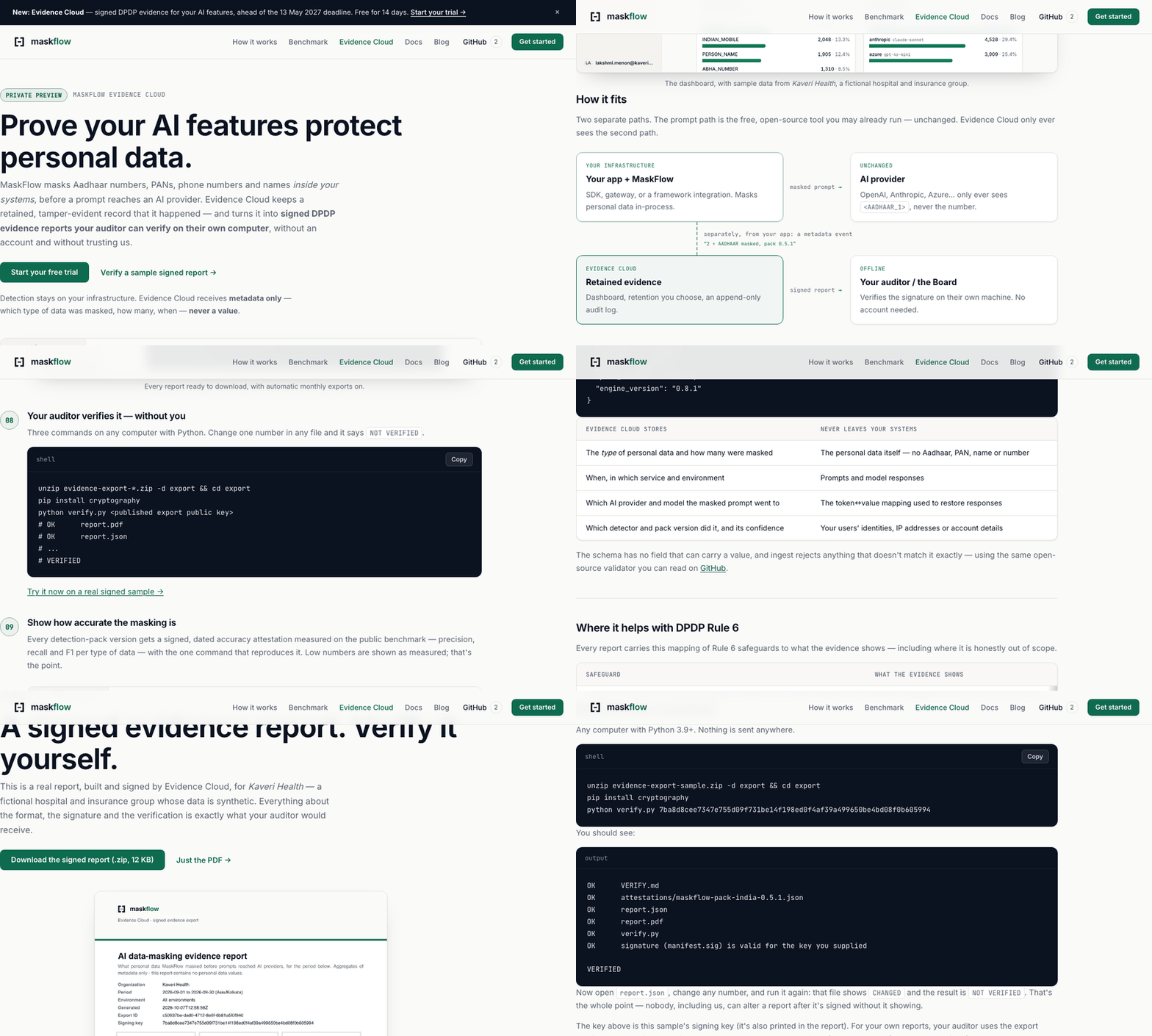
Evidence Cloud (hosted, private preview)
Optional and paid; everything in this repo stays MIT and free. Evidence Cloud keeps a retained, tamper-evident record that masking happened and turns it into signed DPDP evidence reports that your auditor can verify offline on their own computer, without an account and without trusting us.
- Metadata only, opt-in. Detection stays on your infrastructure. It receives which type of data was masked, how many, and when. It never receives a value.
- Signed evidence reports mapped to DPDP Rule 6 safeguards, including where a safeguard is honestly out of scope. Useful for a DPIA or a 72-hour breach notice.
- Signed accuracy attestations, team access, and an append-only audit log.
- Free 14-day trial. Billed annually after that.
How Evidence Cloud works · Verify a sample signed report, no sign-up · Start your free trial
Configuration
Drop a .maskflowrc (TOML/YAML/JSON) in your project to adjust entity thresholds, disable an
entity, add a custom regex-based entity, exclude specific values, or change the substitution
strategy per entity (replace / redact / mask / hash / surrogate — the last swaps in a
plausible fake value drawn from reserved/test-only ranges, e.g. RFC 2606 example domains or
publicly documented payment-industry test card numbers, instead of a placeholder token).
mask()/mask_and_call()/session() all pick it up automatically; no .maskflowrc anywhere
behaves exactly as before this existed:
[entities.PHONE]
strategy = "mask"          # "415-555-0132" -> "XXX-XXX-0132" instead of "<PHONE_1>"

[custom.EMPLOYEE_ID]
pattern = '\bEMP-\d{6}\b'
score = 0.9
pip install maskflow-cli # maskflow config validate / maskflow config show --resolved
See docs/configuration.md for the full schema and precedence rules.
What it detects today
maskflow-sdk and maskflow-cli both bundle maskflow-pack-intl and maskflow-pack-india —
installing either gets you all 28 types below with no extra install step.
International (12 types) — maskflow-pack-intl:
| Type | How |
|---|---|
| Regex | |
| Phone | Regex |
| SSN | Regex + area-code validation |
| Credit card | Regex + Luhn checksum |
| IP address (v4/v6) | Regex |
| AWS access key | Regex |
| API key / generic secret | Regex |
| JWT | Regex |
| IBAN | Regex + mod-97 checksum |
| Street address | Regex |
| Person name | spaCy NER |
| Date of birth | spaCy NER + keyword context |
Indian (17 types, the moat) — maskflow-pack-india:
| Type | How |
|---|---|
| Aadhaar (UID + VID) | Regex + Verhoeff checksum |
Aadhaar (masked display form, e.g. XXXX XXXX 9012) | Regex, unvalidated, needs context |
| PAN | Regex + holder-category structural check (no public final-letter checksum) |
| GSTIN | Regex + state-code range + embedded-PAN check + base-36 checksum |
| IFSC | Regex + bank code against a bundled RBI code list |
| UPI VPA | Regex + PSP handle against a bundled NPCI handle list |
| Indian mobile number | Regex (also the common 5+5 split, e.g. 98765 43210), full confidence with a +91/0 prefix, needs context otherwise |
| PIN code | Regex, unvalidated, needs context (pin/pincode/state name/address) |
| Voter ID (EPIC number) | Regex, structural only (no public checksum) |
| Indian passport number | Regex, structural only (no public checksum) |
| Indian passport MRZ block | Regex + 4 ICAO 9303 check digits |
| Driving licence | Regex + state RTO code against a bundled code list |
| Vehicle registration | Regex + state RTO code against a bundled code list |
| ABHA number (health ID) | Regex, unvalidated, needs context |
| ABHA address | Regex + domain (abdm/sbx) check |
| Bank account number (India) | Regex, unvalidated, needs context (account/a/c/acct) |
| Person name (Indian) | Gazetteer (name corpus) + structural (honorifics, relational markers, initials, form fields; in Devanagari: name labels and honorifics such as नाम: / श्री) + spaCy NER agreement boost. A Devanagari name with no such cue is not detected yet |
| Indian address | Gazetteer (554+ Indian cities/places) + structural (unit markers, landmark-relative phrasing, locality patterns) |
(PERSON_NAME is one shared entity type produced by both packs' layers, so 12 + 17 − 1 shared = 28
unique types total.)
Multi-language
@maskflow/detection on npm is a TypeScript port of the 10 pure regex/structural intl types
(email, phone, SSN, credit card, IP, AWS key, API key, JWT, IBAN, street address) — same API
shape as the Python SDK, tested against the same fixtures so both stay accuracy-matched.
PERSON_NAME/DATE_OF_BIRTH (need spaCy NER) and the India pack's checksum-validated types are
Python-only — @maskflow/detection is a deliberately narrow browser/Node helper, not a second
full engine. See packages/maskflow-js/README.md.
import { mask, unmask } from "@maskflow/detection";

const result = mask("Email me at alice@example.com or call 415-555-0132.");
unmask(result.maskedText, result.mapping); // original text, restored
MaskFlow vs. alternatives
| MaskFlow | Presidio | mask-privacy | |
|---|---|---|---|
| Indian identifiers with checksums | Aadhaar, PAN, GSTIN, IFSC, UPI (in maskflow-sdk) | No | No |
| Session-consistent tokens (unmask later) | Yes | Via custom anonymizer config | Yes, today |
| NER | spaCy | spaCy, Stanza, transformers | Regex-based, no NER |
| Breadth / maturity | Narrow, early (28 types) | Broad, mature (Microsoft-backed, years of production use) | Narrow, early |
| License | MIT | MIT | Varies by package |
| Languages | Python + TypeScript (regex layer) | Python, multi-language via configurable NLP models | JS/TS |
Presidio is ahead on breadth and maturity. If you need broad, battle-tested coverage today, use it. MaskFlow's bet is Indian-identifier accuracy and a reversible mask/unmask flow that's simpler to drop into a single, provider-agnostic call.
Benchmark
Real numbers, not vendor claims — including results where competitors beat us. Scored on
indiapii-v1.0, 2000 synthetic, checksum-valid
documents (Aadhaar/PAN/GSTIN pass the same validity math the real formats use), against stock
Presidio, Presidio with two hand-added Aadhaar/PAN recognizers, and mask-privacy. F1 below is
partial-overlap matching (exact-character matching is too strict for multi-token spans like
addresses — see the full report for both).
| Entity | MaskFlow | Presidio (stock) | Presidio + custom | mask-privacy |
|---|---|---|---|---|
| GSTIN / IFSC / UPI VPA | 100% | not supported | not supported | not supported |
| AADHAAR | 98.4% | not supported | 96.6% | not supported |
| PAN | 100% | not supported | 100% | not supported |
| Indian mobile number | 99.0% | 94.9% | 94.9% | 42.2% |
| Person name | 47.3% | 30.4% | 30.4% | 30.4% |
| Indian address | 43.3% | 48.2% | 48.2% | 50.5% |
Indian address is the one row above where a competitor is ahead — our gazetteer still has room to
grow, and we're not hiding that. Full per-entity breakdown (all 17 types), strict-vs-partial
matching, and latency/memory numbers:
bench/reports/indiapii-v1.0/results.md. Reproduce with
uv sync --group bench && uv run python -m bench.indiapii.harness run; harness source in
bench/indiapii/harness/.
International / US-shaped types
Generic PII is not a surface MaskFlow is built to win — Presidio and mask-privacy own it — but
"measured, not asserted" applies to the intl pack too. Scored on
intl-pii-v1.0, 1800 synthetic documents (Luhn-valid
cards, mod-97-valid IBANs, SSNs in real-but-unassigned area ranges), same harness, partial-overlap
F1:
| Entity | MaskFlow | Presidio (stock) | mask-privacy |
|---|---|---|---|
| Email / IP address | 100% | 100% | 100% |
| Phone | 100% | 86.7% | 64.1% |
| Credit card | 99.4% | 100% | 78.2% |
| IBAN | 99.4% | 76.3% | 100% |
| AWS key / API key / JWT | 100% | not supported | not supported |
| SSN | 100% | 100% | not detected at defaults |
| Street address | 99.8% | 6.5%¹ | 81.1% |
| Person name | 74.0% | 84.1% | 86.1% |
| Date of birth | 63.6% | 29.5%¹ | 79.8% |
Competitors are ahead on person name (MaskFlow's NER recognizer over-trusts spaCy's PERSON
tag on sentence-initial words) and, for mask-privacy, on date of birth (it ships a dedicated
birth-date regex; MaskFlow's spaCy-only DATE pass misses numeric formats and the pack's
context-keyword list omits "birth date"). Both are tracked follow-ups. ¹ LOCATION / DATE_TIME
are mapped generously to ADDRESS / DATE_OF_BIRTH so those engines score non-zero at all — see
bench/intlpii/harness/labels.py. Full table (all 12 types,
strict + partial, latency/memory): bench/reports/intl-pii-v1.0/results.md.
Reproduce with uv sync --group bench && uv run python -m bench.intlpii.harness run.
Is it accurate on your documents?
The numbers above are measured on a synthetic corpus, necessarily — but it's still someone else's
documents. maskflow bench --my-data <path> runs the same scoring against your own labelled JSONL
file and prints per-entity precision/recall/F1, so "is it accurate on my documents?" is a command,
not an argument. See docs/bench.md for the file format.
Does masking hurt the LLM's answer?
bench/indiapii/quality is a 200-task, LLM-judged benchmark that runs each
task unmasked, with placeholder masking, and with surrogate masking, then measures the
masked-minus-unmasked delta in task completion, fluency, factual consistency, and field-extraction
accuracy (plus a hard leak check — a <PAN_1> token must never survive unmask() into the final
answer). Method and scoring are built and unit-tested; a published run is pending an
ANTHROPIC_API_KEY (make quality-bench — ~1200 disk-cached calls, ~$1.50). Once run,
bench/reports/indiapii-quality-v1.0/results.md.
maskflow scan on log-shaped input
The detection benches above are prose; maskflow scan runs over access-log lines,
JSON app logs, stack traces, and request dumps. scan-log-v1.0 is 2000
synthetic log records with the PII-lookalike noise real logs carry (trace ids, UUIDs, git SHAs,
internal IPs, File.java:142 frames), scoring detection and — the metric that matters for an audit
— the false-positive rate. --deep, partial-overlap F1:
| Entity | MaskFlow | Presidio (stock) | Naive regex |
|---|---|---|---|
| Aadhaar / PAN / GSTIN / IFSC / UPI | 100% | not supported | 67–100% |
| Email / Indian mobile | 100% | 79–85% | 95–100% |
| Credit card | 97.8% | 100% | 86.2% |
| Person name | 87.9% | 57.6% | not supported |
| IP address | 66.7%¹ | 66.7%¹ | 59.6%¹ |
False positives / 1000 log records: MaskFlow --deep 428, its patterns-only pass 298, Presidio
544, naive regex 433. Checksum-validated identifiers essentially never false-positive on log noise
(naive regex flags 337 fake Aadhaars; MaskFlow flags 0); the --deep NER pass produces ~2.5× the
false PERSON_NAME hits that the patterns pass does. ¹ every internal 10./172.16./192.168. IP is
reported as IP_ADDRESS — a known gap (no private-IP suppression). A plumbing check verifies the
real scan pipeline surfaces exactly what detect() finds. Full report:
bench/reports/scan-log-v1.0/results.md.
Framework integrations match the core engine
The LiteLLM / LangChain / LlamaIndex / MCP wrappers each adapt the masking engine to a
framework's data shapes. bench/integrations routes 300 indiapii-v1.0
documents through every wrapper's masking layer and asserts the masked (entity_type, value) set,
the byte-exact round-trip, and streamed-response reassembly (chunks split at every byte) are
identical to maskflow.mask() / maskflow.unmask() — 100% across all four
(bench/reports/integration-parity-v1/results.md).
A divergence would be a wrapper bug; it's a CI gate.
Roadmap
Openly not done yet, so you know what you're signing up for:
maskflow-gatewayhardening: more provider schemas, a Redis-cluster session backend, and first-class OpenTelemetry traces.
Links
- Site: maskflow.in
- Evidence Cloud (hosted, paid): maskflow.in/evidence-cloud.html
- Docs:
docs/configuration.md,docs/custom-recognizers.md,docs/scan.md,docs/dpdp-rule6.md,docs/agent-sessions.md,docs/logging.md,docs/gateway.md,docs/litellm-guardrail.md,docs/langchain.md,docs/llamaindex.md,docs/mcp.md,docs/data-refresh.md,docs/bench.md - Changelog
- Security policy
- Contributing
- License: MIT