

mushroomdb





The graph that stays true — and knows who's allowed to see it.
An embedded Rust graph database where edges are a schema declaration: write a rule once, and every write creates, maintains, and retracts the matching edges. Ships a 24-tool MCP server and a live graph of the repository it is pointed at.
Pre-1.0 alpha — APIs and formats may change between minor versions.
Quick start
Install the Claude Code plugin, from any directory:
claude marketplace add MatthewSherlin/mushroomdb
claude plugin install mushroom@mushroomdb
Open the repository you want graphed and type /mushroom:mushroom. The skill builds the graph on
first use and answers with it from then on.
Or install into one project (or your home directory) without the plugin — same skill, invoked
bare as /mushroom:
npx mushroomdb install # /mushroom skill + MCP server + prompt, post-edit and git hooks
Either way, the first thing the assistant does is read the repository back to you. This is a real
run against this repository — ingest-git took 2.5 s, map 0.18 s:
mushroomdb map — 431 files, 6,226 symbols, 652 commits, 2 authors · synced 3s ago at 94719fe
clusters (co-change + imports)
  1. <mixed> crates, tests  (86 files, cohesion 0.73)  crates/server/tests/http.rs, algo.rs, crates/server/src/http.rs
  2. <mixed> crates, src  (45 files, cohesion 0.67)  pack.rs, lib.rs, types.rs
  3. ui src, e2e  (26 files, cohesion 0.89)  api.ts, store.ts, classify.ts
  4. crates/code-extract tests, fixtures  (21 files, cohesion 0.99)  lib.rs, extract.rs, mod.rs
  5. ui fonts, public  (18 files, cohesion 0.89)  IBMPlexMono-Medium.woff2, IBMPlexMono-Regular.woff2, IBMPlexSans-Medium.woff2
  6. crates/core-api src, repograph  (17 files, cohesion 0.72)  facts.rs, render.rs, context.rs
  7. <mixed> crates, bindings  (16 files, cohesion 0.99)  crates/core-bench/Cargo.toml, package.json, crates/sim-harness/Cargo.toml
  8. benchmarks adapters, results  (15 files, cohesion 1.00)  run_handrolled.py, datasets.py, handrolled.py
key files (most depended-on)
  crates/code-extract/src/lib.rs 0.05 · crates/server/tests/http.rs 0.04 · crates/code-extract/tests/extract.rs 0.04 · crates/core-api/tests/algo.rs 0.04 · crates/server/src/http.rs 0.03
owners
  Matthew Michael Sherlin 431 files
hot (last 90 days)
  crates/core-api/src/db.rs 175 · README.md 109 · crates/core-rules/src/engine.rs 56 · crates/core-query/src/cypher/exec.rs 54 · crates/cli/src/lib.rs 51
ask me: why does lib.rs co-change with extract.rs? · who owns ui? · what imports http.rs?
From there: context for one file or symbol from every side, impact before an edit, owners,
why with the commits that prove a link, recall and remember for durable notes.
Full walkthrough: docs/site/code-graph.md.
- Live, not a snapshot. One
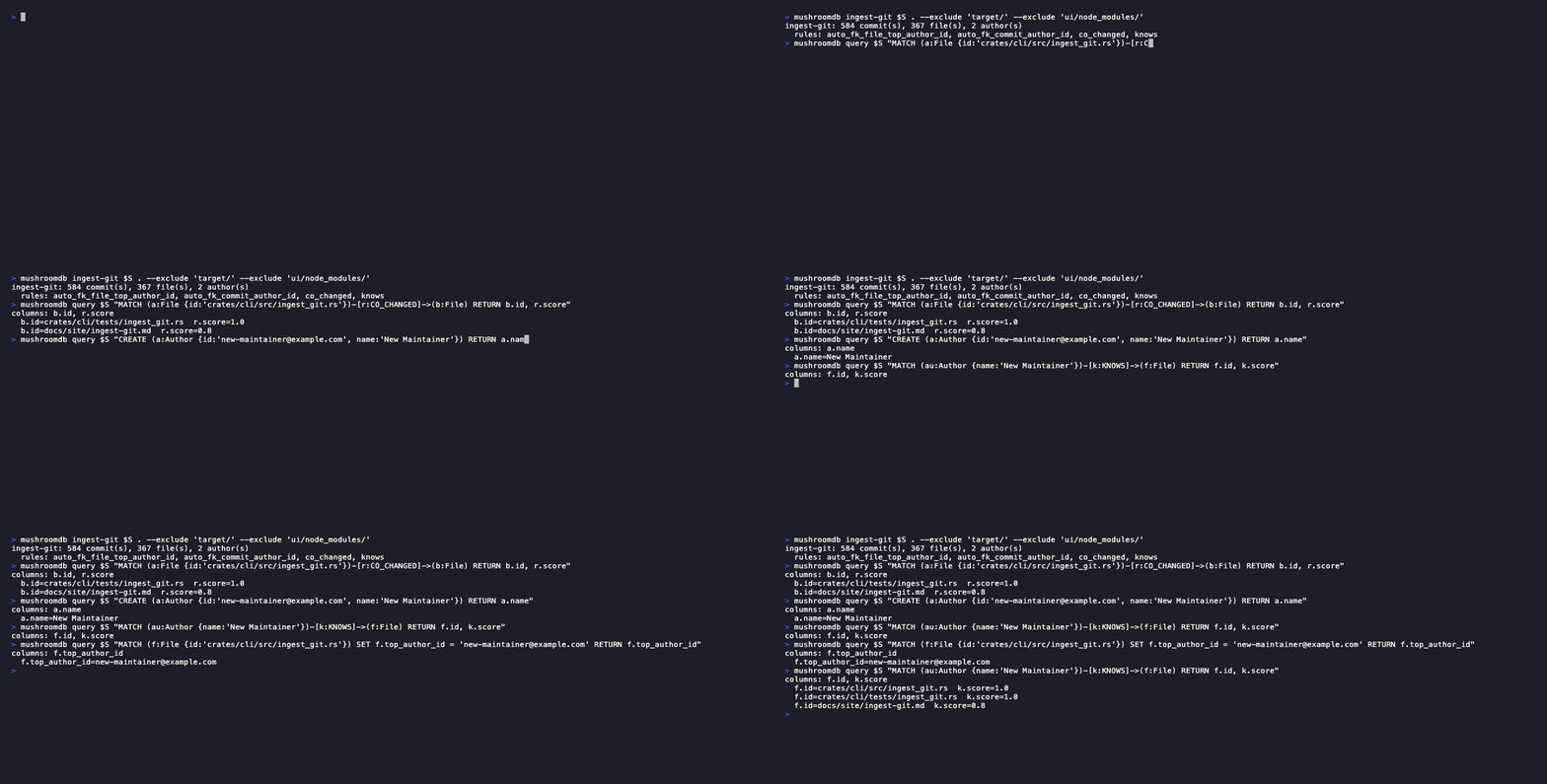
SET f.top_author_id = …moves theTOP_AUTHORedge and re-derives that author'sKNOWSedges before the write closes — theSETin the GIF above is that one write. An editor hook does the same for your code:touchre-extracts an edited file after everyEdit,WriteandMultiEdit, in about 180 ms on this repository's graph. - Retracts instead of going stale. Re-run
ingest-gitto sync: only new commits replay, deleted files drop their derived edges, and renamed files carry their history to the new path. - Explains any link.
explainnames the rule and the score behind an edge, so "which files change together withsrc/api.rs, and why?" has an answer your assistant can quote instead of a guess. - Knows who's allowed to see it. Pass a
maskwith a query and the same graph answers differently per caller; write statements are rejected on masked queries. - Answers what it said last week.
mushroomdb asof ./db --commit 5 --query "…"replays the WAL to a past commit, derived edges included.
Where it fits
What it is
- An embedded, single-binary graph database with a rule engine that maintains edges for you.
- A 24-tool MCP server plus a
/mushroomskill and a Claude Code plugin. - Safe for several processes at once: one writer at a time behind an advisory
LOCKfile, any number of readers, and every handle picks up a peer's commits byrefresh()rather than reopening — so a runningserve, an editor hook, a git hook and a CLI command can share one store.docs/site/concurrency.md - Local-first: your data stays on disk, no cloud service, no LLM in the write path.
What it isn't
- Not a hosted memory service — there is no account, no endpoint, nothing to sign up for.
- Not a vector database. Vector predicates and HNSW are built in; bring your own embeddings.
- Not a Postgres replacement. Single writer, no interactive transactions, memory-first storage.
The differentiator
Most graph databases require you to create edges manually or run a batch similarity script after
each load. mushroomdb makes edge creation a schema declaration. A rule like "connect every Person
to every Org whose skills list overlaps theirs by at least 50%" is written once:
db.create_rule(RuleDef {
    name: "skill_fit".into(),
    src_label: "Person".into(),
    dst_label: "Org".into(),
    predicate: Predicate::Overlap { field: "skills".into(), min: 0.5 },
    edge_type: "FIT".into(),
    weight_prop: Some("score".into()),
    max_edges: Some(5), // keep the 5 best-matching Orgs per Person (top-k per source)
}).expect("rule");
After that, every insert_node and set_prop evaluates the rule incrementally. The engine writes
the edge, stores the Jaccard score, and retracts the edge if the properties later diverge — without
any manual work.
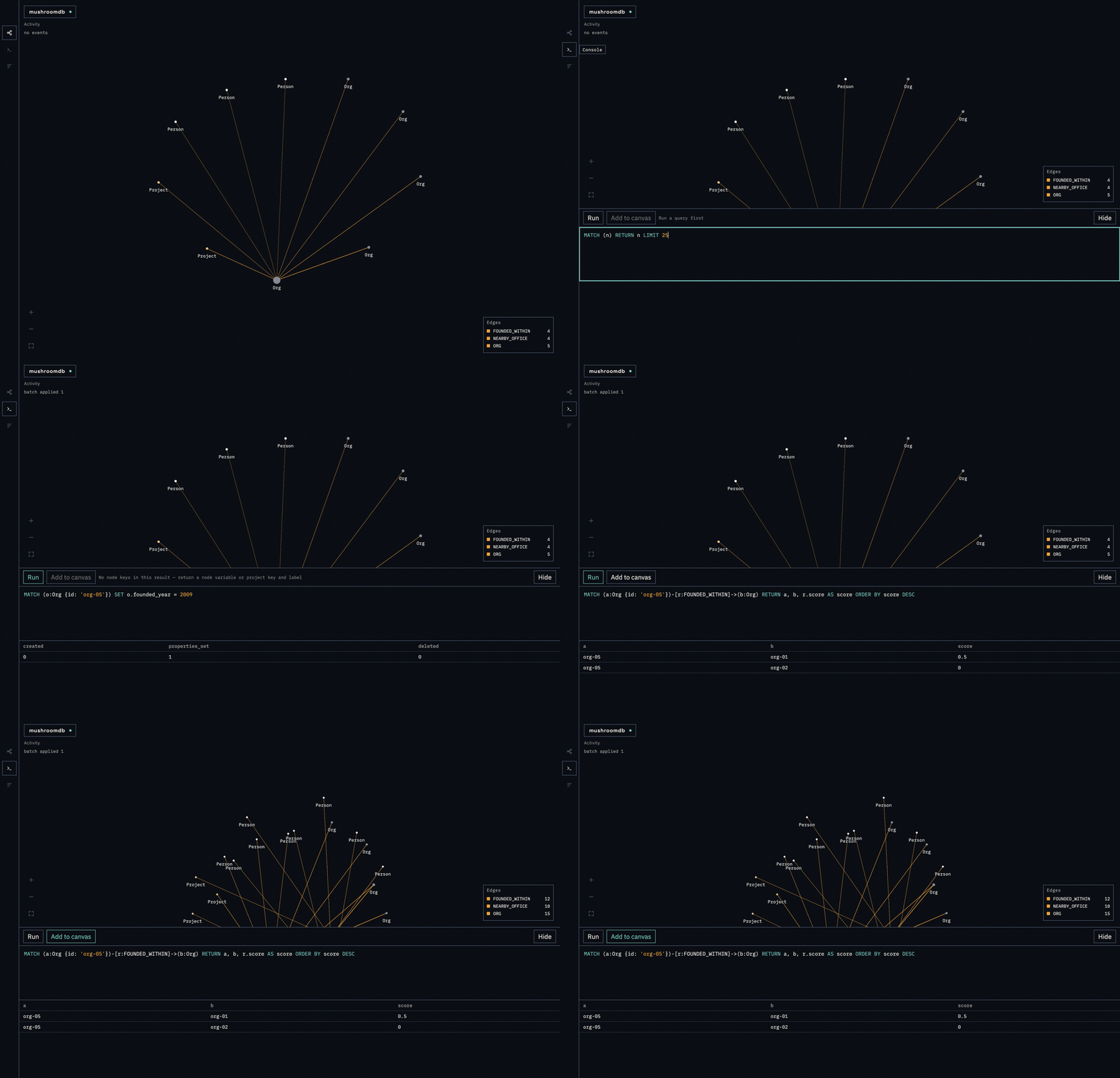
Watch it live — a Cypher SET changes one property, the founded_within rule fires, and new
scored edges appear in the bundled explorer:
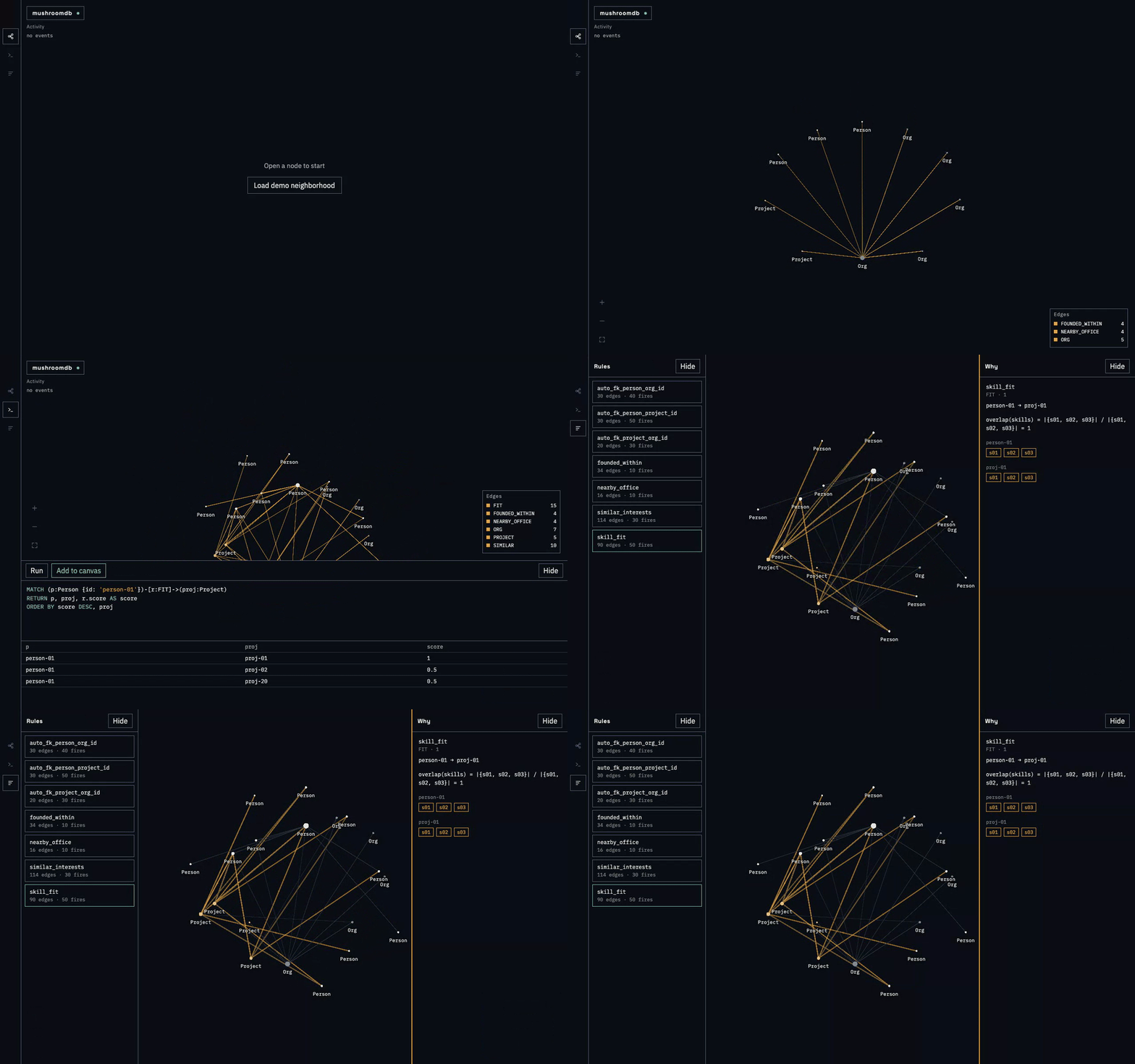
Open the Rules panel, and the Why slide-over shows the exact predicate arithmetic behind every derived edge:
Predicates
Six predicate kinds ship today. They compose via All(...) (AND, score = min) and Any(...)
(OR, score = max), nested up to depth 4.
| Predicate | What it tests |
|---|---|
KeyMatch | FK equality — source field matches destination key |
FieldEqual | Exact match on a named scalar field (string, int, float, bool) |
Overlap | Jaccard on list-valued fields, min threshold |
NumericWithin | Absolute numeric difference within a tolerance; score = `1 - |
GeoRadius | Haversine distance on [lat, lon] fields within km; score = 1 - dist/radius |
VectorSimilar | Cosine similarity on float arrays, min threshold |
Auto-FK: fields ending in _id whose values match existing node keys get KeyMatch rules created
automatically at ingest time. VectorSimilar accepts approximate: true to switch candidate
selection to in-tree HNSW (per-query recall min 0.90, mean 0.998 at 5k nodes / dim 1536,
fixed-seed probe). Full reference: docs/site/rules.md.
Built on the same engine
- Live subscriptions.
subscribe_rule(Rust) andGET /subscribe(WebSocket) streamEdgeFired/EdgeRetractedthe moment they hit the WAL — not polled, not batched. Bounded 65,536-event queue; slow consumers get aLagged { missed: N }marker instead of a disconnect.docs/site/subscriptions.md - Rule attribution across time. Every derived edge writes a HISTORY-MARKER WAL record carrying
the rule name, so
edge_history,node_history, andwas_linkedanswer which rule created a link and at which commit.GraphDb::open_at(&dir, 5)replays to a past commit, derived edges included; out-of-range commits returnCommitOutOfRange, never wrong data.docs/site/timetravel.md - Materialized views. Degree counts and neighbor aggregates (sum/avg/min/max) maintained
incrementally on every edge change — no cron, no triggers, no stale caches.
docs/site/views.md - Rule suggestions.
db.suggest_rules()(ormushroomdb suggest ./db) profiles your data and ranks candidate rules with estimated edge counts and rationale. Seeded sampling, so the same database always returns the same suggestions. No rule is ever applied automatically.docs/site/suggest.md
Agent memory
Graph structure captures the shape of real knowledge — entities, associations, similarity, and lineage — and rule-derived edges keep those associations fresh as new facts arrive.
- Entities map to nodes (
Person,Document,Project,Concept, …). - Associations are edges derived from data: cosine similarity on embeddings, shared field values, FK relationships, geographic proximity. Declare a rule once; every write maintains the matching edges without agent-side bookkeeping.
- Recall has three modes:
find_similarby query vector (HNSW when available, brute force otherwise);find_similarby key (neighbors along a rule-derived edge type);queryfor structured Cypher recall.hybrid_searchfuses fulltext and vector results via Reciprocal Rank Fusion. - Explanations are built in:
explain_associationshows which rules and scores produced each link, so an agent can cite evidence instead of asserting a conclusion. - Node masks are the ACL primitive: pass
mask: [key1, key2, …]toqueryto restrict the visible node set. Write statements are rejected on masked queries.docs/site/masks.md - Schema-as-code:
mushroomdb schema apply <dir> <schema.json>idempotently applies rules, views, and fulltext indexes, printing a created/updated/unchanged diff.
Minimal workflow (four tool calls):
upsert_entity  →  create_rule  →  find_similar  →  explain_association
  (store)           (link)           (recall)          (explain)
Eight task tools answer a question about the repository in one call. They are what the skill
reaches for, and what tools/list shows first:
| Tool | Purpose |
|---|---|
map | The repository in one screen: size, last sync, clusters, key files, owners, hot files |
context | One file or symbol from every side: signature, source, callers, callees, importers, co-change partners, commits, notes |
impact | What changing these files reaches: partners with scores, importers, symbols other files call, owner. Defaults to the working tree's diff |
owners | Top author and share, who else knows the file, last touch, the split by quarter |
why | Every rule edge between two nodes with its evidence, or the shortest path when there is none |
recall | Notes, concepts, files, symbols and people nearest a topic, each with its strongest link |
remember | Write a note into the graph and return its key |
sync | Bring the store up to date: commits since the last sync, then the dirty working tree |
The sixteen graph tools reach the store directly. Their descriptions are prefixed Advanced:
in tools/list, so an assistant knows which surface is the front door:
| Tool | Purpose |
|---|---|
upsert_entity | Insert or update a node by key (no existence check needed) |
ingest_json | Batch-ingest nodes of one label from a JSON array |
create_rule | Declare a derivation rule; backfills existing nodes immediately |
find_similar | Find similar nodes by query vector (HNSW) or by derived edge traversal |
hybrid_search | RRF over fulltext + vector results |
explain_association | Show rules and scores that link two nodes |
explain | Alias for explain_association |
query | Cypher query (read or write); pass mask for ACL-scoped read |
neighborhood | Multi-hop neighborhood traversal with optional edge-type filter |
node_info | Return a node's key, label, and properties |
node_edges | Return all edges incident on a node |
stats | Live node, edge, and rule counts |
node_history | WAL change history for a node (since last truncating snapshot) |
edge_history | Add/retract lifecycle for edges between two nodes, with rule attribution |
was_linked | Point-in-time edge check: was an edge active at a given commit? |
rename_node | Rename a node's key; old_key, new_key |
Full walkthrough, tool reference, and Claude Desktop setup: docs/site/mcp.md.
Skill, plugin, and hook details: docs/site/skill.md.
Install options
claude plugin install mushroom@mushroomdb   # after `claude marketplace add MatthewSherlin/mushroomdb`
npx mushroomdb install            # skill + MCP server + hooks, no toolchain needed
cargo install mushroomdb-cli      # `mushroomdb` binary from crates.io (no embedded UI)
cargo add mushroomdb              # embedded Rust library
pip install mushroomdb            # Python bindings
install writes an MCP entry that runs npx -y mushroomdb@<version>, so the assistant needs
nothing installed globally and nothing is copied into your home directory. Point it at a local
build with --command <path>. mushroomdb doctor verifies the result end to end — config entry,
store, lock, hooks, git hooks, and a real stdio handshake with the configured command.
To see the bundled explorer, write a demo graph and serve it:
mushroomdb demo ./db
mushroomdb serve ./db
Open http://127.0.0.1:8080/. The demo graph has 10 Orgs, 20 Projects, 30 People, and 334
edges — 304 of them derived by seven rule sets. When a token is configured, open
http://host:8080/?token=…. Building the binary with the UI embedded, Docker, and the
install.sh script are covered in CONTRIBUTING.md.
Role-bound tokens limit a caller to a named subset of nodes. Define roles in schema.json
under the roles key (each role has a label selector list), then pass --role-token TOKEN:ROLE
(repeatable) when starting the server, or set MUSHROOMDB_ROLE_TOKENS="tok1:role1,tok2:role2".
A role token receives only the nodes matching its label selectors — read endpoints return rows
filtered to the visible set; write, subscription, and analytics endpoints return 403. Unknown token
or role name: 401. The never-widen invariant is enforced in the server: a client-supplied mask is
always intersected with the role mask. The MCP interface (mushroomdb mcp) is a stdio JSON-RPC
server for local agent use and is not subject to bearer-token or role enforcement.
CLI reference
| Command | What it does |
|---|---|
mushroomdb install [--platform claude-code|cursor|codex|all] [--project|--user] [--db <path>] [--command <path>] [--no-git-hooks] [--no-prewarm] | Write the /mushroom skill + MCP server entry + prompt, post-edit and git hooks. Auto-detects platform and scope |
mushroomdb uninstall [--platform …] [--project] [--db <path>] | Remove exactly what install wrote (manifest-driven; leaves user files) |
mushroomdb doctor [--project|--user] [--platform …] | Verify an install: config entry, npx reachability, store, lock, hooks, git hooks, a real stdio handshake, and duplicate-scope servers. Exit 1 on any fail |
mushroomdb ingest-git <dir> <repo> [--exclude <pattern>]... [--prs] [--no-structure] [--no-docs] [--ensure-gitignore] | Graph a git repository: Author, Commit, File, Symbol nodes plus CO_CHANGED, KNOWS, IMPORTS, CALLS and MENTIONS rules. Re-run to sync. See docs/site/ingest-git.md |
mushroomdb map <dir> [--json] | The repository in one screen: clusters, key files, owners, hot files, and three questions worth asking |
mushroomdb context <dir> <target> | One file or symbol from every side. <target> is a path, a symbol key, or a bare symbol name |
mushroomdb impact <dir> <file>... | What changing these files reaches: co-change partners, importers, and the symbols other files call |
mushroomdb owners <dir> <path> | Top author and share, who else knows it, last touch, the last four quarters |
mushroomdb why <dir> <a> <b> | Every rule edge between two nodes with its evidence, or the shortest path between them |
mushroomdb sync <dir> [--json] | Re-sync the repository the store was built from: new commits, then the working tree where it differs from HEAD. Takes no repo argument — reads it off the graph. --json prints the counts as one object |
mushroomdb touch <dir>|--auto [<file>...] | Re-extract just these files. With no <file> reads them from a PostToolUse payload on stdin (hook body) |
mushroomdb recall <dir>|--auto | Hook body for the /mushroom skill's UserPromptSubmit recall hook: reads a prompt payload on stdin, prints related graph facts. Wired automatically by install |
mushroomdb mcp <dir>|--auto | Start a stdio MCP JSON-RPC server for agent tools |
mushroomdb demo <dir> | Write a deterministic demo graph (10 Orgs, 20 Projects, 30 People) |
mushroomdb serve <dir> | Start the HTTP server + optional UI (default 127.0.0.1:8080; --token on non-loopback; --role-token TOKEN:ROLE) |
mushroomdb query <dir> <cypher> | Run a Cypher read or write (--query also accepted) |
mushroomdb asof <dir> --commit N | Read-only view at a WAL commit |
mushroomdb stats <dir> | Print node/edge/rule counts |
mushroomdb suggest <dir> | Rank candidate linking rules (scored top-k 32, KeyMatch 512) |
mushroomdb schema apply <dir> <schema.json> | Idempotently apply a schema file (rules, views, fulltext indexes); prints a diff |
mushroomdb snapshot <dir> [--keep-wal] | Write snapshot.bin (truncates WAL unless --keep-wal) |
mushroomdb verify <dir> | Audit snapshot integrity: CRC32 all 12 sections, exit 2 on any mismatch |
mushroomdb migrate <dir> | Migrate an older store format in place |
mushroomdb backup <dir> <dest> | Copy store files to <dest> and CRC-verify the copy. WARNING: unsafe against a running serve — use POST /backup for live-served stores |
mushroomdb export <dir> <dest> [--format jsonl|parquet|graphml] | Export nodes, edges, and rules. JSONL is byte-identical across runs; Parquet is not across library versions. GraphML exports nodes and edges only, as a single .graphml file, for import into generic graph viewers and analysis tools |
mushroomdb algo pagerank|wcc|degree <dir> [--top N] | PageRank, weakly-connected components, or degree centrality over manual + derived edges. --weight-prop/--min-weight weight or filter the edge set |
mushroomdb algo communities <dir> [--edge-type T]... [--weight-prop P] [--min-weight X] [--top N] | Louvain communities with per-community cohesion and overall modularity |
mushroomdb --version | Print the CLI's version and exit |
Concurrency: every CLI write command, the hooks, and a running mushroomdb serve coordinate
through one advisory LOCK file in the store directory, so they are safe to run against the same
store at the same time. A writer that cannot get the lock within two seconds exits 3 with
another mushroomdb process is writing; retry, having written nothing. Readers never take the
lock and never wait; recall opens read-only (read_only: true) so an unattended hook can never
delay a writer or fail because one is running. What the lock does not give you: cross-process
transactions, and subscription events for a peer's writes — a commit absorbed by refresh() is
visible on the next read but notifies nobody. Full model:
docs/site/concurrency.md.
Full HTTP endpoint reference: docs/site/api.md.
Known limitations
| Limitation | Detail |
|---|---|
| Memory-first | The in-memory store is RAM-bound. Design target is 10M nodes (~5–15 GB with properties). mmap-backed storage is deferred. |
| Single writer, no interactive transactions | One writer at a time, many readers — within a process via RwLock, across processes via the advisory LOCK file. write_batch commits all ops in one WAL frame (all-or-nothing on crash replay) but is not isolated: readers may observe intermediate states while a committed batch is applied in memory. Multi-statement BEGIN/COMMIT is not supported, and there are no cross-process transactions. |
| Peer writes do not notify subscribers | Commits another process made are picked up by refresh() and are there on the next read, but they fire no EdgeFired/EdgeRetracted event, so /watch and /subscribe see only writes made through this process. Poll if you need to react to a hook's writes. |
| Cold start without a snapshot re-fires all rules | Snapshots persist derived edges, ANN state, and view definitions. At 100k nodes / ~10M derived edges: 0.02 s from a V8 snapshot vs 8.16 min WAL-only (ANN re-fit dominates). Call snapshot() before close. See dogfood/results/scale-100k.md. |
| Two-hop Cypher joins at scale | Dense patterns producing >1,000,000 intermediate rows error without LIMIT. Add LIMIT n — the pull-based executor stops early and never materializes the full binding table. |
| Cypher write subset | CREATE, MATCH…SET, MATCH…DELETE, MATCH…DETACH DELETE, and MERGE (single-key, with ON CREATE SET / ON MATCH SET) are supported. Derived edges cannot be deleted manually. Variable-length paths are hard-capped at 10 hops; unbounded *min.. is rejected at parse time. Full coverage table: docs/site/query.md. |
| Approximate vector mode is opt-in | approximate: true enables HNSW candidate selection. Per-query recall min 0.90, mean 0.998 at 5k / dim 1536 (fixed-seed probe). Review the trade-off before using it in completeness-critical workloads. |
| Demo refuses existing directories | mushroomdb demo exits 1 if the target directory is non-empty, including hidden files (.DS_Store counts). Use a fresh path. |
| Python bindings return dicts | pandas/polars zero-copy is not wired yet. HTTP POST /query defaults to Arrow IPC; JSON via ?format=json. |
Benchmarks
10,000-node graph (Apple M4 Pro, macOS 15.7.3, arm64), mushroomdb v0.1.1 release build, 2026-08-24.
Full methodology and honesty notes:
benchmarks/results/head-to-head-10k-v2.md.
| Workload | mushroomdb | Neo4j | KùzuDB | Memgraph |
|---|---|---|---|---|
| Bulk ingest | 784 ms | 13.2 s | 1.21 min | 12.5 s |
| Neighborhood depth-1 (p50) | 0.4 µs | 1.22 ms | 99.6 µs | 1.34 ms |
| Neighborhood depth-1 (p95) | 2.2 µs | 1.46 ms | 519 µs | 2.14 ms |
| Neighborhood depth-2 (p50) | 0.2 µs | 7.18 ms | 1.08 ms | 9.22 ms |
| Cypher scan-filter-project (1.4k rows) | 1.22 ms | 93.7 ms | 3.95 ms | 83.7 ms |
| Cypher two-hop join (200 rows) | 261.6 µs ★ | 3.99 ms ★ | 1.59 ms ★ | 1.96 ms ★ |
| Cold-start: V8 snapshot open | 0.02 s ▽ | — | — | — |
| Cold-start: WAL-only open | 8.16 min ▽ | — | — | — |
| Server boot-to-ready | n/a (embedded) | 6.6 s | n/a (embedded) | 4.3 s |
Honesty notes:
- mushroomdb numbers are embedded — no network round-trip, no serialization overhead. KùzuDB is also embedded, so its numbers are directly comparable. Neo4j and Memgraph go over bolt/localhost (~0.1–1 ms round-trip per query).
- ★ Two-hop join: same dataset, same warmup policy, all four engines on 5,810,000
INDUSTRY_ALIGNMENT edges. Fresh process → ingest + preload → 3 discarded warmups → median of 10
runs. mushroomdb derives the edges via
create_rule; competitors were pre-loaded via UNWIND MERGE or COPY FROM CSV. All engines return 200 rows. - ★ Earlier v2.1 two-hop values were retracted for cross-engine contamination; the v2 mushroomdb 307 µs figure was retired (measured on a smaller 1M-edge graph). Both are documented in the methodology file rather than quietly dropped.
- ▽ 100k cold-start measured 2026-08-28, warm file cache, cold process,
/usr/bin/time -l: V8 snapshot open 0.02 s at 31–41 MiB RSS; snapshot size 1.8 GiB; snapshot write ~35 s. Cold-cache was not measured. Seedogfood/results/scale-100k.md. - Rule engine vs hand-rolled maintenance (10k nodes, 1,000 specialty updates, drift = 0 for all
three): per-op expert-written 64.93 min, batched expert-written 24.98 s, rule engine
17.58 s. Both hand-rolled variants were written by the engine team with full knowledge of
retraction semantics — drift = 0 is a property of that, not of hand-rolling in general.
benchmarks/results/handrolled-vs-rules.md
Architecture
graph-db/
├── crates/
│   ├── core-storage      # Packed adjacency topology + columnar property store + WAL + snapshots
│   ├── core-rules        # linking rules, per-rule indexes, incremental maintenance
│   ├── core-query        # pull-based interpreter; traversal ops + Cypher subset
│   ├── core-api          # the one public Rust interface; typed error enums
│   ├── code-extract      # tree-sitter symbol/import/call extraction; bytes in, facts out
│   ├── arrow-bridge      # results ↔ Arrow buffers
│   ├── server            # axum HTTP + WebSocket; serves UI
│   ├── cli               # mushroomdb binary
│   └── sim-harness       # DST: virtual clock, fault-injecting IO, seeded runner
├── ui/                   # TypeScript + Vite graph explorer
├── bindings/python/      # PyO3 / maturin
└── clients/typescript/   # HTTP + WebSocket client
Dependency rule (inward only):
bindings/server/cli → core-api → {core-query, core-rules} → core-storage
Storage uses a dense-id WAL with per-commit fsync (configurable via FsyncPolicy), plus mmap-able
V8 rkyv snapshots (12 sections: CSR topology, columnar properties, HNSW blobs, provenance, IVF
state, per-node last-change index, and more — zero-copy, no heap allocation on open). V5/V6/V7
stores are auto-migrated to V8 on GraphDb::open. Derived edges are not WAL-logged; they are
restored directly from the mmap'd sections. See docs/format-stability.md
for the format evolution contract.
Roadmap
Phases 1–4 and Plan 18 all landed. What remains:
| Priority | Item |
|---|---|
| Medium | mmap snapshots; lock-free epoch readers |
| Medium | v1.0 format stability (snapshot + WAL semver guarantee) |
| Low | CASE in a write-statement RETURN; subqueries; napi-rs; WASM |
| Low | Multi-statement BEGIN/COMMIT interactive transactions |
Docs
- Quickstart · Rules · Cypher reference · HTTP + MCP API
- The live code graph · Concurrency · Codebase graph
- Install, plugin and hooks · MCP tools
- Time travel · Subscriptions · Views · Rule suggestions
- Masks and access control · Full-text search · Property indexes · Graph algorithms
- Durability and recovery · Panic policy · Testing · Format stability
- Design spec · Moat roadmap · Case study
Building from source, Docker, packaging, and the test gates are in CONTRIBUTING.md.
License
Copyright 2026 Matthew Sherlin.
Dual-licensed under MIT or Apache-2.0, at your option.