Listed from the MCP registry; nobody on Odel publishes it.

Obsidian MCP Server
Self-hosted agent memory in an Obsidian vault: hybrid search, link graph, tasks, safe writes, OAuth
Runs on your machine from its package; the steps are below.
What it does
- Reads
- Writes
- High impact
At most: moves money, runs code or commands, deletes data, or sends messages for you.
What it costs
FreeOdel charges nothing per call. The publisher may charge for its own service.
Runs locally over stdio
This server isn't hosted — your MCP client launches it from a package registry. Use one of the commands below, or drop the config into your client (e.g. Claude Desktop).
Run
docker run -i --rm ghcr.io/maxkuminov/obsidian-mcp:v1.6.0
MCP client config
{
  "mcpServers": {
    "obsidian-mcp-server": {
      "command": "docker",
      "args": [
        "run",
        "-i",
        "--rm",
        "ghcr.io/maxkuminov/obsidian-mcp:v1.6.0"
      ]
    }
  }
}



Your agents' memory, in the vault you already have, reachable from claude.ai, ChatGPT, Claude Code and your phone.
A self-hosted Model Context Protocol server that turns an Obsidian vault into long-term memory for every agent you use. Agents search it by meaning or by exact words, follow its wikilinks, see what changed since their last session and who changed it, keep their to-dos in it, and write back through guarded, atomic edits. 33 tools over plain markdown files that you can open, edit and grep.
What sets it apart:
- Your existing vault, served in place. No imposed note format, no sidecar syntax, no "memory" folder you have to adopt. Agents read what you read, follow your wikilinks, and pick up your folder layout, frontmatter schema and tag conventions from the vault itself.
- Remote and multi-user. OAuth 2.0 PKCE and API keys, so claude.ai, Claude Desktop, Claude mobile, ChatGPT, Claude Code and n8n all read and write the same files, each user confined to their own vault root.
- Writes are guarded. An edit that carries
expected_hashis refused when the note changed since it was read, and a deployment can require the hash on every edit (Guarding edits against stale reads). Every publish is atomic, a create refuses a path that is already taken, deletes go to.trash/, anddry_runreturns the diff before anything lands.
Connect from Claude Code:
claude mcp add obsidian --transport http \
  --url "https://obsidian-mcp.<your-domain>/mcp" \
  --header "Authorization: Bearer omcp_..."
In claude.ai, Claude Desktop or ChatGPT, add a custom connector at
https://obsidian-mcp.<your-domain>/mcp and sign in through the OAuth
consent page. Connect a client has the rest.
Stack: Python 3.12, FastAPI, PostgreSQL with pgvector, and an embedding backend of your choice (Ollama, OpenAI or Hugging Face TEI; see Pick an embedding backend).
Contents
- Why this exists
- A session at the keyboard
- A session away from the keyboard
- What's in the box
- vs. other Obsidian MCP servers
- Who this is for
- Control panel
- Quick start
- Versioning and compatibility
- Upgrading
- Cost expectations
- The self-describing vault
- Multi-user mode
- Configuration
- Architecture
- Project layout
- Development
- Security notes
Why this exists
There are three things going on here, and they're more interesting together than apart.
1. Agent memory that you can actually read
If you let an agent run for a while, it needs memory. Most setups solve this with an opaque vector store, a SQLite blob, or a managed "memory" service that you can't see into. That works until you want to know what the agent thinks it knows about you, or you need to correct something, or you want to understand why it just made a weird suggestion.
This server gives you a different deal. Agent memory lives as markdown files in your vault. Folder structure, file names, frontmatter, all visible. You can open the file in Obsidian and read it. You can edit it. You can delete it. You can grep it. The agent's "memory" is a human-auditable artifact that sits in the same place as your own notes, with the same tools available.
The home lab is the use case that sold me on this. My vault has notes on the rack, the network, and every Home Assistant integration. I can say "set up a night-light mode in the master bathroom, 1% after 11pm" and a sysadmin agent finds the right config, makes the change, and updates the doc in the same pass. Six months later when I've forgotten how it works, the answer is in the vault, not buried in some chat history I can't search.
The semantic search and wikilink graph still work over that material, so retrieval is fast and conceptual. But the substrate is files you own, not a black box.
To be precise about the scope: what the server supplies is MCP-accessible storage, keyword and semantic search, and graph operations over markdown notes, for whatever MCP clients you connect. The agents direct their own reads and writes. There is no extraction or decay pipeline running behind them, and nothing rewrites a note because a model judged it stale: an agent remembers something because it wrote a note, and forgets it because someone deleted one. By late 2026 that is less of a contrarian position than it sounds. Every vendor's consolidation step (the "dreaming" or "sleep-time" job) has turned into a separate process you can inspect, rather than silent extraction inside the write path. This server keeps the agent as the author. The consolidation help it will grow is a hygiene report that proposes merges and flags duplicates, and never writes (#359), not a pipeline that edits your notes while you are not looking.
2. A shared memory layer between you and your agents
The other half runs the other way: the vault isn't only the agents' memory, it's mine. I think of my Obsidian vault as my exocortex. The "big me" that includes notes, calendars, scripts, search, and AI assistants is substantially more capable than the "small me" of the biological brain alone. It's also where I do most of my thinking, because writing something down is itself a form of thought.
The problem is that until recently, the vault was passive. I had to go find things. Agents that wanted to help me had to be briefed from scratch every session, and they had no way to see what I'd already written about a topic.
This server fixes that. Now the same vault feeds my own daily writing and any agent I plug into it. The agent reads what I read, links what I link, follows the same wikilinks, sees the same frontmatter. When I write a project note on Sunday, my Monday-morning briefing agent already knows about it. When the agent leaves notes from a research session, they show up in my normal Obsidian search.
A concrete version of this: I'll spend a session in Claude Code on a project, wrap up, push the commits, and then just say "update Obsidian." The agent reads the vault guide, figures out where project notes live in my structure, picks the right format and frontmatter, and leaves a session log I can later roll into a status report. No path-passing, no telling it what to write — the conventions are already in the vault, and it follows them.
The same goes for commitments. My to-dos are checkbox lines in those notes, and the task tools let an agent read the same list I do: what is overdue, what is due this week, what I am waiting on from someone else. It can add a follow-up from a conversation or tick one off when the work is done, and the change is one line in a file I can see. That part is optional. Plenty of vaults hold no tasks at all, and nothing else depends on it.
That's the exocortex idea made concrete: one place that holds context, and both the human and the agents reading and writing into it on the same terms.
3. The vault follows you
The thing that still surprises me is that this is internet-facing. Same vault, same notes, reachable from anywhere I happen to be talking to an agent — Claude in a browser tab, Claude on my phone on the train, an n8n workflow firing on a schedule, a Claude Code session on whatever laptop is in front of me. All behind OAuth or a bearer key, all hitting the same source of truth.
So when I hear an interesting podcast on a commute and want to think out loud about it with Claude on my phone, the agent isn't starting cold. It can pull up what I've already written on adjacent topics, surface a note I half-finished six months ago, and at the end of the conversation suggest updates and write them in. The vault doesn't have to be near me to be the thing I'm working in. (A session away from the keyboard walks through exactly one of these.)
A session at the keyboard
To make the abstract concrete, a short transcript from a real session. Tool calls inline; the user types in plain English and the agent picks the right tool.
you  > find anything I've written about why retrieval-augmented
       chat is hard

claude
  → semantic_search(query="why retrieval-augmented chat is hard")
    • 2025-12-03 - RAG failure modes.md
    • 2025-10-18 - Chunking tradeoffs.md
    • 2024-06-22 - Vector recall vs precision.md

  the closest hit is your December note on RAG failure modes. let
  me see what it's connected to.

  → get_neighborhood(path="2025-12-03 - RAG failure modes.md",
                     depth=1)
    8 connected notes. notable ones:
    • "Hybrid search" — a re-ranking design you sketched but
      didn't ship
    • "Out-of-distribution queries" — a half-finished draft from
      October
    • "Embedding model choice" — links to bge-m3, your current
      model

  you have three connected pieces here: a failure-modes catalog,
  an unshipped hybrid-search sketch, and an abandoned O-O-D draft.
  want me to summarize all three together, or pull up the draft
  so you can decide whether to finish it?

you  > pull up the draft, and tag it #revisit-2026 in frontmatter
       while you're there

claude
  → read_note(path="2025-10-18 - OOD queries (draft).md")
  → set_frontmatter(
      path="2025-10-18 - OOD queries (draft).md",
      updates={"tags": ["draft", "rag", "revisit-2026"]}
    )

  here's the draft, and the tag is on. you stopped right before
  the section on confidence thresholds; the open question you
  left yourself was…
Two things to notice. First, the agent didn't need to be told what
folder to look in or what tools to use — it picked them. Second, the
write at the end is structured (set_frontmatter mutating YAML, not
a regex over the file body), so the note round-trips cleanly. The
self-describing vault and the wikilink graph are doing the work that
makes this feel natural.
A session away from the keyboard
The transcript above is the easy case: I'm at a desk, I can see what the agent is doing, and Obsidian is one alt-tab away. The session that actually changed how I think about this server had none of that.
I was out walking with a health podcast in my ears — a long one, two people who clearly disagreed with each other, an hour of it. I had my phone and no intention of going home to a laptop. So I pulled the episode's transcript, handed it to Claude on my phone, and we talked it through while I kept walking: what the actual claim was, which parts I already had notes on, where it cut against something I'd decided months ago and written down at the time.
The agent had the vault the whole way. It surfaced what I'd already written on the topic, flagged that two dates in an older note were wrong, and asked whether a decision I'd recorded last year still stood given what the episode argued. By the time I got back it had written all of it in: the health-related decisions I'd actually landed on during the walk, the date corrections in the old note, a couple of new notes on the episode itself — and, because the conversation kept circling back to it, a durable note on how I decide which experts to trust on medical questions in the first place. That last one is the artifact I keep returning to. It wasn't about the episode at all; it was the reasoning underneath a whole class of decisions, and it now sits in the vault where the next agent will find it.
I never opened Obsidian. Not on the walk, not when I got home. The whole session — retrieval, argument, correction, and the writing that came out of it — went through an agent, and the vault is simply where it landed. Obsidian is how I check the work afterwards, not how the work gets done. That inversion is most of the reason this project looks the way it does.
What's in the box
The server exposes 33 MCP tools across six families, plus the auth and ops layer around them.
Every tool is published with a title and MCP ToolAnnotations, all
four hints set explicitly: readOnlyHint on the nineteen tools that only
read (search, read, list, graph, list_tasks, task_agenda, get_changes, check_upload), destructiveHint on
the eleven that can replace or remove something (edit_note,
move_note, delete_note, set_frontmatter, write_file,
delete_file, import_from_url, complete_task, update_task,
move_task, and request_upload, whose link can overwrite on
redemption),
openWorldHint on import_from_url only. create_note, add_task
and request_download are additive. Clients that honour
annotations run read-only tools without a per-call confirmation (Claude
Code also runs them in parallel) and keep prompting on destructive ones.
They are hints: the server enforces read-only credentials itself,
regardless of what a client does with them. The initialize result also
carries a short instructions paragraph — what the vault is, which tool
to reach for, and the write-safety rules — for clients that load only
tool names at session start. No description exceeds 4,000 characters on
the wire, so none is cut off by a client's description limit.
Search and discovery
keyword_search(query, folder?, tags?, frontmatter?, limit=20), full-text via PostgreSQLtsvector. A note's title and frontmatteraliasesrank above its body, so a query that is a note's title finds that note first; its tags (frontmatter and inline#tags, a nested#a/balso asaandb) are indexed below the title and above the body, andmatched_innames which oftitle,tagsandbodymatched; bare terms are ANDed, and when the full matches do not fill the page, partial matches follow taggedmatch: any; every row carries asnippet:with the matches highlighted (orhead:, the note's opening words, for a title or tags match). The text-search config(s) are configurable viaFTS_CONFIGS(see Full-text search language(s))semantic_search(query, folder?, tags?, frontmatter?, limit=15, rerank=false), vector similarity via pgvector, one one-line preview chunk per note. Notes are chunked at their headings, and each chunk is embedded under aTitle > Heading > Subheadingcontext prefix. A fresh row names the section it matched:§ "Plan/Risks" (#7)or§ (top of note), andread_note(path, section="#7")reads exactly that section. Previews start on a word; a section too short to stand alone (under 200 characters) is grouped with its neighbour, so a preview can include an inner heading line and its§names the enclosing section. Stale rows, and rows not yet re-embedded since the upgrade to heading-aware chunks, carry no locator. While any of your notes is still on the old chunking, each response says so on anindex_transition:line under its headerhybrid_search(query, limit=10, folder?, tags?, frontmatter?, rerank=false), both of the above fused by reciprocal rank fusion over each arm's top 50, one line per note with its fused score, each arm's rank and the1/(k+rank)terms behind the score. The three are peers, and every description carries the same routing sentence: exact identifiers, code symbols, titles or known phrases go tokeyword_search; conceptual or paraphrased questions tosemantic_search; unsure which,hybrid_search. A single arm can beat the fusion on its own kind of query. If the embedding provider is down,hybrid_searchreturns the keyword ranking markedarms: keyword-only (semantic unavailable: …), never silently degraded: the marker is on every return path, so a keyword-only page cannot pass for a fused one.- Every page of
semantic_searchandhybrid_searchcarries aconfidence: ok | lowheader token.lowmeans no keyword note matched all the terms and the closest semantic candidate is underSEARCH_LOW_CONFIDENCE_SIMILARITY, with a one-line hint to trykeyword_searchorget_neighborhoodwhen it costs no row. Nothing is filtered. The threshold ships at 0 (off: alwaysok) until you calibrate it. rerank=trueon either of the last two asks an optional, operator-configured reranker (RERANK_URL) to reorder the candidates the call already fetched (at most 50 notes). Each note is scored on the best of up to four of its fetched chunks, sent as the same text they were embedded from (title, heading path and tags, then the chunk); a reranked row's preview and§locator show the chunk that scored. The response is either fully reranked (reranked: true (candidates: N), arerank_scoreper row) or the unreranked page markedreranked: false (<reason>); without a reranker it answersreranked: false (not_configured). Its rows are one-line quoted objects, likehybrid_search'slist_notes(folder?, limit=50, since?, until?, order_by?, cursor?), sorted by modified timeget_recent(folder?, limit=20, since?, until?, order_by?, cursor?), recently changed, with each modification time in UTC (YYYY-MM-DD HH:MM UTC). On both,order_by="content_changed"withsincelists notes whose content changed (a touch or a re-sync that keeps the bytes does not count);sinceis inclusive anduntilexclusive, each a UTC date (YYYY-MM-DD, the whole day) or an ISO 8601 datetime with an explicit offset. Any of the four switches to keyset paging with amore: cursor=…footer; a call with none of them is unchangedget_changes(since, folder?, kinds?, by="any", limit=50), the change feed: one line per note created, modified, moved or deleted after a cursor, oldest first, each attributed to the API key or OAuth client that made it ((you)for your own credential) orhuman/syncfor an edit the index discovered (Obsidian, a sync client, git). It returnsnext_since, an exactev:<n>cursor an agent stores in its own notes for the next session;byisany | me | agents | human. Deletions say why (removed,not_indexable,quarantined);gapandresetlines say when the view is incompleteget_tags(limit=50), tag and countlist_tasksandtask_agendalist checkbox tasks across the vault from the index; see Tasks (optional)get_vault_guide(), the Obsidian primer plus this vault'sCLAUDE.md, served live- Retrieval changes are measured with
make search-evalagainst judgments mined from the operator's own usage log (a search followed by a read of one of its results); see the search evaluation harness
Read and write
read_note(path, section?, offset=0, limit?)returns a structured result —path,title,tags,frontmatter_yamland a JSONfrontmatterview,heading(section reads),content, and truncation as data (truncated,offset,next_offset,total_chars,outline,notice). Bounded byMAX_READ_RESPONSE_CHARS(default 40,000) — see Response size limits.section=<heading>returns one section's body instead of the whole note;offsetcontinues a truncated read.create_note(path, content), atomic write, refuses overwriteedit_note(path, …)with four mutually exclusive modes: full replace (default),append=True,find=…(with optionalreplace_all), orsection=<heading>(ATX headings, supportsParent/Childpath-style and#Nordinal disambiguation).dry_run=Truereturns a unified diff without writing. Legacy clients may useoperation="append";operation="replace"explicitly selects full replace.move_note(from_path, to_path, rewrite_links=False), relocates and optionally rewrites incoming[[Old]],[[Old|alias]],[[Old#anchor]],![[Old]], and[[folder/Old]]references in source notesdelete_note(path, permanent=False), soft-delete to.trash/<YYYYMMDD-HHMMSS>-<basename>-<8 hex>by default, via a single non-replacing rename, so it never overwrites an existing trash entry (a filesystem that cannot do that rename makes the soft delete refuse with a named error rather than fall back).permanent=Trueunlinks.set_frontmatter(path, updates, remove?), structured YAML mutation. Body is byte-identical when only frontmatter changes.
Tasks (optional)
An agent that keeps notes usually also keeps commitments: a follow-up it promised, a next action, something to check again on Friday. These five tools let it keep them as checkbox lines in the same vault as its notes, and find, add and close them without reading files. Nobody has to use them. A vault without checkboxes behaves exactly as before, and no other tool depends on them.
What counts as a task. By default, any markdown checkbox list item:
- [ ] Renew the certificate, * [x] …, 1. [/] …, including one inside
a blockquote or callout, or indented under another item. A plain checkbox
is a complete task, and Obsidian does not have to be installed. A vault
whose checkboxes are not all tasks can narrow this with a task rule; see
Which checkboxes are tasks. The optional
fields use the Obsidian Tasks plugin's
emoji format, so the same notes also work in Obsidian, with or without
that plugin:
| Field | Written as |
|---|---|
| due | 📅 2026-11-20 |
| scheduled | ⏳ 2026-11-18 |
| start | 🛫 2026-11-15 |
| priority | 🔺 highest, ⏫ high, 🔼 medium, 🔽 low, ⏬ lowest |
| recurrence | 🔁 every week |
| done | ✅ 2026-11-10 |
| cancelled | ❌ 2026-11-10 |
| created | ➕ 2026-11-01 |
[ ], [/] and every other marker are open, [x] and [X] are done,
and [-] is cancelled. A checkbox inside a code block is not a task, and
a Tasks-plugin query block (```tasks) is text the server does
not evaluate. The server supplies the mechanics (listing, one-line
edits, moving a task between notes, and recurrence for the rules listed
below) and no policy: where
tasks live, what a tag means and what is due when are up to you, your
agents and your vault guide.
Which checkboxes are tasks. A checkbox is not always a task. People use checkboxes for checklists, runbooks, verification steps, acceptance criteria, packing lists, meeting agendas and the step lists inside work tickets. None of those is a commitment someone has to act on, but a tool that treats every unchecked box as an open task reports them all.
This matters more in a vault that AI agents write into. Agents produce
checkbox lists freely: a plan, a step-by-step procedure, the "done when"
criteria of a ticket, a status note. Each list adds open "tasks". An
agent that asks "what is on my plate" then gets an answer made mostly of
procedure steps; a text search for a task also matches the same words
in a runbook; and add_task's duplicate check refuses a new task, or
lists "similar tasks", because of a checklist line that was never a task.
In one real vault, 1,868 checkboxes were open: 314 were tasks and 1,554
(83%) were not. In that vault's dedicated task lists, every open checkbox
carried a date, a priority, a recurrence rule or a workflow tag. The
plain checkboxes sat in the same folders and often the same notes as the
tasks, so excluding folders or note tags could not separate them.
So each user (in single-user mode, the server) has a task rule that says which checkboxes count as tasks:
| Rule | A checkbox is a task when | Choose it when |
|---|---|---|
all (default) | always | Your checkboxes are your tasks, for example a small agent-memory vault. |
fields | it carries a task field (a due, scheduled, start, created, done or cancelled date, a priority or a recurrence rule) or one of your task tags | Your real tasks carry a date, a priority or a tag such as #waiting, and your checklists do not. |
filter | its text contains your global filter text, such as #task | You mark every task with one marker, or you already use the Tasks plugin's "Global task filter". |
Task tags match the way list_tasks(tags=…) does: ignoring case and by
/ segment, so the task tag waiting matches #Waiting/bob but not
#waitingroom. The global filter is the Tasks plugin's own mechanism: a
plain text match that respects case, anywhere on the line. #Task does
not satisfy #task, while #tasks and a #task inside inline code do;
the filter does not have to be a tag (TODO works).
The default stays all for three reasons: plain checkboxes keep working
for a vault whose checkboxes are its tasks; it is what the Tasks plugin
does when no global filter is set; and an existing deployment sees no
change until someone picks another rule (under all every response is
byte for byte what it was before). A vault that agents write into
should choose fields or filter, and say in its vault guide (the
vault's CLAUDE.md, served by get_vault_guide) how a task is
written, for example "every task has a 📅 due date or the #waiting
tag" or "every task line contains #task". Agents then create tasks the
rule recognises. add_task helps: under filter it adds the filter text
itself, and under fields it says when the line it wrote is not a task.
The rule is chosen on the panel's Tasks card, or for
everyone without a choice of their own by TASKS_RULE,
TASKS_RULE_TAGS and TASKS_GLOBAL_FILTER (see
Configuration). It applies to the default scope only:
default listings from list_tasks and task_agenda, and add_task's
duplicate check across the index. Nothing is hidden silently. While
fields or filter is in force, a default-scope response carries one
more header line, for example:
Rule — task rule: filter "#task" — excluded by rule: 2 tasks — kept though unsure (text cut): 1 tasks — pass scope="all" to list every checkbox
It names the rule, counts the checkboxes the rule left out (excluded by rule, apart from excluded by scope, which counts the folder and
note-tag exclusions), and counts the ones kept only because the server
could not judge them: a line whose stored text was cut at 1,000
characters before the filter text appeared, or whose tags were cut past
64. Those are listed rather than hidden. scope="all" lists every
checkbox, whatever the rule. Under fields, while rows still await
the first index pass after an upgrade, the line also says the rule is
approximate for them. A stored rule the server cannot apply (only a
manual database edit can produce one) is treated as all, and the line
says so.
Writes under a rule. The rule never blocks a write: complete_task
and update_task address any checkbox by path and id, including one
that only scope="all" lists.
- Under
filter,add_taskputs the filter text at the start of the new task's text when the line does not already contain it, as the Tasks plugin's own task dialog does, and the response addsglobal filter added: "#task". A text that would pass 1,000 characters with the filter added is refused, with nothing written. - Under
fields,add_taskwrites a line with no field and no task tag as asked, and the response addsnote: not a task under your task rule "fields" …: default listings will not show it.update_taskadds the same note, underfieldsorfilter, when its edit leaves a line that is not a task by the rule, for example after removing the last date or the filter text.update_tasknever adds the filter text back. add_task's check against the note it writes into still compares every open checkbox in that note: the same words in the same note are most likely the same thing (update_taskcan give that line a date;allow_duplicate=trueadds anyway).- Under
filter, the duplicate check recognises an existing task whether its filter text sits in front (where the server puts it) or as a trailing tag (where people usually put one):add_task(text="Renew passport")is refused as a duplicate ofRenew passport #task.
A list_tasks cursor is refused (invalid_argument) once the rule
changes in a way that changes the rows (another rule, other task tags
under fields, another filter text under filter); list again.
| Tool | What it does |
|---|---|
list_tasks | Lists tasks from the index without reading a note. Filters: status, folder, path, tags and excluded tags, due / scheduled / done date ranges, undated, priority, words in the text, recurring. Ordered by due date, priority, scheduled date, done date or path, and paged with a cursor. Every row carries the task's id. |
task_agenda | A dated overview from the index: overdue, due today, scheduled and now due, and due in the next days days (default 7). Every section states its count, and a section that is cut short ends with the exact list_tasks call that continues it. |
complete_task | Marks one task done ([x], plus ✅ <date> by default) and, for a recurring task, writes its next occurrence in the same edit. |
update_task | Changes one task's dates, priority, tags, recurrence, status (open, in progress, cancelled) or description, or adds one context line under it. |
add_task | Inserts one new - [ ] line into an existing note, after the last top-level task of the note or of a named section and everything indented under it. |
move_task | Moves one top-level task, with every line indented under it, to another note or section, byte for byte. The destination is written before the source, so an interrupted move leaves the task in both notes, and resume=true completes it; an outside save of an older destination during the move can still lose the task. |
The four write tools need write permission, like every other write.
list_tasks and task_agenda read the same index as the search tools,
and the header of every response counts what the index could not show
(notes not yet scanned, tasks that could not be indexed, notes over the
5,000-task cap), so an empty list never silently means "nothing open".
Task ids. Every listing row prints the task's id, a 12-character
key computed from the task's text. To change a task, pass the note's
path and that id. The server finds the line by recomputing the ids
from the note's current text, never from a stored line number, and
because a write changes the line's text, the response returns the task's
new id. Nothing is ever written into a note to identify a task. Pass the
path as it is on disk: a row escapes unusual characters in a path (a tab
as \t, a backtick as \u0060, a backslash doubled), so undo those
escapes if the row shows any. When a
note holds several identical task lines, their ids carry an occurrence
suffix (3f9a0c1b2d4e.2of3), and a write with such an id also needs
the note's content_hash from read_note as expected_hash.
What a write guarantees.
- One line changes. Only the characters of the field being changed
are touched. The rest of the line (indentation, list marker, field
order, spacing) and every other line stay byte for byte. The only
extra lines are the ones the call asks for: a recurring task's next
occurrence, the new line from
add_task, or one context line. Each planned edit is re-parsed and checked before it is written. - Refused rather than guessed. Each of these is refused with
nothing written, and the refusal ends with one
MCP-REFUSALline carrying its code: an id that no longer matches any line (task_not_found: list again), a bare id that matches several lines (task_ambiguous), a field the call changes that appears twice on the line (task_malformed), an unsupported recurrence rule (recurrence_unsupported), and onadd_taskan open task with the same description (duplicate_task;allow_duplicate=trueadds it anyway).add_taskalso lists up to five similar open tasks, which never block. dry_run=truereturns the diff and the new line(s), and writes nothing.expected_hashis optional and binds the whole note, as onedit_note. Without it, a change made by someone else during the call is retried from a fresh read, at most 3 attempts in total.- Listings see the write at once. A successful write refreshes that
note's task rows in the index (
index: refreshed). If the refresh cannot run, the write still stands and the response saysindex: may lag (<reason>)until the next index pass.edit_note,set_frontmatterandwrite_filealso try to refresh the task rows of a note they change, anddelete_noteremoves a deleted note's tasks; their output does not say whether that worked. A new note created bycreate_note,write_file, an import or an upload, links rewritten bymove_note, and any refresh that could not run show up after the next pass (every 300 s by default).
Recurrence: the supported rules. N is a whole number from 2 to
999, weekday and month names are written out in full English, and any
rule may end in when done, which counts the next date from the
completion date instead of the task's own date:
every day,every N daysevery weekday(Monday to Friday)every week,every N weeksevery week on Monday, Thursdayorevery Monday, Thursdayevery month,every N months(a day the month lacks becomes its last day: January 31 → February 28)every month on the 15th(for the 29th to 31st, a month without that day is skipped),every month on the lastevery year,every N yearsevery March on the 3rd
Every other rule is refused with recurrence_unsupported and
nothing written, wherever it appears: completing the task,
update_task(recurrence=…) or add_task(recurrence=…). That includes
every weekend, every 2 weeks on Monday, every month on the last Friday, every 1 day, abbreviated names, until …, for N times, and
a yearly rule on a task dated February 29. A recurring task is never
completed without its next occurrence. To complete one whose rule is
refused, clear the rule first (update_task(clear=["recurrence"])).
The next occurrence keeps the task's text, tags and priority. Its due
date (or scheduled, or start date, if it has no due date) moves by the
rule, and its other dates keep their distance from it. As in the Tasks
plugin, missed occurrences are not skipped: a weekly task completed
three weeks late gets its old date plus 7 days, which may already be
past.
Dates and the timezone. Every date argument accepts YYYY-MM-DD and
relative forms such as today, tomorrow, yesterday, +7d or -1d
(up to 3,660 days either way). "Today" is the current date in the
caller's task timezone: TASKS_DEFAULT_TIMEZONE (default UTC), or the
timezone saved on the panel's Tasks card. Every response that resolved a
relative date states the timezone and the dates it used. A list_tasks
cursor from a relative-date query is refused after midnight in that
timezone, because the dates moved; list again.
The default scope. list_tasks, task_agenda and add_task's
duplicate check across other notes work in the caller's default scope: the whole vault
minus the excluded folders and excluded note tags saved on the panel's
Tasks card, and only the checkboxes that are tasks under the caller's
task rule. With nothing saved, which is
the default, nothing is excluded. scope="all" ignores the exclusions
and the rule, and every listing states its scope and how many tasks the
scope and the rule left out, so an exclusion is never silent.
Not modelled: custom status cycles (completing a task with any open
marker writes [x]), task dependencies, the plugin's "remove scheduled
date on recurrence" setting, and its "remove global filter from
description" display option (the filter text stays part of the task's
text and, when it is a tag, of its tags, so with #task as the filter
list_tasks(tags=["task"]) matches every task). A task with
🏁 delete is refused on completion (on_completion_unsupported)
rather than deleted. The settings are under
Configuration and the panel card under
Tasks settings.
File access (non-markdown)
Raw read/write/browse of arbitrary vault files (PDFs, images, skill assets, data files) — distinct peers to the note tools, which stay markdown-only. Pure byte transport: no server-side PDF/text extraction, no embedding or indexing of non-markdown files.
read_file(path, encoding="auto", offset=0, limit?), returns text-like files as text, images as an inline image block that renders in-client, and other binaries as a base64 string.text/base64force the form. Refuses files overMAX_FILE_READ_BYTES(default 10 MB); text results are additionally bounded byMAX_READ_RESPONSE_CHARSand continue viaoffset.hash_only=Truereturns the whole file'scontent_hashwithout content; base64 results include that hash in their header. Text results remain plain text.write_file(path, content, encoding="base64", overwrite=False), lands a file in the vault; base64 for binary,textfor UTF-8. No-clobber by default, auto-creates parent dirs, atomic write. Capped atMAX_FILE_WRITE_BYTES(default 25 MB).list_files(folder=".", pattern="*", recursive=False, limit=200),ls-style browse of files and subdirectories with size and mtime, glob-filterable and result-capped.delete_file(path, permanent=False), soft-deletes a non-markdown file to.trash/<YYYYMMDD-HHMMSS>-<basename>-<8 hex>with a single atomic rename. Refuses markdown (that isdelete_note), directories, and symlinks.
All four reuse the path-traversal guard and exclude any path with a
component starting with . (dot-directories and dot-files)
(.obsidian, .git, .trash, …), matching the indexer's visibility
rule.
Guarding edits against stale reads
Pass a read's content_hash as expected_hash when editing, updating
frontmatter, moving or deleting a note, overwriting a raw file, or deleting
a raw file. The canonical token is sha256:<64 lowercase hex>, computed
over the complete raw file bytes; a section or truncated read_note still
returns the whole-file hash. For raw files, use read_file(hash_only=True)
or the base64 header. Do not hash the returned text yourself.
A stale token refuses the operation before mutation, with a final
MCP-REFUSAL JSON line naming stale_precondition and the current hash.
Re-read and reconsider the edit before retrying. Moves bind the source
note only; moves and deletes still allow an in-place edit after their
preflight comparison. Overwrites retain their separate in-call byte check.
Successful publishing writes report a new hash when available.
The argument is optional by default. WRITE_PRECONDITION_REQUIRED=true
requires it on the supported destructive calls; enable this only after
clients supply tokens. Creation is exempt and refuses a supplied token
as no_incumbent. Files above their read cap cannot be guarded.
The task write tools take the same optional expected_hash. In required
mode, complete_task and update_task with a plain task id need no
hash: the id names exactly one line in the bytes the write replaces,
and the rest of the note is spliced from the current file, so the write
cannot carry a stale copy of the note back. add_task removes nothing
and is exempt. An id with an occurrence suffix (<key>.2of3) needs
expected_hash in every mode. move_task binds each note separately:
expected_hash the source (a plain id satisfies required mode there) and
to_expected_hash the destination, which is exempt like add_task.
File transfer
No MCP client can hand a tool the bytes of a file the user is looking
at, so write_file is only usable when the agent already has the
content. These tools close that gap with short-lived capability links,
redeemed over the public /transfer/* routes.
request_upload(path, overwrite=False, expires_in?), mints a single-use link bound to exactly one destination path. The human opens it, picks a file, and it lands atpath— nothing else can be written with it.check_upload(upload_id), reportspending/uploading/completed(with path, size, sha256 and MIME) /unknown(a stream started and the server never recorded how it ended — read the path before re-minting) /revoked(the credential or vault root changed under the link) /expired, scoped to the identity that minted it.request_download(path, expires_in?), mints a link the human can save one vault file from. Usable more than once until it expires, and bound to the file's exact bytes at mint time.import_from_url(url, path, overwrite=False), fetches a public https asset straight into the vault under an explicit outbound deny policy (no private, loopback, link-local, metadata or tunnelled addresses, in any spelling, re-checked at every redirect).
The token travels in the URL fragment, which browsers never send, so
no server-generated request target or access log contains it. Uploads
are claimed before a body byte is read, published atomically with
no-clobber semantics, and bound at mint time to the file state they
were minted against — a link cannot silently undo an edit made while it
was waiting. MCP_HOSTNAME or BASE_URL must be set; without a public
origin the mint tools refuse rather than emit a localhost link.
Wikilink graph
get_backlinks(path, limit=50), notes linking TOpathget_links(path), outgoing links, both resolved and danglingget_neighborhood(path, depth=1, limit=50), undirected BFS over the resolved-link graph, capped at depth ≤ 5 and limit ≤ 200find_related(path, limit=10), semantic neighbors via averaged chunk embeddings and pgvector cosine distance, deduped per note, with the same section locator andindex_transition:line assemantic_searchfind_orphans(folder?, limit=50), notes with zero in or out resolved links
Auth and ops
- API keys with the
omcp_prefix, stored as SHA-256 hashes, withreadandreadwritepermission scopes. Write tools refuse on read-only keys. - OAuth 2.0 PKCE (S256) flow for public and confidential clients,
including ChatGPT, Claude Desktop, and claude.ai. Dynamic registration
defaults to both vault permission levels; the user chooses the actual
grant on the consent screen. A read-only grant lists 20 tools — the
thirteen write tools are left out of
tools/list(and still refused if called by name); choose read + write at consent for all 33, and reconnect the client after changing a grant's scope. - Control panel (Jinja2, hand-written CSS, vendored Chart.js, nonce-based CSP) for keys, usage logs, indexer status, embedding-provider info, and a danger-zone reset.
- Every tool call is logged to
usage_logswith name, params (truncated to 200 chars), duration, response size, and the calling credential's name — recorded at call time, so the audit trail survives deleting the key or OAuth client it describes. /healthis unauthenticated and returnsstatusplus two capability fields:transfer_mount_check_available(the kernel supports the mount check transfer writes need) andvault_named_staging_fallback_active(a write has actually staged under a name on this process)./healthalso carries anindexerobject (status,task_running,failing_scopes,embedding_failing_scopes,max_consecutive_failures,quarantined_notes,last_success_at), and the top-levelstatusbecomes"degraded"when the indexer task has died, any index, embedding or enumeration failure counter — or a scope's run of incomplete re-derives — reachesINDEXER_DEGRADED_AFTER_FAILURES, or a note is quarantined. The HTTP code stays 200 — a restart cannot repair vault content or a provider outage, and Kubernetes uses/healthfor liveness — so monitor thestatusfield (a keyword or JSON check for"status":"ok"), not the status code. Counts only: no path, error text or user id.
Every write — note tools, write_file, uploads and imports — stages
the new bytes in a temporary inode, fsyncs them, and only then
publishes. Creation publishes with a kernel-atomic hard link that
refuses to clobber; move_note and the soft delete publish with a
single non-replacing rename; an overwrite is a same-directory rename
onto the destination. The destination directory (and any directory the
call created) is fsynced afterwards, so a crash mid-write can neither
truncate a note nor lose one the server reported as written.
Staging happens in an unnamed inode wherever the filesystem supports
one, so no temporary name is ever visible in the vault. On a mount that
refuses that (some NFS exports do), those writes refuse with an error
naming VAULT_ALLOW_NAMED_STAGING_FALLBACK; setting that flag takes
named staging back on both write paths as a declared, weaker guarantee.
See System requirements.
vs. other Obsidian MCP servers
The field has sorted itself into two shapes since this README was first written, and the axis that matters is not "lightweight versus heavy" but where the agent runs relative to the Obsidian app.
Desktop-local. The tool talks to a running Obsidian. The Local
REST API plugin has shipped its own Streamable HTTP MCP server
since 4.0.0 (2026-05-15), and 5.5.0 (2026-10-17) added If-Match
conditional writes and result caps, so it is no longer "glue" but a
real local MCP endpoint. The official Obsidian CLI (1.12)
reads, writes, searches and walks backlinks, and requires the app to
be running. In-app agent plugins sit in the same group. All of these
get the app's own metadata cache for free; none of them work on a
headless box, and none give claude.ai or a phone a way in without you
exposing your desktop.
Headless and remote. The server works on the vault files directly,
wherever they are mounted, with no Obsidian process. This server is one. Vault Cortex (aliasunder,
September 2026) is a single container with OAuth 2.1, SQLite FTS5 plus
sqlite-vec fused by RRF and a local reranker, tasks and daily-note
helpers, and a bundled Obsidian Headless Sync client; one vault per
container, no multi-user. StevenStavrakis/obsidian-mcp v2
(2026-08) is a stdio server with journaled atomic writes,
etag/if_match preconditions and 30-day recovery snapshots, and no
semantic search. jacksteamdev/obsidian-mcp-tools was archived on
2026-05-13 and is dropped from the table.
If Obsidian is open on the machine the agent runs on and you need no remote access, the official CLI or the REST plugin is the lighter choice. This server is for the headless, remote, multi-client and semantic case: nothing on the box but a container and Postgres, and every client you own hitting the same vault.
As of 2026-10-28:
| This server | REST plugin MCP | Obsidian CLI | Vault Cortex | StevenStavrakis v2 | |
|---|---|---|---|---|---|
| Runs without Obsidian | ✅ | — | — | ✅ | ✅ |
| Semantic search | ✅ pgvector | — | — | ✅ sqlite-vec + RRF + reranker | — |
| Wikilink graph | ✅ backlinks, neighborhood, orphans, related | backlinks | backlinks, orphans, dead ends | backlinks, outgoing, orphans | — |
| Atomic / journaled writes | ✅ staged, fsync, no-clobber publish | ? | ? | ✅ temp + rename | ✅ journaled, rollback, snapshots |
| Write preconditions (hash / etag) | ✅ expected_hash | ✅ If-Match (5.5.0) | — | — | ✅ if_match |
| Dry-run diff | ✅ | — | — | — | — |
| Soft-delete to trash | ✅ .trash/ | ? | ✅ | ✅ | ✅ 30-day snapshots |
| Multi-user vault roots | ✅ | — | — | — | — (multi-vault, one user) |
| OAuth for claude.ai / ChatGPT | ✅ 2.0 PKCE + API keys | — (API key) | n/a | ✅ 2.1 PKCE + DCR | n/a (stdio) |
| Audit log | ✅ per call, in the panel | ? | — | server logs | transaction journal |
| Setup tax | Postgres + Docker | Obsidian + plugin | Obsidian 1.12 | one container (Sync subscription for the remote image) | Node 22 |
The table reflects each project's documented features on that date,
read from their READMEs and release notes; a ? means I could not
confirm it either way. Verify the specifics before betting on them.
vs. hosted memory systems
The comparison that matters more, now that most of my vault traffic is agents rather than me, is against memory as a service: your agent calls an API, the service stores what it's told, and it hands back what it judges relevant later. mem0, Zep and Letta are the names people usually reach for. What follows is about that architecture — memory behind a service boundary — not about any one product's current feature list, which moves faster than a README can track.
One thing has changed since that paragraph was first true: files
plus search is now the mainstream substrate, not the odd one out.
Letta's MemFS is git-backed markdown; Claude Code's auto-memory is a
MEMORY.md index plus topic files; Anthropic's memory tool is a file
directory; OpenClaw and Hermes keep markdown workspaces. "Readable
markdown memory" on its own no longer sets this server apart. The
closest comparables are Basic Memory (markdown plus a SQLite or
Postgres index, hybrid search, an optional reranker, structured
frontmatter filters; its own folder and note format, AGPL, with a paid
cloud) and doobidoo/mcp-memory-service (self-hosted, remote MCP
over OAuth, opaque memory records rather than files). Against those,
the differences are five, and plain:
- The existing vault, served in place, with no imposed folder or note format.
- Remote and multi-user over OAuth, one vault root per user.
- Destructive-write guards:
expected_hash, atomic no-clobber publish,.trash/, dry-run diffs. - MIT.
- No hosted tier, and none planned.
The difference from memory-as-a-service is where the memory lives and who can open it.
- Readability. When memory sits behind a service API, reading it
means whatever endpoint or console the service exposes, in whatever
shape it stores. Here the memory is the artifact:
Health/2026-08 - Trusting expertise.md, in a folder, in your editor, ingrep. There's no gap between what the agent stored and what you can look at. - Shared with you, and between agents. A memory service is generally scoped to an application and its users; the human's own writing is a different system. Here it's one corpus. I write into it by hand, and every connected client — Claude Desktop, Claude Code, Claude on the phone, an n8n workflow — reads and writes the same files on the same terms. A note I type on Sunday is context for an agent on Monday with no import step.
- Portability. The exit path from a folder of markdown is
cp -r. No export format, no migration script, no question about what you'd be left holding if a project stopped being maintained. That's a property of files, not something this server does for you. - Self-description. The rules live in the corpus rather than in
client config.
CLAUDE.mdat the vault root tells every agent, on its first call, where things go and what frontmatter they carry, so conventions are versioned next to the notes they govern.
What the hosted shape buys you in exchange is real, and worth saying plainly. There's no Postgres to run, no pgvector version to keep current, no container to babysit — you get a memory layer by adding a dependency, which is a genuinely better trade for most people. And systems in that class typically do work this server deliberately doesn't attempt: pulling facts out of a conversation automatically, reconciling ones that contradict each other, and scoring relevance or decaying old memories so they stop crowding out new ones. Here an agent remembers something because it decided to write a note, and the judgment about what's worth keeping is the agent's, not the server's. The consolidation help planned here is a report that proposes and never writes (#359). If you want memory that curates itself, that's a fair reason to pick the other shape.
vs. an agent with raw file access
The other baseline isn't an MCP server at all: point Claude Code, a
generic filesystem MCP, or any agent with file tools straight at the
vault folder. That works — until a write goes wrong. An agent
rewriting a whole file from its memory of an earlier read will
eventually clobber a note, follow a symlink somewhere it shouldn't,
or "tidy up" your .obsidian config. Nothing in a raw file API
pushes back. This server's write path is shaped by exactly that kind
of incident, and it assumes the caller will eventually do something
wrong:
- Targeted edits instead of rewrites.
edit_notecan address a find-string or a single section rather than replacing the file, anddry_run=Truereturns the unified diff before anything lands.set_frontmattermutates YAML structurally and leaves the body byte-identical. - No-clobber defaults.
create_noteandwrite_filerefuse to overwrite an existing file; replacing one is an explicit opt-in. - Atomic writes. Content is staged and renamed into place against a descriptor opened at validation time — a note is never left half-written, and the file that gets replaced is the file that was checked.
- Reversible deletes.
delete_noteanddelete_filesoft-delete into.trash/with a non-replacing rename;permanent=Trueis the explicit escape hatch, not the default. - Kernel-proved containment. Paths resolve under the vault root
via
openat2(RESOLVE_BENEATH | RESOLVE_NO_SYMLINKS | RESOLVE_NO_MAGICLINKS), writes refuse a symlink as the final component, and dot-directories (.obsidian,.git,.trash) are out of reach of every tool. - Bounded responses. Reads are capped and truncation is data
(
truncated,next_offset, an outline) rather than silent loss, so one huge note can't flood an agent's context into a bad edit. - An audit trail. Every call is attributed to a key and logged; the control panel shows who touched what, and when.
When an agent misbehaves through this server you get a refused call,
a diff, a trash entry, and a usage-log line. When it misbehaves with
raw file access you get whatever git diff can recover — if the
vault was in git at all.
Who this is for
- Homelab folks who already run Postgres and Docker, or are happy to spin them up. The setup tax is the price of admission for the semantic and graph layers.
- People who keep an opinionated vault — task placement logic, frontmatter schemas, tag taxonomy — and want agents to follow those conventions on the first call instead of being briefed every session.
- Anyone running more than one MCP client (Claude Desktop, Claude Code, Claude in a browser, n8n) against the same notes and tired of re-explaining the vault to each.
- Folks who want agent memory to live as plain markdown files they can read, edit, grep, and version-control, not in an opaque vector store or a managed memory service.
- People who keep their to-dos as checkboxes in their notes and want agents to work from that one list (see what is due, add a follow-up, close what is done) instead of keeping a second one somewhere else.
Who this isn't for
- "I just want Claude to read my notes" with the lightest possible setup. Use one of the desktop-local tools above; you don't need this.
- Obsidian is open on the machine the agent runs on and you need no remote access. The official CLI or the Local REST API plugin's MCP server is the lighter choice.
- Anyone unwilling to run a database. There is no SQLite fallback; pgvector is doing real work, and a managed Postgres with pgvector support is part of the stack.
- People who want a turnkey hosted product. This is a self-hosted server you run yourself.
Control panel
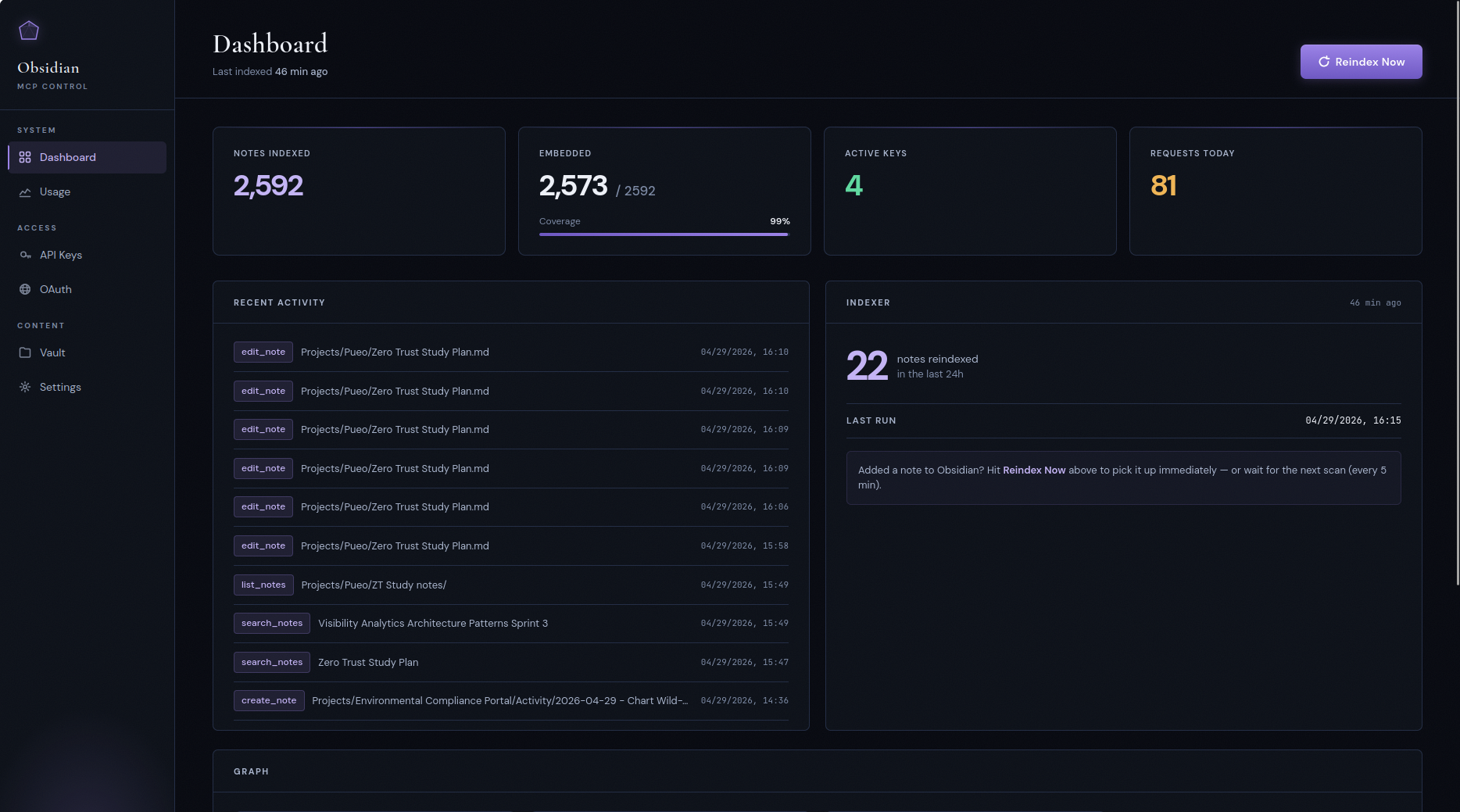
The server ships with a built-in admin UI for the parts of operations that are easier to look at than to query: minting keys, watching the indexer, eyeballing tool-call traffic, and resetting embeddings when you switch providers.
Usage
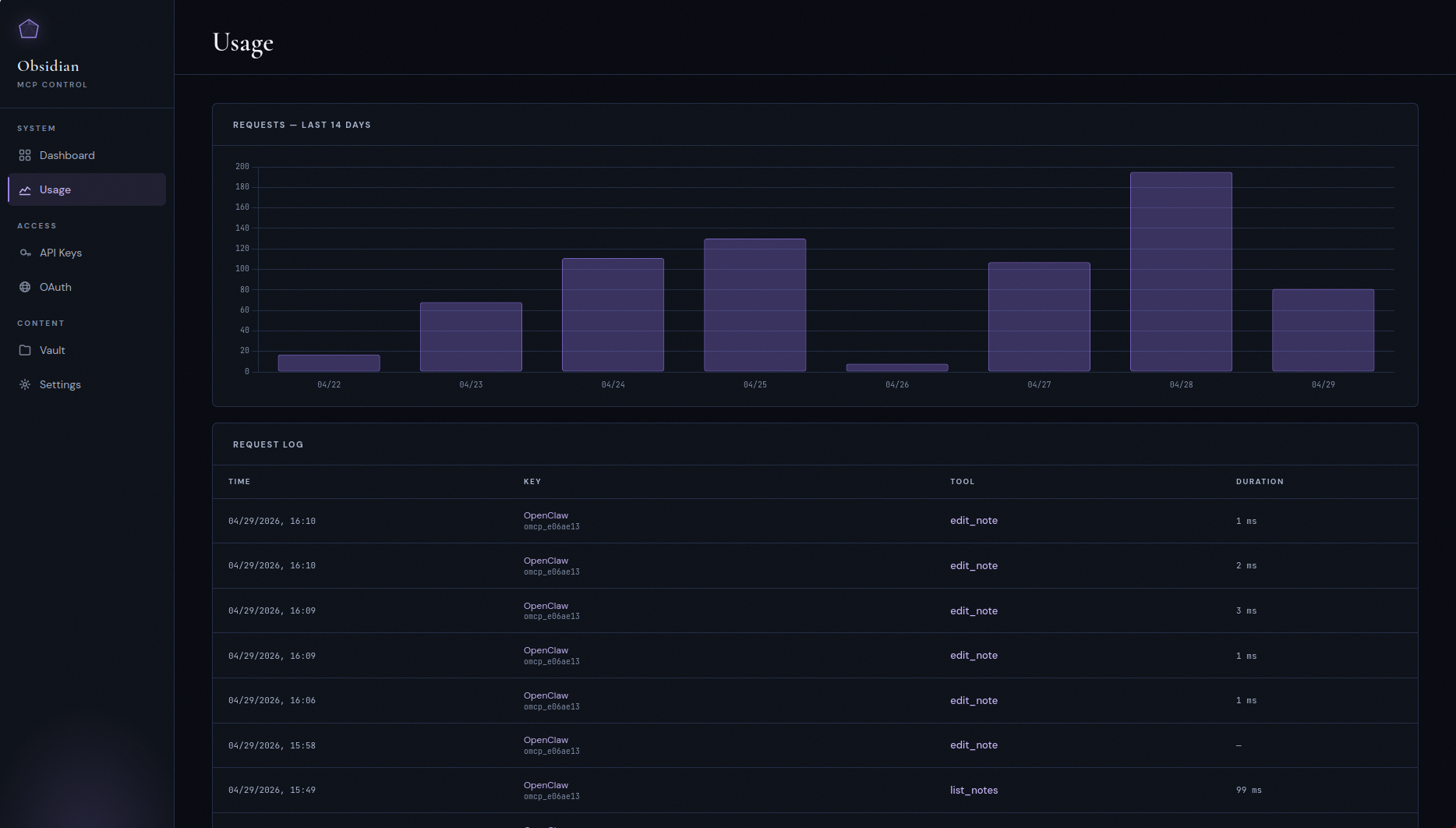
Per-tool-call audit log with a 14-day request histogram. Every MCP call is recorded with the calling key, tool name, duration, and response size — useful for noticing a misbehaving agent burning tokens on something it shouldn't.
API keys and OAuth clients
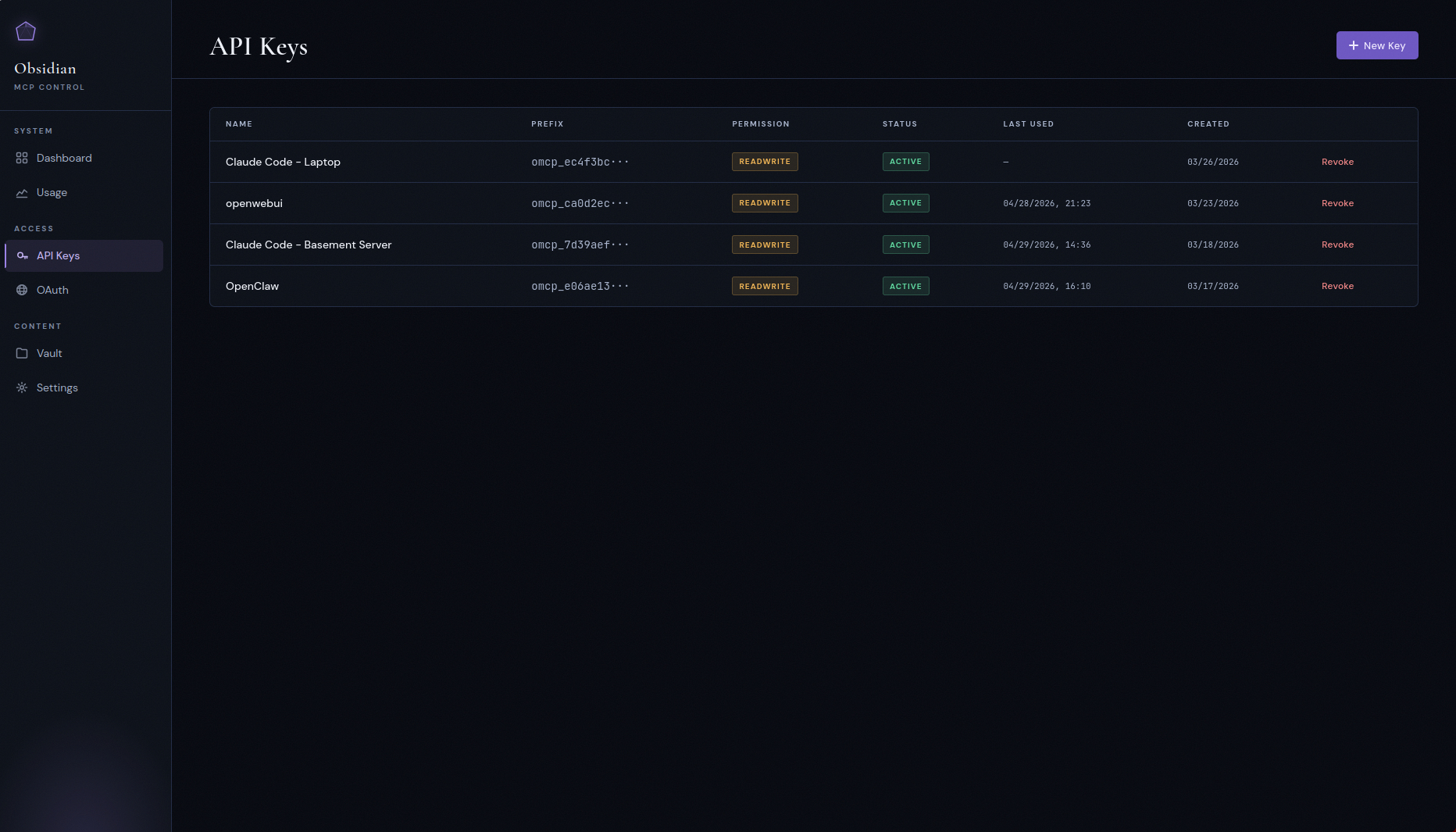
Bearer keys with read / readwrite scopes for API clients, and a
separate OAuth 2.0 PKCE flow for clients like ChatGPT, Claude Desktop,
and claude.ai that expect a proper authorization-code dance. The OAuth
server supports public (none) and confidential (client_secret_post)
token-endpoint authentication plus refresh tokens, and, for metadata-document
clients only, private_key_jwt (RFC 7523 signed client assertions).
Clients identify themselves in one of two ways:
- A Client ID Metadata Document (CIMD, the MCP 2026-07-28 default). The
client's
client_idis anhttpsURL to a JSON document it publishes, and the server fetches it through the same hardened, SSRF-guarded client asimport_from_url. Claude (claude.ai, Desktop, mobile), Claude Code and ChatGPT use this whenever the server advertises it, which it does by default. Claude Code's loopback callback (http://localhost:<any port>/callback) works this way. Claude and Claude Code are public (none) clients. ChatGPT's document declaresprivate_key_jwt: the server also fetches the document's same-originjwks_uri, stores the validated public keys with the client, and ChatGPT then signs a short-lived, single-use assertion for every token exchange and refresh (and revocation). The server refetches the key set from the same pinned URL when an assertion names a key it does not hold, and before a token request once the stored set is more than a day old. - Dynamic Client Registration (
/register, RFC 7591, deprecated by MCP but kept) remains the fallback for any client that sends no URL.
The consent page names a CIMD client by the host its document was fetched
from, never by the name the document gives itself. Every authorization
response carries the RFC 9207 iss parameter.
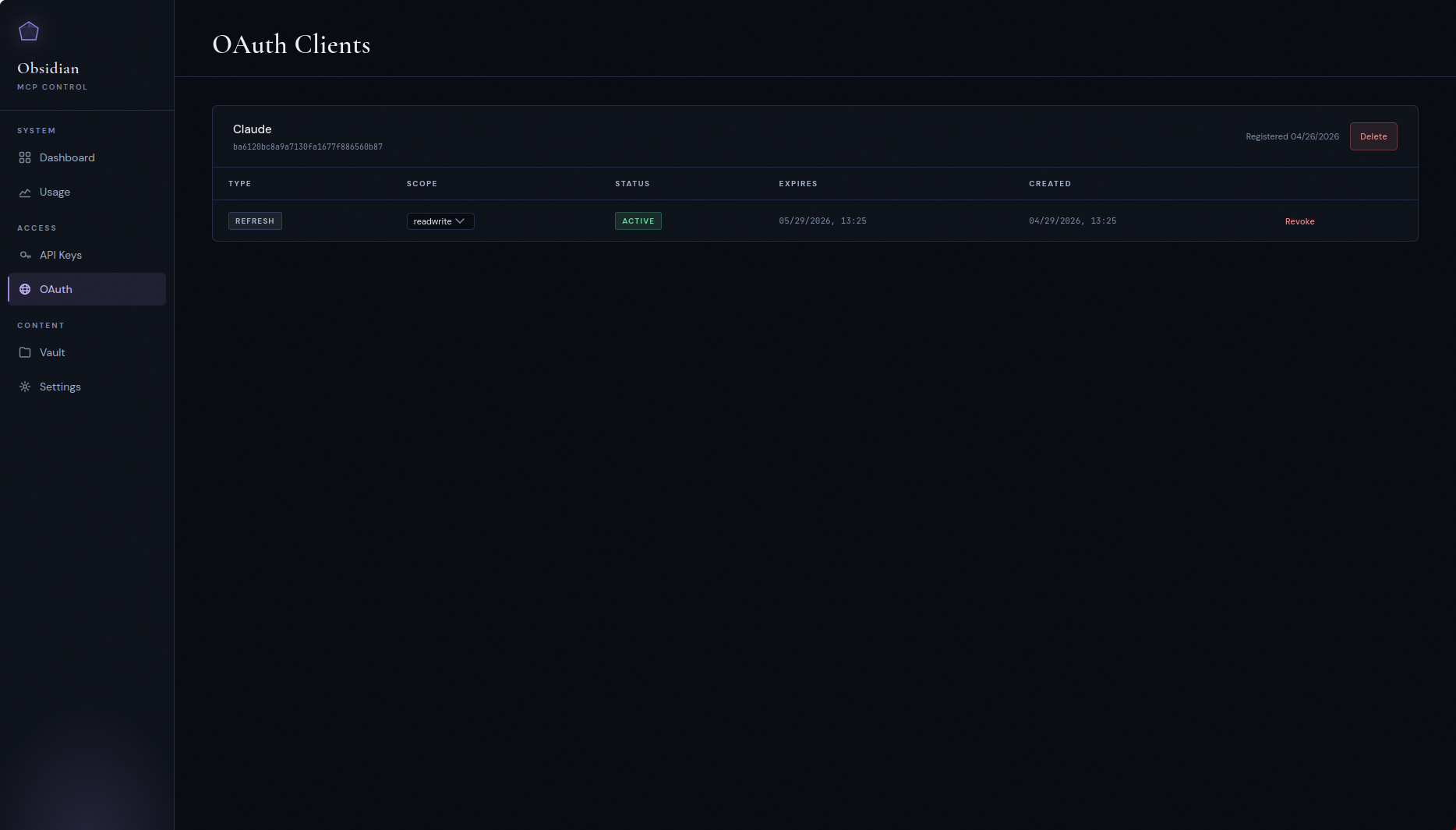
Each client's page lists its grants — one row per /authorize approval,
not per token — with a Revoke control and a permission select per grant,
so revoking really ends the session instead of leaving a refresh token
to mint a replacement. Revoked and expired rows stay listed, dimmed, for
a week.
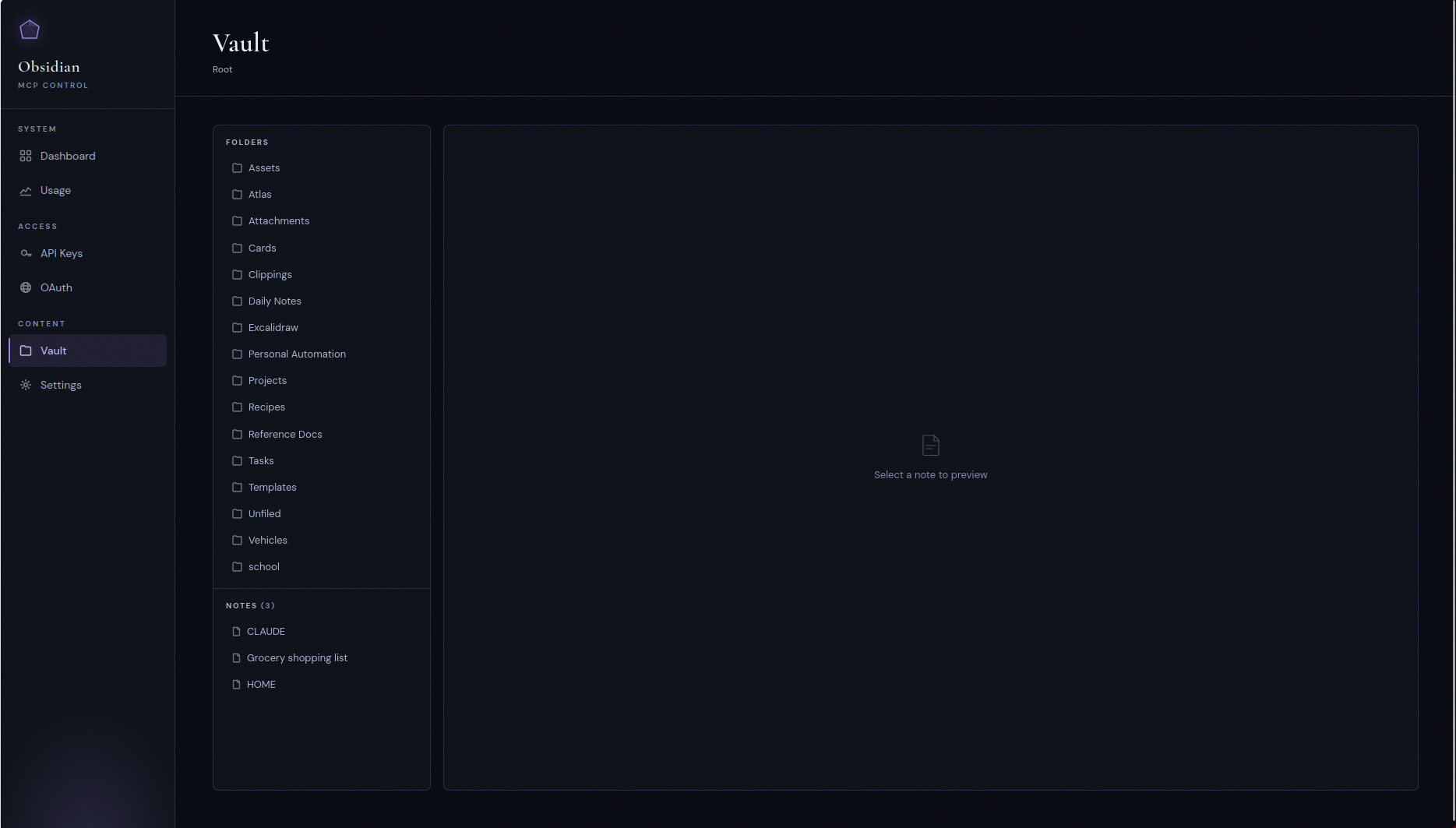
Vault browser
A read-only file tree of the mounted vault, mostly for sanity-checking that the container sees what you think it sees.
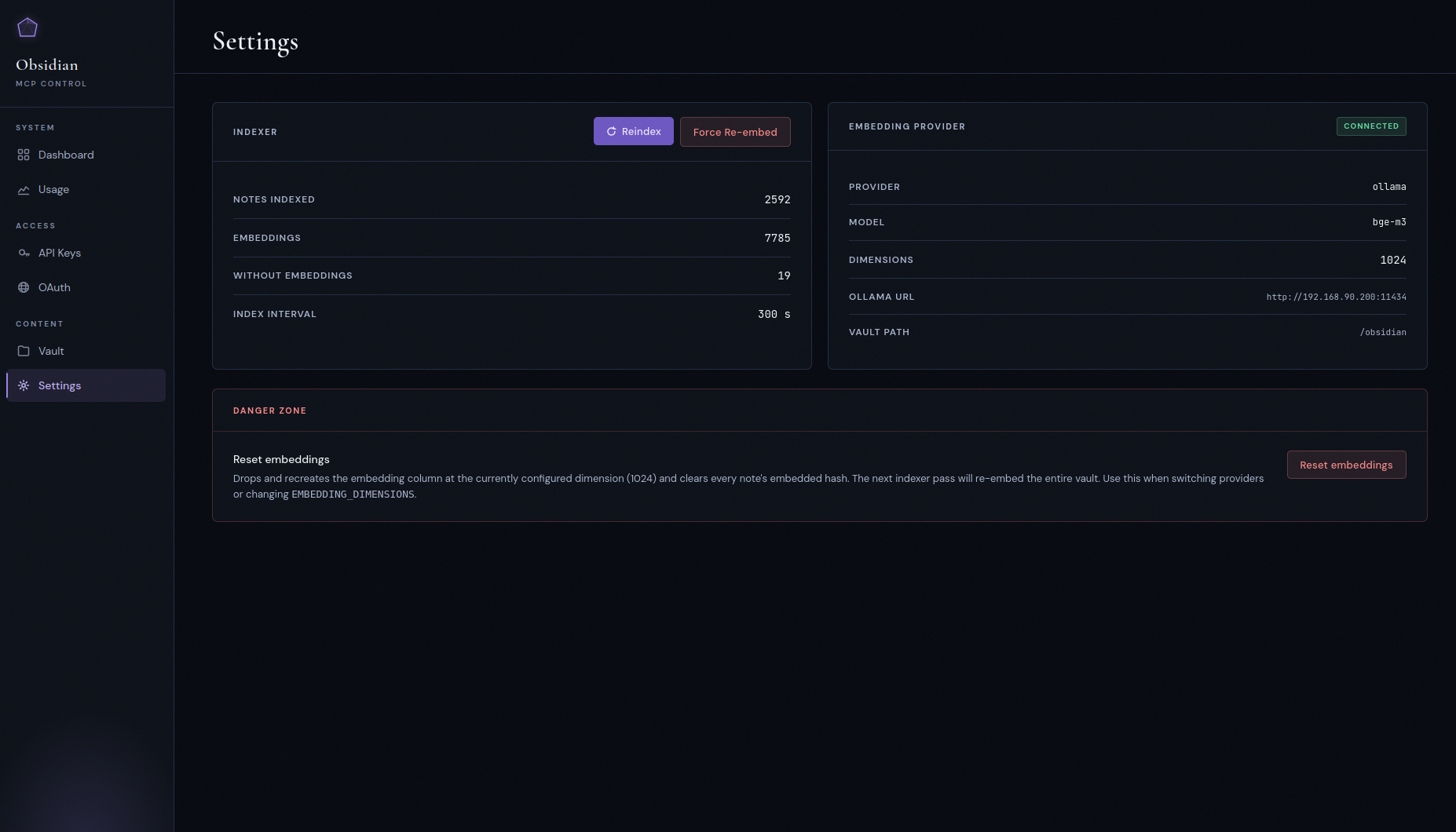
Settings
Indexer status, current embedding provider and model, vault path, and the danger zone: Reset embeddings (drops and recreates the embeddings column at the configured dimension — use it when switching providers) and Force re-embed (keeps the column, clears every note's embedded-content hash so the next pass re-embeds the vault). Both pause the indexer while they run.
The dashboard separates two things that used to be conflated: Last
run is the indexer's own heartbeat — the last pass that completed,
whether or not anything had changed — and Last change detected is
the newest indexed_at on any note. A quiet vault makes the second one
old while the indexer is perfectly healthy.
Tasks settings
A Tasks card holds the settings of the task tools. In multi-user mode it is on each user's Account page and applies to that user's own calls only. In single-user mode it is on the Settings page and applies to every MCP caller of the server. Nothing is stored until the card is saved, and an unsaved card means the server defaults from Configuration.
- Which checkboxes are tasks (first on the card; see
Which checkboxes are tasks). A choice of
Server default (which shows the server's rule in words), Every
checkbox is a task (
all), Only checkboxes with task details or a task tag (fields) or Only checkboxes that contain the global filter text (filter); a Task tags list, one per line, at most 32; and a Global filter text field, at most 64 characters on one line. An "In use now" line shows the rule in effect and whether it is the server default or set here. Server default takes the server's whole rule as one unit (rule, task tags and filter text together) and ignores the card's two fields, so what the card says is in use is exactly what is used. Tags or a filter text the chosen rule does not use are kept, so switching rules to compare loses nothing. Thefilterrule without a filter text is refused, with nothing saved. - Timezone. What "today" means for task dates: relative dates such
as
todayor+3d, and the date written when a task is completed, cancelled or added. Any IANA timezone name (the field suggests common ones); blank usesTASKS_DEFAULT_TIMEZONE. The card shows the zone in use. A saved zone this server cannot load falls back to UTC, and both the card and every task response say so. - Excluded folders and excluded note tags, one per line, at most
32 of each. Tasks in those folders (and their subfolders), or in notes
carrying one of those tags or a tag nested under it (
ticket/opsunderticket), are left out of the default scope: listings, the agenda andadd_task's duplicate check. A caller can still passscope="all", and every listing counts what was excluded. - Four write behaviours, each a choice of Server default (which shows the current default), On or Off: add a done date when a task is completed, add a cancelled date when it is cancelled, add a created date to new tasks (and to a recurring task's next occurrence), and put a recurring task's next occurrence below it instead of above. Each names the Tasks plugin setting it matches, so a vault that also uses the plugin can keep the two in step.
Quick start
Deploying on a VPS from scratch? See
DEPLOYMENT.mdfor the full walkthrough: Postgres setup, Caddy and TLS, vault sync via Nextcloud, and the gotchas that bite first-time deploys. Running Kubernetes? Seedocs/deployment-kubernetes.mdand the kustomize manifests indeploy/kubernetes/.
The bundled Caddy configuration fails closed on /admin, /api, and
/authorize; replace its placeholder basic-auth hash before starting it.
Prerequisites
- Docker and Docker Compose
- A PostgreSQL 16 instance reachable from the container, with
pgvector0.8.0 or newer installed - Either an Ollama instance running an embedding model (
bge-m3, the default, orqwen3-embedding:0.6b, which the reference deployment runs; see Embedding model choice), or an OpenAI API key. Anything that speaks the OpenAI embeddings protocol works (Azure OpenAI, OpenRouter, Together, etc.). - Linux, kernel 5.6 or newer (see below)
System requirements
The server checks these at startup and tells you which one failed rather than misbehaving later.
**Li