Listed from the MCP registry; nobody on Odel publishes it.
Is this yours? Claim it
Research Methods Library
Research methods for AI assistants: study design guidance, R and Python code, and citations
One address for any MCP client. No sign-in needed on this server.
What it does
4 read2 other
Grouped by tool name. At most: only reads or looks up information.
What it costs
FreeOdel charges nothing per call. The publisher may charge for its own service.
Tools
6 · grouped by tool name · checked 14 Nov 2026Read · 4Look things up
- search
- fetch
- get_code
- list_sources
Other · 2Neither hinted nor named
- choose_method
- cite

Research Methods Library
A Model Context Protocol server that grounds AI assistants in methodological texts: study design recommendations, identifying assumptions, runnable R and Python code, and a citation for every source.


The Research Methods Library is a Model Context Protocol (MCP) server. Given a research question, it recommends candidate designs, states their identifying assumptions, returns runnable R and Python code, and supplies a formatted citation for every source consulted. Its index contains approximately 19,000 sections from 8 books, an R package, and the author's research articles (listed under Sources) covering causal inference, econometrics, experimental design, marketing research, credit scoring, machine learning, and artificial intelligence.
The server works with Claude, ChatGPT, Amazon Bedrock AgentCore, Cursor, Visual Studio Code, and any other MCP-compatible client. Access is free and requires no account or API key.
Installation
Endpoint: https://research-methods-mcp.vercel.app/mcp. Access is free and requires no account or API key.


| Client | Configuration |
|---|---|
| Claude (web, desktop, and mobile) | Settings → Connectors → Add custom connector; enter the endpoint |
| Claude Code | claude mcp add --transport http research-methods https://research-methods-mcp.vercel.app/mcp |
| ChatGPT | Settings → enable developer mode → add a custom connector of type MCP server with the endpoint and no authentication |
| Amazon Bedrock AgentCore | Add the endpoint as an MCP server target of an AgentCore Gateway, with no outbound authorization: agentcore add gateway-target --name research-methods --type mcp-server --endpoint https://research-methods-mcp.vercel.app/mcp --gateway <gateway>, then agentcore deploy |
| Cursor, Visual Studio Code | Use the buttons above |
| Windsurf, Cline, Zed, and other clients | Add the following JSON to the client's MCP configuration |
{
  "mcpServers": {
    "research-methods": {
      "url": "https://research-methods-mcp.vercel.app/mcp"
    }
  }
}
Example queries
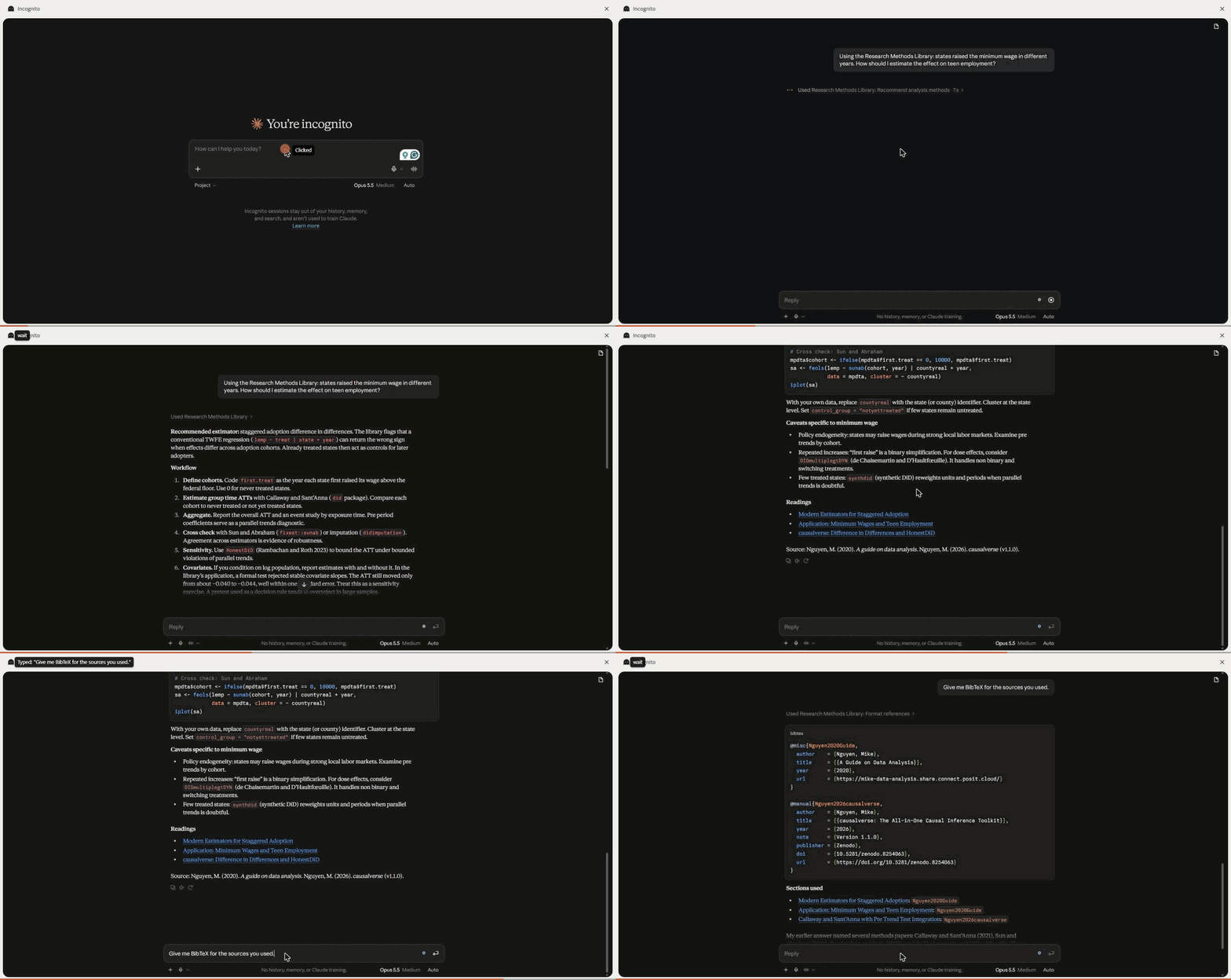
States raised the minimum wage in different years. How do I estimate the effect on teen employment?
For this query the assistant calls choose_method, which returns staggered difference-in-differences together with its scope conditions, the reason a conventional two-way fixed-effects regression can be biased when treatment effects are heterogeneous, the assumptions to verify, implementations in R (did, fixest, didimputation, HonestDiD) and Python (csdid, pyfixest, differences), and the relevant readings.
Give me Python code for a probability-of-default model with gradient boosting.
Only California passed the law and I have 30 years of state data. What can I do?
Write the methods section for my regression discontinuity and give me BibTeX for the sources.
Each response links to the specific section consulted and carries the citation of the work from which it is drawn.
Tools
| Tool | What it does |
|---|---|
choose_method | Matches a research question to methods, with when to use each, key assumptions, R and Python packages, and readings. 62 curated methods. |
search | Finds sections across all works, with links, snippets, code languages, and a citation. Compatible with ChatGPT deep research. |
fetch | Reads a section in full, with its code, link, and citation. Compatible with ChatGPT deep research. |
get_code | Runnable R, Python, or Julia code for a task, with the packages it uses. |
cite | References in APA, Chicago, MLA, Harvard, BibTeX, or RIS for the sections consulted, deduplicated by work. |
list_sources | The works in the library (textbooks, an R package, and research articles), with topics, languages, licenses, and links. |
Prompts (slash commands in clients that support them): plan_analysis, write_methods_section, explain_method. Resources: the library catalog and a table of contents for each work.
All tools are read-only. The server makes no calls to language models and stores no information about its users, only anonymous daily totals of tool calls and client applications; see the privacy policy.
Sources
| Work | Code | Sections | Served | License |
|---|---|---|---|---|
| A Guide on Data Analysis | Python, R | 1,634 | Full text | CC BY-NC-SA 4.0 |
| causalverse: The All-in-One Causal Inference Toolkit | R | 1,163 | Full text and function reference | GPL-3.0 |
| Credit Scoring: Theory, Methods, and Practice | Python | 2,625 | Full text | CC BY 4.0 text, MIT code |
| Marketing Research: A Technical and Academic Treatment | Python, R | 1,997 | Excerpts and code; full text on the website | All rights reserved text, MIT code |
| AI in Action: A Reference for Artificial Intelligence | Julia, Python | 6,266 | Excerpts and code; full text on the website | All rights reserved |
| Advanced Data Analysis | Python, R | 1,834 | Full text | CC BY 4.0 |
| Applying Tidy Finance with Python to Vietnam | Python | 1,331 | Excerpts and code; full text on the website | All rights reserved |
| Tài Chính Ứng Dụng với Python | Python | 1,310 | Excerpts and code; full text on the website | All rights reserved |
| Social Science Theory: A Field Guide to the Theories, Effects, and Frameworks Behind Research and Business | R | 1,118 | Full text | CC BY 4.0 text, MIT code |
| Research Articles and Publications | — | 7 | Abstracts, DOIs, and citations | Publishers' terms |
Sections of A Guide on Data Analysis that appear in the Springer print volumes are cited as their published chapter, then the volume. For example, a section on causal inference is cited as Nguyen, M. (2025). Causal inference. In Experimental design (Vol. 4, pp. 7–48). Springer Cham. https://doi.org/10.1007/978-3-032-01839-7_2, in Nguyen, M. (2025). Experimental design (Vol. 4). Springer Cham. https://doi.org/10.1007/978-3-032-01839-7
Method
The source files of each work (.Rmd, .qmd, .Rd) are parsed into a single index of sections, code blocks, and citations. During index construction every link is verified against the published website: a section whose anchor is absent links to its chapter page, and unpublished pages are excluded. Queries are answered from the in-memory index; no database or language model is involved.
Self-hosting
docker build -t research-methods-mcp .
docker run -p 8080:8080 research-methods-mcp     # http://localhost:8080/mcp
Or with Node.js: npm ci && npm run build && npm start (listens on 127.0.0.1:8787; set HOST and PORT to change). The same handler runs on Vercel through api/index.mjs and vercel.json (the hosted endpoint) and on Deno Deploy through src/deno.ts.
Usage analytics
Usage analytics are off by default. They are controlled by these environment variables:
| Variable | Effect |
|---|---|
UPSTASH_REDIS_REST_URL, UPSTASH_REDIS_REST_TOKEN (or KV_REST_API_URL, KV_REST_API_TOKEN, as set by Vercel's Upstash integration) | Counts, per UTC day, connections by client application (the name the client reports, such as claude-ai or cursor), calls to each tool, and prompt and resource requests, in an Upstash Redis hash usage:YYYY-MM-DD kept for about 13 months. When the endpoint URL carries a source label (/mcp?src=glama), connections and tool calls are also counted per label (src:<label>, src_calls:<label>); labels outside the list SOURCES in src/usage.ts count as other. Tool arguments, IP addresses, and session identifiers are never read or stored. |
STATS_KEY | Serves a private usage report at /stats?key=<STATS_KEY> (add &days=90 for a longer period, &format=json for raw counts). Requires the Redis variables. |
WEB_ANALYTICS_VERCEL=1 | Adds Vercel Web Analytics (cookieless page views) to the HTML pages. Enable Web Analytics in the Vercel project first. |
GA_MEASUREMENT_ID | Adds Google Analytics 4 (G-…) to the HTML pages. It sets cookies. |
The web analytics measure visits to the landing, privacy, and terms pages only; MCP traffic comes from AI providers' servers rather than browsers, so only the Redis counts measure it. The privacy page describes whichever of these are enabled. The maintainer's dashboard, which combines these counts with the book sites' analytics, is described in docs/DASHBOARD.md.
Development
npm ci
npm run build:index   # parse the book repositories (sibling folders) into data/index.json.gz
npm run build         # bundle dist/stdio.js and dist/http.js
npm test              # end-to-end tests through real MCP clients
npm run check-links   # audit every link in the index against the live sites
To add a book, add an entry to sources.yml and rebuild the index. To add or tune a method, edit methods.yml; the build fails if a method points at a section that does not exist.
Citation
Users are asked to cite the works they draw on; the cite tool formats the references. To cite the server itself, see CITATION.cff.
License
The server code is MIT licensed. The content it returns keeps each work's own license, listed above and by the list_sources tool.