Listed from the MCP registry; nobody on Odel publishes it.

mnema: decision records for AI coding agents
Signed, append-only decision records for AI coding agents, over MCP. Verify them offline.
Runs on your machine from its package; the steps are below.
What it does
- Reads
- Writes
- High impact
At most: creates or changes data: records, files, settings.
What it costs
FreeOdel charges nothing per call. The publisher may charge for its own service.
Runs locally over stdio
This server isn't hosted — your MCP client launches it from a package registry. Use one of the commands below, or drop the config into your client (e.g. Claude Desktop).
Run
npx -y @mnema/code
MCP client config
{
  "mcpServers": {
    "mnema-decision-records-for-ai-coding-agents": {
      "command": "npx",
      "args": [
        "-y",
        "@mnema/code"
      ]
    }
  }
}
mnema is the decision record for AI coding agents.
Who decided this, and why? What was turned down? Has it changed since? When an agent settles a choice in a chat that ends, nothing answers. mnema keeps the answer in the repository.
Your decisions, handed to your agents' sessions and held at the edits they govern: append-only and signed in the repository, and checkable by anyone.






| Remember | Enforce | Prove |
|---|---|---|
| With the plugin, each agent session opens with the decisions in force, by name and id. | A rule addressed at a path can refuse an agent's write there, or hold it for a person where the host allows. | Every write the product makes ends in a signed checkpoint and is hash-chained; anyone can verify it, even in a browser, and a reader's guarantee runs up to the last checkpoint. |
Tamper-evident, not tamper-proof: what is still in the record has not changed since it was signed, and a stranger can check that without your keys and without installing this.
Why · Status · Quick start · How it works · Hosts · Family · Watch it · What it proves · Docs
Why
Your agents settle choices all day: a library, an approach, an option turned down. Those choices usually live in a chat that ends, in one tool's memory or in somebody's head, where nobody can check who decided them or whether they were changed since. mnema writes them down in the repository, next to the code, with their reasons and what was turned down. The record is signed and only grows: a change of mind is a new entry that supersedes the old one, never an edit. Where the host runs hooks, each session opens with the decisions in force, and anyone can check offline that what it holds was not changed since it was signed. What is measured, and what is not, is on the evidence page.
Status
- On npm.
@mnema/codeis published: install it withnpm i -g @mnema/code(docs/install.md); to run themainbranch instead, see Build from source. - In the editor stores. The VS Code extension is on the Visual Studio Marketplace and Open VSX as
mnema.mnema, and still needs themnemacommand from@mnema/code. - These pages describe the next version (the
mainbranch). What has not reached npm yet is listed inchangelog/unreleased/, one file for each change; the Changelog holds what each release carried. - Node. Requires Node 24.15.0 or a later 24, or 26.0.0 or later.
- From a checkout. The GitHub Action and the SDK are not published, and run from a clone of this repository (Packages).
Quick start
npm i -g @mnema/code
cd your-repository
mnema init
ADR=$(mnema decision record "Keep money as integer cents" "Float sums drift; cents are exact." | grep -o -m1 'ADR-[0-9]*')
mnema decision move accept "$ADR" --note "Agreed in review."
mnema link "$ADR" src/billing --rel refuses-a-write
mnema verify
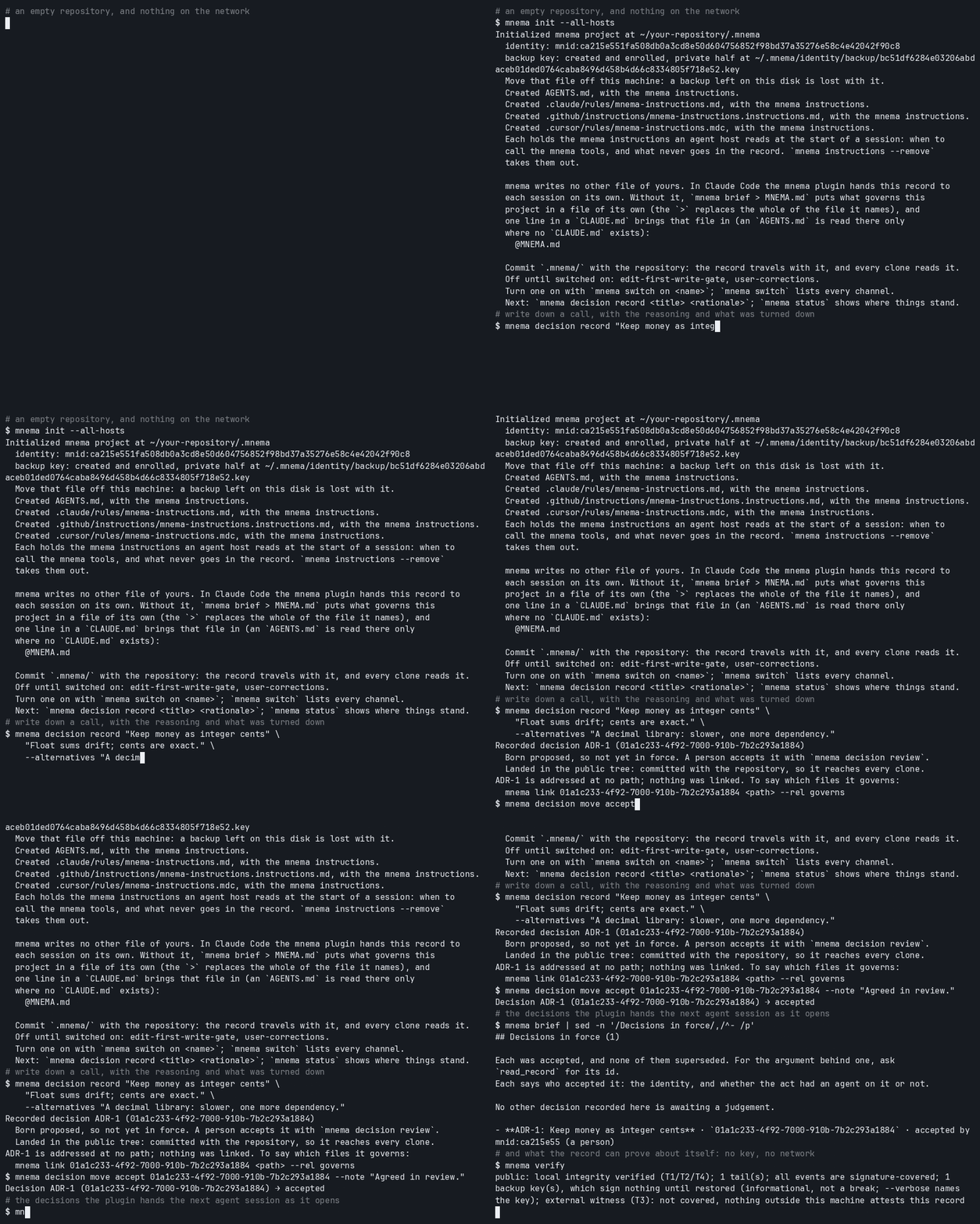
In order: the binary; the record founded in .mnema/; a decision, which enters proposed; accepting it, which puts it
in force; the rule, addressed at a path; and verify, which reads the signed record, one line saying it is intact
being the green. The block has no comments so it can be pasted into any shell, macOS's zsh included.
No agent has run yet: that is the record, a rule in force, and the proof. ADR holds the number
mnema printed for the decision you just recorded. In fish, whose
syntax differs, the first line is set ADR (mnema decision record ... | grep -o -m1 'ADR-[0-9]*').
To hand the record to an agent, install the plugin for your host; in Claude Code:
claude plugin marketplace add mnema-work/mnema
claude plugin install mnema@mnema
To try the same steps in a scratch folder without installing anything, use npx
(the recipe).
Every other host is in Hosts. mnema init also writes the mnema
instructions into AGENTS.md and the other files agent hosts read, naming each; at a
terminal it first asks which hosts, and shows everything it will write before it writes it, and
mnema instructions --remove takes them out. The first record, step by step, is
Your first record.
How it works

- Record. An agent over MCP, or you at the command line, writes a decision with its reasoning and the options turned down, and a task with its description and a handoff with its brief.
- Rule. A person accepts it, or an agent where
agent-acceptsis on (the default; an agent's acceptance is marked as its own), andmnema linkaddresses it at a path. The rule can govern that path, ask for a person there, or refuse a write. - Hand over. With the plugin, each session opens with what is in force (in Claude Code, so does each subagent), and each edit meets the rules for its file. In Claude Code, a note of the host's own memory is also copied into this machine's private tree, until you switch that off.
- Verify. Every write ends in a signed checkpoint and is hash-chained; a reader's guarantee runs up to the last checkpoint.
mnema verify, a second reader in Python, or the pagemnema sitewrites checks it.
More in docs/how-it-works.md; what a session is handed, word for word, is in
docs/agent-hosts.md, and how far each host goes is under Hosts.
Hosts
mnema works with any agent host that has an MCP client, and how much more a host gets depends on what its hooks allow, one rung at a time: (a) the MCP server and rules in a file, (b) the opening of a session, (c) a refusal before a write, (d) a pause for a person.
| Host | Rung | What it gets | Install | |
|---|---|---|---|---|
 | Claude Code Anthropic · terminal and editors | (d) | MCP server · rules file · opening · refusal · pause · rules at an edit | Plugin |
 | VS Code Microsoft · the agent of the editor | (d) | rules file · refusal · pause MCP server · opening: read once | Plugin |
 | Cursor CLI Cursor · command line | (c) | rules file MCP server · opening · refusal: read once | Plugin |
 | Codex OpenAI · command line | (c) | MCP server · rules file · opening · refusal · rules at an edit | Plugin |
 | Copilot CLI GitHub · command line | (d) | MCP server · rules file · opening · refusal · pause · rules at an edit | Plugin |
 | OpenCode Anomaly · command line | (c) | MCP server · rules file · opening · refusal · rules at an edit | Plugin |
 | Gemini CLI Google · command line | (c) | MCP server · rules file · opening · refusal · rules at an edit | Plugin |
 | Qwen Code Qwen · command line | (c) | MCP server · rules file · opening · refusal · rules at an edit | Plugin |
| Cursor Cursor · editor | (a) | MCP server · rules file documented, not measured | MCP server |
 | Antigravity CLI Google · command line ( agy) | (a) | MCP server · rules file documented, not measured | MCP server |
 | Factory Droid Factory · command line | (a) | MCP server · rules file documented, not measured | MCP server |
 | Goose Agentic AI Foundation · desktop and command line | (a) | MCP server · rules file documented, not measured | MCP server |
The logos beside the names of the hosts belong to their owners: Anthropic, Microsoft, Anysphere, OpenAI, GitHub, Inc., Anomaly, Google, the Qwen Code project, Factory and the Goose project. They identify the hosts mnema works with and imply no endorsement, either way. mnema is not theirs. Each file is the vendor's own, unmodified, and its source is listed.
Each cell of the full table, how each one is known (held by a test, read once on a real host, or documented and not measured), and the notes on each host are in How each claim is held.
The mnema family

@mnema/code holds the record, and the command line and the MCP server that read and write it. The rest stand around
it. The detail of most of them is in Features; for the rest, the Link column leads to the page that has it.
| Product | What it is for | Status | Link |
|---|---|---|---|
@mnema/codethe core | The signed, append-only record, with the command line and the MCP server over it. | npm i -g @mnema/code (Install). | Package |
| GitHub Action | On a pull request, comments what the change does to the record and fails the check when it is not signed. | Not published; runs from a clone of this repository. | Package |
| SDK | A library door to the record, for a program that records, reads and verifies. | Not published; runs from a clone of this repository. | Package |
| VS Code extension | Shows the rules in force over the open file, the decisions waiting for a judgment and the stacks adopted. | On the Visual Studio Marketplace and Open VSX as mnema.mnema (code --install-extension mnema.mnema); it runs the mnema command, so @mnema/code stays a prerequisite. | Package |
| Stacks | Installs a set of skills and agents from a plan shown whole, and records the adoption as a signed fact. | Commands of mnema, not a package of their own; the contract they check against, @mnema/stacks, ships with @mnema/code. | Stacks |
| An agent in CI | A pipeline's agent records with a key of its own, so what it records is signed as that agent. | A recipe, not a package. | The recipe |
| A page that verifies itself | mnema site writes one HTML file, and the reader's browser checks it. | A command of @mnema/code, not a package. | The page |
Watch it
The first record: the command line in an empty repository, from init to verify. Recorded from the built binary by recordings/first-record.sh. |  A changed word caught: one word of an accepted decision is changed by hand in its file, and mnema verify names the event whose hash no longer matches and exits 1. A cut that takes the newest events together with their checkpoint is not caught: a hash chain shows what changed, never what is gone (what it proves). Recorded from the built binary by recordings/a-tamper-caught.sh. |
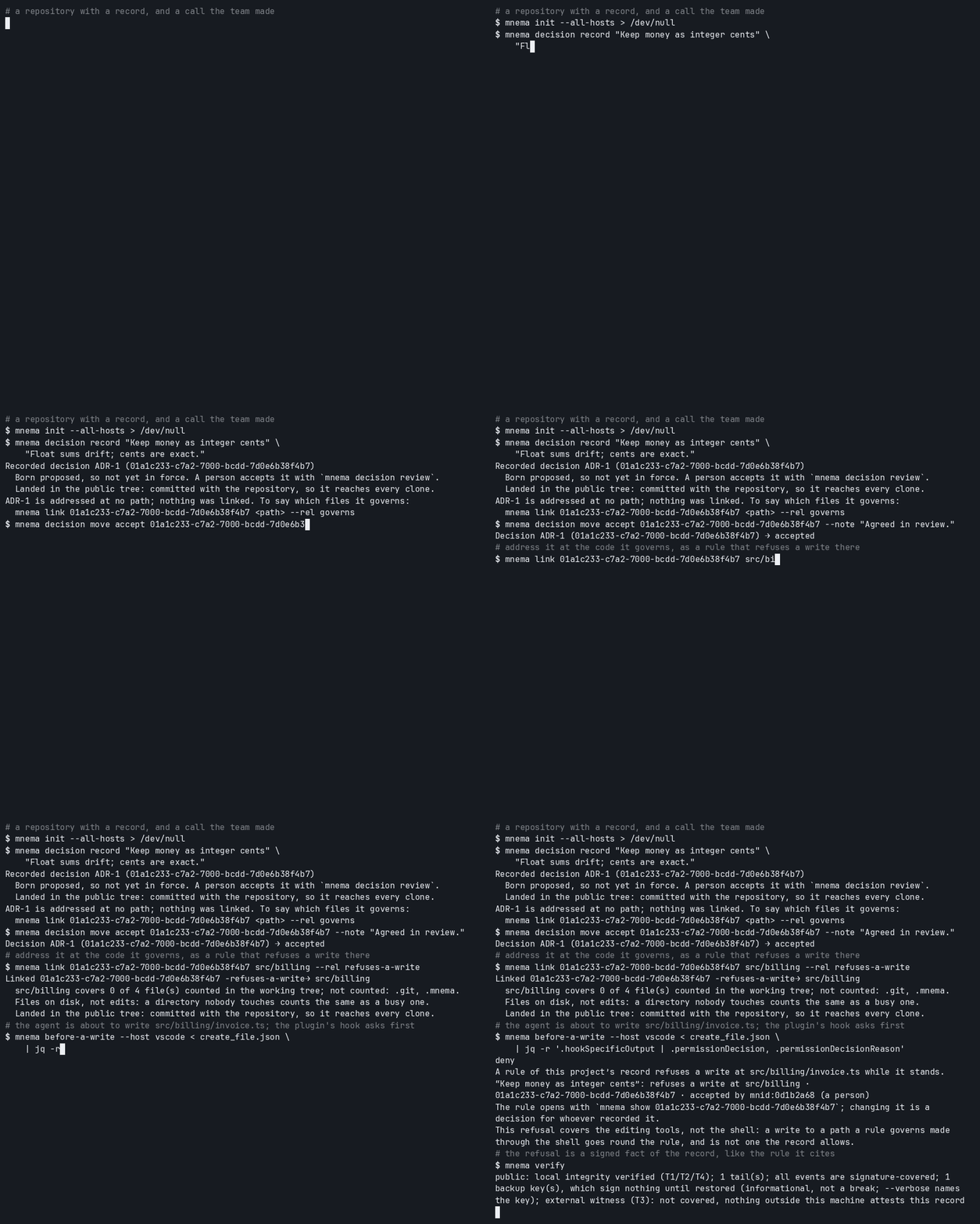 A write refused: the rule addressed at the path stops an agent's edit there. Recorded from the built binary by recordings/a-write-refused.sh. |  A decision superseded: a later call takes its place, the old one leaves the rules the next session is handed (the call that replaced it names it) and stays in the record. Recorded from the built binary by recordings/a-decision-superseded.sh. |
 At a terminal, mnema alone asks what you want to do here, and its first door opens the console: a session that reads the record and refuses to write. It needs a window at least 80 columns wide and 42 rows tall. Driven through a pseudo-terminal by recordings/console.json. |
A case in the suite runs the scripts again against the built binary and fails when a recording no longer
shows what the binary draws, so none of them can go on showing an older product in silence
(the-recordings-are-what-the-binary-draws.test.ts).
What it is not
Each of these is a choice with a reason, and the reasons are in Where it fits.
- Not a semantic memory. Search is by the words written in a record; there are no embeddings.
- Not an agent runner. It calls no model and runs no tool for the agent.
- Not a copy somewhere else. The committed record travels with the repository, and what you record privately stays on this machine, apart from the notes and the private rules your agent's host receives, when a session opens through the plugin and when the agent asks for them, which the host sends to its model; the witness verbs send a digest out, and with Sigstore the identity too, only when you run them.
- Not access control. The gate refuses an illegal move; it does not decide who may write.
What it proves, and what it does not
mnema verify reads the events and the committed public keys of a project's trees (no private
key, no network) and prints each verdict verbatim, naming the level it reached.
- What holds. A changed or reordered event breaks the hash chain, and an edit made without the signing key is caught where the signed checkpoints remain;
verify --require=signedfails when they were taken out. - What does not hold. Nothing proves that nothing was removed: a hash chain shows what changed, never what is gone, and the history a git remote keeps is what covers omission. A record forged whole under a fresh key verifies clean, a key is not proven to be the person a name says, and the agent named on a fact is the name its client announced, unless an agent key signed it (then the name the record enrolled the key under). An agent key's role and its retirement are facts of the record that holds them:
verifycrosses a project's trees for a retirement, and a reader of one tree does not. A refusal of a write covers a host's editing tools, not its shell:sed -ion a protected file goes round it. - What a green
verifymeans. That nothing verifiable is broken, not that the record is honest, and the gate protects the shape of a change, not who may make it.
The whole table, claim by claim, is in docs/what-it-proves.md; how each
claim about the agent hosts is held, and which are not held yet, is in docs/evidence.md.
Docs
- Get started. Install · Your first record · Hosts
- Learn. How it works · What a session is handed · Where a rule arrives · What it proves · Recording decisions · Rules and the commits that cite them · Committing the record · A second machine and your key · What a backup keeps, and what it loses · A record that inherits another · Importing the decisions you already wrote · Switching off what is handed to a model · The session journal and compaction · The ledger of caught failures · As an MCP server · Features · Where it fits · mnema next to a folder of ADRs · The OWASP Top 10 for Agentic Applications · The text the record hands a model · Windows and macOS · When two machines disagree · Glossary
- Reference. Commands · MCP tools · Switches · The command reference · The record format · Packages · SDK · GitHub Action · VS Code extension · Stacks · The plugin · Porting it to a host
- Project. How each claim is held · The page that verifies itself · Verify without installing · A proof of one decision · What comes next · North star · Architecture · Contributing · Build from source · Security policy · Changelog
Contributors
Thank you to everyone whose pull request made mnema better.






Thank you also to @bfs2021, an account that declares itself automated, whose pull requests were merged.
To join them, start from CONTRIBUTING.md, the pinned Start here issue, or an issue labelled ready for an agent.







