
The sovereign AI Operating System
Open to build on · Private at the core
 English ·
  Français ·
  Español ·
  Deutsch ·
  Português ·
  Русский ·
  中文
中文
Everyone is building the intelligence. Mnemosyne builds the relationship — the memory that makes an AI truly know you, across sessions and across time. On your machine. Yours to see.










-8b5cf6?style=for-the-badge&logo=npm)
🔏 Every installer above is cryptographically attested to this exact repo, workflow and commit — via GitHub Artifact Attestations (Sigstore-backed build provenance). Don't take the download on faith — verify the file you got matches what our CI actually built:
gh attestation verify Mnemosyne-OS-Infinity-Setup-x64.exe -R Mnemosyne-OS/Mnemosyne-Neural-OS


🌐 mnemosyne-os.io — the product, for builders · mnemosyne-os.com — the company, press & labs · 📖 docs.mnemosyne-os.io — the user guide

[!TIP] 📖 The user documentation is live: docs.mnemosyne-os.io — every engine explained step by step, in English · Français · Español.
🌍 Fully multilingual — the OS speaks your language
The entire interface is localized in seven languages — onboarding, settings, chat, the voice assistant, every dialog. Switching language even re-selects the ★ recommended embedding model for it, so retrieval quality follows your language, not just the labels. Open windows pick the change up instantly.
| Language | Status | ||
|---|---|---|---|
| English | Your memory. Your machine. Your rules. | Stable |
| Français | Ta mémoire. Ta machine. Tes règles. | Stable |
| Español | Tu memoria. Tu máquina. Tus reglas. | Stable |
| Deutsch | Dein Gedächtnis. Deine Maschine. Deine Regeln. | Beta |
| Português | Sua memória. Sua máquina. Suas regras. | Beta |
| Русский | Твоя память. Твоя машина. Твои правила. | Beta |
| 中文 | 你的记忆。你的机器。你的规则。 | Beta |
Sovereign, local-first memory — in your language: un système d'exploitation de mémoire souverain et local · un sistema operativo de memoria soberano y local · ein souveränes, lokales Gedächtnis-Betriebssystem · um sistema operacional de memória soberano e local · суверенная локальная операционная система памяти · 主权的本地优先记忆操作系统.
Not another agent-memory library
Mem0, Zep and Letta give agents a memory layer you wire into a cloud stack.
Mnemosyne OS is a personal memory OS that runs on your machine — your data never leaves it, a human governs it, and it scores 77.1% on LongMemEval-M (audit it yourself).
The AI that remembers you — not infrastructure you plug into someone else's.
Where the project lives
Published by XPACEGEMS LLC. These are its official addresses:
| Product | mnemosyne-os.io |
| Organizations | mnemosyne-os.com |
| Documentation | docs.mnemosyne-os.io |
| Source | this repository |
| Packages | the npm scope @mnemosyne_os — the list |
Why call it an "OS"?
Not because it has a kernel or drivers — because it does what an OS does: it manages resources on behalf of processes that shouldn't have to manage them themselves. Linux does that for programs (CPU, RAM, disk, network). Mnemosyne does the same thing for AI agents, and the resources are just different:
| An agent needs | Mnemosyne manages it via |
|---|---|
| Memory | Vaults — SQLite + vector stores, partitioned by domain, with AES-256 encryption at rest you arm |
| Context | Chronicles + semantic retrieval — the agent never rebuilds its past by hand |
| Compute | Routing across model tiers (budget/standard/premium, local/cloud) by task complexity |
| Hardware | Real GPU/CPU dispatch for local speech (CUDA detection, isolated sidecars) so a heavy model never blocks the app |
| I/O | A signed intent protocol (query / ingest / forget / focus) instead of raw reads and writes |
| Security | FGAC, scoped JWTs, Zero-Trust IPC validation |
| Persistence | Cross-session continuity — no cold start on every invocation |
This isn't a marketing stretch invented for this repo. MemGPT (Packer et al., UC Berkeley, 2023, arXiv:2310.08560) proposed the same "OS for LLMs" analogy in a peer-reviewed paper — virtual context management modeled on OS memory hierarchies. Mnemosyne takes that same premise further: not a single-session context-paging technique, but a system that runs continuously, isolates multiple agents, and persists on the machine as a daemon — not a library you import and lose on exit.
The flagship app — Mnemosyne OS Infinity Edition
The reference application of the ecosystem: a local-first AI Operating System that
puts a sovereign memory core under strict user control. It runs LLMs locally or in the
cloud, keeps every encrypted vault on your machine, and — for agent-to-agent sync — can
speak over a libp2p transport (@mnemosyne-workspace/mnemosync-p2p).
Unlike fragmented AI wrappers, Mnemosyne never exposes your knowledge vault indiscriminately. Every agentic connection is governed by FGAC (Fine-Grained Access Control) and 400 Zod-validated IPC channels, ensuring total sovereignty over what executes, what's stored, and what syncs.
Core Modules
| Module | Description |
|---|---|
| 🧭 Neural Map | Your memory rendered as a living mathematical topology — nodes are memories, edges are semantic similarity between them, tuned live |
| 🧩 MnemoHub | A store of cartridges (mini-apps) whose catalog is signed by a sovereign wallet and verified client-side before anything renders |
| 💤 Dream State | A consolidation engine that replays and links memories during idle phases |
| 🗄️ Vaults | Memory partitioned by life domain, each with its own protection level and consent boundary |
| 🎙️ Voice Assistant | Local or cloud speech, streaming STT/TTS, gapless local playback |
| 💬 Multimodal Chat | Text, voice, and file-grounded conversation with live retrieval from your own vaults |
| 🧠 Adaptive RAG | Retrieval depth and ranking scale to the model you're running — laptop LLM to frontier cloud model |
| 🔑 Sovereign Wallet & Engramm License | A local Web3 wallet drives licensing (verified on Base), pseudonym claims, and cloud credits — no account, no password, no gas fees |
| 🎨 Spatial Canvas | Widgets live on a 2D canvas, not stacked tabs — position carries meaning |
Under the hood — the engines

Not one big "AI" black box — several independent, purpose-built engines:
- Embedding engine — a priority-ordered chain of embedding providers (cloud, local ONNX, Ollama). Tries each in order and fails loud rather than returning a null vector — a failed embedding must never silently become an invisible memory.
- Retrieval engine — an in-RAM, decrypted vector cache (int8-quantized to scale), ANN search unioned with exact term matching before the final re-rank pass.
- Spine engine — classifies every memory by semantic nature (its "spine" + tags), from a taxonomy that lives as data, not hardcoded logic — so new categories don't require a code change.
- Dream State — two-speed consolidation. A fast, low-latency tier extracts facts during active use; a heavier tier runs at idle/night to resolve contradictions and link memories across sessions. Output is appended alongside raw retrieval, never silently replacing it — see the benchmark results below.
- Adaptive RAG (the "gearbox") — rather than injecting every retrieved candidate, context selection (top-k / MMR / low-discrepancy sampling) scales to both the model tier you're running and the thinking mode you pick.
- Theia — the vision engine — named for the Titaness of sight, who in the myth is Mnemosyne's sister. A complete image-memory engine: your images are embedded 100% locally (SigLIP 2, in an isolated sidecar) into their own vector space, recalled in chat as thumbnails through three rank-fused channels — semantic, pixel-color palette, and emergent categories the engine discovers on its own — and browsed in a living gallery. The human always outranks the model: rate, pin, describe, teach, rename or merge its categories. Honest by construction: a cold or still-indexing engine says so, instead of inventing "no matches". Off by default — one Settings toggle.
- Voice engines, STT and TTS, fully independent — speech-to-text runs small models in-process and large models in an isolated GPU/CPU sidecar (a big STT model loaded in-process can crash the whole app); text-to-speech runs system, cloud, or local (offline binary or GPU voice cloning), scheduled sample-accurately for gapless playback. No NVIDIA GPU → automatic CPU fallback, never a hard block.
- 400 Zod-validated IPC channels connect all of the above to the UI — auto-generated and checked by a drift test on every build.
📄 Deep dive: The Resonance Engine — technical whitepaper. The full architecture behind these engines: why memory should resonate rather than be looked up, how consolidation and adaptive selection work, and the LongMemEval results — kept current as the engine ships.
📚 Full documentation — the user guide lives at docs.mnemosyne-os.io; concepts, architecture, governance, and design decisions live in
doc/.
How memory works
flowchart LR
    A["Document · conversation · file"] --> B["Vault<br/>domain-isolated, graduated protection"]
    B --> C["Chronicle<br/>content + semantic type + embedding vector"]
    C --> D["Semantic retrieval (RAG)"]
    D --> E["query() / ask()"]
    F["Dream State<br/>cold consolidation"] -. replays & links .-> C

    style B fill:#1a1a2e,stroke:#7c3aed,color:#fff
    style F fill:#1a0e1a,stroke:#ff6b9d,color:#fff
Proven on LongMemEval-M — not just a pitch
| 77.1 % (37/48) | overall accuracy, full-haystack (hard) variant, strict judge — August 2026 |
| 29/48 → 37/48 | what the second, fully local retrieval channel bought, under that strict judge |
| +4/−0 · +2/−0 | evidence sessions and answer-bearing chunks on 48 held-out questions — zero regressions |
| Every HIT above | replayed and reproduced before being counted — no cherry-picked runs |
LongMemEval is a public,
independent long-term-memory benchmark. Its full-haystack variant surrounds
every question's evidence with ~480 distractor sessions — the closest published
setup to a real, lived-in memory vault, and harder than the -S slice most
reported numbers use.
Which judge graded a number changes what it means, so we publish both. Under July's flexible judge the same build measures 81.3 %; under the strict one, 77.1 %. Both ledgers ship, and the channel's gain is honestly smaller under the flexible reading (+7/−2) than under the strict one (+9/−1).
July's 72.9 % stays on the record as what it was: a lower bound under the flexible judge, and a composed one — only the multi-session category had been re-run with the full engine, the other 40 rows carried from the baseline. It is archived and DOI-pinned rather than withdrawn. It is not the same instrument as 77.1 %, so the two are published side by side and never chained into a single progression.
Don't take any of it on faith — audit it. The published grader and per-question verdicts let you re-derive every score in one command, no engine and no network. Full methodology, root-cause analysis, and the raw run logs of both campaigns are public too:
🔍 Audit it yourself — live results page → · raw logs & methodology
Citing this work. Both the evidence and the architecture are archived under permanent identifiers, so they can be cited rather than merely linked:
| Verification kit — ledgers, grader, raw logs | 10.5281/zenodo.21727140 |
| The Resonance Engine — technical whitepaper | 10.5281/zenodo.21728283 |
| Author | Tony Trochet · ORCID 0009-0009-1087-3917 |
Interface Gallery
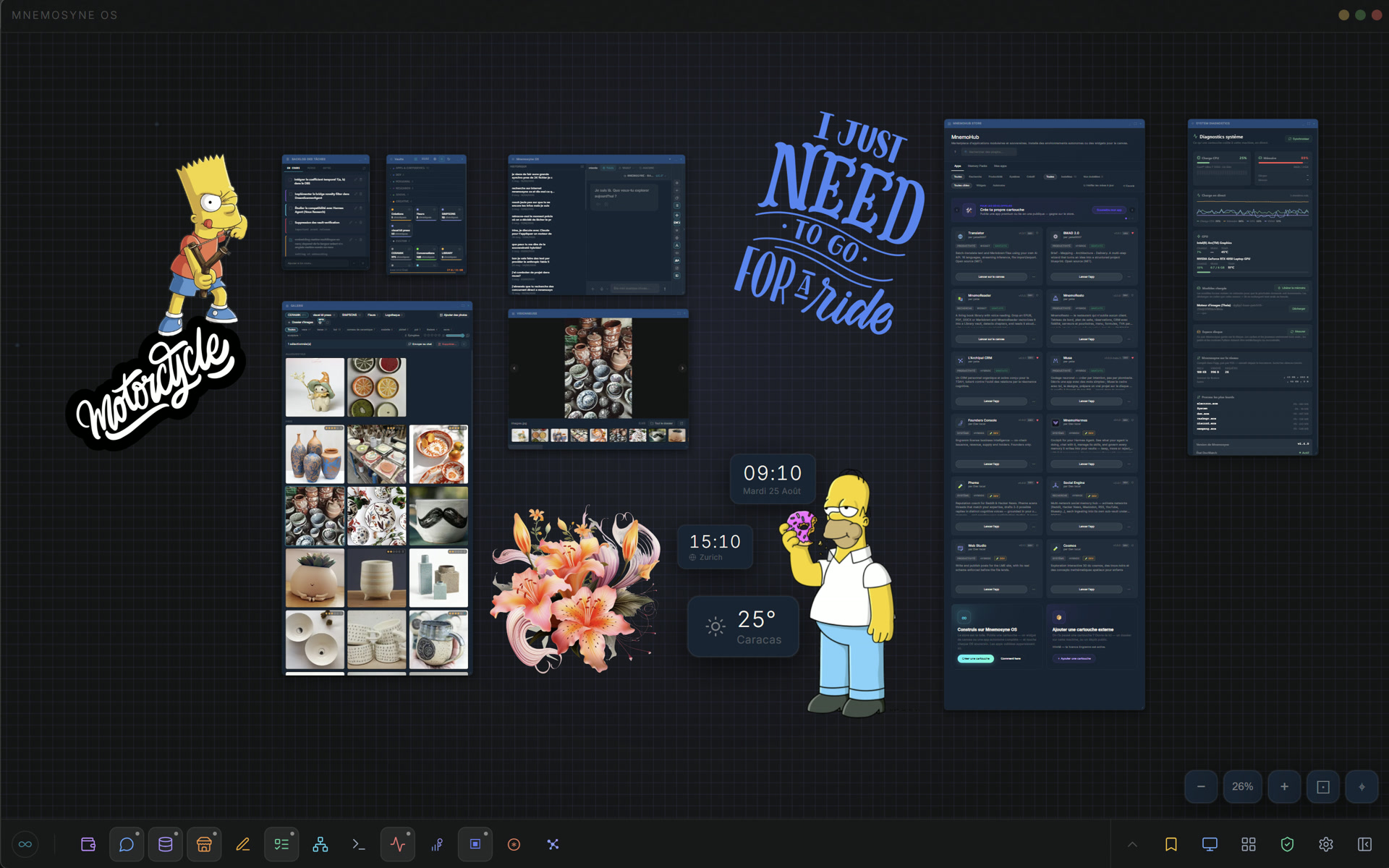
The infinite canvas (v1.4.0): pan the void, zoom 10%–100%, and make the plane yours — the image gallery, MnemoHub, diagnostics, world clocks, weather and stickers, all living on one endless surface
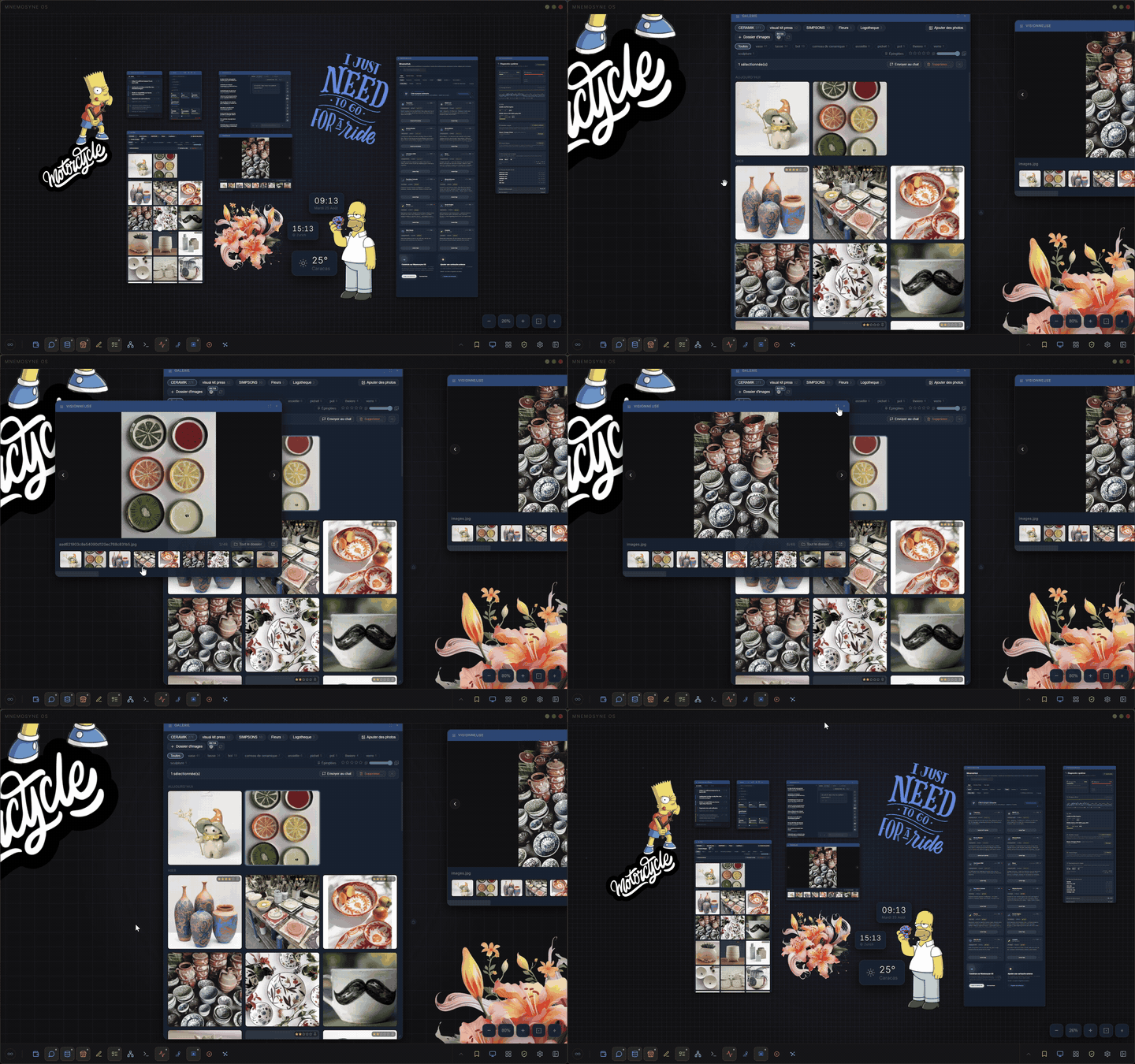
Thirteen seconds of the real thing — the canvas panned, zoomed and decorated live · watch in higher quality
Turn memory on for your images. One Settings toggle gives your vaults an eye:
drop in a folder of photos and Mnemosyne OS remembers every image you add —
indexed 100% locally, organized in a living gallery you can rate, pin and teach,
and recalled in chat: ask for "the pieces that look like a blue cup" and your own photos answer.
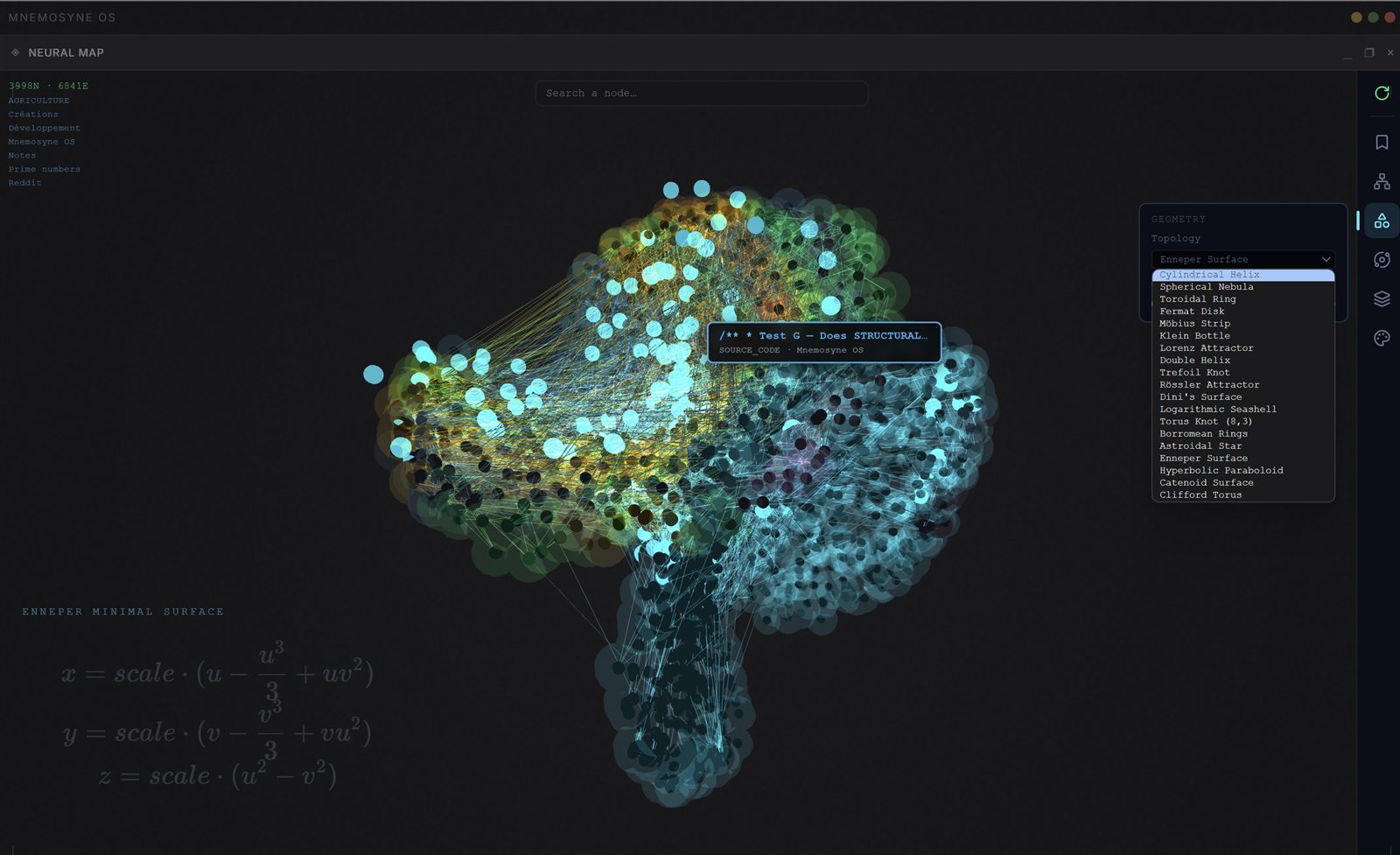
Neural Map: your vault rendered as a living mathematical topology — Enneper surface, Klein bottle, Lorenz attractor, Clifford torus… the equation is the shape
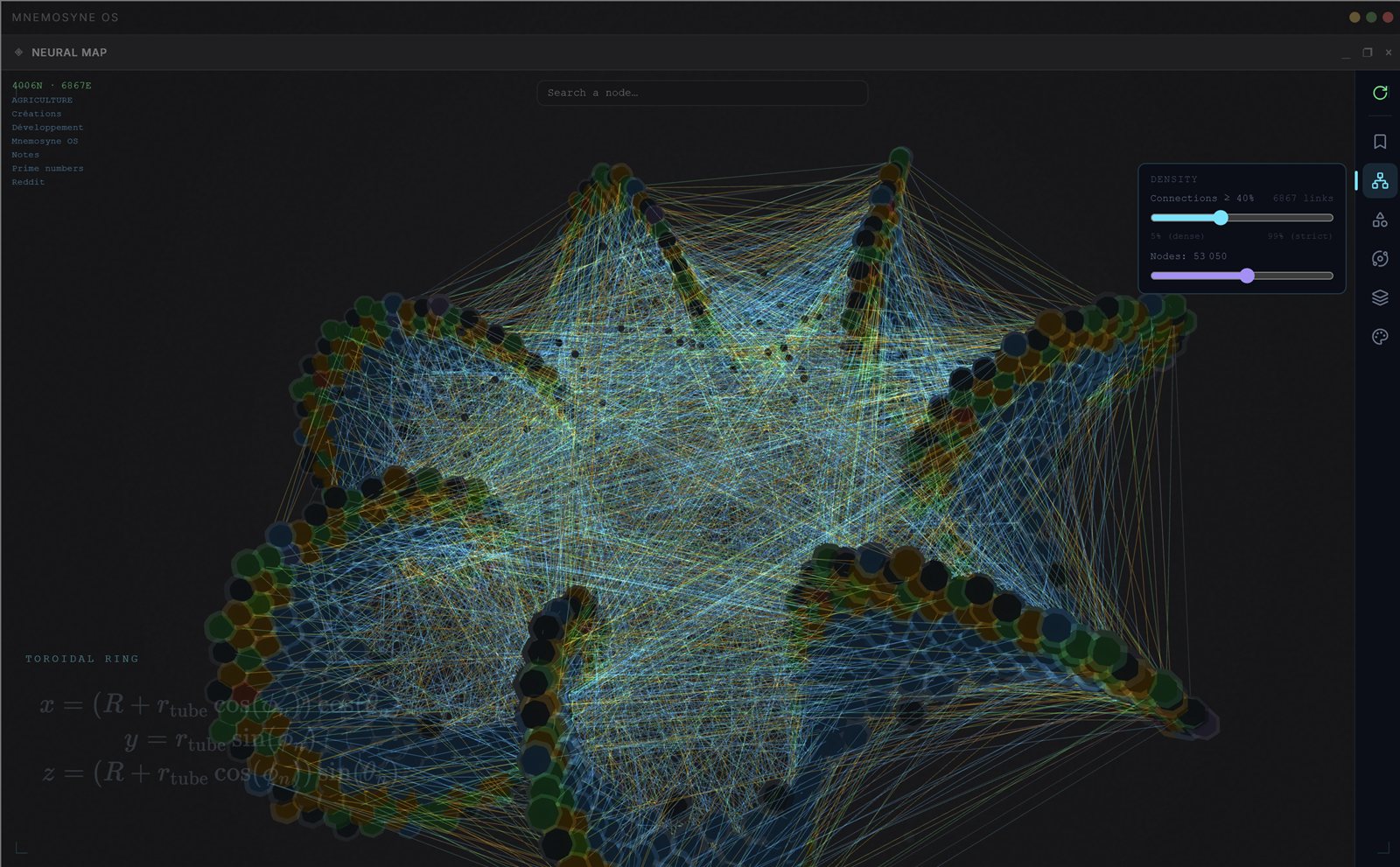
Every node is a memory, every edge a measured semantic link — here the same graph wound onto a torus, tuned live
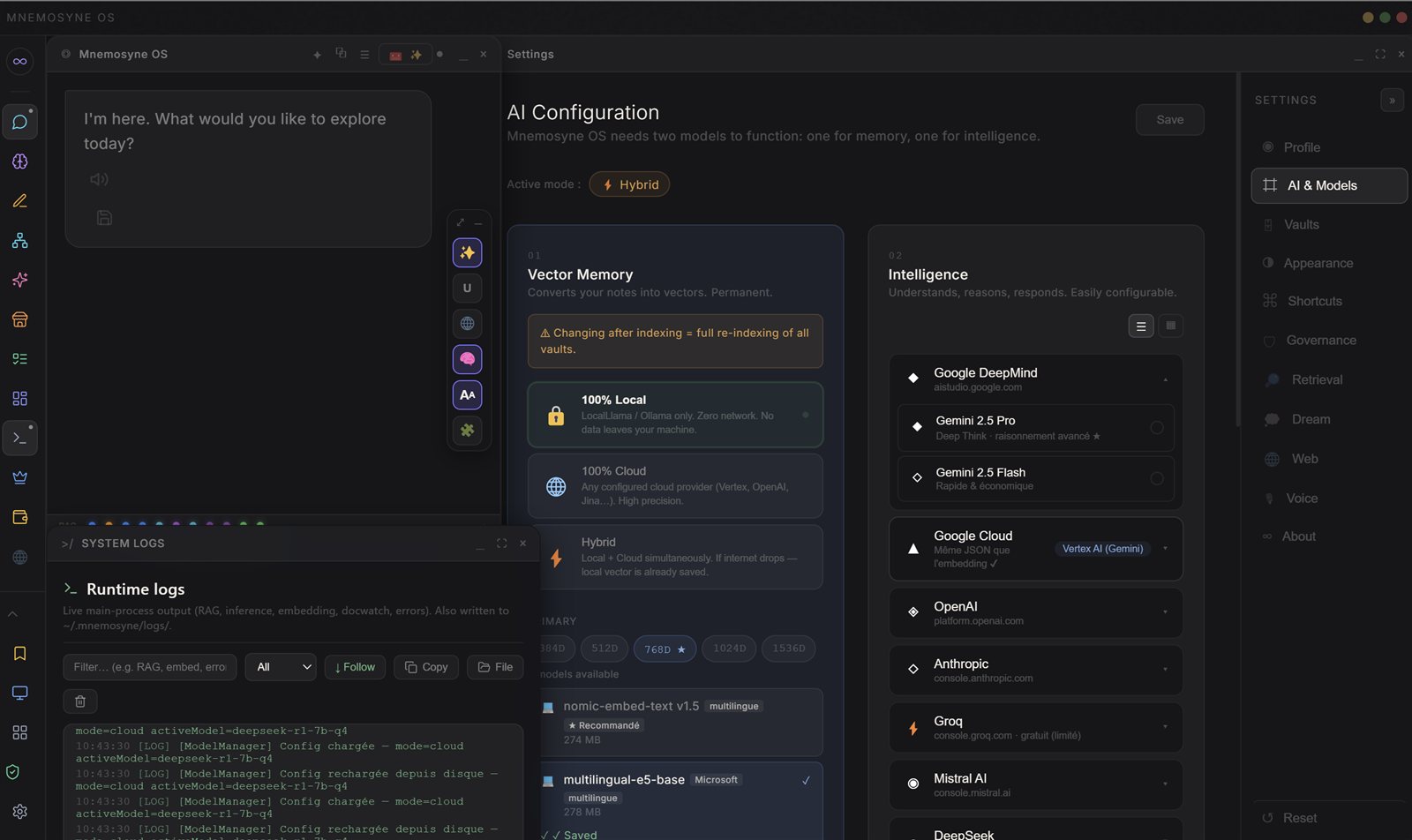
Multi-model by design: run memory 100% local, cloud, or hybrid — Gemini, Claude, OpenAI, Groq, Mistral, DeepSeek, Ollama
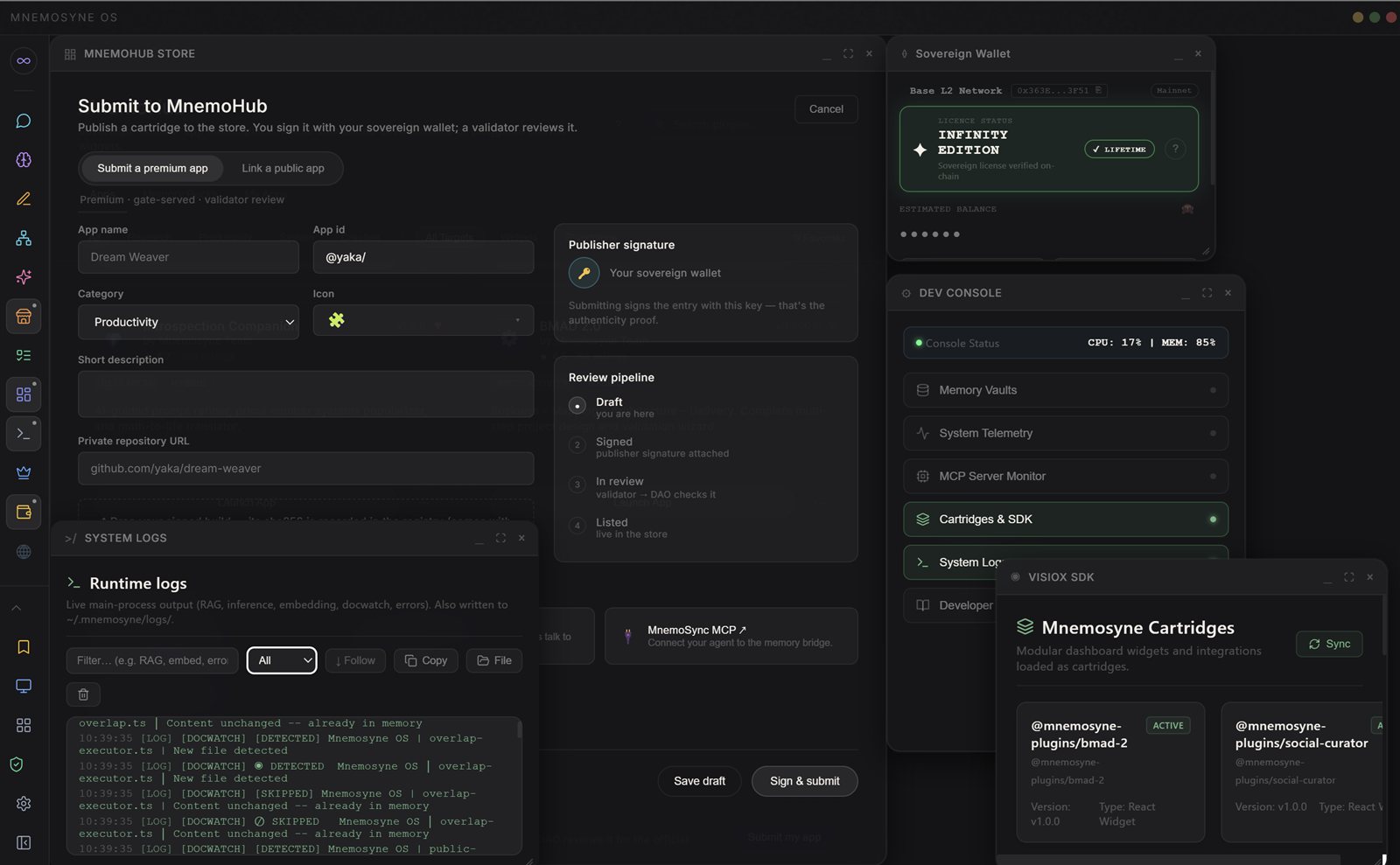
MnemoHub: build a cartridge on the SDK, sign it with your sovereign wallet, and publish it to the ecosystem
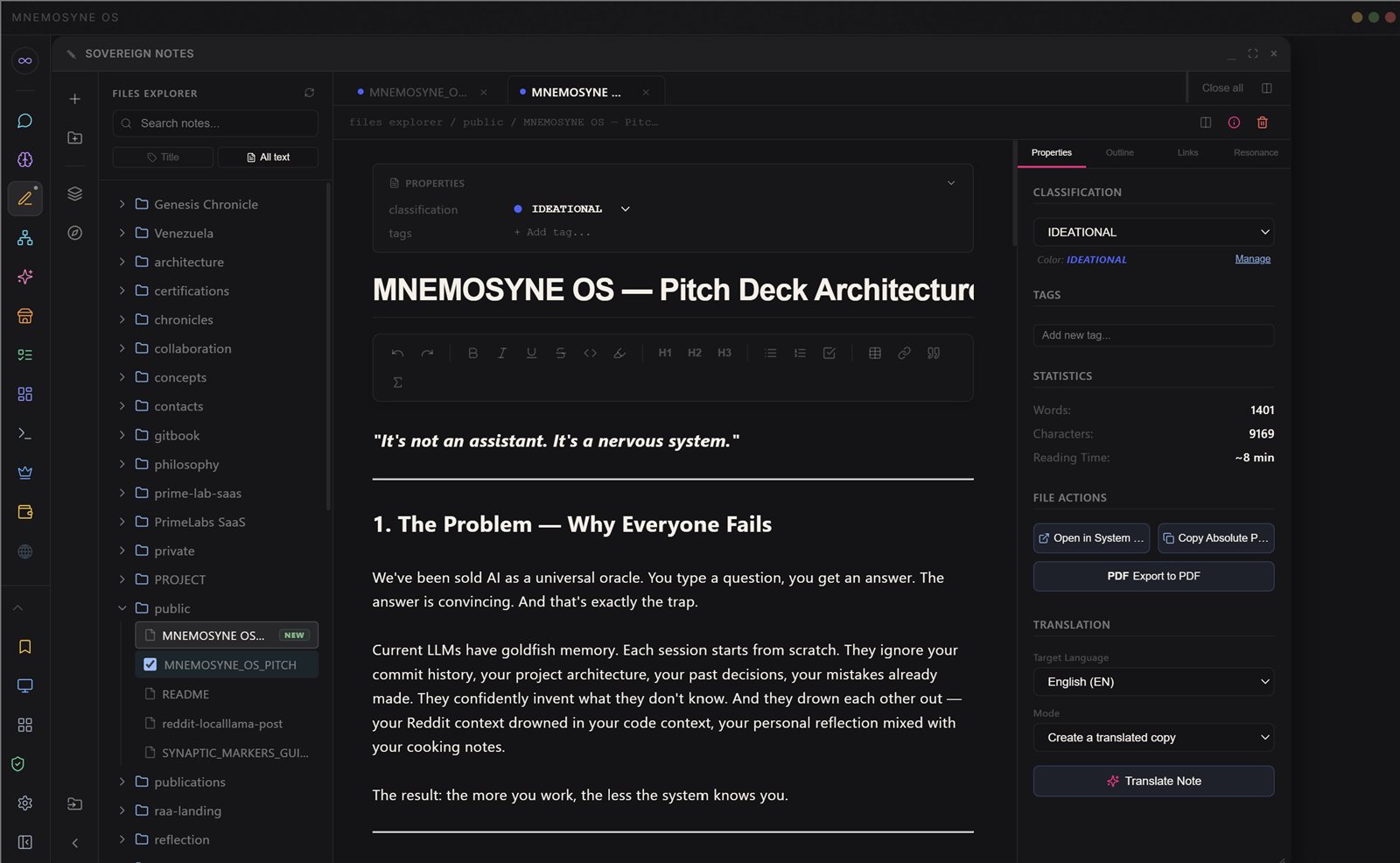
Sovereign Notes: write in a local, classified vault — every note is embedded and retrievable, feeding the same memory your agent draws on
Two doors between your IDE and your memory
You already run an agent next to your editor. It opens every session without the history of the project it is working in, so it reasons its way back to conclusions you reached weeks ago, and it will do that again tomorrow. Part of that history is not lost: the agent wrote it down itself. It is sitting in a dot-directory beside the code, usually gitignored, read by nothing.
Mnemosyne OS opens two doors onto it, and they run in opposite directions.
Door one, memory reads the agent. DocWatch watches a folder you deliberately point
at, whatever its name, so .claude/…/memory is treated like any other source and what
your agent noted becomes retrievable next to your documents and your code. Shipped in
v1.4.3: before that a blanket ignore rule dropped every dot-directory, in silence.
→ Connect your coding agent's memory
Door two, the agent reads memory. @mnemosyne_os/mcp
is a Model Context Protocol server: one entry in your client config, and the agent can
search a vault, ask it a question in prose, and write back what it worked out.
npx -y @mnemosyne_os/mcp
→ Connect Claude to Mnemosyne OS (MCP)
Three of those tools need neither the app, nor a vault, nor a single token: they read the transcripts your harness already writes to disk. That is what makes "is another session live on this branch before I commit?" cheap enough to actually ask.
The mechanism is the whole claim. We publish no measurement of what this saves in tokens or in minutes, so we assert none. Retrieval is not reasoning: a decision a model can look up is a decision it does not derive a second time, and the context it would have spent reconstructing where it is goes to the task instead. Watch it in your own sessions rather than taking a number for it.
Build on Mnemosyne OS
You've seen what it is and that it works — now build on it. Your apps, agents, and skins talk to the private AI memory runtime through a public Gateway contract: a stable, documented surface you build against, while the Cognitive Core stays sealed and never exposed.
Two ways in:
- 🛠️ Build on it — scaffold an app and you're talking to the memory vault in minutes.
- 💾 Run it — install the flagship desktop app, Infinity Edition.
npm create @mnemosyne_os/app
| Package | What it does |
|---|---|
@mnemosyne_os/sdk | Connect an app to the local AI memory runtime (WebSocket / Electron IPC) |
@mnemosyne_os/public-contracts | Shared types & Zod schemas — the integration contract |
@mnemosyne_os/design-sdk | Build custom UI skins in pure JSON — zero TypeScript |
@mnemosyne_os/create-app | Scaffold a new Mnemosyne app in one command |
Start from the cartridge boilerplate and you're ingesting and querying the vault — under FGAC, scoped, and consent-gated — in minutes.
🛡️ Zero-Trust by design. Every SDK connection authenticates with a short-lived JWT, listens on
127.0.0.1only, and is bounded by the scopes your app manifest declares. The OS sees your requests; you never see the core.
The cartridges are real — and readable
The apps in MnemoHub aren't black boxes. Each ships its actual src/ (React + the SDK),
public and inspectable — clone one as a reference implementation and read exactly how a
real app connects to the memory runtime, ingests, and queries the vault through the SDK. Don't
learn the SDK from API docs alone — download a working app and copy the patterns. A few live examples:
| Cartridge | What it is | Clone it to learn | License |
|---|---|---|---|
| MnemoArchipel | The sovereign, offline-first personal CRM | semantic relationship maps + custom node coordinates over the vault | Cartridge License · source-available |
| MnemoResto | A full restaurant suite — POS, reservations, tips, per-product VAT, inventory | structured business data persisted in scoped vaults | Cartridge License · source-available |
| BMAD 2.0 | A wizard that turns an idea into a structured project blueprint | a multi-step flow that reads and writes the vault | Cartridge License · source-available |
| MnemoReader | A living PDF library that reads aloud with word-synced highlighting | document ingestion + streaming local TTS through the SDK | MIT |
| Translator | Batch-translate text & Markdown with your own AI key | bringing your own AI key + batched runtime calls | MIT |
MIT cartridges are yours to fork and ship anywhere. The Cartridge License is source-available — read it, learn from it, modify it — with one condition: it runs inside the Mnemosyne OS ecosystem.
🧩 Make your own. Scaffold a cartridge from the boilerplate, build it against the SDK, and publish it to MnemoHub — exactly how these were made. From
npm createto a signed, installable cartridge, the whole path is yours.
The open ecosystem
The open surface of Mnemosyne OS is MIT-licensed and free to build on:
- Layer-2 SDK (
/packages) — the integration surface above: connect apps, build skins, scaffold projects, evaluate against the Gateway. - MnemoForge CLI (
/cli) — the sovereign developer tool: give any AI agent persistent memory, a behavioral identity, and an automated publish pipeline.
npm install -g @mnemosyne_os/forge
mnemoforge
| Feature | Command |
|---|---|
| 🪬 Soul Protocol — a persistent personality profile for your agent (tone, values, behavioral rules as a structured system-prompt), injected straight into your IDE | mnemoforge soul inject |
| 📋 Canvas Rules — living ruleset persisted across sessions | vault-based, auto-applied |
| 🗂️ Chronicle System — structured AI memory files | mnemoforge chronicle write |
| 🔌 MCP Server — expose vault tools to any agent | mnemoforge serve |
| 🖥️ Responsive dashboard | mnemoforge |

→ CLI Documentation · npm package · Release notes
Why it's safe to build on
The open SDK and the sealed core are separated by a single boundary: the Gateway. Apps speak a public contract; the core's internals are never shipped to, or reachable from, third-party code.
flowchart TB
    subgraph Renderer["Renderer Process (React)"]
        UI["React 18 · TypeScript strict · Vite<br/>i18next (EN/FR/ES) · 30+ lazy-loaded routes"]
    end

    subgraph Bridge["contextIsolation: true · nodeIntegration: false"]
        CB["Context Bridge<br/>400 Zod-validated IPC channels"]
    end

    subgraph Main["Main Process (Electron)"]
        SVC["Services: AI · Vault · Drive · Workspace<br/>Shadow · Window · Network · FGAC · Scheduler"]
    end

    subgraph Net["Sovereign network (127.0.0.1 only)"]
        SDKWS["SDK WebSocket"]
        MCP["MCP server"]
    end

    subgraph Chain["Base L2 — on-chain"]
        ENGRAMM["Engramm License"]
    end

    UI <--> CB
    CB <--> Main
    Main --> SDKWS
    Main --> MCP
    Main -. verify via Gateway .-> ENGRAMM

    style Main fill:#1a1a2e,stroke:#7c3aed,color:#fff
    style Renderer fill:#0f172a,stroke:#38bdf8,color:#fff
    style Chain fill:#1a1a0e,stroke:#f39c12,color:#fff
The Engramm License
Running Mnemosyne OS is unlocked by an Engramm — named after the engram, the physical trace a memory leaves in the brain. Fitting for a memory OS: it's your own verifiable trace of ownership.
Rather than an account and a monthly subscription, your license lives on-chain (Base), bound to your wallet — not to a machine, not to an email. You hold it, so you own your copy and carry it to any device you want, and anyone can verify it. The same Engramm drives your sovereign pseudonym and cloud credits. Holding it and checking it cost you nothing — see below.
Auth — cold boot / warm boot
A local wallet is the only credential. No account, no password server-side to breach.
No gas fees, no crypto to manage. The chain is plumbing, not a paywall — you never pay a network fee, hold a token, or approve a transaction. Ownership is recorded on Base so it stays publicly verifiable, but every network cost is covered for you. A wallet you never have to think about.
sequenceDiagram
    participant U as "You"
    participant W as "Sovereign wallet (local)"
    participant G as "Gateway"
    participant C as "Base L2 (chain)"
    participant T as "OS keystore"

    Note over U,T: Cold boot (first launch / new machine)
    U->>W: launch the app
    W->>G: signed challenge
    G->>C: verify Engramm on-chain
    C-->>G: does this wallet hold the license?
    G-->>W: signed verdict

    Note over U,T: Arming encryption at rest — separate, and up to you
    U->>W: turn on encryption at rest
    W-->>U: 24-word recovery phrase — confirm it
    U->>W: confirmed
    W->>T: seal the AES-256 key

    Note over U,T: Every launch after
    W->>T: read the sealed key
    T-->>W: key → vaults open encrypted

    Note over W,T: Once armed, physical theft = encrypted SQLite.<br/>Until armed, vaults are local but in cleartext.
Security-first Electron architecture
contextIsolation: true,nodeIntegration: falseon every windowsandbox: truefor web content — relaxed only for the local-AI worker threads, mitigated by context isolation + Zod-validated IPC- Explicitly declared IPC methods via Context Bridge, validated with Zod + audit logging
- Strict Content Security Policy
- Windows builds code-signed (Certum OV, RFC-3161 timestamped); every release binary carries a Sigstore build-provenance attestation tying it to the exact CI run and commit that produced it
Sovereignty enforced in code
- FGAC governs exactly what an agent — or a third-party app — can read, write, or sync
- 24h TTL on access grants, auto-healing on refresh
- P2P Shadow Sync with alert system and OS notifications
- No telemetry without consent
Stack
- Runtime: Electron 31, Node.js 22
- Frontend: React 18, TypeScript (strict mode), Vite
- State: Zustand with
useShallowatomic selectors - AI Integration: Claude API, Ollama (local LLMs), OpenAI-compatible endpoints
- Testing: Vitest + Testing Library — green CI gate
- CI/CD: GitHub Actions — typecheck + lint + i18n validation + tests
Open-core & Licensing
Mnemosyne OS follows an open-core model: an open, MIT-licensed developer ecosystem built around a proprietary core.
| Component | License | Description |
|---|---|---|
Developer SDK (/packages/*) | MIT | Open — build apps, agents & skins on Mnemosyne OS |
MnemoForge CLI (/cli) | MIT | Open source — free to use, modify, and redistribute |
| Mnemosyne Neural OS (platform) | Proprietary | © 2026 XPACEGEMS LLC — All rights reserved |
The SDK and MnemoForge CLI are MIT licensed — fork them, build on them, ship your own apps. The Mnemosyne Neural OS platform — the desktop application, Neural Map, MnemoHub, Dream State, Vaults, and associated services — is proprietary software. No part of the platform may be copied, modified, or distributed without explicit written permission from XPACEGEMS LLC.
End-user licensing is separate from the code license above. Running Mnemosyne OS is unlocked per user by the Engramm — an on-chain license bound to your wallet, not a subscription — while the SDK and CLI you build with stay MIT.
Why the core is closed. Everything you need to build is open; what stays sealed is the part that took years of full-time R&D to get right — the memory engines (Spine, Retrieval, Dream State) behind the LongMemEval numbers above. Keeping that core proprietary is what lets an independent lab sustain the project, fund the open ecosystem around it, and grow a team — instead of handing a hard-won engine to anyone who would re-skin it. The trade is deliberate: everything above the Gateway is yours to fork; the engine that makes it worth building on stays ours.
For licensing inquiries: dev@mnemosyne-os.com
Quality
TypeScript errors     : 0   (strict mode, noUncheckedIndexedAccess)
ESLint warnings       : 0
Test suite            : Vitest + Testing Library (green CI)
CI pipeline           : ✅ Green (typecheck → lint → i18n → tests)
Languages             : 3 (EN / FR / ES)
i18n namespaces       : 47
Electron security     : context isolation · Zod-validated IPC · CSP
Development Philosophy
Mnemosyne is built on three principles:
1. Sovereignty — Your data stays local. Your models run locally if you choose. No telemetry without consent. FGAC controls what the AI can and cannot access.
2. Multi-model — No vendor lock-in. Claude, GPT, Gemini, Groq, Mistral, DeepSeek, and MiniMax in the cloud; Ollama or a local GGUF model fully offline; any OpenAI-compatible endpoint on top — switch per task, or let the app route automatically.
3. Agentic by design — Not a chat interface with file upload. A real orchestration layer where multiple AI agents coordinate, with policy enforcement and audit trails.
🔬 Mnemosyne Labs — research, activated
The numbers above are not marketing copy — they are published, citable research artifacts. Mnemosyne Labs is the research arm of the project: methodology in the open, benchmarks anyone can audit, artifacts archived with a DOI.
| Artifact | DOI |
|---|---|
| 📄 The Resonance Engine — technical whitepaper v2.1: the architecture behind the engines, consolidation, adaptive selection, the hybrid lexical channel, and the LongMemEval results |  |
| 🔍 LongMemEval-M audit kit — the scorer, per-question verdicts and honest methodology, packaged so you can audit the claims yourself. This DOI pins the July deposit (the 72.9% campaign); the live kit also recomputes the August one |  |
Both records are open access (CC BY 4.0), cite each other on Zenodo, and are bound to the founder's research identity — ORCID 0009-0009-1087-3917.
→ Mnemosyne Labs · → How to cite this work · → Live audit page
Roadmap
Shipped
- 🚀 Infinity Edition — 20 public releases, now at v1.4.4 · The Whole Document
- 🖼️ Theia — image memory & visual recall — Mnemosyne's sister engine (named for the Titaness of sight) gives every vault an eye: your images are embedded locally (SigLIP 2, no cloud, no API), recall answers with thumbnails under the reply, and a living gallery shows them with categories the engine discovers on its own — categories you can rate, correct, rename or teach, because the human's word always outranks the model's guess. Off by default; one Settings toggle installs, downloads pinned weights and indexes.
- 🧩 MnemoHub — signed cartridge marketplace, community submission pipeline, live publishing
- 🪪 Sovereign identity — claim a public pseudonym bound to your wallet, no account, no password
- 💤 Dream State — a consolidation engine that replays and links your memories while you're away
- 🗜️ Octave — multi-resolution memory compression — the engine behind the compression milestone, aboard since v1.3.8: while you're away, consolidation prepares each memory at several resolutions, so the answer path can carry more memory into a small context window. Strictly extractive — every compressed line is a verbatim excerpt of the original, provable by character offsets, never a paraphrase — and compressed derivatives inherit the exact vault protection of their source. Serving them on the answer path stays off by default until the full benchmark campaign clears it.
- ⚡ MnemoForge CLI v1.4.7 on npm —
@mnemosyne_os/forge· Soul Protocol · Canvas Rules · Chronicle System · MCP Server - 🌱 Public beta — v1.1.0-beta.1 — where it started (personality-profile builder, semantic memory graph, first-contact onboarding)
What's next
- 🗜️ Context compression, on by default — the Octave engine is already aboard (see Shipped): while your machine is idle, every memory is prepared at several resolutions — strictly extractive, offset-provable, never a paraphrase. What remains is serving those compressed forms on the answer path for everyone, gated behind the full measurement campaign, so a lifetime of accumulated memory stays cheap to carry into the small context windows of on-device models. Memory that keeps growing must stay cheap to carry — this is what keeps Mnemosyne sovereign on modest hardware.
- 📱 Mobile companion app — take notes and reach Mnemosyne OS running on your desktop remotely: capture on the go, sync back into your local vault, chat with your own memory away from the machine
- 🔗 Synaptic P2P — a sovereign libp2p mesh (
mnemosync-p2p) so your Mnemosyne can reach a trusted peer's directly: no cloud relay, no VPS, no account. Built for teams who want to share a deliberate slice of memory (an architecture decision, an API contract, a chronicle) without exposing the rest — and, eventually, direct messages between instances. Authentication reuses your existing sovereign wallet; nothing leaves your vault unless you explicitly publish it. - 👥 Team features — shared vaults, multi-agent coordination
- 🖥️ Self-hosted sync server
- 🕸️ Permaweb archival — pay-once, permanent memory storage on Arweave, no subscription and no server that can disappear. Psyche (souls for any AI agent) is the vehicle; bringing it into Mnemosyne OS as a cartridge is the path to making permanent archival a native option for chronicles, and eventually vault backups
- 💰 Creator economy — paid visibility for cartridges, revenue flowing back to builders
About
XPACEGEMS LLC — Independent AI software lab
Headquarters: 2932 NW 72 AVE, Miami, FL 33122, USA
Founder & Lead Architect: Tony Trochet
Product: mnemosyne-os.io — downloads, docs, build on it
Company: mnemosyne-os.com — press, research, Labs
Documentation: docs.mnemosyne-os.io — every engine, step by step
LinkedIn: Tony Trochet
GitHub: @yaka0007
Built through Neural Coding — human-architected, with Claude (Anthropic), Antigravity (Google DeepMind), and Cursor directed as instruments.
📰 What's new
A new build ships most weeks. Windows builds are code-signed (Certum OV, RFC-3161 timestamped) and auto-update once installed.
| Date | Release | In one line |
|---|---|---|
| Sep 3, 2026 | v1.4.4 · The Whole Document | For anyone who drops real documents into a vault: a long document now enters memory whole. It was cut at 18 000 characters, so a 300-page book was remembered as its first six pages. A file refused outright said nothing at all, and two 150-page courses had been turned away in complete silence; a refusal now names the file, its size and the rule it broke. PDF, Word and Excel go from 5 MB to 50 MB. For a company: point Mnemosyne at your own OpenAI-compatible model server on your own network, and the route is yours end to end. The chat reads several vaults at once, follows the vault you picked in the panel, or lets the model choose per question. Ask Mnemosyne about Mnemosyne: a manual ships inside the app in French, English and Spanish, and says plainly when it has no page on your subject. The capture browser is rebuilt for the web: every image of a page in one click, or the page as text, as a PDF, as a screenshot, all reviewed before any of it becomes memory. Plus a problem report from any window that shows you what gets sent before you send it, images pasted inside a .docx kept and indexed, and a boot that stopped rebuilding the neural map eleven times per launch. |
| Aug 31, 2026 | v1.4.3 · What Your Agent Knows | For anyone who codes with an AI agent open beside them: your agent's memory can finally enter a vault. Every agent keeps what it learned under a dot-directory (.claude, .cursor, .aider, .continue), and a blanket ignore rule dropped all of them whole, in silence: the source read enabled, the panel showed a green dot, the log said the watch had attached, and not one file was ever ingested. A folder you deliberately point at is now watched, whatever its name. Searching through the MCP also gains the exact-word channel the app's own retrieval already had. Plus the work that piled up behind the 1.4.2 cut: desktops on the canvas (a desktop is a world, with its own windows, camera and decor), a to-do rework with lists of your own, an archive that is not a delete, drag to reorder, and tasks that leave the list to sit on the canvas and ring; notes that open in a window of their own; vaults readable from across the board; and a vault's weight that says who answers without ever stopping it from recording. |
| Aug 29, 2026 | v1.4.2 · The Clean Cut | Cut a subject out of any image on your own machine: right-click it on the canvas, and put the background back in one click — the original file is never touched. Two permissively-licensed models, the choice yours in Settings. Image memory can now use an NVIDIA GPU, and nothing is marked upgraded without proof it booted on one. A new room for making pictures: several plans open at once, your own images as a brand kit a generation must honour, and a prompt Mnemosyne writes out of your own memory. Oikos reads the devices in your house and keeps a still of them where your memory can find it a year later — one approved device at a time, addresses you declare, polling that stops the moment you withdraw consent. And the canvas travels: opening a window flies to it, with a way back from every trip. |
| Aug 26, 2026 | v1.4.1 · The Closed Pipe | Linux fix: launching the AppImage from a terminal that was later closed broke standard output, and every log line then raised a fatal error dialog — one per line. The log bus now detects the closed pipe and keeps the ring buffer and the daily file, which is the path packaged builds actually use. Also, a scanned book is read whole: OCR reads a document in page windows instead of stopping at 60 pages, and says which page it is on. |
| Aug 25, 2026 | v1.4.0 · The Infinite Vision | Mnemosyne learns to see: Theia, a fully local image-memory engine (SigLIP 2, on-device), makes your photos recallable in chat — ask for "the pieces that look like a blue cup" and the thumbnails answer — with a living gallery (day timeline, stars, pins, and categories the engine discovers and you can correct or teach). The workspace unlocks into an infinite canvas you pan, zoom and decorate with clocks, weather and stickers; paste or drop an image anywhere and a vault picker turns it into memory; a sandboxed capture browser (beta) brings the web in — one human gesture per capture, never automatic. Plus: local models fixed on fresh installs, gapless local read-aloud, and a notes rework with a constellation view and five-colour highlights. |
| Aug 18, 2026 | v1.3.8 · The Second Channel | Retrieval gains a second, fully local channel: your vault is now also ranked by exact words (BM25 over a persistent index built inside the vault) and fused with the semantic ranking by rank — a proper noun, an identifier or a number now finds its session. Measured on LongMemEval full-haystack, strict judge: 29 → 37 of 48, reproduced twice, confirmed on held-out questions with zero regressions. Plus per-app isolation proven on every retrieval channel, and an installer with a proper trilingual EULA that launches the app when it's done. Also aboard: Octave, a multi-resolution memory-compression engine — strictly extractive, off by default on the answer path until measured. |
| Aug 10, 2026 | v1.3.7 · The Kept Promise | The whole loop runs on your machine — model, memory and retrieval, with no key and no account. A refreshed local catalogue with 262k-token context windows (the entry-level model shipped with 4k), your own .gguf files welcome, bring-your-own-key providers that hand you their real model list, a local journal of what every call costs at your prices — and vault protection the routing now honours end to end. |
| Aug 3, 2026 | v1.3.6 · The Persona | The OS takes your shape: four new shell languages (Deutsch, Português, Русский, 中文), abstract voice-orb skins with a full-screen mode, a user-chosen accent that cartridges inherit live, a sixteen-archetype cognitive lens that styles the voice without ever touching retrieval — and web search rebuilt. |
| Jul 29, 2026 | v1.3.5 · The Sealed Vault | Opt-in AES-256 encryption at rest with a 24-word recovery phrase, backups decided by an allow-list of what is genuinely yours, and ~10 GB of machine-bound toolchain moved out of the data folder. |
| Jul 22, 2026 | v1.3.4 | The first code-signed Windows build — no more "unknown publisher". |
| Jul 20, 2026 | v1.3.3 · The Sovereign Ledger | The credit economy: in-app credit and license flow, a creator cockpit for cartridge builders, sovereign pseudonyms backed by a real install counter. |
| Jul 19, 2026 | v1.3.0 · The Memory Covenant | The sealed core, app-sandbox vaults with human-gated permanence, and memory-purge governance. |
| Jul 7, 2026 | v1.2.0 · The Reading Engine | A PDF library that reads to you — deferred local OCR, voice reading, and the spine memory engine underneath. |
✍️ From the blog
The longer stories behind the releases and the campaigns, on the product site:
- A multiplier cannot rescue a zero — dense embeddings can't hear a rare proper noun. What worked: a second, fully local ranking fused by rank — with two reproduced runs, a 48-question holdout, and every number auditable.
- 72.9% — and the three questions we miss — LongMemEval on the full-haystack variant, the one nobody shows: the number, the protocol, the levers we refuted, and the misses we own.
- We gave personality control of memory. It cost 31 points. — the most seductive feature we built this year made retrieval measurably worse; the ablation, and why personality shipped as a costume.
- Present is not the same as loadable — a package can be there, at the right version, and still be unreachable to the code that imports it.
- The memory my brain kept asking for — why this OS exists: not a product, a prosthesis for a brain that ran too fast for the world. (original in French)
Memory decides who an agent stays between sessions — not whatever model happens to be running.

