Listed from the MCP registry; nobody on Odel publishes it.

Lexaudit
Locale vocabulary audit (calques, inventeds, foreign slips). Local CLI via stdio — no hosted API.
Runs on your machine from its package; the steps are below.
What it does
- Reads
- Writes
- High impact
At most: only reads or looks up information.
What it costs
FreeOdel charges nothing per call. The publisher may charge for its own service.
Runs locally over stdio
This server isn't hosted — your MCP client launches it from a package registry. Use one of the commands below, or drop the config into your client (e.g. Claude Desktop).
Run
uvx lexaudit
MCP client config
{
  "mcpServers": {
    "lexaudit": {
      "command": "uvx",
      "args": [
        "lexaudit"
      ]
    }
  }
}Finds odd, wrong or copied-from-another-language words in your texts, and tells you which pages to fix first.
In plain words
You write or translate articles, courses or documentation. A normal spellchecker shouts about every brand name, abbreviation and long German word, and still misses the words that really hurt: a word copied from another language ("calque"), a real word used with the wrong meaning ("false friend"), or a word someone invented.
lexaudit reads your files, ignores the harmless things, and gives you a short ranked list: "look at this page first." It runs on an ordinary laptop in about a second. No graphics card, no internet, no account.
It only reports. It never changes your texts.
Unknown terms? See the glossary.
0.3.0 prep and publish path: docs/p1-INDEX.md.
- Languages: English (
en), German (de), Spanish (es), Polish (pl), Russian (ru), Swedish (sv), Ukrainian (uk) - Hardware: CPU only
- Author: Vadim Nareyko (github.com/nareyko, Founder at Arviser Sp. z o.o.)
- License: dual MIT package and AGPL-3.0-or-later hosted SaaS (details)
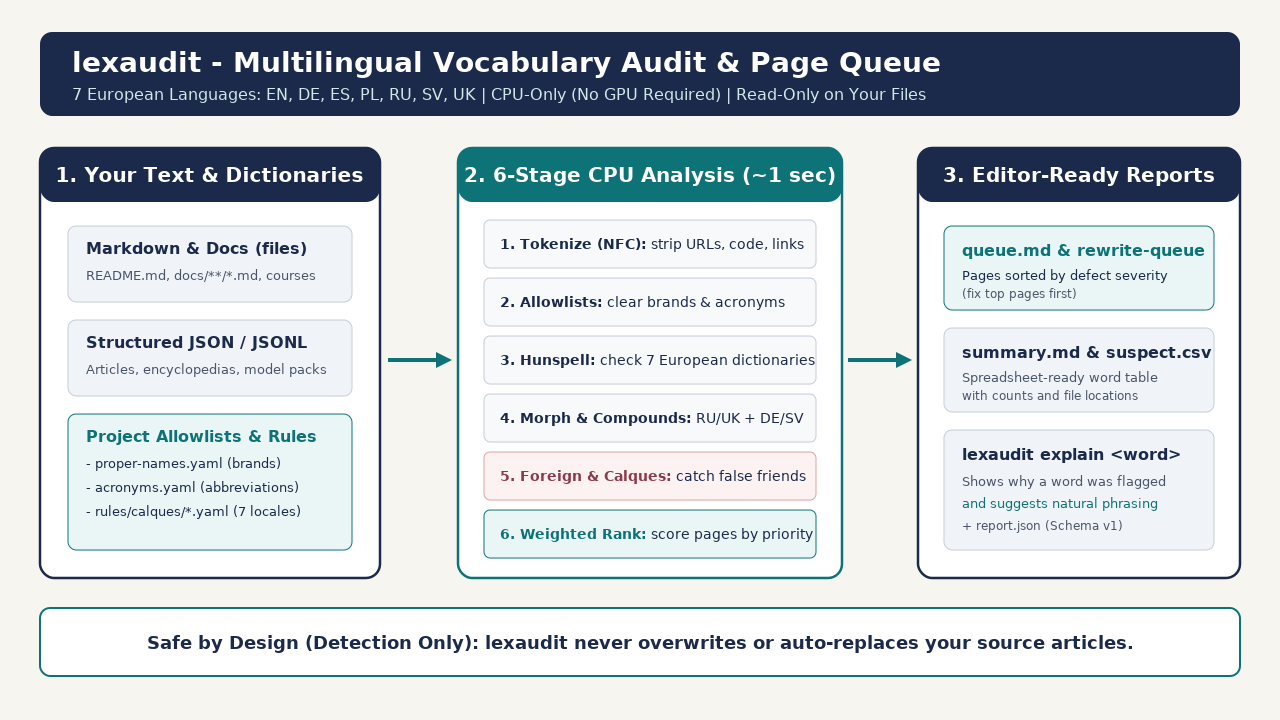
Try it in 30 seconds
pipx run lexaudit audit --path . --locale en --check
# or: uvx lexaudit audit --path . --locale en --check
Missing spelling dictionaries download automatically into your user cache. No GPU. No config file required. Exit code 1 means confirmed calques or invented words remain.
Optional helpers: lexaudit doctor, lexaudit fetch-dicts, lexaudit init.
Check a file or a whole project
# One file or folder, no settings file needed
uv run lexaudit audit --path ./README.md --locale en

# Or create starter settings first, then check everything
uv run lexaudit init
uv run lexaudit audit --locale en
Open the report
The reports are in the output folder, one subfolder per language. Start with queue.md:
| score | unique_suspects | path | top_words |
|---|---|---|---|
| 12.0 | 2 | docs/en/en-04-defect-known-calques.md | orientir surveyness |
| 6.0 | 1 | docs/en/en-05-defect-false-friend.md | denseness |
| 1.6 | 2 | docs/en/en-03-clean-unseen-jargon.md | vinylester haulout |
A higher score means "look here first". top_words shows the words behind the score.
Ask why a word was flagged
uv run lexaudit explain orientir --locale en
word: orientir (normalized: orientir, locale: en)
status: calque (tier: confirmed)
reason: loan-calque-orientir | detectors: calque, hunspell
editorial hint: working rule / ballpark / figures - not orientir
Reproduce our test results
uv run lexaudit audit --config examples/synthetic-demo/lexaudit.config.yaml
Then open tmp/synthetic-demo-out/<language>/queue.md.
How good is it? An honest answer
We built a 42-page test set in all 7 languages: 21 clean technical pages and 21 pages with planted problems. Some problems are known to the rules, some are brand new words the rules have never seen. Details: docs/synthetic-benchmark.md.
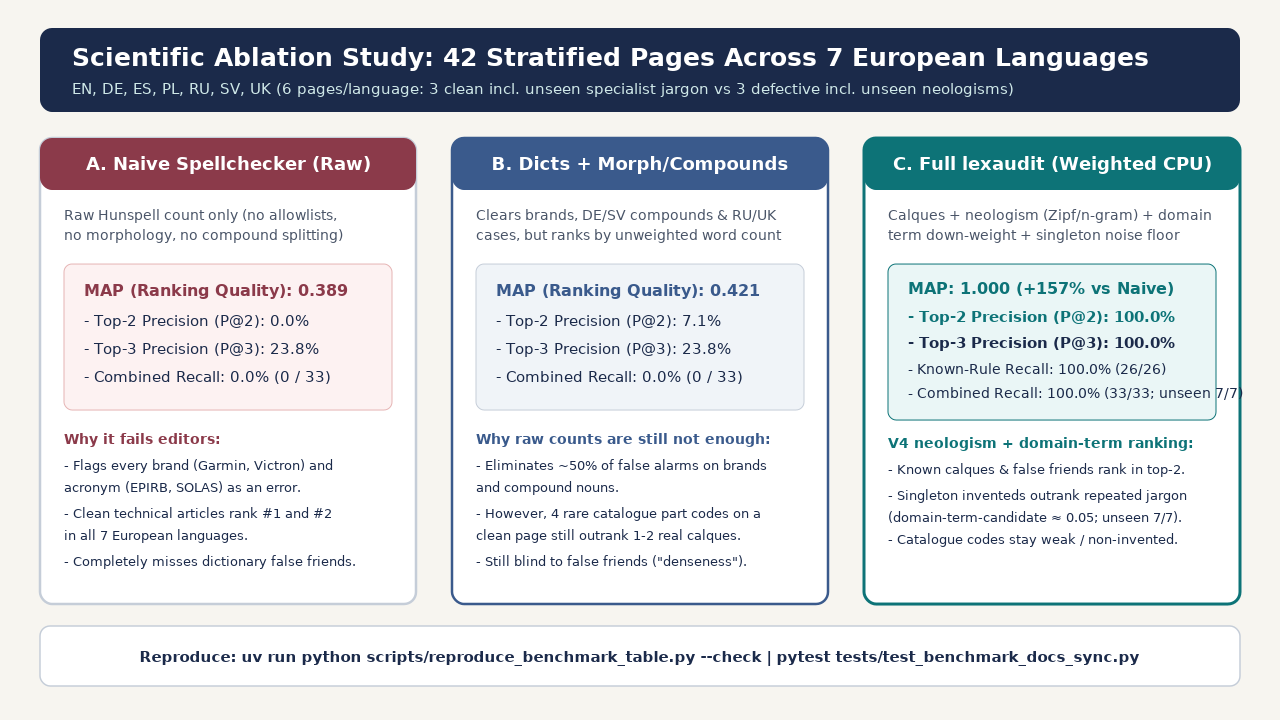
| Setup | Bad page in top 2 | Bad page in top 3 | Recall@2 | Recall@3 | MAP (0 to 1, higher is better) | Known problems found | Brand-new neologisms found | Combined planted problems | Clean-page FP / 1k tokens | Time |
|---|---|---|---|---|---|---|---|---|---|---|
| A. Plain spellchecker | 0.0% | 23.8% | 0.0% | 23.8% | 0.389 | 0.0% (0/26) | 0.0% (0/7) | 0.0% (0/33) | 81.2 | 0.48 s |
| B. Plus your word lists | 7.1% | 23.8% | 4.8% | 23.8% | 0.421 | 0.0% (0/26) | 0.0% (0/7) | 0.0% (0/33) | 47.1 | 0.56 s |
| C. Full lexaudit | 100.0% | 100.0% | 66.7% | 100.0% | 1.000 | 100.0% (26/26) | 100.0% (7/7) | 100.0% (33/33) | 47.1 | 2.97 s |
What this means:
- Pages with known problems come first in every language. The plain spellchecker puts clean pages first.
- Known-rule problems: 100.0% (26/26). Unseen single-occurrence neologisms (Zipf + char n-gram / affix-glue): 100.0% (7/7). Combined planted problems (honest fraction): 100.0% (33/33).
- With exactly 3 defective pages per locale,
Recall@2is 66.7% when the top-2 slots are both bad (Precision@2= 100.0%).Precision@3/Recall@3are 100.0% (singleton inventeds outrank repeated domain jargon). - Clean-page false positives: 47.1 unique flagged words per 1000 tokens (36 unique FP / 764 tokens).
- Domain terms that recur on a page (or sit in H1/title) are tagged
domain-term-candidate, nearly zero-weighted in ranking, and listed under Suggested glossary additions.
Documentation
Start with docs/README.md.
| Guide | What you learn |
|---|---|
| Glossary | Every term in plain words |
| Benchmark | The 42-page test, step by step |
| Architecture | What goes in, what comes out |
| Pipeline | The gates every word passes |
| CLI reference | All commands |
| Agent workflow | From report to fixed page |
| Scores and metrics | How pages are scored |
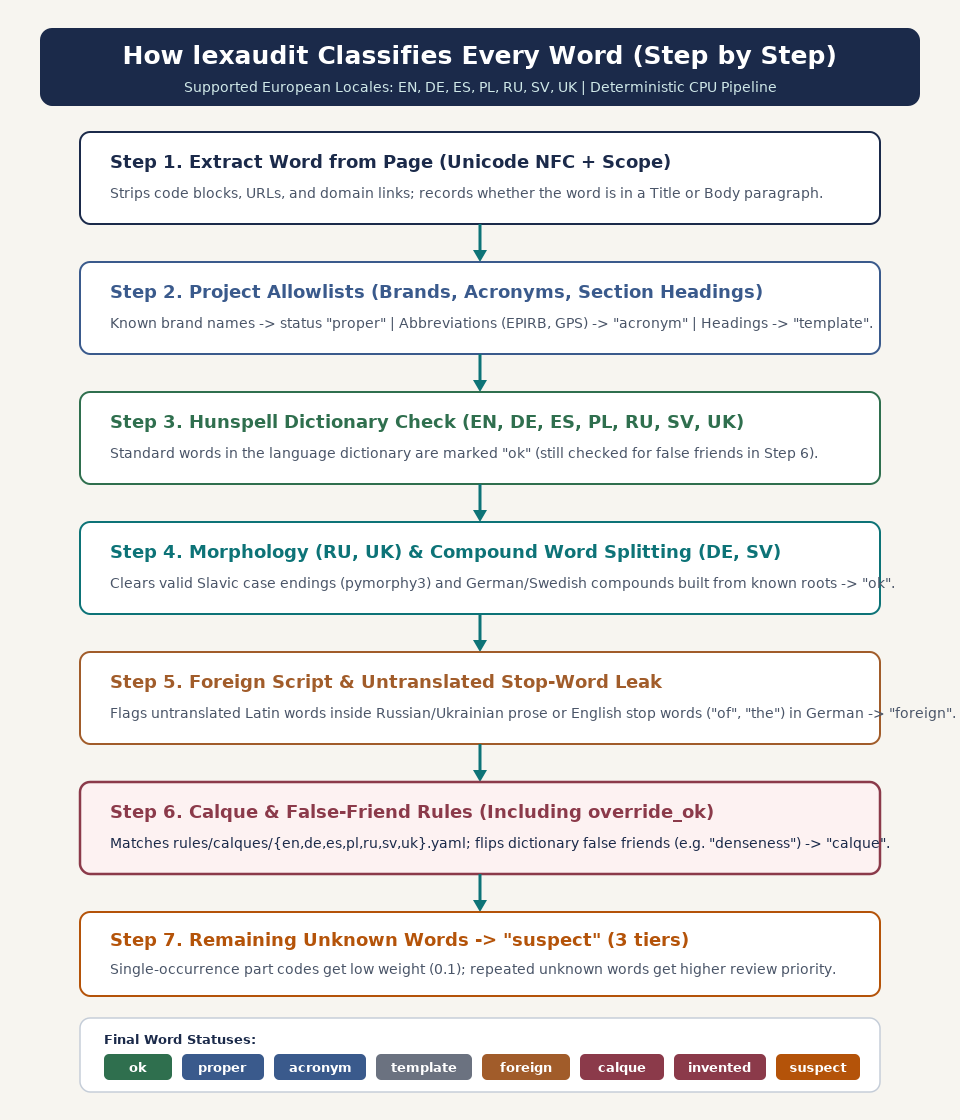
More commands
# Re-rank pages, filter by source (docs, academy, model_pack)
uv run lexaudit rank --locale ru --mode weighted --sources=docs

# Add every page that contains a known bad word to your to-do list
uv run lexaudit expand-needle --needle orientir --locale all \
  --write-queue /abs/path/to/rewrite-queue.md

# Optional: ask a language model for a second opinion (your own endpoint)
uv run lexaudit label --locale ru --top-pages 20 --top-words 50 --tiers likely,weak --profile cpu

# Compare two runs
uv run lexaudit diff --baseline .../report.json --current .../report.json --out /tmp/diff.json
For contributors
Setup and checks:
uv sync --extra dev
uv run ruff check . && uv run ruff format --check .
uv run mypy --strict src/
uv run pytest
uv run python scripts/crap_report.py
uv run mutmut run && uv run python scripts/check_mutation_score.py --min-percent 80
uv build
Test layers: unit and integration tests (branch coverage 80% or more), the 7-language benchmark, property-based fuzzing (Hypothesis), golden regression with a read-only check of your files, JSON Schema contract, complexity gate (CRAP), mutation testing (kill rate 80% or more).
Pictures in docs/images are generated from code: run python scripts/render_diagrams.py (needs Inkscape and Pillow). Never edit the JPG files by hand.
License
| What | License |
|---|---|
| PyPI / this repo’s code (CLI, library, YAML rules, packs) | MIT — use in products and private SaaS is fine under MIT |
| Intended future hosted multi-tenant network service (not shipped here) | Policy text: AGPL-3.0-or-later — not a second license on the MIT wheel |
| Benchmark corpora & fetched spelling dictionaries | LICENSE-THIRD-PARTY.md + upstream *.license.txt |
Full wording: docs/licensing.md. Adding rules: docs/contributing-rules.md.
Origin and author
Created and maintained by Vadim Nareyko (github.com/nareyko). It grew out of auditing multilingual courses and encyclopedias at FairHelm.