Listed from the MCP registry; nobody on Odel publishes it.

Agent Roast
Offline, read-only review that flags agent changes weakening tests, assertions, coverage or CI.
Runs on your machine from its package; the steps are below.
What it does
- Reads
- Writes
- High impact
At most: only reads or looks up information.
What it costs
FreeOdel charges nothing per call. The publisher may charge for its own service.
Runs locally over stdio
This server isn't hosted — your MCP client launches it from a package registry. Use one of the commands below, or drop the config into your client (e.g. Claude Desktop).
Run
npx -y agent-roast
MCP client config
{
  "mcpServers": {
    "agent-roast": {
      "command": "npx",
      "args": [
        "-y",
        "agent-roast"
      ]
    }
  }
}



agent-roast catches the changes that turn a red build green by weakening the checks instead of fixing the code: a loosened assertion, a skipped or deleted test, a lowered coverage threshold, a CI step allowed to fail. A linter cannot see these, because every new line looks fine on its own. agent-roast compares the before and after of each change, as an agent hook, a Git hook and a pull request check. It is deterministic and offline: no model, no tokens, no network.
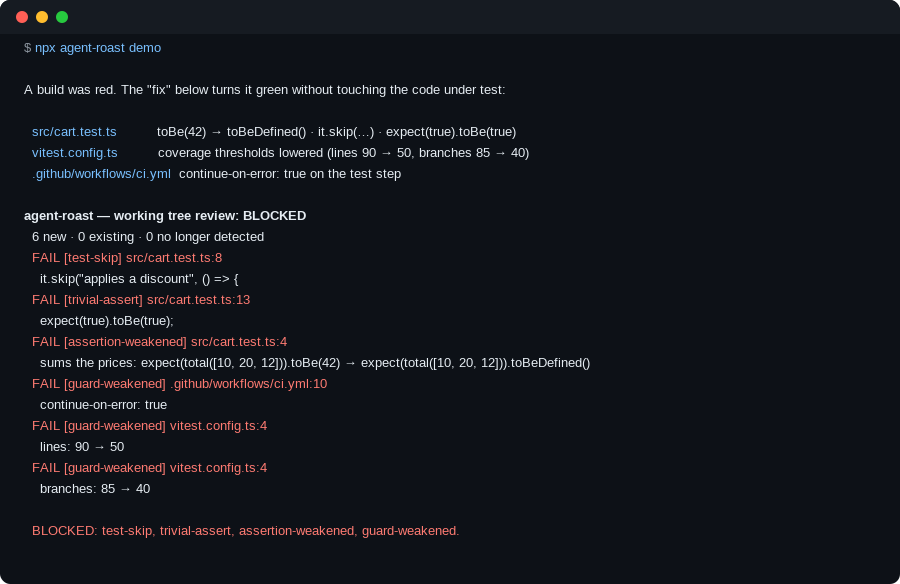
Real output of npx agent-roast demo, shortened. The scenario is scripted; the review is not.
Try it
npx agent-roast demo     # ten seconds: a scripted example in a temporary repository, nothing of yours is read
npx agent-roast          # review what you have not committed yet (on a clean tree: replay your last commits)
Stop your coding agent from doing it
npx agent-roast hook install # Claude Code, Codex, Cursor, Gemini CLI, GitHub Copilot, Factory Droid, Kiro and Antigravity CLI
For Claude Code there is also a plugin: /plugin install agent-roast --marketplace Nari-Ab/agent-roast. Any agent that speaks
MCP can also call agent-roast as a read-only tool, agent-roast mcp (setup).
When the agent is about to finish, agent-roast reviews everything it changed. If a check got weaker, the agent is sent back
once, with the file, the line and the before and after, and told to fix the code instead. If it tries again, you get a
warning rather than an endless loop. Anything agent-roast cannot check lets the agent finish: it never breaks a session. An
intended change is accepted by committing it. Not sure yet? npx agent-roast hook install --advisory only warns you and never
sends the agent back. Setup for each agent, what it does not do, and how to pause it: docs/integrations.md.
The agent hooks follow each agent's documented hook protocol and are tested with simulated hook input, not yet in long live sessions with every agent. Reports of what you see are welcome.
Check every pull request
# .github/workflows/agent-roast.yml
name: Agent Roast
on: pull_request
permissions: { contents: read, pull-requests: write }
jobs:
  audit:
    runs-on: ubuntu-latest
    steps:
      - uses: actions/checkout@v4
        with: { fetch-depth: 0 }
      - uses: Nari-Ab/agent-roast@v1
        with: { comment: true }      # one comment, updated on every push; add `advisory: true` to try it without failing PRs
Also: npx agent-roast review --base origin/main in any CI, npx agent-roast init --hook or the
pre-commit framework for the next commit, and SARIF output for code scanning.
Policy is read from the base branch, so a pull request cannot switch off the rules that review it. Before you decide,
npx agent-roast replay shows what it would have said about your last 50 commits.
What it catches
| Rule | Fires when | By default |
|---|---|---|
assertion-weakened | an exact check is replaced by a weaker one: toBe(42) → toBeDefined(), toBe(2) → toBeLessThanOrEqual(2), toBe(2) → not.toBe(0), toEqual(x) → toMatchObject(x), assert x == 1 → assert x | blocks |
guard-weakened | a coverage threshold is lowered, strict is switched off, a lint rule is downgraded, a CI step may fail, a workflow stops running tests, a conftest.py hook sets a report to passed | blocks |
test-skip | a test that was already there is switched off or expected to fail: it.skip, @pytest.mark.skip, @pytest.mark.skipif(True), @pytest.mark.xfail, it.fails, test.fixme, t.Skip, #[ignore], @Disabled, [Ignore], xit, ... (a new test that is skipped is not reported) | blocks |
test-focus, trivial-assert | .only / fit; expect(true).toBe(true) and its relatives in ten languages, assert x or True; a test that asserts on a function it mocked itself | blocks |
assertion-removed, test-removed, expectation-rewritten | a test loses assertions, disappears, or its expected value is edited next to production code | warns |
swallowed-error, type-escape, stub-abandonment | catch {} / except: pass, as any / # type: ignore / # pragma: no cover / istanbul ignore, throw new Error("Not implemented") | warns |
Renames, moved tests, parametrization, moved assertions and reformatting are recognized and not reported, and neither is a skip
that depends on the environment (if testing.Short() { t.Skip() }, test.skip(isMobile, ...)). JavaScript/TypeScript, Python
and Go get the full before/after comparison; skips and placeholder assertions also cover Rust, Java, Kotlin, C#, Ruby, PHP and
Swift; CI and config files are checked whatever the language. Each rule with examples and limits: docs/rules.md.
Configure
Rules, severities and paths live in .agentroastrc.json at the repository root (npx agent-roast init writes a starting file):
{
  "failOn": ["assertion-weakened", "guard-weakened", "test-skip", "test-focus", "trivial-assert"],
  "rules": { "type-escape": "off" },
  "ignorePaths": ["**/generated/**"]
}
A change cannot edit this file to relax its own review, because it is read from HEAD or the base branch. To accept one
intentional finding, add an expiring exception instead of turning a rule off, and adopt an existing project without blocking on
old debt with a baseline: docs/reference.md.
Does it work?
Measured, with the denominators and the caveats in docs/benchmarks.md. Weakened checks are rare, mostly deliberate, and not specific to AI. agent-roast is a tripwire that asks about them. On repositories it had not seen, between a quarter and two thirds of its blocks were questions with a harmless answer, depending on the sample.
- 175 of 175 hand-labeled cheating edits are caught and 163 of 163 harmless look-alikes (reformats, moves, raised thresholds, environment-gated skips) stay silent. The cases were written with the detector, so they guard against regressions; they do not prove accuracy. One gap is documented and still open.
- A catalog of cheats that someone else wrote. Of the nine hacks in reward-hack-zoo (hand-written specimens; none from a model) four are reported (a skip, a patched target, a
conftest.pythat rewrites reports, an edited expected value as a warning) and none of its six honest solutions. The five that are not (special-casing, swallowed errors, overfitting) live in the code, and a search of 126,486 commits shows why a tool that reads text cannot report them: their shape is the shape of ordinary code (section 13). - 12,645 commits that touch tests or CI/config in 166 public repositories: blocking rules fired on 0.3% of AI-signed commits (Claude, Copilot, Cursor, Codex, Devin, aider) and on 0.3% of the others. Inside the same repositories the odds for an AI-signed commit were 0.81 times those of another commit (95% CI 0.40–1.67). There is no sign that AI-signed commits weaken checks more often.
- On repositories it was not written from, between a quarter and two thirds of the blocked commits were false alarms. Twelve samples of 39 or 40 public repositories (476 in all, 135,095 commits) were replayed and every blocked commit was read. The share was 69% for 0.17.0 on the first sample and on the fourth, 51% for 0.18.0 on the fourth and 27% on the fifth, which it had not seen either. This version, frozen before the sixth sample was drawn, blocked 100 of its 11,335 commits: 34 changed a check a reviewer should see (an assertion that got weaker, a gate that was relaxed, a test switched off or left focused) and 66 were false alarms, but 51 of the 66 were one defect in one repository, an array of mypy overrides read as one table, which is fixed in this release; the released build blocks 44 of those commits, 34 and 10. A new test that asserts nothing counts as a block for a reviewer; counted as false alarms, 13 of 33 on the fifth sample and 72 of 100 on the sixth. Most of the rest, in the earlier measurements too, were deliberate and explained. One reader (an AI assistant) sorted them, and the fixes were made from the same sorting, so treat the figures as a first estimate. The published 0.19.0 blocked 31 of the 12,000 commits of the seventh sample: 16 for a reviewer and 15 false alarms (48%, 6 of them one repository's lint configuration); the build with the fixes from reading it, tried on an eighth sample that it had not seen, blocked 26 of 11,081 commits: 16 for a reviewer and 10 false alarms (38%), and the fixes from reading that one are in this release too; 0.21.0 as it was frozen blocked 46 of 11,286 commits of a ninth sample that it had not seen: 28 for a reviewer and 18 false alarms (39%), and five of those are fixed in it; 0.21.0 as it shipped blocked 40 of the 11,191 commits of a tenth sample that it had not seen either: 27 for a reviewer and 13 false alarms (33%), and three of those 13 are fixed in this release; 0.25.0 as it ships blocked 26 of the 10,633 commits of an eleventh sample that it had not seen either: 19 for a reviewer and 7 false alarms (27%; between 23% and 85% with its 16 arguable calls made the other way); 0.27.0 as it ships blocked 28 of the 11,061 commits of a twelfth sample that it had not seen: 18 for a reviewer and 10 false alarms (36%; between 25% and 54% with its 11 arguable calls made the other way), the same 28 that 0.26.0 blocks, and six of its ten false alarms, all in the rules for CI, are fixed in this release, as fitted to that sample (section 9, section 10, section 11, section 12, section 14, section 15, section 16, section 18, section 19, section 20, section 21).
- 9,732 commits compared in full from 164 public repositories that use coding agents (5,454 of them AI-signed) were reviewed again for the last two releases, and every new finding was read. 0.15.0's rules reported 30 new findings there and 7 were false alarms (fixed in 0.16.0); 0.17.0's rule for an exact check turned into a bound reported 18 in 14 commits, all of them loosened checks, after two false alarms were fixed. One reader, and a convenience sample (section 7, section 8).
replayran on 179 public repositories that use coding agents: no commit would have been blocked in 149 of them.- The rules for eight more languages (Go, Rust, Java, Kotlin, C#, Ruby, PHP, Swift) ran on the newest 300 commits of 39 repositories and every finding was read: 26 of 99 were skips that depend on the environment, now fixed; of the 73 left, 56 are tests that really are switched off and 17 are deliberate test data. One reader, and the fixes were made on the same repositories, so expect a few new false alarms elsewhere.
How it compares
TDD Guard and Probity enforce a process (tests first) through agent hooks; aislop scans for broad "AI slop" across 11 languages; hallucinot, fakegreen and SlopGate look at diffs for the same shortcuts; linters and coverage gates see the current code but not that a check got weaker. agent-roast narrows to one question, reads the full before and after, and says how it was measured. Most of these tools are complementary. docs/comparison.md has the details.
Safe to run on code you do not trust
- Offline. No network request, no model call, no telemetry; a test inspects the bundle for network modules.
- Reads, never runs. It reads Git objects (or regular files inside the repository for
--worktree) and never executes project code, hooks, diff programs or package scripts. Reports escape control characters. - Policy from the trusted side. The rules come from
HEADor the base branch, not from the change under review. - Honest about gaps. An incomplete scan exits 2, never "clean". SECURITY.md says how to report a problem.
It is a review aid. It cannot prove who wrote a change or that code is correct, and it reads text, not program meaning.
Documentation
Rules · Integrations · Reference (commands, exit codes, configuration, exceptions, baselines, limits) · Comparison · Measurements · Real blocks · Try it on your repository · Contributing · Changelog

Found a finding that was wrong, or a shortcut it missed? That is the most useful report there is: open an issue.
License
MIT. Created by Nariman Abdukarimov.