Listed from the MCP registry; nobody on Odel publishes it.
Paper Librarian
Local searchable library of research papers (arXiv + PDFs) with cited answers and linked references
Runs on your machine from its package; the steps are below.
What it does
- Reads
- Writes
- High impact
At most: creates or changes data: records, files, settings.
What it costs
FreeOdel charges nothing per call. The publisher may charge for its own service.
Runs locally over stdio
This server isn't hosted — your MCP client launches it from a package registry. Use one of the commands below, or drop the config into your client (e.g. Claude Desktop).
Run
uvx paper-librarian
MCP client config
{
  "mcpServers": {
    "paper-librarian": {
      "command": "uvx",
      "args": [
        "paper-librarian"
      ]
    }
  }
}An MCP server that gives Claude a local, searchable library of research papers (arXiv + PDFs).
Built on the MCP Python SDK 2.x (MCPServer, the 2.x successor to FastMCP).
Add papers by arXiv id or PDF path, then ask questions about them. Answers cite the paper, section and page, and references between papers in the library are linked in both directions.
Demo
A session in Claude Code with the server connected.
1. Add a paper by arXiv id. add_paper downloads Attention Is All You Need, splits it into
44 searchable chunks and parses its 40 references. None are linked yet because the library was empty.
2. Claude calls the MCP tool. Asked to add BERT (1810.04805), Claude Code routes the request to
the paper-librarian server.
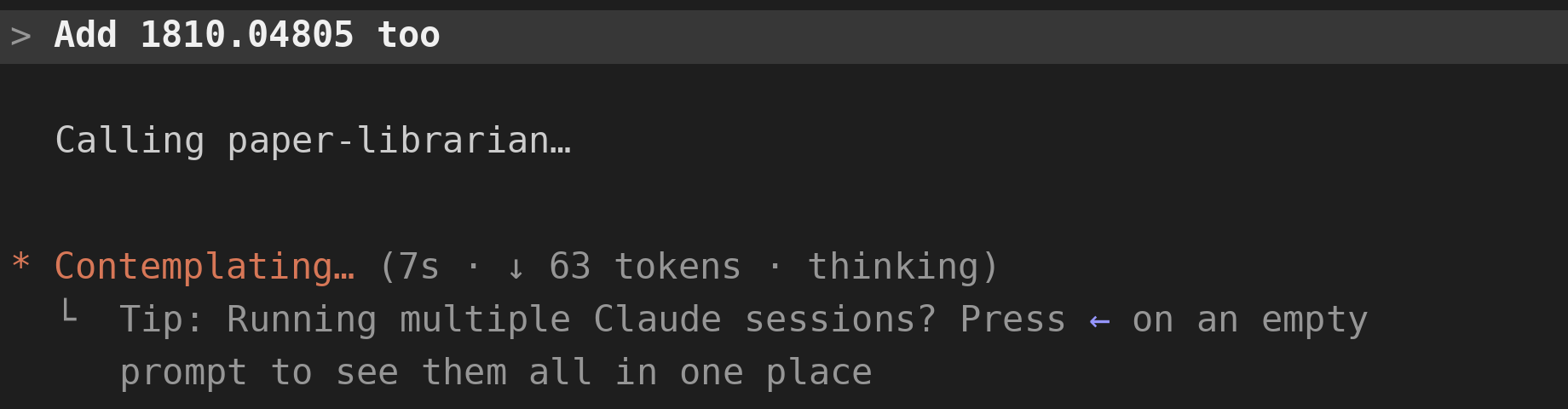
3. Add a second paper; citations link automatically. BERT is added with 71 chunks and 56 references. One of them matches the Transformer paper already in the library, so the two papers are now linked.
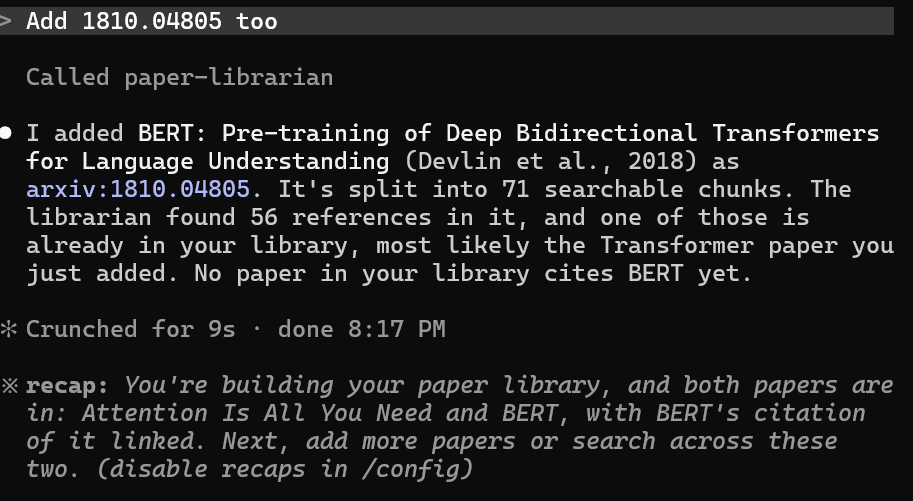
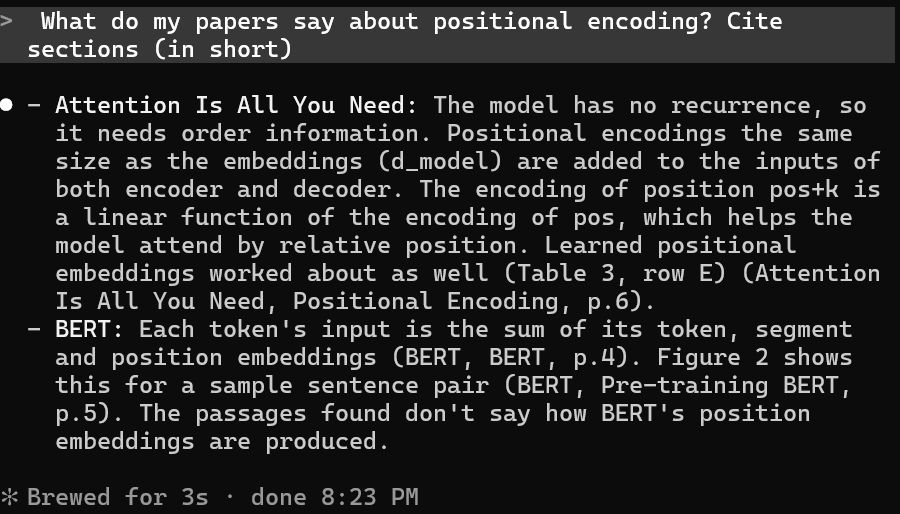
4. Ask a question; answers cite section and page. Hybrid search finds the relevant passages in both papers, and Claude cites each claim, e.g. (Attention Is All You Need, Positional Encoding, p.6).
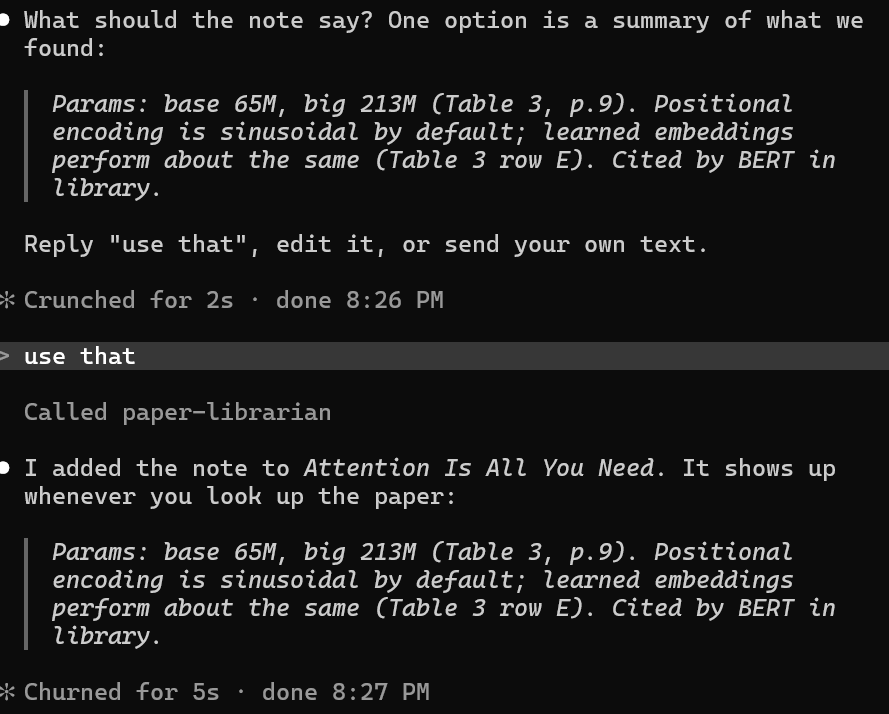
5. Save a note to a paper. add_note attaches a summary to the paper; it is returned whenever the
paper is looked up with get_paper.
Problem statement
Researchers and students keep dozens of papers as PDFs, but an AI assistant can't use them well:
- No memory of your library. Each chat starts from nothing; pasting whole PDFs runs into context limits and has to be repeated every time.
- Answers from memory, not sources. Without access to the actual text, a model summarizes papers from training data, which may be outdated, vague or wrong, and can't point to where a claim comes from.
- PDFs are hard to read programmatically. Two-column layouts, section headings, hyphenation, ligatures and reference lists in several citation styles all break naive text extraction.
- Papers are connected, but the connections are invisible. Which of my papers cite each other? That information is buried in reference lists.
Paper Librarian solves this with an MCP server that runs locally and:
- ingests papers from arXiv or local PDFs into a structured library (sections, pages, references);
- indexes them for hybrid search (meaning-based + keyword), returning passages with section and page so every answer can be cited;
- parses reference lists and links citations between papers in the library;
- exposes all of this to Claude (or any MCP client) as tools, a resource and a prompt.
Everything — database, PDFs, embedding model — stays on your machine.
Features
- Add papers by arXiv id (
1706.03762,arXiv:1706.03762v5), arXiv URL, or local PDF path, with duplicate detection by arXiv id and file hash. - Layout-aware PDF extraction: two-column reading order, section detection using font weight and size, page tracking, ligature and hyphenation repair.
- Hybrid search: vector similarity (sqlite-vec) + BM25 keyword search (SQLite FTS5), merged with reciprocal rank fusion; filters by year and paper.
- Citation graph: reference lists split in
[n],n.and author-year styles; matched to library papers by arXiv id, exact title or fuzzy title; linked forwards and backwards as papers are added. - Section reader: fetch the full text of any section ("Method", "Positional Encoding", …).
- Comparison helper: gathers the most relevant passages per paper per aspect for comparison tables.
- Notes attached to papers.
- Local and private: one SQLite file plus a PDF folder; no external services except arXiv downloads and the one-time model download.
Tech stack
| Layer | Technology | Why |
|---|---|---|
| Language | Python 3.11+ (developed on 3.13) | Ecosystem for PDFs, ML and MCP |
| MCP server | MCP Python SDK 2.3 (MCPServer) | Tools, resources, prompts, progress reporting, stdio transport |
| PDF parsing | PyMuPDF 2.0 | Fast text extraction with font, size and position data per span |
| arXiv | arxiv 4.0 + requests | Metadata lookup (title, authors, abstract) and PDF download |
| Embeddings | sentence-transformers 6.2, model all-MiniLM-L6-v2 (384-dim) | Small (~90 MB), CPU-friendly, good quality for retrieval |
| Vector index | sqlite-vec 0.1.9 (vec0 table) | KNN search inside the same SQLite file |
| Keyword index | SQLite FTS5 (BM25 ranking) | Built into Python's sqlite3, no extra service |
| Storage | SQLite | Single file, transactional, zero setup |
| Testing | pytest 9, anyio, MCP in-process Client | Unit tests plus end-to-end tests through a real MCP client |
| Build | hatchling (pyproject.toml) | Standard packaging; paper-librarian console script |
Architecture
flowchart LR
    Claude["Claude / MCP client"] <-- "stdio (JSON-RPC)" --> Server["server.py<br/>MCPServer: 8 tools,<br/>1 resource, 1 prompt"]

    Server --> Ingest["ingest.py<br/>fetch · extract · sections · chunks"]
    Server --> Search["search.py<br/>vector + BM25 + RRF"]
    Server --> Store

    Ingest --> ArXiv[("arXiv API")]
    Ingest --> Embed["embed.py<br/>MiniLM embeddings"]
    Ingest --> Cit["citations.py<br/>split · match · link"]
    Search --> Embed

    Ingest --> Store["store.py<br/>SQLite + FTS5 + sqlite-vec"]
    Cit --> Store
    Search --> Store
    Store --> DB[("~/.librarian/library.db")]
    Ingest --> PDFs[("~/.librarian/pdfs/")]
How a paper is added (add_paper)
flowchart TD
    A["source: arXiv id / URL / PDF path"] --> B{"arXiv id?"}
    B -- yes --> C["duplicate check by arXiv id"] --> D["fetch metadata + download PDF"]
    B -- no --> E["duplicate check by sha256"]
    D --> F["extract_pdf: column-aware page text"]
    E --> F
    F --> G["split_sections: headings → segments (section, page)"]
    G --> H["chunk_segments: 180-word windows, 30-word overlap"]
    H --> I["embed chunks (MiniLM, normalized)"]
    G --> J["References section → split_references"]
    I --> K["one transaction: paper + chunks + vectors + FTS + citations + backlinks"]
    J --> K
How a question is answered (search)
flowchart LR
    Q["query"] --> V["embed → KNN on chunk_vectors"]
    Q --> K["sanitize → FTS5 MATCH, BM25"]
    V --> R["reciprocal rank fusion<br/>score = Σ 1/(60 + rank)"]
    K --> R
    R --> F["filters: year, paper ids<br/>cap: N hits per paper"]
    F --> S["hits: title · section · page · snippet · matched_by"]
Project structure
paper-librarian/
├── pyproject.toml            # dependencies, console script, pytest config
├── README.md
├── docs/screenshots/         # demo screenshots used in this README
├── src/librarian/
│   ├── __init__.py           # package version
│   ├── server.py             # MCP server: tools, resource, prompt, lifespan        (333 lines)
│   ├── ingest.py             # arXiv fetch, PDF extraction, sections, chunking      (457 lines)
│   ├── search.py             # hybrid search, RRF, snippets                         (198 lines)
│   ├── citations.py          # reference splitting, matching, linking               (161 lines)
│   ├── store.py              # SQLite schema and data access                        (325 lines)
│   └── embed.py              # embedding model wrapper                              ( 53 lines)
└── tests/                    # 90 tests
    ├── test_server.py        # end-to-end through an in-process MCP client          (9)
    ├── test_ingest.py        # arXiv ids, headings, sections, chunking, ingestion   (39)
    ├── test_citations.py     # splitting styles, matching, linking                  (20)
    ├── test_search.py        # keyword / semantic / hybrid, filters, snippets       (10)
    ├── test_store.py         # schema, constraints, cascades                        (9)
    └── test_smoke.py         # dependencies load                                    (3)
Code details
store.py — data model and storage
All data lives in one SQLite file. The schema:
| Table | Columns | Notes |
|---|---|---|
papers | id, title, authors, year, abstract, source, arxiv_id, sha256, path, added_at | id is arxiv:<id> or pdf:<sha256[:16]>; arxiv_id and sha256 are UNIQUE (duplicate protection); source is CHECKed to arxiv/pdf |
chunks | id, paper_id, seq, section, page, text | Searchable passages; UNIQUE(paper_id, seq) |
chunks_fts | FTS5 over text, section | External-content index kept in sync by AFTER INSERT/DELETE triggers |
chunk_vectors | vec0(chunk_id, embedding float[384]) | sqlite-vec KNN index; same id as chunks.id so results can be fused |
citations | id, paper_id, seq, raw_reference, matched_paper_id | matched_paper_id → papers.id, ON DELETE SET NULL |
notes | id, paper_id, text, created_at | |
meta | key, value | Stores embedding_dim; reopening with a different model raises instead of corrupting the index |
Deleting a paper cascades to its chunks, FTS entries, vectors (via trigger), citations and notes.
Store provides typed access (Paper, Chunk, Citation, Note dataclasses):
add_paper, get_paper, find_duplicate, list_papers, delete_paper, add_chunks (with vectors),
get_chunks(section=…), add_citations, get_citations, get_cited_by, unmatched_citations,
set_citation_match, delete_citations, add_note, get_notes.
store.transaction(commit=True) wraps writes; passing commit=False to individual methods lets a
caller group several writes into one atomic transaction (used by ingestion).
The connection is opened with check_same_thread=False because MCP tools run in worker threads; the
server serializes access with a lock.
ingest.py — getting papers in
| Function | What it does |
|---|---|
parse_arxiv_id(source) | Recognizes new-style (2310.06825v2), old-style (hep-th/9901001), arXiv: prefixes and abs//pdf/ URLs; returns the version-less id |
fetch_arxiv(id, pdf_dir) | Metadata via the arxiv API, PDF via requests (arxiv 4.x dropped download_pdf); validates the %PDF header |
extract_pdf(path) | Title (PDF metadata, else largest horizontal text on page 1), authors, year, section segments, raw References text |
page_text(page) | Column-aware reading order: blocks are classified left / right / full-width around the page centre; within bands separated by full-width blocks, the left column is read before the right. Marks indented lines (for reference splitting) and emphasized lines (bold or ≥1.1× body font size, for heading detection). Merges spans on the same baseline and applies NFKC normalization (fi → fi) |
heading_name(line, appendix) | Decides whether a line is a section heading. Known names (Introduction, Methods, …) map to canonical names; other numbered headings (3 Model Architecture) must be emphasized. Rejects years and decimals as section numbers, lines with column gaps, and sentence fragments. Letter numbering (A, B.2) only counts after References/Appendix |
split_sections(pages) | Walks lines, producing Segment(section, page, text, raw); a new segment starts on each page so page numbers stay accurate |
chunk_segments(...) | 180-word windows with 30-word overlap, never crossing a section boundary. 180 words fits MiniLM's 256-token input limit, so nothing is silently truncated |
ingest(source, store, embedder, progress) | The whole pipeline (diagram above); writes paper, chunks, vectors and citations in one transaction, so a failure never leaves half a paper |
rebuild_citations(store) | Re-parses every stored PDF's references, e.g. after improving the parser |
embed.py — embeddings
Embedder is a Protocol (dim, embed(texts)), so tests use small fake embedders.
SentenceTransformerEmbedder loads the model lazily (thread-safe), normalizes vectors, and offers
warm_up() to load in the background at server start so the first search doesn't wait.
search.py — hybrid retrieval
| Function | What it does |
|---|---|
fts_query(text) | Turns free text into a safe FTS5 query (each word quoted, OR-ed), so input like "x"? AND NEAR* can't cause syntax errors |
keyword_search(...) | FTS5 MATCH ranked by BM25, joined to papers for filtering |
vector_search(...) | sqlite-vec KNN; with filters it over-fetches (10×, min 200) and filters after, since vec0 can't filter on paper columns during the scan |
rrf(rankings) | Reciprocal rank fusion, score = Σ 1/(60 + rank); records which methods found each chunk |
search(...) | Runs one or both retrievers, fuses, applies a per-paper cap, and builds SearchHits |
make_snippet(text, terms) | Picks the window containing the most distinct meaningful query words (short words like "of" ignored) |
On a 4-paper, 10-query check (Transformer, BERT, ResNet, word2vec), hybrid search ranked the correct paper first 10/10 times.
citations.py — the citation graph
| Function / class | What it does |
|---|---|
split_references(raw) | Tries [n] markers (≥2), then sequential n. markers (≥3, mostly counting up), then hanging indents for author-year styles (first line at the column edge, continuation lines indented). Rejoins words hyphenated across lines |
reference_arxiv_id(ref) | Finds arXiv:1607.06450, abs/1409.0473, arxiv.org URLs |
Matcher | Matches a reference to a library paper: arXiv id → exact title (compared as lowercase alphanumerics, so Pre-\ntraining = Pretraining) → fuzzy title (≥92% of title characters found in order, after a cheap word-overlap pre-filter). Titles under 12 characters ("BERT") never match on title alone; the longest matching title wins |
link_paper(store, paper, refs) | Stores the paper's references matched against the library, and re-checks older papers' unmatched references against the new paper (backlinks). Self-citations are excluded. Re-running replaces the paper's previous citations |
server.py — the MCP interface
create_server(db_path=None, embedder=None) builds an MCPServer whose lifespan opens the
Store, creates the embedder (warming it up), and yields an AppState(store, embedder, lock).
Tools get it from ctx.request_context.lifespan_context. The factory lets tests inject a temporary
database and a fake embedder; main() runs the default server over stdio and quiets
model-hub HTTP logging (httpx, httpx2, huggingface_hub).
Tools
| Tool | Arguments | Returns | Annotations |
|---|---|---|---|
add_paper | source | paper summary, already_in_library, chunk and reference counts; reports progress | open-world, idempotent |
search | query, limit=8 (max 30), mode (hybrid/semantic/keyword), year_from, year_to, paper_ids | results[]: paper id, title, year, section, page, snippet, matched_by | read-only |
get_paper | paper_id, section? | metadata, abstract, sections (with start page), notes — or one section's full text (chunk overlaps removed, partial names accepted) | read-only |
get_citations | paper_id | references[] with in_library link, cited_by[] | read-only |
compare_papers | paper_ids (2–8), aspects (1–8), passages_per_aspect=2 | passages per paper per aspect | read-only |
add_note | paper_id, text | note id, timestamp | |
list_papers | — | count, paper summaries | read-only |
remove_paper | paper_id | removed id and title (PDF file kept) | destructive |
Resource: library://papers — the library as a Markdown list.
Prompt: literature_review(topic) — guides Claude through search → compare → citations → a cited review.
Paper ids are accepted in full (arxiv:1706.03762) or bare (1706.03762). Expected failures (unknown
paper, missing file, download error, unknown section) are raised as ToolError, so Claude gets an
actionable message such as "No paper '…' in the library. Use list_papers to see paper ids."
Setup
cd paper-librarian
python -m venv .venv
.venv\Scripts\activate      # Windows  (source .venv/bin/activate on macOS/Linux)
pip install -e ".[dev]"
pytest -q                   # 90 tests
The first run downloads the all-MiniLM-L6-v2 embedding model (~90 MB).
Connect to Claude
Claude Code
claude mcp add paper-librarian --scope user -- <path-to-repo>/.venv/Scripts/python.exe -m librarian.server
claude mcp get paper-librarian   # should show: Status: ✔ Connected
Start a new Claude Code session afterwards; servers are loaded when a session starts.
Remove with claude mcp remove paper-librarian -s user.
Claude Desktop — add to claude_desktop_config.json (Settings → Developer → Edit Config), then restart:
{
  "mcpServers": {
    "paper-librarian": {
      "command": "C:/path/to/paper-librarian/.venv/Scripts/python.exe",
      "args": ["-m", "librarian.server"]
    }
  }
}
Try it
- "Add arXiv 1706.03762 and 1810.04805 to my paper library"
- "What do my papers say about positional encoding? Cite sections."
- "Compare BERT and the Transformer on pre-training corpus, model size and results"
- "Which papers in my library cite Attention Is All You Need?"
- Use the
literature_reviewprompt with a topic
Configuration
| Variable | Default | Meaning |
|---|---|---|
LIBRARIAN_HOME | ~/.librarian | Library folder (library.db, downloaded pdfs/) |
LIBRARIAN_EMBED_MODEL | sentence-transformers/all-MiniLM-L6-v2 | Embedding model (must produce 384-dim vectors) |
HF_HUB_OFFLINE | unset | Set to 1 once the model is downloaded to skip Hugging Face checks at startup |
Testing and debugging
pytest -q                                   # unit + end-to-end MCP tests
npx @modelcontextprotocol/inspector .venv/Scripts/python.exe -m librarian.server
tests/test_server.py connects the SDK's Client to the server in-process and exercises every
tool, the resource and the prompt, including progress notifications and error cases.
Known limitations
- Scanned PDFs (no text layer) are rejected; there is no OCR.
- Unusual layouts: three-column pages, or reference lists that fit none of the three styles, may extract or split imperfectly.
- Subsections replace parent names: text under 3.2.1 is labelled
Scaled Dot-Product Attention, notModel Architecture. - Filtered semantic search over-fetches and filters afterwards; with many thousands of papers, a very narrow filter could miss results.
- Ingestion holds the database lock, so other tool calls wait while a paper is being added (typically 5–30 s).
- Hyphen rejoining also merges genuine compounds broken at a line end (
sequence-aligned→sequencealigned). - References to papers outside the library are stored as text only (no Semantic Scholar lookup yet).
Roadmap
- Semantic Scholar lookup for references not in the library
- OCR fallback for scanned PDFs
- Parent/child section hierarchy
- Packaging for
uvx paper-librarian