Listed from the MCP registry; nobody on Odel publishes it.

Velruna
Verified-fact memory for AI agents: facts with source, date and edit history on OpenSearch.
Runs on your machine from its package; the steps are below.
What it does
- Reads
- Writes
- High impact
At most: moves money, runs code or commands, deletes data, or sends messages for you.
What it costs
FreeOdel charges nothing per call. The publisher may charge for its own service.
Runs locally over stdio
This server isn't hosted — your MCP client launches it from a package registry. Use one of the commands below, or drop the config into your client (e.g. Claude Desktop).
Run
docker run -i --rm ghcr.io/nemonobody/velruna:0.9.6
MCP client config
{
  "mcpServers": {
    "velruna": {
      "command": "docker",
      "args": [
        "run",
        "-i",
        "--rm",
        "ghcr.io/nemonobody/velruna:0.9.6"
      ]
    }
  }
}

Persistent, provenance-carrying memory for AI agents (and humans).
Before the name misleads you: this is not a memory that recalls what you cannot name. It is a catalogue of facts a session has already verified — found by text (BM25) or by key, and read in pieces. Matching meaning is the job of the model holding the context, not of the store.
The name is coined: Old Norse vél "device, craft" (modern Icelandic "machine") + rún "secret; carved mark". Runestones and the Bergen trade tags were durable authored records — written once, read by strangers long after — and that is the model here. In Younger Futhark, ᚢᛁᛚᚱᚢᚾᛅ (ᚢ writes /v/). The word is invented; the metaphor is not. Up to v0.8.6 the project was published as
memento.
What it is
velruna stores facts you or an agent have verified about your projects —
file locations, endpoint and config values, behavior — in an OpenSearch index.
Every agent session relearns the same paths, ports and quirks; this stores them
once, with the evidence and an age. The aim is to stop re-verifying the same
path in every session: an agent that keeps the store in the loop (the rule file
is rules/velruna.md) reads the fact with its observation
date and source, and goes back to the source only when the age says it may have
moved. The store records that evidence, who wrote it and when; it cannot verify
anything itself. It is an advisory memory with an audit trail, not an oracle.
Why OpenSearch and not files or SQL: Storage.
Who it is for: one person or a small team working the same repositories
session after session, who want one shared, inspectable store instead of a
memory file per clone — and who already run (or don't mind running) an
OpenSearch node. Sharing one store between sessions, machines and agents is the
point: keys are namespaces, every write carries an author label, so two agents
on the same project can pick up each other's facts without a human relaying
them. If a flat AGENTS.md is enough, it is enough.
Each fact carries evidence, not verdicts:
- provenance (
source): where it came from —tool:read_file,experiment,user:confirmed,doc:*; - observation time (
observed_at): when the value was actually seen; - history: the fact doc keeps the current value, and every accepted
change is journaled to an append-only index
(
<index>-history-<period-date>, monthly by default) — the superseded state is never lost; entries are never rewritten and the journal is not pruned by default (write-forever), so history shows how old it is; - notes: free-text qualifiers, e.g. "checked the dev config only";
- authorship: every write is stamped with who recorded it (the store's
securityuser when the cluster has one, else config/OS user — a self-reported audit label, not authentication) and which model/host/session produced it; the birth labels are write-once, corrections moveupdated_by; - re-verification:
confirmed_bylists who verified the current value (creator first, user+host per entry);velruna_patch reverifymovesobserved_atand journals anop=rediscoveryentry, so a stale fact can actually become fresh again; - summary: a value over
summary_min_lenmust ship a short table-of- contents rendering (kept undersummary_max_len), so store listings stay skimmable without pulling full values into context; - keywords: up to 10 normalized tags per fact (lowercase single tokens),
exact-match filterable — cross-project slices (
perf,security,infra) without a graph backlog, and recipes/rules stay findable by topic; - successor (
superseded_by): at most one link per fact to the record that replaces it, set byvelruna_patch(a later patch may repoint it). A link-only patch journalsop=supersede; a patch that also changes the value or retires the fact keeps that event's op and its entry states the link. The target must be a verified fact and the chain must stay cycle-free; a link pointing back in time is legal but flagged in the journal. It answers "this key is stale garbage, read that one instead" without copying the value; - secret guard: writes scan for credential-like text (the index is
plaintext) — a real credential refuses the write, a hit in an identity field
(key, project, source, keywords;
superseded_bycounts onvelruna_patch) also refuses, while a heuristic hit (a long hash, a base64 blob, an opaque token, a weak assignment) is replaced in place and the answer lists what was cut;rejectby default,asklets a human confirm a false positive,allowopts out; - staleness: reads compute
age_daysandstalefromobserved_atand a per-category TTL (config/endpoint14 days,location/behavior30 days,rule90,recipe180,context_mapnever). A writer may shorten the window per fact (ttl_days), never lengthen it past the category cap.stale: trueis an instruction to re-verify against the source, not to discard the fact.
Two statuses: verified (the subject exists) and obsolete (the subject is
gone — file deleted, endpoint removed). The store holds the evidence; the agent
judges trust and staleness in context.
Authorship is audit metadata, not access control: a write records the store's
security user when the cluster exposes one, otherwise the configured
(author) or OS user, plus model/host/session labels. These birth labels
are write-once; every later write moves updated_by. The journal carries the
same per-entry, so a shared store shows who saw what when. Labels are
self-reported — a client can set any author; the field supports review and
attribution, not trust.
Reading is selective
A session pays only for what it reads. velruna_list and velruna_search
return compact rows — key, summary, category, status, source, age — and the full value
is one velruna_get away; a body over summary_min_len must ship a summary,
so a listing stays skimmable; a fetched page is split into blocks — a section too
long for one block is split, not cut — and read one block at a time. The store
never decides to push a document into the context: that is what lets it work
from a small window — a local model with a modest budget — without dragging
whole pages along.
Non-goals
Deliberate, and worth knowing before filing an issue:
- semantic / vector search — the LLM already does semantics over a summary and an outline; embeddings inside the store are complexity without a reader;
- storing secrets — the index is plaintext, and the guard is a safety net, not a vault;
- authentication of its own — a shared store runs on OpenSearch's security plugin (per-user accounts and roles, document-level security; the recipes are in docs/setup.md);
- deciding for you — a fact is evidence with an age, never a verdict;
- another storage backend behind the same tools — the queries are OpenSearch's (see Storage).
Quick start
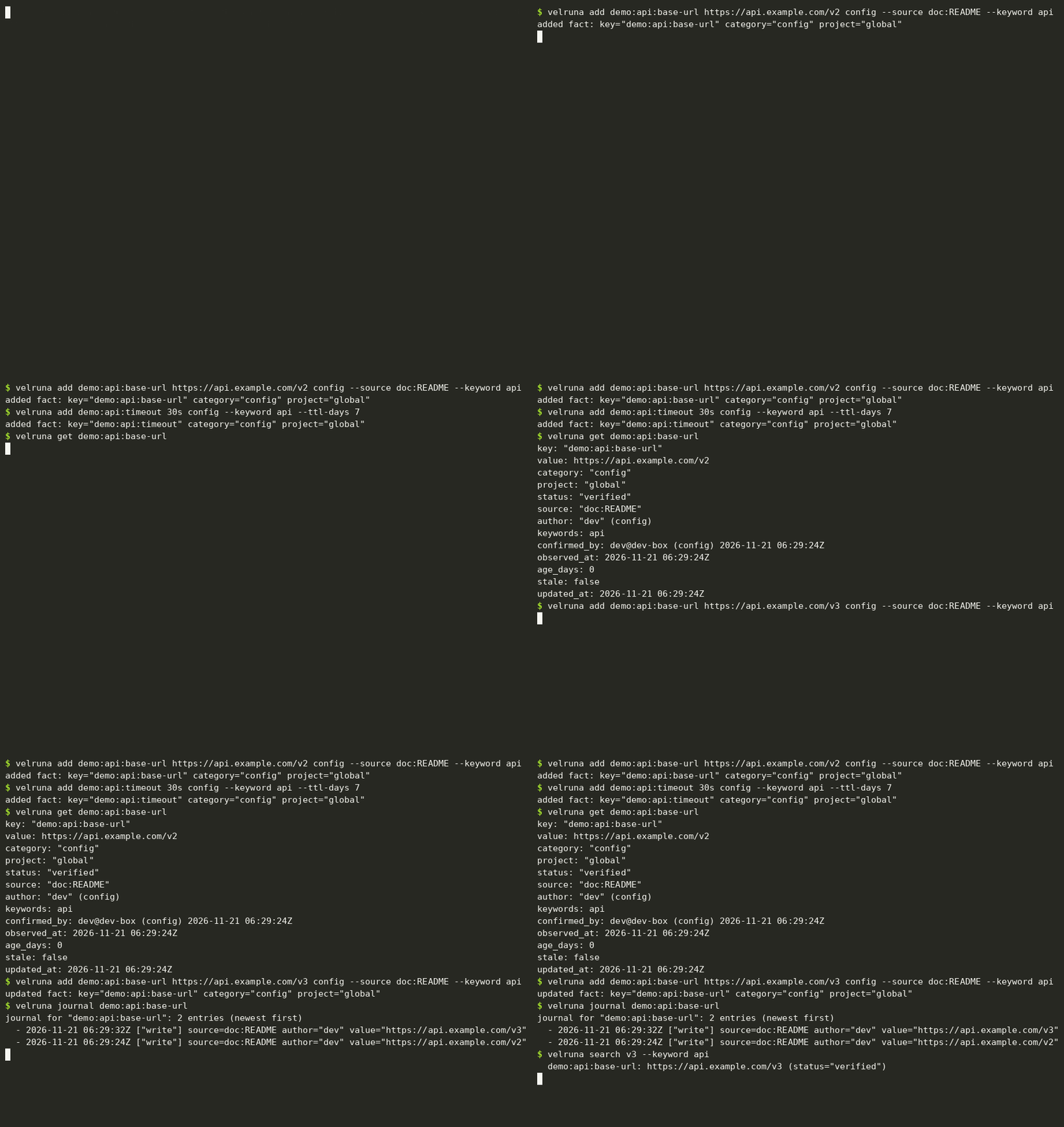
A 20-second tour (hack/quickstart-demo.sh against a throwaway node — add a
fact with provenance and a tag, read it back, correct it, and watch the journal
keep both values):
Build (Go 1.26+):
go build -o velruna .
Or install directly:
go install github.com/NemoNobody/velruna@latest
Or download the binary for your platform from
Releases; with the repo
cloned, scripts/install.sh picks it, verifies the sha256 and puts it in
~/.local/bin.
Or install the MCP bundle from Releases
(velruna-<version>.mcpb): clients that speak the MCP Bundle format show a
configuration form for the OpenSearch URL, user and password — no JSON editing.
Or run the container (release tags only, linux/amd64 + linux/arm64):
docker run -i --rm --user "$(id -u):$(id -g)" \
  -v ~/.velruna.conf:/etc/velruna/velruna.conf:ro \
  -e VELRUNA_CONF=/etc/velruna/velruna.conf -e OPENSEARCH_PASSWORD \
  ghcr.io/nemonobody/velruna:0.9.5 mcp
--user keeps a 0600 config readable (without it the image's uid 65532 needs
a 0644/chown 65532 file — see docs/setup.md §2).
The image is distroless and runs as uid 65532; a container has no session bus, so the password comes from the environment or the mounted config, not from the OS keyring — docs/setup.md §2 and docs/mcp.md.
The server is also listed in the official MCP Registry as
io.github.NemoNobody/velruna (server.json; the OCI package points at the
same image, and a bare docker run now speaks MCP).
You also need a reachable OpenSearch (a single local node is enough). Quickest:
make dev-opensearch runs one in a container (localhost-only, security plugin
off, 512 MB heap, named volume — docs/setup.md §2). A system install follows
the official documentation;
docs/setup.md covers what velruna expects.
Configure: copy velruna.conf.example to velruna.conf (or ~/.velruna.conf).
Against the dev node — no TLS, security off, reachable only from this machine:
{
  "opensearch_url": "http://127.0.0.1:9200",
  "opensearch_user": "dev",
  "opensearch_password": "dev",
  "allow_plaintext": true
}
Against a real cluster: https://…, drop allow_plaintext, and keep the
password out of the file — in the OS keyring (velruna creds set) or in
OPENSEARCH_PASSWORD for containers and headless setups. A plaintext file
password is only read when allow_plaintext is on, which is off by default.
The full annotated example (index names, TTLs, fetch options) is
velruna.conf.example; insecure_skip_verify: true is for a self-signed
local node only — verification is on by default.
The index is created automatically on first use. Env vars override the file:
OPENSEARCH_URL, OPENSEARCH_URLS, OPENSEARCH_USER, OPENSEARCH_CLUSTER,
OPENSEARCH_PASSWORD,
OPENSEARCH_INSECURE_SKIP_VERIFY, VELRUNA_INDEX, VELRUNA_HISTORY_PERIOD,
VELRUNA_HISTORY_LIMIT, VELRUNA_SUMMARY_MIN_LEN, VELRUNA_SUMMARY_MAX_LEN,
VELRUNA_SECRET_GUARD, VELRUNA_ALLOW_PLAINTEXT,
VELRUNA_AUTHOR, VELRUNA_MODEL, VELRUNA_HOST, VELRUNA_SESSION;
VELRUNA_CONF points at an explicit config file. Fetch
options (velruna fetch): VELRUNA_DOCS_INDEX, VELRUNA_DOCS_TTL_DAYS,
VELRUNA_FETCH_TIMEOUT, VELRUNA_FETCH_MAX_BYTES, VELRUNA_FETCH_BLOCK_CHARS,
VELRUNA_FETCH_DOC_CHARS, VELRUNA_FETCH_HOSTS, VELRUNA_FETCH_USER_AGENT,
VELRUNA_FETCH_PROXY_URL,
VELRUNA_FETCH_PROXY_FALLBACK, VELRUNA_FETCH_RESPECT_ROBOTS,
VELRUNA_FETCH_ALLOW_PRIVATE, VELRUNA_FETCH_RENDER,
VELRUNA_FETCH_OBSCURA_PATH, VELRUNA_FETCH_OBSCURA_STEALTH,
VELRUNA_LOCAL_REPO_ROOTS,
VELRUNA_REPO_SCAN_DEPTH.
The password resolves from OPENSEARCH_PASSWORD, then the OS keyring (service
velruna, account cluster/<opensearch_cluster> — with the legacy
host[:port] entry still readable), then the config file — the file only when
allow_plaintext is on. velruna creds set reads a hidden prompt (the password
is never taken from argv) and keys the entry by the store's own identity (its
cluster_uuid), so replacing a node or reordering the node list never orphans
the secret. No creds subcommand prints the value. Check the connection:
velruna status
Store and read back a fact:
velruna add demo:api:port "API port is 8080" endpoint -p demo -s tool:read_file
velruna get demo:api:port
velruna search "api port"
Fetch a web page into the docs index and read it back block by block:
velruna fetch https://www.postgresql.org/docs/current/tutorial.html
velruna doc <hash-from-output> 1      # the "Part I. Tutorial" block
velruna docs "tutorial"
The page is parsed with the HTML5 tokenizer (golang.org/x/net/html), split on
its headings, and each heading-delimited section is split into blocks: a section
longer than fetch_block_chars (default 8000 runes) is split at a line boundary,
never truncated. Blocks are cheap to read, so open the one you want instead of the
whole document — --blocks reads a run of them. fetch_doc_chars (default
100000; 0 = the whole document) is the storage budget: when it runs out, whole
blocks are dropped from the end and the answer says so (truncated,
chars_stored/chars_total) — a block is never cut in the middle. Code blocks
(<pre>) are stored with their newlines and indentation: a code sample whose
braces are missing is not a code sample. Site chrome is filtered, not stored:
when the markup names the article (<main>, role="main", <article>) only
that container is read, nav/aside/footer are removed, and a short block of
at least two links with no letter outside them (a rail, a breadcrumb) is
dropped. The rule is deliberately strict: one word outside the links makes the
block prose, so a labelled menu survives — cutting a paragraph to remove a menu
is the worse mistake. A page that is nothing but links keeps its blocks — an
empty document would hide the loss. Prose outside any of these markers can still
carry a banner; the loss is reported rather than silent: truncated covers the
storage budget and dropped image references, never the chrome filter. A page over
the 2 MB fetch_max_bytes limit is refused with an error, not trimmed.
Commands
| Command | Description |
|---|---|
velruna add <key> <value> <category> [--project <p>] [--source <s>] [--notes <n>] [--summary <s>] [--ttl-days N] [--keyword <k>] [--allow-secret] | Add or correct a fact (prints added/updated/touched (same value), with , resurrected an obsolete fact appended when the write re-declared a dead fact alive; doc-first: the fact doc is written before its journal entry — a correction preallocates the entry id into the fact first, a birth creates the doc and then appends and links; values over summary_min_len require --summary) |
velruna get <key> [--history] | Get a fact by key (history is off by default; --history prints the legacy in-doc chain, or the newest journal entries for journal-era facts — the full journal is one velruna journal away) |
velruna search <query> [--project <p>] [--category <c>] [--status <s>] [--keyword <k>] [--limit N] | Full-text search over values, notes and summaries (--status any disables the status filter; --limit 0 = up to 1000, larger values are clamped to it) |
velruna keys [prefix] [--match <s>] [--project <p>] [--status <s>] | Find facts by key: prefix and/or substring (*, ? wildcards in --match), across projects |
velruna list <project> [--prefix <p>] | List all facts for a project, optionally narrowed to a key prefix (trailing * allowed) |
velruna journal <key> [--since <ts>] [--until <ts>] [--limit N] | Read the journal: the append-only history of a key, newest first |
velruna history-info <key> | Compact journal overview: writes, rediscoveries, time range (no entry text) |
velruna prune <key> [--keep N] [--yes] | Drop old journal entries, keeping the newest N (manual admin tool: destructive, without --yes only the plan is printed) |
velruna migrate-history [--project <p>] [--yes] | Move pre-journal in-doc history arrays into the journal (one-time; plan first, --yes to write) |
velruna obsolete <key> [reason] [--allow-secret] | Mark a fact obsolete because its subject is gone (reason appended to notes) |
velruna links check [--limit N] | Audit the superseded_by graph of live (verified) facts in one bounded scan plus a batched probe round: dangling targets, unverified targets, cycles (edges on retired facts are counted apart — retiring a source is the documented repair); the summary names what the scan could not audit (partial audits never claim "clean") |
velruna status [--conf <path>] | Check connectivity and show the effective configuration (env overrides are listed by name, never values) |
velruna creds set|status|rm [--url <u>] | Manage the OpenSearch password in the OS keyring: set reads a hidden prompt (piped stdin for scripts) and keys the entry by store identity — cluster/<cluster_uuid> (or --name <label>), recorded in the config as opensearch_cluster; status shows the candidate entries and the source, never a value; `rm [--legacy |
velruna fetch <url> [--probe] [--refresh] [-p <p>] [--allow-secret] [--max-chars N] [--block-chars N] | Fetch a page into the docs index and print its outline: cache-aware, blocks are read on demand; --max-chars 0 stores the whole document (default fetch_doc_chars), --block-chars sets the target block size; github URLs that match a local clone print the file path; --probe prints pre-fetch metadata (status, content type, bytes_total or unknown, bytes_sampled, method, final url, note) without storing anything and ignores --refresh/--max-chars/--block-chars |
velruna doc <hash> [n|--section N] [--blocks N] [--full] | Read a stored document: the outline (default), block n, --blocks N consecutive blocks, or every block with --full (answers are capped at 32000 runes; next names the next block; one block is always returned whole even when it alone exceeds the cap) |
velruna docs <query> [--limit N] [-p <p>] | BM25 search over stored documents (the extracted blocks, never the raw page) |
velruna workset create|list|show|add|remove|phase|rename|delete|cursor <args> | Shared worksets: named ordered queues of fact references with per-entry phases, ownership locks, per-agent cursors and a journal. done is reachable only through testing; a claimed entry can be released to todo by anyone and taken over only by --takeover or after workset_takeover_seconds. See docs/worksets.md |
velruna exec [--timeout 120s] [--max-bytes 4194304] [--force] [--propagate-exit] -- <cmd> [args...] | Run a command inside velruna: the full (secret-guarded) output is stored in the docs index as blocks and only a short summary is printed, so long logs never flood agent context. A repeated identical output answers unchanged (dedupe by resolved cwd + argv and the content hash); --max-bytes caps stored text (head+tail, truncated is reported). See docs/exec.md |
velruna mcp | Run as an MCP server over stdio |
velruna dashboards push [--conf <p>] [--index <i>] [--file <f>] | Push the embedded OpenSearch Dashboards bundle into the store's .kibana index (velruna dashboards gen-fields regenerates the bundle's field list) |
Exit codes: 0 success, 1 any error, 3 the named key does not exist
(get/obsolete/prune) — scripts can tell a missing fact from an
unreachable store without parsing stderr. links check is the exception:
0 no findings (the summary says whether the audit was partial), 1
findings exist, 2 the check itself could not run.
Key convention: the key names a stable subject, not its current value —
demo:api:port, not demo:api:v1. Re-using the same key with a new value is a
correction (over an obsolete fact it resurrects the fact too): the fact points
at a fresh journal entry (doc-first) and the entry is appended under it;
re-adding the same value moves notes when supplied and records the
caller's source (the edges fill a default — user:confirmed on the CLI,
tool:mcp over MCP), plus category always and ttl_days/keywords when
given — except an obsolete fact, whose re-add resurrects it (journaled,
observed_at moves).
MCP server
velruna mcp speaks MCP over stdio, so agents (VS Code, others) call
velruna_status, velruna_search, velruna_get, velruna_add,
velruna_add_batch, velruna_patch, velruna_patch_batch, velruna_list,
velruna_keys, velruna_journal, velruna_history_info, velruna_prune,
velruna_obsolete, velruna_fetch_doc, velruna_get_doc and
velruna_search_docs directly. Reads omit
history unless
include_history=true is passed (that chain is the legacy pre-journal
in-doc array; journal history is read with velruna_journal /
velruna_history_info), and carry age_days/stale. velruna_list is
compact by default (a table of contents: key/summary/category/status/source/age — the full
value is one velruna_get away) and newest-activity-first; cheap partial
updates (dated note, status flip) go through velruna_patch without
re-sending the value; velruna_add_batch packs the session-end ritual into
one round-trip. Registration and
troubleshooting: docs/mcp.md.
Use with agents
An importable rule lives in rules/velruna.md: copy it — or
just its compact block — into AGENTS.md, .github/copilot-instructions.md,
.cursor/rules/, or your editor's always-on instructions (drop the YAML
frontmatter when pasting into a rule file). The file is also shaped as a skill:
put it at <skills-dir>/velruna-memory/SKILL.md to have an agent load it on
demand. It tells the agent when to consult and update memory, and how to keep it
honest.
Dashboards
internal/dashboards/objects.ndjson (embedded in the binary) — a ready-made
OpenSearch Dashboards overview ("Velruna — store overview"): KPI row for
facts/journal/docs, activity trends, breakdowns by project/category/status,
journal ops and the top fact keys. make dev-opensearch-dashboards pushes it
automatically on the dev stack; elsewhere run velruna dashboards push.
Install instructions and caveats: docs/dashboard.md.
Storage
Why OpenSearch (and not files or SQL)
The store has to answer four questions at once: full-text lookup over values and summaries, aggregation over projects/tags/operations, an append-only history you can query by time, and safe concurrent access for more than one machine or user. Options we weighed:
- Files (one JSON/YAML per fact) — simplest to read by eye, but every property above would be rebuilt by hand: search, locking, partial-write recovery, a history that is queryable rather than a pile of files, and per-project access control. The filesystem becomes the schema.
- A wiki-style backend (files + a search index, the MediaWiki shape) — it works and it is fast, but the index is a second system to operate, a fact becomes page text, and history is page revisions instead of typed observations. Same operational surface as OpenSearch, less query power.
- SQLite/Postgres — transactions are genuinely better than what we have; we trade them for BM25, aggregations, index-per-period history and a query language that fits "find by summary, group by project, count by op". Value corrections here are last-writer-wins, not CAS (docs/how-it-works.md).
- OpenSearch (chosen) — one engine for all four questions above, and comfortable as a shared, inspectable catalogue rather than a private blob. One local node is enough to start.
The cost is honest: a JVM service to run and a plaintext store to protect. That is the deliberate trade; the security posture is below and in docs/setup.md.
Facts live in a single OpenSearch index (default velruna). One node is enough
to start; a proper cluster works the same way. How to point velruna at a
cluster: docs/setup.md. Schema and design:
docs/how-it-works.md. Backup and restore (the standard
OpenSearch snapshot API): docs/backup.md.
Secrets do not belong in facts (passwords, tokens, private keys) — a rule for
agents and humans, not a guarantee: the store is plaintext, and the
best-effort secret guard (default reject) scans writes. A high-confidence
credential refuses the write; a heuristic hit (an unnamed 40-character hash, a
base64 blob, an opaque token, a weak assignment) is replaced with
[velruna-redacted:pattern] before the fact is stored and listed in the
answer's redactions, so a legitimate fact is not lost to a false positive —
but the text then differs from what was written (a marker can be longer or
shorter than the span it replaced) and is not the complete claim; a hit in an identity
field (key, project, source, keywords; superseded_by counts on a
patch) refuses, because a rewritten key
is a different fact. A secret with no
known shape passes. The rule stays the first line
of defense. Fetched pages get the same guard: high-confidence credential
shapes are redacted out of the stored snapshot; on documentation pages the
unnamed token shapes are ordinary content and are kept (counted in the
answer as guard_medium_ignored), while API payloads (JSON/XML) refuse the
write. Details: docs/how-it-works.md.
JS rendering (obscura, opt-in)
Some documentation sites answer a plain fetch with 403/422/429 — they gate
on the TLS/HTTP2 fingerprint, not the content. fetch_render: "obscura"
enables a fallback: when a plain fetch fails the way bot walls fail (network
walls, IP-ban statuses — not 404/401, not the allowlist, not oversize), the
URL goes to obscura (Apache-2.0),
a lightweight headless browser with a Chrome-shaped stealth fingerprint. The rendered HTML
flows through the exact same extract + guard + store pipeline (via: obscura).
It is opt-in by design: obscura is a third-party binary (~75 MB, linux x86_64, glibc 2.35+) that executes page JS locally. Install it pinned:
make obscura # sha256-pinned v0.2.6 stealth build → ~/.local/bin
then set fetch_render: "obscura" (env VELRUNA_FETCH_RENDER).
fetch_obscura_path points at the binary (default: obscura via PATH);
fetch_obscura_stealth (default true) passes --stealth.
Egress rules: the proxy (fetch_proxy_url, validated at config load — every
command, not just fetch) and the environment proxy are honored by the
renderer; a proxy it cannot forward fails the render loudly, never a direct
render behind it. A direct render resolves the target through the same
public-address rule as the plain fetch (no internal addresses). See
docs/setup.md §8 for the full egress and SSRF model.
v1 limits, stated plainly: the dump mode does not report the post-redirect
URL, so a rendered doc stores final_url = the requested URL; the renderer
is serialized (one render at a time); robots.txt (honored by default via
fetch_respect_robots) gates both the plain and the render path; the
URL is visible in the renderer's argv (/proc) — pages fetched with secrets
in query strings stay a plain-fetch concern.
Platform notes
The Linux keyring provider (native D-Bus Secret Service) is the daily driver
and is exercised live. The darwin/windows providers (system Keychain /
Credential Manager via zalando/go-keyring) are exercised by CI too: the
windows job runs the keyring round-trip on every push and the macos job
runs it against the runner's login Keychain on tags and manual dispatch
(macOS runners bill 10x minutes, so a release check is the right cadence).
Neither has been smoke-tested by the author on real Apple/Windows hardware.
Release binaries cover linux/amd64, linux/arm64, darwin/amd64, darwin/arm64
and windows/amd64; only linux/amd64 is smoke-tested by the author — reports
from the other machines are welcome and move this section. If the keyring
misbehaves on your platform, open an issue.







