
Neo MCP: Your autonomous AI engineering agent




neo-mcp is the Model Context Protocol server that plugs Neo into Claude Code, Cursor, Codex, and the editors you already use. Neo is an autonomous AI engineer: describe any AI/ML task in plain English and it plans, builds, runs, and evaluates the full workflow.
Everything lands in your repo on your machine (code, models, metrics, reports). Nothing is stored remotely.
Neo is built for AI engineering, not general code chat, so it goes deeper on ML, LLM, and data workflows than a typical coding agent.
🌐 Neo · 📚 Docs · 🔑 Get an API key: Neo dashboard
See it in action
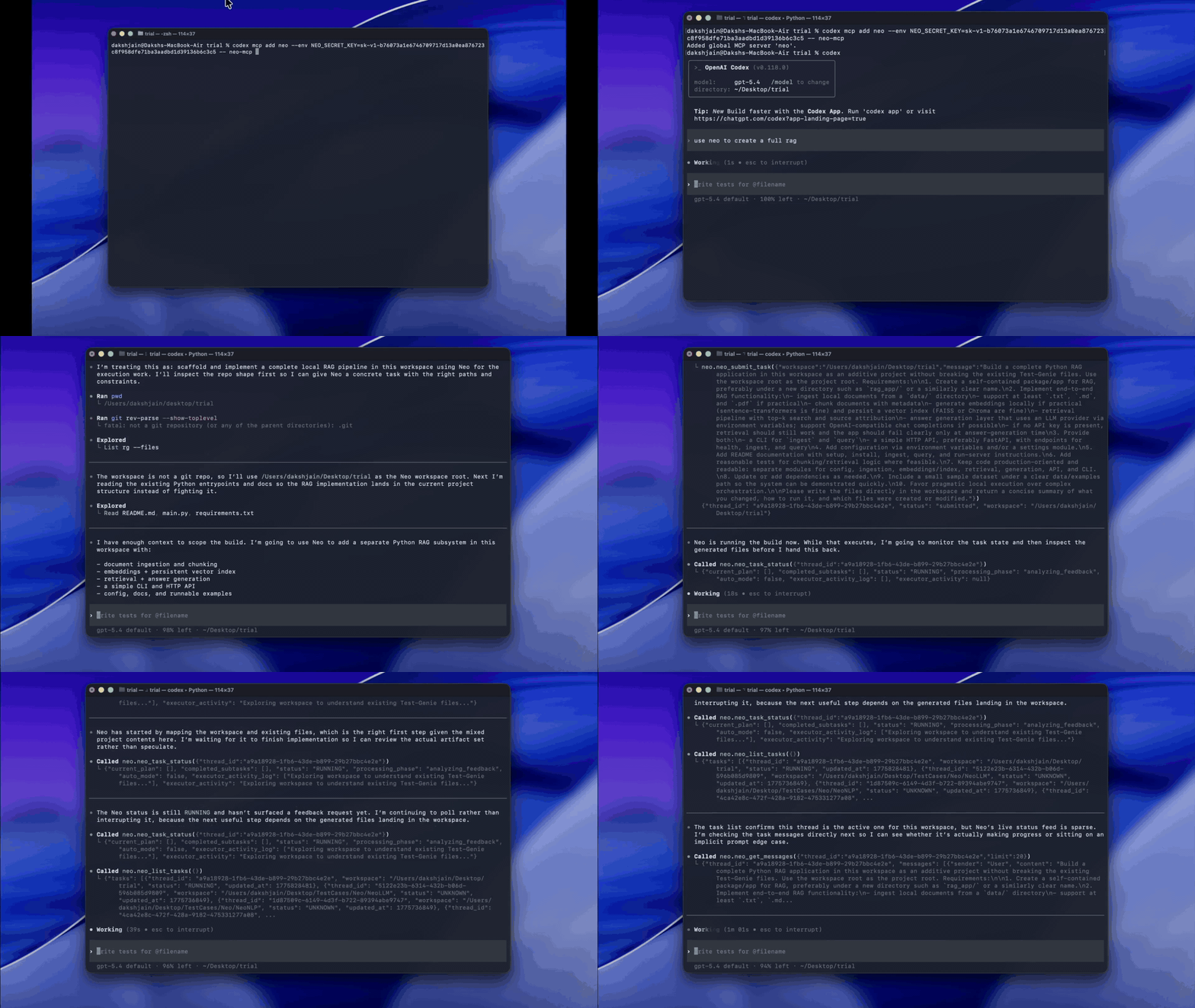
Click to watch the full demo with sound.
What MCP unlocks
- 🧩 Stay in your editor. Drive Neo from Claude Code, Cursor, VS Code (Copilot), Windsurf, Zed, Continue, or Codex. No new app, no context switching.
- 🔬 Go deeper on AI/ML. Autonomous planning, experiments, evaluation, and iteration tuned for real ML work, not just one-shot answers.
- 💾 Local-first. Every output file is written to your machine. Nothing is stored remotely.
What you can build with Neo
- 🤖 Generative AI & LLMs: RAG, semantic search, agents, chatbots, fine-tuning (Llama, Qwen, Gemma), document analysis
- 🧠 ML & deep learning: PyTorch, TensorFlow, scikit-learn training, architecture search, evaluation
- 📊 Data science & analytics: EDA, feature engineering, forecasting, segmentation, A/B testing, reporting
- 👁️ Computer vision: image classification, object detection, OCR
- 🎤 Speech & audio: speech-to-text, text-to-speech, audio classification
- 🔌 Bring your own keys: GitHub, HuggingFace, Anthropic, OpenRouter, OpenAI, AWS S3, Weights & Biases, Kaggle. Stored locally and injected as env vars.
Built for data scientists, ML engineers, analysts, researchers, and PMs who want results, not boilerplate.
Try it
Ask your agent to use Neo. For example:
Use Neo to fix the failing training run and re-run with logging
Benchmark these prompts on our eval set using Neo
Build or debug an end-to-end ML pipeline using Neo
Train a fraud detection model on fraud.csv, optimize for recall
Fine-tune a text classifier on my training data with 5-fold cross-validation
Neo runs the ML work. Your editor handles everything else.
Install
pip install neo-mcp
Requires Python 3.11+.
Tip: use
pipx install neo-mcpto install in an isolated environment and avoid conflicts with your project's virtualenv.
Use Neo from your editor
Replace sk-v1-YOUR_KEY with your actual API key.
After setup, ask your agent: "What Neo tools do you have available?" You should see neo_submit_task, neo_task_status, neo_get_messages, and the rest.
Claude Code
claude mcp add --scope user neo \
  -e NEO_SECRET_KEY=sk-v1-YOUR_KEY \
  -- neo-mcp
Open a new Claude Code session after running this. Neo tools load at session start, not mid-session.
Scope options:
--scope user(global, recommended) ·--scope project(writes.mcp.jsonin current repo) ·--scope local(this machine only)
Verify it registered:
claude mcp list
You should see neo with a green checkmark.
Cursor
Open the config:
- GUI:
Ctrl+Shift+J(Windows/Linux) orCmd+Shift+J(Mac) → Tools & MCP → New MCP Server - Or edit the file directly:
~/.cursor/mcp.json
{
  "mcpServers": {
    "neo": {
      "command": "neo-mcp",
      "env": { "NEO_SECRET_KEY": "sk-v1-YOUR_KEY" }
    }
  }
}
Restart Cursor after editing the file directly. Changes via the GUI apply immediately.
OpenAI Codex CLI
Open the config:
- Run
codex mcpto manage servers interactively via CLI - Or edit the file directly:
~/.codex/config.json
{
  "mcpServers": {
    "neo": {
      "command": "neo-mcp",
      "env": { "NEO_SECRET_KEY": "sk-v1-YOUR_KEY" }
    }
  }
}
Also works with
Windsurf (~/.codeium/windsurf/mcp_config.json):
{
  "mcpServers": {
    "neo": {
      "command": "neo-mcp",
      "env": { "NEO_SECRET_KEY": "sk-v1-YOUR_KEY" }
    }
  }
}
VS Code (GitHub Copilot) (.vscode/mcp.json in your workspace root; requires VS Code 1.99+ and Agent mode):
{
  "servers": {
    "neo": {
      "type": "stdio",
      "command": "neo-mcp",
      "env": { "NEO_SECRET_KEY": "sk-v1-YOUR_KEY" }
    }
  }
}
Zed (~/.config/zed/settings.json):
{
  "context_servers": {
    "neo": {
      "source": "custom",
      "command": {
        "path": "neo-mcp",
        "args": [],
        "env": { "NEO_SECRET_KEY": "sk-v1-YOUR_KEY" }
      }
    }
  }
}
Continue.dev (~/.continue/config.yaml):
mcpServers:
  - name: neo
    command: neo-mcp
    env:
      NEO_SECRET_KEY: sk-v1-YOUR_KEY
More GUI paths and per-editor notes: docs/GUIDE.md
How it works
Your editor  ──MCP──▶  neo-mcp server  ──API──▶  Neo backend
                            │                          │
                            └──────────────────▶  Local daemon
                                                  (writes files,
                                                   runs scripts)
- You describe a task: "Train a fraud detection model on data.csv"
- The editor calls
neo_submit_taskvia MCP - Neo's backend processes the task and sends commands to the local daemon
- The daemon runs on your machine, writing files, running scripts, and installing packages
- Output files appear directly in your workspace
Files are always written to your machine, never stored remotely.
Neo can also store third-party API keys locally (GitHub, HuggingFace, Anthropic, OpenRouter, OpenAI, AWS S3, Weights & Biases, Kaggle) so tasks can use them without asking every time. Keys stay on your machine and are never sent to Neo's backend. Full guide: docs/INTEGRATIONS.md.
Tools
| Tool | Description |
|---|---|
neo_submit_task | Submit an AI/ML task. Returns thread_id immediately. |
neo_list_tasks | List running and recent tasks. Reconnects pollers automatically. |
neo_task_status | Check status: RUNNING / COMPLETED / WAITING_FOR_FEEDBACK / PAUSED / TERMINATED. |
neo_get_messages | Read full task output when COMPLETED. Capped at ~20 000 tokens. |
neo_send_feedback | Reply when Neo asks a question (WAITING_FOR_FEEDBACK). |
neo_pause_task | Pause a running task. |
neo_resume_task | Resume a paused task. |
neo_stop_task | Stop and clean up a task permanently. |
neo_list_integrations | List stored third-party API keys (names only, never the value). |
neo_add_integration | Register a GitHub PAT, HuggingFace token, Anthropic key, or OpenRouter key for Neo tasks. |
neo_test_integration | Call the provider's API to confirm a stored key is still valid. |
neo_remove_integration | Delete a stored key from this machine. |
Integration tools store credentials locally (file mode
0o600under~/.neo/integrations/, or native tool files like~/.aws/credentials,~/.netrc,~/.kaggle/kaggle.json), or your OS keyring ifNEO_INTEGRATIONS_BACKEND=keyring. Keys never leave your machine. Full guide: docs/INTEGRATIONS.md.
Workflow
Standard (tasks over a few minutes):
neo_submit_task  →  returns thread_id
      ↓
neo_task_status  →  poll until COMPLETED or WAITING_FOR_FEEDBACK
      ↓
neo_get_messages →  read full output
Quick task: Pass wait_for_completion: true to neo_submit_task. It blocks until done and returns output directly. No polling needed.
Mid-task question: When status is WAITING_FOR_FEEDBACK, call neo_send_feedback with your reply. Neo resumes automatically.
Reconnecting after closing your editor:
neo_list_tasks   →  all tasks with live status + thread IDs
neo_task_status  →  check the specific task you care about
neo_get_messages →  read output of any COMPLETED task
Environment variables
| Variable | Required | Description |
|---|---|---|
NEO_SECRET_KEY | Yes | API key (sk-v1-...) from heyneo.com/dashboard → Settings → API Keys |
NEO_DEPLOYMENT_ID | No | Pin a specific daemon UUID (auto-generated by default) |
NEO_WORKSPACE_DIR | No | Override workspace directory (useful in Docker or CI) |
NEO_READ_ONLY | No | true = expose only status/message tools; disables submit, stop, and pause |
Diagnostics
neo-mcp status      # daemon and key status
neo-mcp doctor      # full health check; identifies common issues
neo-mcp list        # list known threads
neo-mcp logs --source neo-mcp --lines 100   # MCP server logs
neo-mcp logs --source daemon --lines 100    # daemon logs

# JSON output
neo-mcp status --json
neo-mcp doctor --json
Claude Code logs:
claude mcp logs neo
Troubleshooting
| Symptom | Fix |
|---|---|
neo-mcp: command not found | Re-run pip install neo-mcp, verify with which neo-mcp |
✗ Failed to connect in claude mcp list | Run claude mcp logs neo. Most common cause: NEO_SECRET_KEY not set |
| Neo tools don't appear | Open a new session. Tools load at session start, not mid-session |
Invalid API key (401) | Re-check your key at heyneo.com/dashboard → Settings → API Keys |
Trial or quota ended (403) | Top up at the Neo dashboard |
No healthy deployments available (400) | Daemon failed to auto-start. Restart the MCP server and try again |
| Task submitted but no files written | Daemon stopped mid-task. Check neo-mcp status and restart |
Status stuck on RUNNING | Run neo-mcp doctor to diagnose; restart the MCP server |
| Output truncated | ~20 000 token cap. Use neo_task_status for progress, neo_get_messages for final output only |
Full setup guide (all editors, GUI paths): docs/GUIDE.md · Docs