
xurprise MCP
Agent-native commerce · xurprise. One HTTPS endpoint. Six tools. Zero setup. Multilingual.


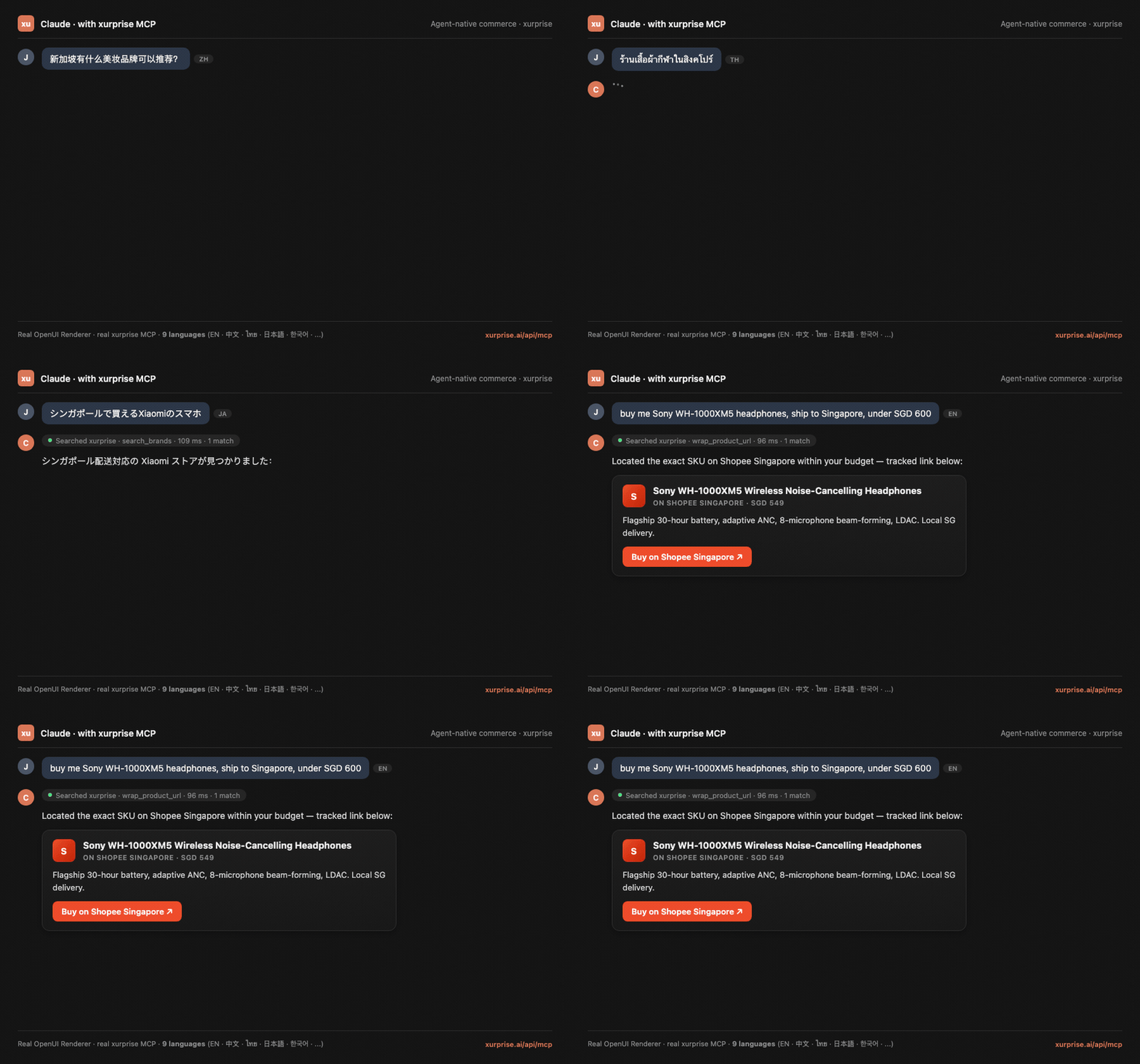
This GIF is recorded from a real page, not a mockup. Visit xurprise.ai/demo to watch it render live in your browser. It runs the official
@openuidev/react-lang<Renderer>against a customBrandCardcomponent, driven by hand-authored openui-lang snippets that wrap the exact JSONxurprise.ai/api/mcpreturns — so what you see is what any OpenUI-based chat client gets when it calls our MCP.
The xurprise MCP server lets any MCP-compatible agent (Claude, Cursor, Cline, Continue, Goose, etc.) discover merchant brands and get attribution-tracked click-through URLs across a curated catalogue spanning Taobao, Shopee, Shein, Xiaomi, Sephora, JD Sports, Airpaz, WPS, FusionHome AI, and more — with region matching built in so agents don't recommend Singapore-only merchants to users in Germany.
Hosted endpoint: https://xurprise.ai/api/mcp
Protocol: Model Context Protocol (MCP) 2024-11-05 over
Streamable HTTP.
Stateless, no auth required, no SDK needed.
Why
Commerce in the agent era has a cold-start problem: when an agent wants to recommend a real merchant, it typically:
- Searches the open web, picks a result based on SEO ranking, and hopes the merchant ships to its user's country.
- Or hardcodes a handful of well-known brands and misses region fit.
xurprise MCP solves this for the niche we cover by giving agents a
machine-readable, region-aware brand catalogue — one call and you
get back a structured list of merchants the user can actually buy
from, with canonical storefront URLs and click-through URLs that log
attribution for us and pass through any aff_sub tag the agent
supplies.
Quick start
Claude Desktop
Edit ~/Library/Application Support/Claude/claude_desktop_config.json
(macOS) or %APPDATA%\Claude\claude_desktop_config.json (Windows).
Option A — native remote HTTP (Claude Desktop ≥ early 2025):
{
  "mcpServers": {
    "xurprise": {
      "type": "http",
      "url": "https://xurprise.ai/api/mcp"
    }
  }
}
Option B — via mcp-remote bridge (any Claude Desktop version):
{
  "mcpServers": {
    "xurprise": {
      "command": "npx",
      "args": ["-y", "mcp-remote", "https://xurprise.ai/api/mcp"]
    }
  }
}
Restart Claude Desktop, open a new conversation, and type something like:
I'm in Singapore. Any good beauty brands I can shop online?
Claude will call search_brands(query="beauty", region="Singapore") and
surface Sephora SG with a click-through URL.
Cursor
Add to ~/.cursor/mcp.json:
{
  "mcpServers": {
    "xurprise": {
      "url": "https://xurprise.ai/api/mcp"
    }
  }
}
Cline / Continue / Goose
Same remote HTTP URL — see each client's docs for the exact config
path. If your client only supports stdio, use mcp-remote as the
bridge (see Option B above).
Raw HTTP (curl, Python, anywhere)
curl -X POST https://xurprise.ai/api/mcp \
  -H 'Content-Type: application/json' \
  -d '{
    "jsonrpc": "2.0",
    "id": 1,
    "method": "tools/call",
    "params": {
      "name": "search_brands",
      "arguments": { "query": "badminton", "region": "Singapore" }
    }
  }'
Tools
Note on response shape. MCP tools/call returns an object with two fields:
content[](text blocks containing JSON) andstructuredContent(the typed result). Per the MCP spec,structuredContentmust be a record (object), not an array — so tools that logically return a list wrap it in a record with aresults/regions/categorieskey. All MCP-compatible clients (Claude Desktop, Cursor, Cline, Continue, Goose, etc.) auto-handle this; you only see it if you're decoding the raw JSON-RPC response yourself.
Multilingual search
The search_brands tool is indexed across 9 language variants so
agents serving SEA users don't have to translate queries to English:
- English, Simplified + Traditional Chinese
- Malay, Indonesian, Vietnamese, Thai
- Japanese, Korean
Verified: 20 test queries in 8 languages, all resolve the same consumer intent to the same brand. A few examples:
| query | language | top-1 match |
|---|---|---|
beauty Singapore | EN | sephora-sg |
新加坡 美妆 | ZH | sephora-sg |
kecantikan Singapura | MS | sephora-sg |
mỹ phẩm Singapore | VI | sephora-sg |
เครื่องสำอาง สิงคโปร์ | TH | sephora-sg |
シンガポール 化粧品 | JA | sephora-sg |
싱가포르 화장품 | KO | sephora-sg |
小米 手机 | ZH | xiaomi-sg |
샤오미 | KO | xiaomi-sg |
机票 / 航空券 / 항공권 | ZH/JA/KO | airpaz-global |
希音 | ZH | shein-global |
The per-brand keyword index covers brand aliases (transliterated names
like 小米 / 샤오미 / シャオミ for Xiaomi), category synonyms
(Fashion / 时尚 / fesyen / thời trang / แฟชั่น / ファッション / 패션),
and region aliases (Singapore / 新加坡 / 싱가포르 / สิงคโปร์ / Singapura).
CJK and Thai queries are tokenized with 2-char n-grams since those
scripts have no whitespace word boundaries.
search_brands
Free-text search over the catalogue. Results are rank-scored on the query against brand name, headline, category, and the multilingual keyword index above.
search_brands({
  query: string,           // required — e.g. "skincare", "Taobao", "athletic shoes"
  region?: string,         // optional — full country name or "International"
  category?: string,       // optional — "Fashion", "Electronics", etc.
  limit?: number,          // optional — default 10, max 50
}) => { results: Brand[], count: number, query: string }
get_brand
Fetch the full record for a slug.
get_brand({ slug: string }) => Brand
list_regions
All shipping regions represented in the catalogue (use before recommending to confirm user's country is covered).
list_regions() => { regions: string[], count: number }
list_categories
All categories represented in the catalogue.
list_categories() => { categories: string[], count: number }
get_click_url
Build the canonical click-through URL. Use this (not the merchant URL
directly) so the click gets logged for attribution, and any aff_sub
you pass will be propagated downstream.
get_click_url({
  slug: string,
  aff_sub?: string,        // optional — up to 200 chars, recommended:
                           // your agent's session id or similar
}) => { click_url: string, slug: string, name: string }
wrap_product_url
Product-level attribution. Use when the user wants a specific item (a particular Sony headphone, a specific Shein dress, etc.) rather than the brand's homepage. You supply any URL on a supported merchant's site — xurprise wraps it into a click-through URL that lands the user on that exact product while preserving attribution tracking.
The agent is expected to discover the merchant URL itself (via its own web search, training knowledge, or MCP tool composition). xurprise is the attribution layer, not the catalogue — this lets you leverage whatever product-discovery capabilities your client already has.
wrap_product_url({
  merchant_url: string,    // required — full https URL on a supported merchant
                           // e.g. "https://shopee.sg/Sony-WH-1000XM5-i.12345.67890"
  product_name?: string,   // optional — surfaces in attribution logs
  aff_sub?: string,        // optional — e.g. your chat session id
}) => {
  click_url: string,       // https://xurprise.ai/go/p?u=...  (302s to the product)
  merchant_url: string,    // canonicalized input
  merchant_hostname: string,
  slug: string,            // which brand the domain maps to
  brand: string,
  name: string,
}
Supported merchant domains (product-level attribution works on any URL within these, even deep paths):
| Brand | Accepted hostname (incl. subdomains) |
|---|---|
| Shopee SG | shopee.sg |
| Xiaomi SG | mi.com |
| Sephora SG | sephora.sg |
| JD Sports SG | jdsports.com.sg |
| Shein | shein.com (any regional subdomain) |
| Airpaz | airpaz.com |
| WPS Office | wps.com |
| FusionHome AI | fusionhome.ai |
| The Trade Wizard | thetradewizard.com |
Taobao is deliberately excluded from product-level wrapping — the
upstream routing for Taobao is whitelist-locked or brand-only, so
product-level attribution isn't reliable there. For Taobao, use
get_click_url with the brand-level slug instead.
Brand schema
Every brand record has:
| Field | Type | Example |
|---|---|---|
slug | string | shopee-sg |
name | string | Shopee — Singapore |
brand | string | Shopee |
categories | string[] | ["Marketplace"] |
regions | string[] | ["Singapore"] |
currency | string | SGD |
merchant_url | string | https://shopee.sg/ |
page_url | string | https://xurprise.ai/brands/shopee-sg/ |
click_url | string | https://xurprise.ai/go/shopee-sg |
headline | string | (1–3 sentence description) |
agent_note | string? | Optional region-routing or caveat guidance |
Current catalogue
As of the latest refresh, 43 brands across region-matched surfaces:
- Marketplace — Shopee SG, Taobao (Ai Taobao International), Taobao (brand-level), Alibaba, Banggood, AliExpress
- Fashion — JD Sports SG, Shein Global, Poplook, Rip Curl SG, Juice Store, Bernardelli
- Health & Beauty — Sephora SG, Kinohimitsu SG, Papique
- Electronics — Xiaomi SG, XP-PEN SG, Stryv SG
- Travel — Airpaz, KKday, Zen Hotels, byFood, TrainPal, Kiwi.com, EasyBook, NINJA WiFi
- Digital Services / Software — WPS, The Trade Wizard, Sider AI, Wegic, iMobie, MyRepublic SG
- Online Courses — Udemy, International Open Academy
- Gaming / Entertainment — UniPin, GameSeal, BINGE
- Gifting & Crafts — Photobook SG, FlowerAdvisor SG
- Home & Living — FusionHome AI, Homestyler
- Automotive — Trapo SG
- Deals / Aggregation — StackSocial
Regional coverage: 12 Singapore-local, 2 Malaysia / SG multi-region, 7 SEA-regional, 22 global.
A handful of brands are exposed as brand-level entries only (attribution redirects
point at the brand homepage, not individual products) — get_brand surfaces the distinction
via the agent_note field when relevant.
For the live list, call list_categories + search_brands or visit
https://xurprise.ai/brands/.
FAQ
Is the catalogue curated or crawled? Curated. Every brand goes through a partner-approval flow and is given a hand-authored headline. We do not scrape.
How fresh is the data?
Regenerated from our internal catalogue on each deploy.
See page_url on each brand and the sitemap lastmod.
Do you track my users?
The /go/{slug} redirect logs {timestamp, slug, user-agent, ASN, country, referer} — enough to distinguish crawler traffic
from human traffic and to attribute clicks across sessions. We do
NOT log raw IPs. Beyond /go/, we do not set cookies or run analytics
on the merchant storefront (that's Shopee/Shein/etc.'s own page).
What happens after a click?
A 302 redirect chain takes the user to the canonical merchant
storefront with attribution preserved end-to-end. Any aff_sub you
pass through get_click_url is carried through the chain.
Can I add my brand? Merchant onboarding is by introduction today. Email xwow.dev@gmail.com if you run a brand in our covered regions (Southeast Asia + China + global-shipping) and want to discuss inclusion.
Who operates this? XWOW Pte. Ltd. (Singapore). Contact: Jiaqi Ge, xwow.dev@gmail.com. xurprise is an independent third-party discovery layer — we don't operate any of the merchant storefronts listed here.
Protocol conformance notes
- Transport: Streamable HTTP (stateless mode — no session id required)
- JSON-RPC 2.0 single requests and batch requests are both supported
- Notifications (no
id) returnHTTP 202 No Content pingmethod is supported for health checks- CORS is wide open (
*) — browser-based MCP clients work
Related
- xurprise.ai — the human landing + per-brand schema.org pages
- xurprise.ai/llms.txt — LLM-friendly site index
- xurprise.ai/sitemap.xml
License
Docs in this repo: MIT (see LICENSE). The MCP server source code is
separate and proprietary to XWOW Pte. Ltd.