MCP Sentinel
Zero-trust MCP security proxy with policy enforcement, PII scrubbing, approvals, and audit trails.
Runs on your machine from its package; the steps are below.
What it does
- Reads
- Writes
- High impact
At most: moves money, runs code or commands, deletes data, or sends messages for you.
What it costs
FreeOdel charges nothing per call. The publisher may charge for its own service.
Runs locally over stdio
This server isn't hosted — your MCP client launches it from a package registry. Use one of the commands below, or drop the config into your client (e.g. Claude Desktop).
Run
npx -y @oaslananka/sentinel
MCP client config
{
  "mcpServers": {
    "mcp-sentinel": {
      "command": "npx",
      "args": [
        "-y",
        "@oaslananka/sentinel"
      ]
    }
  }
}

MCP Infrastructure Suite
The missing infrastructure layer for Model Context Protocol ecosystems.








flowchart LR
    Shared["@oaslananka/shared"]
    Forge["@oaslananka/forge"]
    Sentinel["@oaslananka/sentinel"]
    Atlas["@oaslananka/atlas"]
    Composer["@oaslananka/composer"]
    Bridge["@oaslananka/bridge"]
    Observatory["@oaslananka/observatory"]
    Lab["@oaslananka/lab"]

    Shared --> Forge
    Shared --> Sentinel
    Shared --> Atlas
    Shared --> Composer
    Shared --> Bridge
    Shared --> Observatory
    Shared --> Lab

    Clients["IDE / Agent / SDK clients"] --> Sentinel
    Clients --> Composer
    Composer --> Backends["Backend MCP servers"]
    Sentinel --> Backends
    Forge --> Composer
    Forge --> Sentinel
    Atlas --> Clients
    Observatory --> Sentinel
    Observatory --> Forge
    Lab --> Composer
Why mcp-suite?
Most MCP projects stop at the server boundary. mcp-suite focuses on the harder production layer around it: transport compatibility, trust boundaries, orchestration, discovery, observability, and operator workflows. That makes it useful once you move past a single local demo and start running MCP in teams, CI, or internal platforms.
The suite is built for guarded GitHub-hosted release automation, with every publishable package prepared for public npm publishing under the @oaslananka scope. The monorepo stays strict TypeScript, Turborepo, pnpm, and release-please manifest based.
Compared with one-off MCP utilities, the packages here are designed to compose: shared defines the protocol/runtime baseline, sentinel and composer control traffic, forge orchestrates work, atlas catalogs capability, bridge generates servers, observatory closes the feedback loop, and lab gives contributors a desktop workbench.
Packages
| Package | What it does | Docs |
|---|---|---|
@oaslananka/shared | Shared MCP protocol, transports, auth, retry, telemetry, and testing primitives | Shared docs |
@oaslananka/forge | Pipeline engine for orchestrating MCP tools and external steps | Forge docs |
@oaslananka/sentinel | Zero-trust security proxy with audit, approval, and PII controls | Sentinel docs |
@oaslananka/atlas | Registry API and catalog UI for discovering MCP servers | Atlas docs |
@oaslananka/composer | Aggregation proxy for multiple backend MCP servers | Composer docs |
@oaslananka/bridge | OpenAPI and schema-first MCP server generation | Bridge docs |
@oaslananka/observatory | Metrics, traces, anomaly detection, alerting, and dashboard UI | Observatory docs |
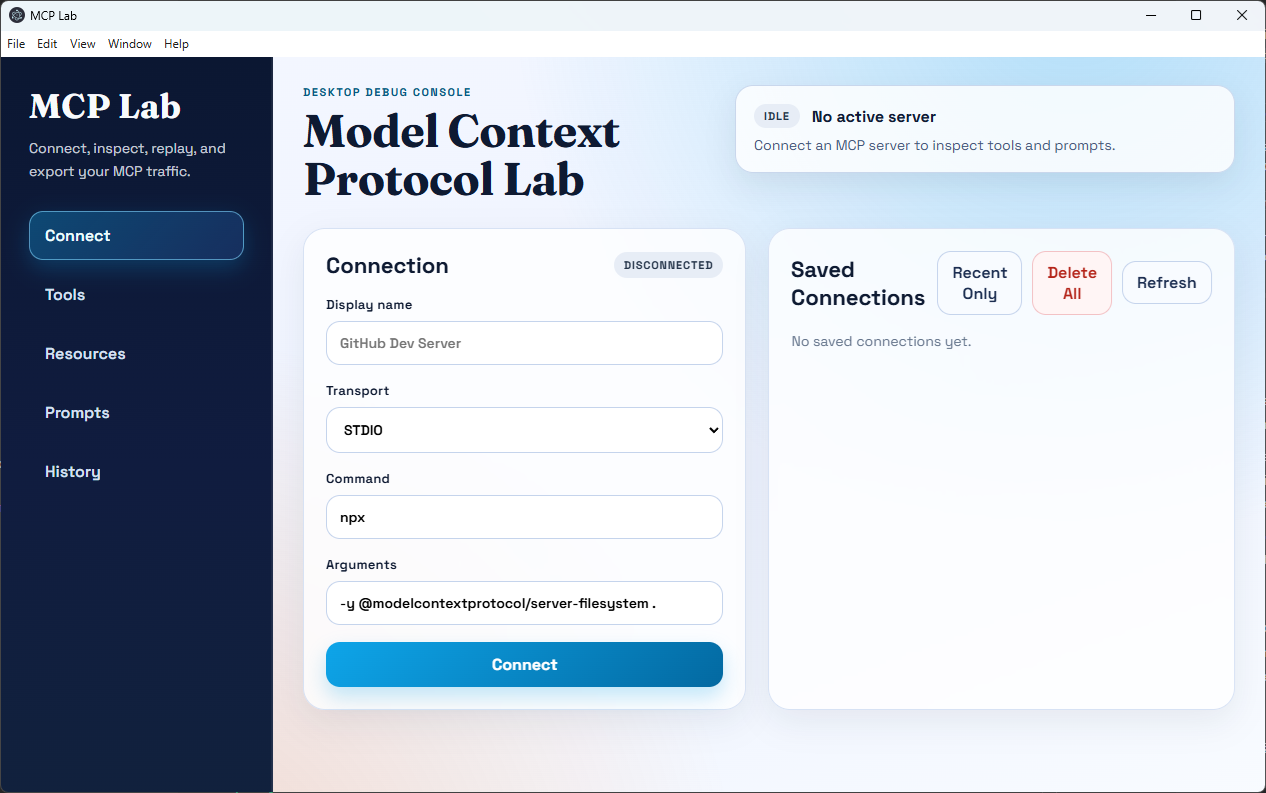
@oaslananka/lab | Electron desktop workbench for connecting to and debugging MCP servers | Lab docs |
MCP Lab Screenshot
Local Playground
The reproducible demo path is a local playground with seeded Atlas and Observatory data:
pnpm install --frozen-lockfile
pnpm build
pnpm run playground:seed
pnpm run playground:atlas
Then start Observatory in another terminal:
pnpm run playground:observatory
Open Atlas at http://localhost:4003, Observatory at http://localhost:4006, and Lab with pnpm --filter @oaslananka/lab dev. Full steps live in the local playground guide.
Quick Start
pnpm install --frozen-lockfile
pnpm build

# Seed and run Atlas
pnpm --filter @oaslananka/atlas exec node dist/cli.js seed --db ./data/atlas.sqlite
pnpm --filter @oaslananka/atlas exec node dist/cli.js serve --db ./data/atlas.sqlite --port 4003

# In another terminal, run Observatory
pnpm --filter @oaslananka/observatory exec node dist/cli.js serve --db ./data/observatory.sqlite --port 4006
Once the services are up:
- Atlas UI: http://localhost:4003
- Atlas health: http://localhost:4003/health
- Observatory UI: http://localhost:4006
- Observatory health: http://localhost:4006/health
Architecture
shared carries the protocol baseline, logger factory, transports, telemetry helpers, and test fixtures used everywhere else. MCP client-facing traffic is typically wrapped by sentinel for policy and audit, then aggregated through composer, or orchestrated from forge. atlas and observatory are HTTP-first operator surfaces, while lab is the developer-facing desktop entry point.
The suite currently defaults to MCP protocol version 2025-11-25 while keeping compatibility helpers for 2025-11-05 handshakes during the 1.0 transition.
Architecture decisions are recorded in the ADR index.
Development
make install
pnpm run format:check
make lint
make typecheck
make test
pnpm run security
make test-coverage
make knip
pnpm run release:dry-run
More setup and workflow guidance lives in docs/development.md, docs/testing.md, docs/security.md, docs/release.md, the generated API reference path in docs/api-reference.md, and the guide docs under docs/guide.
Release Policy
- release-please manifest mode owns version bumps, changelogs, tags, and GitHub releases.
- GitHub Actions builds npm package tarballs, a machine-readable release manifest, SBOM, checksums, and attestations from clean checkout state.
- Production npm publishing is separate, environment-protected, and uses npm trusted publishing/OIDC after checksum, attestation, package-content, and clean-install verification.
- Partial npm publication is resumable: identical immutable versions are skipped, missing versions publish in dependency order, and integrity conflicts fail closed.
- Docs-only, internal-only, and CI-only changes do not publish to npm or update registry metadata.
Contributing
Contributions are welcome. Start with CONTRIBUTING.md, use Conventional Commits for user-visible changes, and keep GitHub Actions parity when adding validation steps. For issue triage, support, stale handling, labels, and maintainer response targets, see docs/governance.md.
Roadmap
@oaslananka/gateway: HTTP-first multi-tenant MCP gateway@oaslananka/sdk: cross-language SDK surface starting with Python- Forge visual editor built on React Flow
- Atlas federation across multiple registry instances
- Observatory exports for Grafana and OTel collector pipelines
- Sentinel policy integration with OPA
License
Apache 2.0 — © 2025-2026 oaslananka