Listed from the MCP registry; nobody on Odel publishes it.

scamgate
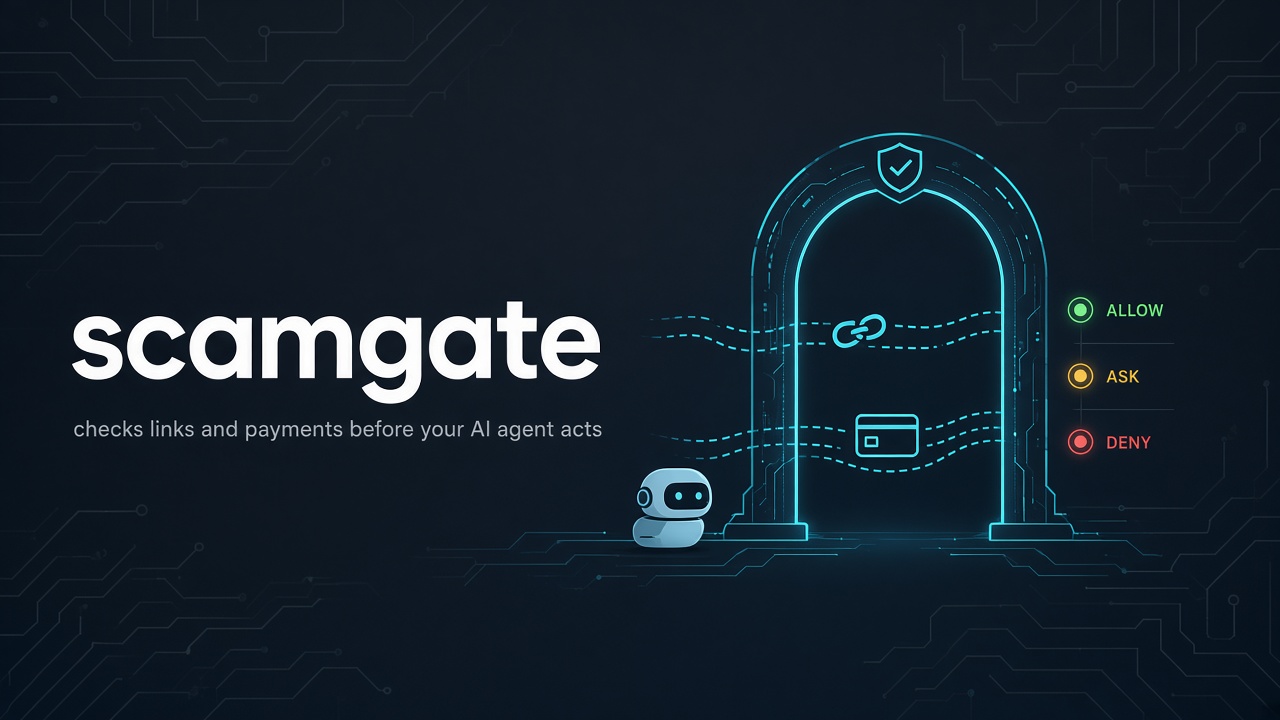
Offline scam check for agents: verify links and payments before acting (allow, ask or deny).
Runs on your machine from its package; the steps are below.
What it does
- Reads
- Writes
- High impact
At most: creates or changes data: records, files, settings.
What it costs
FreeOdel charges nothing per call. The publisher may charge for its own service.
Runs locally over stdio
This server isn't hosted — your MCP client launches it from a package registry. Use one of the commands below, or drop the config into your client (e.g. Claude Desktop).
Run
uvx scamgate
MCP client config
{
  "mcpServers": {
    "scamgate": {
      "command": "uvx",
      "args": [
        "scamgate"
      ]
    }
  }
}
scamgate






A self-hosted scam check for AI agents: verify links and payments before the agent acts.
Website and docs: https://odaiameera.github.io/scamgate/
AI agents now click links and make payments for people, and scammers follow the money. Text planted in pages, listings or messages can steer an agent to a fake shop, a credential prompt or a "pay by bank transfer" request. Agent payment rails secure the payment (tokens, limits, authentication). They don't judge whether the payee or the site is a scam. scamgate does that check, runs locally as an MCP server, and makes no network calls while checking.
How it decides
- Deterministic rules, no LLM judging. The same input always gets the same verdict.
- Each rule that fires adds points and a plain-English reason. The total (capped at 100) decides:
- allow: under 25
- ask (stop and check with the human): 25 to 69
- deny: 70 or more
- The agent gets the decision, the score, every reason, and any warnings (for example a stale feed cache).
Link rules: known-bad-link feeds, your own blocklist, brand look-alikes (typosquats,
homoglyphs, brand names on unofficial domains, real domains used as a prefix like
paypal.com.secure-login.xyz), addresses hidden before an @ (paypal.com@evil.example), raw
IP hosts, punycode, cheap abused TLDs, and pages asking for a seed phrase or a login the task
doesn't need. A link it can't read (an invalid site name, a javascript: or data: link, an
oversized address) asks: it never gets an allow.
Payment rules: new payee plus urgency, changed bank details, irreversible methods (crypto, gift cards, transfer to a new payee), sellers insisting on a method, over budget, pressure or secrecy phrases, and Verification of Payee results.
Quickstart
Requires Python 3.11+.
# with uv
git clone https://github.com/odaiameera/scamgate.git
cd scamgate
uv sync
uv run scamgate update-feeds      # download the known-bad-link feeds into ~/.cache/scamgate

# or from PyPI, pinned to a release
uv tool install scamgate==0.3.3   # or: pip install scamgate==0.3.3
scamgate update-feeds
Using Claude Code? Install the Claude Code plugin instead: it brings the hook, the MCP tools and the feed refresh in one step.
Check a link (real output):
$ uv run scamgate check-url "https://paypa1.com/login" --intent "buy a ticket"
{
  "decision": "deny",
  "risk_score": 100,
  "reasons": [
    {
      "rule_id": "url.lookalike_brand",
      "explanation": "'paypa1.com' disguises 'paypal' with look-alike characters ('paypa1'). The real site is paypal.com.",
      "weight": 60
    },
    {
      "rule_id": "url.intent_mismatch",
      "explanation": "The task is 'buy a ticket', but the link goes to a 'login' page. A credential prompt the task doesn't need is a classic phishing step.",
      "weight": 45
    }
  ],
  "summary": "Do not proceed with this link. Main concern: 'paypa1.com' disguises 'paypal' with look-alike characters ('paypa1'). The real site is paypal.com.",
  "checked_host": "paypa1.com",
  "warnings": [],
  "advisory": "scamgate is advisory. It can miss scams and flag legitimate actions; a human should make the final call on anything flagged."
}
(warnings is empty once feeds are cached. Before update-feeds it says no feed is cached.)
A link listed in a feed comes back with the feed named in the reason:
{
  "rule_id": "url.known_bad_feed",
  "explanation": "This exact link is listed as phishing/malware by OpenPhish community feed.",
  "weight": 100
}
Other commands: scamgate feeds-status, scamgate bench, scamgate serve (MCP over stdio),
plus hook, review, promote and record-payment (see Enforce it with a hook).
Add it to your agent
Claude Code plugin
The easiest way for Claude Code. One install adds the enforcing hook, the check_url, check_payment and
update_feeds tools, and a refresh of the phishing lists every 6 hours. It runs scamgate from PyPI with
uvx scamgate==0.3.3, so it needs uv, and Claude Code v2.1.295 or later so
that a hook that can't start blocks instead of letting calls through.
The plugin installs from this repository, which is its own plugin marketplace. It isn't listed in the plugin directory on claude.ai, so you won't find it by browsing there.
In a Claude Code session:
/plugin install scamgate --marketplace odaiameera/scamgate
Or from your shell:
claude plugin install scamgate --marketplace odaiameera/scamgate
On Claude Code before 2.1.275, run /plugin marketplace add odaiameera/scamgate, then
/plugin install scamgate@scamgate.
New releases don't arrive by themselves: get one with claude plugin update scamgate@scamgate. What the
plugin runs, downloads and stores: claude-plugin/README.md.
MCP server only
Replace /path/to/scamgate with your checkout, or run the PyPI release with uvx scamgate==0.3.3 serve.
Claude Desktop (claude_desktop_config.json):
{
  "mcpServers": {
    "scamgate": {
      "command": "uv",
      "args": ["--directory", "/path/to/scamgate", "run", "scamgate", "serve"]
    }
  }
}
Claude Code:
claude mcp add scamgate -- uv --directory /path/to/scamgate run scamgate serve
Hermes (~/.hermes/config.yaml):
mcp_servers:
  scamgate:
    command: "uv"
    args: ["--directory", "/path/to/scamgate", "run", "scamgate", "serve"]
Then tell the agent: "Call check_url before opening any link and check_payment before any
payment. On ask, stop and show me the reasons. On deny, don't proceed."
MCP tools
check_url(url: str, intent: str | None = None) -> Verdict

update_feeds() -> {updated, failed, not_configured, skipped, summary}

check_payment(payee_name: str, payee_account: str, amount: float, currency: str,
              method: "card" | "bank_transfer" | "crypto" | "gift_card" | "other",
              context_text: str | None = None, is_new_payee: bool | None = None,
              bank_details_changed: bool | None = None, budget: float | None = None,
              vop_result: "match" | "close_match" | "no_match" | "unavailable" | None = None) -> Verdict
Verdict = decision, risk_score, reasons[] (rule_id, explanation, weight),
summary, checked_host (for links: the host a browser would open), warnings[], advisory.
Both check tools are marked read-only and publish this as their output schema, so MCP clients get it as
structured content. update_feeds takes no arguments: it downloads the default lists from their fixed
sources, at most once an hour, so an agent can ask for a refresh but can't choose what lands in the cache.
Enforce it with a hook
The MCP tools only work when the agent chooses to call them, and a prompt injection can tell it not to. The hook moves the check into the harness: the agent can't skip it.
scamgate-hook (or scamgate hook) reads one hook event as JSON on stdin and writes a decision.
It speaks Hermes shell hooks and Claude Code PreToolUse hooks.
- Links: every URL in a web, browser, media, terminal, code or unknown MCP tool call is
checked, including disguised forms (
evilsh%6fp.com,http://3405803781).denyblocks the call,asksends it to you for approval. One bad link in a batch blocks the whole batch. - Payments: money-moving tool calls (wallet, banking or payments MCP tools, or any tool whose
arguments carry an amount and an IBAN, wallet or account) get the same check as
check_payment, with your payee history, whatever the agent claims.denyblocks,asksends it to you. A payment whose payee or amount can't be read, crypto CLIs (cast send,bitcoin-cli sendtoaddress,solana transfer…) and write calls to payment APIs (Stripe, PayPal, Wise, Revolut Business…) go to you. Each approval covers one account and amount. - Hidden code: code that's decoded or downloaded and then run (
… | base64 -d | bash,exec(b64decode(…)),curl … | sh,powershell -enc) goes to you, network keyword or not. - Hidden destinations: a network step scamgate can't read goes to you, judged per command
(
curl https://example.org; curl "$URL"still asks): variables,$(…), string-built, base64/hex-decoded or reversed links,requests.get(open(…).read()), installs of named packages,git clone, new git remotes. In code, only a literal URL counts as readable. - Routine dev work stays quiet: installs from a lockfile, manifest or local path
(
pip install -r requirements.txt,uv sync,npm ci),git push/pull/fetchto remotes you already have, and commands that only read text (grep requests.get src/). Any URL in them is still checked. - Running blind: with no feeds cached, links go to you for approval (
SCAMGATE_NO_FEEDS=warnturns that into a warning). Stale feeds are mentioned in every ask and block. - Tampering: blocks agent writes (including editors like vim/ed/nano and
find -exec,rsync,patch) to scamgate's own code, state and feed cache and to the hook config, plus commands or code that revoke the hook, remove the server, promote rules, record payees or call scamgate's state APIs directly. - The agent's stated reason can only add risk. It's scored with and without the reason, and the higher score wins.
- Approvals stay narrow. Hermes remembers "always" per
rule_key; scamgate's keys include the host and the rules that fired (or a hash of the hidden command), so one "always" can't pre-approve other destinations. Still, pick "once" for asks you don't expect to repeat. - Fails closed: bad input, input over 2 MB, deep nesting or an internal error blocks the call (exit 2).
- Stays fast on long commands. The hook reads a command's words in one linear pass (no
shlex), so a padded command can't tie it up: a 2,000,000-character quoted command takes about 5 s on one Windows machine, down from over 200 s. Decisions are unchanged. - Never says "allow". Silence means "no objection", so it can only tighten your agent's permissions, never loosen them.
Pipeline
hook.handle() is the only enforcement function. The shell hook and the Hermes plugin both call it. MCP does not.
- Integrity check on a wheel install. A mismatch blocks every gated call. Editable and unpackaged installs pass as
dev. - scamgate's own
check_url/check_paymenttools return silence, so asking the gate is not itself blocked. - Tamper: writes to the package, state, feed cache, hook config, and other Hermes profiles, plus commands that uninstall the gate or call
promote/record-payment. - Extra checks: reading the signing key; Hermes safety switches (
approvals.mode off,--yolo,plugins uninstall,--safe-mode,--dangerously-skip-permissions); writes to files other tools run; cron scripts under$HERMES_HOME/scripts; script files named bybash/python/node/pwsh/uv run, followed a few levels deep. - URL extraction.
https:/hostandhttps:///hostare rewritten tohttps://host. Hosts are NFKC-normalised, percent-decoded, and numeric IPv4 is expanded. Segments split on newlines,;,&&,||and|. - Score each URL with and without the agent's reason. Take the higher score, then the worst decision. An unreadable destination asks. More than 20 clean URLs asks.
- A payment result wins a tie with a generic network ask. A URL deny still beats a payment ask.
- Render
{}for silence, Hermesblock/approve, or Claudedeny/ask. Log the ask or deny.
rule_key is the host plus the rule ids, or a hash of the opaque command. One "always" does not cover another host.
The plugin sees per-chat /yolo and approvals.mode: off, and turns an ask into a block unless when_approvals_off is allow. The shell hook cannot see that session state. Measured on one Windows machine: about 0.5–0.7 s per shell-hook process, about 10 ms in-process. Not a benchmark suite.
It does not see a redirect after the request has left, the behaviour of a compiled binary, or a script that is not named in the call. Same-user code outside the agent can still read the signing key. Details: docs, Mechanics.
Hermes (~/.hermes/config.yaml). Needs a Hermes build whose shell hooks understand
"action": "approve" (older builds dropped it, turning every ask into a pass; fixed in issue
#92553, Sep 2026). Hermes asks you to approve a new hook the first time it runs in an interactive
session. Check it with hermes hooks list or hermes hooks doctor:
hooks:
  pre_tool_call:
    - matcher: ".*"          # scamgate passes non-network tools straight through
      command: "scamgate-hook"
      timeout: 15
      fail_closed: true
  post_tool_call:   # optional: records whether you approved each ask
    - matcher: ".*"
      command: "scamgate-hook"
      timeout: 15
Note: with the shell hook, /yolo or approvals.mode: off auto-approves every scamgate ask
(blocks still hold). The Hermes plugin below turns those asks into blocks instead, unless you set
plugins.entries.scamgate.settings.when_approvals_off: allow.
Hermes plugin (preferred). Same checks as the shell hook, in-process,
about 50× faster, and it can see a per-chat /yolo. Needs Hermes 0.19.1+. It's in the Hermes plugin
catalog, or install the src/scamgate directory as a plugin. It registers pre_tool_call,
scamgate_check_url, scamgate_check_payment, scamgate_update_feeds, /scamgate status | review | update and hermes scamgate update-feeds | feeds-status. It keeps the phishing lists fresh by itself:
see In the Hermes plugin. A plugin install has no scamgate command on
PATH; use /scamgate or hermes scamgate instead.
The Claude Code plugin sets this up for you. To wire it by hand instead:
Claude Code (.claude/settings.json). Needs Claude Code v2.1.295+ for onFailure.
Without it, a hook that crashes, times out or can't start lets the tool call through:
{"hooks": {
  "PreToolUse":  [{"matcher": ".*",
                   "hooks": [{"type": "command", "command": "/absolute/path/to/scamgate-hook",
                              "timeout": 15, "onFailure": "block"}]}],
  "PostToolUse": [{"matcher": ".*",
                   "hooks": [{"type": "command", "command": "/absolute/path/to/scamgate-hook"}]}]
}}
Use the absolute path (uv tool dir --bin shows it) so nothing earlier on PATH can stand in for
the hook.
Install a pinned copy for the hook (uv tool install scamgate==0.3.3, or git+https://github.com/odaiameera/scamgate@v0.3.3)
rather than running from a source checkout: an installed copy checks its own files against the
hashes recorded at install time on every call, and blocks everything if they changed. A source
checkout has nothing to check against.
Each gated call costs one process start (about 0.7 s on Windows). Calls that don't touch the network, or scamgate's files, pass straight through.
Ask log, review and promote
Every ask and deny is logged to $SCAMGATE_STATE_DIR (default ~/.local/state/scamgate)
with redacted targets, the rules that fired, the score, the agent's stated reason (stored for
you to read and marked untrusted; in scoring it can only add risk) and whether you then let it run.
scamgate review --days 7                       # which hosts keep tripping it, and what you did
scamgate promote --host shop.example --decision deny
scamgate promote --host shop.example --decision allow --rule url.userinfo
Only a person can add an override. promote asks for confirmation, and refuses to run without an
interactive terminal or inside a known agent (Claude Code, Hermes, Codex), even when an agent
imports scamgate's code directly. Every override line is signed with a key in the state dir, so a
line typed into the file any other way is ignored. A deny covers the host and its subdomains.
An allow is narrow: it waives one rule on one exact host, and can never waive known-bad
feeds, your blocklist, intent checks or your own deny rules, so an attacker can't train the gate
into trusting a whole domain.
Payee history
check_payment doesn't take the agent's word for is_new_payee. It looks the payee up in a
local history of people you've actually paid (stored as salted hashes, never names or account
numbers). It flags:
- a payee you've paid before showing up with a different account (changed bank details);
- a near-name with a new account ("Acme Trading Ltd", "Acmee Ltd", a Cyrillic "е" in "Acme"): the classic invoice-redirection trick;
- an account you've paid before under a different name;
- an agent calling a payee "known" when there's no record of paying them (adds risk).
Only you add to it, after a real payment, the same way as overrides: interactive, not inside an agent, signed lines. If the history's key or salt goes missing, every payee is treated as new with changed details, rather than silently forgetting everyone.
scamgate record-payment --payee "Acme Ltd" --account IE29AIBK93115212345678
Domain age (opt-in)
New domains are a strong scam-shop signal (url.domain_age, 30 points under 30 days old). Looking
one up asks the domain's registry over RDAP, which tells the registry which site you're checking,
so it's off unless you choose:
SCAMGATE_RDAP | What happens |
|---|---|
off (default) | No lookups. The rule never fires. |
cache | Uses ages already cached; never goes online. Fill the cache with scamgate domain-age HOST. |
live | Looks up unknown domains (3 s timeout) and caches the answer for a year (failures for 7 days). |
Official brand domains, shared platforms, IPs and localhost are never looked up. Registries come from IANA's RDAP bootstrap list, cached in the feed cache dir.
Known-bad-link feeds
Only a feed refresh touches the network: scamgate update-feeds, the MCP update_feeds tool,
scamgate serve started with SCAMGATE_AUTO_UPDATE=1, or in the Hermes plugin
/scamgate update, hermes scamgate update-feeds, the scamgate_update_feeds tool and the background
refresh. They all use the same downloader. Checks read a local cache. No feed data is bundled in this repo.
scamgate update-feeds            # default feeds
scamgate update-feeds --all      # also the large opt-in feed
scamgate update-feeds -f openphish
scamgate feeds-status
The cache lives in $SCAMGATE_CACHE_DIR, else $XDG_CACHE_HOME/scamgate, else ~/.cache/scamgate.
Each feed keeps its own files, and meta.json records fetch time, source and counts. A failed
download keeps that feed's previous cache. Verdicts warn when no feed is cached or a feed is older
than 24 hours. A running MCP server picks up a refreshed cache without a restart.
| Feed | Default | Source | License / terms |
|---|---|---|---|
openphish | yes | OpenPhish community feed | OpenPhish Terms: personal, non-commercial use only, no redistribution. Commercial use needs OpenPhish's written consent |
phishing_database_domains | yes | Phishing.Database active domains | MIT |
phishing_database_links | --all | Phishing.Database active links (~65 MB download) | MIT |
urlhaus | if key set | abuse.ch URLhaus online malware URLs | Free abuse.ch Auth-Key required (SCAMGATE_URLHAUS_AUTH_KEY). Fair-use terms; commercial use may need a paid plan |
You are responsible for following each feed's terms. Not used: PhishTank (new registrations are disabled) and Google Safe Browsing / Web Risk (non-commercial only, or paid).
Matching: an exact listed URL scores 100, an exact listed host 75, and a subdomain of a listed domain (domain feeds only) 50.
A long-running scamgate serve can refresh by itself: start it with SCAMGATE_AUTO_UPDATE=1 (the Claude
Code plugin does this unless you turn auto_update_feeds off). It downloads only when the lists are 6
hours old. Otherwise, refresh with cron, for example every 6 hours:
0 */6 * * * cd /path/to/scamgate && uv run scamgate update-feeds >> ~/.cache/scamgate/update.log 2>&1
In the Hermes plugin
The plugin refreshes the default feeds by itself: about two minutes after Hermes starts, and then every 6 hours while Hermes runs. No cron line needed. A lock file in the cache folder makes sure only one Hermes process downloads at a time. Failures are logged and keep the old lists. To refresh by hand:
/scamgate update                  # in a chat
hermes scamgate update-feeds      # in a terminal
hermes scamgate feeds-status
Agents get a scamgate_update_feeds tool so they can refresh stale lists themselves. It takes no
arguments: it always downloads the default feeds from their fixed sources into the configured cache,
and does nothing if they were refreshed in the last hour. An agent can ask for a refresh but can't
choose what is downloaded or where it goes. Shell commands that call the downloader with their own
arguments are blocked, and direct writes to the cache folder still are.
Turn the background refresh off with plugins.entries.scamgate.settings.auto_update_feeds: false or
SCAMGATE_AUTO_UPDATE=0. The refresh sends nothing about the links you check: it downloads whole
lists.
Your own blocklist: src/scamgate/data/blocklist.txt (or $SCAMGATE_BLOCKLIST). It
ships with a few made-up .example domains.
False positives
Feeds list single bad pages on big shared platforms (Google Docs and Sites, Firebase storage,
Microsoft login, Discord CDN, link shorteners). Flagging those whole hosts would block normal
sites. For domains under lists.feed_host_ignore in
rules.yaml (and their subdomains), and for official brand
domains, only an exact URL listing counts. One phishing page on x.vercel.app never flags
vercel.app. The trade-off: a scam on a subdomain of an ignored platform is only caught by exact URL.
Configuration
Weights, thresholds, brand lists and word lists live in
src/scamgate/config/rules.yaml. Point SCAMGATE_CONFIG at
your own copy to override it. To add a rule, write a function in
src/scamgate/rules/ decorated with @register("url.my_rule", kind="url"),
give it an entry under rules: in rules.yaml, and add tests and a scenario.
Bench and tests
scenarios/ holds 24 hand-written example cases (17 scam, 7 legit), each with
an expected decision.
$ uv run scamgate bench
...
Scams: 17  caught: 17  missed: 0
Legit: 7  false positives: 0
Exact decision match: 24/24
This is a regression check for the rules, not a real-world detection rate. uv run pytest
runs the unit tests (1013 at v0.3.3; CI runs them on Python 3.11–3.13). They use fixtures and never touch the network.
Limits
- Advisory by default. Over MCP it only warns, and the agent has to call it. Install the hook to enforce it. Even then it only sees tool calls: a link the agent reaches by a redirect, or a destination hidden in a variable, needs your approval rather than a check.
- Heuristic rules miss scams that don't match them and sometimes flag legitimate actions.
Treat
allowas "no known red flags", not "safe". - Domain age needs opting in (
SCAMGATE_RDAP=cacheorlive, see below), because a live lookup tells the domain's registry which site you're checking. - Known trade-offs: a word one letter off a long brand (
stripes.comvsstripe) still asks. A bank transfer to a new payee asks (25) unless your bank's Verification of Payee matched the name; card payments to new payees don't. - The hook sees a tool call's arguments, not what a program does once it runs: a local script,
binary or package install script that opens the network is invisible unless the command line
shows it. Code that is decoded or downloaded and then run (
base64 -d | bash,exec(b64decode(…)),powershell -enc) asks. - The brand pack covers about 50 of the most-phished brands plus Irish/UK banks, couriers and
services; add your own under
lists.brands. Registrable domains use a curated suffix list (country second-levels and shared hosts likegithub.io,vercel.app), not the full PSL. - Payee history only knows payees you've recorded with
record-payment. scamgate doesn't verify IBANs or call your bank. - Tamper protection stops an agent's normal tools: writes to scamgate, its state and feed
cache, its virtualenv (a new
.pthfile fails the integrity check),~/.claude(settings, hooks and installed plugins) and project.claude/settings*.json, and the Hermes config, however the path is spelled (~,$HOME, globs,cd+ relative,./,//,..). A path only counts when it names the folder itself:~/.cache/scamgate-feeds.logis not inside~/.cache/scamgate. Commands that only read (ls,cat,head,tail,grep,rg,find,stat,which,wc,du,sha256sum) pass on protected paths as long as they have no redirect other than to/dev/null, no$(…)or backticks, and no-exec,-delete,-fprintor--pre. Agent commands that disable or remove a Claude Code plugin, or start Claude in bare mode (which skips every hook), are blocked too. It isn't a sandbox: code running as you can read the signing key and rewrite any file, and code can be written to slip past pattern matching. For the strongest setup, give the agent no direct shell access, install scamgate where the agent's user can't write (uv tool installas another user, or read-only), and for Claude Code put the hook in managed settings withallowManagedHooksOnly. - Hermes trusts a hook by its command string, not its file hash, so it won't notice if the installed scamgate is replaced. The integrity check covers edits to the installed files.
Disclaimer: scamgate is not financial, legal or security advice, and it doesn't replace your bank's fraud controls, Verification of Payee, or human judgement.
Roadmap
- IBAN checksum validation and Verification of Payee integration
- Redirect after-check: re-check the page a browser actually landed on
- Optional local model as a tie-breaker on vague cases only, never overruling a hard rule
- Full Public Suffix List (optional, cached)
- More scenarios based on real fraud typologies
Contributing
Issues and pull requests are welcome, especially new rules, scenarios (scam and legit) and
false-positive reports. Please include a test or scenario with each rule change, and keep checks
offline and deterministic. Read CONTRIBUTING.md before you start, and
report security bugs privately (SECURITY.md). See AGENTS.md for repo conventions.
Thanks to @simin-yuan for the first outside contributions: the report in #20 and the fixes in #21 and #22 that made the hook linear on long commands.
License
MIT. Feed data is not included and stays under each provider's own terms.