Listed from the MCP registry; nobody on Odel publishes it.
Is this yours? Claim it
MCP Readiness
Scan a public MCP server: readiness score, tokens per turn, and key findings.
One address for any MCP client. No sign-in needed on this server.
What it does
1 read
Grouped by tool name. At most: only reads or looks up information.
What it costs
FreeOdel charges nothing per call. The publisher may charge for its own service.
Tools
1 · grouped by tool name · checked 25 Nov 2026Read · 1Look things up
- scan_mcp_server
mcp-readiness-check
Live MCP readiness and context-cost scanning. It connects to your running MCP server the way Claude, ChatGPT and Cursor do, then scores OAuth discovery, safety annotations, Origin/CORS, schemas, and the tokens your tool list costs on every agent turn. It is built on a 13 Nov 2026 scan of 15,067 live servers from the official MCP registry (State of public MCP servers, Nov 2026).
Is your MCP server ready for real agents?
CI quick start: badge and PR gate in 3 steps
Full guide with troubleshooting: https://mcp.pacerai.fit/docs/ci/
- Scan your server free at https://mcp.pacerai.fit (no sign-up).
- Add the badge to your README (swap in your URL):
markdown
[](https://mcp.pacerai.fit/s/your-server.example.com/mcp) - Add the Action as
.github/workflows/mcp-readiness.yml:yamlname: MCP readiness on: [pull_request] jobs: mcp-readiness: runs-on: ubuntu-latest steps: - uses: Om3rr/mcp-readiness-check@v1 id: mcp with: url: https://your-server.example.com/mcp fail-under: 80 # fail below this score (default 70, 0 never fails) max-context-tokens: 8000 # fail if tools/list costs more tokens per turn (default 0 = off) - run: echo "Score ${{ steps.mcp.outputs.score }}, ~${{ steps.mcp.outputs.context-tokens }} tokens per turn"
Local server in CI: start it in the job, wait for the port, then scan localhost:
      - run: |
          PORT=8787 npm start &
          for i in $(seq 1 30); do curl -s -o /dev/null http://127.0.0.1:8787/mcp && break; sleep 1; done
      - uses: Om3rr/mcp-readiness-check@v1
        with:
          url: http://127.0.0.1:8787/mcp
          fail-under: 80
          max-context-tokens: 8000
| Input | Default | What it does |
|---|---|---|
url | required | Streamable HTTP endpoint: public https URL or http://127.0.0.1:PORT/mcp |
fail-under | 70 | Fail below this score (0-100); 0 never fails |
max-context-tokens | 0 | Fail if the tool list costs more tokens per turn; 0 disables |
token | "" | Bearer token (from secrets) to scan tools behind login |
json-path | "" | Write the JSON report here |
api-key | "" | Optional license key; not needed for the free tier |
Outputs: score, context-tokens, findings, mode.
Troubleshooting
- OAuth discovery fails: on 401, send
WWW-Authenticate: Bearer resource_metadata="…/.well-known/oauth-protected-resource", serve RFC 9728 metadata withauthorization_servers, and RFC 8414 metadata on the authorization server. Passtokento scan tools behind login. - Foreign Origin / CORS flagged: validate
Originand return 403 for unknown origins; keepAccess-Control-Allow-Originto an allowlist. On localhost this is a fail (DNS rebinding). - Timeouts or connection refused: each request waits up to 15 s. Wait for the server to start (loop above), bind to the port in
url, and use the Streamable HTTP path, not SSE-only or stdio. - Token budget fails: shorten tool descriptions and schemas, or set
max-context-tokens: 0while you work on it. - First run too strict: start with
fail-under: 0, fix the top issues, then raise it.
GitHub Action: MCP Readiness Scan (free tier, 50 runs/day per repo)
- uses: Om3rr/mcp-readiness-check@v1
  with:
    url: http://127.0.0.1:8787/mcp   # start your server earlier in the job
    fail-under: 80
    max-context-tokens: 8000
Outputs: score, context-tokens, findings, mode. Listing text: MARKETPLACE.md.
Badge (links to your server's own public report page): [](https://mcp.pacerai.fit/s/your-server/mcp)
Hosted scan service and scan_mcp_server remote tool: https://mcp.pacerai.fit — see Use from your agent (MCP). The Worker also stays at https://mcp-readiness.omer20sh.workers.dev for the API, badges, and GitHub Action. See worker/
Free tier: score gate, context-token budget, top 3 issues per run, 50 runs/day per repo, plus this CLI (unlimited, local).
Heavy tool list? The fix step is ToolSlim. Its free lossless optimizer cut Notion's official server from 17,477 to 5,213 tokens per call (70.2%, 13 Nov 2026): npx toolslim <url> --fix.
Fix step: ToolSlim, in the same Action
- uses: Om3rr/mcp-readiness-check@v1
  with:
    url: http://127.0.0.1:8787/mcp
    fix: safe                 # off | safe (lossless) | standard | aggressive
    fix-out: tools.slim.json
The CLI's --json (and --json-out FILE, or the Action's json-path input) includes target and the raw tools list, so toolslim --report scan.json never re-connects to your server. See ToolSlim INTEGRATION.md.
CLI
A zero-dependency CLI (Node 18+) that scores an MCP server's production readiness in about a second and writes a Markdown report you can hand to a team.
node bin/mcp-readiness-check.js https://your-server.example/mcp --token $TOKEN   # Streamable HTTP
node bin/mcp-readiness-check.js --stdio node path/to/server.js                    # stdio servers
node bin/mcp-readiness-check.js <url> --json                                      # machine-readable, exit 1 on any ❌
node bin/mcp-readiness-check.js <url> --html report.html                          # self-contained HTML report (light/dark)
node bin/mcp-readiness-check.js --batch servers.txt --out reports/                # scan many, writes reports/index.html
npm test
What it checks
| Area | Checks |
|---|---|
| Tool poisoning | Instructions aimed at the model inside tool metadata: "ignore previous instructions", <IMPORTANT> tags, "don't tell the user", references to .ssh / .env / API keys, invisible or bidi unicode, long base64 blobs |
| Human-in-the-loop | State-changing tools (delete_*, send_*, pay_*, approve_*, exec…) without readOnlyHint / destructiveHint annotations; servers with no annotations at all |
| Schemas | inputSchema missing or not type: object, untyped args, no required list, duplicate or non-portable tool names, vague or bloated descriptions, too many tools |
| Transport security | Plain HTTP to a remote host, Origin not validated (the spec's DNS-rebinding MUST), wildcard CORS, tools/list or tool calls that work with no credentials |
| OAuth (2025-06-18) | For servers that return 401: WWW-Authenticate with resource_metadata, RFC 9728 protected-resource metadata, RFC 8414 authorization-server metadata, PKCE S256, dynamic client registration, and detection of the legacy 2025-03-26 flow |
| Prompts and sessions | Poisoning in prompts/list metadata; guessable Mcp-Session-Id; stack traces or file paths leaking in errors; generic tool names that collide across servers; missing tool titles; old protocol versions |
| JSON-RPC hygiene | -32601 for unknown methods, no 5xx on unknown tools, protocolVersion, serverInfo, server instructions |
Scoring: start at 100, −15 per ❌, −5 per ⚠️. It is a surface scan, not a substitute for an architecture review of auth, data flows and approval gates.
Use from your agent (MCP)
The hosted scanner is also a free, live remote MCP server at https://mcp.pacerai.fit/mcp (Streamable HTTP, no license key). Add that URL as a remote server in your agent, then call the scan_mcp_server tool with the https URL of an MCP server you own or are authorized to test.
{
  "mcpServers": {
    "mcp-readiness": {
      "type": "streamable-http",
      "url": "https://mcp.pacerai.fit/mcp"
    }
  }
}
The tool returns a readiness score, an estimate of tokens per turn for the tool list, key findings, and a link to the full results page. Calls are rate-limited (10 per minute and 100 per day per client). This is a surface scan, not a security audit. There is no paid or Pro gate on this tool.
The same endpoint is also served at https://mcp-readiness.omer20sh.workers.dev/mcp.
Origin policy
POST /mcp follows the MCP Streamable HTTP rule that servers MUST validate Origin:
- Requests with no
Originheader (server-side agents and CLIs) are allowed. - Browser requests are allowed only from the site's own origins,
https://mcp.pacerai.fitandhttps://mcp-readiness.omer20sh.workers.dev, plushttp/httpslocalhost,127.0.0.1, and::1(any port) for local inspectors such as MCP Inspector. - Any other
Originreceives HTTP 403 with a JSON-RPC error (-32000, "Origin not allowed"). - Allowed browser responses include
Access-Control-Allow-Originset to that origin (not*), plus the sameAccess-Control-Allow-MethodsandAccess-Control-Allow-HeadersasOPTIONS. The server is stateless and does not issueMcp-Session-Id.GET /mcpremains 405.
Examples
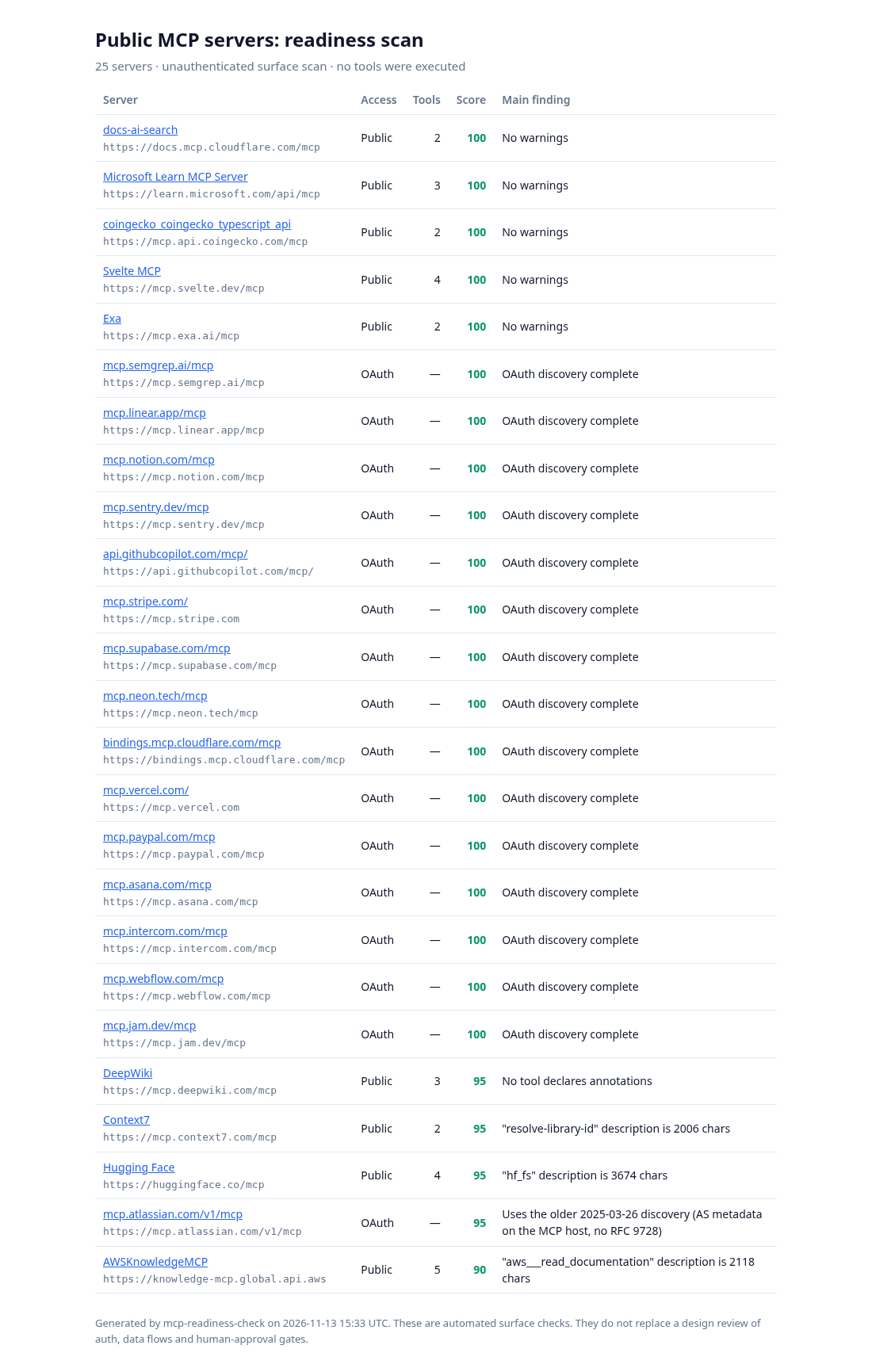
- Scan of 25 public MCP servers (HTML), covering Stripe, Notion, Linear, Sentry, GitHub, Supabase, Vercel, PayPal, Cloudflare, Microsoft Learn, AWS Knowledge, Hugging Face, Context7, DeepWiki and more. The big vendors are in good shape. The gaps are bloated tool descriptions, missing annotations, and one legacy OAuth flow.
- Before/after on our own gateway: agent-commerce-mvp v0.3 (HTML) scored 60/100: it accepted foreign Origins, sent wildcard CORS, and had no annotations on its write tools. After the fixes, v0.4 (HTML) scores 100/100.
Media (docs/media): CLI run (GIF) / MP4 · HTML reports walkthrough (MP4) · screenshots: scan light, scan dark, report before, report after
License
MIT © 2026 Omer Shacham