SecHelix
Evidence-first security review of authorized repositories. Read-only, root-confined, no shell.
Runs on your machine from its package; the steps are below.
What it does
- Reads
- Writes
- High impact
At most: only reads or looks up information.
What it costs
FreeOdel charges nothing per call. The publisher may charge for its own service.
Runs locally over stdio
This server isn't hosted — your MCP client launches it from a package registry. Use one of the commands below, or drop the config into your client (e.g. Claude Desktop).
Run
uvx sechelix
MCP client config
{
  "mcpServers": {
    "sechelix": {
      "command": "uvx",
      "args": [
        "sechelix"
      ]
    }
  }
}
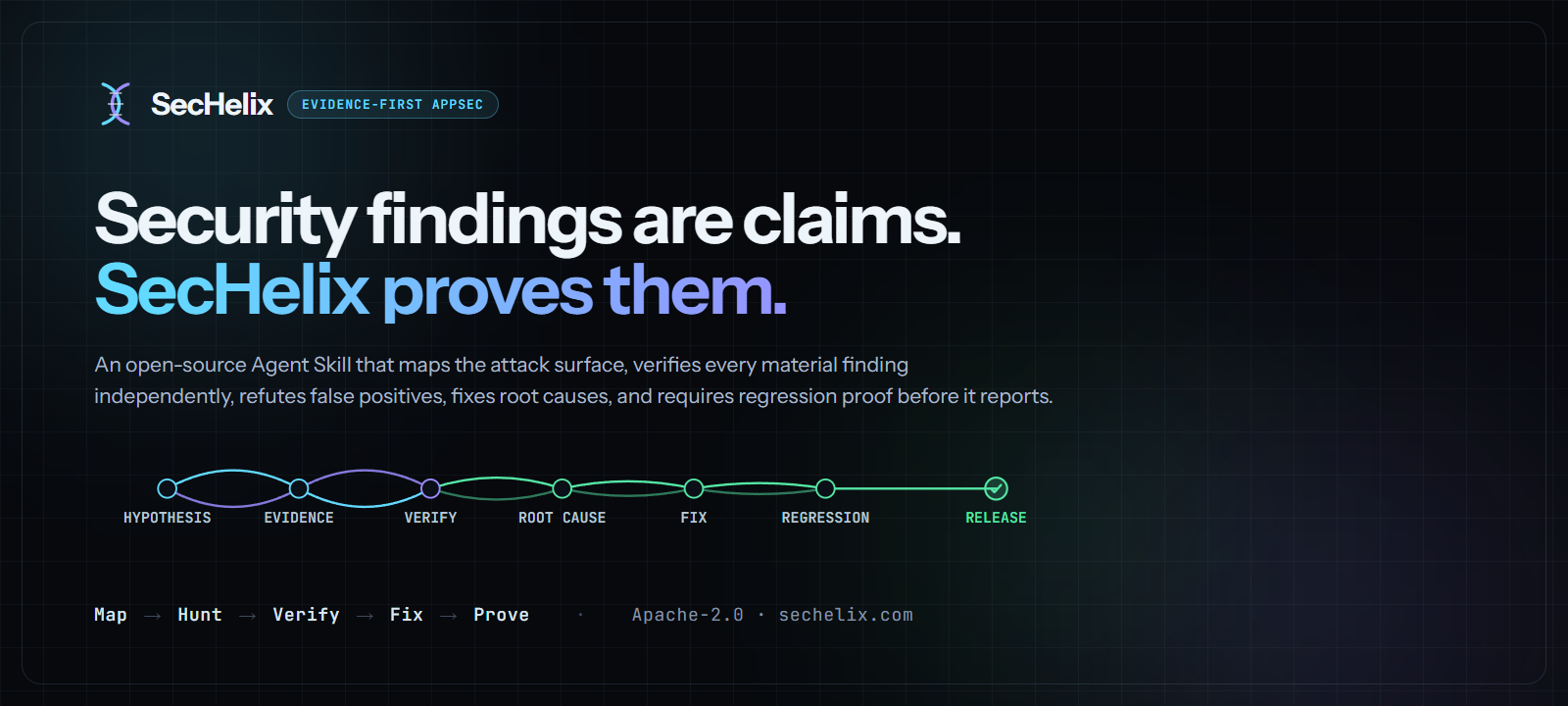
Most AI security tools try to find more. SecHelix tries to prove itself wrong.


SecHelix
Every candidate finding goes to an independent verifier whose only job is to disprove it. The
report shows you what it refuted and why — and returns INCOMPLETE rather than a clean PASS when
it could not actually check.
Open source, Apache-2.0, for code you own or are authorized to test. Runs in Claude Code, Codex, Copilot and other Agent Skills-compatible agents; the Python runtime is optional.
It helps a coding agent:
- map the attack surface and trust boundaries;
- review only security checks that apply to the project;
- investigate authentication, authorization, business logic, injection, SSRF, files, supply chain, AI/MCP and other security surfaces;
- verify important candidates instead of reporting guesses;
- fix the root cause;
- add regression proof and retest;
- return a clear release decision.
See it work in 90 seconds
git clone https://github.com/omarmohelal/SecHelix && cd SecHelix
python examples/expense-api/prove.py
A small multi-tenant API with two candidate issues. One is a real cross-tenant read that a scanner walks past, because the endpoint does have an authorization check — it just checks the wrong thing. The other is f-string SQL that every pattern matcher flags and that is not exploitable at all.
Walkthrough, root cause, the two-line fix and the regression proof: examples/expense-api.
Or take the same test in your browser — ten cases, three of them decoys, no signup: Can you tell the real bug from the decoy?
Install
Recommended for Agent Skills-compatible coding agents:
npx skills@latest add omarmohelal/SecHelix --skill sechelix
Then open the repository you want to review in your coding agent. The skill installs instructions and data only — no executable code. The optional runtime below is a separate, explicit install.
A compact edition, sechelix-lite, is a single runtime-free review skill (about 200 lines plus
five references) for skill directories and hosts where a small context footprint matters. See
docs/distribution/awesome-copilot.md.
Use it
Full security audit
Copy this into your agent:
Use SecHelix for a complete authorized security audit of this repository.
Start STATIC and use LOCAL only if it is safe and useful.
Map the attack surface and trust boundaries first.
Verify important candidates before reporting them.
Fix root causes, add regression tests, retest, and give me the final release gate.
Fast security review
Use SecHelix to triage this repository for security issues.
Prioritize authentication, authorization, business logic, secrets, injection, SSRF, file handling, supply chain, dangerous configuration, and AI/MCP surfaces.
Return evidence-backed findings and clearly mark anything unproven.
AI-built app launch audit
Use this before launching an AI-generated, agent-generated, rapidly prototyped, or vibe-coded application:
Use SecHelix's AI-Built App Launch Audit on this authorized application.
Evaluate launch checks 01-36 from references/ai-built-app-launch.md.
Do not mark PASS without exact code, configuration, policy, test, log, or safe runtime evidence.
For every FAIL or security-relevant UNKNOWN, give the realistic failure mode, smallest root-cause fix, and exact safe verification step.
After fixes, re-run the failed/unknown checks and produce the normal SecHelix release gate.
The launch profile covers practical pre-release failures around secrets, auth/authz, cross-user data, database/storage permissions, debug exposure, input validation, SQL/NoSQL injection, XSS/CSRF, uploads, traversal, SSRF, password reset, sessions/JWT, CORS, rate limiting, staging, default credentials, webhooks, payments/entitlements, IDOR/BOLA, sensitive logs, and production artifacts.
Review a pull request
Review this PR with SecHelix.
Focus on security changes introduced by the diff, verify important candidates, and tell me whether the PR introduces a verified blocker or known risk.
Fix findings
Use SecHelix Fix Mode on the verified findings.
Fix the root cause, look for variants of the same bug, add security regression tests, and retest the original finding.
More copy-paste workflows: Command Cookbook.
What should I ask SecHelix to do?
| Goal | Ask for |
|---|---|
| Full repository review | complete security audit |
| Quick first pass | security triage |
| AI-built/vibe-coded app before launch | AI-Built App Launch Audit |
| Broken access control | authorization / IDOR / BOLA audit |
| Login and sessions | authentication / session / OAuth audit |
| Input handling | injection / XSS / SSRF / files audit |
| Payments and workflows | business logic / race / idempotency audit |
| Dependencies and CI | supply chain / CI/CD audit |
| LLMs, agents and tools | AI / Agent / MCP security audit |
| A code change | PR security review |
| Existing verified issues | Fix Mode |
| Release decision | release gate |
| Shareable output | security report |
You do not need to memorize special slash commands. SecHelix is primarily a skill: tell the coding agent what security job you want done.
How the review works
scope
  → map attack surface
  → select applicable checks
  → investigate
  → independently verify important candidates
  → fix root cause
  → add regression proof
  → retest
  → report + release gate
A scanner match or model suspicion is treated as a candidate, not automatically as a vulnerability.
A strong finding should show the affected surface, attacker control or security boundary involved, reachability, impact, root cause, safe evidence, the fix, and regression/retest status.
What SecHelix does not claim
- It is not a certification.
PASSmeans the release-gate rules found no unresolved blocking condition in what was reviewed, not that the software has no vulnerabilities. - On real code it found 2 of 12 known CVEs. A blinded run against the vulnerable and patched
trees of 12 recent CVEs found 2 cleanly under the pre-registered rule, 3 with hand
adjudication, and no finding it marked
VERIFIEDwas one of the known defects (report). Precision isNOT_MEASURED. - The model still does the reasoning. SecHelix structures the review and labels unproven
claims as unproven rather than dropping them: in that run 92 of 106 findings were marked
LIKELY_BUT_UNPROVENorHYPOTHESIS. It does not make a model see a bug it cannot reason about. - Host support varies. Installation is verified for the Claude Code plugin, the Agent Skills CLI, the portable bundle and the curated Copilot CLI plugin; other hosts are documented paths (compatibility).
- Authorized targets only. It is not an internet scanner and ships no exploit payloads.
Full local runtime: SecHelix + embedded Strix
For the complete local stack, including the exact Strix source revision that SecHelix has compatibility-tested, clone with submodules and run the bootstrap:
git clone --recurse-submodules https://github.com/omarmohelal/SecHelix.git
cd SecHelix
bash scripts/bootstrap-full.sh
This materializes Strix under engines/strix inside the SecHelix checkout and
installs both projects into one Python 3.12 virtual environment. The source is
embedded for reproducible installation, while the SecHelix adapter remains the
authorization/evidence boundary. OpenRouter setup and first-run commands are in
docs/full-install.md.
Optional CLI runtime
The Agent Skill works without the Python runtime. The runtime is optional and adds stored runs, coverage tracking, replayable evidence, reports, CI-friendly exit codes, and an MCP adapter.
Install it with:
pipx install sechelix
sechelix doctor
uv tool install sechelix and python -m pip install sechelix are also supported.
Useful CLI commands
| Command | What it does |
|---|---|
sechelix doctor | Shows available components and reasoning executors |
sechelix audit . --executor claude-code | Runs an audit using Claude Code as the reasoning executor |
sechelix audit . --executor gemini-cli | Runs an audit using Gemini CLI as the reasoning executor |
sechelix audit . --resume-from .sechelix/checkpoints/RUN-....json --executor nexus | Resumes only unfinished nodes after verifying the sealed checkpoint against the same target, scope, graph and input world |
sechelix launch-audit . --executor claude-code | Runs evidence-routed AI-built-app launch checks 19-36 without turning “no candidate” into PASS |
sechelix runs | Lists saved runs and checks their integrity |
sechelix coverage | Shows what previous runs did not examine |
sechelix report | Renders the latest saved run |
sechelix replay <run_id> | Replays a recorded run offline and checks consistency |
sechelix mcp . | Serves the local MCP adapter over stdio |
Example:
sechelix doctor
sechelix audit . --executor claude-code
sechelix launch-audit . --executor claude-code
sechelix coverage
sechelix report --format markdown
sechelix audit .with the default--executor noneintentionally does not pretend to analyze code. Reasoning nodes are blocked and the run remains incomplete until a real executor is configured.
Audit and launch-audit runs now write a self-sealed node-boundary checkpoint under
.sechelix/checkpoints/ by default. If the process or host dies, pass that file
to --resume-from; completed node evidence is kept, remaining nodes can use a
different executor/provider, and resume fails closed if the target commit, scope,
graph, input world, budget limits, or checkpoint digest changed.
For all CLI flags:
sechelix --help
sechelix audit --help
Advanced runtime guide: V4 Runtime Quickstart.
GitHub Action
- uses: omarmohelal/SecHelix@v4.0.0-alpha.7
  with:
    executor: none
Outputs PASS, PASS_WITH_KNOWN_RISK, BLOCKED or INCOMPLETE, writes SARIF
for code scanning, and uploads the run as an artifact. The default
executor: none deliberately reports INCOMPLETE rather than a green check it
did not earn — configure a reasoning executor to get an actual review.
Full reference: GitHub Action.
MCP adapter
uvx sechelix mcp /path/to/the/repository
Seven tools over a root you choose, no shell, no network. Six only read; sechelix_audit writes
only a run workspace inside that root. The root is the security boundary: point it at the
repository under review, not at your home directory.
Reference: MCP adapter.
Execution modes
| Mode | Use it for |
|---|---|
STATIC | Source, configuration and schema review without dynamic traffic |
LOCAL | Safe dynamic proof against a local app and fixtures |
STAGING | Explicitly authorized non-production testing |
PRODUCTION_SAFE | Bounded, non-destructive verification only |
Only test systems you own or are explicitly authorized to assess. See SECURITY.md.
Output
Depending on the workflow and available runtime, SecHelix can produce:
- evidence-backed findings and refuted candidates;
- root-cause remediation guidance or fixes;
- security regression tests;
- retest status;
- Markdown, redacted JSON, SARIF or HTML reports;
- a release decision:
PASS,PASS_WITH_KNOWN_RISK,BLOCKED, orINCOMPLETE.
Documentation
Start with the practical docs and use the deeper material only when you need it:
- Command Cookbook — copy-paste security workflows.
- AI-Built App Launch Audit — evidence-gated pre-launch checks for AI-built/vibe-coded apps.
- V4 Runtime Quickstart — optional CLI/runtime usage.
- GitHub Action — SecHelix in GitHub Actions.
- MCP adapter — the local MCP server surface.
- CI Integration — using SecHelix in CI.
- Architecture — design and internals.
- Evaluation — evaluation methodology and results.
- Extensions — extending the framework.
- SEO Audit and Codebase Cleanup — optional, explicitly requested quality workflows with their own reports (prompts); not part of the security verdict.
- Security Policy — safe use and vulnerability reporting.
- Contributing — contributing to SecHelix.
The repository also contains detailed schemas, catalogs, adapters, evaluation fixtures and research material. They support the framework; you do not need to read them to start using SecHelix.
License
Apache-2.0. See LICENSE.