Listed from the MCP registry; nobody on Odel publishes it.
Is this yours? Claim it
Cloud FinOps Skill & MCP
Cloud cost + FinOps knowledge for AI agents: AWS/Azure/GCP optimisation, AI spend, waste playbooks.
One address for any MCP client. No sign-in needed on this server.
What it does
7 read
Grouped by tool name. At most: only reads or looks up information.
What it costs
FreeOdel charges nothing per call. The publisher may charge for its own service.
Tools
7 · grouped by tool name · checked 23 Nov 2026Read · 7Look things up
- list_references
- get_reference
- find_references
- list_playbooks
- get_playbook
- find_playbooks
- get_live_figures

Cloud FinOps by OptimNow
FinOps knowledge for AI assistants: billing mechanics, commitment decisions and waste runbooks for AWS, Azure, GCP, AI and data platforms. By OptimNow.




Both are in the Claude directory. The plugin loads the FinOps library into Claude's context; the connector serves the same library as seven MCP tools that Claude calls when a question needs them. Using Claude, start with the plugin: with both installed, Claude answers from the plugin and leaves the connector unused. The connector suits other assistants and search by question. See which to choose.
Not using Claude? The same library works in ChatGPT, Gemini, Cursor, Copilot and other tools: see Install.
Ask your assistant how to reduce a cloud bill, size a commitment, read a term sheet or allocate shared AI costs, and it answers from how billing works, with decision rules and worked examples, instead of general advice. The same files work in Claude, ChatGPT, Gemini, Cursor and any MCP-compatible tool. Open source, written by OptimNow from enterprise FinOps delivery, and aligned with the FinOps Foundation framework.
What you can ask, by role
Each question below is answered by a file that exists in this repository today.
FinOps lead
| Question | File |
|---|---|
| Which of our Savings Plans and reservations expire in the next 90 days, and what should we decide before they do? | aws-expiring-commitment-no-decision azure-unused-reservation finops-aws-commitments.md |
| Which of our Azure Windows and SQL Server VMs pay for a licence we already own? | azure-hybrid-benefit-unclaimed finops-itam.md |
| A third of our bill is unallocated. How do we reach a defensible allocation of shared costs? | finops-allocation-showback.md |
| We run half our workloads in our own data centres. How do we give app teams a monthly bill for on-prem capacity they will accept? | finops-on-prem-hybrid.md |
| Who should own commitment purchases, and which meetings do we need to run the practice? | finops-practice-operations.md |
| What changed in cloud and AI billing over the last month that I should know about? | finops-whats-new.md |
| We need to start reporting our cloud carbon emissions. Where do we begin? | greenops-cloud-carbon.md |
Finance and procurement
| Question | File |
|---|---|
| Our client wants separate AWS invoices per business unit. Their AWS contact suggested Cost Categories. Is that right? | finops-aws-billing.md |
| We are migrating from EA to MCA. What FinOps work do we need to do before the switch? | finops-azure-billing.md |
| What has to be true in Finance and in the ERP before we move from showback to chargeback? | finops-chargeback.md |
| Our AWS enterprise agreement renews in 6 months. What should we check on the term sheet before signing? | finops-cloud-contracts.md |
| Finance wants a 12-month cloud forecast with an accuracy target. Which measures do we report, and how tight should the band be at our maturity? | finops-forecasting.md |
| Our Software Assurance renewal is due. Does keeping it pay for itself through Azure Hybrid Benefit or licence mobility? | finops-itam.md |
Engineering and platform
| Question | File |
|---|---|
| Our NAT gateway bill is higher than the compute it serves. Where does it come from and what do we change? | aws-nat-gateway-endpoint-substitution aws-zombie-nat-gateway |
| Which of our Azure PostgreSQL and MySQL servers are being charged for extended support? | azure-database-extended-support finops-azure-data.md |
| Our Log Analytics ingestion doubled. Which tables and which settings do we check first? | azure-log-analytics-sprawl finops-azure.md |
| Our monthly bill jumped from $12K to $38K after a developer enabled Fast mode in Claude Code. How do I get this under control? | finops-anthropic.md |
| How do we split the cost of a shared Kubernetes cluster between teams? | finops-kubernetes.md |
| Our Snowflake bill doubled in a quarter. Is it the warehouses, storage or Cortex, and what do we check first? | finops-snowflake.md |
AI product owner
| Question | File |
|---|---|
| Our AI coding tool spend tripled in 6 months. How do we control it without banning the tools? | finops-ai-dev-tools.md |
| Should we self-host an open-weight model on rented H100s instead of paying per token, and what hidden costs do TCO calculators miss? | finops-ai-self-hosted-vs-managed.md |
| We spend $40K a month on Bedrock and do not know which features it goes to. Where do we start? | finops-bedrock.md |
| Should we buy provisioned throughput or stay pay-as-you-go for 500K requests a day? | finops-genai-capacity.md finops-azure-openai.md |
Executive (CTO, CIO, CFO)
| Question | File |
|---|---|
| Our AI projects cost a lot. When do they pay back, and which ones should we stop? | finops-ai-value-management.md |
| How do we decide which AI initiatives get funded next quarter? | finops-ai-value-management.md |
| Is the AI value my teams report real, or a forecast dressed as a result? | finops-ai-value-management.md |
| Why can nobody tell me what each product costs us to run in the cloud? | finops-allocation-showback.md |
| How much of our cloud spend should sit under commitment, and what is the risk if the business changes? | finops-aws-commitments.md |
| Should business units pay for the cloud they use, and what changes in the P&L if they do? | finops-chargeback.md |
| Should we sign a three-year commitment with our cloud provider, and what do we give up if we do? | finops-cloud-contracts.md |
| Can I trust the cloud forecast Finance gives me, and how far off is normal at our stage? | finops-forecasting.md |
| Are we spending the right amount on cloud for a company our size? | finops-kpis-benchmarking.md |
| How do I know whether my FinOps team is doing a good job? | finops-kpis-benchmarking.md |
| Which three numbers about cloud should the CFO and the CIO see every month? | finops-kpis-benchmarking.md |
| Who on my leadership team should sponsor FinOps, and what does the sponsor decide? | finops-practice-operations.md |
| What should I tell the board about our cloud carbon footprint, and which number is defensible? | greenops-cloud-carbon.md |
| What would it take to cut our cloud bill by 20% without slowing delivery? | optimnow-methodology.md |
| Where should we start with FinOps, and what should we expect in the first six months? | optimnow-methodology.md |
Neither the skill nor the connector can see your cloud account. For a question about your own resources, the answer is a detection query you run yourself, taken from the matching runbook. If you have connected your cloud account or your cost platform to the same session, the skill tells the model to ask before reading it, and to run the runbook's detection only, never its fix. That is an instruction, not a lock: a read-only role on that connector is the guarantee (what was measured).
What it covers
The FinOps Framework
The reference library is mapped to the 22 capabilities of the FinOps Foundation framework, grouped in its 4 domains. A filled square means at least one reference owns the capability; a grey square means the capability is covered inside another file; a dashed square is a known gap, listed with its reasoning in docs/ROADMAP.md.
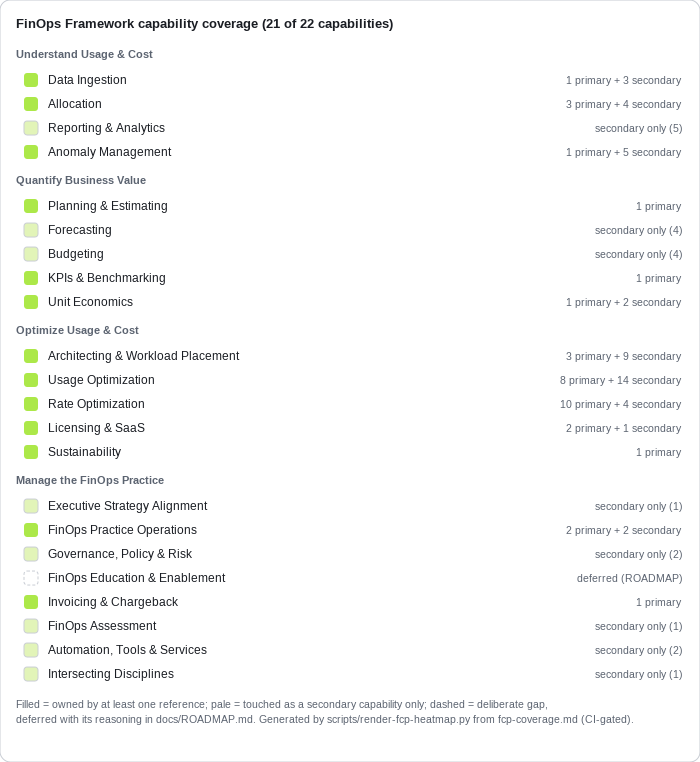
This map is generated from the frontmatter of every reference file, and the CI pipeline fails when the committed map no longer matches the files (fcp-coverage.md).
Providers and business needs
The matrix reads the library by business need. Every cell comes from a named reference file, listed in the notes under the tables.
| Level | Meaning |
|---|---|
| ● deep | A dedicated reference or section, with decision rules, worked examples or detection queries |
| ◐ partial | Covered inside a broader file, or mechanics only |
| – | Not covered today |
| n/a | The combination does not exist |
Hyperscalers
| Business need | AWS | Azure | GCP |
|---|---|---|---|
| Understand and allocate the bill | ● | ● | ● |
| Budget and forecast | ● | ● | ● |
| Commitments and discounts | ● | ● | ● |
| Contract negotiation and renewal | ● | ● | ● |
| Reduce waste | ● | ● | ● |
| AI and GenAI spend | ● | ● | ● |
| Data platforms | ◐ | ● | ◐ |
| SaaS and licences | ◐ | ◐ | ◐ |
| Carbon footprint | ● | ◐ | ◐ |
Other estates
| Business need | OCI | On-prem |
|---|---|---|
| Understand and allocate the bill | ◐ | ● |
| Budget and forecast | ◐ | ◐ |
| Commitments and discounts | ◐ | ◐ |
| Contract negotiation and renewal | – | – |
| Reduce waste | ◐ | ◐ |
| AI and GenAI spend | – | ◐ |
| Data platforms | – | – |
| SaaS and licences | – | ◐ |
| Carbon footprint | – | – |
Platforms
| Business need | AI | Data | SaaS |
|---|---|---|---|
| Understand and allocate the bill | ● | ● | ◐ |
| Budget and forecast | ● | ◐ | ◐ |
| Commitments and discounts | ● | ● | ◐ |
| Contract negotiation and renewal | – | ◐ | ◐ |
| Reduce waste | ● | ● | ● |
| AI and GenAI spend | ● | ◐ | ● |
| Data platforms | n/a | ● | n/a |
| SaaS and licences | ◐ | ◐ | ● |
| Carbon footprint | – | – | – |
On-prem covers owned data centres and the hybrid platforms (Outposts, Azure Local, Arc). AI covers the AI platforms: Anthropic, AWS Bedrock, Azure OpenAI, GCP Vertex AI and the open-weight vendor APIs. Data covers Databricks, Snowflake and Microsoft Fabric. SaaS covers SaaS applications, AI coding tools and licences.
Where each cell comes from
All paths are under plugins/cloud-finops/skills/cloud-finops/.
- Understand and allocate the bill. AWS:
references/finops-aws-billing.md,finops-allocation-showback.md,finops-focus.md,finops-tagging.md. Azure:finops-azure-billing.md,finops-focus.md,finops-tagging.md. GCP:finops-gcp.md(cost data foundation),finops-focus.md,finops-kubernetes.md. OCI, partial:finops-oci.md(cost reports, cost-tracking tags),finops-focus.md. On-prem:finops-on-prem-hybrid.md(internal bill, usage ingestion). AI platforms: the "Cost visibility and allocation" sections offinops-bedrock.md,finops-azure-openai.md,finops-vertexai.md,finops-anthropic.md;finops-for-ai.md. Data platforms:finops-databricks.md(system tables, allocation),finops-fabric.md(shared-capacity allocation),finops-snowflake.md(query attribution). SaaS, partial:finops-sam.md(discovery),finops-focus.md(FOCUS for SaaS vendors),finops-ai-dev-tools.md(attribution patterns). - Budget and forecast. AWS and Azure:
finops-forecasting.md,finops-anomaly-management.md, and the Budgets sections offinops-aws-billing.mdandfinops-azure-billing.md. GCP:finops-gcp.md(budgets, spend caps),finops-anomaly-management.md. OCI, partial:finops-oci.md(Budgets). On-prem, partial:finops-on-prem-hybrid.md(rate setting); capacity planning is on the roadmap. AI platforms:finops-ai-value-management.md(AI investment budgets, stage gates),finops-forecasting.md(AI forecast scenarios),finops-anthropic.md(spend limits). Data platforms, partial: budget controls infinops-snowflake.md,finops-databricks.md,finops-fabric.md. SaaS, partial:finops-sam.md(renewal calendar, metrics),finops-ai-dev-tools.md(spending caps). - Commitments and discounts. AWS:
finops-aws-commitments.md,finops-aws-patterns-databases.md(database commitment tree),playbooks/aws-expiring-commitment-no-decision.md,playbooks/aws-spot-candidate.md. Azure:finops-azure-commitments.md,playbooks/azure-unused-reservation.md. GCP:finops-gcp.md(CUDs, BigQuery commitments),finops-vertexai.md(Flexible Savings Plans),playbooks/gcp-cud-mismatch.md. OCI, partial:finops-oci.md(Universal Credits). On-prem, partial:finops-on-prem-hybrid.md(hybrid platform terms: Outposts, Exadata Cloud@Customer). AI platforms:finops-genai-capacity.md, provisioned capacity infinops-azure-openai.md,finops-bedrock.md,finops-vertexai.md. Data platforms:finops-databricks.md(committed-use bands),finops-snowflake.md(capacity model),finops-fabric.md(reservation). SaaS, partial:finops-ai-dev-tools.md(plan tiers),finops-sam.md(multi-year agreements). - Contract negotiation and renewal. AWS, Azure, GCP:
finops-cloud-contracts.md, plusfinops-azure-billing.md(EA-to-MCA). Data platforms, partial: the data platform section offinops-cloud-contracts.md,finops-databricks.md,finops-snowflake.md. SaaS, partial:finops-sam.md(renewal governance),finops-itam.md(pre-renewal checkpoint, joint negotiation). OCI, on-prem and AI platforms: no file. See "Contract negotiation and renewal" below. - Reduce waste. AWS:
finops-aws.md, the 5finops-aws-patterns-*.mdfiles, 23 runbooks. Azure:finops-azure.md,finops-azure-data.md,finops-azure-patterns.md, 15 runbooks. GCP: the pattern catalogue insidefinops-gcp.md, 7 runbooks. OCI, partial:finops-oci.md(6 patterns, no runbook). On-prem, partial:finops-on-prem-hybrid.md(idle capacity line, cost score). AI platforms:finops-for-ai.md(anti-patterns),finops-genai-capacity.md(provisioned-capacity waste), the optimisation sections of the 4 AI platform files, 2 cross-cloud runbooks. Data platforms: the pattern sections offinops-databricks.md,finops-snowflake.md,finops-fabric.md. SaaS:finops-sam.md(sprawl patterns),finops-ai-dev-tools.md(optimisation levers). - AI and GenAI spend. AWS:
finops-bedrock.md,finops-aws.md(SageMaker), the GPU and SageMaker runbooks. Azure:finops-azure-openai.md. GCP:finops-vertexai.md. On-prem, partial:finops-ai-self-hosted-vs-managed.md. AI platforms:finops-for-ai.md,finops-agentic.md,finops-ai-value-management.md,finops-genai-capacity.md,finops-anthropic.md,finops-open-weight-vendors.md. Data platforms, partial: Cortex infinops-snowflake.md, model serving infinops-databricks.md. SaaS:finops-ai-dev-tools.md,playbooks/cross-cloud-coding-agent-token-waste.md. - Data platforms. AWS, partial:
finops-databricks.mdon AWS, Redshift commitments infinops-aws-patterns-databases.md. Azure:finops-fabric.md,finops-databricks.md. GCP, partial: BigQuery infinops-gcp.md. Data platforms:finops-databricks.md,finops-snowflake.md,finops-fabric.md. - SaaS and licences. AWS, Azure, GCP, partial: marketplace channel governance in
finops-itam.md, Marketplace private offers infinops-cloud-contracts.md, Azure Hybrid Benefit infinops-azure-commitments.md. On-prem, partial: VMware core licensing infinops-on-prem-hybrid.md, BYOL infinops-itam.md. AI platforms, partial: licensing infinops-open-weight-vendors.md. Data platforms, partial: Pro, PPU and F-SKU licences infinops-fabric.md. SaaS:finops-sam.md,finops-itam.md,finops-ai-dev-tools.md. - Carbon footprint. AWS:
greenops-cloud-carbon.md(Sustainability Console, Well-Architected pillar). Azure and GCP, partial: the same file, with the Azure and GCP depth pass on the roadmap;finops-gcp.md(Cloud Carbon Footprint).
Contract negotiation and renewal
The reference finops-cloud-contracts.md covers negotiated spend commitments with the 3 hyperscalers: AWS Private Pricing (EDP and PPA), Azure MACC and the Azure Commitment Discount, and Google Cloud Minimum Commitment. It describes the 12 clauses of an enterprise agreement, where the discount shows in billing data, migration funding (MAP, Azure Accelerate, RaMP), Marketplace private offers as a commitment lever, the reseller channel, 9 intake questions to ask before advising, a 15-point review grid for a term sheet, the usual pitfalls and the timing of a renewal. A closing section covers Databricks and Snowflake commitments inside a cloud contract. Benchmarks come from public sources named in the file; the library carries no observed contract figure.
Also covered: SaaS renewal governance (renewal calendar, auto-renewal review) in finops-sam.md and the pre-renewal checkpoint and marketplace channel governance in finops-itam.md.
Not covered today: negotiation with AI providers (Anthropic, OpenAI and the hosted model vendors; the library covers their reservation mechanics, not their enterprise agreements), OCI Universal Credits beyond their mechanics, and colocation or hosting contracts.
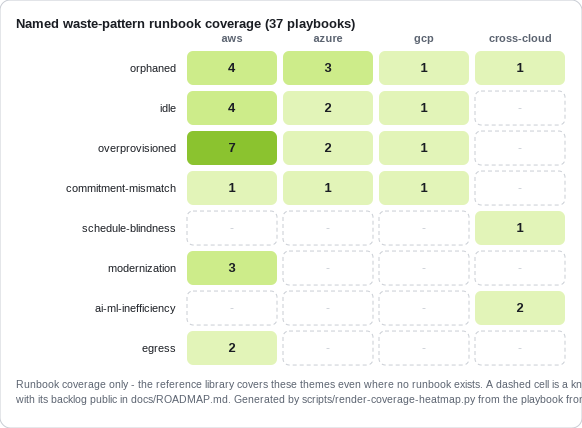
Waste runbooks
A runbook is a step-by-step procedure for one specific waste pattern: the symptoms, a detection query you run in your own account, the fix in safest-first order, and the mistake to avoid. The library files them by provider and by waste category, and each one carries a confidence level that says whether a single signal is enough to act.
What it does not do
- Live prices. The files carry billing mechanics, which stay true for years. Price figures go stale inside a packaged skill within weeks, so they are left out. For a current price the skill points to OptimToken, OptimNow's free comparison of LLM token rates and compute instance rates, each figure with its as-of date.
- Your cloud account. Nothing here reads a bill or an API. For "which of my resources" questions, the deliverable is the runbook's detection query.
- Legal, tax or accounting advice. The contract and chargeback references describe mechanics and the questions to ask; your counsel, tax adviser and auditors decide.
- Topics still open. Accounting for owned capacity (depreciation, lease treatment), AI provider and OCI contract negotiation, and the FinOps Education & Enablement capability. Each is listed in docs/ROADMAP.md with the trigger that would reopen it.
- Guaranteed routing. The model decides which file to read. When an answer arrives without a visible file read or tool call, ask for the library by name ("check the playbook library"). See docs/CONCEPTS.md.
Install
| Where | How |
|---|---|
| Claude.ai, Claude Desktop | From the Claude directory, one click each: the plugin (the skill) and the connector (the MCP server) |
| Claude Code | Plugin: /plugin marketplace add https://github.com/OptimNow/cloud-finops-skills.git then /plugin install cloud-finops@optimnow. Connector: claude mcp add --transport http cloud-finops https://mcp.optimnow.io/mcp |
| Cursor, Windsurf, Codex, Aider, Copilot, Kiro, Gemini CLI | curl -sL https://raw.githubusercontent.com/OptimNow/cloud-finops-skills/main/install.sh | bash -s -- --tool <name> (drop -s -- --tool <name> to auto-detect the tool) |
| Any MCP client | Hosted: add an HTTP MCP server at https://mcp.optimnow.io/mcp, exactly that form. Local: pip install cloud-finops-mcp, config snippets from ./install.sh --tool mcp |
| ChatGPT, Gemini (web) | Self-host for now: ./install.sh --tool chatgpt --grouped or ./install.sh --tool gemini |
Full options, troubleshooting, and the model-agnostic API loader: see
INSTALLATION.md. A version-tagged zip
(cloud-finops-vX.Y.Z.zip) is attached to every
GitHub release.
How it works
- The skill is a folder of markdown files: an entry point that routes a question to the right reference, the reference library and the runbooks. Installed in Claude, Kiro or through the installer for other tools, the guidance sits in the model's context before it answers. No code runs, no data leaves your machine.
- The MCP connector serves the same library the other way round, as 7 read-only
tools the model calls when it decides to: list, search by FinOps capability or
waste category or by a question in your own words, fetch one reference or runbook,
and read the current figures of an OptimToken pricing guide. One click from its
Claude directory listing, or one URL to paste
(
https://mcp.optimnow.io/mcp), nothing to install. Tool calls go to a server OptimNow runs in Paris; see "Data handling" below. - The plugin in the Claude directory is the skill only. The connector is a separate listing, so that the same content is not loaded twice in one session.
- Live prices come from OptimToken, queried at answer time, never copied into these files.
The 2 delivery shapes behave differently: a loaded skill grounds advisory and symptom questions without a decision to make, while the connector depends on the model choosing to call a tool. What that means in practice, with the results measured in November 2026 (adding both behaves as the plugin alone; the connector alone depends on the model), is in docs/CONCEPTS.md. Using a non-Claude model through an API, add the response contract from INSTALLATION.md to your system prompt so answers stay structured and billing-grounded.
Usage examples
One question, asked twice
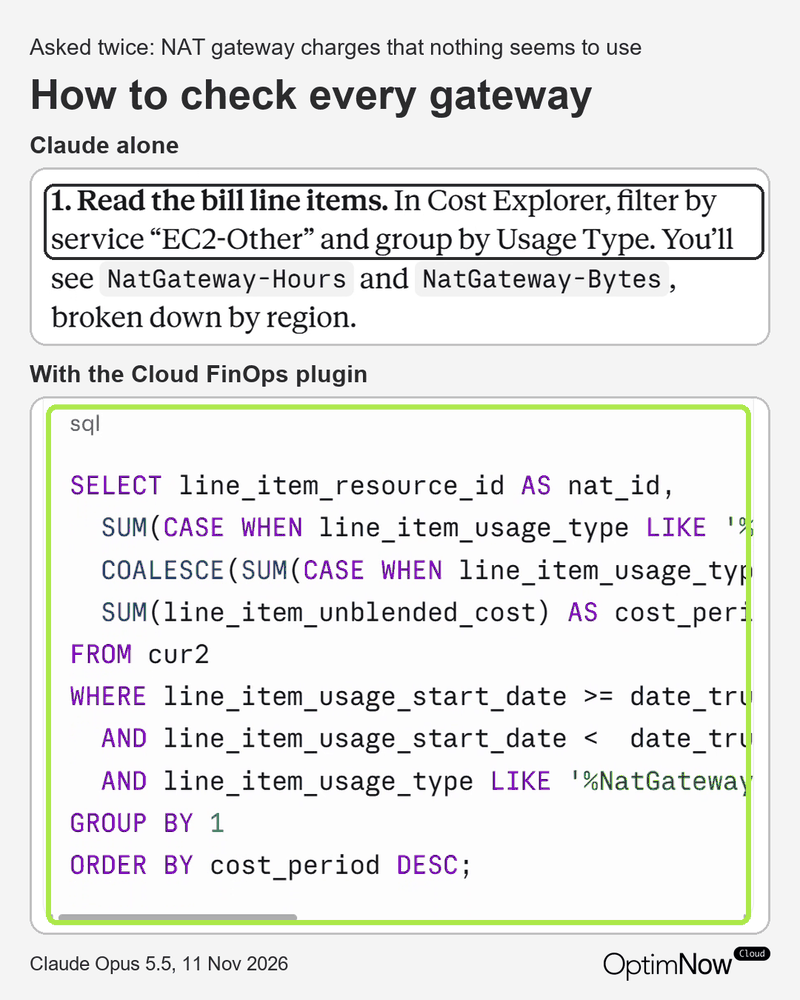
The same question put to Claude Opus 5.5 on 11 November 2026, first alone, then with the plugin installed: "Our AWS bill has NAT gateway charges but I do not think anything uses them - what should I do?"
Claude alone gave sound advice, checked by hand in the console. With the plugin it read the runbook first, and the answer differs in 4 places: one Athena query that checks every gateway in one pass, 2 months of observation where Claude alone asked for 30 days, a price that carries its date and its source, and a sentence saying it cannot see the account. Each version was run once: an example, not a measurement.
A longer walkthrough
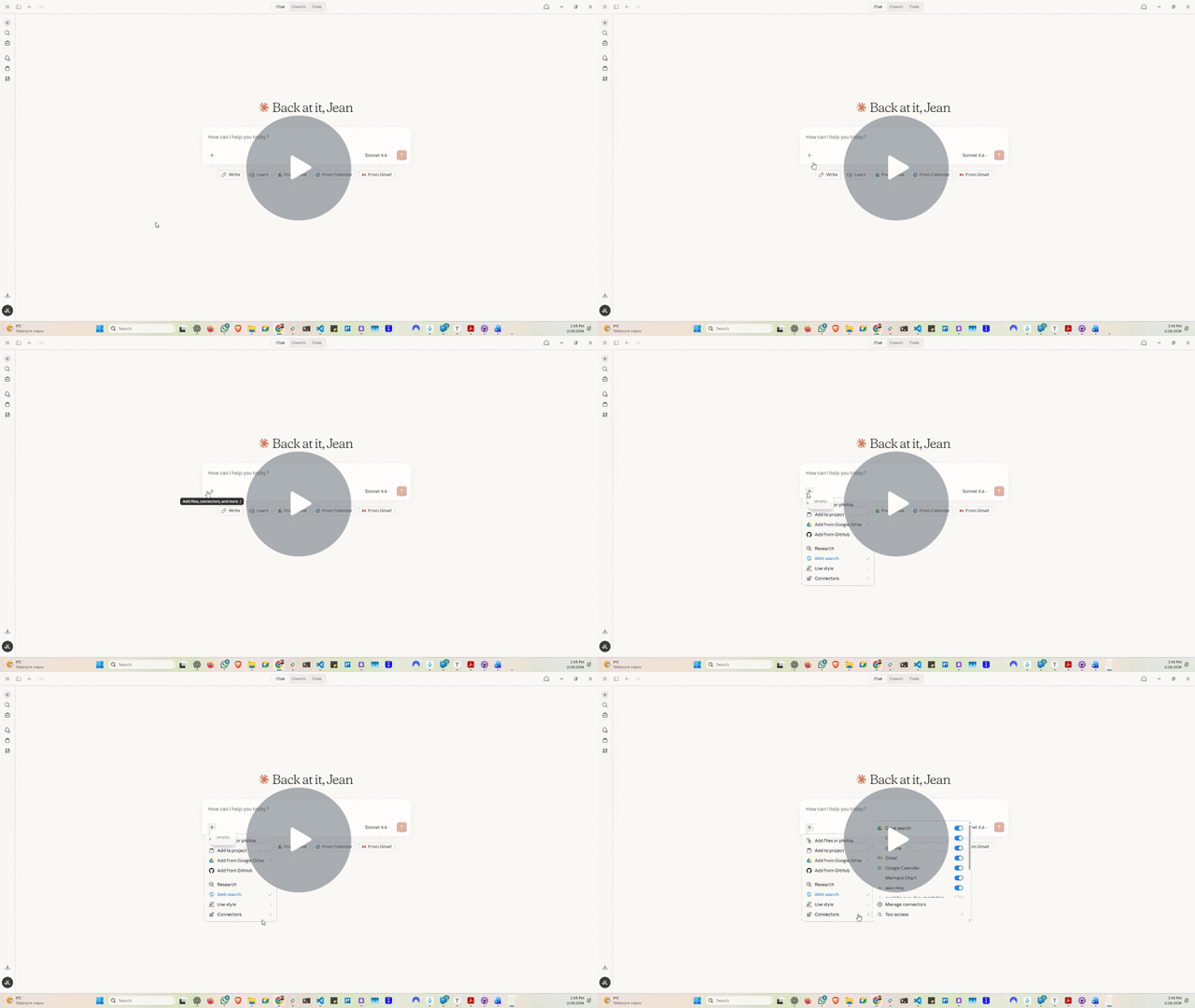
Every reference and runbook declares the questions it answers in its frontmatter
(questions:), in English and French. The role list above is generated from the ones
tagged with a persona and checked in CI. Ask in your own words: the connector's query
parameter and the skill's routing both search those lists.
Design principles
- Visibility before optimisation. Establish what you spend and what drives it, then act. The skill does not recommend commitments to a team that cannot allocate its bill.
- Provider mechanics first, vendor claims second. Guidance is grounded in how billing works (CUR columns, Azure cost-management semantics, BigQuery export, FOCUS conformance), with primary sources cited. Vendor savings and sustainability claims are read critically.
- Maturity is contextual. Where cloud is a cost centre, Crawl plus selective Walk is often the right state; where cloud is the product, Run pays for itself in gross margin. The skill assesses maturity before recommending.
- Cost connects to business value. Every recommendation answers the CFO question: which business outcome does this protect or create.
- Mechanics live here, price figures do not. Any figure a reference quotes carries its date and source; current prices route to OptimToken.
- AI cost management is a first-class domain, with a reference per AI platform and a discipline file for agents, capacity and investment governance.
Data handling
What the skill and the hosted connector run, send and fetch, so you can decide where each is appropriate. Full policy in PRIVACY.md.
- The skill is static text. The entry point, the references and the runbooks are markdown files read into the model's context. They run no code, call no network endpoint and carry no credentials. The runbooks contain detection queries (billing export SQL, CLI commands) that you run in your own cloud account; nothing in this repository reads a cloud account.
- The hosted MCP connector, if you add it, sends tool calls to
mcp.optimnow.io. When the model calls one of the 7 tools, the tool arguments (a reference or runbook name, a section phrase, facet filters, a guide slug, or aqueryin the user's own words, ranked in memory and never stored) travel over HTTPS to that server and the matching content comes back. The server requires no account and no authentication, holds no database and no per-user state, and serves the same public files as this repository. Its application log writes one line per request (method, path, status and request type, never the arguments); when a lookup matches nothing, it also writes the tool name and the arguments that missed, which are short strings the model writes and can include a word copied from your question; aqueryis the exception, logged as its word count only. The server runs on Fly.io, primary region Paris, which holds that log stream, possibly with the client IP address, under its default retention. OptimNow does not sell, share or profile from it. - Price lookups route to a live tool, not to this repo. Whether the model opens OptimToken is its decision in the conversation.
- One tool makes an outbound request.
get_live_figuressends one HTTPS GET tooptimtoken.optimnow.io(an OptimNow site) for a guide'sfigures.json, carrying the guide slug and acloud-finops-mcpUser-Agent, nothing from the conversation. On the hosted connector the request leaves the server; with the PyPI package it leaves your machine. No other tool touches the network. - Nothing else. No telemetry, no analytics beacon, no update check, no package launcher, no credential read from your environment.
Maintenance
The library is updated weekly. Every Saturday an automated scan checks around 30
sources: cloud and AI provider release notes, billing changelogs and pricing pages,
plus FinOps community publications. Each change is confirmed on the provider's own
documentation and reviewed by a practitioner before it is applied. Every merge to
main becomes a new plugin version in the Claude directory, and a version-tagged
release ships the same content to the Claude Code marketplace install, PyPI, the MCP
Registry and the hosted connector. Watch or star the
repository to be notified, and read CHANGELOG.md for what each
version changes for you, in plain words. The provider changes verified over the last
90 days, and those already scheduled, are in a dated digest:
finops-whats-new.md
for the scheduled changes and the current and previous month, and
finops-whats-new-earlier.md
for the months before. Ask "what changed in cloud billing last month?" and the answer
comes from the first.
Contributing
Practitioner experience is the highest-value contribution. Frameworks and vendor docs are already public; what is rare is "we tried X in production, this is what it billed". Corrections to billing mechanics, new or improved runbooks, real-world counter-examples and adversarial review of the recommendations are all welcome: the repository is opinionated, and it should also be falsifiable.
The shortest contribution is a report. Two issue forms, at https://github.com/OptimNow/cloud-finops-skills/issues/new/choose, take an answer that was wrong or incomplete, or a question the library did not cover, with the wording you used. Each confirmed report is fixed on the provider's documentation and becomes a test question run before every release.
The full guide, including the repository structure, contribution types, process and conventions, is in CONTRIBUTING.md. If your change names another OptimNow tool (an MCP tool name, an endpoint URL, a provenance field), read DEPENDENCIES.md first.
Adapting this skill for your organisation
Two paths, both first-class.
An overlay is a second, private skill folder beside this one. It cites the public
sections it builds on by heading and adds what this repository deliberately leaves
out: your negotiated rates, your tag taxonomy, your coverage targets, the decisions
your committee already took, one client account's profile. It copies nothing, so a
public update never breaks it, and a check tells you when a heading it cites has
moved. Start from docs/OVERLAYS.md and the template in
docs/overlay-template/.
A fork is the right tool when you want to change the public text itself: a different methodology, your own house style, a provider this repository does not cover. A fork gives you a stable base you can pull upstream updates into at your own pace. Typical customisations:
- Adding organisation-specific tag requirements to
finops-tagging.md - Adding reference files for internal tools or platforms not covered here
- Adjusting the methodology file to your team's own approach
About OptimNow
OptimNow is a boutique FinOps consultancy that helps organisations connect cloud and AI spend to measurable business value. Based in France, with European reach.
- Website: optimnow.io
- LinkedIn: OptimNow
- GitHub: github.com/OptimNow
Open-source tools built by OptimNow:
| Tool | What it does |
|---|---|
| OptimToken | Compare what 250+ models cost per request, with caching and batch factored in, plus compute instance rates across 7 clouds. Also an MCP connector; this skill routes price questions here |
| AI ROI Calculator | Whether an AI project pays for itself: three-layer cost model, payback, break-even, sensitivity. Also an MCP server |
| AI Cost Readiness Assessment | Where your organisation stands on AI cost management |
| MCP for Tagging | Tag governance automation |
Acknowledgements
This skill incorporates content derived from the following sources:
- FinOps Foundation: framework definitions, capability descriptions and maturity model structure are based on the FinOps Framework.
- Tokenomics Foundation: the token complexity classes in the agentic FinOps reference are adapted from Big-T Notation by Dan Neff (Adobe), published by the Tokenomics Foundation under CC BY 4.0. The AI cost and value references also draw on the Foundation's five-layer tokenomics stack paper, its proposed definition of the total cost of AI, and the drafts of its consumption and value working groups, each cited where it is used.
Every other source is credited inline, in the file that uses it. Billing mechanics cite the provider's own documentation with the date it was read; figures and opinions from practitioner talks (FinOps X 2026 and others) are attributed to the speaker and organisation where they appear.
All referenced content has been adapted with additional context from OptimNow's consulting delivery experience. Any errors or opinionated interpretations are our own. This skill is independently maintained and is not affiliated with or endorsed by the FinOps Foundation.
License
Licensed under CC BY-SA 4.0. See LICENSE.md for the full licence text.
You are free to use, adapt and redistribute this skill, including for commercial purposes, as long as you credit OptimNow and share any derivatives under the same licence. When redistributing the material, please include this attribution:
Cloud FinOps Skill by OptimNow - licensed under CC BY-SA 4.0.