
Canary MCP
Read-only IBKR MCP: account, positions, brief, regime, stress, reporting, Edge, and risk.
Runs on your machine from its package; the steps are below.
What it does
- Reads
- Writes
- High impact
At most: only reads or looks up information.
What it costs
FreeOdel charges nothing per call. The publisher may charge for its own service.
Runs locally over stdio
This server isn't hosted — your MCP client launches it from a package registry. Use one of the commands below, or drop the config into your client (e.g. Claude Desktop).
Distributed as an MCP bundle (`https://github.com/osauer/canary/releases/download/v3.21.1/canary-v3.21.1.mcpb`) — download it and import the bundle in your MCP client.
Canary


A local risk desk for your brokerage account.
It runs with Interactive Brokers today, through IB Gateway or TWS, and keeps the
broker layer in its own Go package, pkg/ibkr, so other brokers can follow.
Canary turns one local IB Gateway or TWS session into a daily brief, current portfolio and market evidence, and a broker-confirmed review of what past position changes delivered. Use the same daemon from an MCP host, the shell, or a paired phone. The standard binary and every MCP tool are structurally read-only: they contain no broker-order preview or execution surface.
Canary is for an IBKR Pro user who runs Gateway or TWS locally and wants stale,
missing, or held evidence to remain visible. It is not a hosted brokerage
service, a trade recommender, or a complete TWS API replacement. If you only
need a Go wire-protocol client, use pkg/ibkr.
To read a running Canary from your own Go program, import the module root
github.com/osauer/canary/v2: it runs the same read-only tool catalogue over the
daemon socket, and canarytest serves the wire types on a temporary socket for
tests. The client also exposes a narrow audited cash-sweep ordering preference;
its tool catalogue remains read-only and the preference cannot activate reserves
or broker execution.
Documentation · Install · First session · Canary Edge · MCP tools · Safety · Privacy
Start
You need IB Gateway 10.37+ or TWS with API socket access enabled, an IBKR Pro account, and macOS or Linux on arm64 or amd64. WSL works; native Windows does not.
For one binary shared by the shell and local MCP hosts:
curl -fsSL https://raw.githubusercontent.com/osauer/canary/main/install.sh | sh
canary status    # prove which gateway and account Canary reached
canary brief     # review what changed and what needs attention
The installer verifies the signed release checksum and installs to
~/.local/bin. The install guide shows how to
inspect the script first and covers every other installation path. Canary can
discover Gateway or TWS automatically; canary status identifies the selected
connection and account. An explicit endpoint pin remains fixed. Market-data
availability depends on your IBKR subscriptions: delayed values stay labeled
and cannot satisfy live-only execution requirements.
For Claude Desktop only, download
canary.mcpb,
open it with Claude Desktop, then quit Claude completely and relaunch it. Ask:
What needs attention today, and which inputs are degraded?
The bundle carries its own macOS and Linux binaries. The Claude Desktop walkthrough covers the first connection.
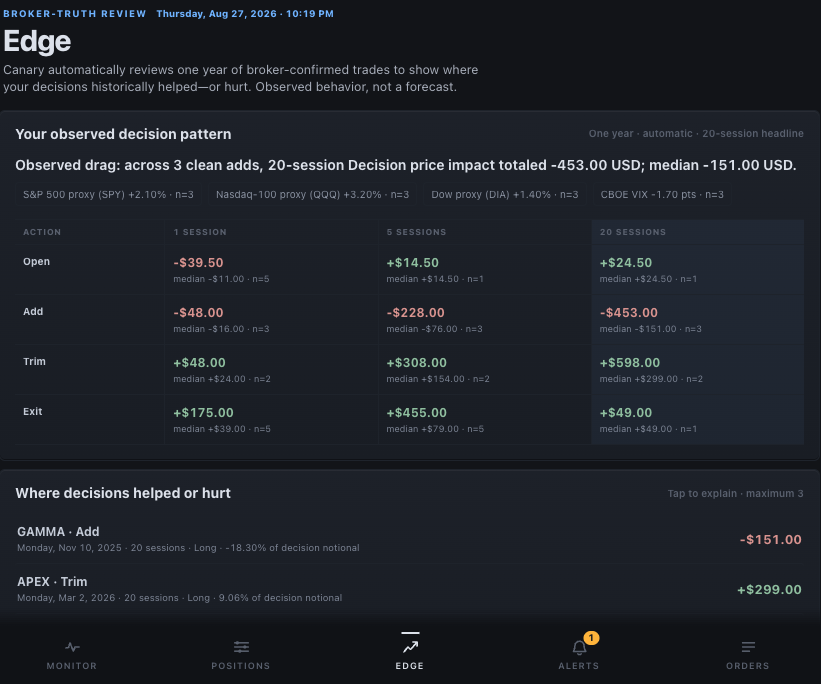
Current Canary SPA rendered from synthetic data. Edge reports observed historical outcomes; it is not a forecast or a causal claim.
Choose your surface
| You want to… | Start with | Boundary |
|---|---|---|
| Ask an agent about the account | The MCP Bundle, or canary mcp from any local framework that can launch a stdio MCP server | Read-only tools; no settings writes, previews, or execution tools |
| Work in a terminal or script | canary brief, canary positions --by underlying, and --json | Deterministic CLI output over the same daemon authority |
| Check the desk from a phone | canary app, then canary app pair | Paired PWA; local by default, optional remote relay |
| Read Canary from your own Go program | github.com/osauer/canary/v2, the daemon client, with canarytest for tests | The MCP tool catalogue over the daemon socket without an MCP process; the daemon keeps every policy and broker gate |
| Build directly on the TWS protocol | github.com/osauer/canary/v2/pkg/ibkr | Lower-level transport; your application owns policy, authorization, and journaling |
Constrained broker actions are not a fifth onboarding path. They require a separate experimental trading binary and remain limited to gated CLI and paired-app flows. MCP stays read-only in every build. Read Gated orders and the trading build before using that artifact.
What Canary helps you answer
- What needs attention now?
canary brief, the Rulebook, and the Action Queue combine current alerts, process exceptions, protection candidates, and exercise candidates without turning any row into submit authority. - Am I within my limits?
canary ruleschecks the book against limits for position size, premium budget, time value, expiry, losses, net market exposure and margin headroom. They start from a compiled baseline;canary rules policy setmakes them yours. - How is the book exposed? Account and position reads identify one selected account, group stock and option legs by underlying, and keep missing values separate from real zeros. Each position carries the listing venue IBKR reports. Multi-account ambiguity is refused rather than blended.
- What did past decisions actually deliver? Canary Edge uses retained IBKR Flex records and exact-contract market history. It reviews account P/L after confirmed external flows, compares adequately repeated stock and ETF opens/adds/trims/exits with leaving the prior position unchanged over 1, 5, and 20 sessions, and reports broker-recorded option P/L separately. It does not infer intent, recommend a trade, or claim causation.
- What did stock lending earn? Dated shares-lent annotations and
canary lending fees --jsonprovide customer net fees, expandable history and explicit report coverage. IBKR controls participation. Fees explain income; they are never added again to broker account P/L. Payment linkage remains unproved. See lending reporting. - What high-fee names are outside my list?
canary lending screen --min-rate 50 --limit 25 --jsonand MCPcanary_lending_screenrank the existing IBKR US USD bulk feed. Optional exclusions remove familiar names; coverage, source dates and truncation stay explicit. This does not establish listing quality, liquidity or lender yield. - Which US equities have large reported short positions?
canary short-interest screen --listed-only --min-average-volume 1000000 --jsonranks FINRA short shares before limiting results. Sort bydays_to_coveror add the shared price/liquidity filters; market coverage is explicit and free-float percentage remains unavailable. See source and freshness semantics. - Where are borrowing fees unusually high?
canary lending rates --symbols AAA,BBB --jsonand MCPcanary_lending_ratesread dated indicative borrower costs for an explicit US-stock universe. Preserve missing data, source age and numeric scale. These rates are research inputs, not your lending yield or a buy recommendation. See lending research. - How much did exchange rates contribute?
canary reporting fx --jsonreads completed daily valuation effects across investments, currency cash and accrued interest, with missing days retained. This differs from realised currency-lot P/L in IBKR's Forex P/L Details. See FX reporting. - Can this reading be trusted? Quotes, calendars, breadth, gamma, regime,
stress, earnings, borrow, halt, and reporting sources carry their own health,
freshness, coverage, and last-good state. Unavailable evidence stays
unavailable.
canary data health --jsonreads the service report;canary data check --jsonrequests a bounded ordinary-quote check. A healthy service does not mean every quote is live or suitable for execution. - When is the market open, and what is scheduled? Exchange calendars cover
US equities and listed options, Xetra, London, Tokyo and Hong Kong, with
explicit coverage bounds and intraday breaks.
canary macroseparately reads cached official economic calendars and publications with their source health. - What work already exists? Proposals, opportunities, and the local order journal show what is blocked or ready for human review and how it changed. They are evidence, not broker authority. A multi-leg option position is reviewed as one unit, net premium paid against net close value at fresh leg quotes, and routed to the strategy workflow or a broker combo; the row places no order. Option purpose follows the measured book, not per-leg declarations. An opt-in cash sweep proposes putting idle cash into bills of the same currency; it never converts one currency into another.
Reconciliation, statement-derived equity, and Edge require one shared IBKR
Activity Flex Query. Run canary setup reporting, then follow the
screenshot-driven field checklist. A received
empty section counts as zero reported activity and does not block readiness.
Missing sections and missing required fields on populated rows remain distinct
problems; canary reporting status --json shows the current evidence.
MCP and agent frameworks
The MCP Bundle is the shortest Claude Desktop path. For another local host,
install the shared binary and point the host at its absolute path. Hosts that
use the common mcpServers shape accept:
{
  "mcpServers": {
    "canary": {
      "command": "/ABSOLUTE/PATH/TO/canary",
      "args": ["mcp"]
    }
  }
}
Use which canary to find the path. A browser-only agent cannot reach this
local stdio process. After upgrading, fully relaunch the host so it respawns
the MCP server.
Continuously running agents can keep this MCP child process available and
reuse Canary's brief, calendar, regime, risk, and order evidence. Use
canary_calendar for official exchange sessions, canary_macro for official
economic calendars and publications, and canary_data_health for passive source
health. Preserve their coverage bounds and original source times. The host owns
durable wakeups, model budgets, and process recovery. Canary owns the observations and risk semantics. See
continuous hosts for
the lifecycle and data-quality contract.
Ask in desk language rather than naming tools:
How is my portfolio exposed by underlying?
Which repeated entries, adds, trims, or exits had the largest observed 20-session price impact, and what coverage bounds that answer?
Are any protection or exercise candidates ready for human review?
The host guide covers Claude Code, Cursor, Continue, Zed, framework integration, logs, and connection checks. The generated MCP reference is the exact tool and schema inventory. The optional Claude Code plugin adds Canary's skill, MCP config, and safety hooks; it does not ship the binary.
Shell and paired app
Every data command supports --json:
canary data health
canary account
canary positions --by underlying
canary brief
canary edge
canary rules
canary regime --explain
canary stress --details
canary technical SPY,QQQ
canary calendar --market us --days 14
canary macro
canary market
canary reporting status
canary proposals list
canary opportunities list
canary orders open
For a continuous display, canary market --watch --json streams broker updates
with explicit account scope and separate source clocks. One-day charts retain
the last applicable session across weekends and closures; retained bars keep
their actual dates.
Run canary status first for connection problems and canary data health for
missing or degraded inputs. canary --help and the
CLI reference carry the complete command and flag
inventory.
For the paired app, run canary app on the machine that owns the Gateway or
TWS session, then run canary app pair and scan the QR code. The current
workspace is Monitor, Positions, Edge, Alerts, and Orders; Settings opens from
the header gear. See the app guide for local pairing,
remote-relay, and Web Push boundaries.
Go wire-protocol library
pkg/ibkr is a clean-room Go client for the TWS wire protocol:
import (
    "context"
    "time"

    "github.com/osauer/canary/v2/pkg/ibkr"
)

func accountSummary(ctx context.Context, clientID int) (*ibkr.RawAccountSummary, error) {
    cfg := ibkr.DefaultConfig()
    cfg.Port = 4002 // Gateway paper

    connector := ibkr.NewConnector(&ibkr.ConnectorConfig{
        // Use an ID not already owned by Canary or another TWS client.
        PreferredClientID: clientID,
        BaseConfig:        cfg,
    })
    if err := connector.Start(ctx); err != nil {
        return nil, err
    }
    defer connector.Stop()

    return connector.RequestAccountSummary(ctx, 5*time.Second)
}
Protocol coverage is purpose-driven, not exhaustive. The package transports broker requests but does not provide Canary's application-level authority boundary. Direct users must supply their own policy, authorization, journaling, and reconciliation controls. Start with the package documentation.
The public Go module deliberately remains on the maintained /v2 line while
product v3 ships as signed binaries. Therefore go install github.com/osauer/canary/v2/cmd/canary@latest installs the v2 CLI, not product
v3.
One authority, several adapters
shell, MCP host, or paired app
              ↓ local Unix socket
         canary daemon
              ↓ local TCP by default
       IB Gateway or TWS
The daemon starts on demand, owns the selected account, broker connection,
market evidence, policy state, and local order journal, and normally exits
after 15 idle minutes. Adapters render typed daemon results; they do not
re-create risk policy. Official public-data sources also feed the daemon;
embedded exchange calendars remain available without a broker connection.
The architecture
and storage guide describe the boundaries and
the retained ibkr XDG paths used for upgrade continuity.
Safety and privacy
- Read-only is the normal product. The installer, updater, and MCP Bundle select the standard binary, whose broker-write handlers are not compiled in.
- MCP has no preview or execution tools in any build. It cannot place, modify, cancel, submit, or exercise an order.
- Trading is a separate decision. The experimental trading artifact keeps actions behind a pinned, broker-confirmed account, pinned client ID and trading mode, any explicit endpoint pin, a fresh exact review contract, broker eligibility where applicable, healthy journaling, daemon revalidation, runtime freeze, and transaction-specific human authority.
- Missing evidence stays missing. A stale or unavailable input never becomes a clean result merely because an older value exists.
Canary has no telemetry and does not send account IDs, balances, quantities, or P/L to the maintainer. Configured public-data refreshes, an MCP host, remote relay, or push service receive only the data disclosed in the path you enable. PRIVACY.md is the authoritative data map; SECURITY.md covers the threat model and signed release artifacts.
Help and project information
- Install and first run
- Daily desk workflow
- Troubleshooting
- Configuration
- Release and update policy
- Contributing
Canary is an independent third-party client for Interactive Brokers' publicly
documented TWS API. It is not built, endorsed, sponsored, or supported by
Interactive Brokers Group, Inc. or its affiliates. pkg/ibkr redistributes no
Interactive Brokers code, libraries, jars, or market data. Nothing here is
investment advice.
Canary is a private project of Oliver Sauer.
MIT. See LICENSE.
FX contribution is available through canary reporting fx and the read-only
canary_reporting_fx MCP tool. See FX contribution and backfill
for daily evidence, reconciliation, query fields and Day/Week/Month/YTD semantics.
Lending price and liquidity context
canary lending market --symbols AAA,BBB --json and the read-only
canary_lending_market MCP tool return matching cached context for 1–100 explicit
USD names in the borrowing feed, or exact identities already resolved for a
displayed research row. Named reads do not initiate missing-feed resolution;
without either identity, the row remains unavailable.
The daemon admits at most 150 background unattempted names per research family, then
progressively admits more on later reads. A single joined worker rotates families
and refreshes one name at a time on the background lane (35-second bound).
Up to 30,000 exact-contract projections are retained while requested, expiring after
24 hours without interest. Named reads request quotes for 15 minutes; intraday
receipts expire after five minutes. Completed-session history is reused until the
next completed session, preserving its actual source dates. Incomplete histories
retry hourly; failures retry after five minutes, except that a name IBKR does
not recognise as a contract reads unavailable and waits at least 30 minutes
and until the broker session changes. History uses the durable cache
without adding chart-refresh interests. No quote fan-out occurs in a screen read.
Rows carry last completed close or a recent actual trade (including delayed-feed
labels), change from prior close, session share volume, average daily dollar
turnover over all 20 completed sessions, and completed-close YTD price change
from the exact prior year-end session. YTD excludes dividends; missing year-end,
latest session or any volume baseline stays missing. Field dates and pending,
partial, unavailable and expiry remain explicit. Filters are research preferences,
not trading policy or a liquidity guarantee. Discovery filters apply across the
full qualifying fee/exclusion universe before the output limit, using only known
market values. Acquisition is progressive: inspect coverage before interpreting
an empty or partial screen. covered, pending and unavailable partition all
candidates; complete requires every candidate to have the fields needed by the
query (default price and turnover). Missing YTD does not block price-only filters.
Desk's own-list view retains its separate named-rate/local filtering path so
nonbulk evidence is not silently dropped.
Canonical discovery filters and sorting
canary lending screen --min-rate 50 --min-price 5 --min-avg-dollar-volume-20d 10000000 --min-high-dates 3 --sort-by avg_dollar_volume_20d --sort-dir desc --limit 50 --json
CLI flags map directly to MCP/RPC min_price, min_avg_dollar_volume_20d,
min_high_dates, sort_by, and sort_dir. Zero disables each optional filter.
Sort keys are symbol, price, day_change_pct, volume,
avg_dollar_volume_20d, ytd_change_pct, fee_rate, and high_dates.
Missing numeric values stay last in both directions; symbols break ties.
high_dates is the number of distinct provider dates at or above min_rate
within seven UTC source dates, reset by a later lower or unknown observation.
An intraday dip followed by recovery starts a new streak on that date.
Each row also exposes at most seven dated history samples for the fee chart.
Repeated polls of one timestamp never add dates. This history is persisted with
the daemon's borrow-fee source state; it starts from genuine retained observations,
not an assumed backfill. Old installations therefore initially know one date.
Displayed research prices
The returned discovery rows receive bounded priority in their displayed order: at most 100 names per family, including a source-ranked discovery tail so filters do not cancel unresolved candidates, with a 15-minute interest replaced by the next query. Three foreground jobs alternate with one available background job, preserving broader-universe progress. A newly displayed name can enter even when the 150-name background batch is full; changing tabs does not accumulate unresolved jobs.
Displayed short-interest symbols missing from the borrowing file may resolve through one session-bound IBKR contract-details request. Only a unique exact symbol, positive contract ID, USD stock type and supported US calendar qualify. No suffix conversion, guessed common-share substitute or issuer-name matching is performed. Non-displayed unmatched names remain unavailable; the full FINRA universe does not trigger a contract-resolution scan.
A short daily-history read supplies the dated last completed close first; the one-year history then fills remaining liquidity and YTD context. A dated regular close from the canonical quote may also supply price. Undated previous-close ticks and old last trades never receive an invented current date. Missing or failed yearly history preserves matching completed-session price and independently dated fields. Borrowing fees remain independent: resolving a price does not create a fee quote.