



Methodology · Leaderboard · Report a bug · Skills for agents
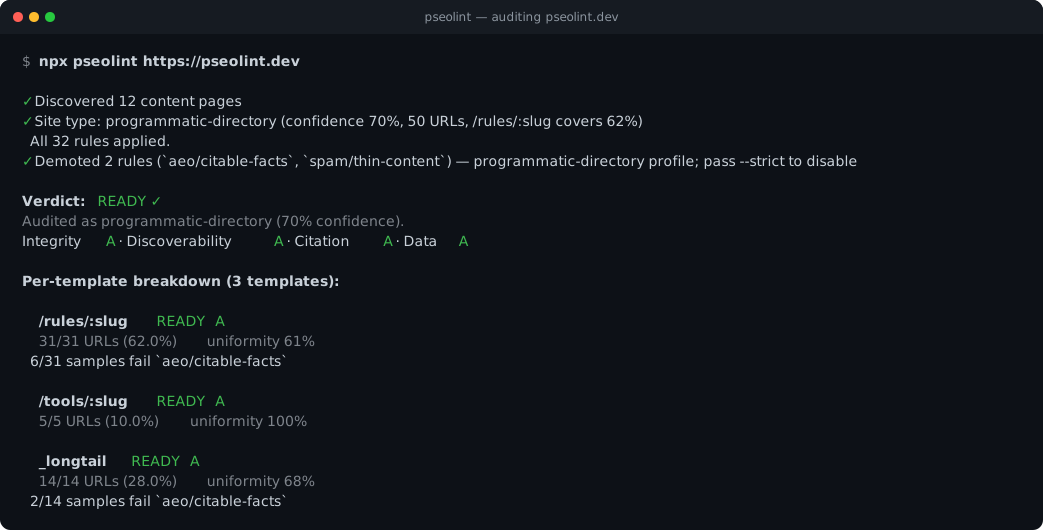
The only tool purpose-built for programmatic SEO compliance. It shifts the unit of analysis from URL to template: point it at a 10,000-URL pSEO directory and pseolint identifies the template clusters (e.g. /listing/:slug, /category/:slug), samples K pages from each, and produces a per-template verdict + variance metric. Fix one template, fix N pages.
npx pseolint http://localhost:3000
Table of contents
Skills for Claude & coding agents (new)
Design pages that pass before you crawl them. The skills/ suite gives
Claude (and any agent that supports the skills / Claude Code plugin format)
programmatic-SEO and answer-engine optimization (AEO / GEO) guidance where
every recommendation is bound to a runnable pseolint rule:
npx skills add ouranos-labs/pseolint --skill pseolint aeo
pseolint: full-lifecycle programmatic SEO: design → build → audit → fix → gate.aeo: get cited in AI Overviews / ChatGPT / Perplexity, not just ranked.
Unlike prose checklists, these have teeth: the design-time advice ends in
npx pseolint pass/fail. See skills/README.md.
Why this exists
Programmatic SEO works, when it works. The gap between "1,000 indexed pages" and "1,000 pages that survive a SpamBrain pass" is where most pSEO sites die. The Helpful Content Update made that gap permanent.
Existing SEO tools (Screaming Frog, Sitebulb, Ahrefs Site Audit) were built for editorially-curated sites. They check pages one at a time. But the SpamBrain risks of pSEO are between pages: doorway clusters, near-duplicates, entity-swap templates, thin-content propagation. You can't catch them with per-page rules.
pseolint audits the graph: it groups results by template before surfacing them. Run it before you publish, gate it in CI, fix the broken template before SpamBrain does.
How it compares
| pseolint | Screaming Frog | Ahrefs Site Audit | Sitebulb | |
|---|---|---|---|---|
| Unit of analysis | template cluster | URL | URL | URL |
| Near-duplicate / doorway / entity-swap detection | ✅ | partial | - | - |
| SpamBrain-policy risk verdict | ✅ | - | - | - |
| AEO / AI-Overview citability checks | ✅ | - | - | - |
| AI fix → pull request | ✅ | - | - | - |
| CLI · GitHub Action · MCP server | ✅ | desktop | SaaS | desktop |
| Open source | ✅ MIT | - | - | - |
The general-purpose crawlers do plenty pseolint doesn't (JS rendering at scale, backlink data, log-file analysis). pseolint is the specialist for the one thing they weren't built for: programmatic-SEO compliance at the template level.
How pseolint differs
- Graph-level, not page-level. Detects near-duplicate clusters, doorway patterns, and entity-swap doorways across thousands of pages. Per-page tools can't see these.
- SpamBrain + AI Overview. 65 rules across 8 categories: SpamBrain-policy mapping (penalty risk) plus
aeo/*(AI Overview citability:llms.txt, AI-crawler access, citable facts, answer-first, summary-bait). - Developer workflow, not SaaS UI. CLI, GitHub Action, JSON/HTML reports, MCP server, browser extension (SERP competitive recon). Lives in your repo and your PRs.
- Actionable, not advisory. Every finding has a fix, an effort tag (
quick fix/moderate/structural), and a Google docs reference. - Safe for hosted use. SSRF guard (DNS-validated), robots.txt honoured for our own crawler, analytics-blocking in render mode,
AbortSignalcancellation,safeMode: "saas"preset for embedding in services. - Calibrated against reputable pSEO. Engine verdicts are calibrated against a curated corpus of in-production pSEO sites that demonstrably win in search. Doorway-pattern findings cluster (no more per-pair noise); verdicts are reproducible at a fixed
sampleSeed. Dated snapshot results, the open-source corpus, and the trade-offs we accepted live at pseolint.dev/methodology. Spec: docs/superpowers/specs/2026-05-03-calibration-against-reputable-pseo.md. - Authority-blind by design, with a manual override. pseolint analyses static content + the link graph it can see. It does NOT measure backlinks, brand mentions, domain age, or any external trust signal: there is no Moz/Ahrefs/Semrush dependency. This means the engine itself is calibrated for the authority tier of the calibration corpus (established brands). It exposes
authorityScore(0-100, via the--authority-scoreCLI flag, the core API, or the MCP param) so callers can adjust the verdict ladder for their tier:>= 80shifts one tier lenient (established brand can absorb shapes a newer site can't);<= 30shifts one tier stricter. Rawrisknumber unchanged so CI gates stay stable. Without the flag, treat verdicts as a directional minimum. - Honest about blind spots. Beyond domain authority, pseolint does not currently detect: image SEO dimensions, schema-content drift (e.g. JSON-LD price ≠ rendered price), outbound-link health, search-intent alignment, parameter-URL crawl-budget waste, and a handful of specialty gaps (mobile-friendliness, cookie-banner detection, AMP/News/Video schema). The complete blind-spot audit lives at docs/superpowers/specs/2026-05-03-pseolint-blind-spots.md: every gap categorized by impact tier with the roadmap fix.
Full version history (calibration rounds, per-rule changes, safety hardening) is in CHANGELOG.md.
Quick Start
# Point it at your local dev server: that's it
npx pseolint http://localhost:3000
Automatically discovers all pages by following internal links. No sitemap, no config, no build step needed.
# Save a visual report
npx pseolint http://localhost:3000 --format html --output report.html

# Audit a live site (per-template output is the default)
npx pseolint https://yoursite.com

# CI gate on build output
npx pseolint ./out --ci-threshold concerning --format json
Per-template output (v0.6 default)
Verdict: CONCERNING
Integrity C · Discoverability B · Citation C · Data A

Per-template breakdown (3 templates):

  /listing/:slug  CONCERNING  C
  10/8201 URLs (0.1%)  uniformity 85%
  8/10 samples fail `spam/thin-content`

  /category/:slug  READY  A
  10/312 URLs (3.2%)  uniformity 94%

  /help/:slug  CAUTION  B
  10/47 URLs (21.3%)  uniformity 78%
  3/10 samples fail `content/missing-author`
--format json includes the templates array alongside the existing findings list:
{
  "verdict": "concerning",
  "risk": 60,
  "templates": [
    {
      "signature": "/listing/:slug",
      "totalUrls": 8201,
      "auditedUrls": ["https://example.com/listing/foo", "..."],
      "verdict": "concerning",
      "risk": 60,
      "variance": {
        "uniformityScore": 0.85,
        "topDriver": { "ruleId": "spam/thin-content", "fireRate": 0.8 }
      }
    },
    { "signature": "/category/:slug", "verdict": "ready", "risk": 12 }
  ],
  "findings": [...]
}
Use --legacy-flat to suppress the template cards and get the v0.5-style flat findings list.
Partial coverage (truncated)
If the crawl is interrupted (e.g. the backpressure watchdog aborts because the origin is degrading), pseolint still emits whatever it collected, flagged as partial:
{
  "verdict": "ready",
  "risk": 12,
  "truncated": true,
  "truncatedReason": "Origin degraded mid-crawl (p95 latency exceeded threshold)",
  "pageCount": 42
}
When truncated is true, treat pageCount, risk, and verdict as lower bounds: a partial pass is not a full pass. The CLI prints a PARTIAL REPORT banner and exits non-zero; the GitHub Action warns (and can fail with fail-on-truncated: true); the MCP tools and web report surface the same flag. Programmatic consumers should branch on it. The full output contract is published as a JSON Schema (packages/core/schemas/audit-summary.schema.json, $id carries the schemaVersion).
Audit Modes
| Mode | Command | What you get |
|---|---|---|
| Local dev server | npx pseolint http://localhost:3000 | Full rendered pages, HTTP headers, redirect detection, crawl discovery. Best results. |
| Live site | npx pseolint https://yoursite.com | Same as above against production. Slower (network latency). |
| Build directory | npx pseolint ./out | Static HTML files only. No HTTP headers, no redirect detection, no soft-404 detection, no sitemap comparison. Use for CI gates. |
Why localhost is recommended: Build directories contain framework artifacts (Next.js
[slug].htmlshells, empty client-rendered pages) that produce false positives. Your dev server renders the actual pages Google will see: with canonicals, meta tags, and full content.
What It Checks
65 rules across 8 categories (all 8 scored), producing a weighted SpamBrain Risk Score (0-100) and an independent AEO sub-score for AI Overview citability. Every rule is backed by a primary source (Google Search Central, sitemaps.org, ogp.me, Lighthouse); the checks we deliberately refuse to run (folklore the primary sources contradict, like title/description character limits) live in docs/folklore.md:
SpamBrain Risk Detection
| Rule | What It Checks | Severity |
|---|---|---|
spam/near-duplicate | SimHash similarity between all page pairs (>85%) | Critical |
spam/entity-swap | Doorway pages where only a proper noun changes | Critical |
spam/doorway-pattern | Composite: entity-swap + thin + identical structure + same meta | Critical |
spam/thin-content | Pages below 300 words (excluding nav/header/footer) | Error |
spam/boilerplate-ratio | Pages with >70% shared template content | Error |
spam/template-diversity | Identical DOM structure across all pages | Warning |
spam/publication-velocity | >100 pages sharing the same publish date | Warning |
spam/template-coverage | Template dimension coverage (e.g. 87 of 960 possible combinations) | Info |
Content Quality
| Rule | What It Checks | Severity |
|---|---|---|
content/unique-value | Each page must have 100+ words not found on any other page | Error |
content/meta-uniqueness | Meta descriptions identical after entity masking | Error |
content/title-uniqueness | Empty/missing title, very short or excessively long title, or two pages sharing the exact title (raw, not entity-masked: catalog templates with per-record entity values pass) | Error / Warning / Info |
content/heading-structure | No <h1>, multiple <h1> elements, or long pages (>600 words) with no <h2> sub-headings | Error / Warning / Info |
content/image-alt-text | <img> tags missing alt attribute (decorative images marked role="presentation" / aria-hidden="true" / alt="" are skipped) | Warning / Info |
content/image-attributes | <img> tags with no width/height (and no inline sizing), which leaves the browser no aspect ratio to reserve and shows up as layout shift; plus pages serving 3+ images where none uses srcset/<picture> | Warning / Info |
content/missing-author | No author schema, meta, byline, or rel="author" | Warning |
content/eeat-signals | Missing E-E-A-T signals (author, dates, sources, about links) | Info |
content/citation-coverage | Pages making 3+ quantified claims with no authoritative citations | Warning |
content/meta-description-presence | Missing or empty meta description. Length is deliberately NOT linted: Google documents no character limit (see docs/folklore.md) | Warning |
Internal Linking
| Rule | What It Checks | Severity |
|---|---|---|
links/orphan-pages | Pages with zero inbound internal links | Error |
links/host-section-divergence | Sub-sections (e.g. /coupons/, /deals/) that diverge from the rest of the host on ≥2 of: cross-section inbound links, topic vocabulary, template signature, authorship coverage. Targets Google's May 2024 site-reputation-abuse policy. | Warning / Error |
links/dead-ends | Pages with zero outbound internal links | Warning |
links/cluster-connectivity | Isolated page clusters with no cross-linking | Warning |
links/unreachable-from-root | Pages with no path from the start URL (graph-disconnected from the entry point) | Warning |
links/link-depth | Pages requiring >3 clicks from root | Info |
links/crawlable-anchors | Links Google cannot follow: <a> without href, javascript: hrefs, onclick/router-attribute pseudo-links. Escalates to Error when a page's navigation is effectively invisible to crawlers | Warning / Error |
links/generic-anchor-text | ≥50% of a page's internal links anchored on "click here" / "read more" / empty text, wasting the anchor signal Google (and AI answer engines) use to label the target | Info |
Technical SEO
| Rule | What It Checks | Severity |
|---|---|---|
tech/canonical-consistency | Missing, invalid, or conflicting canonical URLs (HTML + HTTP header) | Error |
tech/sitemap-completeness | Pages missing from sitemap, phantom 404s, redirecting sitemap URLs | Error |
tech/csr-bailout | Render-diff: substantive content / interactivity that appears only after client-side JS: invisible to crawlers and the first indexing pass (needs --render) | Warning |
tech/core-web-vitals | Core Web Vitals in Google's "poor" tier. Default: lab LCP/CLS from a headless-Chromium render (needs --render). With a free CrUX API key (--crux-api-key), uses real-user field p75 for LCP/CLS and INP: the numbers Google ranks on | Warning |
tech/soft-404 | HTTP 200 pages that look like error pages: plus a synthetic-URL probe that fetches one nonexistent URL per template cluster (a 200 means the directory will index unbounded junk; needs --render) | Error |
tech/robots-compliance | Sitemap URLs blocked by robots.txt (Disallow patterns matching listed pages) | Error |
tech/robots-noindex-conflict | Noindexed pages (meta or X-Robots-Tag) with inbound links | Warning |
tech/canonical-noindex-conflict | Noindex + canonical pointing elsewhere | Warning |
tech/redirect-chain | Redirect chains longer than 2 hops | Warning |
tech/hreflang-consistency | Hreflang reciprocity (A->B requires B->A) | Warning |
tech/og-completeness | Missing og:title, og:description, or og:image: affects social-share previews and AI Overview fallback summaries | Warning |
tech/robots-sitemap-presence | Missing or unreachable /robots.txt or /sitemap.xml at the origin | Warning |
tech/language-mismatch | Declared language (html lang / self-referencing hreflang) vs the Unicode script of the actual text, e.g. lang="ja" on a Cyrillic page. Google indexes by DETECTED language, so mismatched declarations silently break all targeting | Error / Warning / Info |
tech/hreflang-validity | Invalid hreflang codes (en_US, jp, en-UK); Google silently ignores the whole annotation | Warning |
tech/html-size | HTML approaching Googlebot's 2 MB per-file crawl cutoff (uncompressed; content/links/JSON-LD past it are invisible). Per-file, not total page weight (see docs/folklore.md) | Error / Warning |
tech/resource-weight | Subresource bytes from the --render pass: any single script/style/image at or past the same 2 MB per-file cutoff (Error), within 25% of it (Warning), plus a total-page-weight breakdown by kind (Info, explicitly not a crawl limit) | Error / Warning / Info |
tech/meta-robots-conflict | Contradictory robots directives across meta robots / meta googlebot / X-Robots-Tag. Google applies the MOST restrictive, so an accidental noindex silently wins | Error / Warning |
tech/snippet-suppression | nosnippet / max-snippet:0, which kills SERP snippets and AI Overview / answer-engine citability | Warning / Info |
tech/viewport-meta | Missing <meta name="viewport">; Google indexes mobile-first | Warning |
tech/sitemap-hygiene | Cross-host sitemap URLs (dropped per sitemaps.org), future / unparseable / mass-identical lastmod values (Google ignores unreliable lastmod) | Error / Warning |
tech/robots-txt-limits | robots.txt over Google's 500 KiB parse limit, or unsupported directives (noindex: in robots.txt has been ignored since 2019, so pages are NOT excluded) | Warning / Info |
Data Consistency
| Rule | What It Checks | Severity |
|---|---|---|
data/missing-binding | When --data-source is set, flags fields from the source record that don't appear on the matching page (e.g. FAQ items, regulation clauses listed in the source JSON but missing from rendered HTML) | Warning |
data/identical-across-pages | Source-data fields that differ in the JSON but render identically across pages (suggests a missing binding loop or a hardcoded template value) | Warning |
Structured Data
| Rule | What It Checks | Severity |
|---|---|---|
schema/json-ld-valid | Malformed JSON-LD, missing @context or @type | Error |
schema/required-fields | Article/Product/FAQ missing required fields | Warning |
schema/consistency | Mixed schema types across template pages | Info |
Cannibalization
| Rule | What It Checks | Severity |
|---|---|---|
cannibal/url-pattern | URL structures with same tokens in different order | Info |
cannibal/title-overlapandcannibal/keyword-collisionwere dropped in v0.4 due to high false-positive rates on legitimately similar pages (e.g. localized variants, paginated archives). See the v0.4 redesign spec §4.3.
AEO: AI Overview Readiness (v0.3.x)
| Rule | What It Checks | Severity |
|---|---|---|
aeo/llms-txt | /llms.txt missing or malformed at the origin | Warning |
aeo/crawler-access | robots.txt blocks GPTBot / ClaudeBot / PerplexityBot / Bytespider / Google-Extended / CCBot / Applebot-Extended / ChatGPT-User | Warning / Error |
aeo/freshness-signals | No dateModified / modification meta / visible "Last updated" | Warning |
aeo/faq-coverage | FAQ-style content (question-phrased H2s) without FAQPage / HowTo JSON-LD | Info |
aeo/answer-first | First paragraph after H1 is boilerplate or lacks facts / named entities | Error |
aeo/citable-facts | <3 entity-specific citable facts per page after template-fact filtering | Error |
aeo/content-modularity | Sections that cross-reference each other or use vague headings: not independently extractable | Warning |
aeo/summary-bait | Composite: strong opener + no interactive value + facts packed in opener → guaranteed zero-click loss | Error |
Live URL Scanning
When you point pseolint at a URL, it captures what Google sees:
- HTTP metadata: status codes, redirect chains, X-Robots-Tag, Link headers
- Crawl discovery: follows internal links from the start page to find all crawlable pages
- Sitemap comparison: if a sitemap exists, compares it against crawl-discovered pages
# Just give it your homepage: it discovers everything
npx pseolint https://paperforge.dev
Page Groups
Different page types need different standards. Configure groups in pseolint.config.ts:
export default {
  pageGroups: {
    pseo: {
      match: '/templates/**',
      rules: ['spam/*', 'content/*', 'links/*', 'cannibal/*', 'tech/*', 'schema/*'],
      overrides: {
        'spam/thin-content': { thinContentMinWords: 500 },
      }
    },
    listing: {
      match: ['/documents', '/templates'],
      rules: ['tech/*'],
    },
    marketing: {
      match: ['/', '/about', '/pricing'],
      rules: ['tech/*'],
    },
    utility: {
      match: ['**/404*', '**/500*'],
      rules: [],  // skip entirely
    }
  }
};
Each group gets its own score. Unmatched pages get all rules.
SpamBrain Risk Score
The risk score (0–100) aggregates rule penalties into 4 super-categories (Integrity (spam + content + cannibal), Discoverability (links + tech), Citation (aeo + schema), and Data) with site-type-aware weights, so a programmatic directory and a docs site are each scored against the rule weighting that matches their archetype. Since v0.6, scoring runs per template and rolls up to a site verdict: the worst-scoring template that covers ≥5% of the audited URLs.
The score maps to a 4-rung verdict ladder, and CI gates on the verdict (--ci-threshold, default concerning), not a raw numeric band:
| Verdict | Meaning | CI exit (verdict ≥ threshold) |
|---|---|---|
ready | no material risk | 0 |
caution | minor issues | 0 |
concerning | likely penalty-pattern exposure | 1 |
critical | strong penalty-pattern exposure | 1 |
See pseolint.dev/methodology for the calibrated weights and verdict thresholds.
Actionable Output
Findings are automatically enriched before display:
- Pairwise clustering: Thousands of near-duplicate pair comparisons collapse into a handful of cluster findings: "48 pages form a near-duplicate cluster (86–94% similar)."
- Content breakdown: Each cluster shows what's shared vs. unique: "Shared: description of property (31w), buyer acknowledges (35w). Unique: 3324w of 8140w."
- Effort tags: Every finding is tagged
quick fix,moderate, orstructuralso you know where to start. - Template detection: When the tool detects template-generated content, fix suggestions speak to template authors: "Add conditional content sections per entity."
CLI Options
Usage: pseolint [options] [command] [source]

Arguments:
  source                         URL or directory path to audit

Output
  -f, --format <type>            Output format: console | json | markdown | html (default: console)
  --ci-threshold <severity>      Min verdict that fails CI: ready|caution|concerning|critical (default: concerning)
  -t, --threshold <n>            [deprecated] Numeric risk threshold; use --ci-threshold instead
  -o, --output <file>            Write report to file instead of stdout
  --no-color                     Disable colored output

Crawl / fetch
  --concurrency <n>              Max parallel HTTP fetches (default: 5)
  --timeout <ms>                 Per-request timeout in ms (default: 30000)
  --no-crawl                     Disable crawl-based page discovery for URL sources
  --ignore <patterns>            Comma-separated glob patterns to exclude
  --render                       Render pages in a browser before auditing
  --browser-ws <url>             CDP WebSocket endpoint for browser rendering

Sampling
  --sample-size <n>              Audit N pages (default: 0 = all)
  --strategy <random|stratified> Sampling strategy (default: stratified)
  --max-per-template <n>         Cap samples per URL template cluster (default: 0)

Template output (v0.6)
  --per-template                 Render per-template cards above the findings list (default: ON)
  --template <signature>         Filter output to a single template, e.g. /listing/:slug
  --legacy-flat                  Suppress template cards; print the v0.5-style flat findings list

Cache & monitoring
  --cache [dir]                  Enable HTTP cache (default: .pseolint/cache)
  --cache-ttl <duration>         TTL for entries without validators, e.g. 7d, 1h, 30m (default: 7d)
  --state [path]                 Enable state persistence (default: .pseolint/state.json)
  --mode <monitoring|fresh>      v0.5+ change-driven monitoring mode. Auto-monitoring is the
                                 default when prior state exists. Use 'fresh' to force a full
                                 re-audit even with prior state.
  --age-floor-days <n>           v0.5+ minimum days since a URL's last fetch before monitoring
                                 forces a re-fetch regardless of other signals (default: 7)
  --since                        v0.5+ alias for --mode=monitoring (kept for back-compat)
  --exit-on-regression           Exit non-zero when new rule IDs fire vs prior --state

Data
  --data-source <file>           JSON file with source data for content-verification rules

AI triage (opt-in)
  --ai                           Enable AI triage of findings
  --ai-provider <id>             anthropic | openai | google | mistral | groq | xai | cohere | ollama
  --ai-model <name>              Model name (overrides provider default)
  --ai-endpoint <url>            AI endpoint (Ollama only; default: http://localhost:11434)
  --ai-max-tokens <n>            Input token cap per triage call (default: 60000)
  --ai-max-cost <usd>            Refuse a triage call whose pre-flight cost exceeds this USD
  --ai-daily-budget <usd>        Refuse triage when today's total spend would exceed USD (requires --telemetry)
  --ai-cache-ttl <duration>      Triage cache TTL, e.g. 30d, 12h, 60s (default: 30d)
  --no-ai-cache                  Bypass AI triage cache for this run
  --no-ai-suggest                Suppress AI discovery hint in non-AI runs

Telemetry (local, offline)
  --telemetry                    Enable local telemetry write (.pseolint/telemetry.jsonl)
  --telemetry-path <file>        Override telemetry JSONL path
  --no-telemetry-prompt          Suppress the y/n/skip triage feedback prompt
  --triage-feedback <rating>     Non-interactive feedback: helpful | unhelpful | y | n

MCP
  --mcp                          Start as an MCP server (for AI coding assistants)

Commands:
  stats                          Show aggregate telemetry stats from .pseolint/telemetry.jsonl
  stats-export <outPath>         Copy telemetry JSONL to <outPath> for manual review/sharing
Caching & change-driven monitoring (v0.5)
# First run: populates .pseolint/cache and .pseolint/state.json with full baseline
npx pseolint https://yoursite.com --cache --state

# Subsequent runs auto-enter monitoring mode. The decision matrix decides which
# URLs to fetch BEFORE the network round-trip:
#   - new URL                         → fetch (reason: new)
#   - prior fetch ≥ 7 days old        → fetch (reason: age)
#   - ruleset version bumped          → fetch (reason: ruleset)
#   - prior warning/error finding     → fetch (reason: recheck): info findings carry forward
#   - sitemap <lastmod> newer         → fetch (reason: lastmod)
#   - none of the above + lastmod present → SKIP (carry findings forward)
npx pseolint https://yoursite.com --cache --state

# Force a full re-audit even with prior state
npx pseolint https://yoursite.com --cache --state --mode=fresh

# Lower the age-floor for tighter monitoring (default: 7 days)
npx pseolint https://yoursite.com --cache --state --age-floor-days=3

# CI gate that fails when a *new* rule ID starts firing on actually-fetched URLs
npx pseolint https://yoursite.com --cache --state --exit-on-regression
Sites whose sitemaps emit <lastmod> (Next.js, Yoast/WordPress, Astro) get the
biggest savings: typically ~95% fewer fetches on steady-state monitoring runs.
Sites without <lastmod> hit no-signal and refetch every URL; bandwidth is
still saved via cache.ts conditional GETs but round-trips aren't skipped (a
HEAD-fallback path is on the roadmap).
End-of-run summary line:
Monitoring: 47/4012 URLs re-scraped (recheck=23, lastmod=12, age=8, new=4), 3965 carried forward.
AI triage
Turns hundreds of findings into a handful of ranked root causes. Opt-in, bring-your-own API key, with cost guardrails:
# Auto-detect provider from env (ANTHROPIC_API_KEY, OPENAI_API_KEY, etc.)
npx pseolint https://yoursite.com --ai

# Pin provider + model, cap spend
npx pseolint https://yoursite.com --ai \
  --ai-provider anthropic \
  --ai-model claude-haiku-4-5 \
  --ai-max-cost 0.50

# Local-only (Ollama, no network cost)
npx pseolint https://yoursite.com --ai --ai-provider ollama --ai-model qwen2.5:7b

# Enforce a daily spend ceiling across runs (requires telemetry)
npx pseolint https://yoursite.com --ai --telemetry --ai-daily-budget 5.00
Every call prints a pre-flight cost estimate before hitting the provider. Cache hits don't count against the daily budget.
Local telemetry & stats
Telemetry is local JSONL only: zero network, counts + spend + feedback ratings. Off by default.
npx pseolint https://yoursite.com --ai --telemetry
npx pseolint stats              # show your success rate, spend, feedback ratio
npx pseolint stats-export out.jsonl  # copy log for manual inspection
Browser Rendering
For client-rendered sites (React SPAs, Next.js app router), use --render to capture the fully rendered DOM:
# With a remote CDP endpoint (Browserless, etc.)
PSEOLINT_BROWSER_WS=wss://your-browser:3000 npx pseolint https://yoursite.com --render

# With local Playwright
npm install playwright-core
npx playwright install chromium
npx pseolint https://yoursite.com --render
Works with any CDP-compatible browser. Remote endpoints must use wss://.
Core Web Vitals
Two sources, both opt-in:
# Lab: measure LCP + CLS from a headless-Chromium render. Zero external calls.
npx pseolint https://yoursite.com --render

# Field: real-user p75 LCP/CLS/INP from the Chrome UX Report (the numbers Google
# ranks on, and the only source of INP). Free key: https://developer.chrome.com/docs/crux/api
CRUX_API_KEY=... npx pseolint https://yoursite.com          # or --crux-api-key <key>

# Query the mobile field data specifically (Google indexes mobile-first)
CRUX_API_KEY=... npx pseolint https://yoursite.com --crux-form-factor phone
Selection is per-metric: when a CrUX key is set, tech/core-web-vitals uses field
data for each of LCP/CLS/INP and falls back to the lab render for any metric CrUX
lacks, so enabling field data never drops a signal the lab render already had.
CrUX only covers URLs/origins with enough real traffic, so low-traffic pSEO pages get
their origin-level field vitals as a fallback. A site-wide origin reading collapses
into one finding (not one per page). Per-URL lookups are pooled and capped at 150
(--crux-max-lookups <n>, or 0 for unlimited); if the cap forces origin-level
fallback, or CrUX rate-limits (429) / rejects the key (401/403), pseolint says so rather
than silently reporting "no data". The CrUX endpoint is a fixed Google host, so no
external-authority dependency on your own content, consistent with pseolint's
offline-runnable design.
GitHub Action
name: pSEO Lint
on: [pull_request]

jobs:
  audit:
    runs-on: ubuntu-latest
    steps:
      - uses: actions/checkout@v4
      - uses: actions/setup-node@v4
        with: { node-version: '20' }
      - run: npm run build
      - uses: ouranos-labs/pseolint@v0.8.0
        with:
          source: ./out
          threshold: 40
Posts a score summary as a PR comment and fails the check if score exceeds the threshold.
Pin to a release tag (@v0.8.0) or, if you prefer a moving ref that tracks the
latest built bundle, ouranos-labs/pseolint/packages/action@action-v1. The tag
form is the one listed on the GitHub Actions Marketplace: Marketplace only
indexes an action.yml at the repository root, so /packages/action@… resolves
the same action but is invisible to search there.
| Input | Required | Default | |
|---|---|---|---|
source | yes | - | Build output directory or sitemap URL |
threshold | no | 40 | Risk score at or above which the check fails |
token | no | github.token | Token used to post the PR comment |
fail-on-truncated | no | false | Fail when coverage was partial, even if risk is under threshold |
Outputs: risk, score (alias), verdict, pageCount, truncated,
truncated-reason. When truncated is true, treat the numbers as lower
bounds: see Partial coverage.
Fix rail: from audit to pull request
The AI orchestrator produces a fix manifest (validated patches). pseolint apply writes the deterministic ones (meta titles, H1s, robots.txt, sitemap.xml) straight into your source tree; generative or unmatched patches are demoted to a checklist for a human. --pr takes the next step: commit those edits to a tool-owned branch and open a PR.
# 1. Audit → manifest
pseolint orchestrate https://example.com --max-cost 3 --manifest-out manifest.json

# 2. Apply deterministic edits into your working tree (review the diff, commit yourself)
pseolint apply manifest.json

# 3. …or apply + commit + open a GitHub PR in one step
pseolint apply manifest.json --pr --token "$GITHUB_TOKEN"
Mapping (.pseolint/templates.json)
Audited routes don't know your source layout, so you map them once (route pattern → source file). Domain-level patches use the special robots.txt / sitemap.xml keys:
{
  "/listing/:slug": "app/listing/[slug]/page.tsx",
  "/category/:slug": "app/category/[slug]/page.tsx",
  "robots.txt": "public/robots.txt",
  "sitemap.xml": "app/sitemap.ts"
}
Route keys accept :seg / [seg] / * wildcards. A patch with no matching entry (or a literal that can't be found in an interpolated template like Best in ${city}) lands in the checklist (or the PR body) instead of silently corrupting source.
In CI
apply --pr uses git + one GitHub API call; no extra dependency. Give the workflow write permissions and let actions/checkout configure the push token:
name: pSEO fix PR
on: { workflow_dispatch: {} }

jobs:
  fix:
    runs-on: ubuntu-latest
    permissions: { contents: write, pull-requests: write }
    steps:
      - uses: actions/checkout@v4
      - uses: actions/setup-node@v4
        with: { node-version: '20' }
      - run: npm run build
      - run: npx pseolint orchestrate http://localhost:3000 --max-cost 3 --manifest-out manifest.json
        env: { ANTHROPIC_API_KEY: '${{ secrets.ANTHROPIC_API_KEY }}' }
      - run: npx pseolint apply manifest.json --pr
        env: { GITHUB_TOKEN: '${{ github.token }}' }
Re-running updates the same pseolint/fix-<domain> branch (force-with-lease, tool-owned branch only); it never spams new PRs. It no-ops cleanly when there's nothing deterministic to apply.
Output Formats
npx pseolint https://yoursite.com                  # Colored terminal (default)
npx pseolint https://yoursite.com --format json    # CI-friendly JSON
npx pseolint https://yoursite.com --format markdown # PR comments / docs
npx pseolint https://yoursite.com --format html    # Self-contained visual report
Monorepo
| Package | npm | Version | License |
|---|---|---|---|
packages/core | @pseolint/core | 0.7.5 | MIT |
packages/cli | pseolint | 0.7.3 | MIT |
packages/mcp | @pseolint/mcp | 0.7.4 | MIT |
packages/action | GitHub Action (ouranos-labs/pseolint@v0.8.0, Marketplace) | - | MIT |
apps/web | pseolint.dev | - | AGPL-3.0 |
Development
bun install
bun run build
bun run test     # 1,203 tests across 126 files (core)
Roadmap
- AI-inferred template mapping: today
apply --prneeds a hand-authored.pseolint/templates.json; infer route→source automatically. - Closing blind spots: schema-content drift, outbound-link health, search-intent alignment. Every gap is tracked by impact tier in the blind-spot audit. (Core Web Vitals landed: lab LCP/CLS via
--render, real-user field p75 + INP via--crux-api-key.) - Web "Open PR" button: the fix rail runs from the CLI/Action today; a hosted one-click flow is deferred until the GitHub-App auth is justified.
Found a false positive or a missing check? Open an issue. Corpus-backed bug reports move the calibration.
Contributing
Issues and PRs welcome. See CONTRIBUTING.md for the dev loop, and skills/ if you want to teach an agent to design pass-first pages. If pseolint saved you a SpamBrain headache, a ⭐ helps others find it.
License
MIT (packages) / AGPL-3.0 (apps/web)