Listed from the MCP registry; nobody on Odel publishes it.

Global Agent Memory
Shared, project-aware memory for Claude Code, Codex, and other agents with human review.
Runs on your machine from its package; the steps are below.
What it does
- Reads
- Writes
- High impact
At most: creates or changes data: records, files, settings.
What it costs
FreeOdel charges nothing per call. The publisher may charge for its own service.
Runs locally over stdio
This server isn't hosted — your MCP client launches it from a package registry. Use one of the commands below, or drop the config into your client (e.g. Claude Desktop).
Run
uvx global-memory-mcp
MCP client config
{
  "mcpServers": {
    "global-agent-memory": {
      "command": "uvx",
      "args": [
        "global-memory-mcp"
      ]
    }
  }
}Global Agent Memory
Local-first, project-aware, durable memory for Claude Code, Codex, and other MCP-compatible agents.






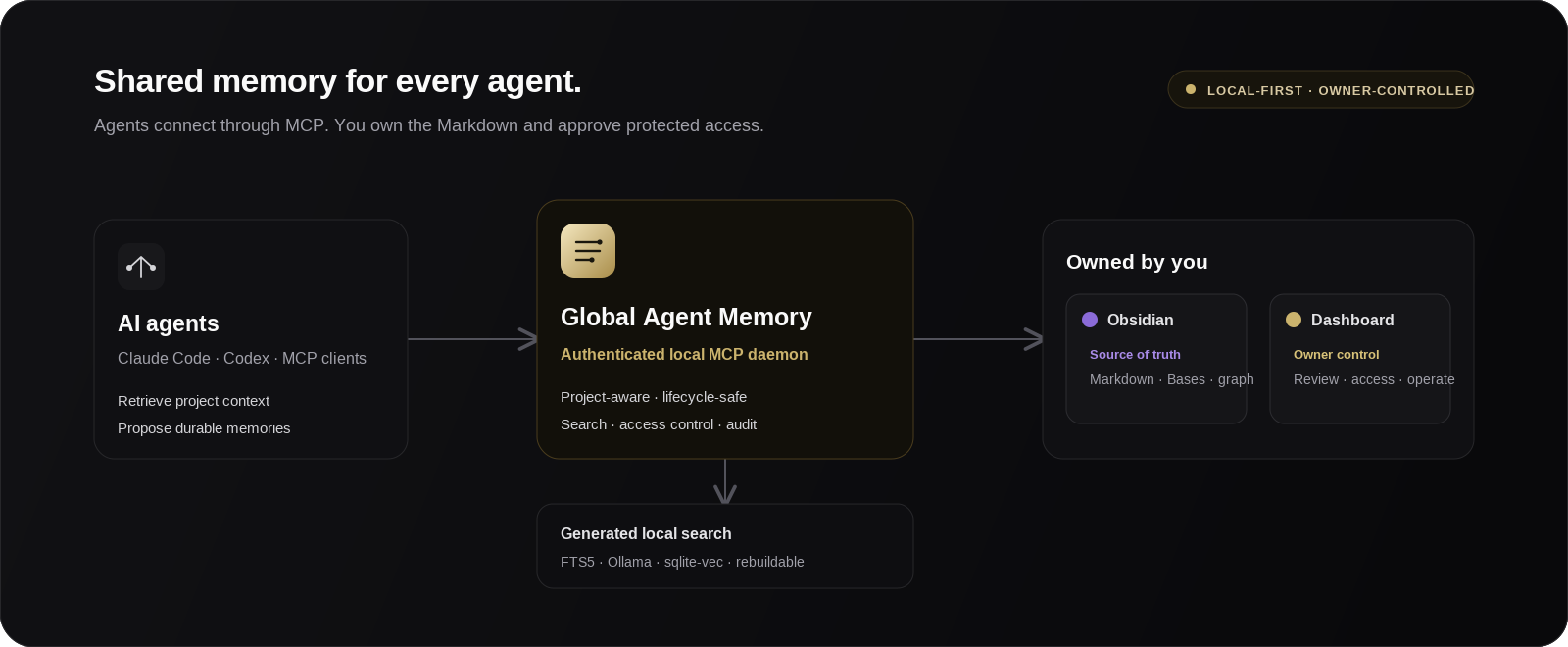
Global Agent Memory gives multiple coding agents one shared, reviewable memory without handing control of your knowledge base to a hosted service. Markdown files are canonical, a hybrid local MCP runtime is the public agent interface, and the dashboard lets a human approve, edit, protect, or remove what agents remember. Agent commands work without a background server. The authenticated localhost server starts on demand for the dashboard and can optionally run continuously for live file watching and shared embedding work.
One Vault. Multiple agents. Human-controlled memory.
Quick start · Obsidian Vault · Dashboard · How it works · Security · MCP contract · Documentation
Why Global Agent Memory?
Coding agents are useful inside a session, but important context is often lost between sessions or fragmented across individual clients. Global Agent Memory provides a durable layer for knowledge such as:
- architectural decisions and project conventions;
- verified workflows and operational runbooks;
- recurring problems and their proven solutions;
- project preferences, entities, and handoff summaries;
- bounded context for a new task or agent session.
Agents propose memories as candidates. A human reviews them before they become durable, controls their visibility, and can later update, supersede, archive, or hard-delete them.
How it compares
| Approach | Shared across agents | Human-reviewable | Project-aware | Owner-controlled access | Portable source of truth |
|---|---|---|---|---|---|
CLAUDE.md / AGENTS.md | Limited | ✓ | ✓ | — | ✓ |
| Basic memory MCP | ✓ | Varies | Varies | Varies | Varies |
| Hosted agent memory | ✓ | Varies | ✓ | Provider-defined | — |
| Global Agent Memory | ✓ | ✓ | ✓ | ✓ | Markdown |
Use project instruction files for compact rules that always belong in a prompt. Use Global Agent Memory when knowledge should be searchable, shared between clients, reviewed by a person, updated over time, or hidden behind explicit permission.
Highlights
- Shared across agents — Claude Code, Codex, and other MCP clients use the same service and immutable memory IDs.
- Project-aware by default — Git roots, remotes, aliases, and the project registry keep retrieval scoped to the active project.
- Markdown is canonical — the Vault remains readable, portable, backup-friendly, and usable with Obsidian.
- Human review workflow — agents create candidates; owners approve, edit, reject, or resolve conflicts in the dashboard.
- Protected and sealed memory — sensitive knowledge can be excluded from ordinary retrieval and placed behind owner-controlled access.
- Hybrid local search — SQLite FTS5 provides keyword retrieval; optional Ollama
embeddings and
sqlite-vecadd semantic ranking. - Offline-friendly — keyword search and lifecycle operations continue when Ollama is unavailable.
- Rebuildable generated state — SQLite, FTS, vectors, queues, and caches can be recreated from Markdown.
- Frozen MCP V1 contract — tools, resources, prompts, envelopes, and compatibility rules are versioned in the repository.
- No required background server: Claude Code, Codex, and CLI commands fall back to the same MCP application services in-process when the optional daemon is offline.
- Local security boundary: when the dashboard or HTTP MCP is active, the server
binds to
127.0.0.1and requires a generated bearer token stored outside the Vault.
Built for real project vaults
The opt-in performance suite creates 10,000 synthetic memories and exercises the same indexing and retrieval paths used by both runtime modes. On the recorded macOS ARM64 baseline, a full rebuild takes 36.5 seconds, warm keyword search P95 is 56 ms, warm hybrid search P95 is 76 ms, and incremental stdio proxy overhead is 1.5 ms. Results vary by machine; the changed-note, search, and proxy budgets run as regression gates. See the methodology and complete baseline.
Three surfaces, one memory system
Global Agent Memory is more than an MCP server. Agents, owners, and knowledge workers use the same canonical memories through three purpose-built surfaces:
| Surface | Designed for | What it provides |
|---|---|---|
| MCP | Claude Code, Codex, and other agents | Project-aware context, search, candidate creation, safe updates, lifecycle actions, and permission requests through a frozen V1 contract |
| Obsidian Vault | Reading, writing, linking, and long-term knowledge ownership | Portable Markdown and YAML, templates, native Bases views, project overview hubs, wikilinks, backlinks, graph navigation, and direct-edit synchronization |
| Local dashboard | Fast owner review and administration | Candidate approval and editing, conflict comparison, visibility classification, protected-access decisions, search, projects, activity, backups, and system health |
The Vault is the durable source of truth. The dashboard is a complementary control plane, and the MCP interface is the safe automation layer used by agents. You can use Obsidian, the dashboard, or both without creating separate copies of your memory.
Dashboard at a glance
Real dashboard UI with synthetic Atlas project data. No private Vault content is shown.
Quick start
This is the shortest path to persistent memory for Claude Code, Codex, and other MCP clients. The guided installer creates the local service, Obsidian-compatible Vault, dashboard, MCP registrations, and agent skills together.
Requirements
- macOS or Linux
- Python 3.12 or newer
uv- Claude Code or Codex for the managed client integrations
- Optional: Obsidian for browsing the Markdown Vault
- Optional: Ollama for semantic retrieval
1. Install
uv tool install global-memory-mcp
To install the latest unreleased source, use
uv tool install git+https://github.com/ozankasikci/global-agent-memory.git. For a
local checkout, use uv tool install ..
2. Run guided setup
global-memory setup
Setup shows one plan and asks once before it changes anything. It initializes the local Vault, creates the protected token, detects Claude Code and Codex, installs their MCP integrations and skills, verifies healthy clients, and opens the dashboard. Opening the dashboard starts its authenticated localhost server on demand. The command is idempotent, so running it again repairs or updates managed components without replacing unrelated client configuration.
Use flags when you need a non-default setup:
# Non-interactive installation
global-memory setup --yes

# Choose a different Vault on first setup
global-memory setup --vault "$HOME/Memory"

# Install only one client, or no client yet
global-memory setup --clients claude-code
global-memory setup --clients none

# Optional: install an always-on native service for live watching and shared indexing
global-memory setup --service

# Preview without changing files or services
global-memory setup --dry-run
3. Use the installed agent shortcuts
Setup installs five basic shortcuts for each detected client:
| Shortcut | Purpose |
|---|---|
gam-context | Load project-aware context for a task |
gam-search | Find a decision, fact, error, convention, or solution |
gam-remember | Propose explicitly supplied durable knowledge as a candidate |
gam-review | Show the candidate queue without changing it |
gam-dashboard | Open the authenticated dashboard |
In Claude Code, invoke them directly, for example /gam-context fix the upload retry bug.
In Codex, type /skills and choose one, or mention it directly, for example
$gam-context fix the upload retry bug.
4. Open the dashboard again
global-memory dashboard
You can also ask a connected agent:
Open the Global Agent Memory dashboard.
The agent calls memory_dashboard_open and opens the same authenticated local
dashboard.
Manual installation and repair
The individual commands remain available for advanced setups and troubleshooting:
global-memory init --vault "$HOME/Documents/Global Agent Memory"
global-memory daemon install-service --kind launchd  # use systemd on Linux
global-memory integrations install all
global-memory integrations verify all
global-memory doctor
Using it with an agent
After integration, you normally describe your intent instead of running memory commands manually.
Retrieve context before work
Before you start, load the relevant memory for this project and summarize the conventions and recent decisions.
Propose a durable memory
Remember that production ARM64 binaries must be built locally and uploaded to the server. Add it as a project convention with the deployment discussion as evidence.
The agent creates a candidate. Nothing becomes active until it is approved.
Update existing knowledge
Find the deployment memory and update it with the new health-check command. Do not create a duplicate.
Open the review surface
Open the memory dashboard so I can review the candidates.
The shared integration skill teaches supported agents when to retrieve, propose, update, and avoid duplicating memory.
Obsidian Vault
The configured Obsidian Vault is the human-readable, durable source of truth—not an export of an opaque database. Every managed memory is a normal Markdown file with YAML properties, a stable memory ID, lifecycle metadata, and project-aware links.
Initialization adds an Obsidian workspace without replacing your existing files:
- templates for decisions, facts, solutions, conventions, preferences, entities, references, session summaries, and project overviews;
- native Bases views for the candidate review queue, active knowledge, recent updates, decisions by project, verified solutions, and lifecycle history;
- project overview hubs that embed project memories and remain stable as notes move through candidate, active, rejected, superseded, or archived folders;
- wikilinks and reciprocal supersession links for backlinks and graph navigation;
- request-time synchronization, so ordinary content and descriptive-property edits made in Obsidian become searchable without a background service;
- optional watcher synchronization for immediate indexing when the background service is enabled.
Obsidian is optional: the same Markdown remains readable and editable with any text editor. Lifecycle and access-policy changes should still go through the dashboard, MCP, or CLI so validation, optimistic concurrency, and audit records remain intact.
Dashboard
The authenticated dashboard is the owner control plane for:
- project overview and recent project activity;
- one-at-a-time candidate review and editing;
- duplicate and conflict comparison;
- memory search and lifecycle management;
- Standard, Protected, and Sealed classification;
- access-request approval and active-grant revocation;
- sealed-memory owner unlocks with audit records;
- project switching, system health, reindexing, and backups;
- opening canonical Markdown in Obsidian or the local file viewer.
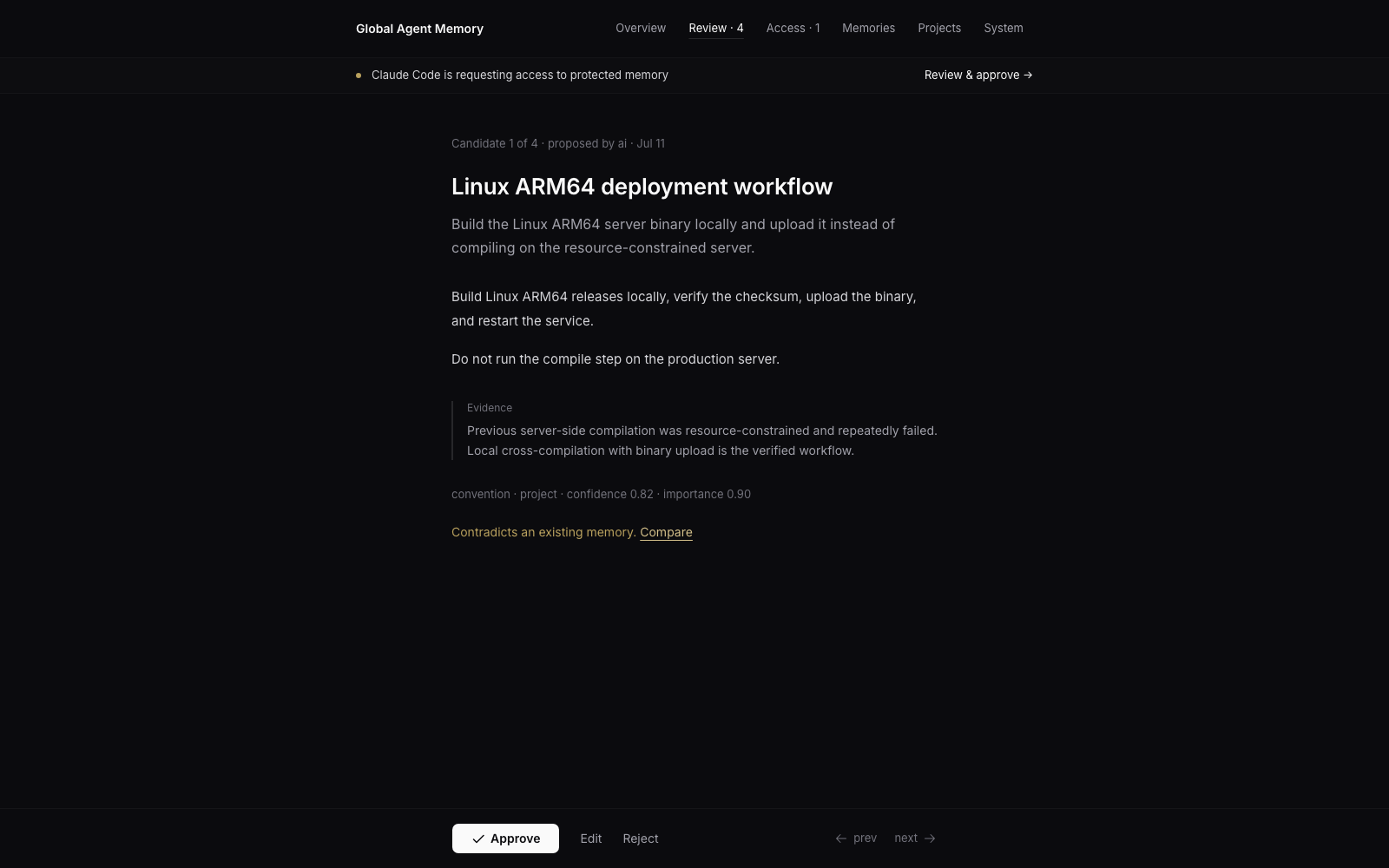
Candidate review keeps evidence and conflicts visible before an owner approves durable memory.
Dashboard launch URLs expire after 60 seconds, can be exchanged only once, and create a local HttpOnly session. Do not share a launch URL.
Memory visibility and access
| Level | Default agent behavior | Owner control |
|---|---|---|
| Standard | Included in ordinary scoped retrieval | Normal candidate and lifecycle review |
| Protected | Excluded from default results; an agent receives only a neutral relevance signal | Owner selects exact memories, permission, duration, policy, and eligible projects |
| Sealed | Body is not indexed or returned through agent tools | One owner-unlocked dashboard view; every access is audited |
Protected grants are scoped by purpose, project, agent, permission, exact memory IDs, and duration. Owners may downgrade a request but never elevate it. Agents may request and poll for access, but they cannot approve, deny, or revoke grants.
Important
Protected and Sealed memory are not secret managers. Never store passwords, credentials, private keys, API keys, or bearer tokens in Global Agent Memory.
How it works
flowchart LR
    A[Claude Code] -->|stdio MCP| H[Hybrid MCP runtime]
    B[Codex] -->|stdio MCP| H
    C[CLI] -->|MCP| H

    H -->|daemonless default| E[Application and domain services]
    H -.->|optional localhost daemon| D[Watcher, shared indexing, dashboard]
    D --> E
    E --> V[Markdown Vault<br/>canonical state]
    E --> I[SQLite FTS5 and sqlite-vec<br/>generated state]
    E --> O[Ollama embeddings<br/>optional]
    D --> W[Local dashboard<br/>owner control]
The global-memory-mcp bridge prefers a healthy shared daemon and otherwise runs the
same MCP server and application services in-process. Both paths expose the same frozen
MCP V1 contract and use the same canonical Markdown and generated SQLite state. The
optional daemon owns real-time Vault watching, background embedding retries, HTTP MCP,
and dashboard sessions. Agent memory operations do not depend on its availability.
The dependency direction is:
transport and client adapters → application services → domain
Vault, SQLite, vectors, embeddings, Git, Watchdog, and client integrations are adapters. The domain layer does not depend on them.
MCP interface
The MCP interface is the only public AI-facing API. Clients do not read the Vault, SQLite database, vectors, token, or runtime logs directly.
The frozen V1 discovery snapshot currently contains 17 tools, 10 resources, and 6 prompts.
| Capability | MCP tools |
|---|---|
| Retrieval | memory_search, memory_context, memory_get, memory_status |
| Candidate and lifecycle | memory_remember, memory_update, memory_approve, memory_reject, memory_supersede, memory_archive |
| Navigation and operations | memory_open, memory_dashboard_open, memory_reindex, memory_projects, memory_tags |
| Protected access | memory_access_request, memory_access_status |
All mutations are replay-safe through request_id. Updates use optimistic concurrency,
and a stale version fails with VERSION_CONFLICT instead of silently overwriting newer
knowledge.
See MCP Contract V1 and the generated
contracts/mcp/v1/ schemas for the complete contract.
CLI examples
The CLI uses the same MCP path as connected agents. It prefers the optional daemon and otherwise invokes the frozen MCP contract through an in-memory transport. It never bypasses access control by reading Markdown or SQLite directly.
# Check health
global-memory status
global-memory doctor

# Register and detect a project
global-memory project add my-project --root "$HOME/Projects/my-project"
global-memory project detect "$HOME/Projects/my-project"

# Search and build bounded task context
global-memory search "deployment rollback" --project my-project
global-memory context "Prepare the next release" --project my-project --token-budget 3000

# Create a review candidate
global-memory remember \
  "Release rollback procedure" \
  "Use the blue-green rollback task and verify both health endpoints." \
  --type reference \
  --scope project \
  --project my-project

# Rebuild generated indexes
global-memory reindex --full

# Back up canonical Markdown
global-memory backup "$HOME/Backups/global-agent-memory.zip"
Run global-memory --help or global-memory <command> --help for the complete command
reference.
Security model
Global Agent Memory is designed as a local service, not a remotely exposed memory API.
- The optional HTTP and dashboard server is restricted to
127.0.0.1. - Streamable HTTP requires a generated local bearer token.
- The token, database, logs, locks, and generated state remain outside the Vault.
- Token files use user-only permissions.
- Dashboard sessions are short-lived, local, and HttpOnly.
- Paths are confined to the configured Vault and checked against traversal and symlink escape.
- Ordinary logs redact bodies, prompts, embeddings, secrets, and authorization material.
- Generated state can be removed and rebuilt from canonical Markdown.
- Agent-facing retrieval is fail-closed for Protected and Sealed memories.
Please report security issues according to SECURITY.md.
Development
Clone the repository, then install Python and dashboard dependencies:
uv sync
npm ci --prefix dashboard
Run the standard quality gate:
make check
The gate covers Ruff formatting and linting, strict MyPy, the TypeScript production build, unit/integration/contract/E2E tests, coverage, and deterministic MCP contract regeneration.
Useful focused commands:
make unit
make integration
make contract
make e2e
make dashboard-check
make performance   # opt-in 10,000-note performance suite
When changing the MCP contract:
make contract-generate
make contract-check
Contributions are welcome. Start with CONTRIBUTING.md, and keep changes compatible with the frozen V1 contract unless a parallel major contract is intentionally introduced.
Community and roadmap
- Ask usage questions and share agent workflows in GitHub Discussions.
- Pick up a scoped contribution from the
good first issueorhelp wantedqueues. - Follow planned distribution, security, and integration work on the public roadmap.
- If the project is useful, starring the repository helps other agent-tooling users discover it.
Documentation
| Guide | Purpose |
|---|---|
| Operations | Installation, daemon management, diagnostics, backup, restore, upgrades, and recovery |
| Claude Code | Managed skill and MCP registration for Claude Code |
| Codex | Managed skill and MCP registration for Codex |
| Hermes Agent | Manual stdio MCP registration and verified retrieval smoke test |
| Architecture | Dependency direction and hybrid runtime ownership model |
| Configuration | Platform-native locations, environment variables, and security defaults |
| MCP Contract V1 | Public compatibility and response-envelope rules |
| Testing | Standard, performance, and live acceptance strategy |
| Performance baseline | 10,000-note benchmark methodology and budgets |
| Release checklist | Current V1 acceptance evidence and remaining release gates |
| Implementation plan | Original product requirements and phased implementation plan |
Project status
Global Agent Memory is under active V1 development and is distributed through
GitHub Releases and
PyPI. The current GitHub release and
source package version is 0.1.7; the MCP contract version is v1.
The product name is Global Agent Memory. The technical identifiers global-memory,
global-memory-mcp, global-memoryd, global_memory, and product: global-memory
remain stable for V1 compatibility.
See the V1 release checklist for verified scenarios and remaining live acceptance work.
License
Global Agent Memory is available under the MIT license declared in pyproject.toml.







