Listed from the MCP registry; nobody on Odel publishes it.

AMR (antimicrobial resistance)
Antimicrobial resistance genes, sequences and literature from NCBI and UniProt
Runs on your machine from its package; the steps are below.
What it does
- Reads
- Writes
- High impact
Not assessed yet.
What it costs
FreeOdel charges nothing per call. The publisher may charge for its own service.
Runs locally over stdio
This server isn't hosted — your MCP client launches it from a package registry. Use one of the commands below, or drop the config into your client (e.g. Claude Desktop).
Run
uvx amr-mcp
MCP client config
{
  "mcpServers": {
    "amr-antimicrobial-resistance": {
      "command": "uvx",
      "args": [
        "amr-mcp"
      ]
    }
  }
}amr-mcp


An MCP server that lets AI assistants (Claude, Codex, Cursor…) query antimicrobial resistance (AMR) data from public, free sources:
- NCBI Reference Gene Catalog, the curated database behind AMRFinderPlus: ~11,500 AMR genes, point mutations, stress and virulence genes
- NCBI E-utilities: protein and nucleotide sequences, PubMed references
- UniProtKB: protein function, keywords and cross-references
- AMRFinderPlus (optional, if installed locally): screen your own genomes
All data sources are public domain or freely accessible; no API keys are required.
Demo
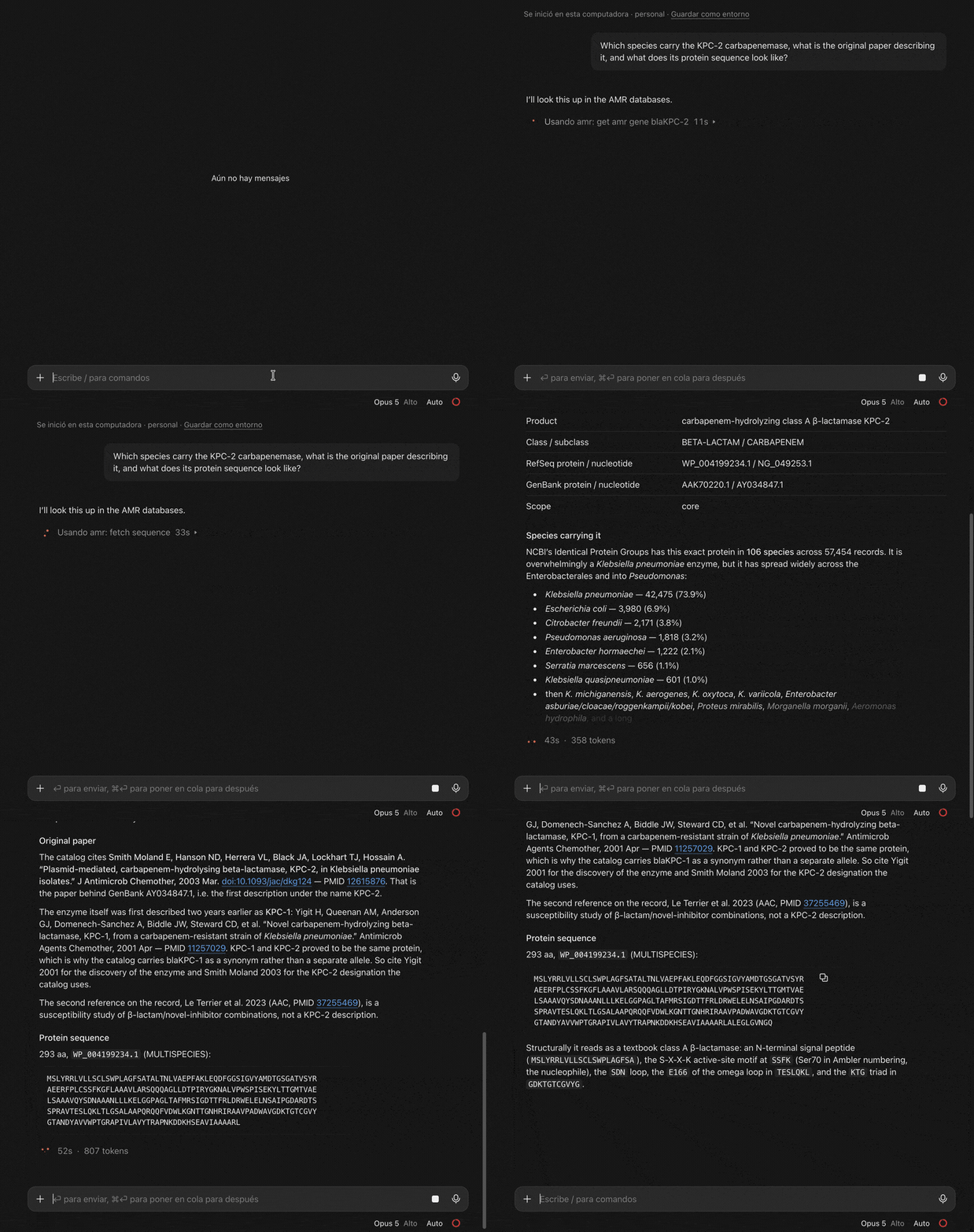
Claude Code answering the first example question below: the server looks up blaKPC-2 in the catalog, counts the species NCBI has found it in, pulls the protein sequence and resolves the original paper.
Example questions
Which species carry the KPC-2 carbapenemase, what is the original paper describing it, and what does its protein sequence look like?
Summarise the carbapenemase gene families in the catalog and how many variants each has.
Give me the protein sequence of mcr-1.1 and its UniProt function annotation.
Run AMRFinderPlus on
~/data/isolate_17.fastaas Escherichia and explain the hits by drug class.
Tools
| Tool | What it does |
|---|---|
search_amr_genes | Search by text, drug class, subclass, organism or element type; group_by_family for broad searches |
get_amr_gene | Exact record for an allele (blaKPC-2) or summary of a family (blaKPC) |
list_drug_classes | Drug classes and how many catalog entries each has |
catalog_info | Catalog version and size |
fetch_sequence | Protein or nucleotide FASTA from NCBI by accession |
get_protein_hosts | Species in which NCBI has sequenced an exact protein (Identical Protein Groups) |
get_pubmed_references | Title, journal, authors and DOI for PubMed IDs |
search_uniprot / get_uniprot_entry | UniProtKB search and entry details |
run_amrfinder | Run a local AMRFinderPlus install on a FASTA file |
Installation
Run it with uv (no install step needed), or pip install amr-mcp.
Claude Code
claude mcp add amr -- uvx amr-mcp
Claude Desktop
Add to claude_desktop_config.json:
{
  "mcpServers": {
    "amr": { "command": "uvx", "args": ["amr-mcp"] }
  }
}
Without uv: pipx
pipx install amr-mcp
which amr-mcp   # e.g. /Users/you/.local/bin/amr-mcp
Then use that absolute path as the command, for example in claude_desktop_config.json:
{
  "mcpServers": {
    "amr": { "command": "/Users/you/.local/bin/amr-mcp" }
  }
}
Desktop apps don't inherit your shell's PATH, so if Claude Desktop can't start the server,
use the absolute path for the command (this applies to uvx too: run which uvx to get it).
Agent skill (optional)
skills/amr-research/SKILL.md tells the agent when to reach for these
tools and how to chain them (gene → hosts → sequence → paper, family overviews, genome screening),
plus the pitfalls to avoid. It works with any agent that reads SKILL.md files (Claude Code, Cursor,
Codex, Copilot…):
npx skills add pabloestepaa/amr-mcp
Or copy the folder by hand, e.g. to ~/.claude/skills/amr-research/ for Claude Code.
The skill uses the MCP server above, so install that too.
Configuration
| Variable | Purpose |
|---|---|
NCBI_API_KEY | Optional, free. Raises the NCBI rate limit from 3 to 10 requests/s |
NCBI_EMAIL | Optional. Contact e-mail NCBI asks tools to send |
AMR_MCP_CACHE_DIR | Where the catalog is cached (default ~/.cache/amr-mcp, refreshed every 30 days) |
To enable run_amrfinder: conda install -c bioconda ncbi-amrfinderplus && amrfinder -u.
Development
python -m venv .venv && .venv/bin/pip install -e ".[dev]"
.venv/bin/pytest -m "not network"   # offline tests
.venv/bin/pytest                    # also hits the live NCBI/UniProt APIs
Data licensing
The NCBI Reference Gene Catalog and NCBI sequence data are US government works in the public domain. UniProt data is available under CC BY 4.0. Please cite the original sources when you publish results:
- Feldgarden M, et al. AMRFinderPlus and the Reference Gene Catalog facilitate examination of the genomic links among antimicrobial resistance, stress response, and virulence. Sci Rep. 2021.
- The UniProt Consortium. UniProt: the Universal Protein Knowledgebase. Nucleic Acids Res.
License
MIT
Developed with AI assistance (Claude Code); all code reviewed and tested by the author.