
Subgraph Registry
Agent-friendly semantic classification of all subgraphs on The Graph Network.
Pre-computed index of 15,330 subgraphs with domain classification, protocol type detection, schema fingerprinting, canonical entity mapping, and composite reliability scoring.
What's new in 0.8.0 — three agent-discovery upgrades:
- Semantic search via 384-dim embeddings (
semantic_search_subgraphs)- Schema evolution tracking with stability days surfaced on every result (
get_schema_changes)- OpenAPI 3.1 spec auto-generated for MCP tools + REST routes, served at
/.well-known/openapi.json
The Problem
Agents querying The Graph need to discover and select the right subgraph before they can query data. Today this requires 3-4 tool calls (search, check volumes, fetch schema, infer structure) before any real work happens. This registry flips that: agents start with structured knowledge, not a blank slate.
What It Does
- Crawls all active subgraphs from the Graph Network meta-subgraph
- Fetches the GraphQL schema for every deployment
- Extracts contract addresses from each manifest's
dataSourcesandtemplates— agents can answer "which subgraph indexes contract 0x… on chain X?" - Generates a per-subgraph starter GraphQL query from the parsed schema (real top entity, real fields, sensible orderBy) — no more generic boilerplate that doesn't compile against most subgraphs
- Classifies each subgraph by domain, protocol type, canonical entities, and schema family
- Scores reliability using on-chain signals (query fees, volume, curation, stake)
- Returns x402 + legacy query URLs — agents can pay $0.01 USDC on Base per query (no API key) or use a Studio key
- Publishes as SQLite database + REST API + MCP server + per-subgraph JSON-LD at
/.well-known/subgraph/{id}.jsonldfor ecosystem crawlers - Generates visual dashboards and bot-readable category files (auto-updated with each sync)
Querying with x402 (no API key)
Every result includes query_url_x402 alongside the legacy query_url. The Graph's public x402 gateway (live since 2026-05-08) accepts $0.01 USDC on Base per query with zero signup.
// An x402-native agent — discovery to data in two calls
const { recommendations } = await mcp.call("recommend_subgraph", {
  goal: "find DEX trades on Arbitrum",
});
const top = recommendations[0];

// POST your GraphQL query. The first call returns HTTP 402 with a
// base64 `payment-required` header; the x402 client signs the
// EIP-3009 USDC transfer on Base and retries automatically.
const data = await x402Fetch(top.query_url_x402, {
  method: "POST",
  body: JSON.stringify({ query: "{ swaps(first: 5) { id amountUSD } }" }),
});
Pricing manifest returned per subgraph:
{
  "amount_usd": 0.01,
  "asset": "USDC",
  "asset_contract": "0x833589fCD6eDb6E08f4c7C32D4f71b54bdA02913",
  "chain": "base",
  "network": "eip155:8453",
  "pay_to": "0x79DC34E41B2b591078d3dE222C43EcaaBD52FcCB",
  "scheme": "exact",
  "asset_transfer_method": "eip3009"
}
Client libraries: @graphprotocol/client-x402, x402-fetch, or any generic x402 wrapper.
Registry at a Glance
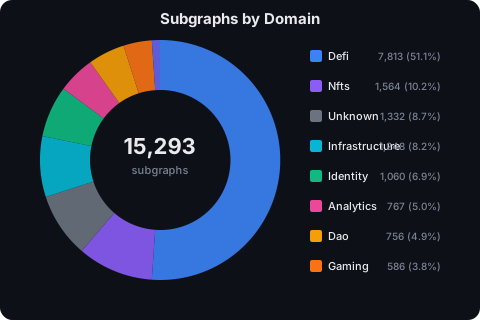
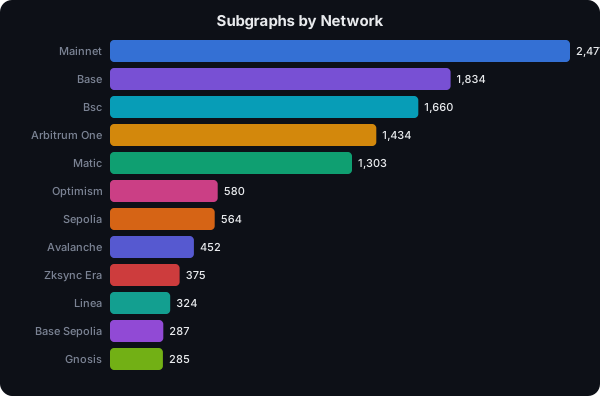
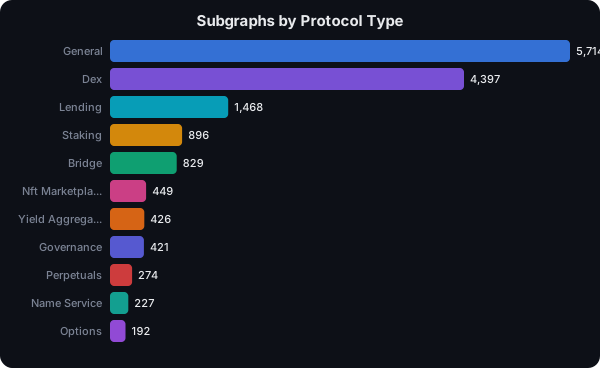
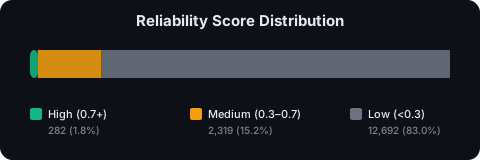
Charts auto-generated from
registry.dbon each sync. Seepython/generate_docs.py.
Browse by Category
Domains
Explore subgraphs by use case — each file lists the top 25 subgraphs ranked by reliability score.
| Domain | Count | File |
|---|---|---|
| DeFi | 7,844 | Swaps, pools, lending, vaults, yield |
| NFTs | 1,565 | Collections, marketplaces, sales |
| Unclassified | 1,333 | Not confidently classified |
| Infrastructure | 1,251 | Indexers, oracles, registries |
| Identity | 1,061 | ENS, name services, resolvers |
| Analytics | 766 | Snapshots, metrics, historical data |
| DAO | 758 | Governance, proposals, voting |
| Gaming | 585 | Players, quests, items, worlds |
| Social | 167 | Profiles, posts, follows |
Full index: docs/DOMAINS.md
Networks
Explore subgraphs by blockchain — each file lists the top 25 subgraphs on that chain.
| Network | Count | File |
|---|---|---|
| Ethereum | 2,484 | Largest ecosystem |
| Base | 1,841 | Fast-growing L2 |
| BSC | 1,670 | BNB Chain |
| Arbitrum | 1,437 | Leading L2 |
| Polygon | 1,304 | Polygon PoS |
| Optimism | 580 | OP Stack L2 |
| Avalanche | 453 | C-Chain |
Full index: docs/NETWORKS.md
Protocol Types
| Type | Count | Description |
|---|---|---|
| DEX | 4,411 | Uniswap, Sushi, Curve, Balancer, PancakeSwap |
| Lending | 1,469 | Aave, Compound, Morpho, Spark, Silo |
| Staking | 898 | Lido, Rocket Pool, EigenLayer, Graph Network |
| Bridge | 836 | Hop, Stargate, Across, Wormhole, LayerZero |
| NFT Marketplace | 450 | OpenSea, Blur, Rarible, Foundation |
| Yield Aggregator | 425 | Yearn, Beefy, Harvest, Convex |
| Governance | 425 | Snapshot, Tally, Compound Governor |
| Perpetuals | 273 | GMX, Gains, dYdX, Hyperliquid |
| Name Service | 227 | ENS, Space ID, Unstoppable Domains |
| Options | 192 | Premia, Dopex, Lyra, Hegic |
Reliability Score
Each subgraph gets a composite reliability score (0-1) based on four on-chain signals:
| Signal | Weight | What it measures |
|---|---|---|
| Query Fees | 30% | GRT fees earned from actual usage |
| Query Volume | 30% | 30-day query count |
| Curation Signal | 20% | GRT tokens curated by the community |
| Indexer Allocation | 20% | GRT allocated to this subgraph by indexers |
All values are log-scaled and capped at 1.0. A 0.5 penalty is applied if the subgraph has been denied/deprecated.
Score tiers: High (0.7+) = strong signal, real usage | Medium (0.3-0.7) = functional, some activity | Low (<0.3) = minimal signal or test deployment
The score measures traction, so it measures age
All four inputs are cumulative — fees and curation accrue, volume needs 30 days to exist at all. A subgraph deployed last month therefore scores near zero no matter how good it is. Measured on the current corpus (served, non-denied):
| Age | Count | Avg reliability |
|---|---|---|
| < 30 days | 64 | 0.107 |
| 30–90 days | 227 | 0.143 |
| 90–365 days | 1,100 | 0.225 |
| > 1 year | 4,034 | 0.313 |
The newest subgraph anywhere in the registry's top 25 is 280 days old — yet 59 of those 64 sub-30-day subgraphs are already serving real query volume.
Rather than reweight the score and trade a measurable signal for a guess,
search_subgraphs returns young matches in a separate emerging list
alongside an emerging_caveat explaining that a low score at that age is
expected rather than damning. Every result also carries age_days and
maturity (new < 30d, emerging < 90d, established). This matters most
for new chains and new protocols, where no mature deployment can exist —
searching "perpetual futures" surfaces years-old Ethereum and BSC deployments
in the main list and the 40-day-old Monad perps subgraph under emerging.
semantic_search_subgraphs ranks by cosine similarity rather than reliability,
so it is already age-neutral — it carries the maturity labels but no
emerging list, because a three-week-old subgraph can top it on merit.
Ranking
Three tools rank, and each ranks differently on purpose:
search_subgraphs— orders by how many of your query terms matched, then by reliability. OR-ing the terms and ordering on reliability alone meant a popular subgraph matching one incidental word beat a precise match on all three, so being more specific returned worse answers. Version tokens (v2,v3,v4) are kept rather than dropped as too short.semantic_search_subgraphs— orders bysemantic_score × (0.5 + 0.5 × reliability). Pure cosine put testnets first, since their text is nearly identical to mainnet's. The 0.5 floor keeps new subgraphs competitive.recommend_subgraph— infers domain and protocol type from the goal, but as a ranking bonus, never a filter. As a filter, one bad keyword collapsed the candidate pool to nothing.
A term matching a subgraph's name counts for more than one matching its
description — %ens% also matches "tokens", so equal weighting handed a
search for ens to four Uniswap subgraphs.
Chain names are aliased, so ethereum, arbitrum, polygon and bnb resolve
to the corpus values mainnet, arbitrum-one, matic and bsc.
Testnets
723 of the 5,425 served subgraphs are on testnets, and their text is nearly
identical to their mainnet twins', so they compete for the top slot. They are
excluded by default and every result carries testnet: true|false. Pass
include_testnets: true to see them — and an explicit request for a testnet
network (network: "sepolia") always wins over the default, so that still
returns exactly what you asked for.
Using the registry from payql
payql can use this registry as its
free discovery source instead of paying for a network-subgraph query. Run the
registry's HTTP transport and point payql at it:
npx subgraph-registry-mcp --http-only          # serves :3848
PAYQL_REGISTRY_URL=http://127.0.0.1:3848/graphql npx -y payql
POST /graphql answers in the Graph network subgraph's subgraphMetadataSearch
shape, which is what payql already parses — so this needs no change on payql's
side, and discovery becomes free and locally-ranked.
Denied deployments
Curation-denied deployments (deniedAt > 0 — denied indexing rewards, usually
spam, duplicates or deprecations) are excluded by default from
search_subgraphs, semantic_search_subgraphs and recommend_subgraph. Pass
include_denied: true to the two search tools to see them; every result then
carries denied: true|false so the choice stays visible.
MCP Server
The registry is available as an MCP server with dual transport — stdio for local clients and SSE/HTTP for remote agents.
Same abilities as graphops/subgraph-mcp (hosted SSE https://subgraphs.mcp.thegraph.com/sse), better discovery. Schema, execute, contract-lookup and 30-day counts use the official tool names so an agent can swap connectors. Search stays on our names (search_subgraphs, recommend_subgraph, semantic_search_subgraphs) because they already beat official search_subgraphs_by_keyword (reliability, real query_volume_30d, network).
Official workflow says ALWAYS call get_deployment_30day_query_counts before selecting. Skip that extra round-trip here — every search/recommend hit already carries query_volume_30d. The counts tool still exists under the official name and reads those same registry figures. Official counts have been observed returning 0 for ENS, Lido and Uniswap; we do not copy those zeros.
The shipped server is the Node implementation in
src/index.js; that's whatnpx subgraph-registry-mcpruns and what's published to npm. A Python equivalent inpython/mcp_server.pyis kept for local development against the same SQLite database — bug fixes and new tools should land in the Node version first.
Discovery tools (never execute GraphQL, never introspect live schemas):
- search_subgraphs — filter by domain, network, protocol type, entity, or keyword. Ranked by matched terms, reliability and real
query_volume_30d. - recommend_subgraph — natural language goal to best subgraphs (includes
schema_stable_days) - semantic_search_subgraphs — vector-similarity search over precomputed embeddings (sentence-transformers/all-MiniLM-L6-v2, 384-dim). Use for fuzzy/paraphrased goals where literal keyword match would miss.
- get_subgraph_detail — full classification for a specific subgraph (includes
schema_changed_atand crawledcontract_addresses) - list_registry_stats — registry overview (domains, networks, counts)
- get_schema_changes — chronological schema-fingerprint history for a subgraph (one row per detected change). Helps agents prefer mature subgraphs whose data contract has been stable.
Opt-in query / schema (caller must invoke; search never auto-queries). Official names for connector swap-in:
- execute_query_by_subgraph_id / execute_query_by_deployment_id / execute_query_by_ipfs_hash — POST GraphQL to The Graph gateway. Same routing as official (
subgraphs/idvsdeployments/id). RequiresTHE_GRAPH_STUDIO_API_KEY(orGATEWAY_API_KEY). Without a key, returns{error: credentials_required, query_url, query_url_x402, hint}immediately — no hang, no x402 auto-pay. Convenience superset: execute_query acceptsidORdeployment_idORipfs_hash. - get_schema_by_subgraph_id / get_schema_by_deployment_id / get_schema_by_ipfs_hash — local
registry_schema(entities, example_query, fingerprint) with no network when the subgraph is in the corpus; live__schemaintrospection only when a Studio key is set. Convenience superset: get_schema. - get_top_subgraph_deployments(contract_address, chain) — official name. Official
chainis graph-node ids (mainnet, notethereum); we accept both. Top 3 from crawled manifests, ranked by reliability then real 30-day volume (not official query-fees / 0-count oracle). Substreams-powered subgraphs often have no dataSources addresses — that gap is reported, not faked. - get_deployment_30day_query_counts — official name,
ipfs_hashesin. Real registryquery_volume_30d. Unknown hashes returnnot_in_registryrather than a fake 0. Usually unnecessary: the same number is already on every search hit.
Set THE_GRAPH_STUDIO_API_KEY in the MCP host env to enable execute/live-schema. No private key is bundled. The keyed gateway often returns HTTP 200 with a GraphQL error body when auth is missing — execute_query surfaces http_status and errors honestly.
Install
# Claude Code
claude mcp add subgraph-registry -- npx subgraph-registry-mcp

# Claude Desktop
{
  "mcpServers": {
    "subgraph-registry": {
      "command": "npx",
      "args": ["subgraph-registry-mcp"],
      "env": {
        "THE_GRAPH_STUDIO_API_KEY": "your-studio-key"
      }
    }
  }
}

# Remote agents (SSE)
npx subgraph-registry-mcp --http-only
# Then connect to http://localhost:3848/sse
The server auto-downloads the pre-built registry (8MB SQLite) from GitHub on first run.
Well-Known JSON-LD Manifest
Stable, machine-readable per-subgraph manifest that other crawlers and agent frameworks can index without going through MCP. Served by the Node MCP HTTP transport:
GET /.well-known/subgraph/{id}.jsonld     Full per-subgraph manifest (JSON-LD)
GET /subgraphs/{id}.jsonld                 Alias (same payload)
GET /.well-known/subgraph-index.jsonld     Discovery list — top 100 by reliability with @id links
Each manifest includes classification, parsed entities, contract addresses (from the indexed dataSources), endpoints (x402 + API-key), a per-subgraph starter query generated from the actual schema, pricing, and metadata. The @context + @type make the shape auto-discoverable.
# Start the HTTP transport
npx subgraph-registry-mcp --http-only

# Fetch the manifest for Uniswap V3 Mainnet
curl http://localhost:3848/.well-known/subgraph/5zvR82QoaXYFyDEKLZ9t6v9adgnptxYpKpSbxtgVENFV.jsonld
Semantic Search
Every subgraph has a precomputed 384-dim embedding from sentence-transformers/all-MiniLM-L6-v2, built from its display name, description, canonical entities, top schema entity names, and protocol metadata. At MCP-tool-call time the Node server embeds the query string with the same model (via @xenova/transformers, quantized ONNX bundled in the npm package — no first-call download) and ranks rows by cosine similarity.
const { subgraphs } = await mcp.call("semantic_search_subgraphs", {
  query: "lending positions near liquidation on a Layer 2",
  limit: 5,
});
// subgraphs[i].semantic_score is cosine similarity in [0, 1]; >0.5 ~= strong match.
Use it when:
- The goal is paraphrased or use-case-shaped (
search_subgraphsis keyword-only). - You're exploring "what data exists for X?" rather than fetching a specific protocol's subgraph.
Same model is shared between Python crawl-time (fastembed) and JS runtime (@xenova/transformers) — vectors are bitwise-comparable so cosine math gives consistent rankings across runtimes.
Embeddings add ~22 MB to registry.db (14k × 384 × 4 bytes); model bundle adds ~23 MB to the npm package.
Schema Evolution
Each crawl computes a schema_fingerprint (MD5 of sorted entity:field_count pairs) per subgraph. Whenever the fingerprint changes from the previous sync, an immutable row is written to schema_history. The table is append-only and survives full DB rebuilds.
const history = await mcp.call("get_schema_changes", {
  subgraph_id: "5zvR82QoaXYFyDEKLZ9t6v9adgnptxYpKpSbxtgVENFV",
});
// {
//   total_changes: 3,
//   stable_days: 47.2,
//   changed_within_24h: false,
//   changed_within_7d: false,
//   changes: [
//     { fingerprint: "abc123...", prev_fingerprint: "def456...", detected_at: 1717... },
//     ...
//   ]
// }
recommend_subgraph and get_subgraph_detail results now also include schema_changed_at (unix seconds of last detected change) and schema_stable_days so agents can prefer subgraphs whose data contract has been stable longer — useful when a query needs to keep working across the agent's planning horizon.
OpenAPI
The full API surface (MCP tools + REST routes) is published as OpenAPI 3.1:
openapi.yaml— checked into the repo, single source of truthdata/openapi.json— bundled with the npm tarballGET /.well-known/openapi.json— served by the HTTP transport for live discovery
The spec is regenerated on every release from the declarative TOOLS[] + REST_ROUTES[] exports in src/index.js via scripts/gen-openapi.js. CI fails any PR that touches src/index.js without regenerating the spec.
REST API
GET /summary                    Registry overview and stats
GET /domains                    Domain breakdown
GET /networks                   Network breakdown
GET /families                   Schema family groups (fork/clone detection)
GET /subgraphs                  Filter subgraphs
GET /subgraphs/{id}             Full detail for one subgraph (now includes contract_addresses and example_query)
GET /search?q=uniswap           Free-text search
GET /recommend?goal=...&chain=  Agent-optimized recommendation
# Start API server
cd python && python server.py

# Example: find DEX subgraphs on Arbitrum
curl "http://localhost:3847/recommend?goal=query+DEX+trades+on+Arbitrum&chain=arbitrum-one"

# Example: filter by entity type
curl "http://localhost:3847/subgraphs?entity=liquidity_pool&network=base&min_reliability=0.5"
Bot-Readable Category Files
The docs/ directory contains structured .md files with YAML frontmatter designed for AI agents and bots to consume:
docs/
├── DOMAINS.md           # Index of all domains with counts
├── NETWORKS.md          # Index of all networks with counts
├── charts/              # Auto-generated SVG visualizations
│   ├── domains.svg
│   ├── networks.svg
│   ├── protocol-types.svg
│   └── reliability.svg
├── domains/             # One file per domain
│   ├── defi.md          # Top 25 DeFi subgraphs by reliability
│   ├── nfts.md
│   ├── dao.md
│   └── ...
└── networks/            # One file per network
    ├── mainnet.md       # Top 25 Ethereum subgraphs by reliability
    ├── base.md
    ├── arbitrum-one.md
    └── ...
Each category file includes:
- YAML frontmatter (domain/network, count, percentage, last updated)
- Top 25 subgraphs ranked by reliability score
- MCP tool and REST API query examples
Architecture
Graph Network Subgraph (meta-subgraph, 140M queries/month)
    |
    v
crawler.py ---- async httpx, ID-based cursor pagination
    |
    v
classifier.py - rule-based domain/protocol classification + schema fingerprinting
    |
    v
registry.py --- builds SQLite + indices
    |
    ├── server.py ------ FastAPI REST API (:3847)
    ├── generate_docs.py SVG charts + category .md files
    └── scheduler.py --- weekly incremental sync

MCP Server (src/index.js, published to npm)
    ├── stdio   ←── Claude Desktop / Claude Code
    └── SSE     ←── OpenClaw / remote agents (:3848)

python/mcp_server.py — local-dev MCP server hitting the same SQLite DB
Quick Start (Local Build)
cd python
python3 -m venv .venv && source .venv/bin/activate
pip install -r requirements.txt

echo "GATEWAY_API_KEY=your-key-here" > .env

# Full crawl + classify (~11 min)
python registry.py

# Generate charts and category files
python generate_docs.py

# Start API server
python server.py
How It Stays Current
A GitHub Actions workflow runs every 3 days:
- Incremental crawl (
updatedAt_gte: lastSyncTimestamp) - Reclassify new/changed subgraphs
- Regenerate SVG charts and category .md files
- Commit and push updates
License
MIT