Listed from the MCP registry; nobody on Odel publishes it.

Pseudolife Memory
Persistent memory for MCP-compatible agents: memory bank, fact cortex, dreams, graph.
Runs on your machine from its package; the steps are below.
What it does
- Reads
- Writes
- High impact
At most: moves money, runs code or commands, deletes data, or sends messages for you.
What it costs
FreeOdel charges nothing per call. The publisher may charge for its own service.
Runs locally over stdio
This server isn't hosted — your MCP client launches it from a package registry. Use one of the commands below, or drop the config into your client (e.g. Claude Desktop).
Run
uvx pseudolife-mcp
MCP client config
{
  "mcpServers": {
    "pseudolife-memory": {
      "command": "uvx",
      "args": [
        "pseudolife-mcp"
      ]
    }
  }
}Pseudolife-MCP



简体中文 · 日本語 · 한국어 · Português (BR) · Español
Persistent long-term memory for Claude Code, Codex, and other MCP clients.
An MCP server that gives coding agents a long-term memory that persists across sessions — surviving context compactions and fresh tasks. Your coding agent is the intelligence; this server is its memory on disk.
What you get:
- Associative memory with honest forgetting — a flat similarity store ranked by hybrid dense-plus-lexical retrieval, with conflict detection that admits potential updates while preserving earlier source notes; whole-note replacement is explicit. (The measured verdict: a preregistered ablation campaign found the previous 8-band continuum tied a flat store on every gate, so the simpler structure ships; the continuum remains one config line away.)
- Canonical facts, not vibes — one current value per
entity.attributeslot (or a member set, for slots that hold many concurrent values); corrections supersede rather than silently overwrite, and the full version history survives. - Dreams — a bundled local extractor, or any OpenAI-compatible endpoint (a Claude model on your Max plan, a GPT-5.6 model on a ChatGPT plan, LM Studio, Ollama, vLLM), consolidates the memory stream into facts and a knowledge graph while you're not looking.
- Lessons from its own work — successes, dead-ends, and your corrections become do/avoid guidance surfaced at the start of every session.
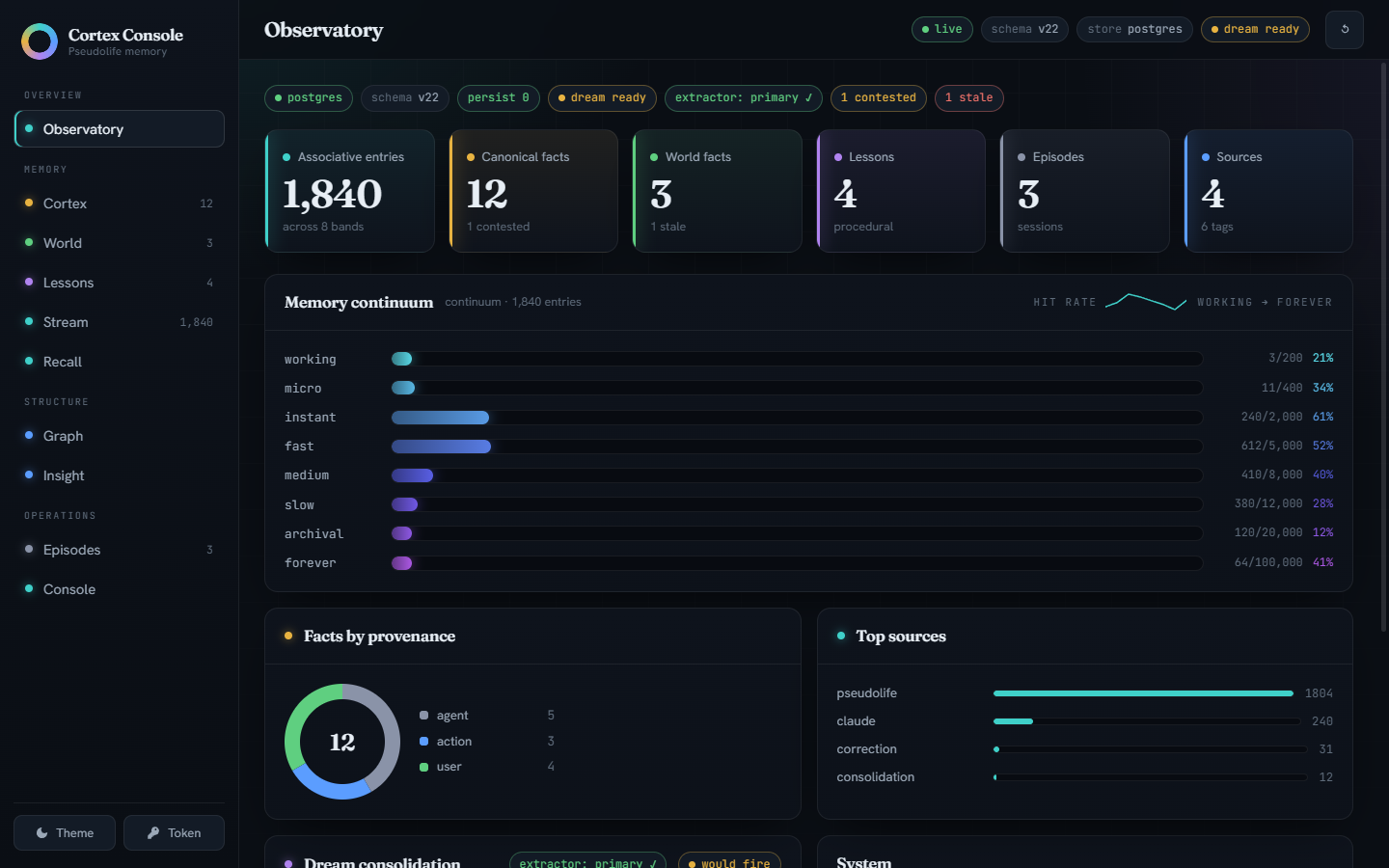
- A web console to watch it think — the Cortex Console above, plus cited world facts, session episodes, and document RAG.
These LongMemEval and BEAM numbers were measured on the Python engine.
Measured, with receipts — the full 500-question LongMemEval sweep, all six question types, and every number ships with its committed run artifact:
| LongMemEval oracle, 500 questions | naive RAG | commit-gated cascade |
|---|---|---|
| accuracy, all six question types | 0.688 | 0.690 |
| context tokens per question | ~1210 | ~883 |
| knowledge-update slice (78 of the 500) | 0.859 |
Equal accuracy to naive RAG across the whole benchmark on ~73% of the
context, and better calibrated about what it does not know: on BEAM-100K's
abstention questions the fact spine scores 0.950 against naive RAG's
0.775, unchanged under two independent judges. Read that as calibration,
not recall — in the budget-matched five-arm run of 2026-09-02 (rag 0.725 there;
one replicate, local judge) an arm served no memory at all scores 1.000 on
the same questions, because refusing is the right answer there and an
empty context always refuses. The fact spine loses where an answer has to
be aggregated across sessions. The second claim to survive a judge swap is
a win rather than a wash: re-run on 2026-09-04 with the hybrid arm
budget-matched to the control at 6 turns, the same 500 questions give
hybrid 0.730 against naive RAG's 0.690 under the local judge and
0.736 against 0.694 under claude-opus-5 — paired +0.040 / +0.042,
p 0.015 / 0.013 — bought with more context, ~1229 tokens against the
control's ~1124, not less, and carried mostly by temporal-reasoning
questions. Graded by a local, byte-reproducible judge (the cross-judge check
names its second judge) — compare within rows, never against GPT-judged
leaderboards.
Retired 2026-08-25 (#188): the 0.936 knowledge-update headline. It was measured on the 2026-07-30 bench stack (Qwen3.6-27B answerer and judge). Re-running the same 78 questions after the 2026-08-17 migration to Qwen3.8-27B puts the cascade at 0.846, below the naive-RAG control — which lands on 0.859 on both stacks. The cascade serves the fact-spine answer unless that channel says "I don't know", so it measures the answerer's abstention behaviour as much as the memory: 32/78 abstentions at 46/46 commit precision on the old stack, 22/78 at 0.839 on the new one. The 500-question table above is on the older judge and has not been re-judged, so read its cascade row as an upper bound.
Full tables, the per-type breakdown, both stacks side by side, and every artifact: Benchmarks.
Quickstart
Install and register the lite tier. No Docker, no database to set up, no container runtime:
pip install "pseudolife-mcp[lite]"
claude mcp add --scope user pseudolife-memory -- pseudolife-mcp
Codex instead of Claude Code — same shape:
pip install "pseudolife-mcp[lite]"
codex mcp add pseudolife-memory --env PSEUDOLIFE_WRITER_ID=codex -- pseudolife-mcp
For Codex, finish setup before starting a fresh task. In the existing
[mcp_servers.pseudolife-memory] table in ~/.codex/config.toml, add
startup_timeout_sec = 240, tool_timeout_sec = 240, and required = true.
The shim can wait up to 180 seconds for a cold daemon; Codex's default
startup budget is 10 seconds. required makes missing memory visible at
startup and waits for its initial catalog. These are starting budgets,
not a promise that a first model download fits. The tool budget leaves time for
the shim's 180-second deadline to report a failure before the host cancels it; prewarm with
pseudolife-mcp serve in a terminal if needed.
Approve memory_message in that table's tool configuration
([mcp_servers.pseudolife-memory.tools.memory_message] approval_mode = "approve", or allow it once and keep the approval); Codex hook setup
(python ops/setup-codex-hooks.py) sets it when you approve the hooks, and
keeps any value you chose. Board mail can wake an
idle Codex task by default, and the woken task reads its mail with that tool:
without the approval it stalls on a prompt until someone answers it. Set
PSEUDOLIFE_CODEX_DOORBELL = "0" in the same env table to keep the task
from being woken (see Codex doorbell).
The agent board (peer awareness and addressed mail between sessions) is on by
default, behind bearer authentication. Without coordination.allowed_principals
in the daemon's config.yaml, only the singular PSEUDOLIFE_MCP_TOKEN
principal is admitted. A Codex bearer from a PSEUDOLIFE_MCP_TOKENS map stays
off the board until an operator lists it (allowed_principals: [default, codex]).
Until then a shim on the default setting leaves coordination off without an
error; one pinned with --enable shows an attach-unavailable hint instead.
python ops/setup-codex-coordination.py --check reports ready (default-on)
or names the cause. See
Codex CLI and desktop.
The MCP handshake delivers compact recall/capture/reflection instructions.
For the complete standing guidance, copy the
bundled memory block into your project
AGENTS.md or ~/.codex/AGENTS.md. For session briefings and per-turn
reminders, follow Codex hooks and verification.
Use one MCP registration and one hook source; an installed plugin may
already provide either. After the daemon is running, execute
pseudolife-mcp doctor from the same environment as the registered command.
It checks the handshake and annotations without calling bank tools. When
the shell has no PSEUDOLIFE_MCP_TOKEN or PSEUDOLIFE_MCP_TOKEN_FILE,
doctor takes the token from the Claude Code registration (~/.claude.json,
or under CLAUDE_CONFIG_DIR), else from the Codex one, and names where it
came from in credential_source; with none and a daemon that requires a
token, it reports BearerMissing.
Then in either coding agent: "remember that my staging box is haze-02" →
the agent calls memory_store; next session, "which box is staging?" →
memory_search finds it. Browse everything at the Cortex Console:
http://127.0.0.1:8765/ui/.
The first session auto-starts the daemon, which provisions an embedded
PostgreSQL 18 (pgvector included, via pg0-embedded) under a stable
per-user data dir and downloads the embedding model (~1.2 GB, one-time).
It is a real Postgres bank, not a cut-down one: pseudolife-mcp backup
writes a standard owner-free pg_dump archive (plus a state archive, 7-day
rotation) that restores into any PostgreSQL 18 target regardless of role —
the Docker tier included — so outgrowing lite is a dump/restore, not a
migration project (backups). For a
tier- and Postgres-version-independent copy, pseudolife-mcp export /
import move the whole bank as portable JSONL
(logical export / import).
Windows needs an ASCII-only data path
(PSEUDOLIFE_MCP_DATA_DIR).
What lite gives you, and the one thing it doesn't
| lite (pip) | durable (Docker) | |
|---|---|---|
| Associative store, hybrid search, supersession, version history | yes | yes |
| Cortex facts, knowledge graph, lessons, world facts, episodes | yes | yes |
Cortex Console, document RAG, pseudolife-mcp backup | yes | yes |
| Dream consolidation filling the cortex on its own | no extractor ships | yes — bundled local CPU sidecar |
| External volumes, health-checked services, deploy/rollback tooling | no | yes |
The gap, stated plainly. Lite ships no extractor, so the dream
pass still runs, prunes, and acknowledges its input batch, but writes no
canonical facts: on this path memory_fact_set is the only cortex
writer. Everything else above works. Nothing about this is silent —
curl http://127.0.0.1:8765/health reports "extractor": "none", and the
stdio shim says the same on stderr at session start.
Any OpenAI-compatible endpoint closes it. The daemon inherits the environment it starts from, so two variables are the whole fix — with a local Ollama:
export PSEUDOLIFE_DREAM_BASE_URL=http://localhost:11434/v1
export PSEUDOLIFE_DREAM_MODEL=qwen2.5:7b
pseudolife-mcp serve
$env:PSEUDOLIFE_DREAM_BASE_URL = "http://localhost:11434/v1"
$env:PSEUDOLIFE_DREAM_MODEL    = "qwen2.5:7b"
pseudolife-mcp serve
/health then reports "extractor": "configured". One gotcha: a daemon
that is already running keeps the environment it started with, and the shim
reattaches to it rather than spawning a new one — stop the old daemon
first. A hosted endpoint works too, and costs you the zero-egress
property: memory text leaves the machine. Extractor tiers, quality, and the
trade-offs: Dreaming.
Durable tier — Docker (recommended for a long-lived bank)
Everything above plus the bundled extractor, external volumes, health-checked services, and backup/rollback tooling. Requires Docker (with the compose v2 and buildx plugins) and at least one MCP-capable coding agent — Claude Code, Codex, and Gemini CLI are wired end-to-end; anything else gets paste-ready config (provider matrix). For Portainer, Dockge, Komodo or a plain compose folder, use the supported external-stack path; never hand-flatten the source compose. One command from clone to first memory:
git clone https://github.com/Pseudogiant-xr/Pseudolife-MCP.git
cd Pseudolife-MCP
ops/install.sh          # Linux / macOS
ops\install.ps1         # Windows (pwsh 7+)
# Codex: add --client codex / -Client codex
# Codex defaults to automatic hook-source detection and asks once for approval.
# Unattended hook approval: --codex-hook-trust yes / -CodexHookTrust yes
# Instructions only: --codex-hooks skip --instructions append
# PowerShell equivalent: -CodexHooks skip -Instructions append
# Both:  add --client both  / -Client both
# Gemini: add --client gemini — or several: --client claude,codex,gemini
# Other MCP agents (Cursor, Windsurf, Zed, ...): --client generic
The installer first asks where the memory bank lives: on this machine
(the default, and everything below), on another machine that already runs
it (a client-only install that asks for the daemon's URL and a pairing code
from pseudolife-mcp invite, or a token), or on
this machine with other machines connecting to it (see
Sharing one bank across machines). It then
asks which agents to wire (multi-select, with a capability
matrix showing exactly what each one gets — session briefing, per-turn
discipline, standing file), runs the preflight (one exact fix line per
missing prerequisite, Docker's compose v2 and buildx plugins included),
then asks which dream extractor should consolidate memories —
- sidecar — the bundled local CPU model; no Claude plan needed, works for everyone, and keeps every memory on the box (~11.8 GB image);
- claude-only — the lightest install: a Claude model via a CLI shim
(
claude-opus-5-5by default since 2026-09-29, when it cleared the extraction-ladder gate againstclaude-opus-5; needs a logged-in Max-planclaudeCLI); the sidecar image is never built or pulled (~11.8 GB lighter; dreams pause while the shim is down); - claude-fallback — the Claude shim primary, the bundled sidecar as automatic fallback (Max-plan CLI plus the ~11.8 GB image);
- openai-only / openai-fallback — the same two shapes on an OpenAI subscription: a GPT-5.6 or GPT-6 model (Terra by default) via the Codex CLI shim on a signed-in ChatGPT plan (extraction quality unmeasured — see the dreaming guide);
- endpoint / endpoint-fallback — any OpenAI-compatible server you name
(
--extractor-url,--model: LM Studio, Ollama, vLLM, a hosted API), alone or with the sidecar as fallback. The earlier namessonnet-*andcodex-*still work as deprecated spellings —
then brings the stack up, installs the selected clients' session hooks
(where the client has a hook system), registers the MCP transport (the
stdio shim by default, with a per-provider writer id; direct HTTP via
--transport http), and health-checks the daemon — finishing with a
per-agent ladder of what got wired and what that agent's platform cannot
support. Codex setup offers one choice to enable automatic memory briefings,
reminders, and session cleanup (plus, where the agent board is on, a board
check-in at session start and a new-mail hint per prompt), use standing
instructions only, or skip.
Automatic setup reuses an enabled PseudoLife plugin or installs the three
lifecycle hooks, backs up configuration, approves only their exact current
definitions, and verifies execution. If verification fails, the same approval
allows the standing memory block as a fallback; setup reports the remaining
repair step. Hook-less providers (Gemini CLI and generic agents) are offered
the standing block. --instructions append always writes the block from examples/CLAUDE.memory.md into
~/.claude/CLAUDE.md / ~/.codex/AGENTS.md / ~/.gemini/GEMINI.md
(useful for subagent visibility even with hooks).
Idempotent — re-run any time; --extractor <mode> switches extractor
setups. See unattended installation for explicit
extractor, client and trust choices.
Without explicit hook approval, unattended setup does not grant trust; use
--codex-hooks skip --instructions append for instructions only. Explicit
--instructions skip prevents fallback edits.
The installer also turns the agent board on: it mints a bearer token in
ops/.env (owner-only, never printed) and gives each shim client it wires an
owner-only token file. Re-running it on an existing install adds that file to
the Claude Code registration in place. The ladder's last line, and
pseudolife-mcp doctor, say whether the board is on or why it is off. At the
end it opens the Console in your browser, signed in (pseudolife-mcp console, which an unattended install names instead of running).
Use doctor --host codex or --host claude-code for a compact coordination
snapshot: reachability, bearer admission, registration evidence, tool inventory
and configured wake are separate. Default doctor is read-only; health and a
configured wake path do not prove delivery. The coordination diagnostic
quickstart
covers saved-instance checks and an explicitly disposable mail proof.
--no-token / -NoToken keeps an open-loopback install with the board
dormant (Turning the board on).
Linux (Docker Engine): your user must be in the docker group —
sudo usermod -aG docker $USER, then log out/in (the preflight checks this).
Membership of the docker group is equivalent to root on that machine:
that is how Docker works, not something Pseudolife adds. To avoid granting
it, run the installer from an account that already uses Docker; rootless
Docker and Podman are not supported yet
(#1642).
Docker Engine also needs the buildx plugin, which Docker Desktop bundles:
the Dockerfiles' RUN --mount caches need BuildKit, and without buildx the
build dies with "the --mount option requires BuildKit". The preflight
fails without it and prints the install line for each distro (Arch: sudo pacman -S docker-buildx; Debian/Ubuntu with Docker's repository or Fedora:
docker-buildx-plugin).
In the Claude and Codex CLI shim extractor modes on Linux, ops/install.sh
also checks that the daemon's container reaches the shim on the host. A
host firewall such as ufw can drop that traffic, and dreams then pause
(or fall back to the sidecar) while the shim itself looks healthy; the
summary marks [!] Extractor shim, and a warning above it names the cause.
When ufw is enabled with a dropping input policy, it names the narrowest rule (sudo ufw allow from <the daemon's network> to <docker0 address> port <shim port> proto tcp), and --firewall-rule ask|yes|no (default ask) decides whether to add it: ask offers it once
at a terminal, defaulting to no, and probes again once the rule is added; an unattended run
changes no firewall unless given --firewall-rule yes, and prints the
command instead. ops/install.ps1 has no equivalent: the check and the
flag are Linux-only.
Unattended install
For an agent or script, select unattended mode explicitly:
ops/install.sh --yes
# Windows (pwsh 7+):
# ops/install.ps1 -Yes
--yes / -Yes, PSEUDOLIFE_UNATTENDED=1, and no terminal on stdin all
select the same no-prompt behavior. A pseudo-terminal does not identify an
agent: set that environment variable or pass the flag when no person can
answer. The header says "Unattended install", and each default choice is
reported. These options take documented defaults; they do not grant consent
to optional firewall, exposure, hook trust or scheduled jobs.
A fresh local install uses the CPU sidecar by default; override it with
--extractor / -Extractor. A client-only install has no extractor choice.
Reruns reuse the installer choices recorded in ops/.env; explicit flags
override them. They preserve unchanged managed files and shim runtimes, and
skip Docker startup/build when the checkout, configuration and running images
match the last healthy install. Stopped containers use existing images.
Older endpoint and CLI-shim configurations are recovered from their managed
settings and shim autostart records. If an older local endpoint named
extractor has no record identifying its family, repeat its original
extractor flags once; the installer preserves the configuration instead of
guessing a CLI family from the port.
Docker reruns also check stack ownership, recorded volumes, credentials and
ports before changing anything; --yes does not bypass these refusals.
Use the installer recovery table
when preflight stops.
Omitted --client / -Client selects installed Claude, Codex and Gemini
CLIs, or generic when none are found. Explicit client flags override this.
For an existing remote bank, use --client-only --daemon-url <url> with
--token-file <existing-path> or --pairing-code <code> (PowerShell:
-ClientOnly, -DaemonUrl, -TokenFile, -PairingCode). To create a new
private token file, use --token-file <new-path> --read-token and supply
the token through stdin; PowerShell uses -TokenFile <new-path> -ReadToken
with the same stdin requirement. An unattended run refuses terminal token
input instead of waiting for it.
Unattended runs keep existing legacy hooks. Codex hooks receive no trust
without --codex-hook-trust yes / -CodexHookTrust yes; choose
--codex-hooks skip --instructions append for standing instructions.
Gemini and generic clients take their standing-instruction prompt's Enter
default (append to ~/.gemini/GEMINI.md or ~/AGENTS.md); use
--instructions skip / -Instructions skip to skip that choice.
An ask firewall rule or client-update schedule is skipped with the
finishing command. On Linux, --firewall-rule yes authorizes that rule;
client-only --client-update-schedule yes|HH:MM opts into its timer.
The Console is not opened; the summary prints pseudolife-mcp console.
The Python installer skips guided tunnel setup in unattended mode and prints
the finishing command. The native installer refuses --tunnel / -Tunnel
before changing the host. See native tunnel setup.
Image sizes, the Windows WSL2 memory cap, and what the installer automates: the containerized install below.
Manual install (the steps the installer automates)
ops/preflight.sh --client codex    # or ops\preflight.ps1 -Client codex
docker volume create pseudolife-mcp-bank
docker volume create pseudolife-mcp-state
docker compose -f ops/docker-compose.yml up -d --build   # first build, once

# ...or pull the prebuilt images instead of building (releases >= 0.14.0):
docker compose -f ops/docker-compose.yml -f ops/docker-compose.ghcr.yml pull pseudolife-pg pseudolife-daemon
docker compose -f ops/docker-compose.yml -f ops/docker-compose.ghcr.yml up -d

# Verify, then wire the transport into one or both clients.
curl http://127.0.0.1:8765/health

# Stdio shim (the installer's default — per-session episode identity).
# PSEUDOLIFE_MCP_NO_SPAWN=1 makes the shim wait for the container instead
# of spawning a host fallback that can shadow the Docker bank after a
# reboot; set it on Docker-tier registrations like these.
pip install pseudolife-mcp
claude mcp add --scope user pseudolife-memory --env PSEUDOLIFE_MCP_NO_SPAWN=1 -- pseudolife-mcp
codex mcp add pseudolife-memory --env PSEUDOLIFE_MCP_NO_SPAWN=1 -- pseudolife-mcp

# ...or direct HTTP (no pip package needed; fine for single-session setups):
claude mcp add --transport http --scope user pseudolife-memory http://127.0.0.1:8765/mcp
codex mcp add pseudolife-memory --url http://127.0.0.1:8765/mcp

# Reinforce the protocol-level memory loop with a global standing instruction:
cat examples/CLAUDE.memory.md >> ~/.claude/CLAUDE.md
cat examples/CLAUDE.memory.md >> ~/.codex/AGENTS.md
# (PowerShell: Add-Content "$env:USERPROFILE\.claude\CLAUDE.md" (Get-Content examples\CLAUDE.memory.md -Raw))
Optional knobs live in ops/.env (cp ops/.env.example ops/.env — the
install/update scripts scaffold it too; every value is commented, a missing
file runs entirely on defaults).
What this is
A memory engine exposed over MCP. There's no chat UI and no LLM doing the thinking — your coding agent is the intelligence; these are tools it calls to store and recall what matters. (Models are bundled as plumbing: embedding weights for retrieval, baked into the Python daemon image and downloaded once by the Rust daemon, and the optional CPU extractor sidecar that consolidates memories into facts while you sleep.)
Where it sits among the common approaches to agent memory — each column is a fair tool for what it's for; this table is about what question each one answers, not who's wrong:
notes file (CLAUDE.md) | auto-journaling plugin | plain vector store | Pseudolife-MCP | |
|---|---|---|---|---|
| Survives sessions and compactions | yes | yes | yes | yes |
| "What is X now?" has one current answer | if you curate it | no — replays what happened | no — every stored version competes at recall | yes — slot-keyed cortex |
| A canonical-fact correction replaces the old value | you edit the file | appended beside it | old and new both retrievable, unranked by recency of truth | cortex supersedes, with full version history kept |
| Facts know their age and go stale | no | no | no | dated, freshness-decayed, quarantined when stale |
| Distils do/avoid lessons from its own outcomes | no | no | no | yes |
| Benchmark numbers ship with their raw run artifacts | — | typically no | typically no | every published number, test-enforced |
Auto-journaling records what the agent did; Pseudolife curates what it learned. Both are useful — they answer different questions. Named alternatives — Mem0, Zep/Graphiti, Letta, Cognee, memU, Memori — and the cases where one of them is the better pick: Comparison.
It layers several complementary stores: the associative store (a flat
embedding store ranked by cosine similarity fused with a BM25 lexical pool
(on by default), with conflict-aware admission and explicit source-note
replacement; an 8-tier
banded layout is available as an opt-in preset); the cortex (slot-keyed canonical facts — one current
value per entity.attribute, or a member set for set-valued slots — with
provenance tiers and contender parking instead of silent overwrites); a typed knowledge graph over those facts
with a closed relation vocabulary and on-read inference; the world
cortex (durable cited facts about external reality, age-decayed trust);
procedural lessons learned from the agent's own work; and a
reference bank for document RAG, stored in the bank since schema v57. The canonical layers in depth:
the memory model; the graph and multi-hop
recall: retrieval.
State lives in Postgres (the durable source of truth) behind a single long-lived daemon; every session attaches through a thin stdio shim (installer default — per-session identity) or directly over HTTP (single-session setups). The result: Claude can pick up where it left off, correct itself when facts change, and reason over relationships — without you re-explaining context each session.
Documentation
This README is the front door — install, wiring, and the basic loop. The deep material lives in the user guide:
| Page | What's in it |
|---|---|
| Install and move | Installer and lite setup, moving a bank, and running under Portainer or another stack manager |
| Configuration | Env vars, tuned defaults, toolset tiers, stdio shim, LAN sharing, data layout, backups, schema history |
| Providers | Capability matrix per coding agent, memory instruction layers, AGENTS.md standard, Codex hook setup and verification, writer ids |
| Retrieval | Reranker, BM25 hybrid, abstention floors, ranking-trace debugging, memory_recall, the knowledge graph |
| Dreaming | Extractor tiers, the bundled sidecar, upgrading the extractor, Sonnet-fallback, cadence, deep dream, consolidation |
| Episodes & sessions | Daemon-owned session episodes, the briefing hook, nested sub-episodes, tags |
| The memory model | Cortex slots, provenance contenders, world cortex, lessons, temporal/HLC stamps |
| Benchmarks | LongMemEval results; why extraction quality dominates |
| Comparison | Mem0, Zep/Graphiti, Letta, Cognee, memU, Memori — the axes, and when to use something else |
| Security posture | Memory poisoning (ASI06): every shipped mitigation, and what is not defended |
| Sharing one bank across machines | Exposing the daemon over Tailscale, a LAN or a proxy; per-machine principals; client-only installs |
| Secure MCP Tunnels | Guided ChatGPT developer-app setup, private keys, cloud verification and optional autostart |
| Agent isolation | The test suite's own Postgres login, and running agent sessions under a separate account that cannot reach the bank's keys |
| Coordination recovery | Agent mailboxes, maintainer passkeys and the board's audit log after a database restore |
Plus evals/README.md (full benchmark methodology) and
CONTRIBUTING.
Tools exposed
The surface was consolidated 2026-07-02 (55 → 32 tools; now 38 with
memory_toolset, the set-slot pair and coordination): lifecycle families became verb-dispatched tools
(memory_dream, memory_forget, memory_graph_review), and
dump/introspection views moved to the Cortex Console (REST) — the manifest
is agent context every session, so it stays lean.
| Tool | Purpose |
|---|---|
memory_store(text, source?, tags?, origin?, episode?, authority?, distortion_tolerance?) | Remember one durable fact / decision / observation (canonical facts reach the cortex via the dream pass or memory_fact_set); authority/distortion_tolerance label the speech act and how exactly it must survive — auto (default) is a deterministic form heuristic, no model call, and both labels are inherited through supersession unless restated |
memory_search(query, top_k?, filters..., rerank?, bm25?, explain?, verbose?) | Associative retrieval; canonical cortex facts surface ahead of recall hits, each dated (asserted_at / last_confirmed / human age, plus stale when it has rotted); explain=True attaches a ranking trace |
memory_recent(n?, sources?, episodes?, tags?, verbose?) | Newest stores, timestamp-ordered (debug + session catch-up) |
memory_supersede(old_text?, new_text, entry_id?) | Correct the selected entry by ID, or one unique exact-text match; ambiguous/missing targets fail closed. Keep the old entry as history; derived_flagged names canonical facts built on it (flagged, never rewritten) |
memory_reinstate(entry_id, operation_id, expected_..., evidence_packet_sha256, reviewer_ids, reason) | Reinstate one independently reviewed retired entry under its durable ID; Postgres-only, named-principal, exact-preimage, append-only and idempotent. Refuses any trace invalidation and never confirms derived cortex facts |
memory_forget(scope, ...) | Forget from one store: memory (by text/substring/source/episode/tag — several filters narrow the match, AND across kinds like memory_search; a match over memory.delete_confirm_threshold entries, default 20, is refused with would_delete until the call repeats with confirm_bulk=true) and fact hard-delete; world and lesson (by entity/attribute) retire the slot with an audit row — reversible via memory_graph_review(action="restore_slot") |
memory_stats() | Store occupancy, hit rates, totals |
memory_agents(action, project?, task?, status?, lease?, worktree?, repository_id?, path?, expect?, children?, park_reason?, park_needs?, park_clear_by?, park_resume?, park_expires?, name?) | Experimental peer awareness or update of the caller's registered context, on by default for authenticated installs (coordination); lists peers active within the hour (three hours while holding a lease), each status with its age and a stale flag past two hours, and each row by its session's name (the title Claude Code or Codex shows, else one the agent set with name, else its memory_session_title, else its label and short id; board names), and counts the rest as idle_omitted; update sets project, task, status, expect (seconds until the status is overdue), children (the labels of subagents working under the caller's address, which only read the board; the Claude Code plugin's subagent hooks keep their own entries there, and a Codex subagent's own row carries its parent_agent_id) and the park record (why the session stopped, what clears it, who can, what to do then; a plain status clears it), which every listed row carries; claim/release take or free an advisory lease, or an advisory claim on one exact repository file (worktree + relative path through the stdio shim; a hashed repository_id + path over direct HTTP; no globs, directories or edit enforcement — exact repository file claims); unknown episode scope stays unknown, and activity is not a resource reservation |
memory_message(action, to?, text?, request_id?, reply_to?, after?, message_id?, clears?, urgent?, limit?, peer?, ack?) | Experimental addressed mail: send (needs to, text and a new unique request_id; reuse the id only to retry the identical send after an uncertain result) to one agent (its id, or a unique prefix of 8+ hex characters), to project:<name> or to all (every attached, non-idle peer, at most 50, one request id for the burst, per-recipient receipts), non-destructive receive (with ack=true it also acknowledges the mail it returns, in a compact result), explicit recipient ack (one id or several comma-separated, ids or prefixes), or read-only history of this instance's own retained sent and received mail (limit ≤ 50, optional exact peer id; no delivery, acknowledgement or wake); requires authenticated adapter binding, remains outside memory retrieval, and never grants user approval; a subagent's own address (a Codex subagent) does not send (child_send_refused): its parent does. Each receipt carries the daemon's wake decision (hinted, not_needed, rung, withheld with the parked need, no_path, capped): a parked peer rings only for mail that clears what it declared it needs (or urgent mail), a peer parked done only for urgent mail from the maintainer, the maintainer's conductor for the project (pseudolife-mcp lease conductor) or the park's named clearer, an idle peer that has not parked only for urgent mail; plain mail to it waits for its next turn (park records and wake) |
memory_get(entry_id) / memory_reinforce(entry_id) | Dereference a memory id to its full episode (+ consolidated_into); reinforce it after finding it useful |
memory_fact_get(entity, attribute, verbose?) | The one CURRENT canonical value at a slot (+ parked contenders); on an empty slot returns ranked candidates (same-entity, then similar slots); aged/contested facts carry a ready-made correct_with call (as do memory_search / memory_world_search hits) |
memory_fact_set(entity, attribute, value, origin?, confidence?, episode?, freshness_class?, authority?, distortion_tolerance?) | Assert a canonical fact deliberately (insert / confirm / supersede / contest); freshness_class (auto default) says how fast the slot rots — auto infers it from the entity's kind; authority/distortion_tolerance (auto = deterministic form heuristic, no model call) inherit the slot's labels unless restated |
memory_fact_resolve(entity, attribute, accept) | Settle a contested slot — adopt (true) or discard (false) the contender |
memory_set_add(entity, attribute, member) / memory_set_remove(entity, attribute, member) | Add/confirm or retract one member of a set-valued slot (many concurrent values, e.g. tags — not one NOW value); a scalar there converts to a set one-way on first memory_set_add, except a number-led aggregate scalar ("32", "$1,500"), which is protected — the add parks as a contender instead. Read with memory_fact_get, which returns {kind: "set", members, removed} for these slots |
memory_history(entity, attribute?, as_of?) | With attribute: version timeline at a slot, with writer/temporal stamps; as_of (ISO-8601 or epoch seconds) keeps only the versions written by then. Without: the entity's causal chain — dated fact/entry/edge/lesson events ("what led to X") |
memory_world_set(entity, attribute, value, source_url?, ...) | Assert a cited WORLD fact (external knowledge; age-decayed trust by freshness class) |
memory_world_search(query, top_k?, verbose?) | Search world facts — each carries effective_confidence, a stale flag, and its citation |
memory_outcome(task, outcome, about?, detail?, polarity?, episode?, used_ids?) | Record a procedural outcome signal (success/failure/correction); the dream distils signals into lessons. used_ids names the search hits the work actually turned on — each credits every retrieval_events row in the session window that served it with a retrieval_uses label (used_via=outcome), the relevance signal a learned reranker trains on; same session, within use_window_seconds, or nothing is credited |
memory_lesson_search(query, top_k?, verbose?) | Recall learned lessons for the task at hand — heed polarity - dead-ends; re_verify flags lessons whose subject facts changed since |
memory_dream(action, limit?, commit_token?, apply?, snippets?, run_id?) | Drive the dream: status / pull / commit / run (server-side extractor) / runs (audit trail of recent passes) / rollback (revert the latest committed pass from its pre-image journal) / deep (full-corpus graph consolidation; dry-run unless apply, which snapshots the graph tables first; snippets=false omits candidate evidence; responses carry evidence-enriched merge_proposals for near-duplicate triage, with long lists capped and their full counts under truncated) |
memory_graph_review(action, proposal_id?, proposal_ids?, proposals?, scope?, src?, dst?, relation?, store?) | Work the review queue: list / propose / relate (link a pair and dismiss its duplicate proposal in one call) / dismiss_pair / dismiss_slot_pair / restore_slot / accept_link / reject_link / accept_merge / accept_junk / reject_entity (merge/entity decisions are audit-stamped decided_by=agent over MCP, human via Console); list takes scope=<memory source> (the project scope of the Console's Graph and Review views) to keep only analyzer findings whose entities carry that source — queued proposals (proposed_link / merge_candidate / junk_candidate) always list; omit or "all" for everything; it is not a finding-kind filter; proposal_ids settles many id-actions in one call; restore_slot undoes a memory_forget(scope="lesson"/"world") retirement — store + the retired entity|attribute key in src (or a bare entity to restore every retired aspect). In the slot keys restore_slot and dismiss_slot_pair take, a literal | inside an entity or attribute is spelled %7C; the one bare | joins the two halves, and a key with more than one bare | is refused |
memory_session_title(title, episode?) | Name THIS session's auto-opened episode (default titles are generic); episode is your session handle from the briefing — concurrent sessions share one HTTP connection, so pass it to land the rename on your own episode |
memory_episode_start(title, hint?, episode?) / memory_episode_end(episode?) | Open/close a nested sub-episode for a substantial task; entries stored while open carry its id; episode is your session handle so the nest/pop lands in your own tree when several sessions run concurrently |
memory_episode_summary(id) | Stats + tag/source distribution + recent entries within an episode |
memory_consolidation_candidates(query?, episode?, ...) | Cluster near-duplicate memories ripe for consolidation |
memory_consolidate(replaces?, new_text, source?, tags?, entry_ids?) | Replace selected entries with one canonical note; validate every ID (or unique exact text) before any changes |
memory_graph_relate(src, relation, dst, ...) | Assert a typed edge (closed relation vocabulary; re-assertion bumps confidence) |
memory_graph_unrelate(src, relation, dst) | Retract an edge (superseded, kept for audit) |
memory_alias(entity, alias) | Bind an alternative name — lookups resolve aliases first |
memory_graph(entity, depth?, include_facts?, to?, relation_filter?) | Entity neighborhood (≤3 hops) with derived transitive/inverse edges and per-edge EXTRACTED/INFERRED/AMBIGUOUS provenance tags; to returns the shortest path between two entities |
memory_recall(query, hops?, top_k?, verbose?) | Multi-hop retrieval for relational questions; low_confidence: true → fall back to memory_search |
memory_relation_define(name, description, ...) | Grow the closed relation vocabulary (deliberate, rare act) |
document_ingest(path, source?) | Index a file (txt/md/pdf/html) verbatim in the reference bank — the lossless complement to agent-side distillation (division of labor) |
document_search(query, top_k?) | RAG search over the reference bank only |
memory_toolset(action) | Check or change this principal's visibility tier: status / expand / collapse |
Each tool returns plain JSON. See pseudolife_memory/mcp_server.py for
docstrings — those are what Claude reads to decide when to call which tool.
The five recall-path tools return compact entries by default (result
payloads are agent context on every retrieval; search and recent entries
keep their write date), and memory_fact_get likewise drops bookkeeping
keys from its record; pass verbose=true for full metadata. Full-table dumps and topology views live in the Cortex Console
(/api/*) and the pseudolife-mcp briefing CLI.
Toolset tiers. Three visibility tiers — minimal (10 tools), core
(24), full (38) — filtered per principal at
tools/list; a principal (the named bearer-token identity, or the writer
id for single-token installs) steps its own tier up or down with
memory_toolset before calling a hidden tool. Defaults, per-client mapping, and weak-model
deployments:
Configuration — toolset tiers.
Architecture
One memory daemon owns the bank and serves MCP over streamable HTTP
at /mcp; every Claude Code session (and any LAN agent) attaches to it.
Postgres 18 + pgvector (in Docker on the durable tier; the lite tier
runs the same Postgres embedded, no container) is the durable source of
truth —
the in-memory store is a write-through cache hydrated at startup
(the CMS counters live in the bank too, in cms_counters since schema
v57; there are no MLP weights).
The daemon runs either containerized (recommended) or as a host process. Claude Code attaches through a thin torch-free stdio shim (the installer default — per-session identity, needed for concurrent sessions) or directly over HTTP (simpler for a single session):
Claude session A ─┐  stdio shim (installer default) or HTTP
Claude session B ─┼───────────────────► pseudolife-mcp daemon ─► Postgres (Docker)
LAN agent ────────┘  or stdio shim         (single writer)        pgvector
                     (per session)         host proc OR Docker
This kills two v0.1 hazards by construction: a single writer means
concurrent sessions can't clobber each other, and entries are transactional
so a crash can't wipe the bank. The single writer is enforced: the daemon
holds a Postgres advisory-lock writer lease on its bank. A second daemon,
or a script or eval that opens the live bank through the service, refuses
to start and names the process that holds it. Stop the daemon before
offline maintenance such as ops/dedup_cortex.py. If the bank fails to
load at startup, the daemon serves nothing rather than a partly loaded
bank, and /health reports degraded with the reason until a retry
succeeds. On top of the associative store sit the
canonical layers — cortex, world facts, lessons, temporal/HLC stamps
(the memory model) — joined to a typed
knowledge graph walkable via memory_graph and multi-hop memory_recall
(retrieval & the graph).
Install — containerized (any OS)
What the durable tier
installer above does, by hand. Keep an installer checkout's original
ops/.env and compose files available. Release-mode installs and supported
stack-manager installs need no checkout for updates, backup or restore;
they retain the original compose context and environment. Copying or
flattening YAML loses that context. For a stack manager, use the
supported external-stack path.
The whole stack — Postgres and the memory daemon — runs in Docker.
The daemon needs no host Python or torch installation. The installer selects
the Python client by default. Set PSEUDOLIFE_SHIM_ENGINE=native to install
the native client without
host Python. This choice is independent of the daemon engine.
A new install normally runs the Rust daemon, a small image (about 0.3 GB,
measured 2026-11-10) that
downloads its pinned models once (about 2.4 GB) into their own volume;
--engine python (Windows: -Engine python) installs the Python daemon
instead, and the installer says why when it takes Python by itself
(Daemon engine). The Python daemon image bakes
in CPU-only torch and the embedding weights — Qwen/Qwen3-Embedding-0.6B
(the default retrieval backbone since schema v25) plus all-MiniLM-L6-v2
(kept baked for the ONNX-parity test path) — so it runs identically on
Windows / macOS / Linux. Requires only Docker (with the compose v2 and
buildx plugins, which Docker Desktop bundles); built once: ~5.0 GB Python
daemon image (measured 2026-07-29 on the deployed build) + ~0.6 GB Postgres +
~11.8 GB extractor sidecar (measured 2026-08-20 with the v3 multi-task
bake; skip the sidecar entirely with the installer's claude-only mode).
The ~12.6 GB and ~10.4 GB figures published before
2026-07-29 are retired: both were inflated by a CUDA torch build that a
dependency-resolution bug pulled into the image (see the CHANGELOG); the
daemon has always been CPU-only.
git clone https://github.com/Pseudogiant-xr/Pseudolife-MCP.git
cd Pseudolife-MCP

# 1. One-time: create the two persistent volumes (bank + daemon state).
docker volume create pseudolife-mcp-bank
docker volume create pseudolife-mcp-state

# 2. Build + start all three services (Postgres, extractor, then the daemon).
docker compose -f ops/docker-compose.yml up -d --build
Or skip the ~5 GB daemon build entirely and pull the prebuilt images (releases ≥ 0.14.0):
docker compose -f ops/docker-compose.yml -f ops/docker-compose.ghcr.yml pull pseudolife-pg pseudolife-daemon
docker compose -f ops/docker-compose.yml -f ops/docker-compose.ghcr.yml up -d
The extractor sidecar is not published and still builds locally; update the
pull path with pseudolife-mcp update (backup, pinned image, rollback tag;
see Updating), not a bare pull + up -d.
Upgrading from a pre-rename install (volumes
ops_pseudolife_pgdata/ops_pseudolife_data)? Don't rename those volumes — keep pointing at them by creatingops/.envwithPSEUDOLIFE_BANK_VOLUME=ops_pseudolife_pgdataandPSEUDOLIFE_STATE_VOLUME=ops_pseudolife_databeforeup. See the compose header.
Windows: cap Docker Desktop's WSL2 VM, which otherwise claims up to ~50% of host RAM — how much the stack actually needs, the
ops/wslconfig.exampletemplate, and the daemon container's own memory cap: Configuration — Windows / WSL2 memory.
The daemon serves MCP at http://127.0.0.1:8765/mcp and restarts with
Docker — no logon task needed. The models are fetched once (into the
Python image at its first build, or into the Rust daemon's model volume
before its first start); every container start after that is offline and
fast. Wire
Claude Code in via the stdio shim (installer default) or directly over
HTTP (both below). Where the data actually lives, and
how to back it up:
Configuration — data layout.
Other machines, one bank: sessions on a laptop, a server or a container can use this daemon too, through a client-only install that runs just the shim. Exposing the daemon (Tailscale Serve, a LAN publish or a reverse proxy), per-machine tokens and board admission: Sharing one bank across machines.
To relocate the bank itself, install the destination first, then run
pseudolife-mcp move on its current
host; start with --dry-run instead of manually copying volumes.
Host-process install (Windows, for GPU / dev): run Postgres in Docker
but the daemon on host Python — for hacking on the daemon or running the
embedder on a local GPU. Steps, the pseudolife-mcp CLI modes, and the
logon autostart task:
Configuration — host-process install.
Updating
Upgrading from before the agent board (no bearer token yet): this
migration step applies to installer-managed Docker installations. Rerun
ops/install.ps1 (Windows) or ops/install.sh (Linux / macOS) with the
same client selection (sessions can stay open: the shim installs as a new
runtime beside the running one).
The installer creates a bearer token for the default shim install and
migrates the environment of the installer-managed pseudolife-memory
stdio registration for Claude Code in place. Custom registrations are
preserved; follow the installer's printed credential warnings for Gemini
or custom registrations. -All / --all and ops/update_clients.py do not
create the token or migrate the registration environment. Then refresh clients
with the Everything at once recipe below and restart them.
A plugin marketplace added as Pseudogiant-xr/Pseudolife-MCP (installers up
to 0.16.1) is refreshed over SSH, which fails on a machine with no GitHub SSH
key. pseudolife-mcp update and the installers move it to the HTTPS URL
themselves, with backups. If that step reports a failure, the manual fallback
is: in settings.json ($CLAUDE_CONFIG_DIR, else ~/.claude), set the
pseudolife-mcp entry's source under extraKnownMarketplaces to
{"source": "git", "url": "https://github.com/Pseudogiant-xr/Pseudolife-MCP.git"},
then run claude plugin marketplace add https://github.com/Pseudogiant-xr/Pseudolife-MCP.git
(never marketplace remove it: that uninstalls the plugin).
One command, no checkout: the installed shim updates the whole install from a release:
pseudolife-mcp update            # the newest release on PyPI
pseudolife-mcp update --tag 0.15.1
pseudolife-mcp update --check    # exit 0 when a newer release exists, 3 when current
The first update from 0.15.0 or earlier has no such command (that shim
answers "unknown mode", and that daemon never announces a release): from a
checkout, git pull, then ops/update.sh --all or ops/update.ps1 -All;
for a pipx or pip install, pipx install --force "pseudolife-mcp[lite]==<version>"
or pip install --upgrade "pseudolife-mcp[lite]==<version>" (the [lite]
extra only for a lite install). After that, pseudolife-mcp update exists.
On a client-only machine (the daemon on another host), update and
--clients-only move this machine's clients to the daemon's release.
If that endpoint is silent or reports no version, retry with
pseudolife-mcp update --daemon-url https://memory.example.com for the
running daemon.
On a Docker-tier install it pulls the pinned GHCR daemon image, backs the
bank up (the checkout's backup script when the compose project still has
one, else its own pg_dump + state-volume tar into ~/.pseudolife-mcp/ backups), tags the running image for rollback, recreates only the
daemon container from the compose files it was created with (or the
package's bundled copies when the checkout is gone), waits for /health
at the new version, then installs the release as a new shim runtime beside
the running one, refreshes the plugin cache and prints the Codex hook
step. The backup stays visible and deliberate: nothing here automates it
away. --clients-only / --daemon-only take one half; the shim itself
runs from wherever it was registered, so use its full path when
pseudolife-mcp is not on PATH. On a pip / lite install it upgrades
the package in the interpreter that holds it (pip, or pipx) and restarts
nothing: it says what to restart.
A Docker host that never chose a daemon engine moves to the Rust daemon on
an update to a release that publishes its image, after the update has
checked the configuration, downloaded the models and backed the bank up;
if anything refuses before the backup the update continues on Python and
says why. The scheduled --unattended update never changes the engine,
--engine python keeps the Python daemon for good, and an update started
from a release older than 0.23.0 moves the host on the next attended run
(Daemon engine).
Docker update, backup and restore require at least 8 GiB free on the filesystems their preflight checks; a low-space refusal leaves the bank unchanged. Update also refuses a Compose configuration that would change the running daemon's bearer settings: restore the original env file, or use the explicit auth handover recipe when the change is intentional.
With updates.check_releases enabled (the default), the Rust daemon checks
GitHub for a stable release with the complete native asset set and
RELEASE-READY.json. An eligible update appears in the session briefing as
release X is available — run pseudolife-mcp update. The native updater
uses the same readiness requirement when it discovers the latest release.
The Python daemon and updater discover releases through PyPI.
See Updating
for client-only and explicit-tag selection. With updates.unattended_clients: true in
config.yaml (off by default) a Docker-tier shim on the daemon's host
installs the daemon's release as its own new runtime and refreshes the
plugin cache by itself whenever the daemon is newer than it; the daemon
recreate stays a deliberate command.
On a headless host, pseudolife-mcp update --schedule 03:30 installs a
daily task or timer that applies a new release only while
updates.unattended_daemon: true is set and no session is active on the
agent board, with the same backup and rollback tag, and posts a board
notice either way; on a client-only machine the same command installs a
daily job that moves its shim and plugin cache to the daemon's release, and
the client-only installer offers to set that job up. Codex keeps its hook approvals across updates (it
approves the hook definitions, not the scripts), and an update from a
checkout refreshes manual Codex hook copies itself. Where Codex runs the
plugin's hooks, the client step refreshes Codex's installed plugin copy
through codex plugin marketplace upgrade while the approved hook
definitions are unchanged (Codex specifics);
only a changed hooks.json makes every update path print the approval steps.
See Updating.
Lite tier by hand: one command, bank untouched:
pip install -U "pseudolife-mcp[lite]"
On Windows, first close every Claude Code, Codex and Claude Desktop session using the shim (quit Desktop from the tray): upgrading a package that is running can leave it half-removed.
Docker tier from a checkout: after a git pull (or local code
change), redeploy the daemon only — safely, without touching Postgres
or the extractor:
.\ops\update.ps1 # Windows
./ops/update.sh # Linux / macOS
Both are thin wrappers over the same Python deploy pseudolife-mcp update
runs (ops/update.py → pseudolife_memory/update_cli.py), so there is
one implementation. It backs up the bank (pg_dump + a state-volume tar), tags a rollback
image (when a previous one exists — it says so loudly when there isn't),
rebuilds + recreates only the daemon, and waits for /health.
It never runs down -v. (Host-process install: just restart the daemon —
pip install -e . is editable.) Build cache is pruned automatically after
every healthy deploy; see
Docker disk retention for the
weekly Scheduled Task and the manual .vhdx compact. Never run
docker system prune --volumes, which deletes volumes.
The image records the commit it was built from, and /health reports it
as build (git_sha, dirty, built_at, and source: checkout or
release). So the script refuses a tree
with uncommitted or untracked files, and lists them. It also refuses a
tree git cannot describe (no git, not a clone, or git's safe.directory
refusal, which it quotes). Commit or clean up first, or pass
-AllowDirty / --allow-dirty to deploy the tree as it is: stamped
dirty: true, or unknown when git cannot describe it. Each deploy
builds a new image, so the daemon container is recreated even when the
commit has not changed.
Everything at once: the daemon is one of three installs. The shim
your clients launch and the Claude Code plugin are separate and do not
move with it. -All / --all moves them in the same run, after the
daemon is healthy:
.\ops\update.ps1 -All # Windows
./ops/update.sh --all # Linux / macOS
No session has to be closed for the shim step. Each shim version installs
into its own runtime (%LOCALAPPDATA%\pseudolife-mcp\runtimes\NNNNNN
on Windows, ~/.local/share/pseudolife-mcp/runtimes/NNNNNN elsewhere) and
every client registers one launcher path
(%LOCALAPPDATA%\pseudolife-mcp\bin\pseudolife-mcp.exe /
~/.local/share/pseudolife-mcp/bin/pseudolife-mcp) that starts the newest
complete runtime. The installer and the update step also make
pseudolife-mcp typed in a terminal reach the launcher. On Linux and macOS
~/.local/bin/pseudolife-mcp becomes a link to it; an older pipx or
pip --user entry there is moved aside as pseudolife-mcp.<kind>-<stamp>
(never deleted), and anything else there is left alone and named. When
~/.local/bin is not on PATH, the step prints the line to add to your
shell profile: export PATH="$HOME/.local/bin:$PATH". On Windows the
launcher directory goes first on your user PATH, ahead of pipx's and
pip's copies; open a new terminal for the name to reach the launcher,
because a terminal that was already open keeps its old PATH.
pseudolife-mcp doctor reports what the name resolves to
(path_resolution) and warns when that is not the launcher; the
launcher's full path always works.
The step installs the checkout as a new runtime beside the old one, moves
any registration that still names a runtime, pipx or virtualenv path to
the launcher in place (Claude Code, Codex, Claude Desktop and Gemini CLI;
each file is backed up first as <file>.bak-<stamp>), and removes older
runtimes once no process runs from them and no registration names them.
Sessions already running keep the runtime they started with; the next
session start uses the new one. A shim running straight from this
checkout's .venv is already live and is named instead. It then
refreshes the plugin cache when its bytes differ from the marketplace
clone (claude plugin update installs the new copy beside the one
running sessions use; nothing is uninstalled), and reports whether
Codex's hook copy matches the checkout (that refresh is a consent step:
python ops/setup-codex-hooks.py). It ends with a ladder of what moved
and which clients need a restart; a client-side step that fails is
reported, never a failed deploy. The same helper runs on its own:
python ops/update_clients.py, and python ops/shim_runtime.py manages
the runtimes by hand (install, list, prune, migrate). Custom
registrations are preserved and named; upgrade those in their own
interpreter. A daemon-side credential change with an old shim leaves the
two out of step: the Claude Desktop registrar refuses a shim that cannot
read the selected token file (exit 4), and names the upgrade.
- Upgrading past 2026-09-28: board mail starts waking idle sessions.
Once the plugin cache and the shim move (
-All, then a client restart), a Claude Code session and a Codex task with acodexCLI are woken when mail arrives that clears the need they parked on; before this both wake paths were opt-in. Nothing rings for chatter, and rings are capped. To keep the old behaviour, setPSEUDOLIFE_AGENT_WAKE_HOOK=0in theenvblock of~/.claude/settings.jsonandPSEUDOLIFE_CODEX_DOORBELL = "0"in the Codex server'senvtable (PSEUDOLIFE_AGENT_COORDINATION=0in either place turns off the board for that client).pseudolife-mcp doctorshows each client's wake path underwake.
The three tell on each other: /health reports the daemon's version
and a digest of the hook scripts it shipped with; the session briefing
opens with a one-line notice when the plugin's version differs from the
daemon's (naming /plugin marketplace update pseudolife-mcp then
/plugin update pseudolife-memory@pseudolife-mcp, or the daemon redeploy,
whichever side is behind), or when the version matches but the hooks do
not (naming the --all command above); the shim says so on stderr and
ahead of its instructions; and pseudolife-mcp doctor reports
version_mismatch.
Two upgrades are not automatic, because neither can be done safely in place. Both have a step-by-step runbook — backup, dry run, apply, verify, roll back — and a fresh install needs neither:
- A bank older than 0.11.0 (schema v25): every embedding column moved from
vector(384)tovector(1024), so the daemon refuses to start rather than half-migrate. Re-embed offline withops/migrate_embeddings.py— the v25 migration runbook.- A Docker-tier bank created before 2026-08-14 (PostgreSQL 16 → 18): a Postgres major bump cannot reuse the old data volume. Run
pwsh ops/migrate-pg18.ps1— the PostgreSQL 18 migration runbook.
Wire into your coding agent
Plugin (hooks + commands). The installer adds it whenever Claude Code
is a selected client (--claude-plugin skip / -ClaudePlugin skip opts
out; an installed plugin is left alone). It wires the session hooks
(briefing + episode identity), the memory-loop instructions, and the
/dream + /memory-status commands. By hand, the same two commands inside
Claude Code do it:
/plugin marketplace add https://github.com/Pseudogiant-xr/Pseudolife-MCP.git
/plugin install pseudolife-memory@pseudolife-mcp
The plugin replaces the settings.json hook, and the daemon serves a compact
memory core and a live briefing as session context. By default
(memory_policy.variant: compact) the full CLAUDE.md block below is not
served; append it if you want the complete guidance.
It deliberately does not bundle the MCP server: Claude Code loads a
plugin server alongside any user-registered one with no deduplication, which
doubled every session's tool namespace next to the installer's registration
— so the transport is registered exactly once, by ops/install.* (stdio
shim by default — per-session episode identity) or the one-liner below.
Hooks an earlier install wrote to ~/.claude/settings.json would duplicate
the plugin's; the installer offers to remove them once the plugin runs
(--claude-legacy-hooks remove / -ClaudeLegacyHooks remove unattended).
Details, non-default ports/tokens, and migration:
plugin/README.md.
**Manual transport registr







