Listed from the MCP registry; nobody on Odel publishes it.
Is this yours? Claim it
Psychedelics Knowledge Graph
Search psychedelic research papers, compounds, outcomes, authors and their relationships.
One address for any MCP client. No sign-in needed on this server.
What it does
9 read
Grouped by tool name. At most: only reads or looks up information.
What it costs
FreeOdel charges nothing per call. The publisher may charge for its own service.
Tools
9 · grouped by tool name · checked 12 Nov 2026Read · 9Look things up
- get_release_info
- list_available_filters
- search_concepts
- get_concept
- search_authors
- get_author_papers
- search_papers
- get_paper
- find_relationships

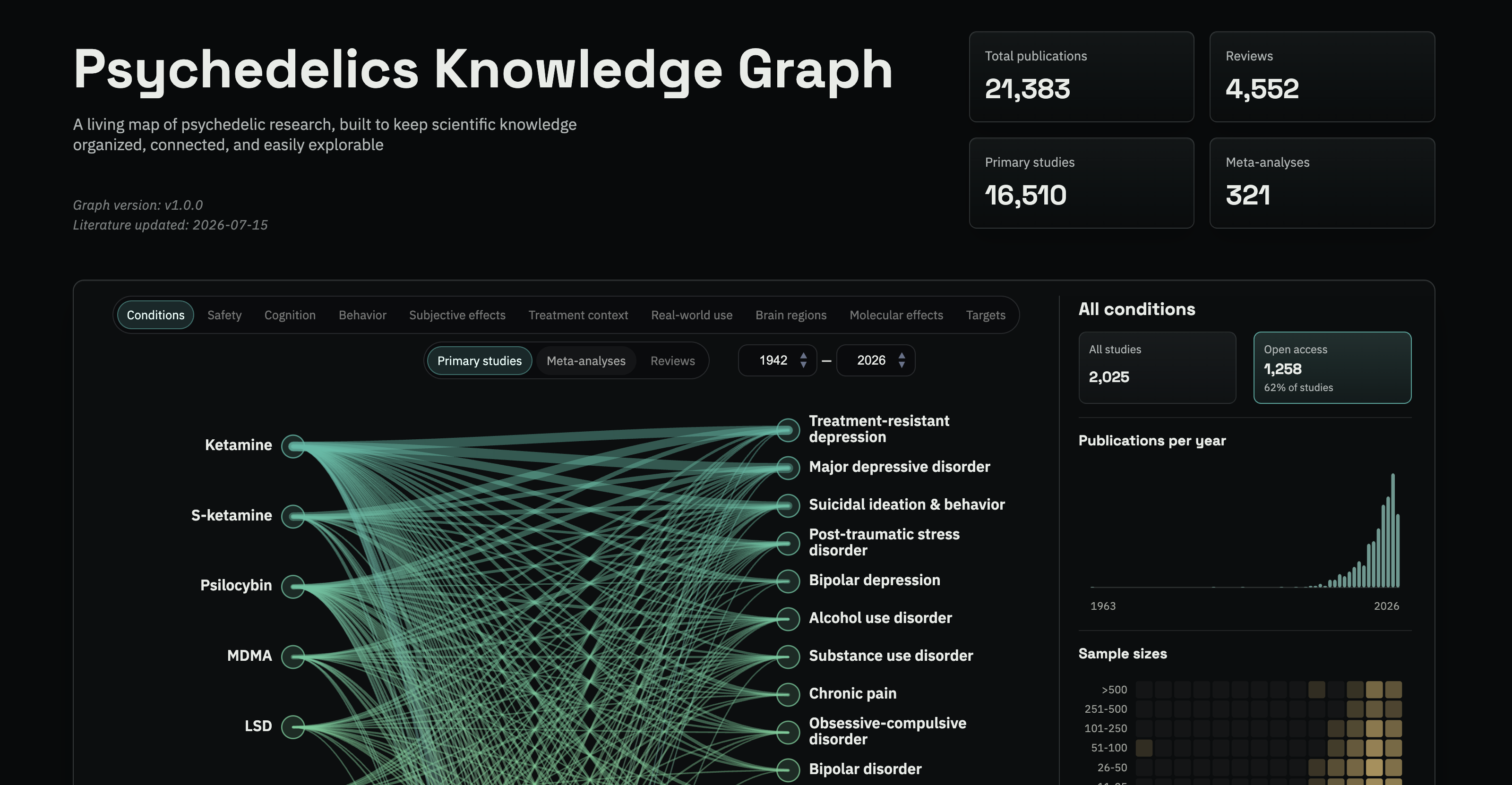
A map of psychedelic research that makes findings easier to explore, audit, and keep up to date.
Explore the knowledge graph · About · Methods · API
About the project
Psychedelic research spans clinical outcomes, molecular mechanisms, brain and behavioral effects, subjective experience, safety, and real-world use. The evidence is growing quickly but remains scattered across source reports and research domains.
Psychedelics Knowledge Graph organizes that literature into structured findings linked to their source reports. Its public interface helps researchers move between broad patterns, individual findings, and the underlying studies.
The repository also contains the tools used to discover and screen records, process selected reports, and add new evidence. It records which reports were included, how their records were screened, and where each finding came from. Primary studies, meta-analyses, and reviews are kept separate, and null, mixed, uncertain, and positive findings are retained rather than collapsed into a single conclusion.
What this repository contains
This repository includes the full workflow behind the public graph:
- Find and deduplicate records while preserving how they were discovered.
- Enrich and screen records, then route selected reports by evidence domain and report type.
- Retrieve and convert available report text.
- Extract structured findings and link them back to the source text.
- Validate and normalize source metadata, entities, findings, and relationships.
- Build the public graph, finding details, bibliography, and Methods views.
The main data is stored in normalized tables. The browser graph presents a readable view of that data rather than trying to display everything at once.
For machine use, every release can also produce a narrow public catalogue of papers, concepts, OpenAlex/ORCID-backed authors, and paper-level relationships. It is available through a read-only REST/OpenAPI service and MCP tools for AI agents. Bulk data releases are intentionally withheld until their fields and semantics have a separate publication review. Granular extraction data remains internal; see the API and agent access guide and public data policy. Production setup is covered by the R2 public-data and API deployment checklist.
Repository map
pipeline/— literature discovery, screening, full-text processing, extraction, validation, updates, and publishingschema/— definitions for extracted fields, graph mappings, and standard namesdata/— curated inputs plus generated local corpus, graph, and publication artifacts; generated production data is released through R2about/,methods/, andfeedback/— public project pagesui/— shared static browser assets and interface scriptsscripts/— graph and site build entry pointsdocs/— scope, search, terminology, evidence, and deployment documentationtests/— pipeline and interface regression tests
For operational commands and the current end-to-end workflow, see the pipeline guide. For a targeted correction to one report or a DOI list, use the scoped update workflow.
Local site preview
Use the Node.js version pinned in .node-version for JavaScript tools and tests.
Netlify reads the same version pin for its builds.
Preview local UI changes against the currently published R2 data:
bash scripts/preview_site.sh public
Then open http://127.0.0.1:8011.
To review an unpublished candidate release, first build and promote it locally
without setting PUBLISH_QUERY_API_R2=1, then run:
bash scripts/preview_site.sh local
The local server opens the explicit ?data-source=local mode and serves only
the generated graph and Methods artifacts named by the candidate release. It
does not expose the repository, papers, .env, or other pipeline data. It also
verifies graph checksums and requires the graph, Methods flow, bibliography, and
inclusion audit to name the same run and release before starting.
The preview mode is mandatory; neither preview command has an implicit data
source. A public-mode server rejects ?data-source=local instead of loading a
different release.
Project principles
- Link every public finding back to its source.
- Keep discovery broad while making graph inclusion conservative.
- Separate primary research, meta-analyses, reviews, and non-primary context.
- Treat uncertainty, disagreement, and missing evidence as meaningful results.
- Keep the evidence base reproducible, correctable, and incrementally updatable.
Licensing and citation
The software is released under the Apache License 2.0. Project-created public data is released under CC0 1.0; third-party reports, abstracts, figures, tables, and provider data retain their original rights and terms.
If you use the project or its public API, cite both the software version and the literature update represented by the graph:
Karvelis, P. (2026). Psychedelics Knowledge Graph (Version 3.0.0; literature updated 2026-11-10). Zenodo. https://doi.org/10.5281/zenodo.24148222
The version-specific DOI identifies the software release, while the literature date identifies the evidence represented by the graph. The concept DOI always resolves to the project's latest archived software version.