
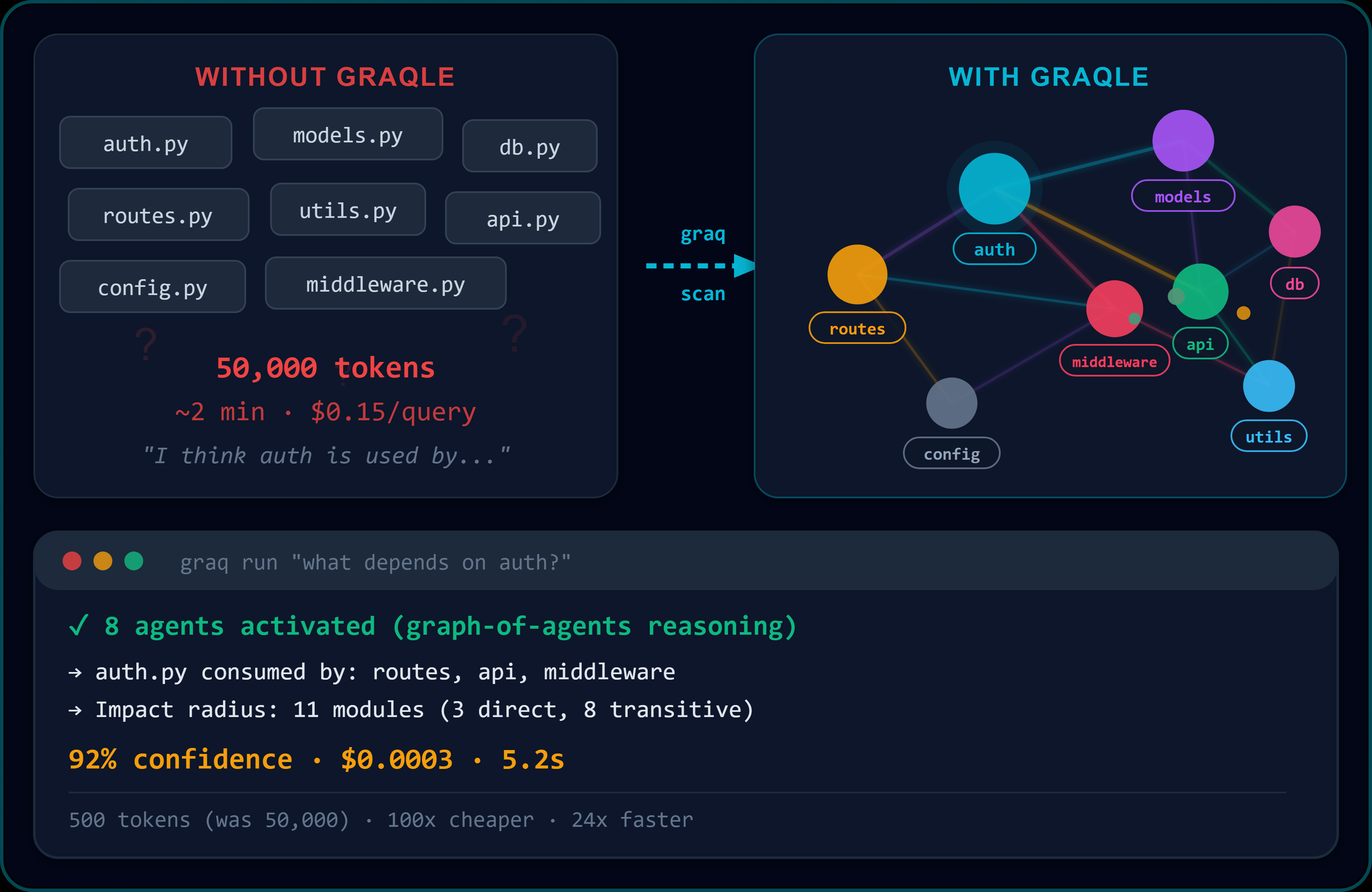
GraQle — query your architecture, prove your AI's decisions
Index any codebase as a knowledge graph so AI agents reason about architecture instead of grepping files. Every decision they make — at build-time or in production — gets a cryptographic receipt anchored to a public transparency log. One Python package, two surfaces: dev intelligence for engineers, runtime governance for regulators.




pip install graqle
Website · Quickstart · Runtime governance · EU AI Act docs · Changelog · VS Code Extension
Two surfaces, one substrate
| Build-time (dev intelligence) | Run-time (production governance) | |
|---|---|---|
| Governs | how your AI writes code | what your deployed AI decides |
| Trigger | a code change | a production decision (loan, hiring, triage, …) |
| Emits | reviewed, impact-analysed, audit-logged changes | a tamper-evident, third-party-verifiable record per decision |
| Built on | typed code knowledge graph + multi-agent reasoning | Layer 5 cryptographic substrate (RFC 8785 JCS → RFC 6962 Merkle → ed25519 → Sigstore Rekor) |
| Status | GA | GA — attest() capture (v0.60.0) + FastAPI middleware / @governed (v0.61.0) + continuous anchoring worker graqle govern serve (v0.62.0) |
Build-time governance proves we hold ourselves to this standard — GraQle is developed through its own governance. Run-time governance lets you hold your deployed AI to the same cryptographically-verifiable standard. Same substrate, both surfaces.
90-second quickstart
Build-time — query your codebase as a graph
# 1. Scan any codebase into a knowledge graph
graq scan repo .
# → typed graph: functions, classes, modules, imports, calls — full architecture mapped in seconds

# 2. Ask GraQle to audit it
graq run "find every authentication bypass risk"
# → Graph-of-agents activates across relevant nodes
# → Traces cross-file attack chains the LLM alone cannot see
# → Returns: confidence score + evidence trail + active nodes + tool hints

# 3. Fix it — GraQle shows exact before/after for each file (governed)

# 4. Teach it back — the graph never forgets
graq learn "cancel endpoint must require admin auth"
# → Lesson persists. Every future audit activates this rule.
Run-time — attach governance to a deployed AI in one line
from graqle.governance.runtime import GovernedRuntime

gov = GovernedRuntime(salt="your-deploy-salt")

def score_application(app):
    decision = model.predict(app)                # your deployed AI, untouched
    gov.attest(                                  # <-- the one added line
        domain="loan", model_id="credit-risk-v4",
        inputs={"applicant_ref": gov.pseudonymize_ref(app.id)},   # PII-safe
        output={"decision": decision.label, "reason_code": decision.reason},
    )
    return decision
Each call produces a durable, PII-safe governed record. Its leaf hash is computed with the same shipped primitive the build-time batcher uses, so a runtime record is byte-compatible with the cryptographic substrate (RFC 8785 JCS → RFC 6962 Merkle → ed25519 → Sigstore Rekor). Capture is out-of-band — it adds 0 ms to your write path.
See examples/runtime_attest_production_decisions.py and examples/runtime_govern_serve_anchoring.py.
Run it as a continuous service (v0.62.0)
# Long-lived anchoring worker — flushes batches + drains the replay queue every tick
graqle govern serve --config graqle.yaml

# Cron-style one-shot tick (single flush + single replay-drain)
graqle govern serve --once

# Article-72-style monitoring snapshot — JSON suitable for any external monitor
graqle govern health
# → { "running": true, "ticks": 47, "records_anchored": 3120, "replay_queue_depth": 0, ... }
The serve loop writes .graqle/govern.health.json atomically after every tick — pipe it into your existing monitoring (Prometheus, Datadog, an oncall dashboard, a simple curl).
Independently verifiable, by anyone. Committed batches anchor to the public Sigstore Rekor transparency log. Any third party can verify a record — auditor, regulator, counter-party — without access to your infrastructure, or ours. Verification doesn't depend on Quantamix staying online.
💰 Token economics — a worked case study
A 4-developer team on a 50,000-node enterprise codebase burns ~$40 per developer per day on flat-file AI-coding tokens in 2026. The same team using GraQle's substrate:
| Scenario | Annual (4 devs) | Saving |
|---|---|---|
| Flat-file baseline (Cursor / Claude Code default) | $42,240 | — |
| GraQle + frontier API (Sonnet 4.6) | $19,874 | −53% |
| GraQle + local SLM (Year 2, 90% migrated) | $5,174 | −88% |
Every number is auditable. Every assumption is sourced (Anthropic pricing, Cursor power-user data, Microsoft's killed Claude Code pilot, NCBI biomedical-KG research showing >50% token reduction, Qwen3-Coder SWE-Bench benchmarks). Scale linearly to a 40-developer enterprise: ~$224k/year saved in Year 1, ~$371k/year in Year 2.
Plus six things Cursor / Copilot / Codex do not offer at any subscription tier: cryptographic audit trail, EU AI Act Article 26 readiness (€15M fine exposure), patent-defensible substrate, survive-vendor-disappearance, multi-agent governance, public Sigstore Rekor anchoring.
→ Read the full case study — math, sources, and a bash snippet to re-run it on your own team's numbers.
What is GraQle
A governance-led multi-agent reasoning system for code, with a built-in cryptographic audit substrate for the AI you ship to production. Scan any codebase into a persistent knowledge graph. Every module becomes a reasoning agent. Agents decompose, debate, and synthesize answers with clearance-level governance. Every change — and every production decision — is impact-analysed, gate-checked, and cryptographically committed.
AI assistants see files. GraQle sees architecture. That's why it catches the cross-file bugs they can't, and why its audit trail survives every level of tampering.
Built for engineering teams who need:
- Cross-file reasoning — impact analysis, lesson recall, dependency-aware refactor (the kind of thing that requires reading 5 files; we read the graph instead).
- Auditable AI decisions — confidence scores, evidence trails, tamper-evident logs anchored to a public transparency log.
- EU AI Act–aligned behaviour out of the box — for European customers, regulated deployments, and analyst-grade due diligence.
- Model-agnostic operation — 14 LLM backends, offline-capable via Ollama, runs entirely on your machine by default. No telemetry. Code stays on your machine.
How it works
- Scan → AST + dependency analysis builds a typed graph (functions, classes, modules, imports, calls).
- Activate → A pre-reasoning safety layer scores each node for relevance, confidence, and risk before the LLM runs.
- Reason → Multiple agents debate. Outputs carry
confidence,graph_health,active_nodes, evidence pointers. - Gate → Governance gates (CG-01..CG-20) intercept write-class operations. Plans required. Risks surfaced. Trade-secret + path-traversal hardening enforced.
- Audit → Every tool call is logged to
.graqle/governance/audit/with redaction + secret scanning. - Commit → For runtime decisions, the audit record gets canonicalised (RFC 8785), Merkle-rooted (RFC 6962), ed25519-signed, and anchored to the public Sigstore Rekor log.
- Learn → Lessons become weighted edges. The graph remembers across sessions, teams, and git operations.
The pipeline runs through five named phases — ANCHOR → ACTIVATE → GENERATE → VALIDATE → COMMIT. Each phase is governance-gated, evidence-attached, and audit-logged.
API defaults: confidence_threshold=0.65 (refusal floor), gate_threshold=0.60 (gate-status floor). Both are configurable per-call.
Model agnostic
Anthropic · OpenAI · AWS Bedrock · Ollama · Gemini · Groq · DeepSeek · Together · Mistral · OpenRouter · Fireworks · Cohere · Azure OpenAI · custom HTTP.
# graqle.yaml — smart task routing
backends:
  reasoning:  anthropic/claude-sonnet-4-6   # quality work
  embedding:  bedrock/titan-v2              # cheap + fast
  summaries:  ollama/llama3                 # local + free
Runs fully offline with Ollama. No telemetry. Code stays on your machine. API keys stay in your local graqle.yaml.
Governance gate — drop-in for Claude Code, Cursor, VS Code
graq init              # sets up a governed project (writes the constitution → CLAUDE.md)
graq gate-install      # one-time, project-local — enforce it for Claude Code
graq init writes the GraQle constitution into your project, so your AI tool
behaves like a disciplined senior engineer from the very first command: governed
tools only (every change is checked), a defined investigate → plan → review →
apply → learn workflow, built-in token-cost rules, and the project's known
pitfalls baked in. One rulebook — shipped as
graqle/data/constitution/ — renders for every
client (Claude Code → CLAUDE.md, OpenAI Codex → AGENTS.md, Cursor →
.cursorrules, Windsurf → .windsurfrules), so editing it once keeps them all
in sync.
gate-install then routes every native write/edit/bash through GraQle's governance gates and adds a permissions backstop to .claude/settings.json. Plans required for risky changes. Trade-secret scanning on git commits. Path-traversal hardening on subprocess capture. CG-01 through CG-20 — all on, all auditable.
MCP-first
// .mcp/config.json
{ "graqle": { "command": "graq", "args": ["mcp", "serve"] } }
76+ MCP tools — every operation Claude Code / Cursor / VS Code Copilot needs is exposed as a governed tool with confidence scores, evidence pointers, and audit-trail entries. No prompt engineering, no glue code.
🇪🇺 EU AI Act–aligned
Articles 6, 9, 12, 13, 14, 15, 25, 50 become applicable on 2026-08-02. GraQle gives your high-risk AI system the signals, audit trail, and disclosure primitives it needs — so the parts of your compliance file you can quote from us, you can quote today.
# One switch flips every EU-AI-Act-aware subsystem at once
graq compliance switch on        # shell snippet → eval to enable
graq compliance switch status    # what's actually armed, in one envelope
graq compliance switch off       # symmetric disable

# Per-subsystem CLI surface
graq compliance status                                      # legacy + new subsystems block
graq compliance export --since 2026-08-01 --sha256-sidecar  # Article 12 evidence
graq compliance baseline-doc generate --output baseline.jsonl  # Q16.1 baseline
graq compliance periodic-assessment run --period-start ... --period-end ...  # Q16.3
graq compliance feedback record --rating 5 --note "..."     # Q16.5 observation
graq compliance eur-lex-check                               # weekly drift guard
| Article | What GraQle provides | Where |
|---|---|---|
| Art 4 — AI literacy | Integration guidance for providers + deployers | Art 4 doc |
| Art 9 — Risk management | Periodic-assessment artefacts with auto-remediation triggers | graq compliance periodic-assessment run |
| Art 11 — Technical documentation | Dated, content-addressed baseline document at deployment | graq compliance baseline-doc generate |
| Art 12 — Record-keeping | JSONL audit export + SHA-256 tamper-detection sidecar | graq compliance export |
| Art 13 — Deployer transparency | graph_health + confidence on every reasoning envelope | every graq_reason call |
| Art 14 — Human oversight | Confidence-gated refusal of auto-apply + claim-limits vocabulary | GRAQLE_EU_AI_ACT_MODE=on + graq edit/apply/auto |
| Art 15 — Accuracy / robustness / cybersecurity | 17 named defences + 7 measurable claims | graq compliance status --include-robustness |
| Art 25 — Value-chain responsibility | Intended-purpose declarations + PCT (Proof-Claims Token) x-ai-eu extension (11 fields) | Art 25 doc + graq pct issue/validate |
| Art 43 — Conformity assessment | Substrate evidence inputs (baseline-doc + audit log + periodic assessment + robustness + Article 14 gate) for the deployer's Annex VI internal-control file | Art 43 doc |
| Art 50 — Transparency for users | Auto banner + ai_disclosure machine field | GRAQLE_EU_AI_ACT_MODE=on |
| Art 72 — Post-market monitoring | graqle govern serve continuous anchoring + graqle govern health snapshot | v0.62.0 |
Three substantive non-claims kept legally clean:
- GraQle is NOT itself a high-risk AI system (no Annex III category applies).
- GraQle is NOT a GPAI provider under Article 51 (we use third-party LLMs, we don't place one on the EU market).
- We provide signals, audit primitives, and conformity-assessment evidence inputs. We never say compliant or certified. The discipline is enforced in code —
TestNonClaimsInvariantsblocks any release that introduces acompliant/certifiedfield.
→ Full Article-by-Article mapping in docs/compliance/eu-ai-act/
Contributions welcome on the compliance docs
The EU AI Act docs are deliberately open to contribution — corrections, translations (DE/FR/ES/IT have highest demand), compliance gap reports from deployers building Annex VI internal-control files, and cross-framework mappings (NIST AI RMF, ISO 42001, ENISA, etc.) are all welcome. See CONTRIBUTING-COMPLIANCE.md for the contribution guide, the vocabulary discipline the CI enforces, and what kinds of changes go through which review path.
Security & integrity
| No telemetry | GraQle does not phone home, collect usage data, or send analytics. |
| No code upload | Source never leaves your machine unless you opt in to cloud sync. |
| Secret scanning | 200+ regex patterns + Shannon-entropy detection + AST scan on every output candidate. |
| PyPI Trusted Publishing | OIDC-only — no long-lived API tokens in our pipeline. |
| Sigstore signatures | Every wheel signed by our GitHub Actions identity. Verify with graq trustctl verify --version <v>. |
| CycloneDX SBOM | Attached to every GitHub Release. |
.pth-file guard | Publish pipeline rejects any wheel containing .pth files (the LiteLLM-class attack vector). |
| Reproducible builds | SOURCE_DATE_EPOCH-pinned, rebuild from tagged source and compare checksums. |
| Survive-disappearance | Production audit records anchor to public Sigstore Rekor — verifiable even if Quantamix disappears. |
→ Full disclosure policy: SECURITY.md · Report vulnerabilities to security@quantamixsolutions.com
What's new in v0.75.0
The EU AI Act layer is complete. GraQle now offers an optional, configurable EU AI Act (Reg. (EU) 2024/1689) compliance layer — off by default, enforced through a tamper-evident, irreversible latch.
- Configurable + irreversible latch (
governance.eu_ai_actingraqle.yaml): once enabled, the layer cannot be silently disabled andblockingcannot be downgraded toadvisory. The latch is an ed25519-signed, hash-chained record (.graqle/eu_ai_act_latch.jsonl) — not a hand-editable flag — so a tamper attempt fails closed and can never turn it off. - Enforced compliance phase (CG-EU-AIA) wired into the gate: when enabled,
AIA-relevant write tools pass an Article-14 human-oversight check.
blocking+ low confidence → refused with an audited per-action override path;advisory→ recorded + advised, never blocked. Reads, planning, and reasoning are never gated. - Light-touch + honest by design — a record-keeping / traceability aid (supports Art. 12 / 72), not a hard wall, and not a substitute for human compliance judgement. The latch supports the Act's expectations; it is not "required by the Act."
This completes GraQle's universal-governance arc (constitution-as-code → every client → universal server gate → cost-is-observability → EU AI Act layer).
What's new in v0.73.0
Cost is observability, never a quality gate. GraQle never cuts reasoning or debate quality to save money. Every cost path is now advisory: it measures and surfaces spend (the cost-savings story) but never halts still-valuable work.
- Reasoning continues past budget to natural convergence /
max_rounds; the cost of continuing is measured (continuation_cost_usdin result metadata). - Multi-backend debate no longer stops on budget — it runs to
max_roundsand reports over-budget rounds instead. - Advisory per-session cost meter in the MCP server surfaces
session_cost_usdand a one-time over-budget note — purely observational, never blocks a tool, and hardened against malformed cost values. - Runaway protection stays value-based (
max_rounds+ the absolute LLM-call ceiling), never price-based.
What's new in v0.72.0
One constitution, every AI client. The governance rulebook now renders into
every supported client from a single source — including OpenAI Codex via
AGENTS.md, which previously had no instruction file. Run graq init and your
AI tool pair-programs with a disciplined senior engineer from the first command,
whichever tool you use.
- The constitution (
graqle/data/constitution/) — governed-tools-only rules, the 9-phase workflow, the full MCP tool inventory, token-cost rules, learned-behaviour workarounds, and a configurable (off-by-default) EU AI Act section. Modular Markdown; edit once, every client stays in sync. - Per-client rendering: Claude Code →
CLAUDE.md, OpenAI Codex →AGENTS.md(new), Cursor →.cursorrules, Windsurf →.windsurfrules. Append-under-marker and idempotent — an existing file is never clobbered. graq gate-installadds a non-destructivepermissionsbackstop to.claude/settings.json(deny native write/exec, allow the governedgraq_*tools) behind the existing PreToolUse hook.
Recent releases
- v0.62.0 — Runtime R2:
graqle govern servecontinuous anchoring worker +govern healthArticle-72 monitoring snapshot. - v0.61.0 — Runtime R1: FastAPI middleware +
@governeddecorator. Drop-in governance for any FastAPI app. - v0.60.0 — Runtime R0 Mode A:
GovernedRuntime.attest()and PII-safepseudonymize_ref(). - v0.59.0 — Layer 5 cryptographic substrate GA: RFC 8785 canonicalisation + RFC 6962 Merkle commitments + ed25519 signatures + Sigstore Rekor anchoring + local replay queue.
- v0.58.0 — EU AI Act Wave 3 substrate (Article 43 conformity-assessment evidence) + OPSF PCT alignment +
GRAQLE_WORKTREE_ROOTfor parallel-worktree dev. - v0.57.0 — EU AI Act Wave 2:
graq compliance switchsingle entry-point, Article 14 confidence-gated refusal, claim-limits vocabulary, EUR-Lex drift guard.
Pricing
| Tier | What you get |
|---|---|
| Free | Local-only graphs · core SDK · governance gates · EU AI Act surfaces · attest() runtime · govern serve anchoring (self-hosted, anchored to public Rekor) |
| Pro — $19/mo | Cloud sync · priority models · hosted Rekor relay |
| Team — $29/dev/mo | Shared KGs · team-wide lessons · audit log retention · SOC 2 evidence pack |
| Enterprise | On-prem · custom backends · dedicated support · regulated-deployment SLAs · contact us |
The free tier is real: the verifier, the runtime attestation path, and the continuous anchoring worker are all in the open-source SDK. Paid tiers add operational scale, team features, and a managed Rekor relay.
Patent & license
Core methods are patent-pending: EP26167849.4 (filed 2026-03-25), EP26162901.8 (CIP), and EP26166054.2 (CogniGraph divisional). The SDK source is fully auditable under the GraQle License — see LICENSE. Reimplementation of the patented methods outside this SDK requires a separate patent license.
→ github.com/quantamixsol/graqle — issues, discussions, contributions welcome.
GraQle is built by Quantamix Solutions. Query your architecture. Prove your AI's decisions.