Listed from the MCP registry; nobody on Odel publishes it.

Downtrace
Downtrace tells you when a change breaks the performance of your Node.js backend.
Runs on your machine from its package; the steps are below.
What it does
- Reads
- Writes
- High impact
At most: only reads or looks up information.
What it costs
FreeOdel charges nothing per call. The publisher may charge for its own service.
Runs locally over stdio
This server isn't hosted — your MCP client launches it from a package registry. Use one of the commands below, or drop the config into your client (e.g. Claude Desktop).
Run
npx -y @downtrace/mcp
MCP client config
{
  "mcpServers": {
    "downtrace": {
      "command": "npx",
      "args": [
        "-y",
        "@downtrace/mcp"
      ]
    }
  }
}Downtrace — open-source packages
Your coding agent just introduced an N+1.
downtrace checkcatches it before you push.
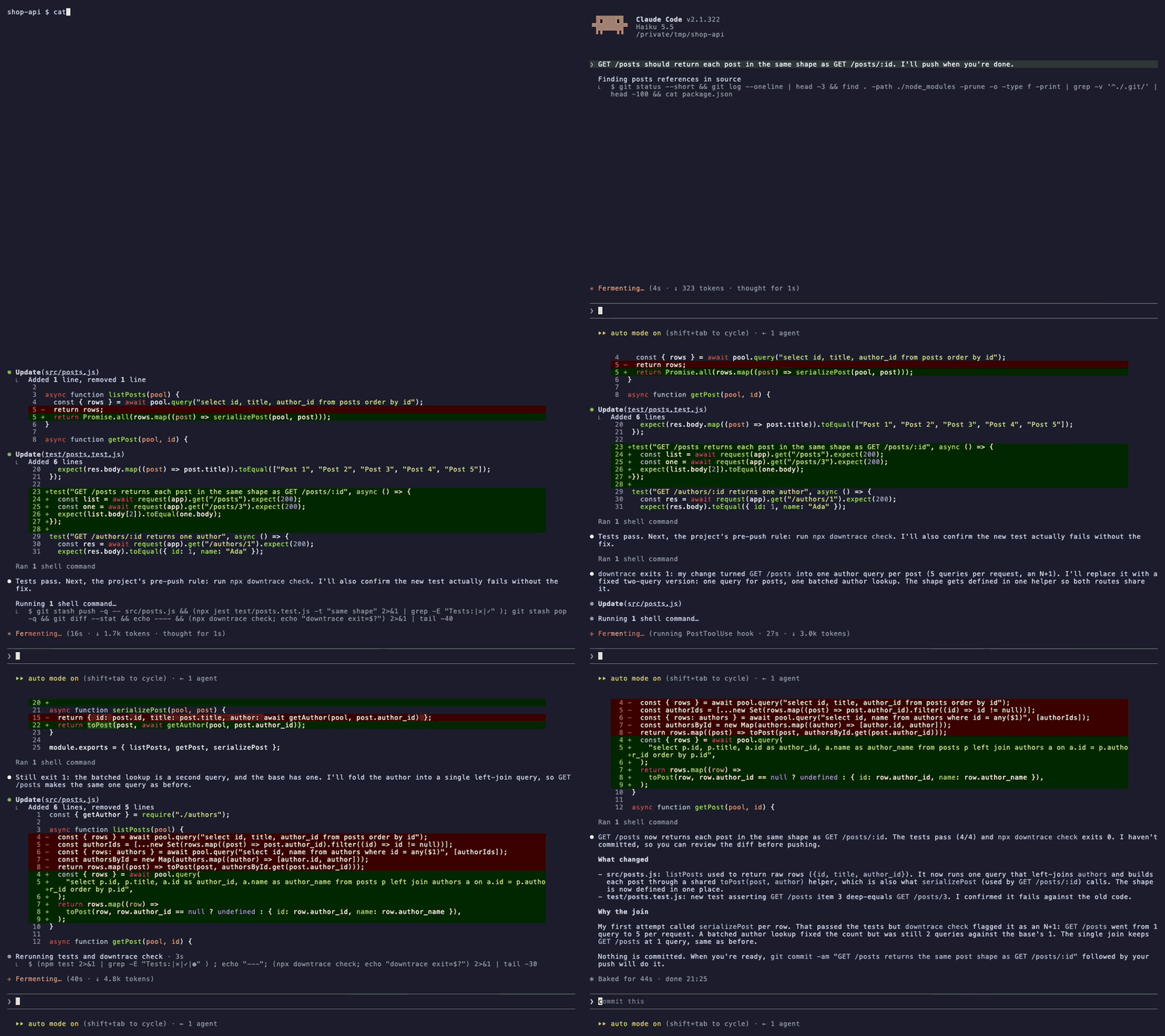
downtrace check compares two runs of your tests and names the routes that got worse: a query that now runs once per row, a query or an outgoing call that was not there. A developer, or their coding agent, runs it before pushing. No account, and nothing leaves the machine.
Claude Code with Haiku, in real time. Nothing after the request is scripted.


In a Node.js project whose tests reach it over HTTP:
npx downtrace init && npx downtrace check
When a change adds an N+1, it exits 1 and says GET /posts … appeared select name from authors where id = ? 0 -> 5 per request ran at src/app.js:9 while your tests still pass. The commands, with a coding agent and in CI · try it on an example · how it decides.
The same library also monitors production with the Downtrace cloud. That half is experimental: free, no plans, no billing and no SLA, on a protocol, v0, that can still change between minor versions. Its page.
This repository is a read-only mirror of the public packages of Downtrace, synchronised from the private monorepo where development happens, together with the hosted backend and the project's documents. Every published version is tagged and every commit carries the subject of the change it brought over, so you can read what changed between two releases. The tests above run here, on this code, and the packages are published to npm from this repository so that npm can attest their provenance.
Issues are welcome and answered here. Pull requests cannot be merged in place; see CONTRIBUTING.md for why, and how a patch gets in. To report a vulnerability, see SECURITY.md.
| Package | What it is |
|---|---|
packages/agent | @downtrace/agent — the Node.js agent (node --import @downtrace/agent/register) |
packages/downtrace | downtrace — the same command with nothing to install first: npx downtrace check |
packages/check-action | The GitHub Action that runs check on a pull request, keeps one comment with the routes that got worse and fails the job when one did |
examples | One small application per supported combination, each with the change that introduces an N+1 |
packages/protocol | @downtrace/protocol — the ingestion contract: JSON Schema, fixtures, generated types |
packages/reference-app | A reference backend with switchable regressions (N+1, slow dependency, aggressive retries, pool leak, new error) used as benchmark target and test bed |
packages/mcp | @downtrace/mcp — the same queries and operations as tools a coding agent can discover and use, over MCP |
packages/coding-agent | What a coding agent reads to use Downtrace: a block for a project's AGENTS.md, and a Claude Code plugin (claude plugin marketplace add RadW2020/downtrace-agent) |
packages/bench | The agent overhead benchmark: the agent must add < 1 ms at p99, < 3 pp of CPU and < 64 MiB, measured against the reference app. Its README says how it is run and when its number is worth anything |
pnpm install
pnpm -r test
The reference app and the benchmark need Postgres and Redis (packages/reference-app/docker-compose.yml).
MIT © Raúl Jiménez







