Listed from the MCP registry; nobody on Odel publishes it.
cert-review
SEI CERT C/C++ code review: rule lookup, clang-tidy and cppcheck findings mapped to CERT rules
Runs on your machine from its package; the steps are below.
What it does
- Reads
- Writes
- High impact
At most: only reads or looks up information.
What it costs
FreeOdel charges nothing per call. The publisher may charge for its own service.
Runs locally over stdio
This server isn't hosted — your MCP client launches it from a package registry. Use one of the commands below, or drop the config into your client (e.g. Claude Desktop).
Run
docker run -i --rm docker.io/raminnietzsche/cert-review-mcp:1.4.4
MCP client config
{
  "mcpServers": {
    "cert-review": {
      "command": "docker",
      "args": [
        "run",
        "-i",
        "--rm",
        "docker.io/raminnietzsche/cert-review-mcp:1.4.4"
      ]
    }
  }
}cert-review-mcp

SEI CERT C and C++ code review as an MCP server, a CLI and two review skills, tuned for Ceph, with the same tools for MISRA C:2012, MISRA C++:2023 and AUTOSAR C++14 (docs/misra-autosar.md).
It does three things:
- Knows the standards.
data/rules.jsonholds every rule and recommendation of the SEI CERT C standard (122 rules, 183 recommendations) and every rule of the SEI CERT C++ standard (83 rules), with paired noncompliant/compliant examples, the risk row (severity, likelihood, detectable, repairable, priority, level), CWE tags and the automated-detection tables. It is built reproducibly from a pinned upstream commit and checked against the standards' own index pages. - Runs real analyzers and maps them to rule IDs. clang-tidy (
cert-*and mapped checks), the Clang Static Analyzer, cppcheck and 42 bundled Semgrep rules for INT, EXP, MEM, CON and other CERT rules; optionally Infer and the CodeQL CERT query packs (docs/analyzers.md). Findings are normalised to one schema, de-duplicated, filtered by a profile, and optionally limited to changed lines. - Prepares the rest for a manual review layer without letting it make things up. For rules
no checker covers,
build_review_packetselects code hunks and the few rule texts worth reading;validate_findingsrejects any finding that does not cite an existing rule ID and quote that rule's text. - Speaks MISRA and AUTOSAR too. A
standardfilter on every rule tool and astandardsselection for the checks (default: CERT only). Findings map to MISRA C:2012 (cppcheck MISRA addon), MISRA C++:2023 and AUTOSAR C++14 IDs. Their copyrighted texts are not bundled; you can load your licensed copy. See MISRA and AUTOSAR.
Comments are only drafted and formatted. Nothing is ever posted to GitHub or GitLab by this project.
Not an official CERT or CMU product. See NOTICE for attribution (CC BY 4.0 text, MIT examples) and the pinned source commit.
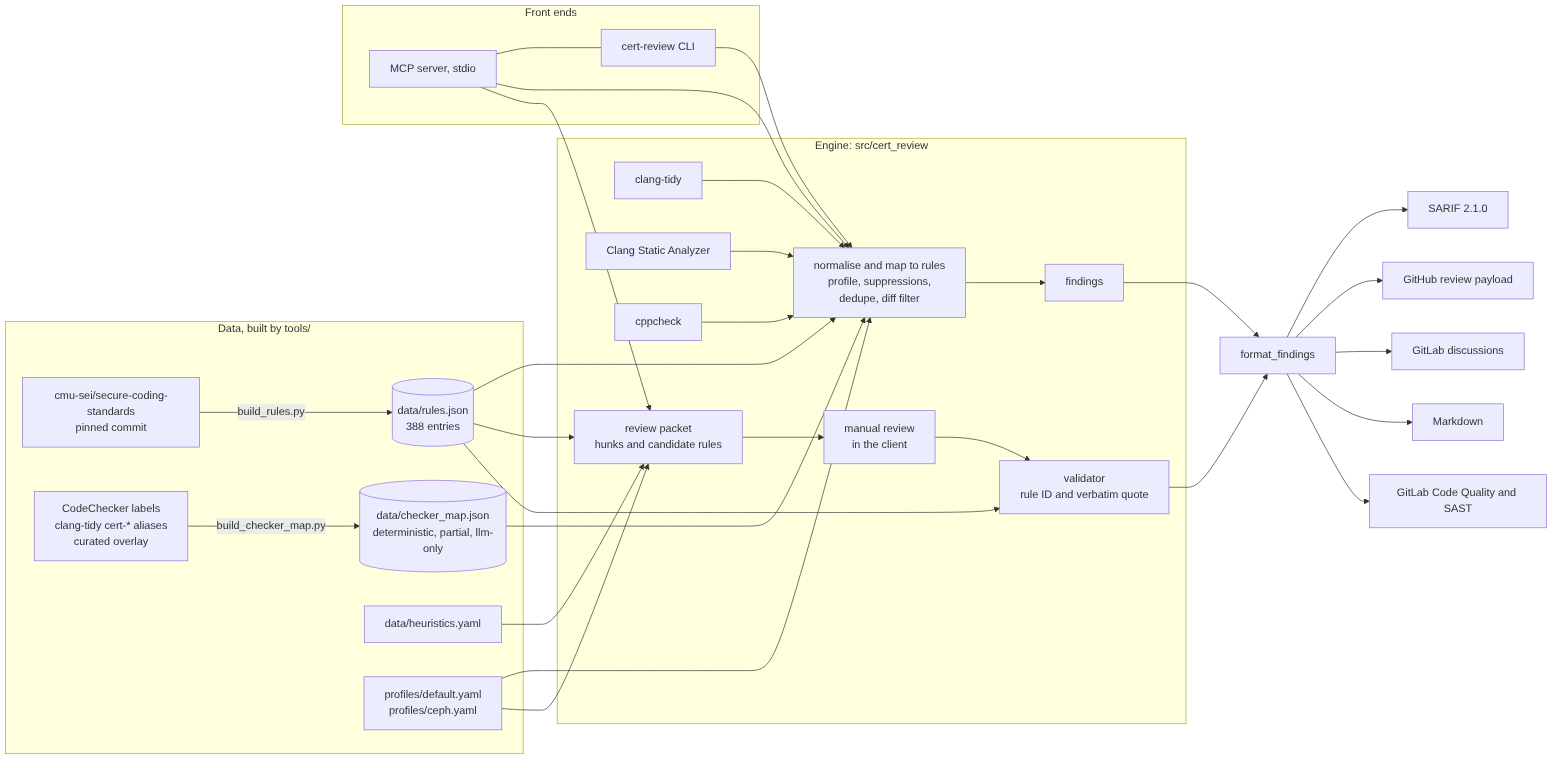
Architecture
The diagram source is in docs/architecture.md.
Coverage
Each rule is deterministic (a rule-specific checker exists: a clang-tidy cert-* check or a
CodeQL CERT query), partial (only general checkers or the bundled Semgrep pattern rules map)
or llm-only (no checker). The reference toolchain is what the Docker images run:
clang-tidy/clang 19.1.7, cppcheck 2.17.1 and Semgrep 1.186.0 with the bundled rules. The
extended toolchain adds Infer 1.3.0 and CodeQL 2.27 with the CERT packs 2.63.0, which are
optional and not in the images.
| Set | Total | All mappings: det / partial / llm-only | Reference toolchain | Extended toolchain |
|---|---|---|---|---|
| C rules | 122 | 100 / 12 / 10 | 16 / 51 / 55 | 100 / 8 / 14 |
| C recommendations | 183 | 4 / 6 / 173 | 4 / 4 / 175 | 4 / 5 / 174 |
| C++ rules | 83 | 82 / 0 / 1 | 18 / 31 / 34 | 82 / 0 / 1 |
Before the Semgrep rules, the reference toolchain covered C rules 16 / 34 / 72 and C++ rules 18 / 29 / 36. A mapped checker is not a detection guarantee; the measured numbers follow.
MISRA C:2012 221 guidelines (131 / 28 / 62), MISRA C++:2023 178 (4 / 31 / 143), AUTOSAR C++14 397 (5 / 51 / 341); details and measurements in docs/misra-autosar.md.
Measured precision and recall on the CERT examples: docs/accuracy.md. Rule counts versus the official index pages: docs/rule-counts.md. Results on a real Ceph subtree: docs/ceph-trial.md.
Recall on real security fixes (Ceph CVEs and memory-safety fixes, curl, libtiff and others): docs/benchmark-real.md.
Install
git clone <this repository> cert-review-mcp && cd cert-review-mcp
python3 -m venv .venv && . .venv/bin/activate
pip install -e '.[dev]'
sudo apt-get install clang clang-tidy cppcheck       # static layer (optional but recommended)
pip install semgrep==1.186.0                        # optional: the bundled CERT pattern rules
pytest                                              # 190 tests
The package reads data/ and profiles/ from the checkout (set CERT_REVIEW_HOME to point
elsewhere). Python 3.11+; works with the official mcp SDK 1.x (FastMCP, 1.15 or later) and 2.x (MCPServer).
Cursor
.cursor/mcp.json in your project (or ~/.cursor/mcp.json):
{
  "mcpServers": {
    "cert-review": {
      "command": "/path/to/cert-review-mcp/.venv/bin/cert-review-mcp",
      "env": { "CERT_REVIEW_HOME": "/path/to/cert-review-mcp" }
    }
  }
}
Then ask: "Use the cert-review ceph_review prompt on my current diff." Copy skills/ into your
skills folder to make the review procedure available.
Docker
Dockerfile.mcp builds the MCP server with the analyzers included (no local clang or
cppcheck needed). Mount your project at the same absolute path it has on the host:
docker build -f Dockerfile.mcp -t cert-review-mcp .
{
  "mcpServers": {
    "cert-review": {
      "command": "docker",
      "args": ["run", "-i", "--rm", "-v", "/home/me/proj:/home/me/proj:ro", "cert-review-mcp"]
    }
  }
}
The same mcpServers block works in Claude Desktop and Cursor. Release tags also publish
multi-arch images (amd64, arm64) to Docker Hub as
raminnietzsche/cert-review-mcp;
use raminnietzsche/cert-review-mcp:latest instead of cert-review-mcp to skip the build.
Details, the CLI from the image, and a tools/list check: docs/docker.md.
MCP Registry
The server is listed in the official MCP Registry
as io.github.RaminNietzsche/cert-review-mcp (server.json), so clients that read
the registry can install the Docker image from there.
Claude Code
claude mcp add cert-review -- /path/to/cert-review-mcp/.venv/bin/cert-review-mcp
mkdir -p ~/.claude/skills && cp -r skills/cert-review skills/ceph-cert-review ~/.claude/skills/
Use as a GitHub Action
- uses: actions/checkout@v4
  with: { fetch-depth: 0 }
- uses: RaminNietzsche/cert-review-mcp@v1
  with:
    profile: default            # or ceph, misra, autosar
    fail-on: error
    upload-sarif: "true"        # SARIF to code scanning
Diff mode on pull requests, SARIF, a job summary, and optional inline review comments
(review-comments: "true", off by default). A GitLab include template publishes Code Quality
and SAST reports. Inputs, outputs and examples: docs/action.md,
examples/github-workflow.yml.
Fork PR comment (MCP-style markdown via review-pr + Docker Hub):
examples/github-workflow-pull-request-target-comment.yml.
MCP tools
Every tool is read-only: it reads local files and bundled data and runs local analyzers.
Nothing is written, uploaded or posted. All tools declare MCP annotations, a title and,
except format_findings, an output schema.
For check_diff and build_review_packet, analysis runs in a private temporary workspace
(the checkout is not modified). With git refs, file bodies come from git show head:path; with
pasted diff_text they are reconstructed from the patch. Pass repo as the logical root for
paths in the diff; findings and SARIF use repository paths, not the temp directory.
Optional diff_context keeps findings within N lines of a change (lower confidence).
| Tool | Purpose |
|---|---|
list_rules(standard, lang, category, kind, classification, level, detectable, coverage, limit) | Filter the rule database; summaries with coverage tier |
search_rules(query, standard, limit, lang) | Rank rules by keyword relevance (API names, concepts, IDs) |
get_rule(rule_id, profile, include_examples) | One rule or guideline: text or summary, examples, risk row or classification, CWE, checkers, cross-references, profile notes |
get_rule_coverage(standard, lang, kind, include_ids) | Rule counts per tier: deterministic / partial / llm-only |
check_files(path, profile, standards, compdb, root, lang, tools, ...) | Analyzer findings for a file or a directory tree |
check_diff(repo, base, head | diff_text, profile, standards, compdb, diff_context, ...) | Analyzer findings on changed lines (optional nearby context) |
explain_finding(finding, profile, context_lines) | One finding: rule summary, why it matches, closest noncompliant/compliant example pair, fix steps |
build_review_packet(path | repo + base | diff_text, ...) | Code hunks plus candidate rule texts for manual review |
validate_findings(findings, packet, profile) | Accept only grounded findings (rule ID + verbatim quote; MISRA/AUTOSAR quotes only when a licensed text is loaded) |
format_findings(findings, style, root, warnings) | markdown, github, gitlab, sarif, codequality or gitlab-sast; formatting only |
format_pr_review(check_result, packet, title, scope, …) | One markdown PR comment: static summary, heuristic hints, style nits |
review_pr(repo, base, head, profile, …) | Preferred for PRs: runs check_diff + build_review_packet + format_pr_review |
check_files and check_diff take an optional baseline_path: findings recorded in a
baseline file are hidden and counted (new, baselined, fixed). See docs/baseline.md.
MCP tool and parameter names changed after the v1 release; see CHANGELOG.md.
standard accepts cert (default), cert-c, cert-cpp, misra, misra-c-2012,
misra-cpp-2023, autosar, autosar-cpp14 or all.
Resources: rule://EXP34-C, profile://ceph. Prompts: cert_review, ceph_review.
CLI
cert-review version
cert-review check src/common/Throttle.cc --profile ceph --compdb build --format markdown
cert-review diff --repo ~/ceph --base origin/main --profile ceph --diff-context 3 --format sarif -o out.sarif
cert-review diff --diff-file change.patch --format github > review.json   # payload only
cert-review explain EXP34-C
cert-review explain-finding ERR34-C --file src/parse.c --line 42     # closest example + fix
cert-review baseline create src --compdb build                      # record existing findings
cert-review check src --compdb build --baseline .cert-review-baseline.json --fail-on warning
cert-review coverage --lang cpp
cert-review rules --lang cpp --coverage llm-only
cert-review packet --repo ~/ceph --base origin/main --profile ceph -o packet.json
cert-review validate findings.json --packet packet.json
cert-review check src --profile misra                       # MISRA C:2012 + MISRA C++:2023
cert-review check src --standards autosar-cpp14,cert        # AUTOSAR and CERT IDs together
cert-review rules --standard misra-c-2012 --classification mandatory
cert-review explain MISRA-C-2012-17.2
--fail-on error|warning|note sets the exit code for CI; with --baseline only new findings count. Silence one rule on a line with
// cert-review: ignore EXP34-C reason.
Profiles
profiles/default.yaml is plain CERT. profiles/ceph.yaml encodes Ceph: C++23/C11,
priority and severity per rule, suppressions with reasons (ceph_assert, dout, crimson,
tests, vendored trees), and idioms (bufferlist, ceph::mutex, RefCountedObject, errno
returns, asio/seastar callbacks) that tell the reviewer how each project construct
changes a rule. Evidence for each idiom is cited inside the file.
profiles/misra.yaml and profiles/autosar.yaml select MISRA C:2012 + MISRA C++:2023 and
AUTOSAR C++14 (standards:), with severity taken from the guideline classification.
MISRA and AUTOSAR
| Standard | Guidelines | Mandatory / required / advisory | Mapped to a checker |
|---|---|---|---|
| MISRA C:2012 (Amendments 1-4, the MISRA C:2023 set) | 221 | 23 / 150 / 48 | 159 (131 by the cppcheck MISRA addon) |
| MISRA C++:2023 | 178 | 5 / 123 / 50 | 35 |
| AUTOSAR C++14 (AP 19-03) | 397 | - / 362 / 35 | 56 |
The MISRA and AUTOSAR documents are copyrighted, so none of their guideline text is
included: only IDs, classification, AUTOSAR enforcement and target, checker mappings,
public SEI CERT cross-references and one-line summaries written for this project
(labelled as paraphrases). Point CERT_REVIEW_MISRA_C_TEXTS, CERT_REVIEW_MISRA_CPP_TEXTS,
CERT_REVIEW_AUTOSAR_TEXTS or a profile's rule_texts: at your licensed copy to see the
official headlines and to have validate_findings check quotes against them. Without it,
MISRA/AUTOSAR findings are accepted on a valid rule ID (grounding: "rule-id-only").
Mapping sources, measured results and file formats: docs/misra-autosar.md.
Rebuilding the data
git clone https://github.com/cmu-sei/secure-coding-standards cert-src
python3 tools/build_rules.py --src cert-src            # fails if counts differ from the index pages
python3 tools/build_checker_map.py --codechecker <codechecker clone> --llvm <llvm-project clone>
python3 tools/build_corpus.py && python3 tools/eval_accuracy.py
python3 tools/build_guidelines.py --cppcheck <cppcheck 2.17.1 clone> --autosar autosar.txt  # MISRA/AUTOSAR
cert-review compdb --repo ~/ceph --tracked                    # cached synthetic compile db
python3 tools/ceph_compdb.py --ceph ~/ceph --tracked          # same (wrapper CLI)
Limitations
- Static coverage is thin by nature: most CERT rules are not decidable by tools; the
llm-onlyandpartialrules depend on the review layer and on a human. - Tools need compilable code. Without
compile_commands.jsonmany files do not parse and checks are skipped. The engine reports this instead of "no findings": the tool status becomespartial, the markdown, SARIF (executionSuccessful: falseplus atoolExecutionNotificationswarning), GitHub review, Action summary and CLI output carry a warning, and--fail-on-parse-error(alias--fail-on-partial; Action inputfail-on-parse-error) turns it into a failing exit code. A file on which an analyzer hits its 300 s timeout is treated the same way. See docs/execution.md for Ceph builds, diff mode, andtools/ceph_compdb.py. - Ceph needs Linux. Its sources include Linux-only headers (
linux/version.h, ...) and Linux-only Boost.Asio features, so e.g.src/rgw/radosgw-admin/radosgw-admin.cccannot be parsed on macOS even with the SDK sysroot and Homebrew Boost. Analyse Ceph on Linux, with the Docker image, or with the GitHub Action.tools/ceph_compdb.pyadds-isysrooton macOS, which is enough for some directories (src/common) but not for all of them. - Mappings come from CodeChecker labels and clang-tidy aliases plus a small curated overlay; general analyzers can map to several rules, so the engine keeps the best few per line.
- Most MISRA C++ and AUTOSAR guidelines have no open-source checker; MISRA C coverage
depends on cppcheck's MISRA addon (needs
python3). - Ceph's profile is based on reading the code and on a limited trial, not on a full build.
License
Code: Apache-2.0 (LICENSE). Bundled CERT content: CC BY 4.0 (text) and MIT (examples); see NOTICE. MISRA and AUTOSAR: facts and original summaries only, no guideline text; see NOTICE and docs/misra-autosar.md.