GroundTruth
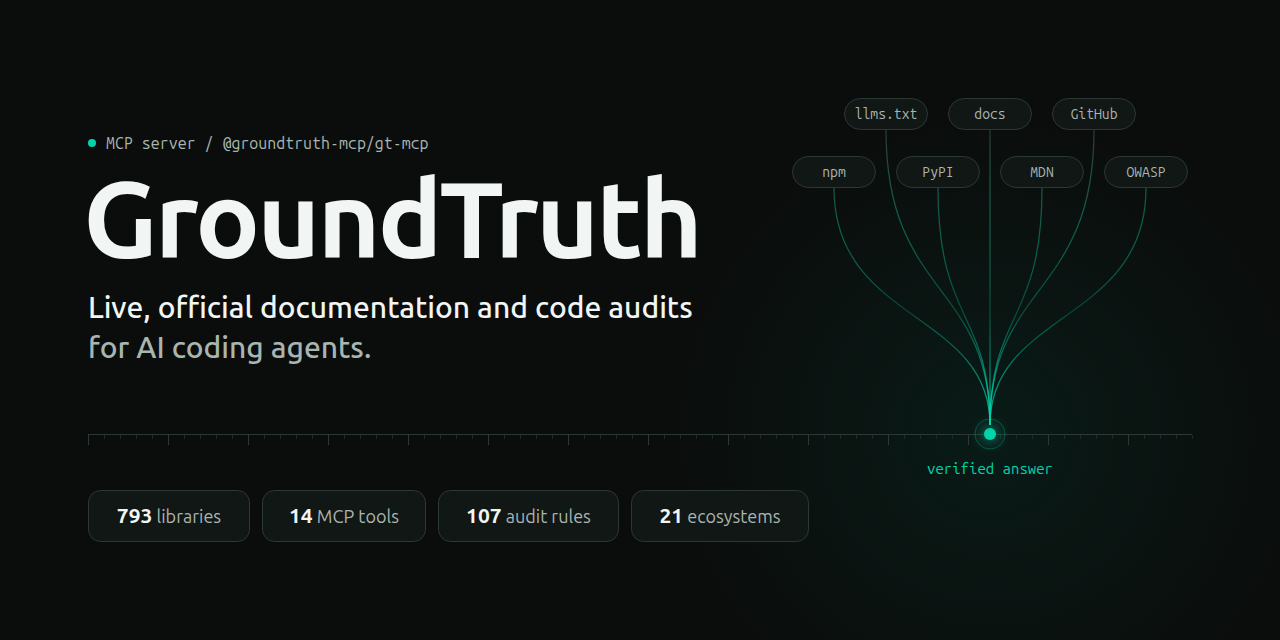
Live docs MCP server. 793+ libraries, evidence-verified answers, code audit, snippets, dispatch.
Runs on your machine from its package; the steps are below.
What it does
- Reads
- Writes
- High impact
At most: only reads or looks up information.
What it costs
FreeOdel charges nothing per call. The publisher may charge for its own service.
Runs locally over stdio
This server isn't hosted — your MCP client launches it from a package registry. Use one of the commands below, or drop the config into your client (e.g. Claude Desktop).
Run
npx -y @groundtruth-mcp/gt-mcp
MCP client config
{
  "mcpServers": {
    "groundtruth": {
      "command": "npx",
      "args": [
        "-y",
        "@groundtruth-mcp/gt-mcp"
      ]
    }
  }
}
Current, official documentation for coding agents, fetched when they ask.





GroundTruth is a self-hosted MCP server and command-line tool. Models write code from what they were trained on, so they still wrap components in forwardRef after React 19 made ref a regular prop, call cookies() synchronously after Next.js made it async, and emit @tailwind directives that Tailwind v4 replaced with @import "tailwindcss". GroundTruth gives the agent the library's own documentation at request time: it reads llms.txt, the docs site as markdown, or the GitHub repository, ranks the sections that answer the question, and checks that the answer covers the topic before returning it. It also audits your source with 107+ patterns and links every finding to the current fix. It runs on your machine. No account, no API key, no rate limit of its own.
Install (60 seconds)
Requires Node.js 24 or newer.
Claude Code
claude mcp add gt -- npx -y @groundtruth-mcp/gt-mcp@latest
Cursor, Claude Desktop, Windsurf and other clients that use an mcpServers block (.cursor/mcp.json, claude_desktop_config.json, ~/.codeium/windsurf/mcp_config.json):
{
  "mcpServers": {
    "gt": {
      "command": "npx",
      "args": ["-y", "@groundtruth-mcp/gt-mcp@latest"]
    }
  }
}
VS Code (.vscode/mcp.json):
{
  "servers": {
    "gt": {
      "type": "stdio",
      "command": "npx",
      "args": ["-y", "@groundtruth-mcp/gt-mcp@latest"]
    }
  }
}
Any other MCP client: run npx -y @groundtruth-mcp/gt-mcp@latest as a stdio server.
Command line (same tools, no MCP client needed):
npm install -g @groundtruth-mcp/gt-mcp
gt-mcp bp nextjs caching
@latest makes npx pick up new releases on the next session start. When a newer version exists, tool responses carry a one-line notice (GT_NO_UPDATE_CHECK=1 turns the check off).
Optional: GitHub token
GroundTruth reads READMEs, release notes, migration guides and code examples from GitHub. Without a token GitHub allows 60 requests per hour. A token with no extra scopes raises that to 5,000 and enables code search in gt_examples.
claude mcp add gt -e GT_GITHUB_TOKEN=ghp_yourtoken -- npx -y @groundtruth-mcp/gt-mcp@latest
In a JSON config, add "env": { "GT_GITHUB_TOKEN": "ghp_yourtoken" } next to args.
What you get
Fourteen tools. Each does one job, and each is also a CLI command.
| Tool | CLI | What it does |
|---|---|---|
gt_dispatch | ask | Routes a plain request ("use gt for drizzle migrations") to the right tool and arguments |
gt_resolve_library | resolve | Finds a library by name; falls back to npm, PyPI, crates.io and Go modules |
gt_get_docs | docs | Live docs for one topic; also accepts a docs URL |
gt_best_practices | bp | Patterns, anti-patterns and configuration guidance for a library |
gt_auto_scan | scan | Reads your manifest and fetches best practices for each dependency |
gt_search | search | Any topic without a library: OWASP, MDN, web.dev, W3C, AI provider docs, Google APIs |
gt_audit | audit | Scans source files and reports issues at file:line with links to the fix |
gt_changelog | changelog | Release notes before you upgrade |
gt_compat | compat | Browser and runtime support from MDN browser-compat-data and caniuse |
gt_compare | compare | Two or three libraries side by side |
gt_examples | examples | Real-world code from GitHub |
gt_migration | migrate | Migration guides and breaking changes between versions |
gt_batch_resolve | batch | Resolves up to 20 libraries in one call |
gt_snippets | snippets | Ranked code snippets per library and version, cached on disk |
The server also exposes 2 MCP resources (library-registry, library-docs) and 8 prompts (audit-my-project, upgrade-check, best-practices-scan, compare-libraries, security-check, migration-guide, find-examples, dependency-audit).
You don't need the tool names. Ask in plain language:
use gt for nextjs
use gt for drizzle migrations
gt audit
use gt to check WCAG focus indicators
use gt for OpenTelemetry setup
find all issues and fix with gt
Or call tools directly:
gt_resolve_library({ libraryName: "nestjs" })
gt_get_docs({ libraryId: "nestjs/nest", topic: "guards" })
gt_best_practices({ libraryId: "vercel/next.js", topic: "caching" })
gt_auto_scan({ projectPath: "." })
gt_search({ query: "OWASP SQL injection prevention" })
gt_audit({ projectPath: ".", categories: ["security", "accessibility"] })
gt_changelog({ libraryId: "vercel/next.js", version: "15" })
gt_compat({ feature: "CSS container queries", environments: ["safari"] })
gt_compare({ libraries: ["prisma", "drizzle-orm"], criteria: "TypeScript support" })
gt_examples({ library: "hono", pattern: "middleware" })
gt_audit
Walks your project, runs 107+ patterns across 18 categories, reports each issue at file:line, then fetches the fix from the authoritative source.
gt_audit({ categories: ["all"] })                      // all 18 categories
gt_audit({ categories: ["security", "node"] })         // OWASP + Node.js
gt_audit({ categories: ["python", "security"] })       // Python OWASP scan
gt_audit({ categories: ["accessibility"] })            // WCAG AA
gt_audit({ categories: ["typescript", "react"] })      // type safety + React rules
| Category | What it checks |
|---|---|
security | XSS, SQL injection, command injection, SSRF, path traversal, hardcoded credentials, CORS wildcard |
accessibility | Missing alt text, onClick on div, icon-only buttons, inputs without labels, outline: none |
react | forwardRef (React 19), useFormState renamed, index as key, conditional hooks |
nextjs | Sync cookies/headers/params (Next.js 16), Tailwind v3 directives, missing metadata |
typescript | any type, non-null assertions, @ts-ignore, floating Promises |
performance | Missing lazy loading, useEffect data fetching, missing Suspense boundaries |
layout | CLS-causing images, 100vh on mobile, missing font-display |
node | console.log in production, sync fs ops, unhandled callbacks |
python | SQL injection via f-string, eval/exec, subprocess shell=True, pickle.loads |
| Also | mobile, css, vue, svelte, angular, testing, seo, i18n, api |
Sample output:
## [CRITICAL] SQL built via template literal
Category: security | Severity: critical | Count: 2

Fix: db.query('SELECT * FROM users WHERE id = $1', [userId])

Files:
  - src/db/users.ts:47
  - src/api/search.ts:23

Live fix: OWASP SQL Injection Prevention Cheat Sheet
gt_auto_scan
Point it at a project root. It reads the manifest and lockfile, works out which libraries you use and at which versions, and returns best practices for each, top libraries first. Default output is about 15K characters.
Reads package.json, deno.json, requirements.txt, pyproject.toml, Cargo.toml, go.mod, pom.xml, build.gradle, build.gradle.kts, composer.json, Gemfile and pubspec.yaml.
gt_search
For anything that isn't one library.
| Area | Topics |
|---|---|
| Security | OWASP Top 10, SQL injection, XSS / CSP, CSRF, HSTS, CORS, JWT, OAuth 2.1, WebAuthn, SSRF, API security |
| Accessibility | WCAG 2.2, WAI-ARIA, keyboard navigation |
| Performance | Core Web Vitals, image optimization, web fonts, Speculation Rules |
| Web APIs | Fetch, Workers, WebSocket, WebRTC, IndexedDB, Web Crypto, Intersection Observer |
| CSS | Grid, Flexbox, Container Queries, View Transitions, Cascade Layers, :has(), Subgrid |
| AI providers | Claude, OpenAI, Gemini, Mistral, Cohere, Groq, LangChain, LlamaIndex |
| Maps, Analytics, Ads, Cloud, Firebase, Vertex AI, YouTube, Gmail, Sheets | |
| Infrastructure | Docker, Kubernetes, GitHub Actions, Terraform, Cloudflare Workers |
CLI
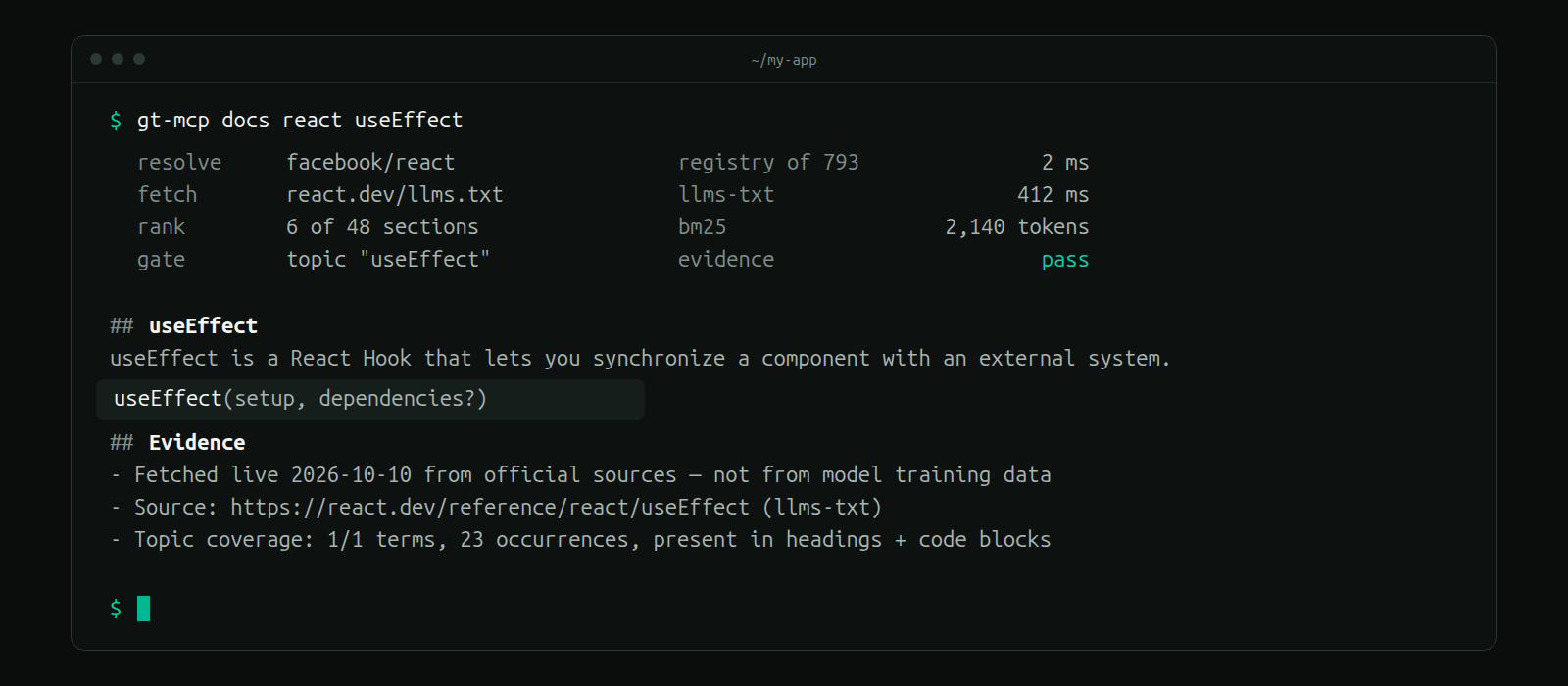
gt-mcp <command> runs the same 14 tools in-process and prints the answer. With no arguments, gt-mcp is the stdio MCP server, exactly as before.
gt-mcp docs react useEffect                  # live docs for one topic
gt-mcp bp nextjs caching                     # best practices
gt-mcp search "OWASP SSRF prevention"
gt-mcp audit .                               # audit the current project
gt-mcp scan .                                # best practices for every dependency
gt-mcp compat "CSS container queries"
gt-mcp ask "how do I paginate with drizzle"  # let gt_dispatch pick the tool
gt-mcp call gt_compare '{"libraries":["prisma","drizzle-orm"]}'
echo '{"libraryName":"drizzle"}' | gt-mcp call gt_resolve_library -
| Command | Does |
|---|---|
tools | Lists every command, its tool and its arguments (--json for machine output) |
call <tool> [<json>|-] | Calls any tool with JSON arguments; - reads them from stdin |
help [command] | Shows a command's flags, generated from the tool's input schema |
--json | Prints the full CallToolResult as JSON instead of the text |
Exit codes: 0 ok, 1 tool error, 2 usage error. Logs stay quiet on stderr unless something goes wrong (GT_LOG_LEVEL defaults to warn for commands). The server flags still work: --version, --health, --routing-table, --help.
Performance
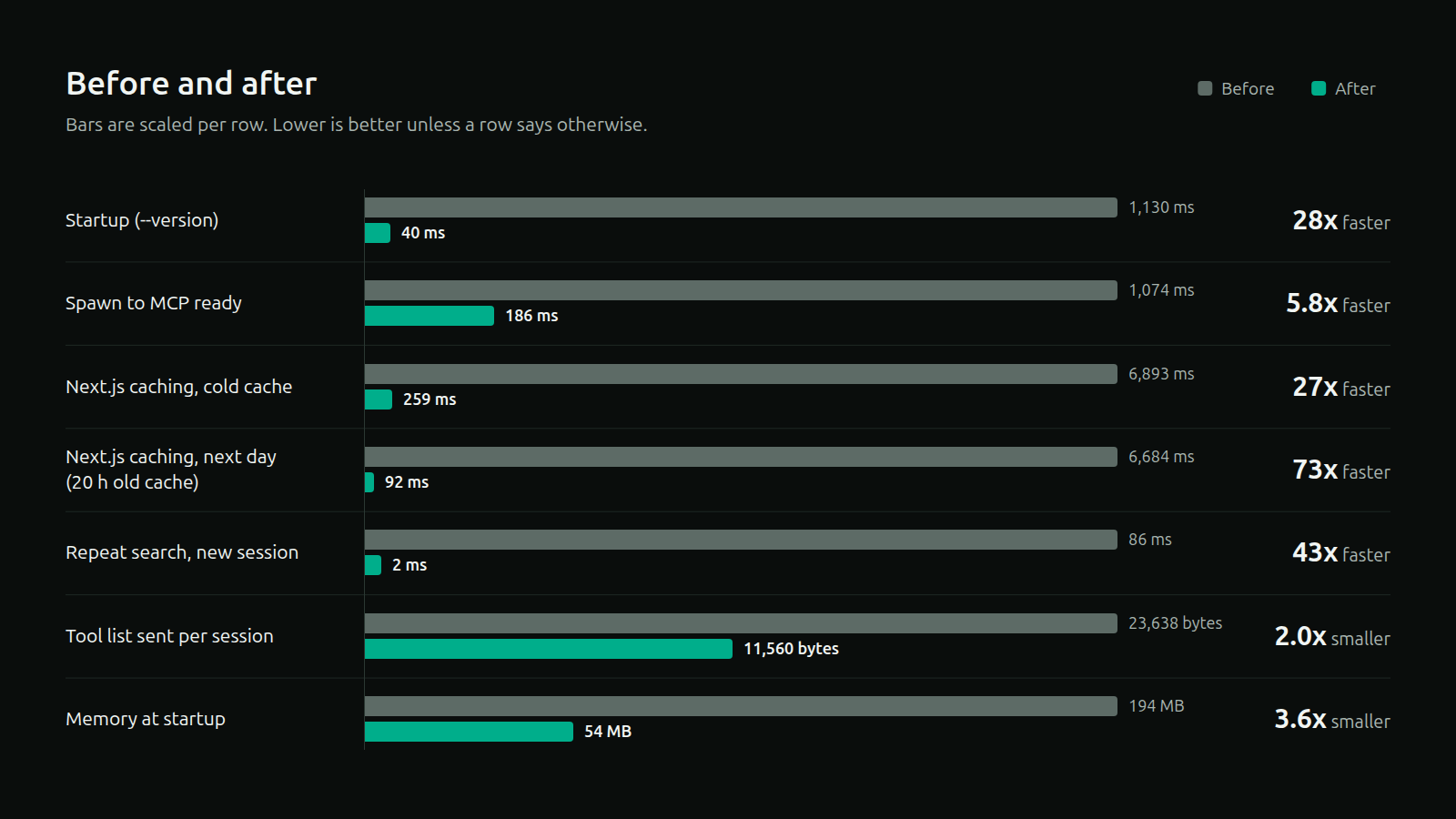
Measured on one machine with the same harness, published 7.5.0 against 8.0.0. Network timings depend on your connection and on the docs site.
| Measurement | 7.5.0 | 8.0.0 | Change |
|---|---|---|---|
gt-mcp --version | 1,130 ms, 194 MB | 40 ms, 54 MB | 28x faster |
| Spawn to MCP ready | 1,074 ms | 186 ms | 5.8x faster |
gt_best_practices Next.js caching, cold cache | 6,893 ms | 259 ms | 27x faster |
| Same call the next day (20 h old cache) | 6,684 ms | 92 ms | 73x faster |
Repeat gt_search in a new session | 86 ms | 2 ms | 43x faster |
Fewer tokens per session and per answer:
| Measurement | 7.5.0 | 8.0.0 |
|---|---|---|
tools/list, paid by every session | 23,638 bytes | 11,560 bytes (-51%) |
| Tool descriptions | -75% | |
| Wire bytes per docs or best-practices answer | halved (duplicate structuredContent removed) | |
gt_auto_scan default output | ~60K characters | ~15K characters |
gt_dispatch reply | 2.7K characters | 0.9K characters |
More of the answer reaches the model in clients that display structuredContent instead of the text:
| Tool | 7.5.0 | 8.0.0 |
|---|---|---|
gt_compat | 220 characters | the full support table |
gt_examples | 142 characters | 3.5K characters |
Where the time went: the binary is a small bootstrap that loads the server lazily and uses the Node compile cache; docs pages are requested as markdown; the reader service is only a fallback; and cached pages are served stale-while-revalidate. A page up to 7 days old is returned at once and refreshed in the background.
How it works
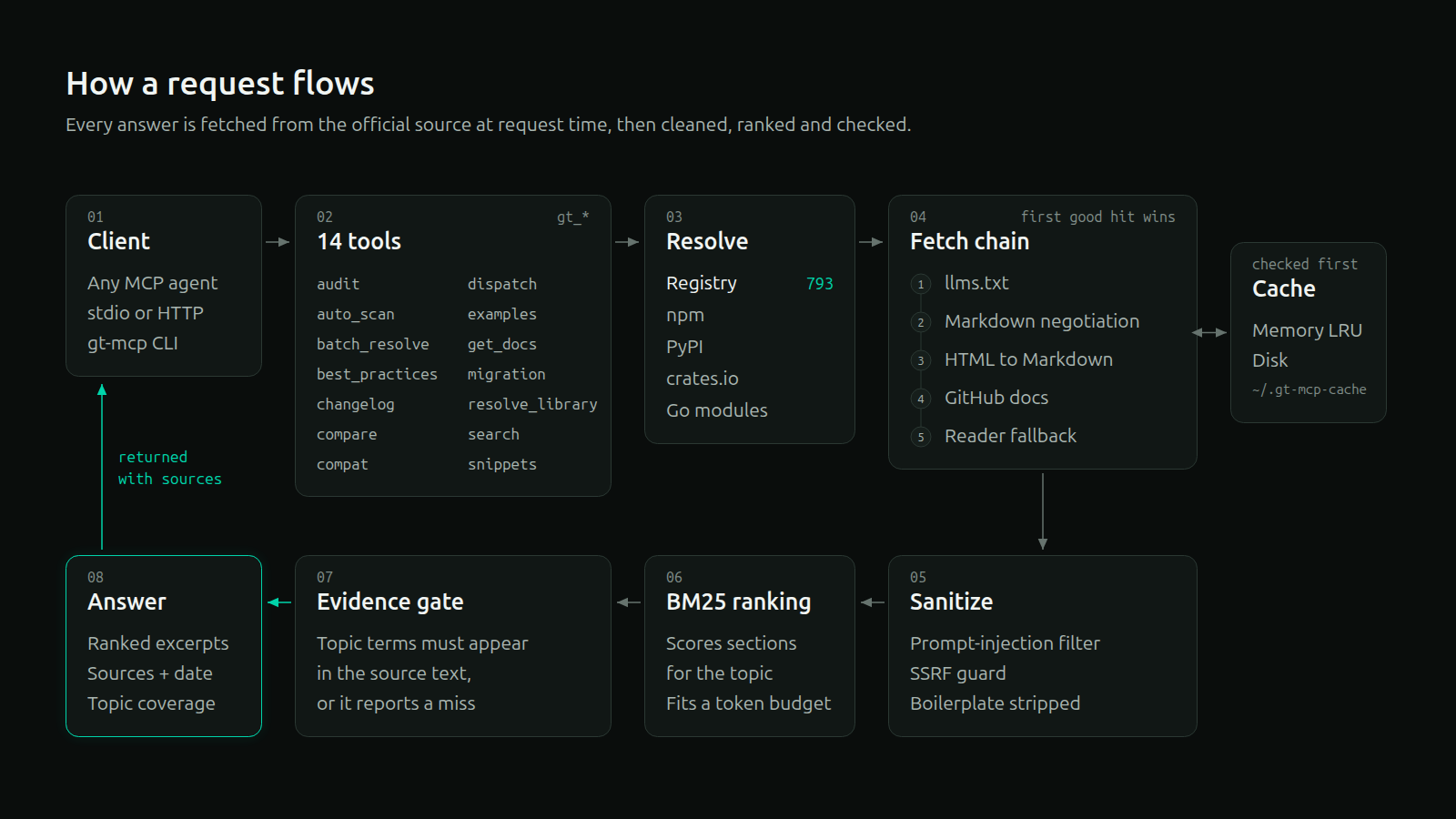
- Resolve. The library name is matched against the curated registry, then npm, PyPI, crates.io and Go modules.
- Cache. An in-memory LRU, bounded by entry count and by characters, then the disk cache in
~/.gt-mcp-cache. - Fetch. Sources are tried in order and the first useful one wins:
llms.txt/llms-full.txt, the files maintainers publish for LLMs. A nestedllms.txtresolves to the library's own index.- The docs page as markdown, via
Accept: text/markdowncontent negotiation where the site supports it. The Next.js caching page is 715 KB as HTML and 16 KB as markdown. - The HTML page, converted to markdown directly.
- GitHub: README, docs files, releases. GitHub-hosted libraries read their own README, not GitHub's site-wide
llms.txt. - The Jina reader, as a hedged fallback that starts after 1.5 s or after a direct fetch fails.
- Sanitize. Prompt-injection filter, SSRF guard, navigation and boilerplate stripped.
- Rank. BM25 scores each section against the topic and fills the token budget with the ones that mention it.
- Check. The evidence gate (below) decides whether the answer covers the topic.
- Answer. Ranked excerpts with source URLs, fetch date and topic coverage.
The fetch layer keeps connections alive for 60 s, shares one in-flight request between identical callers, honours per-call cancellation and the GT_TOOL_TIMEOUT_MS deadline, caches 404s and oversized bodies so they are not retried, and skips a host for a while after repeated failures.
Evidence, not vibes
The failure mode of every docs tool is the confident non-answer: you ask about row-level security, the tool hands back the Postgres landing page, and your model writes something plausible from it.
GroundTruth checks the content it fetched against the question before returning it. The check counts how many of your topic's terms appear, how often, and whether they show up in a heading or inside a code block. Link targets and URL query strings don't count, so a 404 page whose navigation happens to contain your topic doesn't pass.
- Weak coverage triggers a second, topic-targeted fetch instead of shipping the first page that loaded.
- Zero coverage returns an explicit miss. You get the sources that were checked, an outline of what those pages do cover, and what to try next. Treat it as a true negative.
- Every successful answer ends with an
## Evidencefooter: source URLs, fetch date and topic-coverage numbers, so you can check where it came from.
The check is synonym-aware: an rls query is satisfied by a page that says "row level security", and a page found by expanding "migration" to "upgrade guide" isn't failed for lacking the literal word.
Accuracy, 7.5.0 against 8.0.0:
| Check | 7.5.0 | 8.0.0 |
|---|---|---|
| False library detections on a 212-query generic corpus | 94 | 0 |
| Correct detections on a library corpus | 217 of 217 | |
| Live 23-check matrix across all 14 tools | 17 of 23 | 23 of 23 |
Both routing corpora run in the test suite.
Coverage
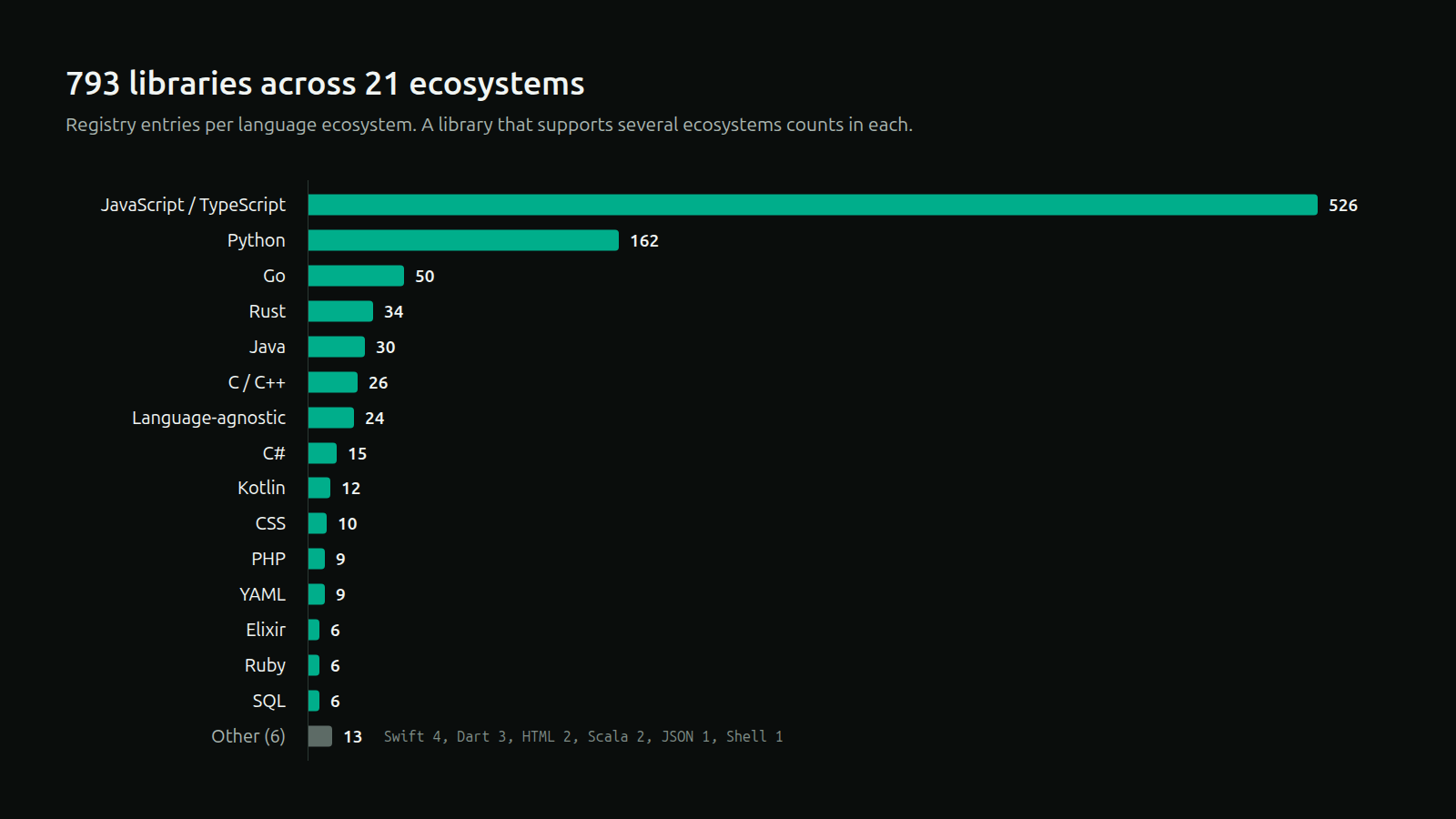
793 curated libraries across 21 language ecosystems, plus automatic fallback to npm, PyPI, crates.io and Go modules for anything outside the registry.
Release 8.0.0 adds 195 libraries: Python, data and AI tooling, Java, Kotlin and Spring, .NET, Go, Rust, Ruby, PHP, Swift, Dart and Flutter, Elixir, C and C++, infrastructure, databases, observability and more JavaScript and TypeScript. Every one of the 598 existing entries was probed live: 35 broken docs roots fixed, 115 moved docs sites updated, about 190 verified llms.txt indexes added. The curated URL tables (2,638 URLs) were re-checked.
| Ecosystem | Examples |
|---|---|
| JavaScript / TypeScript | Next.js, React, Tailwind CSS, shadcn/ui, TanStack Query, Zustand, Hono, NestJS, tRPC, Vite, Vitest, Playwright |
| Python | Django, FastAPI, Flask, Pydantic, SQLAlchemy, Celery, NumPy, Pandas, Polars, PyTorch, scikit-learn |
| Java / Kotlin | Spring Boot, Hibernate, Quarkus, Micronaut, Ktor, Jetpack Compose, JUnit, Mockito |
| .NET | ASP.NET Core, Entity Framework Core, .NET MAUI, xUnit.net, Serilog |
| Go / Rust | Gin, Echo, Fiber, GORM, Tokio, Axum, Actix Web, Serde, sqlx |
| Ruby / PHP / Elixir | Ruby on Rails, Sidekiq, RSpec, Laravel, Livewire, Symfony, Phoenix, Ecto, Oban |
| Mobile | Flutter, Riverpod, SwiftUI, Alamofire, React Native, Expo |
| C / C++ | CMake, Clang / LLVM, OpenCV, gRPC |
| Databases | PostgreSQL, Redis, MongoDB, SQLite, ClickHouse, Elasticsearch, Prisma, Drizzle ORM |
| Infrastructure | Docker, Kubernetes, Helm, Terraform, Pulumi, Ansible, Cloudflare Workers |
| Observability | OpenTelemetry, Prometheus, Grafana, Grafana Loki, Sentry |
| AI | Claude API, OpenAI SDK, Gemini API, Vercel AI SDK, LangChain Python, HuggingFace Transformers |
The full list is the registry source: src/sources/registry.ts.
Security
GroundTruth fetches untrusted web content and hands it to a model, so the fetch path is hardened:
- SSRF guard blocks private, loopback, link-local and ULA ranges, on redirects too. IP-literal URLs are checked against the full blocklist, including cloud metadata at
100.100.100.200andfd00:ec2::254, NAT64 and 6to4. - Prompt-injection sanitizer decodes HTML entities and strips zero-width and bidi characters before scanning, then redacts the exact matching span using an offset map. It is best-effort pattern redaction; treat fetched docs as untrusted input.
- Tokens stay on their origin.
GT_GITHUB_TOKENandGT_JINA_API_KEYare never forwarded to another origin, including on redirects. - Audit patterns are ReDoS-safe. The worst-case input went from 9.5 s to 1 ms.
- HTTP mode binds
127.0.0.1by default, validatesHostandOrigin, and compares the bearer token in constant time. - No user data on disk. The disk cache holds fetched documentation under hashed keys, not prompts or tool inputs.
Report vulnerabilities privately through GitHub Security Advisories. Scope and threat model: SECURITY.md.
HTTP and Docker
Set GT_HTTP_PORT and GroundTruth serves Streamable HTTP instead of stdio. It speaks MCP spec 2026-07-28 and still serves 2025-era clients.
| Path | Purpose |
|---|---|
/mcp | MCP endpoint (POST, GET, DELETE) |
/health | Health JSON, including a cache-directory check |
/metrics | Prometheus metrics |
Local, loopback only:
GT_HTTP_PORT=3100 npx -y @groundtruth-mcp/gt-mcp@latest
It binds 127.0.0.1. Without GT_AUTH_TOKEN it starts open to local callers and logs a warning. With a token, every path, /health and /metrics included, needs Authorization: Bearer <token>.
Docker:
docker build -t gt-mcp .
export GT_AUTH_TOKEN="$(openssl rand -hex 32)"
docker run -d --name gt -p 127.0.0.1:3100:3100 -e GT_AUTH_TOKEN gt-mcp
claude mcp add --transport http gt http://localhost:3100/mcp --header "Authorization: Bearer $GT_AUTH_TOKEN"
The image is 277 MB, runs as the unprivileged gt user, and binds 0.0.0.0 inside the container, so it refuses to start without GT_AUTH_TOKEN. Its healthcheck sends the token. The -p 127.0.0.1: prefix keeps the port on the host's loopback; drop it to serve other machines.
Behind a reverse proxy: the server speaks plain HTTP. Terminate TLS at the proxy and add the public hostname to GT_HTTP_ALLOWED_HOSTS, otherwise requests carrying it get 403. On a non-loopback bind the server will not start without GT_AUTH_TOKEN.
Sessions: stateless by default. GT_HTTP_STATEFUL=1 gives each 2025-era client its own session, closed after 30 minutes without a request.
An authenticated caller can make the server fetch public URLs and run gt_audit and gt_auto_scan on any directory the process can read. Don't mount anything into the container you wouldn't want read.
Configuration
Everything is optional. Invalid numeric or enum values fail at startup instead of falling back silently.
| Variable | Default | Purpose |
|---|---|---|
GT_HTTP_PORT | unset | Serve MCP over Streamable HTTP on this port instead of stdio |
GT_HTTP_HOST | 127.0.0.1 | HTTP bind address; any non-loopback address needs GT_AUTH_TOKEN |
GT_HTTP_ALLOWED_HOSTS | unset | Comma-separated extra Host/Origin values the HTTP server accepts |
GT_HTTP_STATEFUL | unset | 1 gives each 2025-era HTTP client its own session |
GT_AUTH_TOKEN | unset | Bearer token required on /mcp, /health and /metrics |
GT_GITHUB_TOKEN | unset | GitHub API token: 5,000 requests per hour instead of 60, enables gt_examples code search |
GT_JINA_API_KEY | unset | Jina reader key, lifts page rendering off the anonymous rate limit |
GT_CACHE_DIR | ~/.gt-mcp-cache | Disk cache directory |
GT_CACHE_TTL_MS | 1800000 | Default cache lifetime |
GT_SWR_STALE_TTL_MS | 3600000 | How long past expiry a cached page may still be served |
GT_TOKEN_LIMIT | 8000 | Default answer size in tokens |
GT_MAX_TOKEN_LIMIT | 20000 | Largest tokens value a call may ask for |
GT_TOOL_TIMEOUT_MS | 55000 | Deadline per tool call |
GT_FETCH_TIMEOUT_MS | 15000 | Timeout per outbound HTTP request |
GT_MAX_CONCURRENT_FETCHES | 12 | Outbound requests in flight at once |
GT_CONCURRENCY | 8 | Parallel library fetches in gt_auto_scan (max 12) |
GT_DEEP_FETCH_MAX_PAGES | 8 | Linked pages read when the first page misses the topic |
GT_DEEP_FETCH_RELEVANCE_THRESHOLD | 0.3 | First-page topic relevance (0-1) that skips the deep fetch |
GT_DEEP_FETCH_TIMEOUT_MS | 25000 | Time budget for one deep fetch |
GT_CIRCUIT_BREAKER_THRESHOLD | 3 | Consecutive failures before a host is skipped |
GT_CIRCUIT_BREAKER_RESET_MS | 60000 | How long a failing host is skipped |
GT_LOG_FORMAT | text | text or json; logs go to stderr |
GT_LOG_LEVEL | info (warn for CLI commands) | debug, info, warn or error |
GT_NO_UPDATE_CHECK | unset | 1 skips the npm registry update check and its notice |
GT_NO_WATERMARK | unset | 1 drops the notice line and the invisible watermark |
NODE_DISABLE_COMPILE_CACHE | unset | 1 skips the on-disk compile cache |
gt-mcp --help prints the same list.
Upgrading from 7.x
8.0.0 has four breaking changes. Stdio users on Node 24 or newer who read the text content are not affected by any of them.
| Change | What to do |
|---|---|
HTTP mode binds 127.0.0.1 by default (7.x bound all interfaces) | To expose it, set GT_HTTP_HOST=0.0.0.0 and GT_AUTH_TOKEN. The Docker image already sets the host and needs the token. |
Requests with a foreign Host or Origin get 403 | Add your public hostname to GT_HTTP_ALLOWED_HOSTS. |
Prose tools no longer return structuredContent | Read the text content; it carries the full answer. gt_resolve_library, gt_batch_resolve and gt_dispatch keep their structured result. |
| Node.js 24 or newer | Upgrade Node. |
Also new under the hood: the MCP TypeScript SDK v2 (@modelcontextprotocol/server), tools/list cache hints, and a fixed HTTP mode (7.5.0 answered only the first HTTP request). Production dependencies went from 169 packages (27 MB) to 13 (7.7 MB), and the Docker image from 566 MB to 277 MB. Full list: CHANGELOG.md.
vs. Context7
Context7 is a good product. The differences:
| GroundTruth | Context7 | |
|---|---|---|
| Hosting | Self-hosted (stdio) + HTTP mode | Cloud backend, local MCP client |
| Rate limits | None | 1,000 free/month ($10/seat for 5,000) |
| Transport | Stdio + Streamable HTTP | Stdio + Streamable HTTP |
| Source priority | llms.txt, markdown docs, HTML, GitHub, reader fallback, fetched at query time | Vector DB with proprietary crawl pipeline |
| Answer verification | Evidence gate on every topic query; explicit miss when unverifiable | No |
| Tools | 14 specialized tools | 2 tools |
| Code audit | 107+ patterns, 18 categories, file:line, live fixes | No |
| Freeform search | OWASP, MDN, AI docs, Google APIs, web standards | Library docs only |
| Changelog, compat, compare, examples, migration | Yes | No |
| MCP Resources + Prompts | 2 resources, 8 prompts | No |
| Lockfile detection | Reads exact versions from lockfiles | No |
| Libraries | 793+ curated + npm/PyPI/crates.io/Go fallback | Undisclosed (claims "thousands") |
| API key required | No | No |
Context7 indexes docs into a vector database, which is fast but lags behind new releases. GroundTruth fetches from the source at query time and tells the model when it found nothing on the topic.
Contributing
Adding a library is a pull request to src/sources/registry.ts with id, name, docsUrl, and llmsTxtUrl if the project publishes one.
pnpm install
pnpm typecheck
pnpm test        # 2063 tests across 267 files
pnpm build
CI runs the suite on Node 24 and 26. Issues and requests: github.com/rm-rf-prod/GroundTruth-MCP/issues.
Reference
| What | Where |
|---|---|
| Tool schemas and parameters | tools/list in any MCP client, gt-mcp tools, or src/tools/ |
| Complete library list | src/sources/registry.ts |
| Audit rules, 18 categories | src/sources/audit-patterns.ts |
| Routing table | gt-mcp --routing-table |
| Health, telemetry, circuit-breaker state | gt-mcp --health, or /health in HTTP mode |
| Release history | CHANGELOG.md |
Star history
License
Elastic License 2.0. Free to use, self-host and build on. The one thing you can't do is offer it as a managed service.