Listed from the MCP registry; nobody on Odel publishes it.

Agentic Wallet Guardian V3
Explainable ALLOW/WARN/BLOCK risk decisions for AI agent actions before execution, signed as OAA.
Runs on your machine from its package; the steps are below.
What it does
- Reads
- Writes
- High impact
At most: moves money, runs code or commands, deletes data, or sends messages for you.
What it costs
FreeOdel charges nothing per call. The publisher may charge for its own service.
Runs locally over stdio
This server isn't hosted — your MCP client launches it from a package registry. Use one of the commands below, or drop the config into your client (e.g. Claude Desktop).
Run
uvx agentic-wallet-guardian-mcp
MCP client config
{
  "mcpServers": {
    "agentic-wallet-guardian-v3": {
      "command": "uvx",
      "args": [
        "agentic-wallet-guardian-mcp"
      ]
    }
  }
}Agentic Wallet Guardian
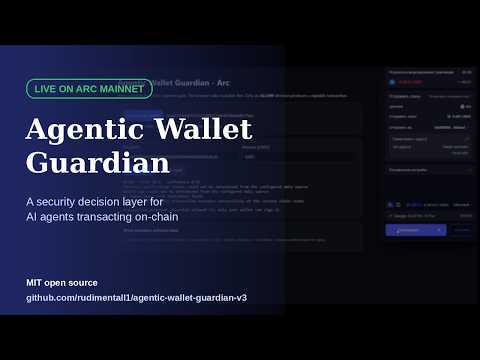
Watch the demo
Select the preview to play the video in your browser.

Let AI agents transact on-chain without giving them unrestricted control of the wallet. Guardian evaluates each proposed action before signing or broadcast and returns an explainable ALLOW / WARN / BLOCK decision.
POST /decision -> ALLOW / WARN / BLOCK (with a reasoned explanation)
It runs on your own infrastructure, using your own policy rules and your own reputation data - see Why self-hosted for why that matters and how this differs from calling a hosted security API directly.
Guardian is chain- and use-case-agnostic - Arc/USDC below is one live deployment, not the whole scope. See docs/hackathons.md for which track this submission targets and why.
Arc Mainnet Demo
Live demo: http://77.239.125.37:8765/arc
Demo video: https://youtu.be/srH0ZLwtwqQ
Agentic Wallet Guardian is deployed on Arc mainnet and includes a live browser demo for USDC payments. The Guardian evaluates the requested operation before execution, applies its security policies, and only an approved operation is passed to the user's wallet for signing.
Verified Arc mainnet transaction: 0xd781e8b04b5ca89c3a34fcec50a6636049f7647d2b0e1b2bb64d5b1ee54daadf
The transaction was successfully executed on Arc mainnet using USDC through the Guardian demo.
See it decide, live: run the API locally (GUARDIAN_ENABLE_CORS_FOR_BROWSER_DEMO=true uvicorn api.main:app --reload), then open examples/browser-demo.html
in a browser - no build step, no server for the page itself. Every
scenario button sends a real POST /decision to your running instance
and renders the actual response (risk score, every signal that fed into
it, every policy rule that fired) - nothing in the page is scripted or
faked. GUARDIAN_ENABLE_CORS_FOR_BROWSER_DEMO is off by default (see
guardian/config.py) since it's specifically for this local-demo case,
not something to leave on for a real deployment.
Why self-hosted
There are good hosted alternatives for agent-transaction security (GoPlus's AgentGuard, Blockaid, Chainalysis/TRM for compliance). If you just want a risk score and don't care who sees the query, calling one of those directly is less work than running this. Guardian exists for the cases where that tradeoff doesn't work for you:
- Nothing about which wallets, contracts, or amounts your agents touch
leaves your infrastructure. Threat-intel and contract allow/deny checks
are local JSON files you populate yourself (see
data/threat_lists/README.md), not a lookup call to a third party. A hosted API inherently sees every address and amount you ask it about. - Your policy rules live in your code, not a vendor's dashboard.
Spending caps, reputation gates, and which action types require
confirmation are plain Python in
guardian/policy/, reviewable and changeable without waiting on anyone else's product roadmap. - No per-call fees or rate limits imposed by someone else - only the
ones you configure for your own users (
GUARDIAN_RATE_LIMIT_PER_MINUTE). - No vendor lock-in. Every external data source (RPC endpoint, Blockscout instance, DexScreener) is swappable behind a small provider interface - see Architecture.
The honest tradeoff going the other way: you also take on running it, keeping your local threat lists current, and you don't get a hosted vendor's chain coverage or dedicated threat-research team for free. This is the right choice for teams that specifically need data sovereignty or deep policy customization - not a strict upgrade over every hosted option.
Architecture
                AI Agent
                    |
                    v
             Action Intent
   { agent_id, wallet, chain, action_type,
     target, amount, metadata }
                    |
                    v
        ┌───────────────────────────────┐
        │   Guardian Decision Engine    │
        ├───────────────────────────────┤
        │  1. Hard Rules                │  <- chain support, sanity checks
        │  2. Wallet Intelligence       │  <- mock | real RPC (web3.py)
        │  3. Token Intelligence        │  <- mock | real DexScreener | real GoPlus
        │  4. Contract Intelligence     │  <- local lists, then mock | real Blockscout | real GoPlus
        │  5. Simulation                │  <- mock | real eth_call dry-run (see below)
        │  6. Threat Intelligence       │  <- local JSON allow/deny lists
        │  7. Anomaly Detection         │  <- vs. this agent's own history (see below)
        │  8. Policy Engine             │  <- spending caps, reputation gates
        │  9. Risk Fusion               │  <- signals -> single 0-100 score
        │ 10. Reputation Adjustment     │
        │ 11. Explanation               │  <- evidence -> human-readable reasons
        └───────────────────────────────┘
                    |
                    v
          ALLOW / WARN / BLOCK
                    |
                    v
          Blockchain Execution
Every data source in steps 2-4 is a small provider interface with a mock
implementation (zero config, zero network calls) and a real one, selected
per-source by environment variable - see .env.example. Switching from
demo mode to a real deployment is a config change, not a code change.
Repository layout
guardian/
    config.py          GuardianConfig - the one place that reads os.environ
    core/               ActionIntent, Signal, Decision, EvaluationContext
                            (zero external dependencies - no pydantic/FastAPI)
    decision/           DecisionEngine (orchestrator), RiskFusionEngine, hard rules
    reasoning/          explanation + confidence builders
    intelligence/
        wallet/           analyzer.py + providers.py (mock | RpcWalletDataProvider)
        token/            analyzer.py + providers.py (mock | DexScreenerTokenDataProvider | GoPlusTokenDataProvider)
        contract/         analyzer.py + providers.py (mock | BlockscoutContractDataProvider | GoPlusContractDataProvider)
        simulation/       pre-execution dry-run (mock | real eth_call) + tx_builder.py (real calldata for transfer/approve)
        goplus_client.py  shared GoPlus Token Security API client (used by both contract + token)
        threat/           blocklist.py (local AddressList) + intelligence.py
    policy/             PolicyEngine + policy templates (spending caps, reputation gates)
    reputation/         AgentReputation (score derived from decision history)
    memory/             storage.py (protocol) + InMemoryStorage + sqlite_storage.py
api/
    main.py             FastAPI app: /decision, /health, /capabilities, /agents/{id}/history, /demo/{scenario}
    security.py         API-key auth dependency + rate-limit middleware
    schemas.py          pydantic request/response models (API boundary only)
mcp_server.py           MCP stdio server - same DecisionEngine, no HTTP required
data/threat_lists/      local, operator-maintained allow/deny lists (empty by default - see its README)
scripts/
    refresh_ofac_list.py   fetch OFAC's public SDN list into the local threat list
tests/                  101 tests covering the engine, policy, reputation, and every provider
guardian/* is intentionally dependency-free (standard library only,
except where a real provider needs httpx or web3), so the decision
core can be unit-tested, embedded in another service, or ported to a
different web framework without dragging FastAPI along. Only api/
touches pydantic/FastAPI.
Honesty about the current state
This is real, runnable, tested decision infrastructure with real (not mock) data sources available for every signal source - but "available" isn't the same as "flip a switch and trust it blindly." Specifics:
- Wallet (RPC provider):
is_contractandtx_count(nonce-based) are reliable with any JSON-RPC endpoint. Wallet age requires an archive-capable node and is off by default (GUARDIAN_RPC_ESTIMATE_AGE=false) - most free public RPC endpoints don't serve historical state, so this fails closed to "unknown" rather than guessing. - Contract (Blockscout provider): real verification-status lookups against a public Blockscout instance. Their exact response schema and rate limits can change - this is written to degrade to "unknown" on any unexpected response, never to fabricate an answer, but hasn't been load- tested against production traffic.
- Token (DexScreener provider): real liquidity data, but matching a bare ticker symbol to an on-chain pair is inherently ambiguous (many unrelated tokens share a symbol, and scammers deliberately mint look-alikes). The provider picks the highest-liquidity pair on the requested chain and reports its own match confidence rather than presenting a guess as certain - for anything where that ambiguity matters, match by contract address instead of symbol.
- Contract + Token (GoPlus provider): real contract-security
(owner-can-drain, mintable, self-destruct, hidden owner) and
trading-security (honeypot, buy/sell tax, blacklist, pausable transfers,
holder concentration) from GoPlus's Token Security API - meaningfully
more signal types than Blockscout/DexScreener give individually, since
GoPlus's own static analysis covers both in one call. Two real limits:
it only has data for contracts it's actually analyzed (mostly token
contracts, not generic dApp/router contracts), and
GoPlusTokenDataProviderneeds a contract address - a bare symbol like "PEPE" can't be resolved and is honestly reported as unverifiable rather than guessed at. - Sanctioned-address list is real, populated data: 103 addresses (100
EVM + 3 Solana) from OFAC's SDN list, via
0xB10C/ofac-sanctioned-digital-currency-addresses -
verified end-to-end (a known-sanctioned address correctly triggers
BLOCKthrough the full pipeline) and verified to correctly reflect delistings, not just additions (Tornado Cash's addresses, removed from the SDN list in March 2025, are correctly absent). Re-runscripts/refresh_ofac_list.pyperiodically - sanctions change in both directions. malicious_contracts.json/verified_contracts.jsonstill ship empty on purpose (seedata/threat_lists/README.md) - there's no single authoritative source for "malicious contract" the way OFAC's list is authoritative for sanctions, so populating these is a judgment call for whoever operates this instance, not something to seed by default with unverified entries.- Simulation is real, but conditional.
RpcSimulationProvider(GUARDIAN_SIMULATION_PROVIDER=rpc) genuinely dry-runs a transaction viaeth_call/eth_estimateGasagainst current chain state - a revert comes back with its actual reason, not a guess, and ERC-20approve()amounts are decoded from real calldata instead of inferred. This activates when the caller supplies raw calldata viaintent.metadata["data"], OR - new - whenGUARDIAN_TX_BUILDER=rpcis also set and the intent is a plaintransferorapprove(see next bullet). Aswapintent with no transaction built yet still has nothing to dry-run - Guardian reports that honestly (simulation_not_attempted) rather than guessing. - Transaction building closes part of that gap, deliberately not all
of it.
RpcTransactionBuilder(GUARDIAN_TX_BUILDER=rpc) turns a semantictransfer/approveintent into real calldata - it fetches the token's actualdecimals()via RPC rather than assuming 18 (a wrong assumption there would scale the amount by orders of magnitude), and deliberately has no hardcoded token-address registry: a bare symbol like "USDC" is refused rather than guessed at, since a wrong address here wouldn't just be a bad risk signal, it'd be an artifact that could end up in a real transaction.swapis built against Uniswap V2 Router02 only (one immutable, well-known contract - function selectors computed locally viaWeb3.keccak, not copied from memory) - realgetAmountsOut()on-chain quote, caller-suppliedmax_slippage_bpsrequired (never a default, same reasoning as decimals above).bridgeis a genuinely open-ended L2/bridge routing problem in general - dozens of protocols, wildly different trust models - but this module handles one well-scoped slice of it: L1 -> L2 deposits through a destination chain's own official OP Stack bridge (currently: Base and Optimism -depositETHTo/depositERC20ToonL1StandardBridge, both addresses independently cross-checked - Base against Etherscan's label plus basehub.org, Optimism against the official ethereum-optimism/superchain-registry plus a second independent dev-tool config - before being hardcoded). L2 -> L1 withdrawals are NOT built - that's a genuinely different, much slower proof/challenge-window flow, not a variant of the deposit call. Bridging to anywhere else, or via any non-canonical bridge, returnsNonerather than guessing. - Intent verification can now actually enforce, not just flag.
decision/intent_verification.pycompares an agent's declaredapproveamount against what the simulated calldata really encodes - but that comparison needs the token'sdecimals()to convert between human units and atomic ones.GUARDIAN_DECIMALS_PROVIDER=rpc(RpcTokenDecimalsProvider, seeguardian/intelligence/token/decimals.py) fetches that for real viaeth_call, cached forever per (chain, token) since a deployed contract'sdecimals()can't change. Left at itsnulldefault, a mismatch this module could otherwise catch degrades to an honest "cannot verify" WARN instead - same "no silent guessing" rule as everywhere else in this module, not a gap that got missed.RpcTransactionBuildershares this same cache when both are configured with a real provider, instead of doing its own independent, uncached lookup for the same token. - Storage:
InMemoryStorage(default, zero setup),SQLiteStorage(GUARDIAN_STORAGE_BACKEND=sqlite- persists across restarts, no external infra), orPostgresStorage(GUARDIAN_STORAGE_BACKEND=postgres+GUARDIAN_POSTGRES_DSN- the fit for multiple replicas behind a load balancer, where SQLite's single-writer model becomes the bottleneck;pip install -r requirements-postgres.txt). Tested against a real local Postgres instance, not mocked - seetests/test_postgres_storage.py. Redis is still open if you specifically want it; the two-methodMemoryBackendinterface is small enough to implement against anything. - API auth/rate-limiting are intentionally minimal - built for one self-hosted instance behind your own network boundary, not a multi-tenant gateway. Put a real API gateway in front if you need that.
- Not security-audited. The policy engine and risk fusion logic have
not been reviewed by anyone outside this repo. Treat
BLOCKas a strong signal, not a guarantee, until that's happened.
Everything downstream of a Signal - fusion, policy, reputation,
explanation, the API - does not need to change as any of the above
gets hardened further. That boundary is the actual design contract here.
Quickstart
Zero-config demo mode (mock providers, in-memory storage, no auth):
pip install -r requirements.txt
uvicorn api.main:app --reload
Or with Docker:
docker compose up --build
Try the canned scenarios:
curl http://localhost:8000/demo/safe
curl http://localhost:8000/demo/unknown
curl http://localhost:8000/demo/malicious
Or submit your own intent:
curl -X POST http://localhost:8000/decision \
  -H "Content-Type: application/json" \
  -d '{
        "agent_id": "trading-agent-001",
        "wallet": "0x742d35Cc6634C0532925a3b844Bc454e4438f44e",
        "chain": "ethereum",
        "action_type": "swap",
        "from_token": "ETH",
        "to_token": "USDC",
        "amount": 5
      }'
Going from demo to a real self-hosted deployment
Copy .env.example to .env and adjust:
cp .env.example .env
At minimum for a real deployment: set GUARDIAN_API_KEY (auth is off by
default), GUARDIAN_STORAGE_BACKEND=sqlite (persistence), and whichever
GUARDIAN_*_PROVIDER variables you want pointed at real data instead of
mock - see the comments in .env.example for every option, and
RpcWalletDataProvider/BlockscoutContractDataProvider/
DexScreenerTokenDataProvider/GoPlusContractDataProvider/
GoPlusTokenDataProvider's docstrings for what each one actually
gives you.
If more than one agent shares this deployment, also set
GUARDIAN_AGENT_API_KEYS (format: agent_id:key,agent_id2:key2). A
single GUARDIAN_API_KEY only proves a caller holds a valid key - it
does not prove which agent_id a given request actually came from, since
agent_id is just a field in the request body. Anyone holding the shared
key can submit any agent_id and inherit that agent_id's accumulated
reputation and capability grants. GUARDIAN_AGENT_API_KEYS binds each
agent_id to its own key; GUARDIAN_API_KEY, if also set, keeps working
as a master key that can act as any agent, for admin/testing use. For a
genuinely single-agent deployment, GUARDIAN_API_KEY alone is fine.
MCP (no HTTP required)
For agent frameworks that speak MCP (LangChain, CrewAI, Claude Desktop,
etc.), mcp_server.py exposes the same decision engine as two tools
(evaluate_action, get_agent_history) over stdio - install
requirements-mcp.txt alongside requirements.txt (they resolve into one
environment; see the comment at the top of requirements-mcp.txt) and
point your MCP client at python mcp_server.py.
Arc mainnet payment demo
Guardian 3.2 adds a small, non-custodial Arc mainnet surface for autonomous USDC payments.
- Arc mainnet, chain ID 5042, official RPC
https://rpc.mainnet.arc.io - Arc USDC ERC-20 interface
0x3600000000000000000000000000000000000000(6 decimals) - Guardian runs the normal hard-rules, intelligence, simulation, policy and risk pipeline before it releases a transaction
- the demo policy caps autonomous payments at 5 USDC and blocks approve/swap/bridge/contract-call actions on this surface
- only an
ALLOWdecision produces a signable transaction; the browser wallet remains the only signer - the public demo keeps one bounded history identity (
arc-demo-agent) so visitor traffic cannot create unbounded per-agent memory keys - open
/arcon a running instance to connect a wallet, ask Guardian, and sign the resulting Arc payment
Manual Arc verification:
python scripts/verify_arc_mainnet.py
The script checks chain ID, live block height, gas price and the mainnet USDC decimals() call. It does not require a private key.
Running the tests
pip install -r requirements.txt -r requirements-chain.txt -r requirements-mcp.txt
pytest -q
requirements-chain.txt (web3) is needed by the RPC and on-chain
attestation tests. requirements-mcp.txt installs the MCP SDK used by
mcp_server.py. PyJWT and cryptography are core dependencies because OAA
attestations use JWTs and Ed25519 signing. The CI install matches this
full test environment.
PYTHONPATH=. python3 -m unittest discover -s tests -v
CI (.github/workflows/ci.yml) runs the full suite on every push/PR
against Python 3.11 and 3.12.
Signed, verifiable decisions (OAA)
Every decision this service returns — from a single policy check up through the full pipeline — is signed as an OAA (Open Agent Attestation) token: an Ed25519-signed JWT wrapping the decision, the action, and the reason.
Anyone holding the public key can verify a decision offline, without calling back to whatever instance of Guardian issued it — useful for an auditor, a downstream service, or just a record you want to trust later without trusting the server that produced it.
python examples/example_oaa_attestation.py
python examples/example_full_pipeline.py   # capability -> intent -> engine -> OAA
The reference OAA implementation is ~150 lines
(oaa.py/attestation.py upstream) and is shared, unmodified,
across this project and agent-guardrail —
same signing format, same verification path, no per-project fork.
Using Guardian in front of MetaMask Agent Wallet
MetaMask Agent Wallet's Guard Mode / Beast Mode apply the same static
spend limits and allowlists to every agent. Guardian is a second,
independent check in front of it: does this specific action look
right for this agent, right now — before the mm CLI is ever
invoked.
skills/guardian-check/ is a standard
Agent Skill — the same open format MetaMask
itself uses for mm (npx skills add MetaMask/agent-skills). Install
it alongside MetaMask's own skill in any Agent-Skills-compatible
runtime (Claude Code, Cursor, Codex, OpenClaw), and the agent will
call a running Guardian instance for an ALLOW/WARN/BLOCK decision
before running any mm command that moves funds — mm send, mm swap, mm bridge, mm perps, mm predict trade, mm earn, mm aave, mm pay.
Guardian never holds keys and never executes anything — mm remains
the only thing that signs or broadcasts. This is a decision gate the
agent is instructed to consult first, not a modification to
MetaMask's own pipeline (there's no public hook for that today).
uvicorn api.main:app --reload   # run Guardian locally
export GUARDIAN_API_URL="http://localhost:8000"
python skills/guardian-check/scripts/check.py \
  --agent-id my-agent --wallet 0x... --chain ethereum \
  --action-type transfer --target 0x... --amount 50
From advisory to enforced: GuardianValidator
Everything above is advisory - Guardian tells you ALLOW/WARN/BLOCK, but
the caller still has to choose to respect that. onchain/
is a real ERC-7579 validator module for ERC-4337 smart accounts that
closes that gap: once installed, the account's UserOperations only ever
reach the chain if a trusted Guardian signer attested, for that exact
operation, that the decision was ALLOW - not something an agent can skip
asking or ignore the answer to. See onchain/README.md
for why it needs a second, EVM-native signature format alongside OAA
(Ed25519 has no EVM precompile and costs ~2,000,000 gas to verify in pure
Solidity; this module's entire validateUserOp costs 27k-59k gas), what's
deliberately out of scope (WARN never passes on-chain; no professional
audit yet), and how to build, test, and deploy it - including a test that
verifies a signature produced by real, running Python
(guardian/onchain_attestation.py) is accepted by the real Solidity
contract, not two implementations that only agree with themselves.
Roadmap
Replace the mock wallet/token/contract analyzers with real data sources.Done - see Honesty about the current state for what "real" does and doesn't cover yet per source.Wire up real pre-execution simulation.Done fortransfer/approveend to end (GUARDIAN_SIMULATION_PROVIDER=rpc+GUARDIAN_TX_BUILDER=rpc- see Honesty about the current state).swapneeds real DEX routing.getAmountsOut()quote, explicit caller-suppliedmax_slippage_bps(never defaulted), no calldata built without a real quote. Fixed a real bug found while building this: simulation was dry-running againstintent.target(the recipient/spender encoded inside ERC-20 calldata) instead of the actual contract being called (from_token) - meaning transfer/approve simulation silently "succeeded" against any EOA recipient regardless of whether the real call would have reverted.BuiltTransactionnow carries an explicitto; seetests/test_tx_builder.pyfor the regression tests that would have caught it.bridgestill open.L1StandardBridge(depositETHTo/depositERC20To) - other destinations, other bridge protocols, and L2->L1 withdrawals all remain open; see Honesty about the current state.Populate threat-intel / sanctions feeds; stop shipping empty sets.Done for sanctions (sanctioned_addresses.json- 103 real OFAC SDN addresses, refreshable viascripts/refresh_ofac_list.py).malicious_contracts.json/verified_contracts.jsonremain empty by design - no single authoritative source exists to seed them the way OFAC's list does for sanctions.SwapInMemoryStoragefor a persistent backend.SQLiteStorageis available;a Postgres/Redis backend is still open for multi-replica deployments.PostgresStoragedone - tested against a real local Postgres instance (tests/test_postgres_storage.py), same two-methodMemoryBackendinterface as the other backends. Redis remains open if specifically wanted.Add an MCP server wrapper.Done (mcp_server.py). A packaged Python/TypeScript SDK on top of the REST API is still open.- Publish an OpenAPI spec and a hosted demo endpoint.
- Get the policy engine and risk fusion reviewed/audited before anyone
relies on a
BLOCKfrom this service in production - it's a security tool, so it needs the same scrutiny it applies to others. Add per-agent capability limits (delegation scoping).Done -guardian/policy/capabilities.py, and wired intoDecisionEngine.evaluate()via an optionalcapability_registryconstructor argument (previously it was a standalone module you had to call yourself outside the normal pipeline - seeexamples/example_capability_limits.py, which now runs throughDecisionEnginedirectly). Opt-in: pass no registry (the default) and nothing changes; an operator can grant a specific agent a scoped capability (allowed action types, allowed chains, per-action and daily spending caps, an expiry) with zero private-key material involved. Agents with no grant are unaffected. This module still never touches private keys or session-key issuance itself - that remains out of scope, a categorically higher-stakes problem.Real enforcement of a decision (vs. an agent choosing to respect it) remains deliberately out of scope.Partially done -onchain/'sGuardianValidatoris an ERC-7579 module that makes a decision genuinely unbypassable for any ERC-4337 smart account that installs it, without Guardian ever holding a key. It does not manage session keys, custody, or account creation - it only gates execution behind an attestation - so this is a real, load-bearing piece of "account abstraction," not the whole of it.Verify declared intent against decoded simulation results.Done -guardian/decision/intent_verification.pycatches the case where an agent declares one amount but the actual calldata it was handed encodes a meaningfully different (but still finite) one, andDecisionEngine.evaluate()now actually calls it (it didn't before - the module and its example script existed, but nothing in the real decision pipeline invoked it).It's still not a working guardrail on its own, though: comparing atomic units needs the token'sdecimals(), and no decimals provider exists yet.GUARDIAN_DECIMALS_PROVIDER=rpc(RpcTokenDecimalsProvider, seeguardian/intelligence/token/decimals.py) closes that: a realeth_callto the token's owndecimals(), cached forever per (chain, token) since that value can never change once a contract is deployed. Left at itsnulldefault, everyapprovewith a successful, finite-amount simulation still gets an honest "cannot verify without decimals" WARN instead of either a false BLOCK or a silent skip - configuring the real provider is what turns that into an actual BLOCK on a genuine mismatch. Seeexamples/example_intent_verification.pyfor the check blocking a real mismatch, andtests/test_decision_engine.py'sTestIntentVerificationWithRealDecimalsProviderfor the end-to-end version wired through a real (mocked-RPC) decimals lookup rather than a hand-suppliedtoken_decimalsargument.Flag actions that deviate from an agent's own historical pattern.Done -guardian/intelligence/anomaly/analyzer.py. Distinct from reputation (a single trust score) and policy (static, operator-set limits): this compares the current intent against this specific agent's own recorded history - new action type, new chain, or an amount that's a statistical outlier versus what this agent has done before, even if it's within policy limits and the agent's reputation is fine. Honestly reports "insufficient history" rather than guessing a baseline from fewer than 5 prior data points - seetests/test_anomaly_detection.py.Sit in front of a real agent wallet, not just accept intents from a generic API caller.Done for MetaMask Agent Wallet -skills/guardian-check/is a standard Agent Skill an agent installs alongside MetaMask's ownmmskill; the agent calls it before running any fund-movingmmcommand and only proceeds on ALLOW. Tested end-to-end against a liveuvicorninstance (ALLOW/WARN/BLOCK/config-error all exercised for real, not just asserted) - see the "Using Guardian in front of MetaMask Agent Wallet" section above. No public hook exists (yet) to run inside MetaMask's own pipeline; this works at the agent-orchestration layer instead.
Related projects
Same author, same principle applied elsewhere:
- agent-guardrail - a generic policy firewall for AI agent tool calls (not blockchain-specific). Published on PyPI, MIT, 46 tests.
- x402-attest - cryptographically signed (Ed25519), independently verifiable attestations for agent-to-agent payment policy decisions. Early proof of concept.
- open-agent-attestation - vendor-neutral open spec (JWT+EdDSA) for signing agent policy decisions, verifiable by anyone. x402-attest above uses a custom format; this is the generalized version. Draft v0.1.
License
MIT - see LICENSE.







