Verdi Bridge
Inspect waveforms and navigate RTL in live Synopsys Verdi. Requires a licensed Verdi installation.
Runs on your machine from its package; the steps are below.
What it does
- Reads
- Writes
- High impact
At most: only reads or looks up information.
What it costs
FreeOdel charges nothing per call. The publisher may charge for its own service.
Runs locally over stdio
This server isn't hosted — your MCP client launches it from a package registry. Use one of the commands below, or drop the config into your client (e.g. Claude Desktop).
Run
uvx verdi-bridge
MCP client config
{
  "mcpServers": {
    "verdi-bridge": {
      "command": "uvx",
      "args": [
        "verdi-bridge"
      ]
    }
  }
}



Getting started · Tool reference · Architecture · 中文
Give your RTL debugging agent eyes on the waveform
Connect your AI agent to live Synopsys Verdi. Let it find signals, inspect transitions, move through simulation time, and open the driving RTL—all in the same GUI you use to debug.
“Add the FIFO read/write pointers, go 20 cycles before the error, and investigate why full stayed high.”
“When did BVALID drop? Show the handshake signals and the code that drives it.”
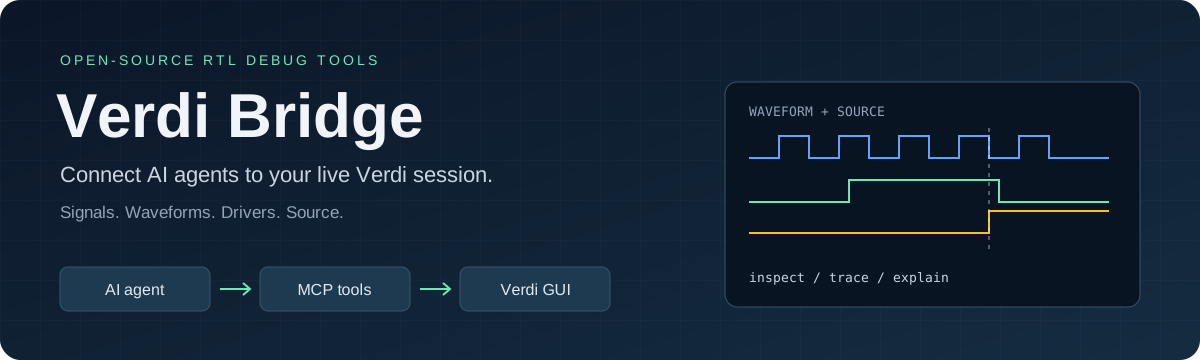
Verdi Bridge turns those requests into observations from your simulation and visible actions in nWave and nTrace. The agent reasons; the bridge observes. Sixteen typed MCP tools work locally or over SSH with your existing Verdi setup.
Video walkthrough
Ask an agent to investigate a bug, then watch it choose signals, inspect live waveforms and navigate RTL. A 1m38s silent demo: an English prompt and original English agent replies beside synchronized Verdi capture. This is a separate English-language run, not a translation. Tool calls are selected by the agent, not a replay script.
https://github.com/user-attachments/assets/b041c1bd-4be5-4040-b281-2f15001b1e35
How this was recorded · Installation tutorial
Quick start
pip install verdi-bridge
Or run without a checkout using uv:
uvx verdi-bridge tcl-path
This prints the bundled Tcl adapter path. Load it in Verdi and connect your MCP
client, then use uvx verdi-bridge serve as the stdio server.
A licensed Verdi installation is required. Client: Python 3.11+; remote host:
Python 3.6+ and Verdi's Tcl 8.6. No vendor software is bundled.
What you can do
| Workflow | Tools |
|---|---|
| Find and display signals | find_signals, browse_scope, add_signals |
| Navigate an error window | set_cursor, set_time_window, jump_before_error |
| Inspect actual waveform values | find_transitions, get_value_changes, sample_signals |
| Discover error times and clocks | read_log, measure_clock |
| Follow drivers into RTL | trace_driver, read_source, read_source_file, goto_source |
Waveform queries preserve X/Z values. Time arguments carry explicit units. The same interface works with different RTL designs; no FIFO-specific logic is built into the bridge. See the Python and CLI examples.
See it in a real debugging session
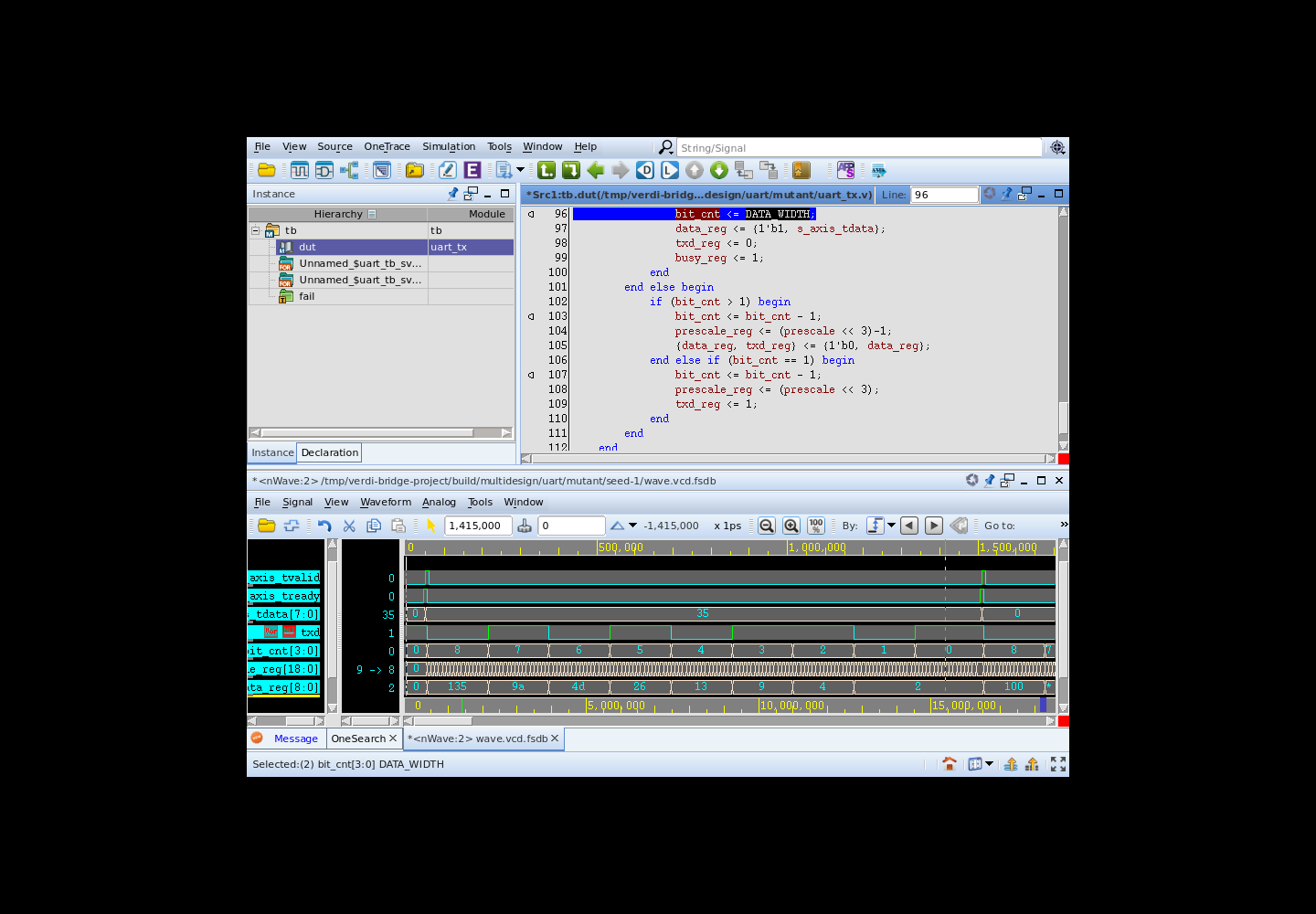
Tested with UART TX, AXI-Lite, FIFO and arbiter RTL in licensed VCS/Verdi sessions. The agent can put relevant signals on screen, inspect their changes, and navigate to source while you follow along.
Real RTL examples · Blind debugging trial · Validation results and limitations
Project status
Experimental v0.3.1. Tested with Verdi T-2022.06-SP2-1 on Linux. New-session startup is verified; attachment to an arbitrary existing GUI is not yet separately validated. The bridge does not automatically compile, edit or repair RTL.
Contributing · Trust boundary · Validation limits · Report an issue
Inspired by the agent-to-EDA-tool workflow of virtuoso-bridge-lite. This is an independent implementation. MIT licensed; see third-party notices. Not affiliated with Synopsys. Verdi is a Synopsys trademark.