Listed from the MCP registry; nobody on Odel publishes it.

Assay MCP Server
Policy-enforcing MCP proxy with portable evidence output.
Runs on your machine from its package; the steps are below.
What it does
- Reads
- Writes
- High impact
At most: moves money, runs code or commands, deletes data, or sends messages for you.
What it costs
FreeOdel charges nothing per call. The publisher may charge for its own service.
Runs locally over stdio
This server isn't hosted — your MCP client launches it from a package registry. Use one of the commands below, or drop the config into your client (e.g. Claude Desktop).
Distributed as an MCP bundle (`https://github.com/Rul1an/assay/releases/download/v8.0.2/assay-mcp-server-v8.0.2-linux.mcpb`) — download it and import the bundle in your MCP client.
Assay
Check MCP tool calls against a policy and review the decisions offline.
Put Assay between your MCP client and a local stdio server. In enforcement mode, Assay checks each routed tools/call request before forwarding it. Its open evidence profile records decisions and, when available, observations of what happened next.



Quickstart · How it works · See it work · MCP example · OWASP MCP Top 10 · Discussions
Try the MCP quickstart to see the decision for a read request sent to a local mock. The decision records permission to forward the call. A real file read would require separate evidence from the server or operating system.
One golden path: the release-pinned agent journey records the nine driven CLI/MCP steps and their exit/stdout contracts. Its protected-action fixture lives in examples/privileged-action-gate/.
Enforcement and evidence
- Enforce. In enforcement mode, the gate decides
tools/callrequests routed through it before forwarding, with the precise reason for each allow or deny. Separate controls on supported Linux hosts include cgroup eBPF IPv4/TCP connect filtering (whose hook error path allows connections) and Landlock TCP-connect port allowlisting.assay sandbox --enforcerefuses an unavailable backend or conflicting filesystem policy unless--allow-audit-fallbackis explicit.--enforce-netrequires--enforce; active Landlock network enforcement rejects policies it cannot express as TCP-port allowlists, even with audit fallback enabled. - Inspect. Configured producers can export recorded decisions and observations in a bundle. Run
assay evidence verifyon a saved bundle to review the result. The privileged-action flow carries the verdict, pre-call establish journey, and declared-vs-observed conformance for CI review without a hosted backend.assay mcp wrap --decision-logrecords tool-call decisions;assay evidence prepare-incident-packageturns that log into an incident packageverify-incident-packageaccepts, with the surface grades the verifier derives. The package is not a count of all calls, not completeness of capture, not proof of what the server did, and an allow is not proof a human accepted. - Stay honest. Trust Basis classifies supported claims as
verified,self_reported,inferred, orabsent; its gates check the declared claim boundaries. A tool returning "success" is the provider's assertion, never proof. Assay ships no single safety score; read each artifact’s source, coverage and non-claims before relying on it.
Quickstart
Install the CLI on Linux or macOS:
curl -fsSL https://getassay.dev/install.sh | sh
assay --version
If you prefer to build from source, run cargo install assay-cli --version 8.0.2 --locked.
For installation diagnostics, run assay doctor.
From an empty directory, run a local demo:
assay demo
The demo creates rules in assay-demo/assay.yaml and a sample trace in
assay-demo/traces.jsonl. To try it with your coding agent, ask:
Change the Calculate operation in the demo trace from
addtomultiply. Run the command below and explain which rule caught the change.
assay validate --config assay-demo/assay.yaml --trace-file assay-demo/traces.jsonl
The original trace passes. After the edit, validation exits with code 1 because
the rule allows only add and subtract.
To see a tool call go through the MCP gate, open a source checkout or an extracted CLI archive and run:
python3 examples/mcp-quickstart/run.py
For v8.0.2, run the last command from a source checkout or an extracted published CLI archive.
The installer is binary-only and does not carry the bounded quickstart assets. The live
getassay.dev installer verifies the selected archive against its published SHA-256 sidecar before
extraction. Set ASSAY_REQUIRE_PROVENANCE=1 to additionally require GitHub artifact provenance;
the default reports provenance_not_requested and strict success reports provenance_verified.
A checksum proves byte equality with the published sidecar, not producer identity. Provenance
identifies the source and build, not runtime safety or semantic correctness.
Captured runner output (the bundled local mock performs no external action):
assay quickstart: PASS
mcp_requests=initialize,tools/list,tools/call
decision=allow tool=read_file
decision_artifact=.assay/quickstart/decisions.ndjson
non_claim=forwarded_to_local_mock_only
Released surfaces:
- Static project manifests are shipped for Claude Code and Cursor; Codex uses the equivalent TOML entry documented in the editor MCP recipe. Manifest presence is not host-discovery proof.
assay mcp config-pathsupports Claude Desktop and Cursor only. - Published v8.0.2 CLI archives cover Linux x86_64/arm64, macOS x86_64/arm64, and Windows x86_64. The Python wheels cover CPython 3.12, 3.13, and 3.14 on macOS x86_64/arm64 and Linux x86_64; other interpreters and platforms are not claimed.
- Published
assay-mcp-serverarchives cover Linux x86_64/arm64. MCPB andserver.jsonpackage descriptors are also published; their presence is not host-discovery proof. - CI: GitHub Action. Core flows need no hosted backend or API key. New to the threat model? The OWASP MCP Top 10 mapping states, per risk, what Assay covers and deliberately does not.
What ships
| Output | What it is |
|---|---|
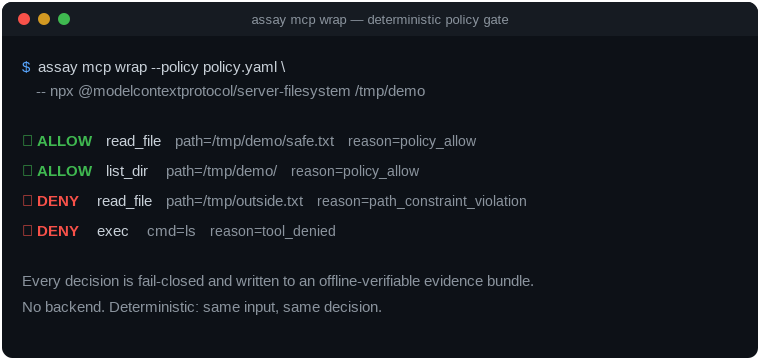
| Policy gate | assay mcp wrap — deterministic allow/deny before tools run, with the reason. |
| Evidence bundle | Offline-verifiable, tamper-evident archive for audit and replay. |
| Trust Basis / Trust Card | Canonical trust-basis.json (bounded claim classification) plus review-friendly trustcard.{json,md,html}. |
| External receipts | Eval outcomes, runtime decisions, and model inventory as bounded receipts with JSON Schema contracts. |
| Tool-decision logs | For handled known-tool calls, the assay-mcp-server stdio server emits an info-level tool_decision event when enabled by its log filter; decision contains a JSON-encoded observed decision entry with projected target fields. |
| SARIF / CI | GitHub Action, Security-tab integration, policy gates on PRs. |
| Attestation | Sign an evidence bundle as a DSSE-wrapped in-toto v1 Statement with the evidence-bundle/v1 predicate. |
  Agent ──► Assay ──► MCP Server
              ├─ ✅ ALLOW / ❌ DENY  (policy, with reason)
              ├─► 📋 Evidence bundle (offline-verifiable)
              └─► 📊 Trust Basis → Trust Card → SARIF / CI
Install pin: v8.0.2. CHANGELOG.md and release notes remain the authority for released behavior; the install pin advances after publication checks.
Launch definition and support commitment: docs/LAUNCH.md.
Is this for me?
Yes if you already have eval output, runtime decisions, inventory artifacts, or MCP tool-call tests, and you want a small reviewable CI artifact instead of a dashboard — bounded auditability, not a scalar trust badge.
Not yet if you need Assay to judge model correctness for you, want a hosted dashboard as the product, or want a compliance claim rather than a bounded evidence boundary. Assay is not a trust-score engine, a generic eval dashboard, or a hosted observability product — see what it is and is not.
See it work
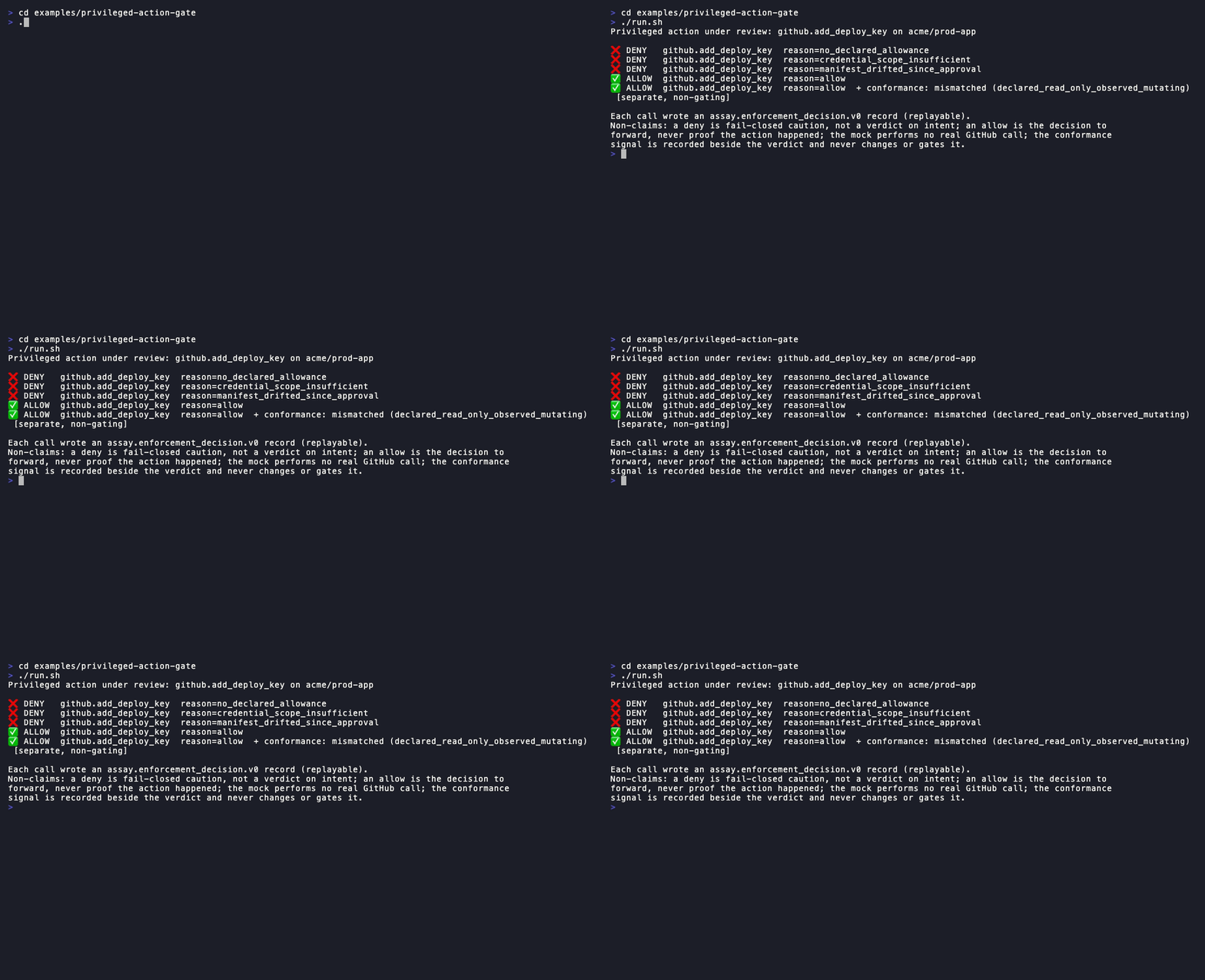
An agent tries a privileged action — github.add_deploy_key — through the enforcing proxy, decided per call before it forwards, offline against a local mock (no real credentials):
cd examples/privileged-action-gate && ./run.sh
A deny is fail-closed caution, not a verdict on intent; an allow is the decision to forward, never proof the action happened. Declared-vs-observed conformance is recorded beside the verdict, never as a gate. Full walkthrough: privileged-action-gate.
Pick your path
| You have | What you get | Start here |
|---|---|---|
| Promptfoo JSONL from CI evals | Eval outcome receipts + verified bundle + Trust Basis diff | Promptfoo JSONL |
OpenFeature EvaluationDetails | Decision receipt + verified bundle | OpenFeature |
| CycloneDX ML-BOM model component | Inventory receipt + verified bundle | CycloneDX ML-BOM |
| MCP tool calls | Allow/deny audit trail + observed-behavior evidence | MCP Quick Start |
| A GitHub PR gate | Trust Basis diff, gate status, SARIF/JUnit-ready output | CI Guide |
| A Runner archive / coverage annotation | Coverage descriptors + claim-class cells + a claimed-vs-observed check | Coverage-honesty walkthrough |
The workflow stays small: import or record a bounded outcome, bundle and verify it, compile trust-basis.json, gate the Trust Basis diff. Assay doesn't make the upstream tool the source of truth; it makes the evidence boundary inspectable. For privileged tool actions, the MCP proxy records each tools/call as a structured tool-decision surface — keeping the asserted-versus-verified line honest.
Policy is simple
This policy allows the time tool. Other tool names are denied.
version: "2.0"
name: "my-policy"
tools:
  allow: ["get_time"]
Try the Filesystem walkthrough with Claude Code or a model-free replay. List a disposable directory, try writing a file, then inspect both policy decisions. The Filesystem server enforces its permitted directories. The hardened preset assumes different paths and tool names.
assay init --from-trace trace.jsonl generates the runtime-observation policy used by the trace-generation flow (files, network, and processes); it is not an MCP authorization policy. Migrate a legacy MCP constraints: policy with assay policy migrate. See Policy Files.
Why Assay
| Canonical evidence | Assay's evidence model is the stable contract; OpenTelemetry and protocol adapters (ACP / A2A projection profile / UCP) map into it. |
| Deterministic | The policy gate uses explicit rules; its decision depends on the request, policy and applicable session state. This does not make live evaluators or external effects deterministic. |
| Bounded claims | Explicit about verified vs visible vs absent — no score-first UX. |
| Offline-first | No backend required for core enforcement and bundle verification. |
| Checkable provenance | Which piece of the source-class and coverage model shipped when, as commits you can git log rather than claims you have to take — provenance, prior art credited first. |
Learn more
- MCP Quickstart · Editor MCP recipe — policy-enforcing MCP in Cursor / Claude Code / Codex
- MCP 2025/2026 protocol-era parity — pinned
resultTypeand interim-result compatibility corpus - Coding-agent governance · OpenTelemetry & Langfuse — observed runs → evidence
- Evidence Receipts in Action — Promptfoo / OpenFeature / CycloneDX receipt families
- CI Guide · Evidence Store (S3 / B2 / MinIO)
- OWASP MCP Top 10 mapping · Security experiments
- Positioning: ADR-033 · RFC-005
Evidence epistemology, latency, and the internal Runner
Trust claims use explicit epistemology, not a single safety score: verified (direct evidence or offline verification), self_reported (emitted without independent corroboration), inferred (bounded, documented rules), absent (no trustworthy evidence). Assay ships no aggregate trust score or safe/unsafe badge as the main output — see ADR-033.
The historical fragmented-IPI experiment results, dated 2026-03-02 and naming commit 289a43ecc144, report 0.771ms p50 / 1.913ms p95 for the deterministic set. The harness times complete local mock tools/call round trips, including JSON-RPC transport and the tool response. These reported timings do not isolate policy-decision overhead or establish current-release or end-to-end model performance.
Assay-Runner is an internal/experimental measured-run subsystem behind the delegated Linux/eBPF acceptance path. Its crates are included in the workspace publication process so dependent packages can resolve them; publication does not make Runner a standalone product or give its APIs a separate stability commitment.
Ecosystem
Related projects for evidence generation, verification, and reviewability; each has its own interface and scope:
- assay-action — GitHub Action: verify bundles, PR summaries, SARIF (Marketplace).
- Assay-Harness — recipe, gate, and report layer over canonical evidence artifacts.
- observed-effect-v0 — worked examples of the bounded observed-effect evidence record and its neutral carriers (in-toto, SCITT, MCP evidenceRef).
- gateway-evidence-replay — deterministic offline replay verifier for gateway-path evidence bundles.
- RGE-Bench — a conformance kit for evidence reviewability, maintained separately under its own machine-checked neutrality guard. Reproduction there is digest-scoped and does not carry forward: the v1 71-vector digest
sha256:e769822bc6c9e31085da7b1a17b163b9747fe0d04314fbb8685d4e612087c7cband the historical v2 digestsha256:ba0e3795d75c788fa48313ab462493f22d78759851d1b3275d8117051bb22fd0(95 vectors) each carry one reported independent implementation by a second author on a different stack. JM-Lab reported the v2 95/95 reproduction on 2026-08-24, from the contract text and author-supplied inputs without readingexpected. Neither reproduction transfers to the current 104-vector v3 candidate digestsha256:93f8ae9654eb5a16dee28d882087669cae5183e02e116ba1e8071a30594cfb6a, which the record lists as unreproduced. See its REPRODUCTIONS.md.
Open profile: privileged-mcp-action/v0
privileged-mcp-action/v0
is a composition and verification contract over evidence records that already exist: what a
privileged MCP tool call decided, what was observed of its effect, and what stays unproven. It adds
no new envelope and no aggregate verdict.
It ships with a 14-vector conformance corpus (5 accept, 9 reject) whose digest is a candidate: it is not called reproduced until a non-author implementation derives the expected outcomes from the specification text alone.
That reproduction is open, and the invitation is real: #1840. Any language, any stack. The invitation names the exact commit the current digest describes. The clean-room protocol provides an opaque, attested inputs pack, a one-command scoring action, and an implementation-report template without supplying verifier logic or expected outcomes. The corpus README states the authorship boundary and the claim ceiling.
Contributing
cargo test --workspace
cargo clippy --workspace --all-targets -- -D warnings
See CONTRIBUTING.md and GitHub Discussions.







