
The open-source governance harness for AI agents.



Put enforceable policy, human approvals, isolated execution, budgets, and signed evidence around any AI agent. Runeward works with an existing agent or multi-agent framework rather than requiring a new model or orchestration stack.
Prove it in one command
Prerequisites: a running Docker/Podman engine and the runeward binary.
runeward quickstart
The command creates .runeward/quickstart.toml, checks the policy, runtime, image, and state path,
runs an allowed command, proves a destructive command is denied before execution, and verifies the
signed audit trail. It never overwrites an existing policy unless --force is passed.
doctor and dashboard readiness also resolve required secret sources. A Charter that references an
unset env:// value is not presented as launch-ready.
runeward doctor quickstart                     # explain setup problems safely
runeward --config-dir .runeward serve          # dashboard + governed REST API
runeward evidence export quickstart -o run.json
runeward evidence verify run.json              # independent policy/audit verification
What Runeward adds
| Concern | Container alone | Runeward |
|---|---|---|
| Tool calls | Executes what the process requests | Checks every shell, code, file, network, and browser action first |
| Risky actions | Application-specific | allow, deny, or require-approval with an attributed decision |
| Network | Usually open unless separately configured | Deny-by-default hostname policy; strict L3 enforcement on Kubernetes |
| Limits | CPU/memory | Wall-clock, exec, egress, token, cost, and retry-loop budgets |
| Audit | Runtime logs | Append-only, hash-chained, Ed25519-signed events |
| Handoff | Ad-hoc logs and folders | Workspace tar, recovery snapshots, and portable signed evidence JSON |
| Agent identity | One opaque process | Tenant, actor, parent run, provider, model, and durable run lineage |
| Interfaces | Runtime-specific | CLI, REST, MCP, web dashboard, Kubernetes CRDs, and local SDK adapters |
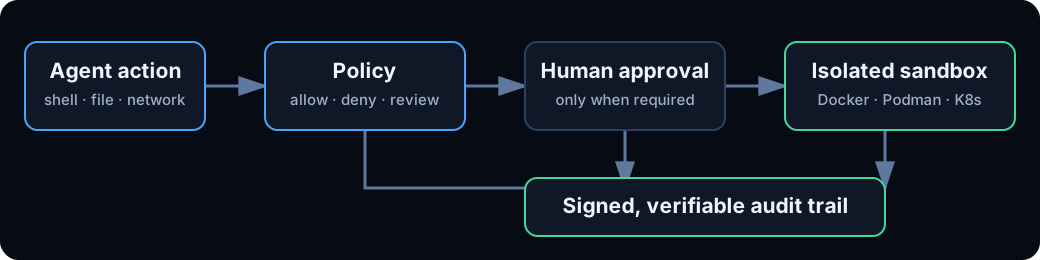
Every governed action follows one path:
agent request → policy → human approval when required → limits → sandbox → signed audit event
Naming
Documentation and UI use familiar terms first. Existing API paths and file fields retain the original themed names for compatibility.
| Plain-language term | Runeward name | Existing surface |
|---|---|---|
| Sandbox | Citadel | /v1/citadels, Kubernetes Citadel |
| Policy file/profile | Charter | /v1/charters, *.toml profile |
| Approvals | Conclave | /v1/conclave |
| Signed audit trail | Chronicle | /v1/chronicle, [chronicle] |
| Network controls | Perimeter | /perimeter, [network] |
| Budgets and limits | Rationing | [rationing] |
| Agent group/fleet | Cohort | /v1/cohorts, [cohort] |
See the full naming and writing convention.
Install
Choose the package that matches how you use Runeward:
| Install with | What it installs | Command |
|---|---|---|
| Homebrew | Runeward CLI for macOS or Linux | brew install Runewardd/tap/runeward |
| PyPI | Python client and agent-framework adapters | python -m pip install runeward |
| npm | TypeScript client and agent-framework tools | npm install @runeward/sdk |
For normal local use, install the CLI with Homebrew. For an agent integration, install the SDK for its language as well. The pip and npm packages connect to a running Runeward API; they do not replace the CLI/runtime.
Homebrew — CLI
Local sandboxes require a running Docker, OrbStack, or Podman engine.
brew install Runewardd/tap/runeward
runeward version
runeward quickstart
pip — Python SDK
Requires Python 3.9 or newer. The base client has no third-party runtime dependencies.
python -m pip install runeward
python -c "import runeward; print(runeward.__version__)"
npm — TypeScript SDK
Requires Node.js 18 or newer.
npm install @runeward/sdk
npm ls @runeward/sdk
See Adapters for LangChain, CrewAI, LlamaIndex, OpenAI Agents, Strands, Vercel AI SDK, and LangChain.js installation options.
Other CLI installation options
The signed macOS/Linux installer requires
cosign so it can fail closed while
verifying the checksum manifest. Windows binaries are available from
Releases.
curl -fsSL https://raw.githubusercontent.com/Runewardd/runeward/main/install.sh | sh
To build the current main branch, use Go 1.26.6:
git clone https://github.com/Runewardd/runeward
cd runeward
go build -o bin/runeward ./cmd/runeward
./bin/runeward version
Use it with an agent
Expose governed tools to an MCP-capable IDE or agent:
{
  "mcpServers": {
    "runeward": {
      "command": "runeward",
      "args": ["mcp", "--config-dir", ".runeward"]
    }
  }
}
Or place an agent CLI inside a sandbox and run one or many governed workers:
runeward cohort --agent claude --model sonnet build "Build a tested API"
Adapters are included for LangChain, CrewAI, LlamaIndex, OpenAI Agents, Strands, Vercel AI SDK, and LangChain.js. See Adapters and agent groups.
The dashboard also has a read-only Live chat TTY for each Citadel. Agent harnesses publish
user, assistant, tool, and system turns with runeward_publish_conversation (or the REST,
Python, and TypeScript equivalents), and authorized teammates can follow the redacted conversation
without terminal input access. Runeward cannot infer private UI chat text that the agent client does
not publish; wire the publish call into the harness turn callback. The publisher must connect to the
same runeward serve control plane as the dashboard (through /mcp, REST, or an SDK).
Harness agents and subagents
Runeward is the enforcement boundary around an agent, not the component that decides how the agent reasons. Route the tool calls of a parent agent and each delegated subagent through Runeward to give them explicit policy, approval, isolation, budget, and evidence boundaries.
Existing concepts keep their meaning: a Cohort is a group of peer workers sharing a task board; it is not being renamed to “subagents.” The orchestrator still decides when to delegate, while Runeward records the parent/run/provider lineage and prevents a child Citadel from widening its parent's tenant or Charter. Every participating agent can receive its own Citadel and Chronicle. See Agent harnessing.
Policy workflow
Policies support built-in glob rules, CEL, OPA/Rego, and signed OCI bundles. Test them in CI, start from a reviewed scaffold, or derive exact proposals from verified production evidence:
runeward policy scaffold package-approval
runeward policy test quickstart --case 'tool=shell,action=rm -rf /,expect=deny'
runeward policy learn run.json > proposed-policy.toml
policy learn never edits a policy automatically. It verifies the evidence first, skips redacted
actions, produces exact matches, and requires a human to review and broaden them.
Security posture
- The server binds to loopback by default and requires authentication before a non-loopback bind.
- Non-loopback HTTP also requires TLS unless
--allow-insecure-httpexplicitly acknowledges that a trusted reverse proxy terminates TLS. - Multi-principal RBAC scopes sandboxes, agent groups, recovery snapshots, and dashboard views to their tenant while attributing every operation to its actor. Static tokens and OIDC JWTs use the same authorization model, and embedded HTTP MCP shares the REST ownership checks.
- Browser automation is experimental and disabled by default. Enable it only in a trusted deployment
with
RUNEWARD_ENABLE_EXPERIMENTAL_BROWSER=1after reviewing the security model. Browser-capable Charters declarecapabilities = ["browser"]; the dashboard then exposes governed rendered-text and screenshot actions and their policy/egress results. - An optional browser IDE (code-server in-cell + ticketed reverse proxy) is similarly experimental:
RUNEWARD_ENABLE_EXPERIMENTAL_IDE=1, Charter[ide],Dockerfile.idetargetside/ide-agents, exampleside-demo/ide-claude/ide-codex/ide-cursor. Limits: not per-keystroke policy; no Cursor/Claude Desktop/Codex GUIs in-cell; no first-class GitHub Copilot on code-server. See Browser IDE and the security model. - Per-action policy applies to tool calls routed through the control plane (REST, MCP, dashboard file/shell/code actions, and SDKs). An interactive terminal or a process already running inside a sandbox is a direct sandbox session: it receives isolation/network/resource controls and terminal recording, but its individual commands are not intercepted for approval. Use governed tool calls when command-level policy and signed verdicts are required.
- Report vulnerabilities privately using SECURITY.md. Runeward remains pre-1.0; residual limitations are tracked in ROADMAP.md.
Documentation
- Quickstart
- Policies / Charters
- REST API
- Browser IDE (experimental code-server proxy)
- Security model
- End-to-end testing
- Published site: runewardd.github.io/runeward
Contributions are welcome; see CONTRIBUTING.md. Licensed under Apache 2.0.