Listed from the MCP registry; nobody on Odel publishes it.

aus-accounting-mcp
Reviews, 148 bounded tax and super worksheets, cited retrieval from your local Markdown. Not advice.
Runs on your machine from its package; the steps are below.
What it does
- Reads
- Writes
- High impact
At most: only reads or looks up information.
What it costs
FreeOdel charges nothing per call. The publisher may charge for its own service.
Runs locally over stdio
This server isn't hosted — your MCP client launches it from a package registry. Use one of the commands below, or drop the config into your client (e.g. Claude Desktop).
Run
uvx aus-accounting-mcp
MCP client config
{
  "mcpServers": {
    "aus-accounting-mcp": {
      "command": "uvx",
      "args": [
        "aus-accounting-mcp"
      ]
    }
  }
}






claude mcp add --scope user aus-accounting -- uvx --from 'aus-accounting-mcp==0.13.0' aus-accounting-mcp
That connects Claude Code; it needs Python 3.14+ and uv, and no API key. The tax worksheets also need the australian-tax-calculators 1.4.0 executable on PATH (how); every other tool works without it. For Claude Desktop, download the .mcpb file from the bundle releases and open it with Claude Desktop. The server runs on your machine, so ChatGPT connectors and the Claude.ai web app, which accept only remote servers, cannot run it. Other clients.
Australian Accounting is a set of local tax and payroll calculation engines and an MCP server for Australian accountants and bookkeepers, and the developers who build tooling for them.
Nine engines (8 in Rust, 1 in Python) apply Australian tax and payroll rules to figures
you supply. Aus Accounting MCP, a local Model Context Protocol server, gives an AI
assistant the published Python releases of 5 of them and, from 0.10.0, the
australian-tax-calculators executable. Its native build in this repository
links the Rust crates of all 6 instead and is not released yet.
Each tool returns a calculation, the facts it used and the matters it refuses to decide. The engines and the MCP server run locally: they read files you point them at, contact no service, write to no ledger and lodge nothing. Two boundaries sit outside that: an MCP host sends every tool argument and result to its model provider, and the optional LodgeiT adapter below makes bounded HTTP calls only when you enable it.
Missing facts stay unknown: a Payday Super row with a fund-receipt date but no matched_amount or remitted_amount evidences when the fund received something, not how much, so the checker leaves it UNKNOWN rather than ON_TIME and names the amount it needs (from payday-super-checker 0.1.7; 0.1.6 and earlier read that receipt as covering the whole SG amount and say so in a caveat). Supply the amount the fund received with every receipt date.
Results you can check, dated because sources and releases move:
- Division 7A. On 7 October 2026 the minimum yearly repayment function of the ATO's
Division 7A calculator and decision tool
and the
div7a-loan-reviewPython 0.2.0 source agreed to the cent on 12,800 fabricated cases with no repayments, for 2019-20 to 2026-27. Its repayment code and rate table are unchanged to the published 0.3.2, but the comparison was not rerun on later releases or the unreleased Rust port. It covers the repayment figure only, not the calculator's interest or closing balance (record and limits). - Payday Super. For wages paid on 30 July 2026,
payday-super-check0.2.3 gives a due date of 11 August 2026, because NT Picnic Day on 3 August is not a business day. The ATO's worked example gives the same date on the usual 7 business day path. Run and read 5 November 2026. - MCP tools. Aus Accounting MCP 0.10.0 listed 27 local tools on
19 November 2026, including
validate_abn,validate_acnandget_reviewed_rate; 0.9.0 and 0.8.0 listed 25, 0.7.1 listed 22. 0.8.0 added thedoctorcommand.
Commands for the Payday Super date and the tool count
The first command downloads a fabricated register, and row 4 of the second prints
QE day 2026-07-30 due 2026-08-11. Its rows are late, so that command exits 2.
curl -sSLO https://raw.githubusercontent.com/ryanduguid/australian-accounting/main/packages/payday-super-checker/examples/quarterly_remittance_2026_27.csv
uvx --from payday-super-checker==0.2.3 payday-super-check quarterly_remittance_2026_27.csv --as-at 2026-11-05 -o report.csv
This asks the published server for its tools and prints the count, in bash with jq
installed. It keeps the server's input open until the tools/list reply arrives: a
server whose input closes first can exit before answering.
coproc MCP { uvx --from 'aus-accounting-mcp==0.10.0' aus-accounting-mcp; }
printf '%s\n' '{"jsonrpc":"2.0","id":1,"method":"initialize","params":{"protocolVersion":"2025-06-18","capabilities":{},"clientInfo":{"name":"check","version":"0"}}}' '{"jsonrpc":"2.0","method":"notifications/initialized"}' '{"jsonrpc":"2.0","id":2,"method":"tools/list"}' >&"${MCP[1]}"
jq -n 'first(inputs | select(.id == 2)) | .result.tools | length' <&"${MCP[0]}"
kill "$MCP_PID"
Start here: what each component is · MCP client setup · tool reference · scope, limits and examples
Try one contribution
All examples are synthetic, and accounting decisions stay with the reviewer.
Input: $120 super contribution for payday 6 August 2026, remitted 14 August, with no fund receipt evidence as at 20 August.
With uv installed, download the synthetic CSV as timely_remittance_no_receipt.csv. Open a terminal in that folder and run:
uvx --from payday-super-checker==0.2.3 payday-super-check timely_remittance_no_receipt.csv --as-at 2026-08-20 --confirm-remittance-only -o payday-report.csv
This downloads the pinned PyPI package without cloning the repository. It writes payday-report.csv in the current folder, replacing that file if it exists. Open the report to see the due date and verdict.
The confirmation acknowledges the missing receipt; it does not establish payment. Omit --confirm-remittance-only to see the same AT_RISK result with exit 2, which asks you to resolve or acknowledge that evidence gap.
Output: AT_RISK, due 17 August 2026; exit 0 acknowledges the remittance-only evidence, without proving timely receipt.
| Evidence | Result | Human decision |
|---|---|---|
| Remitted before the deadline; receipt missing | AT_RISK | Obtain fund receipt evidence before concluding it was on time. |
| Fund receipt recorded on 17 August for the full $120 contribution | ON_TIME on supplied facts | Confirm the evidence and any applicable timing exception. |
Read the 5-minute Payday Super case · Division 7A repayment case · MCP setup
The recorded public evaluation uses release 0.1.3. Follow its fixed revision and commands to reproduce that historical run; the quick trial above uses release 0.2.3, which, like every release from 0.1.7, requires an evidenced amount alongside a fund-receipt date.
Choose the next example
The next Australian Accounting example depends on the task:
| Your task | Start here |
|---|---|
| BAS pack review | Two synthetic packs with expected findings |
| Xero Activity Statement transaction GST review | BAS workflow and transaction procedure |
| Month-end close | Balanced trial balance with unresolved exceptions |
| GST planning | Browser planning calculators |
| Division 7A | Repayment assertions and the review boundary |
| Other engines and agent workflows | Examples and reproduction routes |
For transaction GST coding, load the linked bas-preparation skill and its
bundled transaction reference. They require row coverage and separate evidence
for supply treatment, buyer credits and BAS attribution. Aus Accounting MCP does
not provide a transaction GST classifier; its calculations or a control-account
tie-out cannot establish correct tax coding. Missing facts remain unresolved for
the authorised reviewer. The walkthrough explains instruction-file delivery to
Codex, ChatGPT and Copilot without claiming equivalent tested behaviour.
Use Aus Accounting MCP
For the MCP server, install Python 3.14+ and uv, then configure your MCP client to run:
uvx --from 'aus-accounting-mcp==0.13.0' aus-accounting-mcp
The tax worksheets also need the australian-tax-calculators 1.4.0 executable on
PATH or at the absolute path in AUS_TAX_CALCULATORS_BIN; the
MCP install notes say where to get it.
Without it they refuse with an install message and every other tool works.
This starts a local stdio server; it waits for an MCP client rather than opening a web page. It requires no API key. Package installation downloads dependencies; the tools then use bundled data without network requests or record writes. The MCP host you connect it to is a separate boundary: it sends every tool argument and result to its model provider, so use fabricated data with a hosted model.
The pin selects the published 0.13.0 release, so a new release does not reach you on its own. To move to a later release, replace the version in your client configuration with one from PyPI; uvx downloads it, and later launches reuse the cached copy without a download until the uv cache is cleaned.
Once it is connected, ask your assistant in plain English. Each of these fabricated requests resolves to one tool call:
| Ask | Tool |
|---|---|
| 'Compare a hairdresser with $180,000 sales, no other income, $60,000 wages, $30,000 rent and $40,000 other expenses to the ATO benchmarks.' | get_ato_benchmarks |
| 'Super for a 6 August 2026 payday was $120 and was sent on 14 August. As at 20 August, is it on time?' | calc_payday_super_deadline |
| 'What is the Division 7A benchmark interest rate for 2026-27?' | get_div7a_benchmark_rate |
| 'An employee who gave a TFN and claims the tax-free threshold (scale 2) is paid a regular $1,000 weekly wage in 2026-27, with no offsets, loans, bonuses or other adjustments. How much PAYG should be withheld?' | calculate_tax_worksheet |
Client setup and examples · Tool reference · PyPI · Glama listing
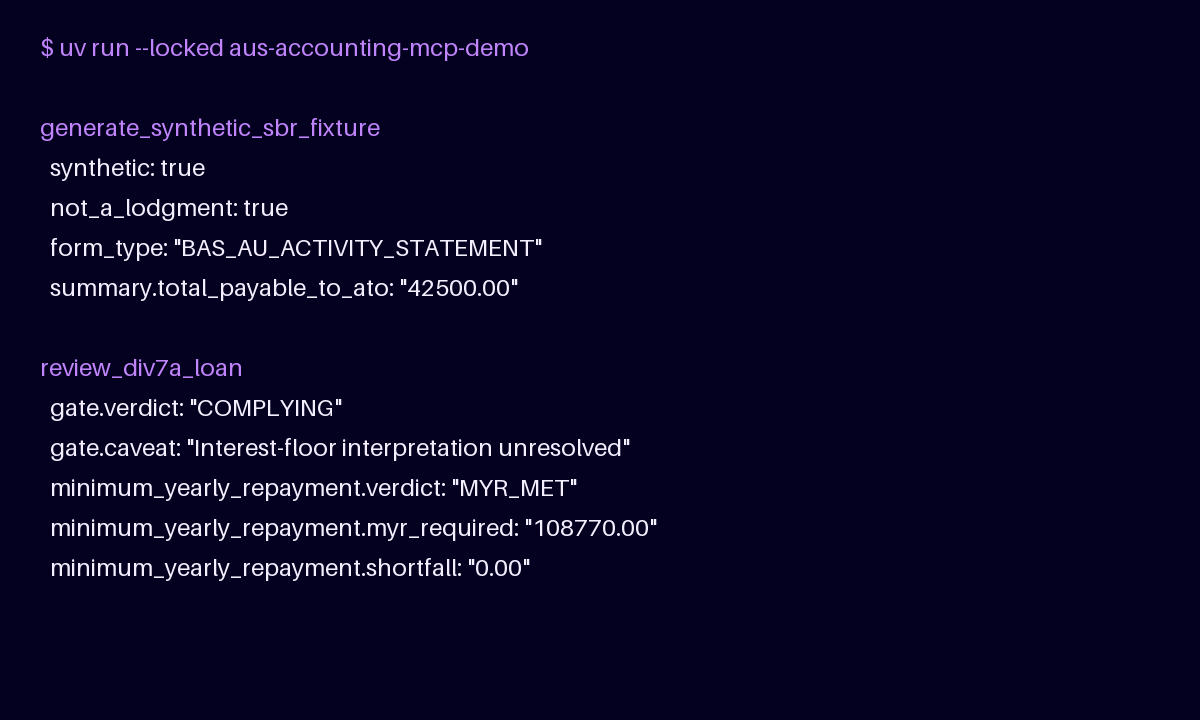
The tools list ATO benchmark industries, compare supplied expense buckets, review Payday Super timing, look up reviewed Division 7A rates, review an operator-supplied Division 7A loan, refuse unsupported Division 7A matters and generate synthetic CTR/BAS fixtures. They also assess related Payday contributions, build a Payday Super evidence pack, calculate 148 bounded tax and super worksheets, review GST coding, reconcile BAS figures with the ledger, list lodgment due dates, test ABN and ACN check digits, report data freshness and retrieve cited excerpts from a local Markdown library, legislation corpus or ATO rulings corpus. Division 7A review is limited to the delegated engine's s 109N/s 109E scope; it does not form amalgamated loans or classify repayments under s 109R.
For an editable source installation, run pip install -e . from
apps/aus-accounting-mcp/. The repository root is not an installable Python package.
How the accounting tools fit together
The accounting skills guide preparation and can call this server. Workpapers and unresolved exceptions go to an authorised human for review.
flowchart TB
accTitle: How the accounting tools fit together
accDescr: An assistant using the accounting skills exchanges requests with the Australian Accounting MCP server, which sends calculations to the calculation packages. The assistant sends workpapers and exceptions to authorised human review. The Federal Register of Legislation feeds the legislation corpus, a finding aid. The reviewer uses the corpus to locate provisions and checks authority at the Register.
%%{init: {"theme": "base", "look": "classic", "themeVariables": {"background": "#000000", "primaryColor": "#66023C", "primaryTextColor": "#FFFFF0", "primaryBorderColor": "#FFFFF0", "lineColor": "#FFD32A", "textColor": "#FFFFF0", "edgeLabelBackground": "#000000", "clusterBkg": "#000000", "clusterBorder": "#9B7735", "titleColor": "#E5E4E2"}}}%%
    assistant["Assistant using<br/>accounting skills"] <--> mcp["Australian Accounting<br/>MCP server"]
    mcp -->|Calculations| engines["Calculation packages"]
    assistant -->|Workpapers and exceptions| reviewer["Authorised human review"]
    official["Federal Register<br/>of Legislation"] -->|Corpus build| corpus["Legislation corpus<br/>Finding aid"]
    corpus -. Locate provisions .-> reviewer
    official -. Check authority .-> reviewer
    style engines fill:#990024,stroke:#FFFFF0,stroke-width:2px,color:#FFFFF0
    style reviewer fill:#E7162F,stroke:#FFFFF0,stroke-width:2px,color:#FFFFF0
    classDef external fill:#745EB1,stroke:#FFFFF0,stroke-width:2px,color:#FFFFF0
    class official external
The corpus is not an automatic source feed into the calculation engines; the research tools above only search a copy you configure. Dashed arrows show reference use, which still requires checking the applicable authority.
Components
Australian Accounting holds 13 components, each in its own directory:
| Path | Distribution | Import package | Commands |
|---|---|---|---|
packages/australian-tax-calculators/ | australian-tax-calculators (Rust) | none | australian-tax-calculators (JSON stdin worksheets and contract-register FILE) |
apps/aus-accounting-mcp/ | aus-accounting-mcp | aus_accounting_mcp | aus-accounting-mcp, aus-accounting-mcp-demo |
packages/ato-benchmark-compare/ | ato-benchmark-compare (Rust) | none | ato-benchmark-compare |
packages/payday-super-checker/ | payday-super-checker (Rust) | none | payday-super-check |
packages/div7a-loan-review/ | div7a-loan-review (Rust) | none | div7a-loan-review |
packages/the-exchequer-tally/ | the-exchequer-tally (Rust) | none | the-exchequer-tally |
packages/solomons-sword/ | solomons-sword (Rust) | none | solomons-sword |
packages/the-wip-tally/ | the-wip-tally (Rust) | none | wip-tally |
apps/au-accounting/ | au-accounting (Rust) | none | au-accounting, one subcommand per Rust engine |
packages/gst-review/ | gst-review (Rust) | none | gst-review: GST coding states against registration and BAS-to-ledger reconciliation |
packages/lodgment-calendar/ | lodgment-calendar | lodgmentcalendar | Python function: ATO lodgment program due dates for BAS, IAS, income tax and FBT returns, UNKNOWN where a fact is missing |
apps/lodgeit-calculator-adapter/ | lodgeit-calculator-adapter (Rust, not released) | none | lodgeit-adapter: optional adapter for a third-party calculator service; off by default, makes HTTP calls only when enabled (LODGEIT_ADAPTER_ENABLED=1 or --enable-network) |
packages/au-tax-rates-data/ | au-tax-rates-data (Rust, never released on its own) | none | rates validate, snapshot, check and ato-tables: ATO rates and thresholds with verbatim source quotes, validated offline |
IMPORTS.md records the source repository, commit and tree of every imported component. The
MCP application is the io.github.ryanduguid/aus-accounting MCP Registry server; it
depends on the published ato-benchmark-compare, payday-super-checker,
div7a-loan-review, gst-review and lodgment-calendar distributions, and from
0.10.0 runs the released australian-tax-calculators executable. In the development
workspace, uv takes gst-review 0.1.0, div7a-loan-review 0.3.2,
ato-benchmark-compare 0.2.2 and payday-super-checker 0.2.3, the last Python
releases, from PyPI.
The uv workspace develops lodgment-calendar and the MCP application; the
published Python MCP server links none of the Rust crates, which only its unreleased native
build does.
Alternatives
Australian Accounting calculates from figures you supply, and its research tools use folders you configure. As read on 13 November 2026, these kinds of project cover nearby ground:
- A hosted MCP connector over more than 34,500 ATO documents (guidance, legislation and public rulings), with point-in-time legislation queries, for Claude.ai, ChatGPT and other clients after sign-in. It charges for lookups beyond a monthly free allowance and sends search queries to a United States embedding provider.
- Open source Australian calculators with refusal codes, and an Australian tax and benefit microsimulation model, which serves a different purpose.
- A hosted practice platform for Australian accounting firms, with proposals, AML/CTF checks, e-signing, job tracking and an AI assistant on one client file, which also publishes browser calculators.
- A hosted platform that prepares and lodges returns, BAS and financial reports through Standard Business Reporting.
- Free browser calculators for individual and sole trader tax, PAYG, GST, super and HECS, some also offered inside AI assistants, and a remote MCP server for Australian pay, income tax, super, HECS, family payments and child care subsidy.
This repository offers none of those hosted services. It has no connector for ChatGPT or the Claude.ai web app, and it ships no ATO guidance or rulings corpus: its rulings tools search a corpus you supply. It is not a registered tax or BAS agent, does not lodge and holds no third-party certification such as ISO 27001.
Rust engine installation, component development, boundaries and releases
Development home for the Aus Accounting MCP application and 9 Australian accounting engines. Each component keeps its own distribution name, version, lockfile, tests, release notes, commands and licence. There is no root distribution, shared runtime library or combined version.
Install the Rust engines
7 of the 8 Rust engines are unreleased standalone binaries; only
australian-tax-calculators has releases (below). With
Rust 1.99 or later, install au-accounting, one command
with a subcommand per engine (benchmarks, div7a, exchequer, payday-super,
gst-review, solomons, tax and wip):
cargo install --locked --git https://github.com/ryanduguid/australian-accounting au-accounting
au-accounting div7a --help then shows that engine's own commands; see
its README. To install one engine's own command
instead, name its crate from the table above, for example:
cargo install --locked --git https://github.com/ryanduguid/australian-accounting div7a-loan-review
au-accounting gst-review review-coding and reconcile-bas read JSON on stdin;
see the GST Review schemas.
Release Policy's release-binary.yml
publishes x86_64 Linux and Windows executables to GitHub Releases, without
crates.io. Only australian-tax-calculators uses it, under
australian-tax-calculators/v* tags; install the other crates from source as
above.
Working in a component
Change into the component directory and use the commands its own README.md,
AGENTS.md or CONTRIBUTING.md documents. The root CONTRIBUTING.md routes the
common commands and names the root workflow that runs them.
To skip local setup, open the repository in GitHub Codespaces.
The devcontainer installs uv and runs uv sync --locked, so the fabricated examples
above run as written. Codespaces usage counts against your own GitHub quota.
The Codecov badge reports the Python components only. Each Rust crate's line coverage
is held to a floor in CI, from .github/ci/rust_coverage_floors.json.
Boundaries
Four structural boundaries hold across Australian Accounting:
- The MCP application depends on engines only through their published distributions.
- Engines never import
aus_accounting_mcpor another engine, and no production module uses a relative import that leaves its package;tests/test_boundaries.pyproves both. - Only the workflows under the root
.github/workflows/are active; component directories carry none. - No client data, credentials or generated client reports enter this repository.
Releases
aus-accounting-mcp, lodgment-calendar and australian-tax-calculators are each released
on a namespaced tag <component>/vX.Y.Z by their own root workflow
.github/workflows/release-<component>.yml, which calls the pinned Release Policy reusable
workflow for that component directory only. The other 7 Rust engines have reserved tags and no
publisher yet. CONTRIBUTING.md has the table.
The rates dataset in packages/au-tax-rates-data/ is never released on its own; the next
aus-accounting-mcp release bundles a copy of its records.
To check a downloaded release's checksum and SLSA provenance, follow Verify a release.
Licence
Ryan Duguid's code is licensed under AGPL-3.0-or-later with section 7(b) attribution terms. The terms require preserving attribution to Ryan Duguid in his retained material or the covered work's Appropriate Legal Notices. Ryan asks for a link to this repository.
Versions released before this change keep the licences they were released with, including any future grants under those terms.
Each component's LICENSE applies to that component. Its NOTICE records any
separate terms for source data and adapted fixtures. The notices at
packages/ato-benchmark-compare/NOTICE, packages/au-tax-rates-data/NOTICE and
apps/aus-accounting-mcp/NOTICE cover their ATO material.
Ryan Duguid is not a registered tax agent or BAS agent. Outputs are review aids, not tax, legal or financial advice or lodgements, and a person reviews each one before it is relied on. Support covers software issues reproduced with fabricated data: do not send taxpayer information or ask for advice, return preparation, tax-treatment confirmation or lodgement. The MCP server and each engine have their own DISCLAIMER.md.
Solomon Grundy, born on a Monday, reconciled by Sunday.
Reusing this code? See Licence and the attribution terms.
Made in Newcastle, Australia by Ryan Duguid.