oxml-mcp
XML tools for agents: XPath queries, inspection, and schema validation in Rust.
Runs on your machine from its package; the steps are below.
What it does
- Reads
- Writes
- High impact
Not assessed yet.
What it costs
FreeOdel charges nothing per call. The publisher may charge for its own service.
Runs locally over stdio
This server isn't hosted — your MCP client launches it from a package registry. Use one of the commands below, or drop the config into your client (e.g. Claude Desktop).
Run
docker run -i --rm ghcr.io/sebastienrousseau/oxml-mcp:0.0.9
MCP client config
{
  "mcpServers": {
    "oxml-mcp": {
      "command": "docker",
      "args": [
        "run",
        "-i",
        "--rm",
        "ghcr.io/sebastienrousseau/oxml-mcp:0.0.9"
      ]
    }
  }
}oxml-mcp
A Model Context Protocol server that lets a model query XML
instead of reading it — powered by
oxml, with zero
unsafe code.






Contents
Getting started
- Why a model wants this — the problem an XML tool solves for an LLM
- Install — Cargo, from source
- Transports — stdio, streamable HTTP, SSE
- Quick Start — three lines, no client required
- Configure — Claude Desktop, and any MCP client
The oxml ecosystem
- The oxml ecosystem — six crates, one version
Reference
- Tools —
xml_query,xml_validate,xml_check,xml_inspect,xml_format - Protocol — MCP
2025-11-25and2026-07-28, and the two kinds of failure - Errors — the two kinds, and which is which
- Design — why five tools, and why documents are strings
- Capabilities in 0.0.10 — release inventory
- Ecosystem comparison — how this compares to the alternatives
- Benchmarks — latency per request, measured in pairs
Practical
- Examples — a full session, and every error path
- When not to use oxml-mcp
- FAQ
- Development
- Security
- Documentation
- Acknowledgements
- License
Why a model wants this
A 40 MB XML file does not fit in a context window, and pasting a fraction of it produces confident answers about the fraction.
count(//record) fits in twelve characters and returns a number. That
is the whole argument: give the model a query interface and the
document stays on disk.
The secondary argument is arithmetic. A model asked to count elements
in a document it can see will approximate. xml_query with
count(//record) will not.
Install
cargo install oxml-mcp
Without a Rust toolchain, the same binary ships as an image on GHCR (the MCP registry entry points at it):
docker run --rm -i ghcr.io/sebastienrousseau/oxml-mcp:0.0.9
Transports
One binary, three ways to reach it. Every server in the suite takes the same flags.
| Command | Transport | Endpoint | Protocol revisions |
|---|---|---|---|
oxml-mcp | stdio | stdin and stdout | 2024-11-05 to 2026-07-28 |
oxml-mcp --transport streamable-http --host 127.0.0.1 --port 8000 | Streamable HTTP | http://127.0.0.1:8000/mcp | 2025-11-25 and 2026-07-28 |
oxml-mcp --transport sse --port 8001 | HTTP+SSE (legacy) | http://127.0.0.1:8001/sse, /messages/ | 2024-11-05 |
Streamable HTTP serves both current revisions on the one endpoint: a
client that sends initialize gets a session and an Mcp-Session-Id;
a client that names 2026-07-28 in each request's _meta is served
statelessly, with server/discover in place of the handshake.
Responses stream as server-sent events, and GET /mcp opens the
server-to-client stream. The SSE transport is the older one, for hosts
that still expect an endpoint event and a message URL.
The HTTP transports bind the loopback interface unless --host says
otherwise, and they do not authenticate. Put the server behind a
gateway you trust before binding a routable address. --version and
--help do what they say.
Quick Start
The server speaks JSON-RPC 2.0 over stdio, so three lines are enough to see it work — the handshake, then a call — and no client is required:
printf '%s\n' \
  '{"jsonrpc":"2.0","id":1,"method":"initialize","params":{"protocolVersion":"2025-11-25","capabilities":{},"clientInfo":{"name":"me","version":"0"}}}' \
  '{"jsonrpc":"2.0","method":"notifications/initialized"}' \
  '{"jsonrpc":"2.0","id":2,"method":"tools/call","params":{"name":"xml_query","arguments":{"xml":"<library><book><title>Dune</title></book></library>","xpath":"//title"}}}' \
  | oxml-mcp | tail -n 1
{"jsonrpc":"2.0","id":2,"result":{"resultType":"complete","content":[{"type":"text","text":"Dune"}],"structuredContent":{"count":1,"values":["Dune"]},"isError":false}}
For day-to-day use you want a client to do that for you — see Configure.
Configure
Add it to your MCP client's server list. For Claude Desktop, in
claude_desktop_config.json:
{
  "mcpServers": {
    "oxml": {
      "command": "oxml-mcp"
    }
  }
}
For Claude Code:
claude mcp add oxml -- oxml-mcp
Without arguments the server speaks JSON-RPC 2.0 over stdin and
stdout, one message per line, which is what these clients expect. A
client that connects over HTTP instead points at a server started with
--transport streamable-http — see Transports. There is
no configuration file.
The oxml ecosystem
| Crate | What it is |
|---|---|
oxml | The library: parser, tree, XPath 1.0 |
xmlschema | XSD validation |
oxml-cli | The command line |
oxml-wasm | WebAssembly bindings |
oxml-mcp | This crate — MCP server |
oxml-lsp | Language Server Protocol server |
All six ship one version number, in steps of 0.0.1.
Tools
xml_query
Evaluate an XPath 1.0 expression and return the matching values.
| Argument | Type | |
|---|---|---|
xml | string | The document |
xpath | string | An XPath 1.0 expression |
namespaces | object | Optional. Prefix-to-URI bindings for the expression |
{"name":"xml_query","arguments":{"xml":"<r><t>Dune</t><t>Germinal</t></r>","xpath":"//t"}}
Dune
Germinal
One value per line. Expressions returning a number, string or boolean
return that value directly, so count(//t) gives 2. Every tool also
returns its answer as structuredContent, against the outputSchema
it advertises — here {"count": 2, "values": ["Dune", "Germinal"]}.
xml_inspect
Summarise a document's shape: root element, maximum depth, every element name with its count, and the namespaces it uses.
{"name":"xml_inspect","arguments":{"xml":"<r><t>x</t></r>"}}
Root element: r
Maximum depth: 3
Elements:
  r: 1
  t: 1
Call this first. A model that knows the element names can write a
query that works; one that guesses writes //item against a document
whose elements are called record.
xml_check
Report whether a document is well-formed, with a line and column if it is not.
{"name":"xml_check","arguments":{"xml":"<a/>"}}
The document is well-formed (2 nodes).
xml_validate
Validate against an XML Schema, returning every violation with the path to the element it concerns.
| Argument | Type | |
|---|---|---|
xml | string | The document |
xsd | string | The schema |
xml_format
Format an XML document with configurable indentation (spaces) and empty element style, or minify it.
{"name":"xml_format","arguments":{"xml":"<root><item/></root>","indent":2}}
| Argument | Type | Default | |
|---|---|---|---|
xml | string | (required) | The document |
indent | integer | 0 | Spaces per indentation level (0 for minified) |
empty_elements | string | "self-closing" | "self-closing" (<a/>), "spaced" (<a />), or "expanded" (<a></a>) |
Protocol
MCP over JSON-RPC 2.0, implemented by rmcp,
the official Rust SDK. Two revisions are current and both are served:
2025-11-25, with an initialize handshake, and 2026-07-28, which
has no handshake — each request names its revision in _meta and
server/discover describes the server. Older revisions back to
2024-11-05 are accepted from a client that asks for them.
| Method | |
|---|---|
initialize | Capabilities, server info, the negotiated revision |
server/discover | The same, for the stateless revision |
tools/list | The five tools: input schema, output schema, annotations |
tools/call | Invoke one |
ping | Answered |
Every tool is annotated read-only, idempotent and closed-world, so a client can call it without asking.
The two kinds of failure are kept apart, because MCP distinguishes them and a model only ever sees one of them.
A tool that ran and could not do the job — a malformed document, an
invalid expression — is a successful JSON-RPC response carrying
isError: true. The model sees the text and can correct itself.
A request the protocol rejects — malformed JSON, an unknown method,
a request with an id but no method — is a JSON-RPC error with the
standard code, or an HTTP status over HTTP. Nothing ran, and the
client handles it rather than the model.
| Situation | Reply |
|---|---|
| Malformed document | result, isError: true |
| Invalid XPath expression | result, isError: true |
| Schema violation | result, isError: true, with the violations as structuredContent |
| Missing or mistyped argument | result, isError: true, naming the field |
| Unknown tool | result, isError: true, naming the five that exist |
| Unknown method | error, -32601 |
id with no method | error |
| Malformed JSON | HTTP 415 over HTTP; skipped over stdio, the session continues |
Errors
A malformed document is not a crash and not a protocol error:
{"name":"xml_check","arguments":{"xml":"<a>"}}
{"content":[{"text":"…not well-formed…","type":"text"}],"isError":true}
The model reads that text and can fix the document or tell the user.
Design
Five tools, not fourteen. Every tool description is in the model's context on every request. A server with twenty narrow tools spends more context describing itself than a document would.
Documents are passed as strings, not paths. The server never opens a file. The client decides what the model may read, which is where that decision belongs — a server that took paths would be a way to read any file on the machine.
One protocol implementation, not ours. The JSON-RPC and MCP layers are the official SDK's. Three protocol revisions and three transports are a protocol project, and keeping a hand-written one honest against them is not where the value of an XML server lies. What is this crate's own is the five functions and the text a model reads.
Capabilities in 0.0.10
- Five tools: query, inspect, check, validate, format
- XPath 1.0: ten axes, 25 functions, all four value types
- XSD validation
- XML formatting and minification (
xml_format) - JSON-RPC 2.0 over stdio, MCP
2024-11-05,2025-11-25, and2026-07-28 - Streaming JSON-RPC responses over streamable HTTP and SSE
- Escaped surrogate pairs in JSON input, so a document containing an emoji works from a Python client
- No filesystem access, no network access
Not yet: resources, prompts, documents by path or URI.
Ecosystem comparison
The alternatives are ways of getting XML in front of a model rather than competing servers:
| Approach | Document size | Precision | Reaches the network |
|---|---|---|---|
oxml-mcp | bounded by the tool call, not the context window | an XPath expression with an exact answer | never |
| Paste into the context | must fit, and costs tokens every turn | the model pattern-matches by eye | no |
| A filesystem or shell server | unbounded | whatever grep gives you | depends on the server |
| A generic HTTP fetch server | unbounded | none | yes, by design |
The last row is the one worth pausing on. A server that fetches is a
server that can be pointed at your internal network by a document it
was asked to read. The tools here have no code that opens a socket;
the only listener is the one you start with --transport, and it
only ever answers.
Benchmarks
cargo bench --bench protocol
Latency per request, since an MCP client sends one and waits. The
JSON-RPC layer adds roughly 10–25% over the bare parse on a 200 KB
payload and is a few microseconds on a small one. See
doc/BENCHMARKS.md, which also explains why that
comparison has to be measured in pairs.
Examples
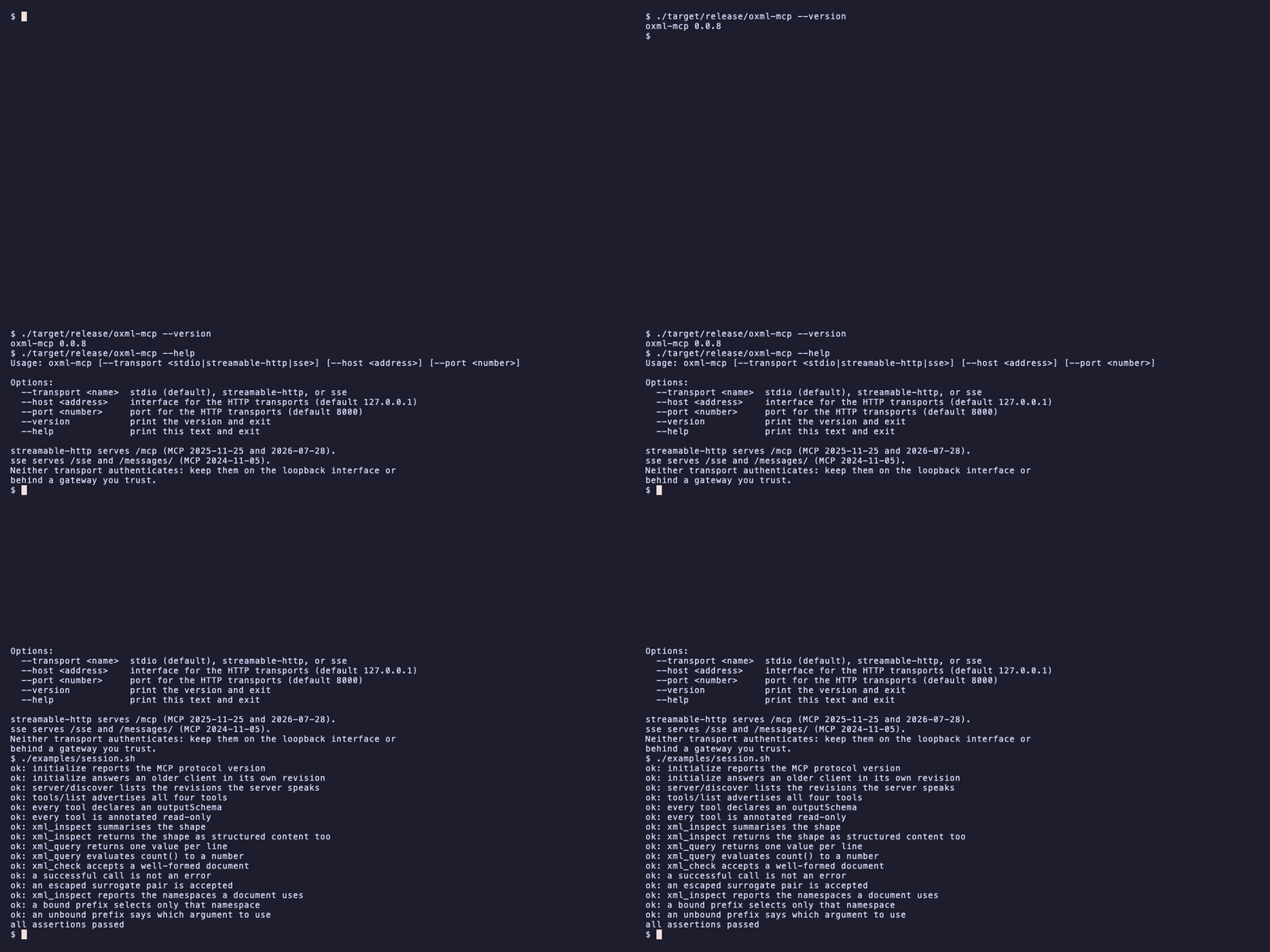
examples/ drives the real binary over stdio and asserts
the responses, so the invocations in this README fail CI when they stop
being true.
| Example | What it shows |
|---|---|
session.sh | A full session: initialise, list, call each tool |
errors.sh | Malformed documents, bad expressions, protocol errors |
When not to use oxml-mcp
- The document fits in context. Paste it; a tool round-trip is slower and adds nothing.
- You need the model to write XML. These tools read.
- You need XSLT or XPath 2.0. Neither is available.
- The document is larger than memory. It is parsed in full.
- You want the server to fetch documents. It never will; that is the point.
FAQ
Why does the model have to pass the whole document every time?
Because the server holds no state between calls. That keeps it correct when several clients share one binary, and it means there is no cache to invalidate or leak between sessions.
For a large document this is genuinely wasteful, and a future release
may add a handle-based flow. Until then, xml_inspect once and a
precise xml_query beats several exploratory ones.
Can it read a file from disk?
No, and it will not be able to. The server takes document contents. A server that took paths would let any model with access to it read any file the server process can — the client is where that decision belongs.
Is it safe to point at untrusted XML?
Yes. External entities are never dereferenced, so a document
containing <!ENTITY xxe SYSTEM "file:///etc/passwd"> cannot make the
server read that file. Entity expansion and nesting depth are bounded.
Why are there only five tools?
Every tool's description occupies context on every request. Five broad tools cost less than twenty narrow ones and cover the same ground, because XPath is already a query language.
Does it work with clients other than Claude?
It implements MCP with no client-specific behaviour, over stdio and both HTTP transports, so any compliant client should work. It is checked against the Python SDK's client over both HTTP transports and scores 100/100 with an independent MCP auditor in both current protocol eras.
My document contains an emoji and the call failed.
That was a bug, fixed in 0.0.3. Python's json.dumps escapes non-ASCII
by default, so an emoji arrives as a surrogate pair — 😀 —
and the JSON parser rejected escaped surrogate pairs. Any Python client
sending an emoji hit it.
How do I query a document with namespaces?
Pass them with the query:
{"name":"xml_query","arguments":{
  "xml":"…","xpath":"//m:item","namespaces":{"m":"urn:example"}}}
A prefix resolves against these bindings, not against the document,
so the same expression works across documents that spell the prefix
differently — only the URI has to match. An unbound prefix is an error
that names the argument to pass and points at xml_inspect.
xml_inspect reports the namespaces a document uses, which is what
makes the argument usable: a model cannot bind a URI it cannot see.
Namespaces (pass these to xml_query as `namespaces`):
  urn:example: 12 element(s)
An unprefixed name test matches only nodes in no namespace, which
is what XPath 1.0 specifies. namespace-uri() still works and needs no
binding.
What happens if the model sends invalid JSON?
A JSON-RPC parse error, -32700. The server does not exit; the next
line is read as normal.
Why is an unknown tool isError rather than a JSON-RPC error?
Until 0.0.8 it was -32602. In the stateless HTTP revision the SDK
carries that code as an HTTP 400, which a client reports as a
transport fault and a model never reads. A model that misspelt a tool
name is better served by text naming the five tools that exist. See
Protocol.
Development
./scripts/gate.sh
That runs everything CI runs, in the order that fails fastest: format,
clippy, tests, rustdoc, the #![forbid(unsafe_code)] check, the
examples, the 95% coverage floor and an MSRV build. It pins the
toolchain rather than trusting rust-toolchain.toml, because a
RUSTUP_TOOLCHAIN in the environment silently overrides that file and
a lint that exists in one release and not another then makes a green
local run and a red CI one.
The individual steps, if you want them one at a time:
cargo test --all-features
cargo clippy --all-targets --all-features -- -D warnings
cargo fmt --all --check
cargo bench --bench protocol
OXML_MCP="$PWD/target/release/oxml-mcp" ./examples/run-all.sh
CI runs the same set on Linux, macOS and Windows.
Security
The tools never open a file or a socket. External entities are never
dereferenced. Entity expansion and recursion are bounded.
#![forbid(unsafe_code)]. The HTTP listeners exist only when asked
for on the command line, bind loopback by default, and do not
authenticate — see Transports.
The threat model is that both the document and the JSON around it are hostile — the document because a model was asked to look at something from the internet, and the JSON because it is the program's entire input. See https://github.com/sebastienrousseau/oxml/blob/main/doc/SECURITY-MODEL.md.
Documentation
- API documentation
- BENCHMARKS.md
- PROTOCOL.md
- Architecture decision records
- TOOL-DESIGN.md
- SECURITY-MODEL.md
- TESTING.md
- CHANGELOG.md
- CONTRIBUTING.md
- SECURITY.md
Acknowledgements
oxml-mcp exists because of work that came before it:
- Anthropic — for the Model Context Protocol specification this server implements.
- lxml and libxml2 — the reference for what an XML toolkit should offer, and decades of hard-won correctness.
- W3C — for the
XPath 1.0 specification that
xml_queryfollows.
License
Dual-licensed under either the Apache License, Version 2.0 or the MIT License, at your option.