
Tickscope MCP
Real-time, free crypto market data for any AI agent — via MCP.




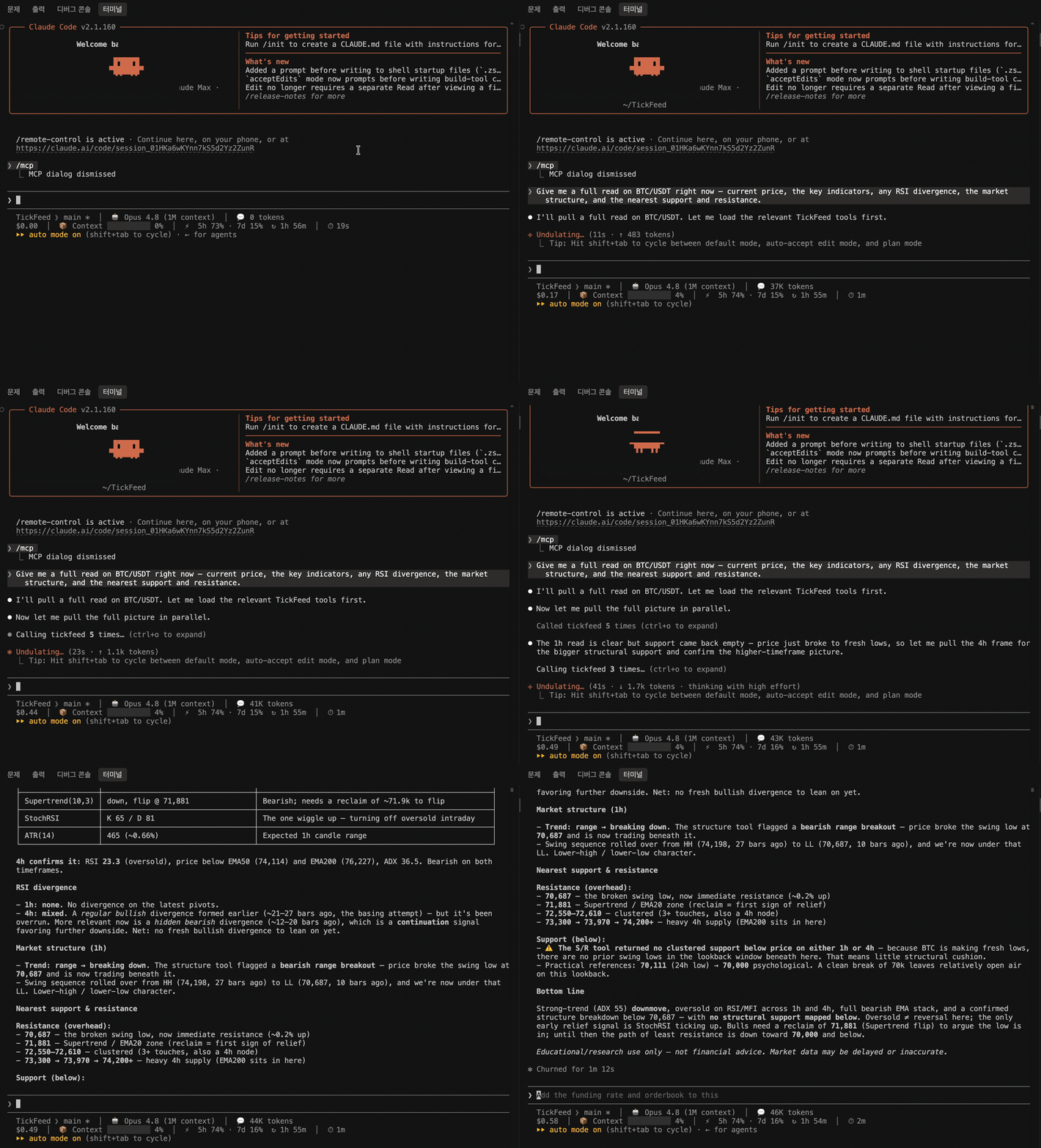
Tickscope is a self-hostable Model Context Protocol server that gives any MCP client (Claude Code, Cursor, Codex, Gemini CLI, …) real-time and historical crypto market data for free. It keeps exchange WebSocket connections warm in the background, so your agent reads prices that are fresh to the sub-second, straight from a live connection. The same server covers 73 technical indicators and chart-structure recognition, with no API keys.
⚠️ Educational/research tool. It does not provide financial, investment, or trading advice, and it does not guarantee data accuracy or timeliness.
Contents
- Why · See it run · 30-second install
- Supported exchanges · Tools · Indicators · Structure recognition
- Example prompts · Configuration · Development · Roadmap
Why
Trading agents are exploding, yet their data layer stays fragmented, REST-poll-only, and often locked behind a paywall. Tickscope gives those agents real-time, free market data from one server — many exchanges, no API keys.
See it run
uv run examples/demo.py            # live BTC/USDT walkthrough (no API keys)
uv run examples/demo.py ETH/USDT 4h
A colorized terminal walkthrough — cold→warm freshness (REST → WebSocket), indicators with signals, divergence, market structure, and support/resistance — against live Binance/Bybit/OKX. See examples/RECORDING.md to turn it into the GIF above.
30-second install
uvx tickscope-mcp
Register it with your client (Claude Code example, examples/claude_code_config.json):
{
  "mcpServers": {
    "tickscope": {
      "command": "uvx",
      "args": ["tickscope-mcp"],
      "env": {
        "TICKSCOPE_EXCHANGES": "binance,bybit,okx",
        "TICKSCOPE_DEFAULT_EXCHANGE": "binance"
      }
    }
  }
}
Cursor, Codex and Gemini CLI use the same command/args/env shape in their respective MCP config files.
Supported exchanges
| Exchange | REST | WebSocket |
|---|---|---|
| Binance | ✅ | ✅ |
| Bybit | ✅ | ✅ |
| OKX | ✅ | ✅ |
Any ccxt-supported exchange can be enabled via TICKSCOPE_EXCHANGES. Public data only — no keys required.
Tools
| Tool | What it does |
|---|---|
list_exchanges | Configured exchanges + default |
list_symbols | Tradable symbols (filter by quote/search) |
get_ticker | Current price snapshot (primary quote tool) |
get_recent_trades | Recent executed trades from the live buffer |
get_ohlcv | Historical candles (DuckDB-cached) |
get_orderbook | Order book snapshot + spread |
compute_indicators | 73 indicators (RSI/MACD/Supertrend/WaveTrend/Squeeze/…) with derived signals |
detect_divergence | Regular/hidden bullish & bearish divergence (price vs oscillator) |
detect_cross | Pine-style ta.crossover/ta.crossunder between any two series |
detect_patterns | Candlestick patterns (engulfing, hammer, stars, …) with bias |
analyze_structure | Market structure: swings, trend, BOS / CHoCH |
find_support_resistance | Clustered support/resistance zones from pivots |
deep_analyze | Multi-timeframe read: trend confluence + market-state context + historical signal performance, with a synthesized verdict |
screen_market | Scan many symbols by indicator/price filters |
get_aggregated_price | Volume-weighted price + cross-exchange spread (arbitrage) |
get_funding_rate | Perpetual funding rate |
watch_symbol | Pre-warm a live subscription (optional) |
get_watched_symbols | Active subscriptions + buffer state |
server_status | Health / diagnostics |
Every market-data response includes source (websocket|rest), age_ms, and timestamp so the freshness is always provable.
Indicators (73)
- MAs / overlays:
sma ema wma smma dema tema hma vwma zlema alma kama trima lsma vidya t3 vwap vwapbands bbands donchian keltner supertrend ichimoku psar - Momentum:
rsi stochrsi macd ppo stoch cci willr roc mom tsi ao cmo uo dpo trix coppock kst fisher rvi mfi wavetrend squeeze qqe crsi stc elderray zscore linregslope - Volatility:
atr natr stdev hv chop ulcer massindex - Volume:
obv adl cmf chaikinosc eom fi pvt vo klinger - Trend:
adx dmi aroon vortex - Structure:
heikinashi pivots
Specs are "name:p1,p2" and also accept Pine Script syntax — ta.rsi(14), ta.ema(20), ta.wt(10,21), ta.sqz — so TradingView users can paste familiar expressions. Derived signals include overbought-oversold state, MACD/PPO/WaveTrend/QQE cross, zero-line cross for oscillators, Supertrend/PSAR direction & flip, squeeze on/off, DMI/Heikin-Ashi trend, and Ichimoku cloud position. Includes crypto/Pine favorites (WaveTrend, TTM Squeeze, QQE, Connors RSI, Schaff Trend Cycle, VIDYA, T3). Adding a new indicator is a one-line REGISTRY declaration.
Structure recognition
On top of numeric indicators, Tickscope describes what the chart is doing: detect_patterns names candlestick patterns (engulfing, hammer/hanging man, doji family, morning/evening star, three soldiers/crows, …) with their bias; analyze_structure returns swing highs/lows labeled HH/HL/LH/LL, the inferred trend, and Break-of-Structure / Change-of-Character events (SMC-style); find_support_resistance clusters swing pivots into support/resistance zones with touch counts. These give an agent the vocabulary to describe a chart the way a trader would.
Deep analysis
deep_analyze answers a question about a symbol in one call, instead of making the agent chain a dozen tools. It returns:
- Multi-timeframe trend confluence — the same symbol read across a 1d/4h/1h ladder, with whether the timeframes agree or conflict.
- Market-state context — where price sits in its recent range (percentile), the trend state (
trending_up/trending_down/ranging, from ADX + Kaufman efficiency ratio), and the volatility state (from ATR percentile), so a bare "RSI 30" reads against the conditions it showed up in. - Historical signal performance — for the current divergence, the forward-return distribution of every past confirmed occurrence on this symbol/timeframe (count, win rate, median). A strictly causal event study — no look-ahead, no repaint.
- A synthesized verdict — bias, confidence, timeframe agreement, the execution-timeframe market state, and explicit caveats, all computed deterministically in Python so the call never hinges on the model eyeballing raw numbers.
compute_indicators now carries the same market-state context inline (it's ~free), and signal history is memoized per closed bar, so warm reads stay fast. Clients that support MCP prompts expose this as a slash command — /mcp__tickscope__deep_analyze (symbol + timeframe) — to trigger a full read on demand.
Resources
Supporting clients can also read live state as MCP resources: tickscope://status, tickscope://watched, and the template tickscope://ticker/{exchange}/{symbol}.
Example prompts
- "What's BTC/USDT trading at on Binance right now, and the 24h change?"
- "Should I care about this SOL/USDT setup? Do a deep, multi-timeframe read."
- "Is there an RSI divergence on BTC/USDT 4h — and how has that signal performed on this pair before?"
- "Screen the top 50 USDT pairs by volume for ones with RSI below 30."
- "Map the key support/resistance on ETH/USDT 4h and tell me if the structure just broke (BOS/CHoCH)."
- "What's the perpetual funding rate for BTC on Bybit right now — is it overheated?"
- "Compare BTC/USDT across Binance, Bybit and OKX and show the arbitrage spread."
See examples/demo_prompts.md for a fuller recipe book (deep analysis, signal backtests, screening, monitoring, strategy checks).
Configuration
All settings are environment variables (see .env.example):
| Variable | Default | Description |
|---|---|---|
TICKSCOPE_EXCHANGES | binance,bybit,okx | Enabled exchanges (comma-separated) |
TICKSCOPE_DEFAULT_EXCHANGE | binance | Default when exchange is omitted |
TICKSCOPE_MAX_WATCHED_SYMBOLS | 25 | Max concurrent WS subscriptions (LRU evicted) |
TICKSCOPE_RING_BUFFER_SIZE | 1000 | Per-symbol trade buffer size |
TICKSCOPE_OHLCV_CACHE_PATH | ~/.tickscope/ohlcv.duckdb | DuckDB cache file |
TICKSCOPE_OHLCV_CACHE_TTL_S | 60 | Freshness window for the newest candle |
TICKSCOPE_REST_RETRIES | 3 | Retry attempts for transient REST errors (rate limit / network) |
TICKSCOPE_SCREEN_CONCURRENCY | 5 | Max concurrent symbols during screening/aggregation |
TICKSCOPE_TRANSPORT | stdio | stdio or http |
TICKSCOPE_LOG_LEVEL | INFO | Log level |
Development
uv venv && uv pip install -e ".[dev]"
pytest                # ~100 unit + MCP-integration tests (live excluded)
pytest -m live        # live exchange tests (Binance/Bybit/OKX, run locally)
ruff check . && mypy  # lint + type gates
Tests cover indicator math against reference values, service cache/auto-watch logic, the full MCP tool path (tests/test_mcp_integration.py calls tools through mcp.call_tool), price-structure recognition, and a live suite that exercises the whole stack against real exchanges. See CONTRIBUTING.md for the project layout and contribution flow.
Roadmap
- Pine Script-style indicator mapping (
ta.rsi,ta.crossover, …) - 73 indicators + candlestick patterns + market structure (BOS/CHoCH)
- Multi-exchange aggregation (weighted price / spread)
- MCP resource push for watched symbols
- Anchored / session VWAP
- More exchanges (Kraken, Bitget, Gate, …)
- Agent Skill (
SKILL.md) wrapper
Contributing
Issues and PRs welcome — see CONTRIBUTING.md and our Code of Conduct. Keep dependencies minimal and the v1 scope read-only (public data, no order execution, no API secrets).
License
MIT © Tickscope contributors.
Disclaimer
This tool is for educational and research purposes only. It is not financial, investment, or trading advice. Market data may be delayed, incomplete, or inaccurate; do not rely on it for real trading decisions. Respect each exchange's terms of service and rate limits. See SECURITY.md.