
CliDeck MCP
Verifiable external memory for AI agents
CliDeck MCP is an open-source framework for building verified, continuously updated knowledge systems that AI agents can access through MCP.
Built with Codex and GPT-5.6. Codex was the primary engineering environment for the project, while GPT-5.6 Luna powers its asynchronous knowledge-growth pipeline. Published answers remain deterministic and do not call a model at read time.
A model should not have to memorize every version of every technical manual. It needs strong fundamentals, reasoning ability, and the ability to use tools. Exact, specialized, and rapidly changing facts can live in an external knowledge system and be updated without retraining the model.
CliDeck MCP implements this architecture:
- known questions are answered deterministically, without calling an AI model;
- unknown questions become high-priority learning tasks;
- Codex and GPT-5.6 discover and analyze official documentation;
- independent validation passes check applicability and quality;
- new knowledge is published as immutable revisions;
- published knowledge is immediately reusable without AI.
Network Knowledge is the first production Domain Pack. Engineering Measurements demonstrates that the same core can support other technical and scientific domains.
- Public MCP:
https://mcp.clideck.com/mcp - Live read-only demo:
https://mcp.clideck.com/demo - WebMCP Network Change Room:
https://mcp.clideck.com/webmcp - Product page:
https://clideck.com/software/mcp - Code license: Apache-2.0
The WebMCP Challenge extension
CliDeck MCP existed before The WebMCP Challenge. The immutable knowledge system, public MCP endpoint, version-aware network tools, change review, snapshot redaction, signed verification, continuous research pipeline, and operations console are pre-existing capabilities.
The Network Evidence Workbench was added after August 25, 2026 specifically for the challenge. It gives a person and a browser agent the same live, revision-safe workspace for examining real device output and finding sourced answers in CliDeck.
What is new
- a separate public
/webmcpexperience that leaves/adminand/demounchanged; - six stable browser-native WebMCP tools for reading the current case, detecting context, searching knowledge/workflows, presenting agent analysis, and tracking additional research;
- local text and text-layer PDF extraction with visible page/line selection, explicit limits, and secret redaction before any network request;
- a monotonic
case_versionand abort propagation so a late response can never overwrite a case the user has changed; - active-revision provenance beside official CliDeck results and a visually separate browser-agent interpretation;
- ordinary buttons for every primary action, so the product remains useful in browsers without WebMCP.
Judge walkthrough
- Open
https://mcp.clideck.com/webmcpin ChatGPT's in-app browser, or in Chrome 149+ withchrome://flags/#enable-webmcp-testingenabled. - Load the labelled Cisco Catalyst 9300 IOS XE 16.10 sample, analyze it, and search for the applicable upgrade procedure.
- Enable Share redacted evidence with browser agent and ask the agent to explain the current sourced result.
- Replace the sample with IOS XE 17.8.1. Observe the new context and
case_version, then search again for the EFSU-capable path. - Upload a text-layer PDF or LOG, select the relevant page/line window, and repeat the flow.
- Ask a genuinely unknown question and start a real tracked research task.
The page never connects to a device and never executes a command. Complete files stay in browser memory. Only the selected, locally redacted window is sent to CliDeck; browser-agent access requires one explicit opt-in. IP, MAC, hostname, and username values are intentionally preserved as diagnostic context and disclosed in the interface.
Why this project exists
A general-purpose model may understand networking fundamentals while still having outdated or incomplete knowledge about exact commands, operating-system versions, restrictions, and operational procedures. Reading hundreds of manuals during training does not guarantee a precise answer for a particular device and software release.
CliDeck MCP separates responsibilities:
- the model understands the question, reasons, and selects the appropriate tool;
- MCP stores exact, structured, and version-aware knowledge;
- a Domain Pack enforces the rules of its subject area;
- the core manages publication, history, trust, conflicts, and rollback.
This architecture may reduce the need to encode every version of specialized documentation directly into model weights. We do not claim proven pretraining cost reductions; that would require separate experiments. The practical benefit already exists: exact knowledge can be validated and updated independently of the model.
What makes CliDeck MCP different
Deterministic answers
A known question does not invoke an LLM. PostgreSQL performs version-aware retrieval, the Domain Pack validates the result, and MCP returns a structured answer.
Known answers are therefore:
- fast;
- repeatable;
- inexpensive;
- verifiable;
- independent of model-generation variance.
If applicable knowledge is unavailable, the system returns unknown instead
of guessing.
Learning from unknown questions
An unknown question becomes a maximum-priority knowledge demand:
Unknown question
      ↓
Official-source discovery
      ↓
Download and deterministic conversion
      ↓
Chunking and extraction
      ↓
Independent verification and Deep Review
      ↓
Immutable publication
      ↓
Instant deterministic reuse
A demand is considered learned only after the same deterministic query finds an active published revision.
A continuously running Codex knowledge factory
The pipeline runs continuously while enabled. Mechanical stages do not consume AI tokens:
- downloading;
- PDF, HTML, and text conversion;
- OCR;
- chunking;
- hashing;
- indexing;
- publication.
GPT-5.6 Luna runs through isolated, ephemeral Codex sessions and is used only for work that requires semantic reasoning:
- discovering official sources;
- analyzing ambiguous material;
- independent verification;
- Deep Review;
- expert tasks.
Up to eight isolated executors lease work atomically. The pipeline can be paused and resumed without duplicating tasks or published knowledge. Routine discovery, analysis, verification, and Deep Review use GPT-5.6 Luna with low reasoning effort. Medium reasoning is reserved for unresolved Deep Review cases, rather than being spent on every record.
No separate model API integration required
The pipeline can run through an existing authenticated local Codex installation.
Runs through your existing local Codex setup. No separate model API integration is required. Subject to your Codex plan and usage limits.
This allows developers to use available capacity in their Codex plan to grow a private or public knowledge system without first integrating and funding a separate model API.
This is an operating option, not a promise of free or unlimited usage.
How Codex and GPT-5.6 were used
Codex was not added at the end as a code-generation demo. It was the primary engineering workspace and collaborator throughout the project, from the first architecture decisions to the running production system.
During development, Codex and GPT-5.6 were used to:
- translate product goals into the MCP, worker, researcher, and admin architecture;
- define trust boundaries, immutable revision contracts, release rollback, and privacy controls;
- implement the TypeScript services, PostgreSQL migrations, Domain Pack SDK, scaffolder, and local operations dashboard;
- design and test the continuous multi-executor pipeline;
- build security tests, deterministic evaluations, browser tests, and production smoke checks;
- inspect real pipeline telemetry and correct throughput, reliability, and data-conservation defects;
- create the canonical backup, migration, deployment, health-check, and rollback workflow.
Codex and GPT-5.6 are also part of the product's operation:
- A known question is answered by deterministic PostgreSQL retrieval and Domain Pack validation, with no model call.
- An unknown question creates a prioritized learning demand.
- Isolated Codex executions pinned to GPT-5.6 Luna
(
gpt-5.6-luna) discover official material, analyze ambiguous fragments, verify candidates, and perform Deep Review. - The core—not the model—enforces schemas, applicability, risk, conflicts, provenance, confidence, and immutable publication.
- Once published, the new answer becomes instantly reusable without another GPT-5.6 call.
This separation is deliberate: Codex and GPT-5.6 propose and review new knowledge; the deterministic core decides what is allowed to become active knowledge. CliDeck MCP is therefore not a wrapper that asks an LLM a question and trusts whatever text comes back.
Universal Domain Packs
CliDeck MCP is not limited to network equipment. Subject-specific behavior lives in Domain Packs.
The core owns:
- immutable revisions;
- releases and rollback;
- provenance;
- confidence thresholds;
- conflict handling;
- audit;
- publication policy.
A Domain Pack defines:
- domain context;
- record types;
- data schemas;
- normalization;
- deterministic validation;
- mapping into a universal knowledge revision.
Developers can scaffold their own pack:
pnpm domain:create -- --id marine-science --name "Marine Science"
pnpm domain:validate -- --id marine-science
The scaffolder creates a manifest, schemas, mapper, fixtures, and tests. Codex and GPT-5.6 can help adapt a fork to a new subject without rewriting the trusted publication and release core.
Optional providers can add object storage, spatial data, relation graphs, or domain-specific laboratory validation.
Network Knowledge
The first production pack stores network knowledge with explicit context:
- vendor;
- product family and model;
- operating system;
- version scope;
- CLI mode;
- risks and prerequisites;
- verification;
- rollback;
- limitations and conflicts.
The public MCP supports:
- device-context resolution;
- command and diagnostic retrieval;
- complete operational workflows;
- expert research tasks;
- CLI snapshot detection and redaction;
- planned-change review;
- post-change verification;
- upgrade guidance;
- CDP, LLDP, route, traceroute, and topology analysis;
- generic queries across other Domain Packs.
Dangerous commands are not hidden. The system returns the available information while clearly explaining risk, prerequisites, verification, and rollback.
Portable software is resolved independently from hardware vendor identity.
ONIE, SONiC, OpenWrt, Debian/Linux tooling, and Cumulus Linux/NVUE knowledge
can therefore be reused across documented platforms. Model and vendor overlays
still take precedence over family-wide records. NX-OS, IOS-XE, Cumulus, and
OpenWrt use explicit version-branch rules: an exact or bounded record wins,
and a nearby patch in the same branch is returned only as a labelled
best-effort fallback. Hardware-sensitive generic answers remain complete but
carry requires_platform_confirmation and a stop condition.
Existing immutable revisions are indexed without rewriting their content or FTS data:
pnpm knowledge:reindex-applicability -- --resume --verify
The command is batched, resumable, checksum-recorded, and idempotent.
CliDeck MCP provides guidance but never connects to a network device and never executes commands.
Verifiable knowledge
Every published revision must pass:
- Domain Pack schema validation;
- applicability and version checks;
- deterministic risk classification;
- conflict detection;
- confidence and quality thresholds;
- internal provenance validation;
- additional requirements for dangerous procedures.
An official vendor document is sufficient evidence when a specific fragment directly supports the published claim.
Published revisions are immutable. Updated information creates a new revision, while releases allow the active knowledge state to be switched or rolled back atomically.
Simple infrastructure
PostgreSQL acts as:
- the knowledge store;
- the full-text search engine;
- the task queue;
- the lease manager;
- the revision store;
- the release engine;
- the audit store.
Redis, a vector database, and an external model API are not required dependencies.
Privacy and security
Public MCP responses never expose:
- source URLs;
- manual titles;
- evidence fragments;
- internal source IDs;
- acquisition-pipeline details;
- credentials or access tokens.
Minimal internal provenance remains available to the local super_admin for
verification and audit.
Raw CLI is processed in memory. A user example is stored only after explicit opt-in, redacted again, isolated, and automatically removed after its retention period. It is never published automatically.
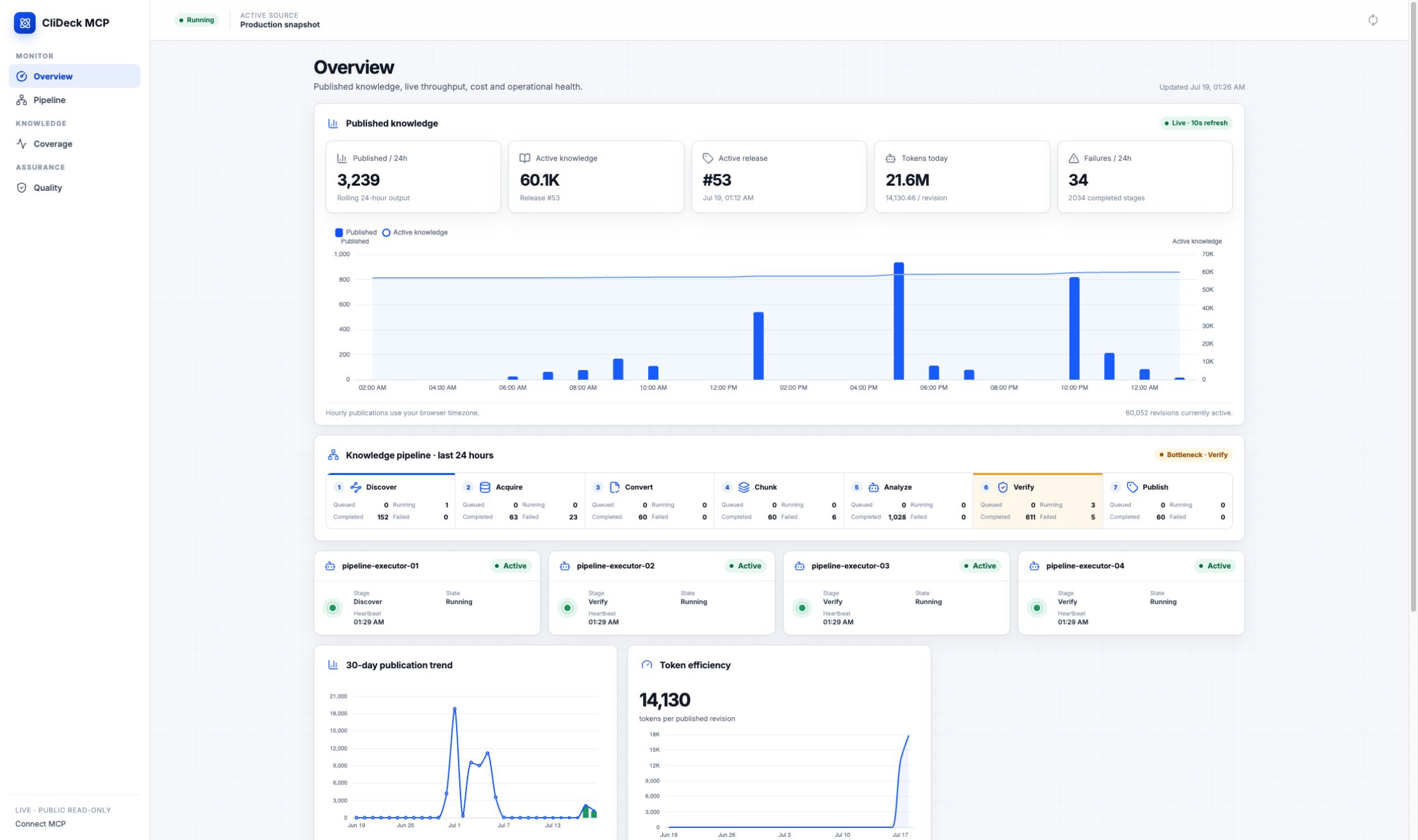
A truthful public demo
https://mcp.clideck.com/demo is not a mock dashboard or a separate marketing
implementation.
The demo uses:
- the same React frontend;
- the same pages;
- the same components;
- the same charts and tables;
- real production counters;
- real pipeline and executor states;
- the same administrative dialogs.
The only differences are enforced by the public_demo role:
- source identity and private values are replaced server-side with
XXXXXXXX; - final mutations are not sent;
- the database, pipeline, and releases cannot be changed.
Sensitive values are removed by the server, not hidden with CSS blur.
Current status
The production instance contains more than 66,000 active knowledge revisions. Live statistics and current pipeline activity are available in the public demo.
The product evaluation suite contains 250 deterministic scenarios. The current result is:
- 250 passed;
- 0 failed;
- 0 dangerous false-safe results.
Deep Network Pack coverage is currently concentrated on Cisco Catalyst and
IOS-XE. Other vendors can be recognized, but their verified knowledge coverage
varies. The system prefers to return a limitation or unknown rather than
generate an unsupported answer.
Production knowledge and third-party documents are not distributed with the open-source repository. The repository contains the framework, schemas, scaffolder, tests, and only project-authored or explicitly permitted fixtures.
Connect
Add the hosted MCP server to Codex:
codex mcp add clideck --url https://mcp.clideck.com/mcp
codex mcp list
Run a local instance:
cp .env.example .env
pnpm install --frozen-lockfile
docker compose up -d postgres
pnpm db:migrate
pnpm db:seed
pnpm build
pnpm dev:api
The local MCP endpoint is:
http://127.0.0.1:8787/mcp
CliDeck MCP uses Streamable HTTP and is not limited to CliDeck or Codex clients. Any compatible MCP client can connect to it.
Create your own Domain Pack
pnpm domain:create -- --id marine-science --name "Marine Science"
pnpm install --lockfile-only
pnpm domain:validate -- --id marine-science
pnpm --filter @clideck/domain-marine-science test
Read the detailed guides:
License and data
Apache-2.0 applies to the source code and project-authored sample fixtures.
It does not automatically grant rights to:
- third-party documents;
- production knowledge;
- private manuals;
- user data;
- datasets imported by an operator.
See DATA-NOTICE.md for details.