Listed from the MCP registry; nobody on Odel publishes it.
Deprecated. Deprecated by the publisher: Moved to com.soflution/memorypilot




MemoryPilot
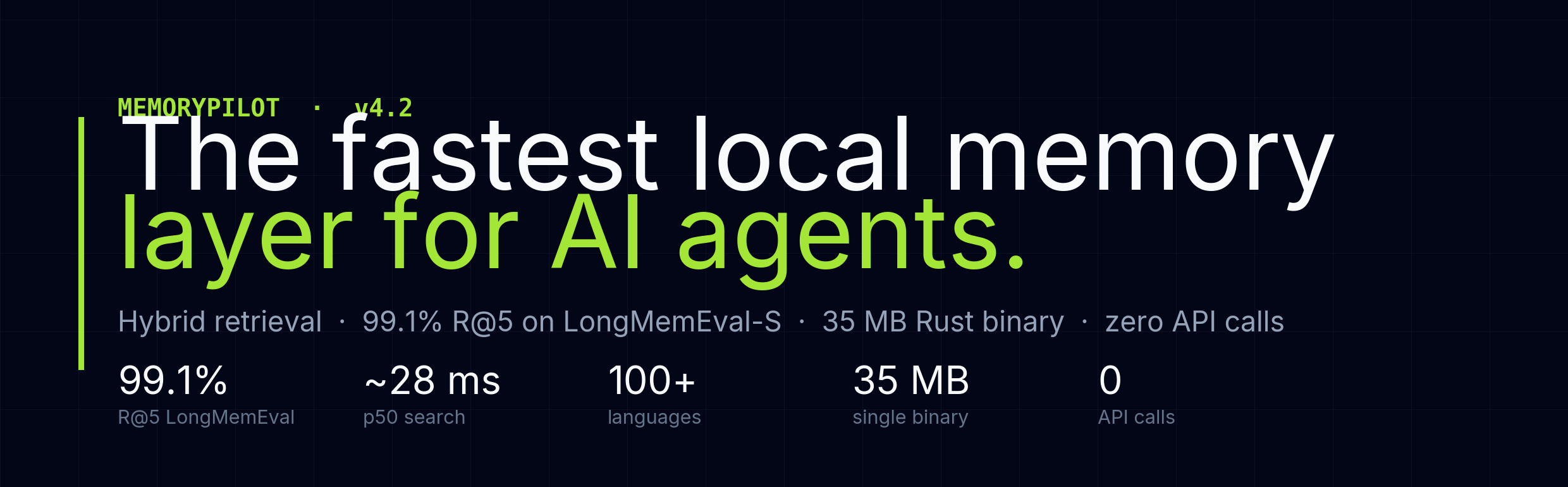
Long-term memory for AI agents: fast recall, project brains and skills, local, in one binary.
Runs on your machine from its package; the steps are below.
What it does
- Reads
- Writes
- High impact
At most: creates or changes data: records, files, settings.
What it costs
FreeOdel charges nothing per call. The publisher may charge for its own service.
Runs locally over stdio
This server isn't hosted — your MCP client launches it from a package registry. Use one of the commands below, or drop the config into your client (e.g. Claude Desktop).
Distributed as an MCP bundle (`https://github.com/Soflutionltd/MemoryPilot/releases/download/v4.10.0/memorypilot.mcpb`) — download it and import the bundle in your MCP client.
The most advanced MCP memory server. Period.
Hybrid search (BM25 + jina-embeddings-v5 RRF + cross-encoder rerank) · 100+ languages · Temporal Knowledge Graph · Query-aware ranking · Corpus origin detection · Agent/persona disambiguation · Topic tunnels · AAAK compression (5-10x token savings) · GraphRAG · Chunked RAG · Auto-Compaction · Auto-Classification · Memory Capsules · HTTP API · Signed automatic updates · Single binary · Zero API calls







Why
AI coding assistants forget everything between sessions. MemoryPilot gives them persistent, searchable memory with project awareness, semantic understanding, and automatic knowledge organization. Built-in AAAK compression and memory capsules reduce token consumption by 5-10x when loading context. Every memory is auto-classified with the right importance, kind, and TTL on insert. The database compacts itself automatically — zero maintenance.


Benchmarks
LongMemEval-S (ICLR 2025) — Academic Standard
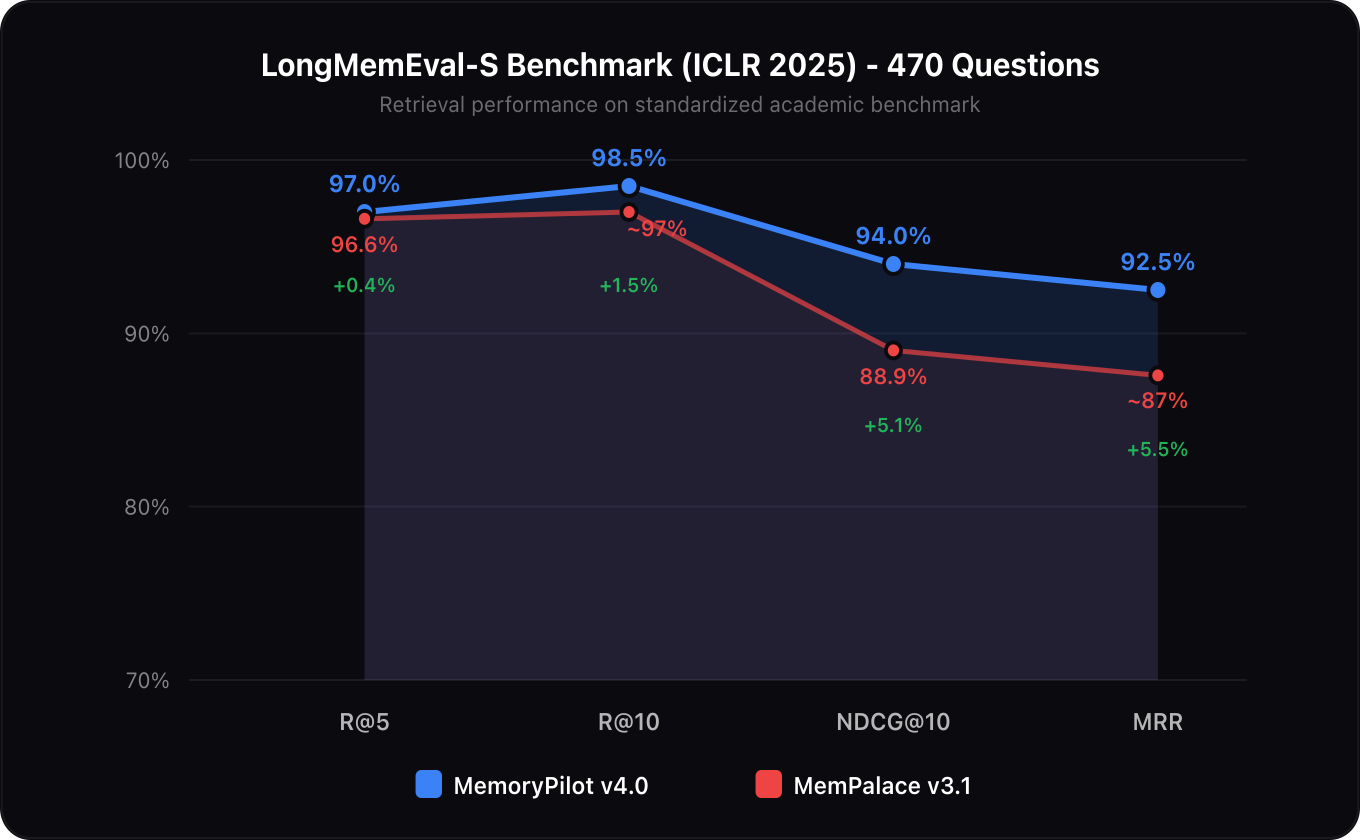
Evaluated on the 470 answerable questions of LongMemEval-S (ICLR 2025; the 30 abstention questions are left out, as the official retrieval protocol does). Turn-level index, ~50 sessions per haystack.
What the score measures. R@5 here is session-level recall_any@5: a question counts as a hit when at least one of the top 5 retrieved turns belongs to one of its gold sessions. It is a retrieval metric, not answer accuracy, and a question that needs several sessions counts as a hit as soon as one of them is found (300 of the 470 questions have more than one gold session). For scale: a plain BM25 over turns, with no embeddings, scores about 93% on the same metric and 74% on recall_all@5. These figures were measured with v4.2 (multilingual-e5-small); the current default model has only been measured on a 100-question slice (see v4.6 below).
Retrieval scores (same metric family, setups differ)
| System | R@5 (recall_any, session level) | Notes | Source |
|---|---|---|---|
| MemoryPilot v4.2 (adaptive rerank) | 99.1% | 470 questions, ~900 ms/query on an M-series Mac | This repo, --benchmark-longmemeval |
| MemoryPilot v4.2 (rerank off) | 98.7% | 470 questions, ~28 ms/query with MEMORYPILOT_CROSS_RERANK=off | This repo, --benchmark-longmemeval |
| MemPalace v3.12.0 (hybrid) | 98.4% | 450 held-out questions after tuning on 50; 96.6% raw on 500 | MemPalace README, read 2026-11-16 |
| ICM v0.11.5 | 97.4% | 500 questions (487 hits), no LLM, one memory per session | rtk-ai/icm README, read 2026-11-16 |
| agentmemory v0.9 | 95.2% | 500 questions (abstention included), all-MiniLM | github.com/rohitg00/agentmemory benchmark/LONGMEMEVAL.md |
| mcp-memory-service v10.34.0 | 80.4% | labelled R@5; hit definition not stated | v10.34.0 release notes |
Answer accuracy (a different metric: an LLM reads the retrieved context and a judge grades the answer)
| System | QA accuracy | Context per question | Setup | Source |
|---|---|---|---|---|
| Recallium (closed) | 98.4% | 12,600 tokens | Claude Opus 5.5 in an agentic harness, gpt-4o judge, whole sessions as the retrieval unit | recallium.ai/benchmarks, read 2026-11-17 |
| MemoryPilot | 97.2% (486/500) | 6,047 tokens | Claude Opus 5.5 as reader, gpt-4o-2024-08-06 judge, one search per question, no LLM call at write time | This repo, benchmarks/results/longmemeval-s |
| Maximem Synap | 95.6% | 7,400 tokens | Gemini 3.8 Flash as reader, gpt-4o judge | maximem.ai/evals, read 2026-11-17 |
| Mastra (observational memory) | 94.87% | not published | see source | mastra.ai research, read 2026-11-17 |
| Hindsight | 94.6% | not published | see source | vectorize-io/hindsight-benchmarks, read 2026-11-17 |
| Mem0 (managed platform) | 94.4% (472/500) | not published | Mem0's own suite, top-200 retrieval; reader and judge not stated on the page | mem0ai/memory-benchmarks, read 2026-11-16 |
| Zep (cloud, 2026) | 90.2% (451/500) | 4,408 tokens (median) | gpt-5.4 as reader and as judge | getzep.com research, read 2026-11-16 |
| Zep / Graphiti (2025 paper) | 63.8% / 71.2% | not published | gpt-4o-mini / gpt-4o as reader, GPT-4o judge | arXiv 2501.13956, Table 2 |
| Supermemory | 85.2% / 84.6% | not published | gemini-3-pro / gpt-5 as reader, LongMemEval-S, 500 questions | supermemory.ai research, read 2026-11-16 |
MemoryPilot's end-to-end run (2026-11-18, compact search as released in v4.14.0). All 500 questions, abstention included. MemoryPilot indexes each haystack turn by turn with no LLM call, answers one search_memory per question, and the 50 turns it returns go to the reader in the official LongMemEval prompt (run_generation.py, chain of thought on). The official judge prompts (evaluate_qa.py) grade the answers with gpt-4o-2024-08-06 at temperature 0. The search is a compact one: assistant turns ranked after the third are cut to 150 characters, which keeps the prompt at 6,047 tokens per question (measured: 3,023,706 prompt tokens over 500 questions).
| Question type | Correct |
|---|---|
| knowledge-update (78) | 76 |
| multi-session (133) | 124 |
| single-session-assistant (56) | 56 |
| single-session-preference (30) | 30 |
| single-session-user (70) | 69 |
| temporal-reasoning (133) | 131 |
| All (500) | 486 (97.2%) |
| of which abstention (30) | 27 |
Every answer and every verdict is in benchmarks/results/longmemeval-s: the run itself (search metrics, the reader's 500 answers, token counts) and the same answers graded by the official judge. The folder also holds an earlier run with the 50 turns returned whole (485/500 at 15,497 tokens per question). The dataset is LongMemEval (MIT). To reproduce, with an API key in MEMORYPILOT_LLM_API_KEY:
MemoryPilot --benchmark-longmemeval benchmarks/longmemeval_s_cleaned.json --e2e --cot --answer-max-tokens 1500 --context-turns 50 --compact --llm-base-url https://api.anthropic.com/v1 --answer-model claude-opus-5-5 --judge-model claude-haiku-5-5 > run.json
MemoryPilot --benchmark-longmemeval benchmarks/longmemeval_s_cleaned.json --rejudge run.json --llm-base-url https://api.openai.com/v1 > run-gpt4o.json
Limits of this measure: a single run; the settings (50 turns, cut at 150 characters after rank 3) were chosen on this same question set, not on a held-out split; nobody outside this project has rerun it. The compact mode ships in v4.14.0; the run predates the widening of its candidate pool to 100, which has not been measured end to end.
All figures are published by their own authors, none was reproduced independently, and the two tables cannot be compared with each other. On answer accuracy MemoryPilot is second to Recallium's published score and uses about half its context; on session-level recall MemoryPilot posts the highest published local score, by a margin smaller than the gap between this metric and a plain BM25 baseline. The protocol to settle a comparison: same 470 questions, same hardware, every system run by the same script, reporting
recall_any@5,recall_all@5, turn-level evidence recall and end-to-end QA accuracy with a fixed reader and judge.
What a memory costs (measured, MemoryPilot --footprint)
Quality is one axis. The others decide what a memory costs on every conversation and every write.
| Measure | MemoryPilot v4.14 | How to reproduce |
|---|---|---|
| LLM calls per write | 0 | Dedup, entities, graph links and embeddings run locally |
| LLM calls per search | 0 | Local encoder and reranker |
| Tools exposed, default profile | 25 | --footprint |
| Tool list, default profile | 23,919 characters, about 6,000 tokens | --footprint (tokens estimated at 4 characters each) |
| Tools exposed, full profile | 74 | MEMORYPILOT_TOOLS=full |
| Tool list, full profile | 45,809 characters, about 11,500 tokens | --footprint |
| Server instructions | 2,736 characters, about 680 tokens | --footprint |
| Runtime dependencies | none | One binary; no database server, no API key |
For scale, as published by each project and read on 2026-11-16: Mem0, Zep, Graphiti, Letta, Supermemory and Hindsight call an LLM on every write; MemPalace does not. Tool counts: Cognee 6 by default, Mem0 11, Zep 12, ICM 32, MemPalace 47. Clients that defer tool schemas (Claude Code does by default) mostly pay for tool names and server instructions, so the count matters less there than on clients that load every schema.
Other long-term-memory benchmarks: ICM publishes 92.9% answer accuracy on LoCoMo (1,540 questions, Gemini as reader and judge, source); Mem0 92.5% and Zep 94.7% on LoCoMo, on their own harnesses. MemoryPilot has no LoCoMo runner yet.
Detailed view — MemoryPilot vs MemPalace (closest local competitor)
| Metric | MemoryPilot v4.2 (rerank off) | MemoryPilot v4.2 (adaptive rerank) | MemPalace v3.3.3 | Delta vs MemPalace |
|---|---|---|---|---|
| R@5 | 98.7% | 99.1% | 96.6% raw / 98.4% hybrid | +2.5% vs raw / +0.7% vs hybrid |
| R@10 | 99.6% | 99.4% | ~97%¹ | +2.6% vs raw |
| NDCG@10 | 95.1% | 96.0% | Not published | MemoryPilot publishes |
| MRR | 93.6% | 94.9% | Not published | MemoryPilot publishes |
| Avg search latency | ~28 ms (MEMORYPILOT_CROSS_RERANK=off) | ~900 ms (the default) | N/A | search call only, models warm |
¹ Validated with the full 470-question evaluation set (after dropping the 30 abstention questions) in two modes: hybrid retrieval with the rerank off (BM25 + cosine RRF,
MEMORYPILOT_CROSS_RERANK=off, ~28 ms/query) and the default adaptive cross-encoder rerank (MEMORYPILOT_CROSS_RERANK=adaptive, jina-v2-multilingual, fusion weight 0.45, ~900 ms/query, suitable for benchmarks and high-stakes recall). Latencies cover the search call only, with models loaded; MemPalace's figures come from a different question split.
By Category (470 questions, adaptive rerank)
| Category | R@5 | R@10 | MRR |
|---|---|---|---|
| single-session-user (64) | 100% | 100% | 96.6% |
| single-session-assistant (56) | 100% | 100% | 98.8% |
| multi-session (121) | 100% | 100% | 95.7% |
| knowledge-update (72) | 100% | 100% | 98.2% |
| temporal-reasoning (127) | 97.6% | 98.4% | 93.3% |
| single-session-preference (30) | 96.7% | 96.7% | 75.9% |
French / Multilingual Benchmark — --benchmark-fr
To complement the English-only LongMemEval, MemoryPilot ships its own deterministic French benchmark covering 109 memories and 109 paraphrased queries across infra, mobile, web, security, and ML domains. The queries are intentionally distant from the indexed wording so they actually exercise the semantic lane.
| Mode | R@5 | R@10 | MRR | Avg latency |
|---|---|---|---|---|
| Default fast (BM25 + jina RRF) | 92.7% | 99.1% | 74.4% | ~100 ms |
| Adaptive cross-encoder rerank, mmarco (v4.10) | 99.1% | 99.1% | 97.4% | ~210 ms (Apple Silicon) |
| Adaptive cross-encoder rerank, jina-reranker-v2 (default since v4.11) | 100% | 100% | 98.0% | ~436 ms (2-vCPU Linux VM) |
v4.5 fixed a ranking bug that had capped this benchmark at R@5 ≈ 70% since v4.0: knowledge-graph neighbours were injected at a hard-coded score (0.1) above every genuine RRF hit (max 2/41 ≈ 0.049), so they occupied the cross-encoder window and pushed real matches past limit. Neighbours now enter below the weakest genuine candidate and only the cross-encoder can promote them.
v4.5.0 also closes two write-path stability bugs surfaced by that work: the episodic rollup embedded every hourly bucket on each pass (before checking whether the episode already existed) and did so synchronously inside add_memory, then panicked on multi-byte French text; it now runs on its own thread with a cheap existence check first. And auto-compaction held a Mutex across run_gc/compact_to_capsules, whose merged rows re-enter add_memory — a deadlock hidden until the rollup stopped panicking ahead of it.
Run-to-run variance is bounded to ±1 pp on R@5 / R@10 thanks to deterministic memory ids, deterministic id-based RRF tie-break, synchronous ANN warm-up, and explicit cross-encoder pre-warm before the first query. This is the metric to watch for any French / multilingual regression.
v4.6 — beyond single-fact retrieval
v4.6.0 targets the LongMemEval categories a top-k retriever alone cannot win: multi-session aggregation, temporal reasoning, knowledge updates and abstention. Everything stays local and rule-based or int8 ONNX. Measured on LongMemEval-S@100 (64 single-session + 36 multi-session, plus the 7 abstention questions of that slice) against v4.5.0, same machine, cross-encoder adaptive:
| Metric | v4.5.0 | v4.6.0 |
|---|---|---|
| R@5 / R@10 | 99% / 100% | 100% / 100% |
| MRR / nDCG@10 | 96.3% / 97.2% | 96.5% / 97.3% |
| Multi-session gold coverage@10 | 93.6% | 94.5% |
| Multi-session questions with all gold sessions in top-10 | 30/36 | 32/36 |
| False abstention on answerable questions | — | 4% |
Extractive answer (search_memory … answer=true), contains-gold | — | 48% (72% single-session; counting questions are out of reach for span extraction) |
--benchmark-fr is unchanged within noise (R@1 96.3%, R@5 99.1%, MRR 97.6%).
- MMR diversity (
src/diversity.rs) — the finalists plus the RRF ranks just below them are re-ordered by maximal marginal relevance over their stored vectors (λ = 0.4, redundancy floor 0.55). The top hit never moves, so MRR is untouched; a second, distinct source can displace a restatement of the first.MEMORYPILOT_MMR=0disables it. - Temporal grounding (
src/temporal.rs) — explicit dates in a memory (2026-09-01,12 septembre 2026,September 12,hier…) becomedateentities at ingest; a temporal phrase in the query (last week,il y a deux semaines,en mars,last Tuesday) becomes a day window that boosts dated candidates inside it (×1.25) and mildly demotes dated candidates far outside (×0.85). Undated memories are neutral, so a mis-parsed window costs at most the boost.MEMORYPILOT_TEMPORAL=0disables it. - Contextual embeddings — transcript chunks and other context-poor kinds are embedded with a
[date · project]prefix while the stored content and its hash are left untouched. - Superseding — the daily consolidation pass links a memory to a newer, near-identical restatement with a changed value (cosine ≥ 0.86, lexical overlap 0.55–0.95, ≥ 1 h apart) and the old one is demoted (−0.35) at search time. Both stay retrievable;
consolidate_memories(apply=true)reports the links made. - Calibrated confidence — every search returns
confidence: { top_cosine, peak, cross_score, margin, level, abstain }. On LongMemEval the abstention haystacks are built from the same user's other sessions and no cheap signal separates them from answerable questions (top-1 cosine p50 0.46 vs 0.54, cross-encoder logits overlap fully), so the hardabstainis deliberately conservative (cosine < 0.35, 4% false abstention) andlevelcarries the graded signal.MEMORYPILOT_ABSTAIN_COSINEmoves the floor. - Extractive reader (
src/reader.rs, opt-in) —search_memorywithanswer: truerunsdeepset/roberta-base-squad2(int8 ONNX, 125 MB, English, loaded on demand through the idle pool) over the top-5 passages and returns the literal span or nothing. ~480 ms per question on CPU. It is a benchmarking instrument and a shortcut for literal lookups, not a language model: it abstained on 5/7 LongMemEval abstention questions where the retriever could not.--benchmark-longmemeval --readerreports SQuAD-style EM / F1 / contains.
Search Quality — Real-World (500 memories, 30 scenarios)
| Metric | MemoryPilot v4.2 | MemPalace v3.1 (raw) | Quantum Memory Graph |
|---|---|---|---|
| R@5 | 100% | 96.6% | 93.4% |
| R@10 | 100% | N/A | 93.4% |
| NDCG@10 | 95.6% | 88.9% | 90.8% |
| Cluster Coherence | 96.7% | N/A | N/A |
| Multilingual | 100+ languages (validated FR R@5 99.1%) | English only | English only |
| AAAK Compression | 5-10x (no recall loss) | 30x (recall drops to 84.2%) | N/A |
| Avg Search Latency | ~28 ms rerank off / ~410 ms adaptive (default) | N/A | ~80 ms |
| Install size | 35 MB binary + ~530 MB of models downloaded on first run | ~500 MB (Python+ChromaDB) | 1.5 GB |
| Dependencies | none at runtime (single binary, ONNX bundled; models fetched from Hugging Face once) | Python + ChromaDB + SQLite | Python + ONNX |
vs the best memory servers on the market:
| Feature | MemoryPilot v4.7 | MemPalace v3.3.3 | agentmemory v0.9 | Mem0 | Zep / Graphiti |
|---|---|---|---|---|---|
| LongMemEval | 99.1% R@5 (v4.2, recall_any) | 98.4% R@5 (held-out split) | 95.2% R@5 | 94.4% QA accuracy (not comparable) | 63.8% QA accuracy (not comparable) |
| LongMemEval MRR | 94.9% | not published | 88.2% | not published | not published |
| Search | Hybrid BM25 + jina-embeddings-v5-nano RRF (768-dim, int8) + adaptive multilingual-reranker-small cross-encoder | ChromaDB cosine (all-MiniLM-L6-v2) | BM25 + vector + graph (RRF) | Vector search (cloud API) | Temporal KG traversal + vector |
| Embeddings | jina-embeddings-v5-text-nano-retrieval (100+ languages, 8k context, local ONNX) | all-MiniLM-L6-v2 (English only) | all-MiniLM-L6-v2 (English only) | OpenAI API calls (external) | OpenAI / cloud LLM extraction |
| Multilingual | 100+ languages native (FR, EN, ES, DE, JA, ZH...) | English only | English only | Depends on API | Depends on LLM backend |
| Knowledge Graph | Temporal triples with validity + confidence | Temporal triples (SQLite) | Knowledge graph (no validity window) | Basic graph (no temporal) | Temporal KG (Graphiti, core feature) |
| GraphRAG | Auto entity extraction + graph traversal + combinatorial reranker | No | Partial (graph search lane) | No | Yes (LLM-based extraction) |
| Cross-encoder rerank | multilingual-reranker-small (adaptive) | No | No | No | No |
| Query-aware ranking | Preference/temporal/role/update/technical intent boosts | Hybrid v4 keyword + temporal boosts | RRF fusion only | Depends on API | Graph-distance scoring |
| Corpus origin detection | AI transcript/codebase/notes/platform detection | v3.3.4 prep | No | No | No |
| Agent/persona disambiguation | Agents are separate from real people | v3.3.4 prep | Hooks-based session scoping | No | Partial (entity nodes) |
| Topic tunnels | Cross-project topic links via KG | v3.3.4 prep | No | No | No |
| Code-aware chunking | Tree-sitter Rust/Python/TS/TSX/JS + Svelte script extraction | Tree-sitter code chunking | No | No | No |
| Chunked RAG | Transcript auto-chunking + auto-distillation (8 types) | Conversation chunking by exchange | Session replay + JSONL import | No | LLM-based summarisation |
| Compression | AAAK + Memory Capsules (5-10x token savings) | AAAK dialect (experimental, regresses recall to 84.2%) | 4-tier consolidation + decay | No | No |
| Auto-Classification | Zero-shot kind/importance/TTL on insert | No | Pattern-based via hooks | No | LLM-classified entities |
| Auto-Compaction | GC triggers automatically at 500+ memories | No | Lifecycle decay + auto-forget | No | Manual |
| Memory Capsules | Compress old memories into dense summaries | No | Tier-based consolidation | No | No |
| Memory Pinning | Pin critical memories — always in recall, GC-proof | No | No | No | No |
| Graph Traversal | Find related memories via KG (depth 1-3) | No | Yes (graph lane) | No | Native (Cypher / Neo4j) |
| Bulk Operations | Delete by kind/project/tag/age with safety guards | No | Governance delete API | No | Manual |
| Health Dashboard | Memory distribution, stale count, orphans, DB size | No | Real-time web viewer (port 3113) | No | No |
| Dedup Detection | Jaccard similarity scan for near-duplicates | No | Not documented | No | LLM-based reconciliation |
| Person detection | Auto-detects team members from text | No | No | No | LLM-extracted entities |
| Self-Healing | Background auto-linting loop | No | No | No | No |
| Garbage collection | Heuristic merge + scoring + orphan cleanup | No | Lifecycle + decay | Basic TTL | No automatic GC |
| Project brain | Yes, with team members (<1500 tokens) | No | Session summary on demand | No | No |
| File watcher | Context boost from recent edits | No | Filesystem connector (@agentmemory/fs-watcher) | No | No |
| Deduplication | Content hash (exact) + Jaccard 85% (fuzzy) | Basic hash | Confidence scoring | Embedding similarity | LLM-based merge |
| HTTP API | Multi-threaded REST server (optional) | No | REST + MCP + leases + signals | Cloud hosted | REST + GraphQL |
| Memory types | 15 types, importance 1-5 | Wings/Rooms hierarchy | Tier-based (working / short / long / archival) | 1 type | Episodic / semantic |
| MCP tools | 74 tools, 25 exposed by default (the rest behind memory_admin) | 47 tools | 65 tools | N/A | Limited MCP server |
| Hooks / event capture | SessionStart auto-recall for Cursor, Claude Code and Codex, per-prompt recall (Claude Code), conversation index at session end, opt-in Stop auto-ingest (incremental, distilled, agent narration filtered, secrets redacted) + file watcher | No | 12 named hooks (Claude Code, Cursor, Codex, Copilot CLI…) | No | No |
| Privacy | 100% local, zero API calls | 100% local | 100% local (SQLite) | Cloud dependent | Cloud or self-host (LLM required) |
| Language | Rust (single binary, zero deps) | Python (pip install) | TypeScript / Node (npm install) | SaaS | Python + Neo4j |
| Startup | 1-2 ms (open_at) / synchronous warm via open_at_warm | ~5 ms | Node boot + iii-engine init | N/A (cloud) | Heavy (Neo4j boot) |
| Binary | 35 MB single binary | Python + ChromaDB (~500 MB installed) | Node runtime + iii-engine deps | SaaS | Python + Neo4j (~1.5 GB) |
| Storage | SQLite WAL + FTS5 + 16-conn read pool | ChromaDB | SQLite + iii-engine | Cloud DB | Neo4j + Postgres |
| Concurrency | EmbedPool (4) + RerankPool (1, tunable) + 16 read conns + debounced cleanup | Single-threaded | Node event loop | Single-threaded | Neo4j-bound |
| External LLM dependency | None | None | None (local embeddings) | OpenAI required | LLM required for ingestion |
| GitHub stars (Sept 2026) | nascent | nascent | ~28.9k | 53k | — |
The 9 Pillars
1. Hybrid Search (BM25 + jina RRF)
Every memory gets a 768-dimension transformer embedding on insert via ONNX Runtime (jina-embeddings-v5-text-nano-retrieval, int8, local inference — 100+ languages including French, English, Spanish, German, Japanese, Chinese — no API calls, no external services; the model is fetched from its Hugging Face repository on first run, licence CC-BY-NC-4.0). Queries and documents use the model's asymmetric Query: / Document: prefixes. The int8 weights are memory-mapped, so the embedder costs ~250 MB resident, most of it reclaimable file-backed pages. Search runs both BM25 full-text and cosine similarity in parallel, then merges results with Reciprocal Rank Fusion.
Results are boosted by importance weighting, knowledge graph link density, file watcher context, and penalized for expired knowledge triples.
Ephemeral working memory is available in the same MCP through remember_working, recall_working, and clear_working. It keeps fast session scratchpad context in RAM, capped to 256 items, without polluting SQLite or durable recall.
Performance optimizations:
- Lazy embedding:
add_memoryreturns instantly, embeddings computed in background thread - Two-tier query embedding cache (LRU 256 + write-through SQLite): repeated queries skip ONNX inference
- Read connection pool (16 connections): concurrent vector searches don't block writes, sized for HTTP server workloads
- EmbedPool (4 sessions, env-tunable): parallel embeddings without serialization on a single ONNX mutex
- RerankPool (1 session, env-tunable to 2): parallel cross-encoder rerank under multi-client load
- Content hashing (FNV-1a): backfill skips unchanged memories
- Synchronous warm-up entrypoint
open_at_warm: hydrates the ANN index in RAM before returning, eliminating cold-start tail (p95 search latency 3939 ms → 229 ms in the 4-client concurrency bench)
2. Temporal Knowledge Graph
A full knowledge graph with temporal validity. Facts have valid_from / valid_to dates and confidence scores. When facts become outdated, they are invalidated rather than deleted — giving the AI a timeline of how knowledge evolved.
Entities (technologies, files, components, people) are automatically extracted from memory content and linked bidirectionally. Search results from memories with all-expired triples are penalized.
5 dedicated KG tools: kg_add, kg_invalidate, kg_query, kg_timeline, kg_stats
3. GraphRAG
Every memory is automatically analyzed for entities: technologies, file paths, components, projects, and people. Entities are stored in a dedicated table. Memories sharing entities are auto-linked with inferred relationship types (resolves, implements, depends_on, deprecates...).
When searching, MemoryPilot traverses the knowledge graph from the top matches to pull in related context — e.g., finding the architecture decision that led to a specific bug fix. A combinatorial reranker then selects the best cluster of connected memories rather than independent top-K results, producing cohesive context (94% cluster coherence). Tuned RRF fusion (k=40), exact term coverage boost, smart FTS tokenization, query-time KG expansion, temporal recency, and importance tiebreakers push NDCG@10 to 94% with perfect R@5/R@10.
4. Chunked RAG (Transcripts)
Save full conversation transcripts without polluting the LLM context window. The add_transcript tool automatically chunks large texts into ~2000 character blocks and links them together. Chunks are excluded from recall but fully searchable.
For source code, MemoryPilot uses local tree-sitter parsing by default for Rust, Python, TypeScript, TSX, and JavaScript, with Svelte support via <script> extraction plus markup chunking. Code is split on semantic boundaries such as functions, classes, impl blocks, interfaces, and exports instead of arbitrary paragraphs.
Auto-distillation extracts structured memories from transcripts: decision, preference, todo, bug, milestone, problem, and note. Smart disambiguation: a segment mentioning both a bug and its resolution is classified as milestone, not bug.
Supports session_id, thread_id, window_id for multi-window memory scoping.
5. AAAK Compression
Inspired by MemPalace's symbolic memory language. When compact: true is passed to recall or get_project_brain, output is compressed ~3x using a terse, pipe-separated format:
[DEC:5] Use Clerk over Auth0 | tags:auth,stack | proj:MyApp
[PREF:4] Always use TypeScript strict mode | tags:typescript
6. Self-Healing (Auto-Linter)
MemoryPilot watches your files. When you save a Rust, Svelte, or TypeScript file, it lints in the background. Compilation errors are automatically stored as bug memories with the exact stack trace. When the error is fixed, the memory is auto-deleted.
The linter thread reuses a single DB connection for its entire lifetime.
7. Garbage Collection & Auto-Compaction
Old, low-importance memories are scored for cleanup candidacy. Groups of related stale memories are merged into condensed summaries using heuristic keyword extraction. Orphaned links and entities are cleaned. DB is vacuumed after significant deletions.
Auto-compaction triggers automatically when the memory count exceeds 500: the GC runs in the background after add_memory, debounced to once per 5 minutes. Zero manual intervention.
Memory Capsules (compact_memories tool): compress old low-importance memories into dense ~100-200 token capsules. Credentials and architecture decisions are never compressed. Capsules preserve Knowledge Graph links, giving you 5-10x token savings on aged memories without recall loss.
8. Zero-Shot Auto-Classification
Every memory is automatically classified on insert when the caller doesn't specify kind or importance. Pattern-based heuristics detect:
- Credentials (API keys, secrets) → importance 5, no TTL
- Architecture decisions → importance 5
- Preferences/patterns → importance 4
- Bugs → importance 3, TTL 90 days
- TODOs → importance 2, TTL 30 days
- Code snippets → importance 2
- Milestones → importance 4
No LLM needed — pure regex + keyword heuristics. The AI can still override by passing explicit kind and importance.
9. Project Brain
One tool call returns a dense JSON snapshot of a project under 1500 tokens: tech stack, architecture decisions, active bugs, recent changes, key components, and team members (auto-detected person entities). Supports compact: true for AAAK compression.
What's new in v4.14.1
A security release: no change in behaviour, search results are identical to v4.14.0 on the project's deterministic benchmarks.
- SQLite 3.54.1 (rusqlite 0.43) fixes CVE-2026-119375, the advisory that v4.14.0 shipped with. A database written by this version is still read by v4.14.0, so the automatic rollback stays safe.
- cookie 0.18.3 (RUSTSEC-2026-0594) and url 2.5.9 (RUSTSEC-2026-0592) moved to their patched releases.
What's new in v4.14
- Compact search (
search_memorywithcompact: true): the same ranking in a short context. Assistant turns ranked after the third are cut to 150 characters, unless the question is about what the assistant said; a total or a timeline reaches further. The reranker reads 64 candidates out of a pool of 100, whatever the limit. This is the mode behind the LongMemEval-S result above: 97.2% (486/500) at 6,047 prompt tokens per question. - One reranker, served from this repository: multilingual-reranker-small replaces the previous one; its download and loading are more robust.
- Conversation finder: a turn keeps its drafts, its actions and its whole texts; a question in French finds a text written in English, and the reverse;
search_in_conversationsearches inside one conversation; the running conversation no longer shows up in its own search; the index says what it may be missing; a message that Cursor stores under several identifiers is indexed once. A memory keeps the conversation it comes from. - Projects: a project is identified by its git remote, worktrees are attached to it, and a name alias leads to the same project.
merge_projects,rename_projectand theprojectfield ofupdate_memory, with a backup of the database before any merge or rename.get_memory_healthreports duplicate and orphan projects. - Secrets no longer hide a note: a note that holds a secret keeps its kind and its text, and only the value is masked (
[secret masqué : …]); the answer ofadd_memorysays so. The value is not kept: it belongs in a secret manager. Only an explicitcredentialgoes to the vault. File names, version tags and code identifiers are no longer taken for secret values. - Tool annotations: each of the 74 tools states its title and whether it reads, adds or changes data (
readOnlyHint,destructiveHint), so a client can ask for confirmation where it matters. - Memory kinds: requests sent to a third party have their own kind and a waiting list; an absence that was not confirmed is no longer stored as a fact; a kind chosen by the caller no longer receives an automatic expiry.
- Skills: third-party skills are imported and updated after review, with a trust list for updates without review.
--footprint: what MemoryPilot costs a client before any call (tools, characters, instructions).- Benchmark tooling: end-to-end LongMemEval with an LLM judge (
--e2e), evidence coverage at several depths without any LLM call, re-grading of saved answers by another judge (--rejudge). - Fixes: a first start on a new database no longer fails with "database is locked"; the description of
memory_adminfits the 4,096-character limit of clients; rustix moved to its patched release (RUSTSEC-2026-0486). - Known advisory in v4.14.0, fixed in v4.14.1: the bundled SQLite (3.45, through rusqlite 0.31) is affected by CVE-2026-119375, which needs a crafted database and
-walpair written by another party into MemoryPilot's data directory.
What's new in v4.13
- Conversation finder (
find_conversation,read_conversation): "the Gina comparison for MemoryPilot sorting" finds the conversation where it happened, whichever tool it was in. The index lives in its own database (~/.MemoryPilot/conversations.db, never mixed with memories), is read-only on the sources, and syncs incrementally (a few seconds at most, before a search). It keeps each request, the final answer of each turn, what the agent wrote at length on the way (a draft, a plan) and the actions of the turn (commands run, pages opened), whole, not its short progress notes: 703 conversations, 26,000 messages and 110 MB (vectors included) for 120 GB of Cursor history. On 22 real questions asked from memory, the right conversation comes first for 77% of them and in the top 3 for all of them (MRR 0.87, 150 ms median); words alone reach 91% in the top 3 in 26 ms.--index-conversations(with--rebuildto read every conversation again from its source, as after an upgrade that indexes more),--find-conversation "<query>",--benchmark-conversations <file>. A question in French finds a message written in English, and the reverse, by a lane of translated words (a French and English lexicon of everyday and product vocabulary). The index also says what it may be missing (coverage_warnings: a sync that failed, a session seen running but never read, weeks of silence inside a long conversation), and a turn where the agent typed text on a site known for requests (a vendor's developer forum, a feedback form; more with theexternal_hostssetting) is recorded as an external request to confirm.
What's new in v4.12
- Automatic updates: a running server installs new releases by itself and switches to them in place when idle, without restarting the IDE. Signed manifest, checksum, Developer ID check on macOS, database backup and a self-test of the new binary before anything is replaced; a version that fails to start three times is rolled back. Progressive rollout,
MemoryPilot update [--check],MEMORYPILOT_AUTO_UPDATE=0to turn it off. See Automatic updates. - Rerank fusion weight 0.6 (was 0.45): best R@1 and MRR on a 119-question LongMemEval-S sample (R@1 93.3% to 94.1%, MRR 95.6% to 96.1%), French benchmark R@1 96.3% to 97.2%, average search latency within run-to-run noise (703 ms and 724 ms). A non-numeric or non-finite
MEMORYPILOT_CROSS_RERANK_WEIGHTnow falls back to the default instead of producing NaN scores. --benchmark-longmemevalreports R@1 and recall_all@5 (every gold session in the top 5).- Security updates: h2 (unbounded empty DATA frames), bundled root certificates (distrusted emSign intermediates), crossbeam-epoch, tokio, cxx, rustls, rustls-webpki and openssl moved to their patched releases.
What's new in v4.11
-
Jina models only, non-commercial use: jina-embeddings-v5-text-nano-retrieval and jina-reranker-v2-base-multilingual are the only models (the e5, bge, gte and mmarco options are gone). Both are CC-BY-NC-4.0: see Models: non-commercial use only.
-
Fixes from the October 2026 audit (each one has a regression test in
crates/memorypilot-core/src/db/audit_tests.rs):- A search with
limitof 25 or more (31 on temporal queries) panicked and stopped the process; the limit is now capped at 100 for every interface. - Credentials: the password of a connection URI (
postgres://user:password@host) is masked, and such a URI in a note makes it a credential. SQLite now seals a credential before writing it (no clear text in the table, the FTS index or the WAL) and refuses the write when the vault key is unavailable, unlessMEMORYPILOT_VAULT=off. Entities come from the masked label, soget_project_brainnever returns a secret. A one-shot startup migration repairs databases written by older versions. - Deduplication: a near-duplicate that corrects a figure or a date ("30 jours" then "60 jours") now replaces the old text instead of being dropped; the replaced text is kept in
metadata.previous_versions. - Compaction never touches pinned memories, and every original that
run_gc,compact_memoriesor consolidation removes is kept whole in an archive:list_archivedandrestore_memorybring it back. - An embedding computed for a text edited in the meantime is no longer stored.
- Episodes are built per project (they used to mix every project of an hour), are rebuilt when a source memory changes, disappear with a deleted one, and never include credentials.
- Filtered searches no longer depend on the global ANN top 200, which could miss a small project's best matches past 5,000 vectors.
- The Cursor hook ingests a long transcript backlog in chunks instead of keeping only its last 400 KB.
- Exports include every memory (they stopped at 10,000).
- A search with
-
Memories checked against Git: a memory that cites files of its project's repository is compared with the commits made after it. Search, recall and get add a
verificationobject when there is something to say:likely_resolved(a later fix commit touches the files a bug cites),possibly_resolved(a later fix commit reads like the bug's resolution),changed_since(the cited files changed), or the recordedresolved/verified. Mass commits (over 40 files) and docs, tests or chores are ignored. Git is read on demand and cached per HEAD: nothing is copied into the database.verify_memorygives the detail,resolve_memoryrecords open / resolved / verified with the fixing commit; resolved bugs leave the project brain.MEMORYPILOT_VERIFY=offturns it off. -
Facts read from the repository:
project_factsreturns what the project's repository says about itself right now, computed on demand and never stored: package manifests and versions (package.json,Cargo.toml,pubspec.yaml), Cloudflare config (wrangler.toml/.jsonc, variable names only), cf-orchestrator deploy targets, Supabase migrations, SvelteKit routes, last commit. Recall (project_facts) and the project brain (derived_facts) carry a few-line summary. A memory that states an older framework version than the repository uses ("Tailwind 3" whenpackage.jsonhas^4.1.0) is markedcontradicted; newer versions are read as plans, not stale facts. -
Connectors: GitHub, deploys, Supabase production:
project_factsadds open and recently merged pull requests and open issues (gh, already logged in), the last successful cf-orchestrator deploy of each target with the commits made since in its directory, the latest Git tag with the commits since, and, when a Supabase access token is available, the migrations ofsupabase/migrationsnot yet applied in production (Management API, scopedatabase:read; token fromSUPABASE_ACCESS_TOKENor the Keychain, serviceMemoryPilot, accountsupabase-access-token, passed to curl on stdin, never on the command line). Recall reads a cached copy refreshed in the background every 5 minutes, so it never waits on the network. A bug memory that cites a pull request or issue merged or closed after it was written is markedlikely_resolved.MEMORYPILOT_CONNECTORS=offturns them off. -
Secrets as pointers: no tool returns the value of a credential any more,
fullmode and exports included. A credential comes out as its masked label plus asecretpointer: where the value lives (thelocationset withupdate_memory, anop://reference in the label, or the vault) and how to ask for it.reveal_secret {id, reason}is the only way to the value: the user confirms in a macOS dialog an agent cannot click (Reveal / Refuse, 55 s), and every request is logged to~/.MemoryPilot/logs/reveal-audit.logwithout the value. Updates can no longer destroy a secret: writing back the masked text, replacing the metadata, or changing the kind alone is refused or keeps the ciphertext.MEMORYPILOT_REVEAL_CONFIRM=noneskips the dialog (audit only);MEMORYPILOT_SECRETS=revealrestores transparent decryption; over HTTPreveal_secretis refused unlessMEMORYPILOT_HTTP_SECRETS=on. -
1Password as the home of secrets:
MemoryPilot --sync-1password [--apply]backs up the vault key to 1Password (item "MemoryPilot vault key"), then points every credential to anop://reference: an existing item about the same account (title or URL host in the text) that already holds the value is linked, otherwise a Login or Secure Note is created (tagmemorypilot-import). Nothing is deleted; dry run by default.reveal_secretthen reads the value from 1Password first (op-sofwhen installed, elseop; values only on stdin/stdout) and says where it came from. -
memorypilot-corelibrary: storage, search, recall, knowledge graph and vault now live incrates/memorypilot-core(Cargo workspace); theMemoryPilotbinary is the MCP server on top of it.db.rsis split into one file per domain. Memory rows go through aMemoryStoretrait and everything search and recall read through aRecallStoretrait (SQLite today), with contract tests any other store must pass (store-contractfeature). Same tests, same benchmark results (scripts/bench-gate.sh). -
Server mode, storage (in progress, not part of the release binaries):
crates/memorypilot-serverstores memories for many customers in one Postgres database (full text withtsvector, vectors with pgvector). Tenant, space and end user are isolated twice: every query filters by them, and row level security rejects any row of another tenant. It passes the same store contracts as SQLite, and the write path (dedup, entity and date extraction, links) and the hybrid search pipeline run unchanged on either store: on the French benchmark, Postgres scores recall@10 100% and MRR 97.9% (SQLite: 100% and 98.1%), missing first place on the same three queries. End users link their memories only to what they can see. Connections to Postgres require TLS with the certificate and host name verified (Mozilla roots plus an optional CA file, such as Supabase's), or are explicitly plain for a local or private database. Thememorypilot-serverbinary serves a REST API (/v1/memories,/v1/search) over pooled sessions, authenticated by per-app API keys (read,write,subjects; only their SHA-256 is stored, revocation takes effect at once); withX-MemoryPilot-Subjectan app acts for one of its end users, created on first use, who changes only their own memories. The same keys open an MCP endpoint (POST /mcp, Streamable HTTP) with six memory tools; it serves both the current stateless protocol revision (2026-07-28, version and headers checked on every request) and clients still oninitialize(2025-03-26 to 2025-11-25). Each key has a request rate (600 per minute by default, 429 with Retry-After beyond) and each tenant a memory quota (100,000 by default), both adjustable per tenant. Usage (requests, writes, searches) is counted per space and day for billing, and every change is written to an audit log by id only, which the application role can add to but never read. For GDPR, an app exports an end user's own memories and facts (GET /v1/subject/export) or erases that end user with everything they own (DELETE /v1/subject); both are audited and never create an end user. A leaving customer's data is exported as JSON lines (export-tenant) and deleted only with the tenant's exact name (delete-tenant). Vectors are computed in the background, one batch per tenant in turn, so a memory is found by keywords at once and by meaning a moment later. Large scopes (5,000 vectors and up) find nearest neighbours through a pgvector HNSW index of the model's dimension (384, 768 or 1024), with an iterative scan so a tenant filter cannot empty the results. Credentials are sealed with a key unique to the tenant, itself wrapped byMEMORYPILOT_MASTER_KEY(envelope encryption); reads and exports return the masked label only. The Docker image (Dockerfile,docker compose up --build) bakes the jina embedding model and serves on port 8080. REST clients live insdks/(TypeScript, Python, Dart; not published). MCP clients (claude.ai, ChatGPT) connect with OAuth 2.1: PKCE S256, dynamic registration, onempt_token per end user after pasting an API key on/oauth/authorize. SetMEMORYPILOT_PUBLIC_URLto the public origin. The SvelteKit console (console/, served at/console) signs in with an API key. How to wire Claude, ChatGPT, iPhone, Slate, LightFrame and Docix:integrations/. Server benches without an LLM:scripts/bench-server.sh. Its admin commands create tenants, spaces and keys (memorypilot-server help).scripts/test-postgres.shruns its tests against a local pgvector container. -
No Keychain prompts: the server reads the vault key only when it holds credentials, on a background thread (a prompt no longer freezes every request). The macOS release is signed and notarized, Homebrew installs it on Apple Silicon, and
install.shchecks the checksum and the signing team. -
Vault key safety and recovery: a refused Keychain read no longer creates a new key (only a missing item does).
--restore-vault-keyputs back a key read on stdin after checking it opens every sealed credential;--reseal-recovered [--apply]re-encrypts with the current key credentials recovered in clear (JSON on stdin), each checked against its stored label, all or nothing.
What's new in v4.10
- Outdated memories hidden automatically: when a newer memory says "X instead of Y" about an older one, or is a newer status of the same thing, the older one is tagged
superseded(kept, readable by id,unsupersedeto undo) and no longer surfaces in recall or search. - Better recall: the memories matching the current task come first and are always reranked by the cross-encoder. Recall golden set: top-1 73% → 82%, top-5 91% → 100%, cross-project leak 9% → 0%.
- Index repair at startup (
repair_index), andMemoryPilot --seal-backup FILE...to encrypt credentials inside old backups.
What's new in v4.9
- Project isolation in recall: memories from another project only surface when they name the current one (cross-project leak 55% → 18%, hit rates unchanged).
- Lean tool list: 17 core tools (~13 KB of schema per conversation instead of ~24 KB); everything else through
memory_admin.MEMORYPILOT_TOOLS=fullrestores the full list. - Credentials encrypted at rest: XChaCha20-Poly1305, key in the macOS Keychain (key file elsewhere), masked over HTTP (masked everywhere since v4.11, see secrets as pointers).
archive_transcripts: old raw transcripts move to~/.MemoryPilot/archive/*.jsonland out of the live index.find_conflicts: report of same-project memories that contradict each other.rate_skill: usage feedback on learned skills; reliable ones rank first, failing ones are demoted.- Remote access:
--httpnow requires a token (~/.MemoryPilot/config/http.token), asAuthorization: Beareror/mcp/<token>.scripts/remote-access.shsets up a LaunchAgent and a Cloudflare tunnel so claude.ai, the iPhone app or another PC can use the same memory.
Install
Homebrew (macOS / Linux)
brew install Soflutionltd/memorypilot/memorypilot
That's it. On Apple Silicon, Homebrew installs the signed and notarized release binary (from the first signed release on); Intel Macs and Linux build from source via cargo (Homebrew pulls Rust automatically). After install, run ./install.sh from the cloned repo or follow the manual MCP config below.
Why signed matters on macOS. Credentials stored in MemoryPilot are encrypted with a key kept in your Keychain. macOS lets a binary read it without asking only when that binary is signed by the team that created the key. The signed release keeps that identity across updates, so you are never prompted; a binary built from source (
cargo install, Homebrew on Intel) has a new identity at each build, and macOS asks for your Keychain password after each update. Without stored credentials, the Keychain is never read.
One-liner — auto-configures every IDE on your machine
curl -fsSL https://raw.githubusercontent.com/Soflutionltd/MemoryPilot/main/install.sh | bash
What this does:
- Detects your platform (macOS arm64 / x64, Linux x64 / arm64).
- Fetches the pre-built binary from the latest GitHub Release and checks its
.sha256. - On macOS, checks the signature: refuses a binary signed by another team, warns when it is unsigned.
- Installs to
~/.local/bin/MemoryPilotand clears Gatekeeper attributes on macOS. - Auto-configures every supported IDE / agent it finds — Cursor, Claude Desktop, Claude Code, Codex CLI, Gemini CLI, Windsurf, VS Code, OpenCode, Cline, Roo Code — in a single pass.
If no pre-built binary is available for your platform, it falls back to cargo build --release --features http automatically (requires Rust).
Automatic updates
A running server (stdio or --http) looks for a new release 2 minutes after it starts, then every 6 hours. Apart from the first model download, this is the only network call MemoryPilot makes on its own: two small HTTPS requests to github.com for the release manifest and its signature, carrying no identifier, then the archive when there is a new version. When there is one:
- The manifest must carry a valid minisign signature from the key compiled into the binary, and the archive must match the SHA-256 the manifest lists. On macOS the new binary must also be signed by Developer ID team
TB8CC687M3, and on every platform it must answer--versionwith the expected version. - The database is copied (
VACUUM INTO) to~/.MemoryPilot/backups/memory/memory-before-v<version>.db(mode 600, the three latest copies kept), and the new binary opens a second copy with its schema upgrades (--self-test). Any failure stops the update and nothing is replaced. - The binary is replaced atomically; the previous one stays next to it as
MemoryPilot.old. Each running server switches to the new version in place as soon as it is idle (a second without a request over stdio, a few seconds over HTTP): the IDE keeps its connection, there is nothing to restart. - If the new version fails to start three times, the previous binary is put back and that version is skipped. The database is not rolled back automatically, because other servers may have it open: the copy from step 2 is there to restore by hand.
Releases roll out progressively: first to a share of installations (chosen from a random id kept in ~/.MemoryPilot/state/update/install-id, never sent), then to everyone after a delay, and a rollout can be paused. MemoryPilot update installs the latest release now, rollout and skipped versions aside; MemoryPilot update --check only reports it.
Not updated automatically: Homebrew installs (brew upgrade memorypilot), binaries inside a cargo target/ directory, debug builds, platforms without a release binary (Intel Macs, Windows), and any server started with MEMORYPILOT_AUTO_UPDATE=0. A binary installed with cargo install moves to the signed release binary at its first update. Installations of v4.11.0 or older do not have the updater yet: update them once by hand (install.sh again, or brew upgrade).
Alternative paths
# Via Cargo, pinned to a release tag — works anywhere Rust runs
# (unsigned on macOS: Keychain prompt after each update if you store credentials):
cargo install --git https://github.com/Soflutionltd/MemoryPilot --tag v4.14.1 --bin MemoryPilot

# Local clone + auto-config (same installer, run from inside the repo):
git clone https://github.com/Soflutionltd/MemoryPilot.git && cd MemoryPilot && ./install.sh
The installer is idempotent: re-run it any time to refresh configs without breaking the others.
Pre-built binaries
Every release ships pre-built binaries for the three mainstream targets. Linux builds come from the release CI workflow on every v*.*.* tag; the macOS build is signed with Soflution's Developer ID and notarized by Apple (scripts/release-macos.sh):
| Platform | Target triple | Archive |
|---|---|---|
| macOS Apple Silicon | aarch64-apple-darwin | MemoryPilot-aarch64-apple-darwin.tar.gz |
| Linux x86_64 | x86_64-unknown-linux-gnu | MemoryPilot-x86_64-unknown-linux-gnu.tar.gz |
| Linux arm64 | aarch64-unknown-linux-gnu | MemoryPilot-aarch64-unknown-linux-gnu.tar.gz |
Each archive is paired with a .sha256 for verification. Grab them from the releases page.
Intel Mac (
x86_64-apple-darwin): no pre-built binary — theort/ ONNX Runtime crate used byfastembeddoes not publish prebuilts for this target. Usebrew install Soflutionltd/memorypilot/memorypilot(builds from source) orcargo install --git .... Apple Silicon Macs (M1+) are fully covered with a pre-built binary.
Supported IDEs / agents (auto-configured by ./install.sh):
| Agent | Config file / command | Auto-configured |
|---|---|---|
| Cursor | ~/.cursor/mcp.json | ✓ (stdio) |
| VS Code | ~/.vscode/mcp.json | ✓ (stdio) |
| Claude Desktop | ~/Library/Application Support/Claude/claude_desktop_config.json | ✓ (stdio) |
| Claude Code | claude mcp add | ✓ (CLI) |
| Codex CLI | codex mcp add | ✓ (CLI) |
| Gemini CLI | ~/.gemini/settings.json | ✓ (stdio) |
| Windsurf | ~/.codeium/windsurf/mcp_config.json | ✓ (stdio) |
| OpenCode | ~/.config/opencode/opencode.json | ✓ (stdio) |
| Cline (VS Code) | ~/Library/Application Support/Code/User/globalStorage/saoudrizwan.claude-dev/settings/cline_mcp_settings.json | ✓ (stdio) |
| Roo Code (VS Code) | ~/Library/Application Support/Code/User/globalStorage/rooveterinaryinc.roo-cline/settings/cline_mcp_settings.json | ✓ (stdio) |
| ChatGPT Desktop | Settings → Apps → Create | via HTTP (see below) |
Additional MCP-compatible clients (use the same stdio binary, manual config):
| Agent | Notes |
|---|---|
| Goose | YAML config under ~/.config/goose/config.yaml — add MemoryPilot under extensions: with type: stdio, cmd: ~/.local/bin/MemoryPilot |
| Kilo Code | Same cline_mcp_settings.json format under the Kilo VS Code extension storage path |
| Continue.dev | ~/.continue/config.json — add to mcpServers |
| Zed | Settings → Assistant → Context Servers → add stdio command |
| Aider | No native MCP; use the REST API (see HTTP API section) |
The script is idempotent — run it again to update without breaking existing MCP configs.
ChatGPT Desktop
ChatGPT requires a remote MCP endpoint. Start the HTTP server, then add it as a custom connector:
MemoryPilot --http 7437
In ChatGPT: Settings → Apps → Create → URL: http://localhost:7437/mcp
Manual install
git clone https://github.com/Soflutionltd/MemoryPilot.git
cd MemoryPilot
cargo build --release --features http
cp target/release/MemoryPilot ~/.local/bin/
chmod +x ~/.local/bin/MemoryPilot
xattr -cr ~/.local/bin/MemoryPilot  # macOS only
Then add MemoryPilot to your IDE's MCP config manually (see table above for file paths).
How it works
That's it. MemoryPilot automatically injects a dynamic System Prompt into your IDE on startup. The AI will proactively call add_memory in the background to store your architecture decisions, API keys, and bug fixes without manual intervention. All configured IDEs share the same memory database.
For ChatGPT or any MCP client that needs HTTP: run MemoryPilot --http to expose the Streamable HTTP endpoint at /mcp.
Or use via McpHub for SSE transport with all your other MCP servers.
First run
# If upgrading from v1 (JSON files):
MemoryPilot --migrate

# Compute embeddings for existing memories:
MemoryPilot --backfill

# Force re-embed all (skips unchanged via content hash):
MemoryPilot --backfill-force
MCP Tools (25 by default, 74 in the full profile)
Core
| Tool | Description |
|---|---|
recall | Start here. Loads all context in one shot: project memories, scoped thread/window memories, preferences, critical facts, patterns, decisions, global prompt. Supports mode = safe/default/full, compact = true for AAAK compression. |
get_project_brain | Instant project summary (<1500 tokens): tech stack, architecture, bugs, recent changes, components, team members. Supports compact = true. |
search_memory | Hybrid BM25 + jina RRF search, boosted by importance, graph links, and file watcher context. Batched triple scoring. |
get_file_context | Memories related to recently modified files in working directory. |
find_conversation | Finds a past conversation from a vague description, across Cursor (every window, sub-agents folded into their conversation), Claude Code and Claude desktop agent sessions. Exact words and stems, misheard words (one or two letters off, split names glued back), and meaning, fused per conversation. Also finds conversations by a commit or a file they mention. Returns the matching message, commits, files and related memories. |
read_conversation | Reads a found conversation, paginated, optionally centred on the matching message. |
search_in_conversation | Searches inside one conversation and returns only the matching messages (id, role, date, snippet), so a conversation of thousands of messages is searched instead of paged through. |
log_external_request | Records what was sent to a third party (forum post, bug report, support ticket, e-mail): destination, subject, URL, date, status and last reply. Updates a request when an answer arrives. |
pending_external | Lists the requests still waiting for an answer, the longest-waiting first. They also open the recall of their project. |
Memory CRUD
| Tool | Description |
|---|---|
add_memory | Store with lazy embedding, auto-dedup (hash exact + Jaccard 85%), auto entity extraction, auto graph linking, auto-classification (kind, importance, TTL inferred from content). |
add_memories | Bulk add multiple memories in one call with per-item dedup. |
add_transcript | Store a long transcript as chunked archive, auto-distill structured memories (decision, preference, todo, bug, milestone, problem, note). |
ingest_session | Ingest local Claude/Cursor/session transcripts into the same MemoryPilot MCP. Defaults to distill_only=true, so only high-value memories are indexed. |
get_memory | Retrieve by ID. |
update_memory | Update content, kind, tags, importance, TTL. Skips re-embedding if content unchanged (hash check). |
delete_memory | Delete by ID (cascades to entities and links). |
list_memories | List with project/kind filters and pagination. |
Agent hooks (automatic memory, zero agent effort)
MemoryPilot --install-hooks
Installs the hooks in every agent found (./install.sh runs it for you) (existing settings and hooks are kept, a .bak is written):
| Agent | File | Hooks | Context output |
|---|---|---|---|
| Cursor | ~/.cursor/hooks.json | session start, session end | additional_context |
| Claude Code | ~/.claude/settings.json | session start, user prompt, session end | hookSpecificOutput.additionalContext |
| Codex | ~/.codex/hooks.json | session start | hookSpecificOutput.additionalContext |
- Session start runs
MemoryPilot --hook session-start --agent <agent>and injects the compact recall of the opened project. - Session start also runs
MemoryPilot --sync-agentsin the background (see below). When Cursor runs both its own hook and the Claude Code one, a session is served once. - User prompt (Claude Code
UserPromptSubmit) runsMemoryPilot --hook user-prompt --agent claude: the prompt the user just sent is searched in the store, and up to 3 memories that answer it are injected in full (4,000 characters at most). Only hits scoring at least 60% of the top hit are kept. Nothing is injected when the ranker abstains (confidence.abstain), for a slash command or a prompt of fewer than 4 words, for memories of another project, for credentials and raw transcripts, or for a memory already injected in the session. A session gets 10 memories at most, all prompts together: past that the hook returns at once, without searching. The search is the default one, cross-encoder rerank included: about 1 to 1.6 s per searched prompt on an M-series Mac (the models load in each hook process), nothing for a prompt that is not searched. - Session end (
SessionEnd, CursorsessionEnd) runsMemoryPilot --hook session-index --agent <agent>: the conversation index is brought up to date in a detached process, sofind_conversationsees the session that just ended. Nothing is distilled into memories.
MemoryPilot --install-hooks --with-ingest
Opt-in: also distills every turn into memories.
- Stop runs
MemoryPilot --hook stop --agent <agent>, answers{}immedi