Codebase Doctor
Read-only codebase audits for coding agents: secrets, RLS, deps, review verdicts. No writes.
Runs on your machine from its package; the steps are below.
What it does
- Reads
- Writes
- High impact
Not assessed yet.
What it costs
FreeOdel charges nothing per call. The publisher may charge for its own service.
Runs locally over stdio
This server isn't hosted — your MCP client launches it from a package registry. Use one of the commands below, or drop the config into your client (e.g. Claude Desktop).
Run
npx -y codebase-doctor
MCP client config
{
  "mcpServers": {
    "codebase-doctor": {
      "command": "npx",
      "args": [
        "-y",
        "codebase-doctor"
      ]
    }
  }
}


Models build. Codebase Doctor verifies.
It finds the thing, and it never guesses.
Most repository scanners fail in one of two ways: they flood you with false positives, or they silently skip the hard case and report "clean." Codebase Doctor does neither. Every finding carries evidence, every audit reports what it couldn't analyze, and a clean run means the scope was actually checked.
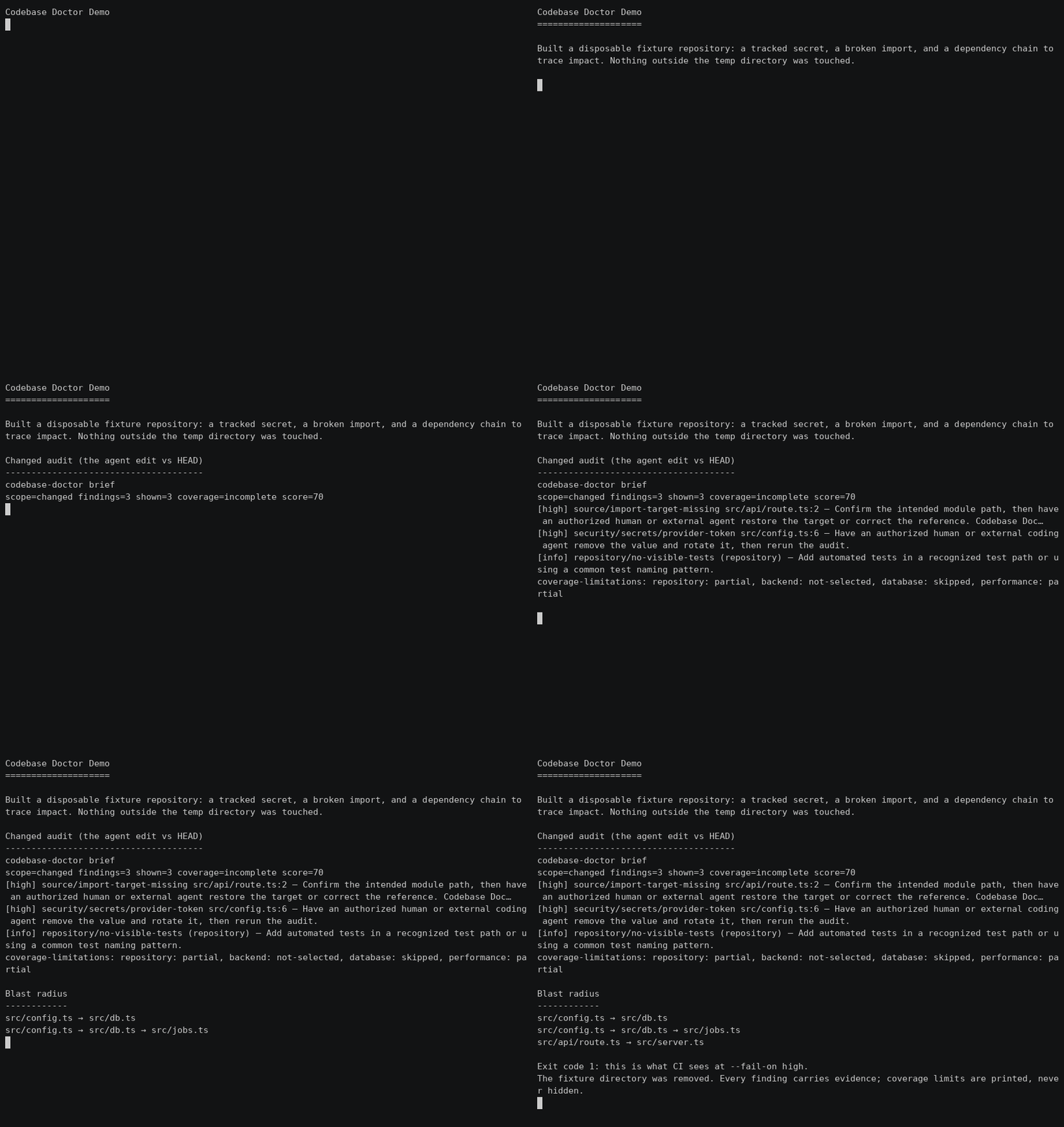
npx -y codebase-doctor audit . --changed --format brief
codebase-doctor brief
scope=full findings=1 shown=1 coverage=incomplete score=80
[high] security/secrets/provider-token src/config.ts:12 —
  Have an authorized human or external coding agent remove the value and rotate it,
  then rerun the audit.
coverage-limitations: validation: skipped, database: skipped, security: partial
That last line is the point. Most tools print findings and stop. This one tells you what it didn't check, every single run.
Why this exists
Coding agents ship code faster than review can keep up. The failure isn't that agents can't write code — it's that nothing verifies what they wrote before it merges.
Codebase Doctor is that verification step. It builds a source graph, scans for committed secrets, dependency drift, unsafe Dockerfiles, workflow injection, RLS mistakes, and accessibility regressions — then tells you exactly what it could not verify.
Benchmarked, not vibes: 17 seeded single-defect fixtures score 100% rule recall and zero medium+ false positives (results, reproducible with npm run benchmark).
Red-teamed: an adversarial mutation corpus tries to hide each defect in a different shape — 11/11 mutants caught, 7/7 controls clean, gated in CI (corpus, reproducible with npm run red-team).
Cross-checked: two independently written offline analyzers (this repo's sql-rls and rls-doctor) run over the same SQL corpus — 10 findings matched, 0 severity mismatches, 1 documented coverage difference, safe schema clean under both (scoreboard, npm run differential).
Field study: of 100 agent-configured public repositories, 23% ship at least one high-severity finding — 10% have broken imports, 4% committed key material, 11% risky agent configuration (report, anonymized and reproducible).
Install
npx -y codebase-doctor audit .          # no install
npm install -g codebase-doctor         # global
Quick start
codebase-doctor demo                             # disposable fixture: secret, broken import, blast radius
codebase-doctor bisect security/secrets/provider-token .   # when did this enter history?
codebase-doctor audit . --json                   # full audit
codebase-doctor audit . --changed --json         # just my diff
codebase-doctor audit . --changed --base main --json    # PR review
codebase-doctor audit . --format sarif           # GitHub code scanning
codebase-doctor audit . --format html > report.html     # shareable standalone report
codebase-doctor verify . --baseline before.json  # confirm fixes landed
demo needs no configuration and no repository: it builds a disposable git
fixture with a tracked secret and a broken import, audits the simulated agent
edit with the real pipeline, prints the blast radius, and exits 1 to show the
CI gate. Nothing outside a temp directory is touched.
Options
--run-checks          Permit configured validation commands
--changed             Audit Git changes and their affected scope (implied by review)
--base <ref>          Compare changed scope from the merge base with this ref
--json                Emit schema-versioned JSON
--format <format>     Output format: text, json, sarif, brief, or html (review adds markdown, github)
--all-findings        Review only: include findings outside the changed lines
--output <file>       Review only: write the report to a file as well as stdout
--exclude <glob>      Exclude a repository-relative path glob; repeatable
--baseline <path>     Compare with a prior Codebase Doctor JSON report
--timeout <ms>        Per-command timeout (default: 120000)
--fail-on <severity>  info|low|medium|high|critical|none (default: high)
--require-complete    Exit 2 when audit coverage is incomplete
--max-findings <n>    Cap brief output (default: 100)
--score               Print only the Repo Health score
--badge               Print a shields.io badge URL for the Repo Health score
--receipt <path>      Write a portable coverage receipt (digest-verified)
--receipt-key <path>  Sign the receipt with an Ed25519 private key (PEM)
--pheromone <path>    Write a privacy-bounded signal (rules and counts only)
--with-database       Permit live PostgreSQL catalog access
--with-advisories     Opt-in OSV advisory lookup over lockfile packages
--database-schema     Schema to inspect; repeatable (default: public)
--database-timeout    Catalog statement timeout in ms (default: 10000)
Code review
review is the pull-request command. It always audits changed scope, narrows
findings to added diff lines, and prints a verdict — APPROVE, COMMENT, or
REQUEST_CHANGES — so unrelated old issues never fail a PR:
codebase-doctor review . --base origin/main --format markdown > review.md
codebase-doctor review . --base origin/main --format github
codebase-doctor review . --format json  # includes a machine-readable review envelope
--format markdownrenders a PR-comment-ready body with the verdict, findings, source impact, and coverage limitations.--format githubemits::error/::warning/::noticeworkflow commands that annotate pull-request diffs inline from Actions logs, with no network access.- A finding on an unchanged line is out of scope for the verdict and counted
as omitted; the full
auditstill reports it.--all-findingsdisables narrowing, and--output <file>writes the report to a file as well as stdout. - With
--baseline, only new findings in the diff gate the verdict. - Exit
1means the review requests changes; exit2is an operational failure, never a clean result. Inspect coverage before calling the reviewed diff verified or clean.
GitHub Action
permissions:
  contents: read
  security-events: write

steps:
  - uses: actions/checkout@v4
  - uses: subhajitlucky/codebase-doctor@v0.1.10
    with:
      format: sarif
      upload: "true"
      fail-on: high
Findings appear in the Security tab. See docs/github-action.md.
What it checks
Secrets — working tree and history
Precision-first and not exhaustive: it detects private-key material, provider-token shapes, paired AWS credentials, credential-bearing URLs, and high-confidence sensitive assignments. A Git-ignored .env is normal storage and is not a finding; a tracked one containing a real credential is.
security/secrets-history catches the case that matters most: a secret committed and later deleted from the working tree, so a rotated-looking repo doesn't hide an exposure. It inspects the most recent 200 commits across all branches without ever checking out, rewriting, or executing repository content. Changed audits scope the history log to changed paths, so deleting a leaked file cannot review clean.
Matched values are withheld from every finding, fingerprint, error, and report. Codebase Doctor never prints your secrets — including in its own SARIF. An external authorized human or agent must remediate the shareable content and rotate or revoke the credential, then rerun the same audit.
Dependencies
security/dependencies is read-only and offline. Lockfile-aware for npm lockfile versions 2 and 3, pnpm (v5+), Yarn (classic and Berry), Bun, and Python poetry and uv locks. Remaining ecosystems stay explicitly unsupported rather than receiving guessed findings.
Rule families: security/dependencies/missing-lockfile, security/dependencies/manifest-lock-drift, security/dependencies/insecure-source, security/dependencies/mutable-git-source, security/dependencies/missing-integrity, security/dependencies/workspace-registry-resolution, security/dependencies/competing-npm-lockfiles, and security/dependencies/competing-lockfiles.
A normal semver range such as ^5.0.0 is not a finding when the lock agrees. Raw dependency specifications and resolved URLs are withheld from reports and never enter a fingerprint. An external authorized human or agent must correct the metadata and rerun the same scope. Inspect coverage before calling the dependency graph clean or verified.
It never invokes npm, another package manager, a shell, an installer, or a lifecycle script, and makes no network request. It makes no CVE or advisory claim on its own. Python coverage parses poetry.lock and uv.lock package blocks and pyproject.toml Poetry and PEP 621 declarations with a bounded line scanner (no TOML dependency): insecure transports, unpinned git references, missing hash evidence, missing lockfiles, competing lockfiles, and decidable manifest-lock drift are reported, while undecidable specifiers, markers, direct-URL drift, transitive-only entries, and requirements-only layouts stay visible as partial coverage.
--with-advisories performs one bounded OSV lookup against resolved packages. Only names, versions, and ecosystems leave the machine.
Source impact — what breaks if I change this file
repository/source-graph uses a real syntax parser (never executes your code) to build a static import graph across JS/TS, Python, Go, Java, and Rust. In changed mode it walks reverse edges and reports a deterministic shortest impact path from each changed file.
Changed mode is mixed-scope per doctor, not a universal file filter: Project Doctor structural rules run with the full repository snapshot and may report findings outside changed paths for manifests, lockfiles, workspaces, and test visibility. File-local doctors (backend, frontend, infrastructure, agent surface, performance) examine only changed files present in the inventory, so changed audits stay proportional to the change. Configured validation check plans are built from full project topology and then filtered to affectedProjectIds. Static SQL selects affected migration streams and replays full current history for every selected stream. Live database remains a full observed schema-set audit only with separately requested --with-database. Zero changed findings is not a full clean result.
repository/source-graph recognizes static import, re-export, type-only import, literal require, and literal dynamic import edges across JavaScript and TypeScript (plus Python, Go, Java, and Rust) with a real syntax parser that never executes repository code. Cycles are valid topology, not findings, and this module is finding-free by design.
A separate precision-first repository/source-integrity Doctor emits only the source/import-target-missing rule, keeping topology limitations from becoming guessed bugs. It diagnoses only four proof classes: an explicit relative target with a supported source extension; a single deterministic alias whose configured target explicitly names a supported source file; a unique workspace package whose explicit entry names a supported source file; and an internal Go package under a module path without a replace directive.
Extensionless, JSON, custom-loader, conditional, ambiguous, external, and dynamic references and cycles are not findings. It does not check named exports or validate that a referenced export name exists.
Full mode examines all qualifying edges; changed mode examines changed importers and complete reverse-impacted importers. A deleted or renamed target selects its unchanged importer.
It emits at most 1,000 findings per audit and reports partial coverage whenever that ceiling or any upstream graph limitation applies. Partial coverage is not a clean source-integrity result. Raw import specifiers and source text are withheld from findings, which expose only normalized paths, import kind, proof class, and safe location.
An external authorized human or agent must correct or restore the intended target and rerun the same scope.
codebase-doctor audit . --changed --base main
src/db/schema.ts → src/repositories/user.ts → src/api/users/[id]/route.ts
→ src/app/dashboard/page.tsx → tests/integration/user.test.ts
Cycles are valid topology, not findings. The graph module intentionally emits no bug findings — repository/source-graph is finding-free by design, and the separate precision-first repository/source-integrity Doctor reports only provably missing import targets, so topology limits never become guessed bugs.
Schema-1 reports may include sourceImpact (schema 1). Changed mode walks reverse internal edges, adds impacted projects to affectedProjectIds, and reports a deterministic shortest impact path per changed source root. Reports preserve full impacted-file counts while serializing only bounded impact records. A path proves only the static edge chain, not a bug in the dependant. Raw import specifiers and source text are withheld; the module uses no plugins, network requests, or writes.
Local tsconfig and jsconfig files contribute a deterministic subset of relative aliases; this is not complete Node or TypeScript module resolution. Dynamic non-literal imports, ambiguous targets, unsupported configuration or syntax, unreadable input, and graph ceilings are coverage limitations, not findings.
Workflow and infrastructure
script-injection (attacker-controlled ${{ github.event.* }} in a run: step), pull-request-target-checkout, write-all-permissions, unpinned action refs, unpinned Docker base images, pipe-to-shell, root-user, and world-writable files. Workflows are never dispatched and images are never built.
PostgreSQL and Supabase RLS
Offline database/sql-rls runs automatically when a supported PostgreSQL migration stream is discovered: it requires no credentials, makes no network request, and never executes migration SQL, reconstructing expected table, policy, RLS, and grant state from supported migrations. Partial coverage is not a clean static SQL result.
Live database/rls inspects observed database state through a read-only catalog of policies, privileges, roles, memberships, enforcement, and bypass paths, permissioned separately with --with-database using environment credentials and a read-only, repeatable-read transaction.
database/rls-drift compares the two — expected migration state against observed live state — and reports table-missing-live, rls-disabled-live, force-rls-disabled-live, policy-missing-live, grant-missing-live, rls-enabled-live-only, and policy-unmanaged-live.
Database and Drizzle hazards
The read-only, offline database/drizzle module and its database/drizzle/raw-sql-date-parameter rule catch a runtime boundary: a JavaScript Date interpolated into a raw Drizzle sql template can bypass the column's timestamp encoder, so postgres-js may throw ERR_INVALID_ARG_TYPE, while equivalent SQL can still work in psql.
// Before: raw interpolation can bypass the timestamp column encoder.
const rows = await db.execute(sql`select * from jobs where run_at <= ${date}`);

// After: guidance for a human or separately authorized external coding agent.
const rows = await db.select().from(jobs).where(lte(jobs.runAt, date));
Applicability requires an exact drizzle-orm/postgres-js adapter import, or scoped owning/workspace evidence for both drizzle-orm and postgres. It reports only statically proven Date flows and never infers from a variable name. Findings are medium severity, high confidence.
Not findings: Date(), Date.now(), an encoded toISOString() string, typed comparisons such as lte(column, date), and a fresh inline encoder object passed directly to sql.param(value, encoder). Encoder identifiers and aliases are not statically proven safe even when declared const, because their objects may be mutated elsewhere; those interpolations and unresolved flows become partial coverage limitations rather than guessed findings. Partial coverage is not a clean Drizzle audit. Raw SQL and parameter values are withheld from findings, fingerprints, and reports. An external authorized human or agent must make the repair and rerun the same scope.
Agent surface — the newest attack target
Audits the agent configuration surface without executing or contacting any of it:
- MCP client configs: unpinned package runners, shell commands, inline credentials, broad filesystem grants
SKILL.md: unscopedallowed-toolsgrants (Bash(*), bareWrite)- Permission bypass:
bypassPermissions,--dangerously-skip-permissions,--yolo,yes-always, broadpermissions.allow
Frontend
JSX/TSX and static HTML accessibility (img-missing-alt, iframe-missing-title, html-missing-lang, positive-tabindex) and static SEO (missing-title, missing-meta-description). No browser, no build.
frontend/security is read-only and offline over JSX sources: dangerously-set-inner-html fires for a dynamically computed value without a provable sanitizer call (DOMPurify.sanitize, sanitizeHtml). Static literals are safe and spread props suppress the check.
Backend and auth
backend/auth is read-only and offline over JavaScript and TypeScript sources. It never starts a server, sends a request, or issues a token — it reads source text only.
Rules: cors-wildcard-origin-with-credentials (wildcard origin: "*", reflected origin: true, or an allowlist containing *, with credentials enabled), session-cookie-security-disabled (cookie secure or httpOnly explicitly false), jwt-decode-without-verify (a decode call in a file containing no verify call), and jwt-verify-algorithm-unrestricted (no algorithms allowlist).
backend/api is read-only and offline over the same sources: sql-string-concat-query fires for concatenated or interpolated SQL text passed to a provably bound pg, postgres, mysql, mysql2, better-sqlite3, or sqlite3 query call (parameterized queries with a values array are safe), and child-process-exec-dynamic fires for non-static commands passed to a provably bound child_process exec/execSync (including spawn with shell: true), while execFile and plain spawn never fire. Instance calls through new Pool()-style construction resolve like direct imports. Unresolvable query text stays a coverage limitation.
A rule fires only when the callee provably resolves to the audited package through an import declaration or CommonJS require, so an unrelated local helper named cors or decode is never reported. Configuration that cannot be resolved statically — a non-literal options expression, a computed cookie flag, or a spread property that could supply the value — is a coverage limitation, never a guessed finding, so inspect backend coverage before calling a codebase clean. The decode and algorithm rules are file-scoped: a verify call in middleware in another file does not suppress them. Configured origin and secret literals are withheld from reports and never enter a fingerprint.
Not covered: API shape validation, worker, webhook, cron, and rate-limit analysis. An external authorized human or agent corrects the configuration, then reruns the same scope.
Current coverage versus north star
This is the part most scanners skip.
There is one unified auditor — one doctor for the whole codebase, not a collection of separate products. Framework- and domain-specific knowledge lives inside it as built-in internal audit modules.
A full audit examines the full requested repository scope for applicable implemented modules. It is not complete or universal — it is not every-domain analyzer coverage. Inspect coverage before calling a codebase verified or clean.
Every report includes domainCoverage — a checklist of nine domains separating applicability from status, so not-detected differs from detected-but-unsupported, skipped, failed, or not-selected, with module-level status details, evidence, and limitations. coverageComplete does not mean the code is bug-free or correct.
That means:
- A clean run means the scope was actually checked.
--require-completeexits2rather than letting a skipped area report as clean.- A truncated or bounded scan says so in
coverageSummarywith exacttotal/emitted/omittedcounts and deterministic sample paths.
| Domain | Current source coverage | North star |
|---|---|---|
| Repository structure | Inventory, framework detection, manifests, workspaces, lockfiles, test visibility, JS/TS + Python + Go + Java + Rust impact graph | Cross-language dependency and behavioral topology |
| Configured validation | JS/TS and Python command planning; execution only with --run-checks | Sandboxed validation across ecosystems |
| Database | Offline migration RLS, Drizzle Date hazards, live RLS, static-to-live drift | Schemas, queries, permissions, more engines |
| Frontend | JSX/HTML a11y, static-HTML SEO, and raw-HTML sinks | React, Next.js, bundle analysis, broader a11y |
| Backend and authz | Read-only, offline backend/auth (CORS, session-cookie, JWT) plus backend/api (SQL concatenation, shell execution) analysis in JS/TS; NestJS detection | Worker, webhook, cron, rate-limit analysis |
| Security | Secrets (tree + history), dependency rules, opt-in OSV | Secrets, permission, vulnerability, supply chain |
| Infrastructure | Dockerfile and GitHub Actions | Hosting and deployment analysis |
| Performance | Static file hygiene: committed build artifacts, oversized sources | Cache, query, memory, profiling |
| AI systems | Agent-surface audit: MCP configs, SKILL.md grants, permission settings | Prompt, token, grounding analysis |
North-star entries are planned modules, not shipped behavior. Built-in source-impact graph, secrets analysis, and dependency analysis ship together in 0.1.4 and are not part of the historical 0.1.3 package.
Precision and bounded-report contract
Workspace publication entries, generated targets, and fixture-controlled paths are coverage limitations unless independently proven broken; they are not missing-target findings by themselves. Detected pnpm, Yarn, and Bun scopes never receive npm-specific findings. Only a cryptographic match to an inventoried localhost-only certificate can classify a private key as an intentional local test key; every other matched private key remains high severity.
Schema-1 reports bound repeated evidence without hiding its size: coverageSummary preserves exact total, emitted, and omitted counts, and limitationGroups preserve each reason, deterministic sample paths, and omitted path counts.
Inspect coverage before calling a codebase verified or clean. Read docs/architecture.md for the full contract.
Read-only by design
Codebase Doctor reports. It exposes no direct target-file write API, has no direct filesystem-write capability, and includes no remediation executor. It can never be granted direct target-write or remediation authority, and never modifies, fixes, or repairs target files. A human or a separately authorized agent makes changes, then reruns the same scope to verify.
Separately authorized --run-checks launches repository-owned validation subprocesses; they are not filesystem- or network-isolated and may have side effects. That is validation execution, not Doctor repair authority.
--changedgrants no command execution, network, or database access- validation commands need
--run-checks; live database needs--with-database; OSV lookup needs--with-advisories - database credentials come from
DATABASE_URLorSUPABASE_DB_URL, never a connection-string flag - source analysis parses syntax and never executes source; lockfile analysis never invokes a package manager
- apart from an explicitly requested OSV lookup, it makes no external network calls
Shadow audits
shadow audits a disposable copy of the repository. Validation commands
(--run-checks) execute inside the copy, so repository-owned side effects —
file writes, caches, hooks — cannot touch your working tree:
codebase-doctor shadow . --run-checks --fail-on high --receipt shadow.json
The copy is always removed, the original is never modified, and the receipt
is marked environment: shadow (disposable copy). This is the safe way to
run untrusted validation commands.
Verifier swarm
swarm verifies multiple repositories with parallel read-only workers and
composes a fleet verdict. Verdicts are honest by construction:
findings— gating findings (at--fail-onor above) are presentunknown— evidence was lost: failed or partial coverage, or a failed workergaps— no gating findings, but some domains were not attempted by designverified— every applicable domain completed or was not applicable
codebase-doctor swarm ../api ../web ../worker --workers 4 --receipt-dir receipts/
codebase-doctor swarm ../api ../web --require-complete   # exit 2 on unknown or gaps
The fleet verdict is the worst of its members; a clean verdict is never claimed over lost evidence. Each worker can emit a coverage receipt.
Chronological bisect
bisect finds the commit where a rule or fingerprint first appeared by
auditing history oldest-first in disposable git worktrees:
codebase-doctor bisect security/secrets/provider-token .
codebase-doctor bisect <fingerprint> . --max-commits 500 --json
Output carries the commit, author, message, location, fingerprint, and the
parent-absence evidence: the parent commit was scanned immediately before
and did not contain the target. Each commit is audited in a disposable
worktree; the working tree is never modified. --all-history scans merges
too; the default is first-parent.
Repo Health score
Every report carries a deterministic score: 100 minus severity penalties —
critical 25, high 10, medium 4, low 1, info 0 — minus 10 when applicable
coverage did not complete, clamped to 0–100. Bands: green ≥ 80, yellow ≥ 50,
red < 50. Acknowledged (suppressed) findings never count, and the score never
replaces the report: inspect coverage before calling a codebase verified.
codebase-doctor audit . --score    # Repo Health: 71/100
codebase-doctor audit . --badge    # https://img.shields.io/badge/Repo%20Health-71%2F100-yellow
--score and --badge print only the score or badge; exit codes still follow
--fail-on. JSON reports always include the score object with its
findingPenalty and coveragePenalty breakdown, and brief output carries
score= in its header.
Exit codes
| Code | Meaning |
|---|---|
0 | Requested audits completed and no finding met the threshold |
1 | Requested audits completed and at least one finding met the threshold |
2 | An audit could not complete, or coverage was incomplete under --require-complete |
Exit 2 is an operational failure, not a clean result.
Baselines and SARIF
--baseline classifies fingerprints as new, unchanged, or resolved, and applies --fail-on only to new findings. After an external fix, confirm it:
codebase-doctor audit . --json > before.json
# ... fix happens elsewhere ...
codebase-doctor verify . --baseline before.json
verify reports each fingerprint as resolved, unchanged, unresolved, or new, and exits 1 unless everything is verifiably resolved. unresolved means absent under incomplete coverage — never a repair. The fresh verify scan runs the same offline audit scope as audit so security and database findings are comparable; live database access stays ungranted.
Coverage receipts
Every audit can emit a portable coverage receipt — what was checked, what was not, the deterministic score, and finding fingerprints — with a SHA-256 digest over the canonical body and an optional Ed25519 signature:
codebase-doctor audit . --receipt receipt.json
codebase-doctor audit . --receipt receipt.json --receipt-key key.pem
codebase-doctor verify-receipt receipt.json   # exit 0 valid, 2 tampered
Receipts never contain secret values or source text. A digest proves tamper evidence; a signature proves the key holder issued it. See docs/receipts.md.
Pheromone signals
An audit can emit a pheromone signal — rules, severities, and counts only, never paths, fingerprints, source text, or repository names:
codebase-doctor audit . --pheromone signal.json
codebase-doctor pheromone merge signals/*.json --min-signals 3 --out index.json
merge verifies every signal's digest (and signature, if present), fails
closed on tampered input, and excludes patterns observed in fewer than
--min-signals signals (k-anonymity). The result is a public pattern index
of what actually occurs — without exposing anyone's code. See
docs/pheromones.md.
Intent verification
intent verify checks declared intent against audit evidence — it never
interprets prose. Claims live in JSON or a fenced intent block in a PR
body:
```intent
{ "intentVersion": "1", "claims": [
  { "id": "no-secrets", "kind": "rule-absent", "ruleId": "security/secrets/provider-token" },
  { "id": "score", "kind": "score-at-least", "value": 90 }
] }
```
codebase-doctor intent verify pr.md . --require-verified
Each claim is verified, violated (with evidence locations), or
undecided — undecided means the claim depends on coverage that did not
complete, and it is never counted as verified. Exit 1 on any violation;
--require-verified exits 2 on undecided. See docs/intent.md.
Economic verification
economy verify replays a transaction journal in a disposable shadow
ledger — nothing is submitted, nothing moves — and proves or witnesses
economic invariants before real value does:
codebase-doctor economy verify journal.json --policy policy.json
non-negative-balances— overdraft / double-spend, with the exact operationper-operation-limitandwindow-volume-limit— size and velocity limitsallowlist— transfer counterpartiesdeclared-balances— the journal's reported balances must match the replay
Violations carry witnesses (operation id, index, balance snapshot); exit 1 on
any violation, --require-proved exits 2 on undecided. See
docs/economy.md.
Proof-carrying repairs
fix generates a repair for a finding and verifies it in a disposable
copy before writing anything:
codebase-doctor fix <fingerprint> . --patch fix.patch --receipt fix.json
For source/import-target-missing it finds the unambiguous existing
candidate (exact stem match first, same directory preferred), applies the
one-line change in a shadow copy, re-audits, and writes the patch only if
the finding fingerprint disappears and no new medium+ finding appears. The
patch is a real git diff; the receipt binds the fingerprint to the patch
SHA-256 and the before/after verdicts. The original repository is never
modified. See docs/repairs.md.
Exploit witnesses
witness turns a risky-pattern finding into a concrete exploit — the
payload, the transformed sink text it produces, and why it violates the
boundary:
codebase-doctor witness <fingerprint> .
# Payload:     ' OR '1'='1' --
# Transformed: select * from users where id = '' OR '1'='1' --'
Supported rules: backend/api/sql-string-concat-query,
backend/api/child-process-exec-dynamic, and
frontend/security/dangerously-set-inner-html. A small concatenation
evaluator handles literals, template literals, +, parentheses, and TS
casts; anything else is undecided, never guessed. The artifact is bound
to the finding fingerprint with a digest, and nothing is ever executed. See
docs/witness.md.
Acknowledged findings (suppressions)
A finding a human has reviewed and accepted can be acknowledged inline without hiding it from any report:
const API_KEY = "..."; // codebase-doctor-ignore: security/secrets/provider-token -- rotated test credential
- The directive names rule ids, doctor ids, or
doctor/*prefixes, and applies on the finding's own line or the line immediately above it. Findings without a location cannot be acknowledged inline, and directives that match nothing are ignored. - Acknowledged findings leave
findings(so failure gates pass) but stay fully listed undersuppressedwith their reason and directive location. They still count as present: baseline comparisons report themunchangedandverifynever reports themresolved. Removing the directive brings the finding back as new. - Suppressed findings are excluded from SARIF uploads by design; inspect
suppressedin JSON, text, or brief output instead.
MCP server and agents
claude mcp add codebase-doctor --scope user -- npx -y codebase-doctor@0.4.13 mcp
Read-only tools, each annotated readOnlyHint: true, destructiveHint: false, idempotentHint: true: audit_codebase, review_changes, verify_changes, explain_finding, verify_intent, build_receipt, describe_capabilities. Responses are bounded at roughly 50 KB; the server never enables --run-checks or live database access. Failures return structured JSON shaped as { error: { code, message, nextAction } }. Setup for Codex CLI, Gemini CLI, and generic stdio clients is in docs/agents.md.
Registry metadata ships in server.json (io.github.subhajitlucky/codebase-doctor); publishing steps for the official MCP registry, Smithery, and Glama are in docs/mcp-registries.md.
Live listings: Glama · official MCP registry (io.github.subhajitlucky/codebase-doctor).
A Claude Code plugin ships in this repository (.claude-plugin/ + skills/):
/plugin marketplace add subhajitlucky/codebase-doctor
/plugin install codebase-doctor
codebase-doctor instructions prints ready-to-paste snippets for AGENTS.md, CLAUDE.md, .cursor/rules/, .windsurfrules/, .clinerules/, and copilot instructions. It only prints — it never writes files.
Workflow: audit . --changed --format brief after edits, review . --base main --format brief for a PR verdict, full audit . at trust boundaries, verify after an external fix.
Roadmap
- Built-in backend, performance, and AI semantic audit coverage
- Per-domain coverage guarantees beyond the global
--require-completegate - Pull-request annotations, hooks, and agent plugins on the same report schema
- Approved validation in read-only mounts or disposable copies
- Deterministic doctor benchmark (
npm run benchmark, see docs/benchmark.md): recall, medium+ false-positive rate, review verdicts, and suppression honesty on seeded fixtures - Cross-model benchmarks: defects found, verification success, token cost
Dogfooding
CI audits this repository with Codebase Doctor itself:
node dist/cli.js audit . --baseline .codebase-doctor-baseline.json --format brief --fail-on high
The baseline records this repository's accepted findings — currently none:
the self-audit is clean. Any new finding fails CI. All fixture sources
are split so the token never appears contiguously in the working tree or in
history — the generated fixture still contains it, so demo keeps
demonstrating a real secret finding.
Rival scanner scoreboard
Most benchmarks are self-run on self-authored fixtures. This one is too — and says so — then puts the same corpus through independently installed rival scanners:
npm run rival-differential -- --markdown docs/rival-scoreboard.md
It seeds disposable repositories with the same 17 deterministic cases plus advisory and control rows, runs codebase-doctor and pinned Semgrep CE, gitleaks, Trivy, and osv-scanner over each, and publishes a dated snapshot of caught, missed, noise on clean controls, and out-of-scope cells — including where codebase-doctor loses. Rival results are not a CI gate; registries and advisory databases move.
- Snapshot + methodology: docs/rival-scoreboard.md
- A weekly workflow publishes the latest run to the Actions job summary (
.github/workflows/rival-scoreboard.yml).
Development
npm install && npm run build && npm run typecheck && npm test
Releases are checked with npm pack, installed into a clean temporary project, and run through the generated binary.
License
MIT