Listed from the MCP registry; nobody on Odel publishes it.
Is this yours? Claim it
SuVerse
Find local US businesses: what they offer, prices from their own sites, and how to order or book.
One address for any MCP client. No sign-in needed on this server.
What it does
10 read3 act2 other
Grouped by tool name.
What it costs
FreeOdel charges nothing per call. The publisher may charge for its own service.
Tools
15 · grouped by tool name · checked 11 Nov 2026Read · 10Look things up
- list_niches
- list_cards
- find_business
- search_catalog
- get_card
- get_offering
- get_product
- get_business
- quote_order
- check_availability
Act · 3Change something
- place_order
- book_slot
- order_status
Other · 2Neither hinted nor named
- request_to_owner
- request_status
SuVerse Agent Assistant
SuVerse — get found by AI. (Formerly SuVerse. The service now lives at www.suverse.io; the old address www.suverse.io keeps answering for the API and MCP. The npm package and the registry entry keep their names.)



AI agents can find a local business, see what it sells, check availability and price, and open a real order or booking.
Why
Local businesses are close to invisible to AI agents. Their menus, price lists and booking pages are written for people, an agent cannot phone the shop, and many businesses have no website an agent could use at all. SuVerse reads what each business publishes, turns it into one card per business with real links to order, book or ask, and serves the cards to any MCP client.
60-second quickstart
Two MCP doors, both streamable HTTP — no key, no account, no payment:
| door | |
|---|---|
https://www.suverse.io/mcp/catalog | the free business catalogue: the 15 tools below and nothing else (recommended) |
https://www.suverse.io/mcp | the same 15 tools for a client without a key (with a SuVerse node key it is the compute door) |
Claude — Customize → Connectors → Add custom connector → URL https://www.suverse.io/mcp/catalog → Add.
No sign-in is asked for.
ChatGPT (plans with Developer mode) — turn on Developer mode in the connector settings, then Create a connector
with the MCP URL https://www.suverse.io/mcp/catalog and no authentication. The menu names differ between ChatGPT
versions.
Cursor (~/.cursor/mcp.json) or any client that takes a JSON server list:
{
  "mcpServers": {
    "suverse": { "type": "http", "url": "https://www.suverse.io/mcp/catalog" }
  }
}
Checked by connecting the official MCP TypeScript SDK client with exactly this entry: 15 tools listed, a live call answered.
One request — search_catalog with {"query": "a dozen red roses delivered", "location": "Miami, FL", "limit": 3} —
and the live answer (2026-11-02), cut to the first business:
{
  "found": 12,
  "returned": 3,
  "businesses": [
    {
      "id": "f2f197e1-7e39-4794-9e3c-54a77a75ef24",
      "name": "More Than Flowers",
      "trade": "Florist",
      "miles_away": 2.1,
      "offerings": [
        {
          "id": "e9a2aebb-cd9e-4627-8d8d-84d866a26bee",
          "title": "Three Dozen Roses - Hot Pink",
          "price": 135,
          "availability": "in_stock",
          "link": "https://morethanflowersmiami.com/miami-more-than-flowers/three-dozen-roses-hot-pink.html?ref=suverse"
        }
      ],
      "can": ["check_delivery", "contact", "order"],
      "links": {
        "order": "https://morethanflowersmiami.com/miami-more-than-flowers/mayflower-wrapped-bouquet.html?ref=suverse",
        "contact": "tel:+17865876195"
      }
    }
  ]
}
Read any business website yourself
reader/ is SuVerse's own open reader: the same readers the catalogue runs, on your machine, for any
website — items with prices, the doors to order, book or ask, hours and contacts, every value with the words it was
read from. No Google, no proxy, no browser; robots.txt obeyed; a model only with your own ANTHROPIC_API_KEY
(--no-model turns it off).
cd reader && npm install && npm run build
node dist/cli.cjs read https://example-business.com --pretty
Its shared cache is free and on by default (--no-share or VERSUM_SHARE=0 turns it off): what is sent and kept
is in reader/README.md and the
privacy policy.
How to search (for agents)
The server sends these rules to every client in its instructions; the short version:
- Turn the person's request into a business type and a place. «I'm locked out of my car in Tampa» →
locksmith,Tampa. «My AC is blowing warm air, 33618» →hvac,33618. You don't need the catalogue's internal niche keys:list_nichesandsearch_catalogmatch ordinary words. - Pick the tool: you know the name →
find_business; you know the type →list_cards; you don't, or you need a specific item («vegan pizza», «brake pads») →search_catalog. - No place, no guess. If the request has no city or ZIP, ask the person. The catalogue answers
location_neededrather than picking a place for you. - A result is a candidate. Check the card: what it lists, whether it comes to the customer (
at_customer: confirmed / confirmed not / unknown), the service area, the doors. - Keep facts apart: opening hours are not free time, an item price is not the final total, «nearby» is not «serves your area», no data is not «no».
- Next step through the right door: menu or catalogue to look,
bookto book,quote_orderfor a total,request_to_ownerto ask the owner (only where a channel is connected), otherwise the phone. - Nothing on the person's behalf without their permission — no requests, bookings, orders or payments.
Each result says why it matched (match.basis: a confirmed item, the business's own words, a category tag, or the
category only). When the catalogue cannot tell what kind of business a raw phrase needs, it says so and suggests close
types instead of returning look-alikes.
Tools
| tool | what it does | main parameters |
|---|---|---|
list_niches | the trades the catalogue knows near a place, with counts | location, radius_miles, niche |
list_cards | every business of one trade near a place, in one fixed order (online niches: no location) | niche, location (required for local trades), query, needed_by, max_price, deliver_to, page |
find_business | a business by its name | name (required), location |
search_catalog | a match by meaning, when the trade is not known | query (required), location, fulfillment, max_price, only_local |
get_card | one business in full: what it sells, what can be done, how it reaches you | id |
get_business | synonym of get_card | id |
get_offering | one thing in full, with its price checked again right now | id |
get_product | synonym of get_offering | id |
quote_order | what an order would cost delivered to an address — asked of the shop's own cart, nothing ordered | offering_id, deliver_to (required), quantity, options |
check_availability | ask the business's own system: in stock now, which slots are free | business_id, offering_id (required), from, to |
place_order | place an order in the business's own system; the buyer pays on the platform's checkout page | business_id, lines (required), customer |
book_slot | book a slot in the business's own calendar (Square Appointments) | business_id, offering_id, start_at, customer (required) |
order_status | what became of an order or a booking placed through this door | order_id |
request_to_owner | send a request to the business's verified owner (Telegram, e-mail or WhatsApp) — not a booking until the owner confirms | business_id, what, customer, idempotency_key (required), date, time, quantity, branch, note |
request_status | what became of a request: delivery (sent · link_given · expired · failed) and the owner's answer (declined · other_time · available = free but not booked · confirmed = booked) | request_id |
check_availability, place_order and book_slot work for businesses whose owner connected Shopify or Square
(the card shows live_data, and a connected door). Shopify: place_order returns the shop's own checkout link with
the items in the cart; the buyer gives their details and pays on Shopify. For every other business the card's doors
link to its own order and booking pages.
request_to_owner works for businesses whose owner claimed the card and connected a channel; for the others it
answers no_channel with the card's other doors. Retrying with the same idempotency_key never sends a second request.
Example: quote_order — Flowers of Miami, 12 roses
{"offering_id": "a05bbf1c-32c0-4a56-9038-310b0c35b852", "deliver_to": "1000 Brickell Ave, Miami, FL 33131"} —
«Tiny Bouquet of 12 Red Roses with Baby Breath», live answer of 2026-11-02, from the shop's own cart:
| option the shop's cart offers | shipping | total |
|---|---|---|
| Local Delivery (picked first by the shop) | $20.00 | $80.25 |
| Local Pickup | $0.00 | $58.85 |
Item $55.00; the totals include the shop's own tax for this address. placed: false — nothing was ordered; only the
delivery address was sent (no name, e-mail or phone), and the cart session was emptied afterwards. delivery_date came back
unknown: the shop does not publish one through its cart.
Online businesses
The catalogue holds every kind of business, not only local ones: software and apps, APIs and MCP servers, online shops, open-source tools, content sites and marketplaces. Each card says what it is — local, online, or both (a local business that also sells online; a local business with its own app stays local) — and why.
- An online card has no location. It shows «Online service», what it does, who it is for, pricing and plans, a free trial or plan, platforms, integrations / API / docs, support and the company — each read from the business's own pages with a quote.
list_nicheslists the online niches underonline_niches.list_cardswith an online niche ignores the location;search_catalogwith no location and an online request (software, an app, an API…) returns online businesses — neverlocation_needed.get_cardadds anonlineblock: every fact with the page it was read on.
Only real businesses
Some «local businesses» are lead-generation sites: one company selling calls under several made-up names. SuVerse checks for them and keeps them out:
- the same price list on several different websites, and their phones in the same block of numbers;
- no licence number on a site in a licensed trade;
- no owner, founding year or company named;
- the same site template and text across those sites.
A confirmed lead-generation card is never on the shelf — not in search_catalog, list_cards or find_business,
not in the sitemap — and its page answers 410. A card that only looks suspicious is reviewed by a person before
anything is hidden. The check runs every week.
Publishing standard
SuVerse also publishes independent pages about some local businesses (www.suverse.io/offers/…): written
only from the business's own public pages, re-checked the day they go live, marked as independent («did not ask for
it and did not pay for it, and is not a SuVerse client or partner»), with a way to have them corrected or removed.
Every page passes 18 checks before it is published. The rules are public:
Our Publishing Standards.
Limits
| MCP doors, no key | no per-call limit today — please cache what you read |
| MCP with a SuVerse node key | the key's limit, returned in x-ratelimit-limit / -remaining / -reset |
| owner site: live card builds | no daily cap per address; 60 requests an hour per address |
| free check | 3 a day per website, 20 a day per address |
The business card
get_card returns one card per business. The full schema, inferred from live cards of every kind of business, is
schema/card.schema.json. The main parts:
-
identity —
id,name,address,location,phone,email,website,hours/hours_folded,page_url -
offerings — what it sells: each with
id,title,price,currency,availability,link -
actions (the doors) —
order,book,reserve,request_quote,contact,check_delivery; each with a realurl(ortel:/mailto:) and theproviderwhen it is a platform -
fulfillment — delivery, pickup and the rest, with what is known and what is not
-
reach — how an agent can deal with the business, in one word:
reach meaning online_platformorders or bookings go through a platform (a shop, ordering or booking system) own_cartthe business's own website takes the order form_onlya request form, no online order phone_onlythe telephone is the only door no_sitethe business has no website not_readthe site could not be read -
status —
unverified: read from the business's own public pages; the owner has not confirmed it. A business whose owner claimed and confirmed its card showsowner_verified. As of 2026-11-08 no business owner has verified a card yet: the only verified cards are SuVerse's own test businesses, which are not on the shelf.
Transparency rating
Every card carries the public SuVerse Transparency rating: how much a buyer can know about the business before contacting it, from what the business publishes about itself. It is not a rating of the quality of the work: no stars, no reviews, no «best», and SuVerse never orders businesses by it on any page.
| item (local business) | counts when |
|---|---|
| Prices published | at least one price as text on the business's own pages |
| Licence shown | only trades that need a state licence (HVAC, plumbing, electrical, roofing, dentists…) |
| Hours | on the site, the Google Business Profile, or set by the verified owner |
| Service area / Address | the area served (trades that go to the customer), or a street address (places customers visit) |
| Phone or a booking / contact link | a tap-to-call number or a booking or contact link |
| Website read in the last 30 days | SuVerse read the site within 30 days |
Online businesses use their own list for each kind (software, API, shop, open source, content, marketplace), from the
same config as the free check. There is no «who it's for» item: the agent decides who a business fits; when the
business itself states its audience on its site, get_card gives it under stated with its source, never scored. Grade: A every item · B all but one · C half or more · D less than half.
Every ✓ links to the page it was found on and the date it was read. Method:
www.suverse.io/transparency.
For agents: get_card → transparency {grade, have, of, items with source and read_at, or how_to_add};
list_cards and find_business → transparency {grade, have, of, items: {key: true|false}} on each card. You may sort
or filter by it; the list order does not use it. In the card page's JSON-LD it is a plain additionalProperty
(PropertyValue, propertyID: suverse-transparency), not a Review or AggregateRating.
Taxonomy
Every card belongs to one or more niches (trades): a key, the words people use for it (also_called) and the
kinds of things it sells (tags). taxonomy/niches.json lists the 128 niches as of
2026-11-02, read from list_niches; the live catalogue has 130 as of 2026-11-03.
Coverage
| cards on the shelf | 34,716 (live count: the badge above, or /api/public/stats) |
| niches | 136 |
| towns and neighborhoods | 87 |
As of 2026-11-08 (20:36 UTC). Scanning of new areas is paused; existing cards are kept and re-read.
| doors and prices (2026-11-08, out of 34,716 cards) | |
|---|---|
| with an online order door | 2,773 |
| with an online booking or reservation door | 5,188 |
| with at least one price | 5,211 |
The densest coverage today is Tampa, St. Petersburg and the eastern Tampa Bay suburbs. Some places are still thin or empty — for example northern Pinellas (Clearwater, Dunedin, Palm Harbor) — and other Florida cities have far fewer cards so far. An empty result near such a place usually means the area is not scanned yet, not that no such business exists.
For business owners
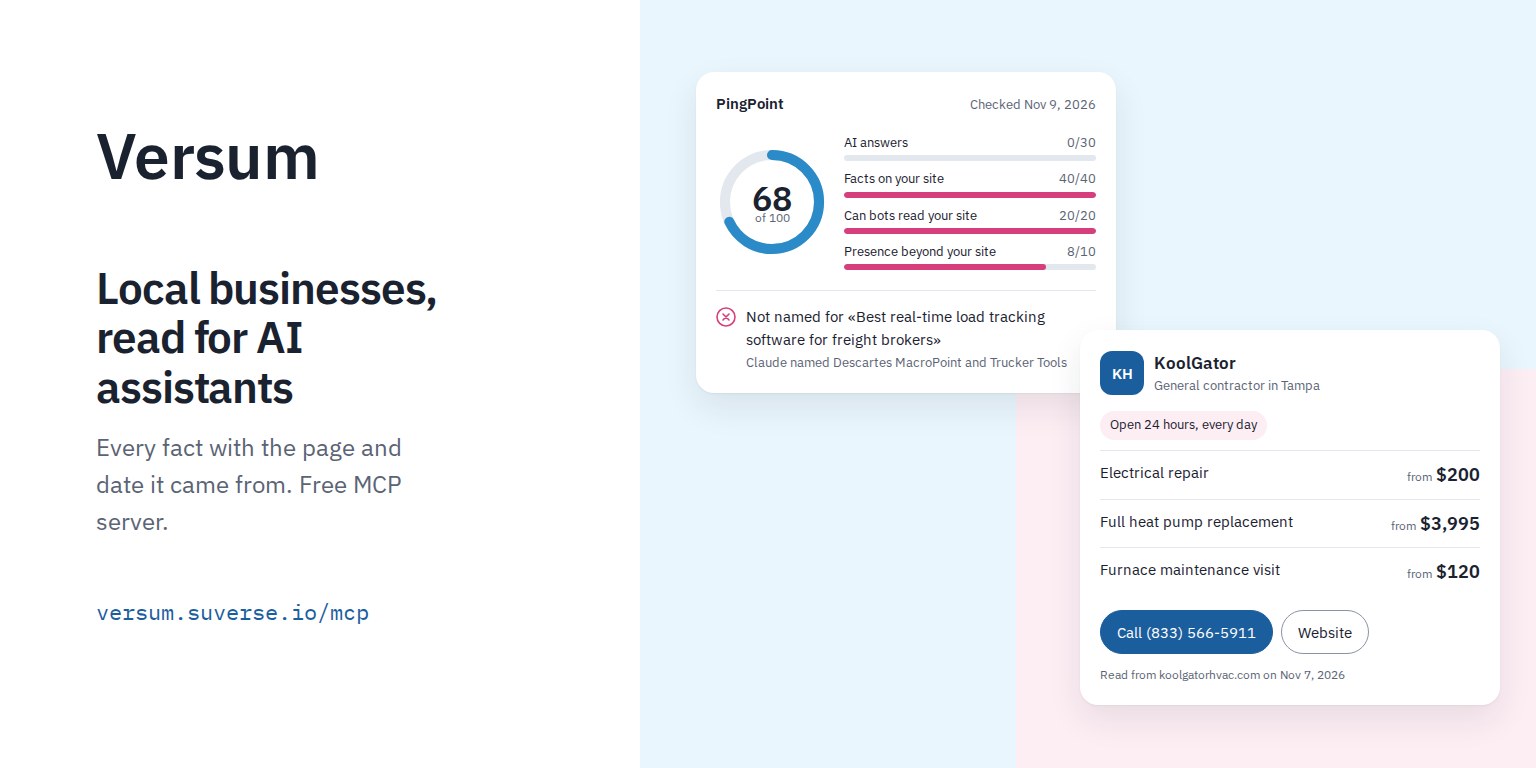
- Free check: «What AI knows about your business» — on www.suverse.io, enter
your website and get a score out of 100 by a published formula (How we score):
whether AI assistants name you (three buyer questions per niche and city, asked weekly through Claude with web
search — the report names the engine and the date), which facts buyers look for are on your site, whether search and
AI bots can read it, how you compare with businesses of your niche within 15 miles, and what to fix first. Every ✓
links to the page it was found on. The full report adds every source and a ready LocalBusiness JSON-LD block and
llms.txtbuilt only from your own facts. Online businesses get their own formula by type (software, API / MCP, online shop, open source, content, marketplace), questions without a city made from the business's own description and audience (a marketplace is asked where to buy and sell, not which software to use), and SoftwareApplication / Organization code. If the address you enter is an app or sign-in area (app.…,dashboard.…,/login), the public site of the same business is read too and the report says which pages were read. Reports are private (not indexed, not in the sitemap); the check is free with no daily limit for now. Google Maps, reviews and rankings are not part of the check. - Claim your card on www.suverse.io: find your business, confirm it is yours (a code to a contact already on your card or website, or Shopify / Square), then edit what the card says and publish it. Every card has a public page, for example www.suverse.io/b/flowers-of-miami-miami.
- Telegram bot «SuVerse for Business» (@VersumBusinessBot): requests from customers and agents arrive there, with buttons to confirm, decline or reply.
- Connect Shopify or Square from the owner page: the card then shows the store's live items, prices and availability, and agents can place orders and (Square) book slots in the owner's own system.
- Grow your business (on the owner page, at
/growand in the bot with/grow): the next steps for your card, and Start promotion — independent pages built to the Publishing Standards, each published only after it passes all 18 checks, marked as published at the owner's request. Free during the test period; open only to owners who verified their business. - Coming soon: the Shopify App Store listing.
Owner API and the owner's own site (2026-11-09)
Everything an owner does — on the web, in the SuVerse app (iPhone in TestFlight; Android next) or through an assistant — is one
JSON API: https://www.suverse.io/api/owner/v1 (OpenAPI).
Sign in with an email code (a short-lived access token plus a refresh token). Signing in proves the contact only: a
business is managed after a claim verified through a contact the business itself publishes (its website or Google
listing), a file or tag on its own website, or a person's review of a document — or when the owner added it.
-
Add a business without a website: name and description in the owner's own words → duplicate check (a strong match means «claim it», a similar name is only a suggestion) → niche → the niche's fields → live, marked «from the owner».
-
Weak website: the cabinet shows the Transparency grade and exactly what to add; «Improve my own website» gives JSON-LD, llms.txt and ready text for what the site is missing, and can create DRAFT pages on the owner's WordPress.
-
The owner's own SuVerse site (
www.suverse.io/s/<name>): only after the owner turns it on; it shows only owner-approved data; its look is settings only (colours with contrast checks, font, layout, sections) — no custom code. -
No sign-in to look around (2026-11-10): the SuVerse app opens like the website. Public, token-less doors:
GET public/search?q=(a business by name and city),GET public/businesses/{id}(the read-only view: Transparency grade, the AI check score and how often AI named the business, key facts — only what the public card shows),POST public/build(build a card live when it is not found), and «This is my business»:GET|POST public/businesses/{id}/claimsends a code to an email the business itself lists;POST public/claims/{id}/verifywith the right code makes that contact the manager and signs it in. Limits per connection; 3 codes an hour per business. -
Connect to Claude / ChatGPT:
POST businesses/{id}/mcp-keygives the owner a personal MCP address for their own card (shown once; a new one turns the old one off).
Agents keep reading the same cards through MCP; nothing here changes the tools below.
How it works
- A scan lists the businesses of a trade in an area.
- The analyzer reads each business's own website: menus, price lists, shop catalogues, booking and ordering pages.
- Everything it keeps carries the page and the words it was read from; nothing is invented.
- One card per business goes on the shelf, with real doors.
- Agents ask the MCP door; owners can claim, correct and connect their card.
flowchart LR
  A[Scan an area] --> B[Read the business website]
  B --> C[Card: offerings, prices, doors]
  C --> D[MCP door for agents]
  C --> E["/b/ page + owner site"]
  E -->|owner claims, edits, connects Shopify / Square| C
Listed in
- Official MCP Registry —
io.suverse.www/catalogandio.github.sudzikcoin/suverse-agent-assistant(the earlier Versum-named entriesio.suverse.versum/catalogandio.github.sudzikcoin/versum-agent-assistantare marked deprecated and point here; their addresses keep working) - mcptry (mirrors the official registry)
- Glama
- mcpub.dev
- wellknown.network
- ToolSDK MCP Registry
Roadmap
Done:
- The open reader with a shared cache:
reader/. - The catalogue-only MCP door
/mcp/catalog(15 tools, no key). - Owner claims, Shopify and Square connections, requests to owners through Telegram.
- The lead-generation filter.
- Independent promotion pages and the public Publishing Standards.
- The free «What AI knows about your business» check for owners.
Next:
- Publish the npm package
@suverselabs/suverse-mcp(stdio, typed functions for the tools); its source is innpm/. - WhatsApp click-to-chat doors.
- Scanning more areas (paused today).
License and contact
MIT for the schemas, the taxonomy, the documentation and the open reader (reader/) in this repository; the hosted
catalogue's service code is closed.
Privacy Policy · Terms of Service · Publishing Standards · How we score (SuVerse LLC).
Contact: info@suverse.io. The compute side of SuVerse is suverse-node.