Listed from the MCP registry; nobody on Odel publishes it.

Emfirge
Git branch for your cloud. Understand AWS risk, prove fixes, and ship safer changes.
Runs on your machine from its package; the steps are below.
What it does
- Reads
- Writes
- High impact
At most: moves money, runs code or commands, deletes data, or sends messages for you.
What it costs
FreeOdel charges nothing per call. The publisher may charge for its own service.
Runs locally over stdio
This server isn't hosted — your MCP client launches it from a package registry. Use one of the commands below, or drop the config into your client (e.g. Claude Desktop).
Run
npx -y @emfirge/mcp
MCP client config
{
  "mcpServers": {
    "emfirge": {
      "command": "npx",
      "args": [
        "-y",
        "@emfirge/mcp"
      ]
    }
  }
}emfirge
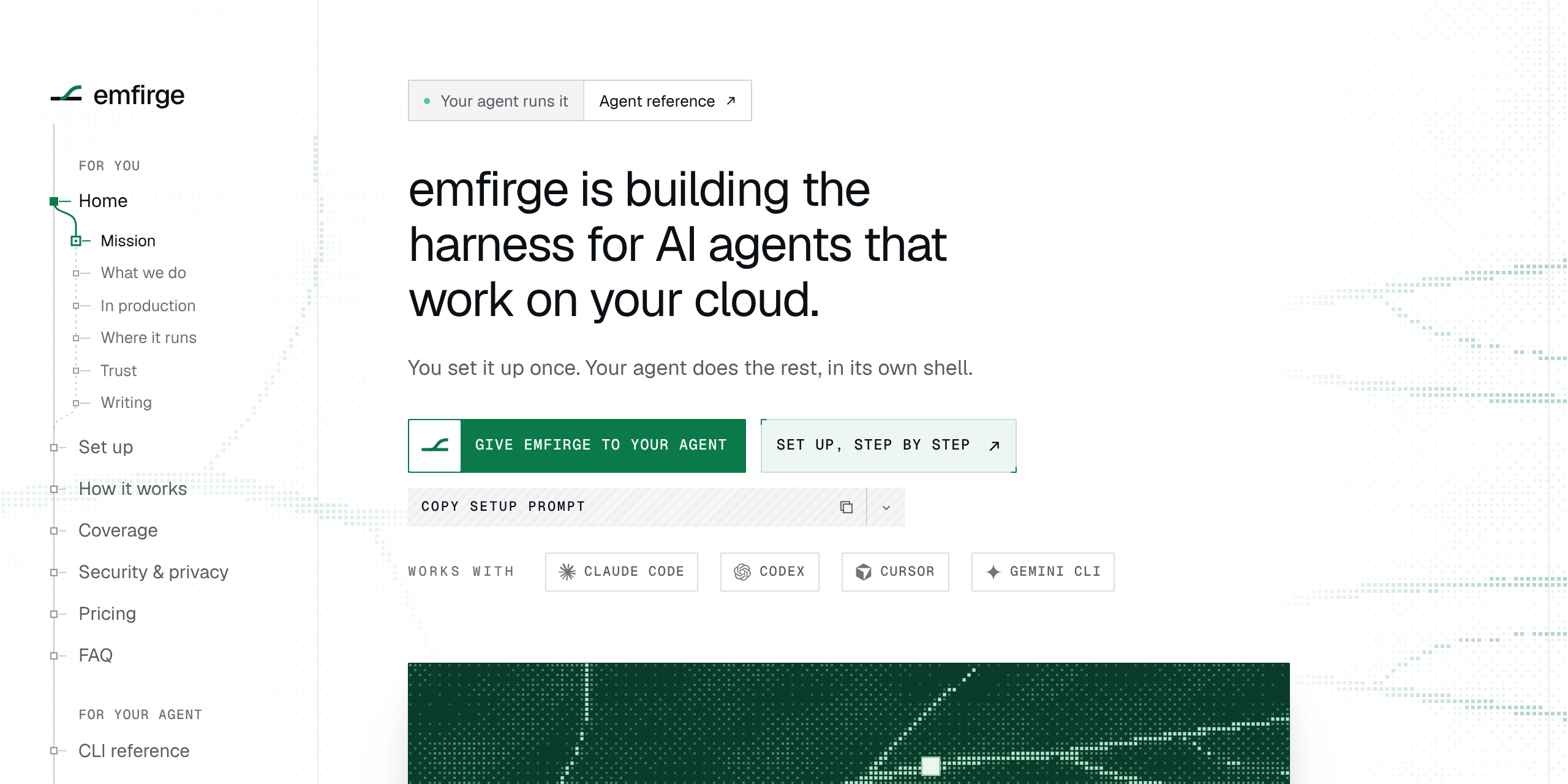
The harness for AI agents that work on your cloud.
You set it up once. Your agent does the rest, in its own shell.
Website · Set up · How it works · CLI reference · llms.txt
People don't use emfirge. Their agent does.
Agents can already write the Terraform and run the AWS CLI. What they can't do is see what a change will break. Emfirge gives them that: a true model of your AWS, a branch of it to try a change on, and six checks that say what the change does, before anything is real.
Emfirge supplies the truth. Your agent supplies the intelligence. There is no AI inside emfirge: the same branch always gets the same answer, and it never writes to your cloud.
you    ▸ Clean up the unused databases in us-east-1.

agent  ▸ I tried it on a branch first. Verdict: block.
         data: orders-db is deleted and has no recovery point
               (data_store_deleted_no_recovery_point)
         availability: 2 services depend on orders-db

         On a second branch, deleting only legacy-reports-db passes.
         Shall I apply that one?
Simplified. The reason codes are the engine's real ones.
Give emfirge to your agent
Paste this into an agent that can run commands (Claude Code, Codex, Cursor, Gemini CLI). It needs Node.js 20 or later.
Set up emfirge for my AWS account and use it for every AWS change from now on.
emfirge is a CLI. Run it as `npx -y emfirge <command>` (Node.js 20 or later). Run `npx -y emfirge guide` first; the full reference is https://emfirge.cloud/cli.md.

1. Run `login`. It opens my browser so I can sign in with GitHub or Google. If it does not open, show me the address it prints, then wait for me.
2. Run `connect` and show me the link it prints. I will create the read-only role and send you the role ARN. Ask me which AWS region to use.
3. Run `context --refresh --role-arn ARN --region REGION`, then `context inventory`. Keep the role ARN: later steps need it.

Before any AWS change: open a branch (`branch open`), try the change on it (`try`), and read `check`. Never apply a change that did not pass. If it fails, fix your plan and try again on the branch. Ask me before `check --policy` or `check --evidence`: they cost money. When a change passes, apply it with your own access, run `report`, and tell me what changed.
You approve two things: the browser sign-in, and one click in AWS that creates a read-only role (delete the stack to revoke it). Running in the cloud or CI? Use an API key instead of the browser: see Set up.
The loop
context → branch → try → check → fix → retry → apply → report
| Verb | What the agent does |
|---|---|
context | Asks what is true: inventory, dependencies, what is reachable, who can access what, cost, what is live |
branch | Opens a copy of live AWS. Fork, roll back, compare, discard. Live never moves |
try | Puts its change on the branch, as typed changes, AWS CLI commands, AWS API calls, a Terraform plan or a CloudFormation change set |
check | Reads six answers with facts, what was checked and what is unknown. --verdict gives pass, warn or block |
request | Asks the owner. Not built yet |
report | The hand-back of what it applied, bound by hash to the verdict it passed |
The agent applies the change itself, with its own access. Emfirge never does.
Six checks
Always all six, always in this order. Each one answers with facts and lists what it could not check.
| Check | The question |
|---|---|
| Data | Did something that holds data disappear with no recovery point? |
| Exposure | Is anything newly reachable from the internet or another account? |
| Money | How did the monthly cost change? |
| Availability | Did something live traffic depends on break or disappear? |
| Control | Did who can do what, or what is logged, change? |
| Outside world | Does the change leave the cloud (support cases, emails, domains, schedules)? |
Where a public source exists, the checks use it: AWS's own API models and Price List, pathfinding.cloud, Prowler and policy_sentry. The same change gives the same verdict whichever way it comes in.
Rules emfirge keeps
- Read-only, always. It reads your account through a role you can revoke. It has no write permission of any kind.
- Unknown is never safe. A change emfirge can't model can't
pass. What it did not check is listed, not hidden. - Private by default. Account IDs and names are swapped for tokens (
S3_001) on your machine before any model sees them. - Facts, not fixes. Emfirge says what a change does. Your agent decides what to do about it.
Emfirge is a model of your cloud, so pass is evidence, not a guarantee. It is advisory: it stops nothing on its own.
In numbers
| Agents deleting prod, benchmark | 49 / 49 locked incident tests pass (synthetic accounts) |
| Laws | 89 numbered properties that must always hold (backend/tests/laws) |
| Engine tests | 3,274 |
| Resource types a branch can change | 18 (coverage) |
| Privilege-escalation paths checked | 92, from pathfinding.cloud |
Status
Free while in beta. What works today and what does not is on the site: coverage, pricing, FAQ.
Repository layout and licenses
| Path | What it is | License |
|---|---|---|
backend/ | The engine: collector, branches, input adapters, the six checks, verdict, hand-back | AGPL-3.0 |
cli/ | emfirge, the CLI on npm | Apache-2.0 |
mcp/ | Shared client code and the MCP adapter | Apache-2.0 |
site/ | emfirge.cloud | AGPL-3.0 |
iam-role.yaml | The read-only role | AGPL-3.0 |
Built by
Emfirge is designed and built by Ansh Sonkar (@theanshsonkar). Building with AI agents on AWS? Email ansh@emfirge.cloud.