Listed from the MCP registry; nobody on Odel publishes it.

OpenRouter
MCP server providing access to 300+ AI models via OpenRouter
Runs on your machine from its package; the steps are below.
What it does
- Reads
- Writes
- High impact
At most: only reads or looks up information.
What it costs
FreeOdel charges nothing per call. The publisher may charge for its own service.
Runs locally over stdio
This server isn't hosted — your MCP client launches it from a package registry. Use one of the commands below, or drop the config into your client (e.g. Claude Desktop).
Run
uvx mcp-openrouter
MCP client config
{
  "mcpServers": {
    "openrouter": {
      "command": "uvx",
      "args": [
        "mcp-openrouter"
      ]
    }
  }
}
🚀 One MCP server for OpenRouter models 🚀
mcp-openrouter is a Python MCP server that lets Codex, Claude Code, opencode, and other MCP hosts call OpenRouter models from local stdio tools.
It exposes chat, image generation, embeddings, model listing, and model search through a small FastMCP server with retry handling, host-aware installation, and optional default model environment variables.
Install
Install the published server into every detected MCP client:
uvx mcp-openrouter install --yes
Install into selected clients:
uvx mcp-openrouter install --yes --clients codex,claude,opencode
Run from a local checkout:
git clone https://github.com/tsilva/mcp-openrouter.git
cd mcp-openrouter
uv sync --dev
uv run mcp-openrouter
mcp-openrouter with no arguments starts the stdio server. The explicit command is uv run mcp-openrouter serve.
Commands
uvx mcp-openrouter install --yes                 # install into detected MCP clients
uvx mcp-openrouter install --yes --force         # replace an existing openrouter config
uvx mcp-openrouter uninstall --yes               # remove from detected MCP clients
uv run mcp-openrouter                            # run the local stdio server
uv run pytest tests/test_cli.py tests/test_client.py tests/test_config.py tests/test_installer.py tests/test_release_metadata.py tests/test_server.py
uv run pytest tests/test_tools.py
uv run ruff check src/
uv run ruff format src/
Tools
| Tool | Purpose |
|---|---|
chat | Send a prompt or message list to an OpenRouter chat model. |
generate_image | Generate one image and optionally save it to an absolute local path. |
embed | Generate embeddings for a string or list of strings. |
list_models | List models, optionally filtered by vision, image_gen, embedding, tools, or long_context. |
find_models | Search model names and slugs, returning up to 20 matches. |
Example MCP prompts:
Use openrouter chat with anthropic/claude-sonnet-4 to summarize this file
Use openrouter generate_image with google/gemini-3-pro-image-preview to create a square app icon
Use openrouter embed with mistralai/mistral-embed-2312 to embed "Hello world"
Use openrouter list_models with capability "image_gen"
Use openrouter find_models to search for "claude"
Configuration
The local gateway needs no application key; upstream credentials stay with
the gateway. The installer rejects
real gateway tokens from --api-key or AGENTBRIDGE_API_KEY before changing host
configuration; it persists only a non-secret marker. Authenticated remote gateways
need a separately reviewed proxy profile.
Optional defaults make the model parameter optional for matching tools:
DEFAULT_TEXT_MODEL=google/gemini-3-pro-image-preview
DEFAULT_IMAGE_MODEL=google/gemini-3-pro-image-preview
DEFAULT_CODE_MODEL=anthropic/claude-sonnet-4.5
DEFAULT_VISION_MODEL=google/gemini-3-pro-image-preview
DEFAULT_EMBEDDING_MODEL=mistralai/mistral-embed-2312
The current tools read DEFAULT_TEXT_MODEL, DEFAULT_IMAGE_MODEL, and DEFAULT_EMBEDDING_MODEL. DEFAULT_CODE_MODEL and DEFAULT_VISION_MODEL are available for client conventions. Non-secret defaults may remain in .env; the API key must not.
Notes
- Python 3.10+ is required.
- The published runtime command installed into hosts is
uvx mcp-openrouter. - Supported installer targets are Codex, Claude Code, and opencode.
generate_image.output_pathmust be absolute, for example/Users/you/output.png.- Unit tests mock network calls. Live tool tests are opt-in and require a separately authorized proxy session and request content.
- After changing server code, restart the MCP host so it launches a fresh server process.
- Keep
server.jsonand the package version in sync before release. Release notes are generated on GitHub. The Makefile release helper ismake release-x.y.z.
Local MCP Development
Register a local checkout when you want an MCP host to run your working tree instead of the published PyPI package.
Claude Code:
claude mcp add openrouter --scope user -- uv run --directory /path/to/mcp-openrouter mcp-openrouter
Codex:
codex mcp add openrouter -- uv run --directory /path/to/mcp-openrouter mcp-openrouter
opencode:
{
  "mcp": {
    "openrouter": {
      "type": "local",
      "command": ["uv", "run", "--directory", "/path/to/mcp-openrouter", "mcp-openrouter"],
      "enabled": true
    }
  }
}
Architecture
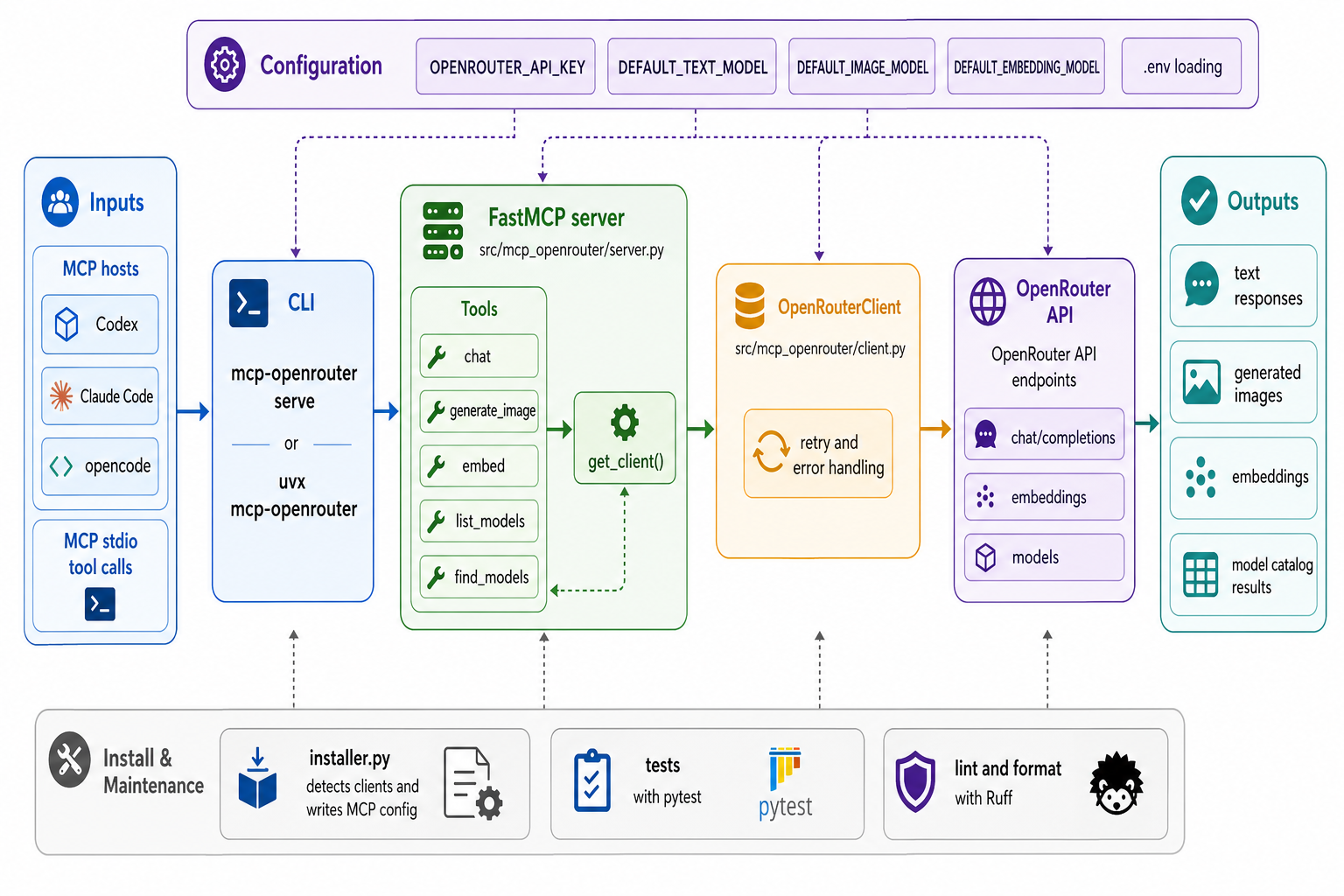
AgentBridge routing
All model requests use AgentBridge as their sole endpoint. Set
AGENTBRIDGE_BASE_URL to its API root (default
http://127.0.0.1:8082/api/v1). AGENTBRIDGE_API_KEY is an optional gateway
access token; upstream OpenRouter credentials are managed only by AgentBridge.
Existing model choices are preserved and gain the gateway's openrouter/
namespace on requests. Image generation and embeddings require the gateway
application routes; there is no direct-provider fallback.