Listed from the MCP registry; nobody on Odel publishes it.

Supabase RLS Check
Read-only Supabase RLS checks: explain rules, analyze/diff SQL exports, scan public env vars.
Runs on your machine from its package; the steps are below.
What it does
- Reads
- Writes
- High impact
At most: only reads or looks up information.
What it costs
FreeOdel charges nothing per call. The publisher may charge for its own service.
Runs locally over stdio
This server isn't hosted — your MCP client launches it from a package registry. Use one of the commands below, or drop the config into your client (e.g. Claude Desktop).
Run
uvx supabase-rls-check
MCP client config
{
  "mcpServers": {
    "supabase-rls-check": {
      "command": "uvx",
      "args": [
        "supabase-rls-check"
      ]
    }
  }
}
A command-line tool that reads PostgreSQL catalog metadata from a Supabase project and flags Row Level Security (RLS) mistakes: tables without RLS, USING (true) policies, SECURITY DEFINER functions callable by anon, public Storage buckets and 16 other patterns. It also scans a local app folder for leaked service_role keys. It never needs a database password or a service_role key, and it never reads table rows. It also ships as an MCP server and a GitHub Action. Python 3.11+, PostgreSQL 15+.
It is for people who ship a Supabase app with the anon key in the browser and want to check what that key can reach. It is a review aid, not a penetration test (see Limitations).
pipx install supabase-rls-check      # or: uvx supabase-rls-check --help
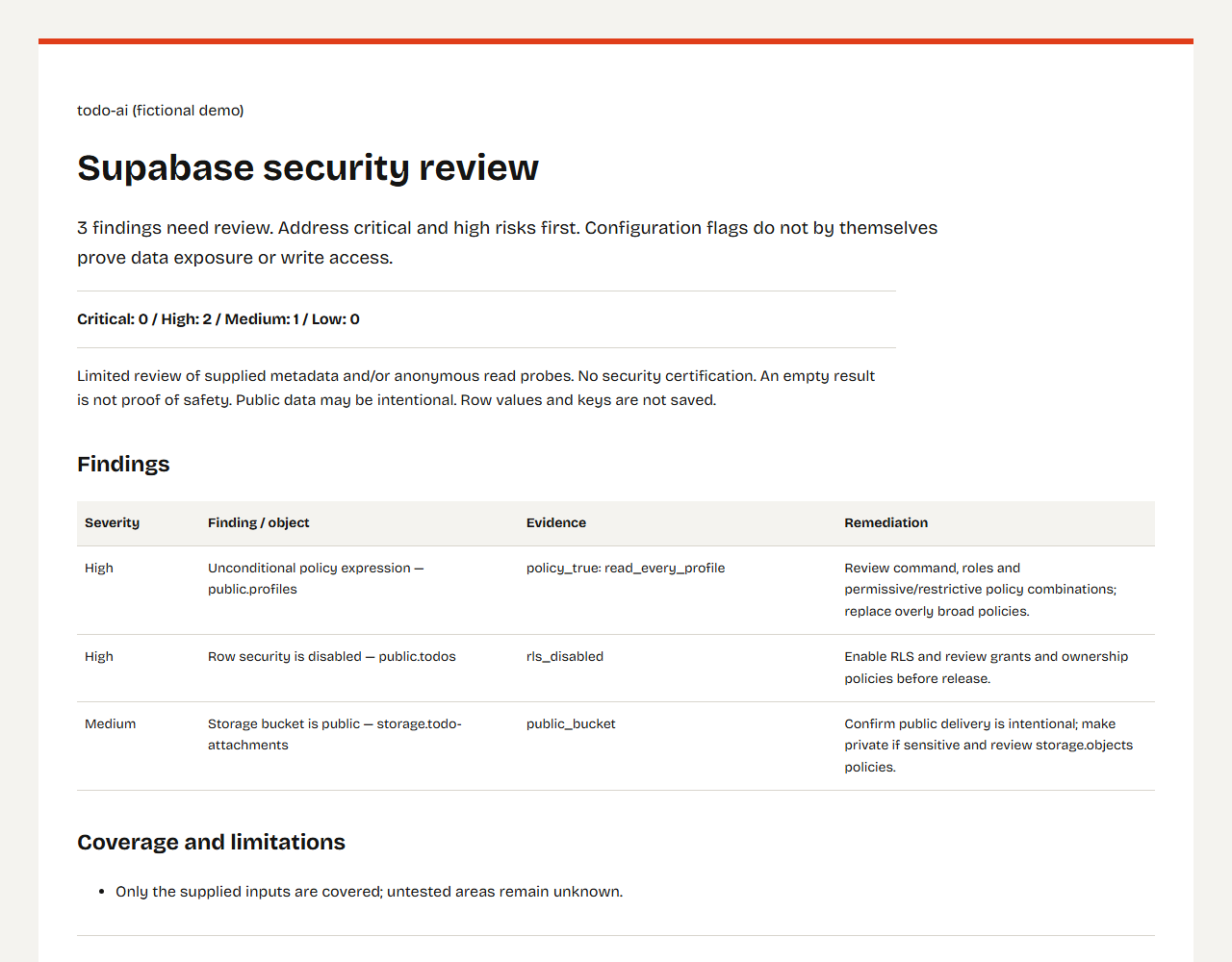
supabase-rls-check report --from demo/todo_ai.csv --out-dir demo --project "todo-ai (fictional demo)" --i-own-this-project
The second command runs on the fictional dataset in demo/todo_ai.csv:
rule,schema_name,object_name,policy_name
rls_disabled,public,todos,
policy_true,public,profiles,read_every_profile
public_bucket,storage,todo-attachments,
It writes demo/report.md, demo/report.html and demo/fix.sql. The Markdown report contains this table:
| Severity | Finding / object | Evidence |
|---|---|---|
| High | Unconditional policy expression: public.profiles | policy_true: read_every_profile |
| High | Row security is disabled: public.todos | rls_disabled |
| Medium | Storage bucket is public: storage.todo-attachments | public_bucket |
fix.sql is a review template that starts with BEGIN; and ends with ROLLBACK;. It enables RLS on profiles and todos and leaves a commented example policy for you to adapt.
Install
pipx install supabase-rls-check
pipx install "supabase-rls-check[mcp]"   # adds the MCP server (mcp>=1.10)
pip install -e ".[dev]"                  # from a source checkout
Usage
1. Export catalog metadata with check.sql
supabase-rls-check sql --print-sql > check.sql
Paste check.sql into the Supabase SQL Editor, adjust the sensitive-table name pattern if needed, run it, and export the single result set as CSV or JSON (columns rule,schema_name,object_name,policy_name,basis). The query reads catalogs only, never application rows. The query file is also at src/supabase_rls_check/sql/check.sql.
Validate and normalize the export:
supabase-rls-check sql --from export.csv --out sql_results.json --i-own-this-project
2. Optional: check anonymous read access with probe
probe asks your project, with the public key only, which tables an unauthenticated visitor can read. With --site it also looks for a service_role JWT in your frontend.
supabase-rls-check probe \
  --url https://YOUR_PROJECT.supabase.co \
  --anon-key YOUR_ANON_OR_PUBLISHABLE_KEY \
  --site https://your-app.example \
  --out probe_results.json \
  --i-own-this-project
- Pass the project origin to
--url, not/rest/v1/. - Only
anonJWTs andsb_publishable_keys are accepted.service_roleandauthenticatedtokens are rejected before any request is sent. - If OpenAPI discovery is off on PostgREST, name the tables yourself with
--tables todos profiles. - Set
SUPABASE_ANON_KEYinstead of--anon-keyto keep the key out of shell history.
It adds two findings: anon_readable (High; column names and visible row count only) and service_role_exposed (Critical; a JWT with role = "service_role" found in the page HTML or a same-origin script).
3. Build the report
supabase-rls-check report \
  --from sql_results.json probe_results.json \
  --out-dir review_out \
  --project "My Supabase App" \
  --i-own-this-project
Output in review_out/:
report.html: standalone, works offline, A4 landscape print stylesheet for Save as PDF.report.md: summary for issues or pull requests.fix.sql: commented review template wrapped inBEGIN; ... ROLLBACK;. The tool never runs it. Replaceuser_idwith your ownership column and test on staging first.
Add --lang vi for Vietnamese text. A Vietnamese demo is in demo/vi/report.md.
Scan your app folder for leaked secrets
scan-env reads local files only, needs no network and no consent flag, and masks every secret it prints (first 6 characters, then …, then last 4).
supabase-rls-check scan-env . --out envscan.json
supabase-rls-check report --from sql_results.json envscan.json --out-dir review_out --project "My Supabase App" --i-own-this-project
It reads .env, .env.*, app.json, app.config.*, eas.json, AI agent and MCP config files (.claude/settings.json, .claude/settings.local.json, .cursor/mcp.json, .mcp.json, .vscode/mcp.json) and client source files (*.js, *.jsx, *.ts, *.tsx, *.mjs, *.cjs, *.vue, *.svelte). It skips node_modules, .git, virtualenvs, build output (dist, build, web-build, android/app/build, ios/build, ios/Pods), binary files and files over 2 MB.
It reports:
public_env_service_role(Critical) andpublic_env_secret_key(High): secrets in variables that get bundled into the client (EXPO_PUBLIC_,NEXT_PUBLIC_,VITE_,REACT_APP_,PUBLIC_,NUXT_PUBLIC_).service_role_in_client_codeanddb_url_in_client_code(both Critical):service_roleJWTs,sb_secret_keys or Postgres URLs with a password in client files.supabase/functions/,server/,api/,scripts/andbackend/are excluded.agent_config_secret(Critical): the same secrets in agent or MCP config files, reported with the file path and, for valid JSON, the key path.
The anon JWT and sb_publishable_ keys belong in a client app and are never reported. Matching is line by line, so obfuscated, split or encoded keys can be missed.
Explain a rule, run the MCP server
supabase-rls-check explain rls_disabled
supabase-rls-check explain definer_anon_exec
supabase-rls-check mcp        # needs the [mcp] extra; stdio transport
The MCP server has five local, read-only tools: analyze_sql_export(path), explain_rule(rule), scan_public_env(path), diff_results(old_path, new_path) and list_rules(). Rule listing and export analysis use the same rule table, including the Realtime and MFA checks. probe is not exposed, so an AI client never handles your API key or makes HTTP requests through this tool.
Compare two runs with diff
supabase-rls-check diff \
  --old baseline_results.json \
  --new sql_results.json \
  --out diff.json \
  --fail-on-new high
diff lists findings that are new or resolved between two local CSV or JSON files. With --fail-on-new (critical, high, medium or low) it exits 1 when a new finding at or above that severity appears. A finding is keyed by (rule, schema_name, object_name, policy_name, basis). basis says why a heuristic rule fired, for example table name matches pattern 'payment' or table comment tag 'pii'. Adding a pii comment to a table therefore shows up as a new finding, and the earlier pattern-based one as resolved. JSON files without a basis key still load, with basis set to "".
One consequence: a baseline exported before 0.6.1 lists an extension-owned table with an empty basis. The first diff against it reports that table as new (with owned by extension <name>) and the old entry as resolved, so --fail-on-new high exits 1 once. Export the baseline again with 0.6.1 or later to clear it.
GitHub Action
The repository is a composite action. It runs check.sql with psql inside a default_transaction_read_only session, writes report.md, report.html and fix.sql, adds a summary table to the job page, and fails the job when a finding is at or above fail-on. Unlike the flow above, it needs a Postgres connection string. Store it as a repository secret and point it at staging or a read-only role. The action refuses to run unless i-own-this-project is "true". Outputs: findings (total) and failing (at or above fail-on).
name: RLS check
on: [pull_request]
jobs:
  rls:
    runs-on: ubuntu-latest
    steps:
      - uses: Tthanh2k6/supabase-rls-check@main
        with:
          database-url: ${{ secrets.STAGING_DATABASE_URL }}
          i-own-this-project: "true"
          fail-on: High        # Critical, High, Medium, Low or none
      - uses: actions/upload-artifact@v4
        if: always()
        with:
          name: rls-report
          path: rls-report/
To catch schema drift outside pull requests, run check.sql on a schedule and diff it against a baseline, for example .rls-baseline.json committed to the repository:
name: RLS drift check
on:
  pull_request:
  schedule:
    - cron: "0 6 * * *"
jobs:
  drift:
    runs-on: ubuntu-latest
    steps:
      - uses: actions/checkout@v4
      - uses: actions/setup-python@v5
        with:
          python-version: "3.12"
      - name: Run check.sql and diff against baseline
        env:
          DATABASE_URL: ${{ secrets.STAGING_DATABASE_URL }}
        run: |
          python -m pip install supabase-rls-check
          supabase-rls-check sql --print-sql > check.sql
          PGOPTIONS='-c default_transaction_read_only=on' \
            psql "$DATABASE_URL" -v ON_ERROR_STOP=1 --csv -f check.sql > current.csv
          supabase-rls-check sql --from current.csv --out current.json --i-own-this-project
          supabase-rls-check diff \
            --old .rls-baseline.json \
            --new current.json \
            --out diff.json \
            --fail-on-new high
      - uses: actions/upload-artifact@v4
        if: always()
        with:
          name: rls-diff
          path: |
            current.json
            diff.json
Rules
check.sql has 20 rules. It queries PostgreSQL 15+ system catalogs and storage.buckets in one read-only query. The table also lists two scan-env rules that read local files.
| Rule ID | Severity | What it flags |
|---|---|---|
rls_disabled | High | Table or partitioned table in public with RLS off. If an extension owns the table (for example PostGIS spatial_ref_sys), it is still reported with basis = owned by extension <name>, and fix.sql suggests moving the extension to an extensions schema, because ENABLE ROW LEVEL SECURITY fails there with "must be owner" (see supabase/supabase discussion #52767). Detection uses pg_depend (deptype = 'e') and covers direct extension members only. Some extensions cannot be relocated, so check first. |
policy_true | High | Policy in public with USING (true) or WITH CHECK (true). |
policy_true_writable | Critical | Permissive UPDATE, DELETE or ALL policy for anon, authenticated or public with USING (true), on a table where anon or authenticated holds UPDATE or DELETE. Anyone with that role can change or delete every row. |
sensitive_anon_policy | High | Policy granted to anon or public on a table whose name matches user, profile, order, payment, invoice, customer, patient, secret, token or document, or that has a pii table comment. basis records which one matched. |
definer_anon_exec | High | Non-trigger SECURITY DEFINER function in public that anon can execute (callable at /rest/v1/rpc/*). |
definer_search_path | High | SECURITY DEFINER function in public with no fixed search_path. |
view_not_invoker | High | View in public without security_invoker, so it runs with the owner's privileges. |
public_bucket | Medium | Storage bucket with public = true. |
public_bucket_listable | Medium | Public bucket that also has an anon or public SELECT (or ALL) policy on storage.objects matching the bucket id or true, so anyone can list its file names. |
public_extension | Low | Extension installed in public instead of an extensions schema. |
policy_user_metadata | High | Policy in public that reads user-editable user_metadata from auth.jwt() or request.jwt.claims. Use app_metadata or an authorization table. |
policy_auth_per_row | Low | Policy on an RLS-enabled table that calls auth.uid(), auth.jwt(), auth.role() or current_setting() without a sub-select. This is a performance finding: write (select auth.uid()). |
auth_users_exposed | Critical | View in public that depends directly on auth.users, lets anon or authenticated SELECT, and is materialized or lacks security_invoker. |
matview_api_exposed | High | Materialized view or foreign table in public that anon or authenticated can SELECT. RLS does not apply to materialized views, so every row is readable through the Data API. |
policy_any_authenticated | Medium | Policy that only checks the caller is signed in (auth.role() = 'authenticated' or auth.uid() IS NOT NULL), so every account gets the same access. |
secret_column_exposed | Medium | Column in public named or ending in api_key, apikey, secret, client_secret, access_token, refresh_token, private_key or password that anon or authenticated can SELECT (basis = column name). RLS limits rows, but the client still receives the plaintext value. |
definer_trusts_id_arg | Medium | SECURITY DEFINER function in public, executable by anon or authenticated, with an argument ending in _id or equal to uid, user, org or tenant, whose source never references auth.uid() or auth.jwt() (basis = argument names). Needs review: it misses functions that delegate the check to a helper and may flag ones that validate the ID against a membership table. |
db_url_in_client_code | Critical | scan-env: a postgres(ql)://user:password@ URL in a client-bundled file. Placeholders such as ${DB_PASSWORD} are ignored. |
realtime_messages_no_policy | Medium | realtime.messages has RLS enabled but no policy explicitly targeting authenticated or PUBLIC; private channel joins lack authorization. Skips missing Realtime objects; inherited roles are not resolved. |
realtime_messages_policy_true | High | A policy on realtime.messages for anon, authenticated or PUBLIC has constant true in USING or WITH CHECK (basis = policy name and command). Review effective grants and restrictive policies before inferring access to every private topic. |
mfa_table_without_aal2 | Medium | Review needed: a table in public tagged mfa in its comment or named mfa_* / *_mfa lacks a RESTRICTIVE policy expression containing auth.jwt() and aal2 (case-insensitive, whitespace tolerant). basis identifies the tag or name convention. This does not verify command/role coverage or prove MFA enforcement. |
agent_config_secret | Critical | scan-env: an sb_secret_ key, service_role JWT or Postgres URL with a password in an agent or MCP config file. |
policy_true_writable, policy_user_metadata, policy_auth_per_row, auth_users_exposed, matview_api_exposed, public_bucket_listable, policy_any_authenticated, secret_column_exposed, definer_trusts_id_arg and all three Realtime/MFA rules add only commented guidance to fix.sql, never DDL. To make sensitive_anon_policy independent of table names, tag tables with COMMENT ON TABLE public.x IS 'pii'.
Realtime and MFA: Private Broadcast/Presence channels use realtime.messages policies: SELECT authorizes receiving and INSERT authorizes sending; scope them by realtime.topic() and membership (Realtime authorization). To opt a table into MFA review, use COMMENT ON TABLE public.x IS 'mfa' or the name conventions above. An aal2 check in a PERMISSIVE policy can be bypassed by another permissive grant, so the check looks for RESTRICTIVE (MFA guide). These are catalog heuristics; test channel access and both aal1/aal2 sessions separately.
Some rules overlap on purpose. policy_true fires on the same policy as policy_true_writable. A materialized view over auth.users produces both auth_users_exposed and matview_api_exposed. A regular view over auth.users can also trigger view_not_invoker. A listable public bucket produces both public_bucket and public_bucket_listable.
Policy checks are heuristics over PostgreSQL's deparsed SQL. The per-row auth check only recognizes calls wrapped directly in a SELECT; complex subqueries need manual review. The auth.users check follows direct dependencies and returns nothing when auth.users does not exist.
How it is tested
pytestruns the offline suite (python -m pytest -q; probe tests block real HTTP requests). It covers consent, probing limits and redaction,scan-env,diff, escaping, English/Vietnamese output, exports for all 20 catalog rules, and MCP tools (includinglist_rules, excludingprobe). Live PostgreSQL tests skip unlessRLS_CHECK_TEST_DATABASEis explicitly set.- GitHub Actions runs
check.sqlon PostgreSQL 15.tests/fixtures/seed_pg.sqlplants issues for 19 rules next to controls, and CI compares 38 expected findings (withbasis) exactly. The mutually exclusive no-policy case usesseed_realtime_no_policy.sqlandrealtime_no_policy.csv. CI also checks missing Auth/Realtime objects, anonymous-only and PUBLIC policies, disabled RLS, both policy expressions and restrictive MFA checks. - A second CI job,
diff-e2e(also runnable asscripts/e2e_diff.pywithpsqlavailable), applies a small schema, builds a report, reruns unchanged (diff --fail-on-new highexits0), addsCOMMENT ON TABLE ... IS 'pii', reruns, and checks that the same command now exits non-zero onsensitive_anon_policy.
Safety rules
- Use it only on projects you own or have written permission to test, including any
--sitedomain. Commands that process project exports or targets need--i-own-this-projector--have-written-consent, and exit before touching the network without one. probesendsGETandHEADonly. It does not follow redirects, setstrust_envto false, caps responses at 5 MB and uses a 20 second timeout.probeasks for at mostlimit=1row per relation, keeps it in memory, extracts column names, discards the values and replaces JWT patterns with[REDACTED]in metadata and error messages.
Limitations
This is a configuration and anonymous-read review aid. It is not a penetration test or a security certification.
- Findings are review signals. A public bucket or an anonymous
SELECTpolicy is sometimes intended. - An empty result, an HTTP
200 []or a401/403on one request does not show the project is safe. - It does not test cross-user isolation between authenticated users,
INSERT/UPDATE/DELETEpermissions, function bodies, Edge Functions, custom Auth hooks or complexstorage.objectspolicy combinations. --sitereads the entry HTML and up to 20 directly linked same-origin HTTPS<script src>files. Dynamically imported chunks, source maps, split or obfuscated tokens andsb_secret_*keys are outside its reach, and JWT signatures are not verified.fix.sqlis a starting template ending inROLLBACK;. A new permissive policy does not override existing broad ones. Export the current policies and grants, and test with two users on staging before committing changes.
Related
- Agent skill for Claude Code, Cursor, Codex and other SKILL.md agents: Supabase RLS Review on Agensi. It walks the agent through the review, policy fixes and a two-user isolation test on staging.
- MCP listings: Glama and mcprush.
- Paid manual review of RLS policies,
SECURITY DEFINERbodies and two-user isolation on staging, from $69 (report plus a ROLLBACK-wrapped fix script): Upwork, Contra.
License
Code: MIT License, Copyright (c) 2026 Trung Thanh Tran. The Bricolage Grotesque report fonts in assets/ are under the SIL Open Font License 1.1 (assets/BricolageGrotesque-OFL.txt).






