
Derbent
Gate for coding agents' MCP and built-in tool calls: rules, approvals and hash-chained receipts
Runs on your machine from its package; the steps are below.
What it does
- Reads
- Writes
- High impact
Not assessed yet.
What it costs
FreeOdel charges nothing per call. The publisher may charge for its own service.
Runs locally
This server runs on your machine over stdio, but its source registry didn't list a distribution package. Check the source repository for setup instructions.

Derbent
One guarded pass for all your coding agents.

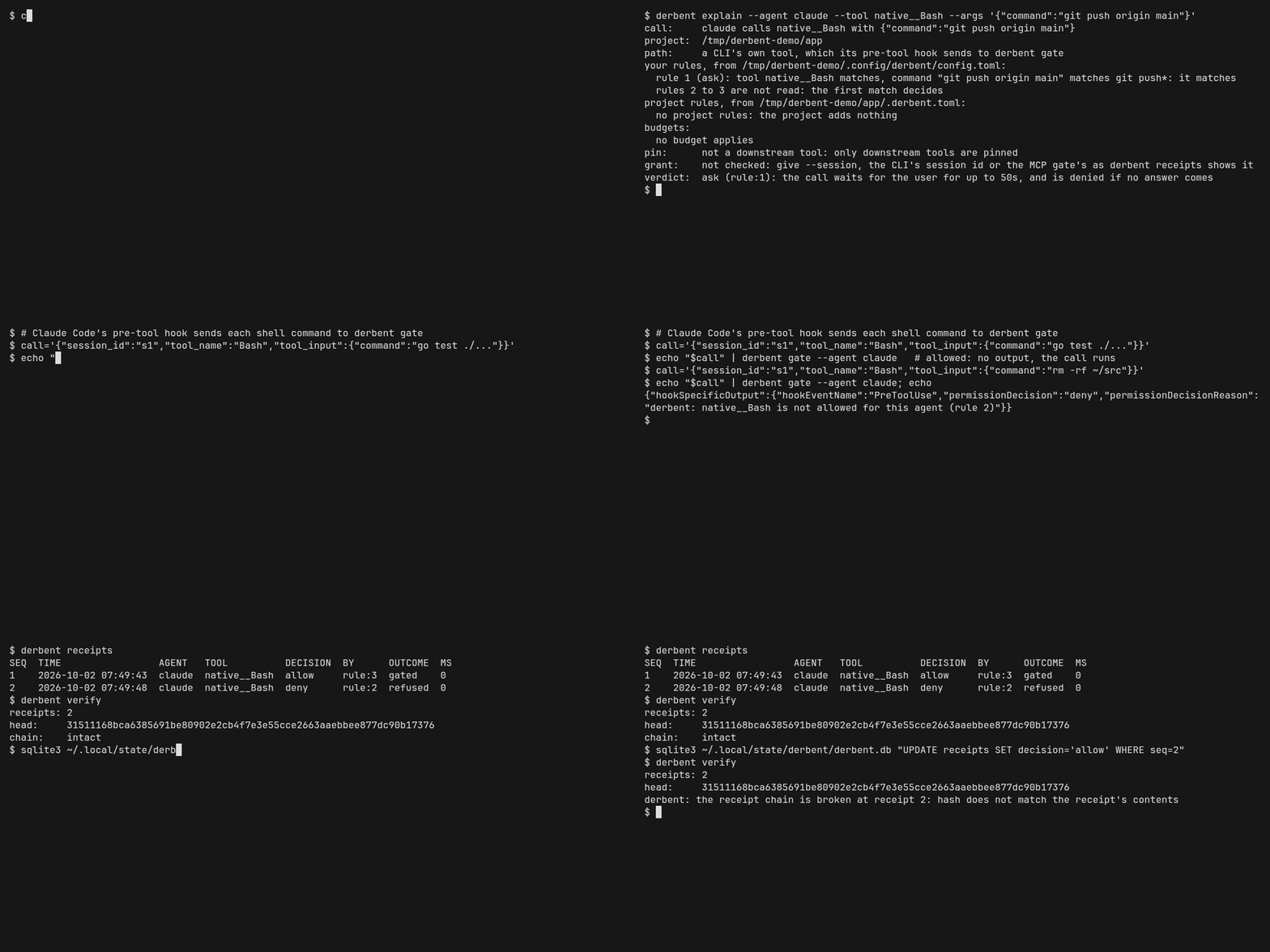
Every tool call that reaches Derbent, MCP or a CLI's built-in tools, is decided by one policy and written to a tamper-evident log, and the calls you care about wait for you.
Derbent guards against mistakes and prompt injection, and keeps an audit trail. It is not a sandbox: an agent that can already run shell commands as you can get around it (see Limits).
In Turkish history, a derbent was a guarded post on a mountain pass: its keepers decided who went through and kept a record of everyone who did. Derbent does the same for your coding agents' tool calls.
Claude Code, Codex, GitHub Copilot CLI and Antigravity CLI connect to Derbent as one MCP server, and your other MCP servers sit behind it. Each CLI's pre-tool hook sends its built-in tools, such as the shell and file edits, through the same gate. Every call is decided by your rules and written down.
Support for Codex and Antigravity CLI is experimental (configured from their docs, not yet checked in a real session).
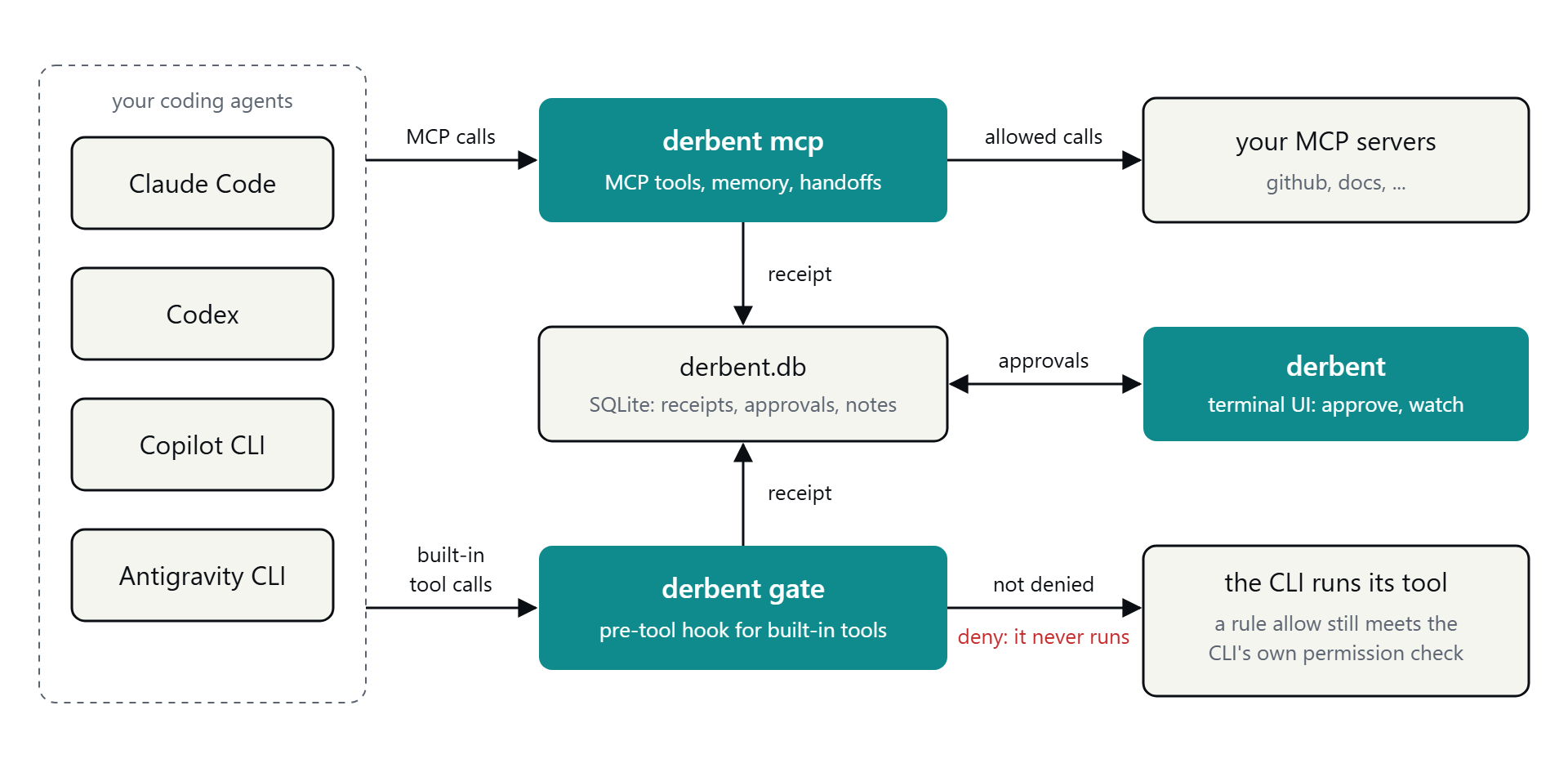
It is one binary for Windows, macOS and Linux. There is no daemon and no network listener: a SQLite file is the only shared state (ADR 0001).
What you get
- Rules that allow, deny or ask, by agent, tool and argument. The first match wins. The same rules apply to MCP tools and to built-in tools such as the shell, in all four CLIs, and a repository can add project rules that only make them stricter.
- Approvals. A call your rules ask about waits until you press
ain the terminal UI, or is denied after 50 seconds by default. - Receipts. Every call gets a hash-chained receipt, and
derbent verifynames the first receipt where the chain breaks after one was edited, moved, inserted or removed. Keep the head hash it prints to catch the newest ones being deleted too.
Also:
- Shared memory and handoffs. Agents keep notes per repository and can leave tasks for each other.
- Pins hold back a downstream server's tool when its definition changes.
- Budgets stop an agent stuck in a loop.
Install
Download the binary for your system and SHA256SUMS from the
latest release, check the hash, and put it
on your PATH as derbent (derbent.exe on Windows):
# Linux on amd64; the other files differ only in the end of the name
curl -LO https://github.com/tunahanaliozturk/derbent/releases/download/v1.0.0/derbent-v1.0.0-linux-amd64
curl -LO https://github.com/tunahanaliozturk/derbent/releases/download/v1.0.0/SHA256SUMS
sha256sum --ignore-missing -c SHA256SUMS
install -m 755 derbent-v1.0.0-linux-amd64 ~/.local/bin/derbent
Or build it with Go 1.27 or later:
go install github.com/tunahanaliozturk/derbent/cmd/derbent@latest
Homebrew (brew install tunahanaliozturk/tap/derbent) and Scoop install it too; see
Install and set up.
Every release can be rebuilt byte for byte from its tag. Install and set up has the other systems, how to check a release, and each CLI's entries by hand.
Quick start
derbent init --preset balanced   # add Derbent to each CLI it finds, and write a first config
derbent doctor                   # check what init wrote
derbent                          # open the terminal UI in a terminal of its own
derbent init shows every change and asks once before it makes any. It copies each file it changes
first and never replaces an entry you already have. With --dry-run it only shows the changes. Two of
them, from a real run with the paths shortened:
claude: ~/.claude.json
  copied first to ~/.claude.json.derbent-backup-20260930T205424Z
  runs:
    claude mcp add --scope user derbent -- ~/bin/derbent mcp --agent claude
derbent: ~/.config/derbent/config.toml
  a new file
  adds the balanced preset (derbent init --preset balanced --print shows it)
It also adds the derbent gate hook to each CLI's settings; Install and set up shows
every entry. Start your agents as usual. Their calls now appear in the UI, and calls the rules ask about
wait there for you. Built-in tools says what each CLI's hook covers.
To put your other MCP servers behind the gate, so each agent needs only the one derbent entry, see
Downstream servers.
How a call is decided
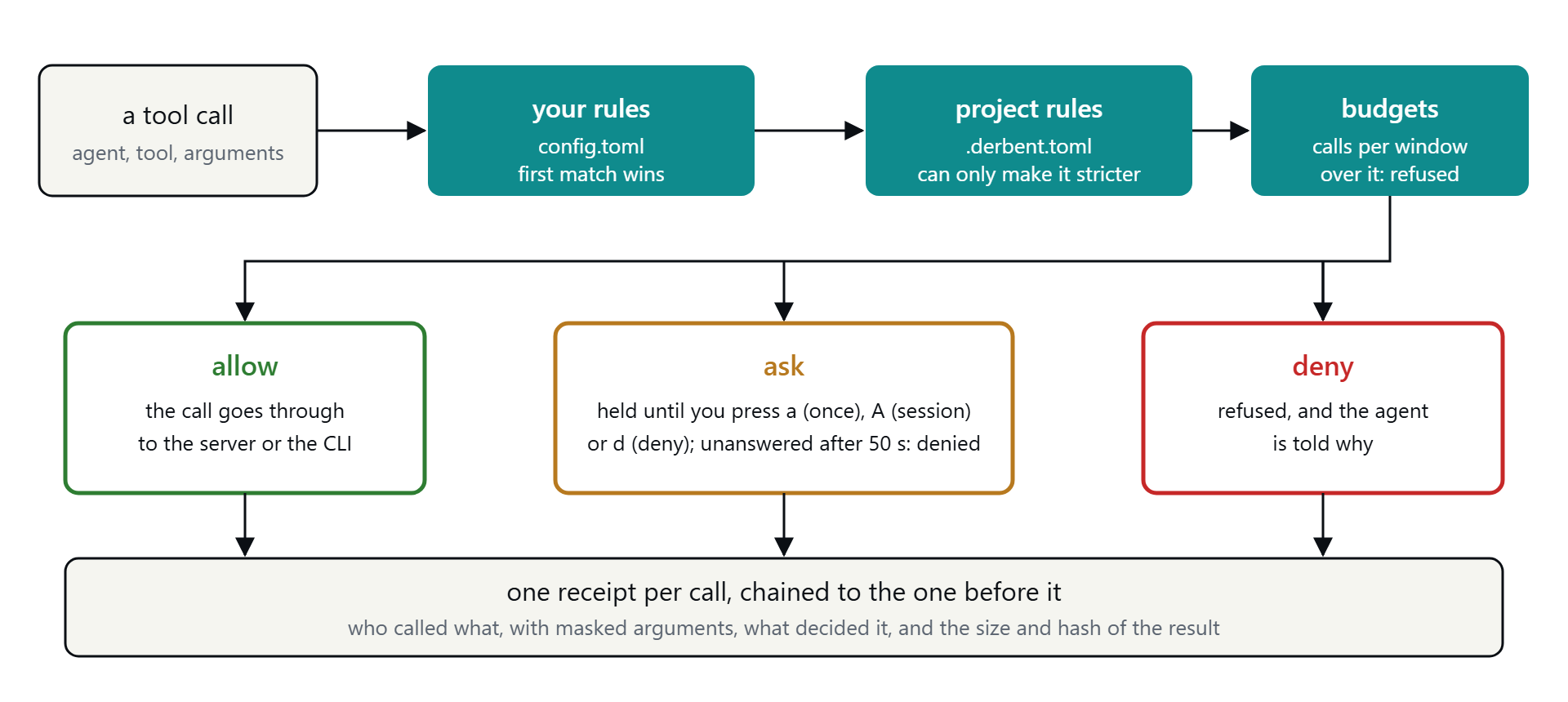
Rules live in config.toml in your user config directory (%AppData%\derbent\ on Windows,
~/.config/derbent/ on Linux, ~/Library/Application Support/derbent/ on macOS). A downstream MCP
server's tools are named <server>__<tool>, and a CLI's built-in tools native__<tool>:
[[rule]]
tool   = "github__issue_read"
action = "allow"

[[rule]]
tool   = "github__*"          # every other GitHub tool waits for you
action = "ask"

[[rule]]
agent  = "claude"
tool   = "native__Bash"       # Claude Code's shell, through the hook
args   = { command = "git push*" }
action = "ask"

[[rule]]
action = "allow"              # the last rule has no condition
To see how a call would be decided before it happens:
derbent explain --agent claude --tool native__Bash --args '{"command":"git push origin main"}'
It prints each rule and why it matches or not, down to the first match, then the project's rules,
budgets, pin and grant, and ends with verdict: ask (rule:3) for this call under the rules above. Rules covers globs, the three presets (watch,
balanced, strict), project rules, budgets and rule suggestions.
Receipts
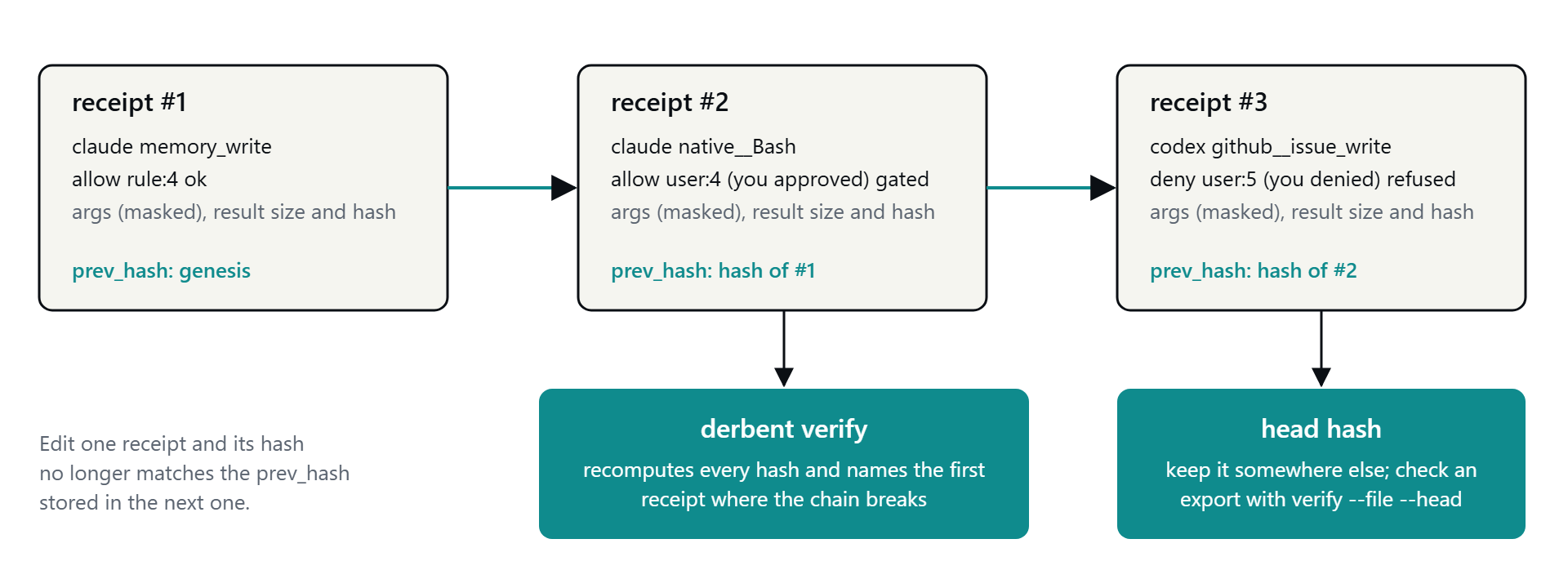
derbent verify                              # count, head hash, and whether the chain is intact
derbent receipts --agent codex --since 1h   # also --tool, --project, --limit, --json
A receipt keeps the arguments after masking secrets, and only the size and hash of what a tool returned (ADR 0004). Someone who can write the database could still rewrite the whole chain or delete the newest receipts, so keep the head hash somewhere else if you want to be able to tell later. Receipts and verify covers exports that can be checked without the database.
Commands
| Command | What it does | More |
|---|---|---|
derbent | Terminal UI: waiting calls, agents, live receipts, memory, grants | Approvals |
derbent init, derbent doctor | Add Derbent to each CLI, then check the setup | Install |
derbent mcp --agent <name> | The MCP server each CLI starts | Install |
derbent gate --agent <name> | The pre-tool hook for built-in tools | Built-in tools |
derbent pending, approve, deny | Answer waiting calls from any shell | Approvals |
derbent grants, revoke | List and take back session grants | Approvals |
derbent explain | Show how a call would be decided | Rules |
derbent suggest | Print the rules your answers point to | Rules |
derbent config check | Validate the config and list each server's tools | Servers |
derbent pins | See and accept changed downstream tools | Servers |
derbent receipts, verify | Read, export and verify receipts | Receipts |
derbent handoffs | List the tasks agents left for each other | Memory and handoffs |
derbent version | Print the release |
Overhead
Measured on GitHub's hosted runners on 2026-10-01 (Linux on an Intel Xeon Platinum 8370C, Windows on an AMD EPYC 9V74, 4 vCPUs each), median of ten runs at p50, from docs/benchmark-results:
| Linux | Windows | |
|---|---|---|
| MCP tool call, direct to the server | 256.5 µs | 293.0 µs |
| MCP tool call, through the gate | 756.0 µs | 909.0 µs |
| Starting the binary and exiting | 4.292 ms | 40.40 ms |
Hook call, derbent gate, allowed | 6.421 ms | 64.51 ms |
The gate adds 499.5 µs to an MCP call on Linux and 616.0 µs on Windows, for the extra stdio hop, the rule decision, the project rules check and the receipt written to SQLite. A hook call costs about 2.1 ms more than starting the binary on Linux and 24 ms more on Windows, where most of its cost is the process start. The numbers come from one run on shared runners, and runs differ by more than one run's intervals: the day before, the same code on the same Windows CPU model put the gate 459.5 µs over a direct MCP call, against 616.0 µs here. The results page has p99, calls per second and the caveats.
Limits
The whole list, with the reasons, is under Known limits and risks. The ones to know first:
- Only calls that pass through the gate are seen. Tools a CLI never shows its hook, such as Codex's hosted web search, are outside it.
- The CLIs marked experimental at the top have entries and hook adapters that follow each CLI's documentation and have not been checked in a real session. Claude Code and Copilot CLI (1.0.88, on 2026-10-02) have.
- Argument globs match strings, not meaning:
git push*does not matchcd repo && git push. - Approvals guard against mistakes and prompt injection inside MCP. They do not stop an agent that can
already run shell commands as you: it can run
derbent approveitself. - A receipt export shows its last run unchanged only against a head you kept, and never that nothing was left out of it.
- A suggestion refuses the shells, launchers and operators it knows, but a text rule can be fooled and
those lists cannot be complete, and an
allowfor a command prefix lets any options through. - A handoff's address is a label, not an identity: any agent that can call
handoff_takecan claim every open handoff addressed to*. - Approvals depend on you watching. Unattended,
askmeans denied after the timeout. - Pins trust the first definition they see, including a new tool that an update adds to a pinned server, so name the tools you allow for a server whose updates you do not review.
- A budget can be passed by the calls in flight at the same moment.
- CI runs the tests on Windows and Linux and only builds on macOS.
For teams
A team audit trail, with receipts synced off each machine and an export for a SIEM, is an idea, not a plan. If you would use it, say so in this discussion.
Docs
- Install and set up: every system, checking a release, each CLI by hand
- Rules: rules, presets,
explain, project rules, budgets, suggestions - Approvals and the UI: keys, grants, answering from a shell
- Built-in tools: the hook, tool names per CLI, what each CLI covers
- Downstream servers and tool pins
- Receipts and verify: what a receipt holds, exports,
verify --file - Memory and handoffs
- Demo: a transcript of two real Claude Code sessions sharing one gate
- Design, the contract for the build, and the decisions behind it
Changes are listed in the changelog. To build, test or send a change, see CONTRIBUTING.md. To report a vulnerability, see SECURITY.md.
Licence
Apache 2.0. See LICENSE.