
vmd-hydrate-mcp
Drive VMD from any LLM — render GROMACS/LAMMPS trajectories and analyze clathrate-hydrate cages through the Model Context Protocol.
Quick Start · Features · MCP Tools · Usage · 한국어



[!NOTE] An MCP server that lets Claude (or any MCP client) control VMD directly — load GROMACS/LAMMPS trajectories, identify clathrate-hydrate cages (sI/sII/sH), script headless renders, and compute order parameters (F3/F4) and H-bond networks — turning molecular-dynamics analysis into a conversation. Unlike the existing VMD MCP, it keeps a stateful VMD session, is secure by default, and owns the one thing no other MCP does: hydrate cage science.
See it in action
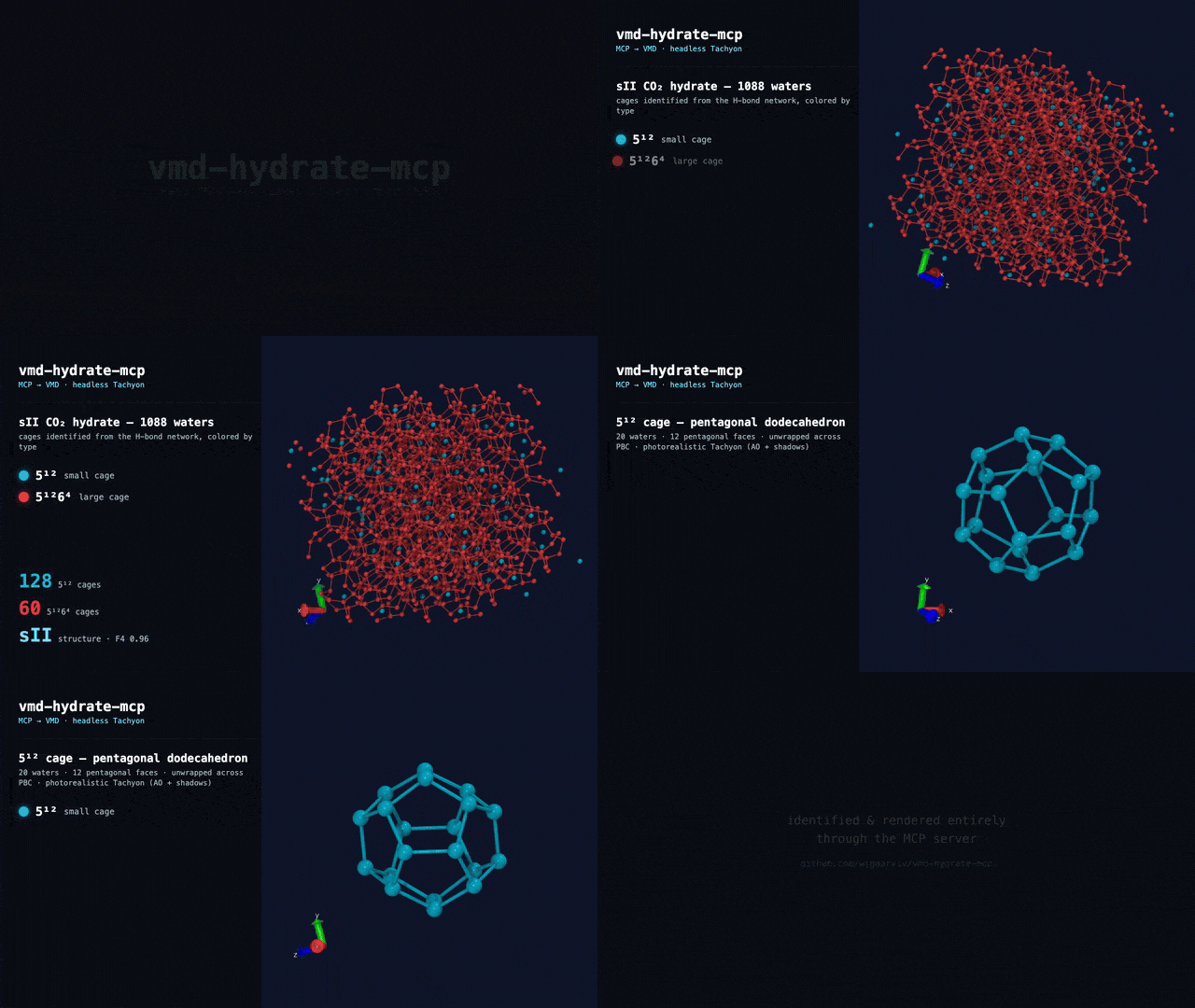
Every frame is a real headless VMD (Tachyon) render, driven entirely through the MCP server. The sII cages — 128 × 5¹² + 60 × 5¹²6⁴ — are identified by this repo, not mocked. · ▶ full-quality MP4
Features
- Clathrate Cage Identification -- find and classify hydrate cages (5¹², 5¹²6², 5¹²6⁴, …) from the H-bond network and label the crystal structure (sI/sII/sH). Validated on the sII benchmark (128 small cages, exact).
- Photorealistic, Style-by-Prompt Cage Rendering -- cages render with ambient occlusion + shadows, orthographic by default, each cage type in ONE unified color (a curated palette: 5¹²=cyan, 5¹²6⁴=red, …). Just ask: "show only the sII large cages in magenta with emphasized width" and the MCP filters, recolors, and thickens them.
- Stateful VMD Session -- a persistent VMD process (Tcl socket server) keeps your molecules, selections, and camera alive across tool calls -- no reloading on every command.
- Hydrate Order Parameters -- F3 (tetrahedrality) and F4 (⟨cos 3φ⟩) computed in pure NumPy, validated to the reference to 6 decimals (F4 = 0.926698 on the sII benchmark).
- H-bond Networks -- water–water hydrogen-bond graph with coordination stats, the substrate for cage identification.
- Headless Rendering -- CPU Tachyon ray-traced PNGs with no display or GPU, returned inline as images. Works on laptops, servers, and HPC.
- Attended (GUI) Mode -- run fully offscreen (default), or set
VMD_HYDRATE_MCP_DISPLAY=guito open a visible VMD window and watch Claude load, color, rotate, and render your system live. - GROMACS + LAMMPS -- one server ingests
.gro/.xtc/.trr, LAMMPS.data/dump, PDB, DCD, mmCIF. - Secure by Default -- filesystem allowlist + a Tcl command allowlist (not a bypassable denylist) + a loopback, token-gated control socket. No
run_tclfoot-gun exposed. - MCP-Native -- clean English tool names and typed outputs; works in Claude Desktop, Claude Code, and any MCP client.
Quick Start
[!IMPORTANT] Requires a local VMD install (2.0b1 or 1.9.4+) — this server drives your VMD; no registry or package ships it. On macOS, VMD lives inside a
.app, so setVMD_BINifvmdisn't on yourPATH. (The pure hydrate/measure tools still work without VMD.)
Install
Zero-install via uvx (recommended):
uvx vmd-hydrate-mcp                                  # run the server
uvx --from 'vmd-hydrate-mcp[mda]' vmd-hydrate-mcp    # + MDAnalysis for measures/selection
Or from source:
git clone https://github.com/wjgoarxiv/vmd-hydrate-mcp.git
cd vmd-hydrate-mcp && uv pip install -e ".[mda]"
Register with an MCP client
Claude Code — one command:
claude mcp add vmd-hydrate -- uvx vmd-hydrate-mcp
Claude Desktop / any client — add to the mcpServers config (or commit a project .mcp.json):
{
  "mcpServers": {
    "vmd-hydrate": {
      "command": "uvx",
      "args": ["vmd-hydrate-mcp"],
      "env": { "VMD_HYDRATE_MCP_ALLOW_DIR": "/path/to/your/data" }
    }
  }
}
[!IMPORTANT] Set
VMD_HYDRATE_MCP_ALLOW_DIR(os-path-separated) to the directories the server may read. All file arguments are realpath-checked against this allowlist — paths outside it are refused.
Attended (GUI) mode
By default the server drives VMD headless (offscreen). To instead open a real VMD window you can watch while Claude controls it live, add VMD_HYDRATE_MCP_DISPLAY=gui to the server's env:
{ "mcpServers": { "vmd-hydrate": {
  "command": "uvx", "args": ["vmd-hydrate-mcp"],
  "env": { "VMD_HYDRATE_MCP_DISPLAY": "gui", "VMD_HYDRATE_MCP_ALLOW_DIR": "/path/to/data" }
}}}
Then ask things like "load prod.gro, show water as points and the surfactant as VDW, then slowly rotate it" — the window updates in real time via load_structure → add_representation → rotate_view. (Requires a local desktop session; the same Tcl socket drives both modes.)
MCP Tools
| Tool | Purpose | Backend |
|---|---|---|
vmd_status | VMD version + molecules loaded in the live session | VMD |
load_structure | Load a structure/trajectory (returns a molid) | VMD |
list_molecules | List loaded molecules | VMD |
set_representation | Style/color/material/selection for a molecule (replaces reps) | VMD |
add_representation | Layer another representation (multi-rep views) | VMD |
clear_representations | Remove all representations | VMD |
rotate_view / zoom_view / reset_view | Live camera control (visible in GUI mode) | VMD |
render | Headless PNG of the current view | VMD + Tachyon |
resolve_selection | Atom count for a selection (catches the 0-atom .gro trap) | MDAnalysis |
measure_geometry | Distance / angle / dihedral by atom index | MDAnalysis |
radius_of_gyration | Rg of a selection | MDAnalysis |
hydrate_order_params | F3 + F4 water order parameters | NumPy |
hbond_network | Water H-bond network + coordination | NumPy |
identify_cages | Cage counts (5¹²/5¹²6⁴/…) + sI/sII/sH structure | NumPy |
render_cages | Photorealistic cage render (AO+shadows, ortho); filter / recolor / emphasize cages by prompt | VMD + NumPy |
Usage
1. Analyze hydrate order in a trajectory frame
Compute the F3/F4 order parameters for hydrate.gro
Returns f4_overall, f3_overall, water count, and a plain-language interpretation (crystalline / hydrate-like / liquid / ice).
2. Render a structure
Load hydrate.gro, show the water oxygens as VDW spheres, and render it
Produces an inline PNG rendered headlessly with CPU Tachyon.
3. Inspect the H-bond network
Build the water hydrogen-bond network for hydrate.gro at frame 0
Returns bond count and average coordination (≈4 for a well-formed clathrate).
4. Style hydrate cages by prompt
Load hydrate.gro and show only the sII large cages in magenta with emphasized width
Renders a photorealistic, orthographic image of just the 5¹²6⁴ cages in magenta with thicker edges — the MCP maps this to render_cages(cage_types=["51264"], highlight_color="magenta", emphasis=True). Omit the filters and every cage type is drawn in its palette color (5¹²=cyan, 5¹²6⁴=red, …).
Does it really drive VMD?
Yes — and you can confirm it in one command. examples/verify.py runs the same code the MCP server exposes on a bundled sII CO₂-hydrate example: it pings the real VMD binary, identifies the cages, and renders them headlessly.
python examples/verify.py
Expected output:
[1] VMD found : /Applications/VMD2b1.app/.../vmd_MACOSXARM64
    ping      : pong 2.0b1 MACOSXARM64
[2] Identifying cages in a real sII CO2 hydrate (1088 waters)...
    cage counts : {'51264': 60, '512': 128}
    structure   : sII  (confidence 0.93)
    F4 order    : 0.965  (highly ordered (crystalline hydrate / ice-like))
[3] Rendering cages headlessly (blue = 5^12, red = 5^12 6^4)...
    saved       : examples/output/cages.png (362495 bytes)
OK — vmd-hydrate-mcp drove VMD and identified the cages above.
The images below are real, unretouched VMD renders from that pipeline (not illustrations):
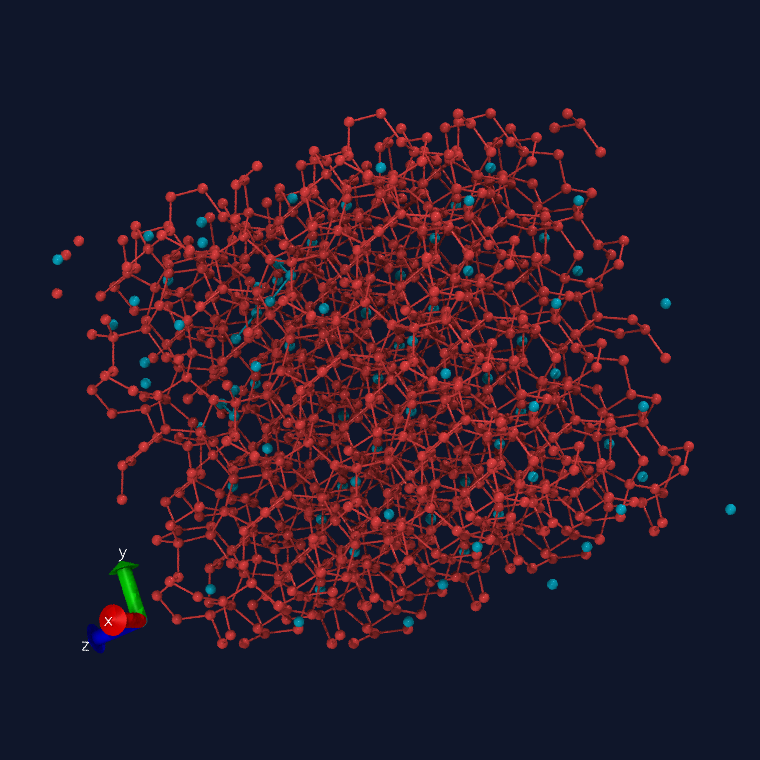 sII crystal — cages colored by type (cyan 5¹², red 5¹²6⁴), photorealistic Tachyon | 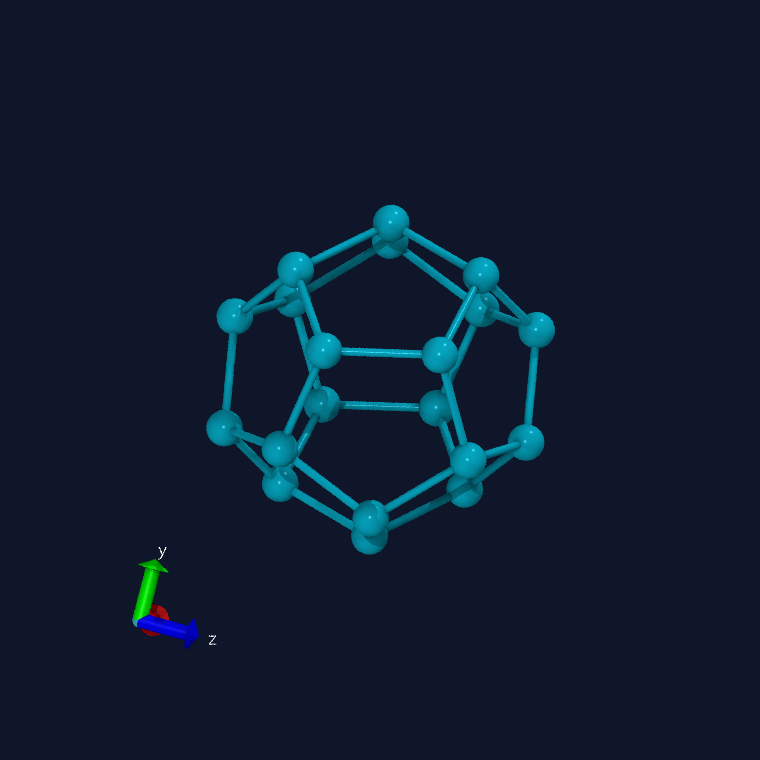 a single 5¹² dodecahedron, unwrapped across PBC (ambient occlusion + shadows) |
The demo video at the top is assembled from frames like these — see video/build_frames.py (drives VMD) and video/remotion/ (Remotion compositing). Rebuild it with python video/build_frames.py && cd video/remotion && npm i && npm run gif.
How It Works
  [.gro / .xtc / LAMMPS dump]
            |
            v
     MCP client (Claude)  --stdio-->  vmd-hydrate-mcp (FastMCP)
                                          |            |
                          numbers  <------+            +------>  visualization
                     MDAnalysis + NumPy                     persistent VMD session
                   (F3/F4, H-bonds, Rg)                    (Tcl socket, 127.0.0.1)
                          |                                         |
                          v                                         v
                  structured JSON                         Tachyon --> PNG image
Numeric science runs in Python (no display, unit-testable in CI). Visualization and rendering run in a long-lived, token-gated VMD process. The two never mix units: hydrate math is nanometers, VMD/MDAnalysis measures are Ångström.
Requirements
| Dependency | Required | Purpose |
|---|---|---|
| VMD 2.0b1 or 1.9.4+ | for viz/render | the visualization engine |
| Python 3.10+ | yes | the server |
mcp | yes | Model Context Protocol SDK |
MDAnalysis ([mda]) | for measures/selection | topology-aware loading |
sips / ImageMagick / Pillow | for render | TGA→PNG conversion |
[!WARNING] On macOS, VMD ships as a
.appand its CLI binary lives inside the bundle. Ifvmdis not on yourPATH, setVMD_BINto the binary (e.g./Applications/VMD*.app/Contents/vmd*/vmd_MACOSXARM64). Pure hydrate/measure tools work without VMD.
Contributing
- Fork and branch (
git checkout -b feature/x). uv pip install -e ".[dev,mda]"and keeppytestgreen (science tests need no VMD).- Commit, push, open a PR. Found a bug? Open an issue.
License
MIT — see LICENSE.