Listed from the MCP registry; nobody on Odel publishes it.
Is this yours? Claim it
DogPolicies
Verified dog rules for California and Nevada travel: hotel pet fees, trip plans, highway stops
One address for any MCP client. No sign-in needed on this server.
What it does
9 read1 act10 other
Grouped by tool name.
What it costs
FreeOdel charges nothing per call. The publisher may charge for its own service.
Tools
20 · grouped by tool name · checked 26 Nov 2026Read · 9Look things up
- dogpolicies_search_places
- dogpolicies_get_place
- dogpolicies_compare_places
- dogpolicies_find_hotels
- dogpolicies_get_brand_policy
- dogpolicies_get_airline_policy
- dogpolicies_compare_airlines
- dogpolicies_browse_answers
- dogpolicies_get_rule
Act · 1Change something
- dogpolicies_subscribe_changes
Other · 10Neither hinted nor named
- dogpolicies_near
- dogpolicies_plan_trip
- dogpolicies_route_stops
- dogpolicies_i5_corridor
- dogpolicies_i5_conditions
- dogpolicies_road_conditions
- dogpolicies_emergency_vet
- dogpolicies_changes_since
- dogpolicies_changes_near
- dogpolicies_report_correction
DogPolicies MCP server
dogpolicies.com · Verified dog rules for California and Nevada travel: hotel pet fees, trip plans, highway stops. Install guide and example · Status
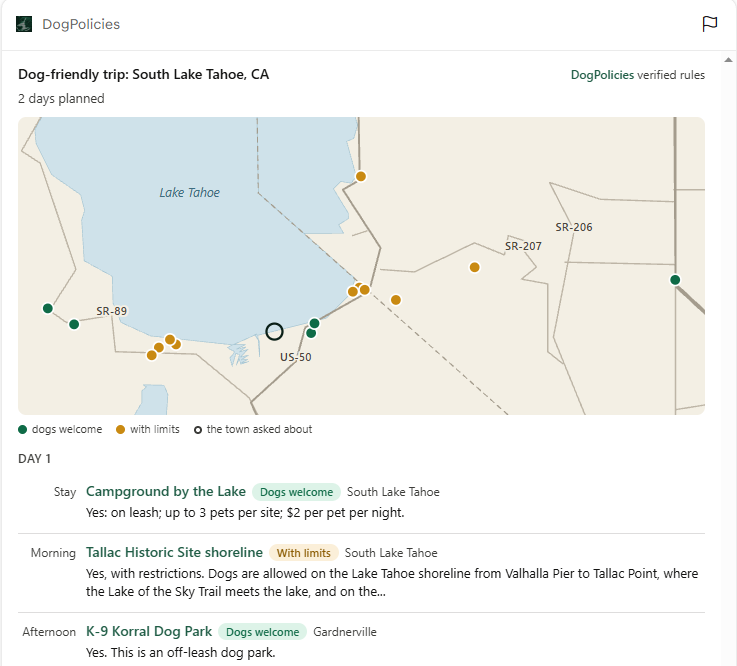
In Claude: “Use DogPolicies: plan two nights in South Lake Tahoe with our dog.” Every stop links to its source and the date it was checked.
DogPolicies answers dog-travel questions for California and Nevada, and every fact it returns carries its official source (an agency page or the business's own published policy) and the date it was checked; Nevada coverage is still thin. It does the work a web page cannot: the pet-fee arithmetic for a specific dog, day-by-day trip plans, highway stops in driving order with Caltrans conditions right now, the nearest 24-hour emergency vet on the way, what changed since a date, and corrections a person checks. In Claude and ChatGPT a trip, a town or a drive also comes back as a card in the chat.
Listed in Claude's connector directory since November 4, 2026: add DogPolicies in Claude with nothing to install. Also on npm and in the official MCP Registry. DogPolicies is independent and not affiliated with Anthropic.





Connect
The hosted server is https://dogpolicies.com/mcp/: Streamable HTTP, no key, no account, nothing to install.
- Claude (claude.ai or Claude Desktop): open DogPolicies in Claude's connector directory, add it and turn it on in the chat's tools menu. By hand: Settings → Connectors → Add custom connector, name DogPolicies, URL
https://dogpolicies.com/mcp/. - Claude Code:
claude mcp add --transport http dogpolicies https://dogpolicies.com/mcp/ - Cursor and VS Code:
Both add the hosted URL; the app asks you to confirm.
- Any other client that connects to a remote MCP server: give it the URL above.

To run it on your own machine over stdio instead (the data ships inside the package and works offline; Node.js 20.19 or newer):
{
  "mcpServers": {
    "dogpolicies": { "command": "npx", "args": ["-y", "dogpolicies-mcp"] }
  }
}
On Windows write "command": "cmd", "args": ["/c", "npx", "-y", "dogpolicies-mcp"], because clients start commands without a shell. Or let the installer write it:
npx dogpolicies-mcp install                      # Claude Desktop; --client cursor | vscode | windsurf | claude-code, or --all
npx dogpolicies-mcp install --hosted --dry-run   # the URL form instead, previewed without changing anything
claude mcp add dogpolicies -- npx -y dogpolicies-mcp   # Claude Code (Windows: -- cmd /c npx -y dogpolicies-mcp)
The installer finds the client's config on Windows, macOS and Linux, backs it up, merges one entry without touching other settings, refuses a file it cannot parse and prints the restart step. Claude Desktop also takes the one-click extension, dogpolicies-mcp-<version>.mcpb, from the latest release. npx dogpolicies-mcp --http --port 3737 serves Streamable HTTP at http://127.0.0.1:3737/mcp.
Config files, by hand
- Claude Desktop: Settings → Developer → Edit Config (
%APPDATA%\Claude\claude_desktop_config.jsonon Windows,~/Library/Application Support/Claude/claude_desktop_config.jsonon macOS), then fully quit and reopen it. - Cursor:
~/.cursor/mcp.json, or.cursor/mcp.jsonin a project;{ "url": "https://dogpolicies.com/mcp/" }for the hosted server. - VS Code:
~/.copilot/mcp-config.jsonwith the same block, orcode --add-mcp '{"name":"dogpolicies","type":"stdio","command":"npx","args":["-y","dogpolicies-mcp"]}'. - Windsurf:
~/.codeium/windsurf/mcp_config.json;{ "serverUrl": "https://dogpolicies.com/mcp/" }for the hosted server.
What it does
The tools, by the job they do. Every one except dogpolicies_report_correction only reads.
Fit and arithmetic
dogpolicies_find_hotels: which hotels take this dog, by weight, number of dogs, nights and a pet-fee budget. Each hotel is a match, a possible (call to confirm) or excluded, with the arithmetic spelled out ("2 dogs x 3 nights x $25 per pet per night = $150, capped at $100 per stay = $100"). Amounts are pet fees, never room rates.dogpolicies_plan_trip: a whole stay in one call. Stays that fit, with the pet fee for every night worked out, then the plan day by day: the stay, a morning beach, trail or off-leash area, an afternoon park and a dinner patio, each a real record with its source and date; a slot the data cannot fill is left empty with the reason.start_datedates each day,stay_idbuilds the plan on a chosen stay, andsave: truereturns ahttps://dogpolicies.com/trips/#v1.…link that carries the whole plan inside the link, so nothing is stored. Near I-5 it adds the drive leg.dogpolicies_get_brand_policy: a hotel chain's published pet policy (Best Western, Extended Stay America, Kimpton, La Quinta, Motel 6, Red Roof), its listed exceptions and how many properties carry it.
Routes and live state
dogpolicies_route_stops: dog stops along a highway in driving order, each with its mile, side and distance off the road: I-5, US-101, Highway 1, I-15, I-80 and US-50 in California; I-15, I-80, US-50, US-95 and US-93 in Nevada. Rest areas with pet areas, travel stops with dog parks, hotels with the stay's pet fee, campgrounds, parks and beaches. On I-5 also family stops (restrooms and a pet area stated by the source) and paired exits.dogpolicies_i5_corridor: I-5 in California by named stretch (the Grapevine, the Westside, Shasta and the rest), a mile range or the next miles ahead of a point.dogpolicies_i5_conditions: Caltrans lane closures, chain controls, road weather and sign messages on I-5 right now, each placed on the road beside the nearest dog stop. Live state, not rules; it needs the network.
A rest area Caltrans reports closed right now carries closed_now (Caltrans' reason and end time) in route_stops, i5_corridor and plan_trip, and is never offered as the next stop.
dogpolicies_road_conditions: Caltrans chain controls, lane and ramp closures, road weather and sign messages right now on I-80, US-50, I-15, I-5 and US-395 in California (Donner Summit, Echo Summit, Cajon Pass, the Grapevine, the Eastern Sierra past Mammoth Lakes) and the Lake Tahoe highways SR-89 (Emerald Bay, Luther Pass), SR-28, SR-267 and SR-88 (Carson Pass), by route, town or named stretch, each at its route mile beside the nearest dog stop. Live state, not rules; Nevada roads are not covered (the answer links Nevada 511); it needs the network.
Emergency
dogpolicies_emergency_vet: the nearest 24-hour and emergency animal hospitals to a town, place or point, nearest first, each with its phone, address, hours, distance in a straight line and the hospital's own page as the source.open_24h_onlykeeps the 24-hour ones; when none is within the radius it still names the nearest 24-hour hospital at any distance. Where and when only, never medical advice.dogpolicies_nearanddogpolicies_plan_tripadd the nearest 24-hour hospital asvet, anddogpolicies_route_stopsaddsvetsfor the start and end of the stretch.
Change
dogpolicies_changes_since: re-checks and rule changes since a date, newest first; on the hosted server also the corrections filed or decided since then, by ticket and status.dogpolicies_changes_near: the same around a town, region or point, for one place (place_id) or along a highway's stops (route,from_mile,to_mile), to re-check a trip before you go.dogpolicies_subscribe_changes: Atom and JSON Feed links that follow one place, a town or area, or a highway's stops for rule changes, with the last 90 days' counts and a sentence to hand to the traveler; it stores nothing and sends no email.
Comparison and citation
dogpolicies_near: everything dog-related near a town, neighborhood, region or airport, nearest first by kind; the usual first call. Names as people say them ("Van Nuys", "the Mission", "Lake Tahoe", "SFO", "LAX airport"); small spelling slips are corrected and labeled.dogpolicies_search_places: one named place, or a filtered list by type, county, region, area, dogs allowed or off leash. Free text such as "dog friendly hotels in Carmel" is read as the kind and the place.dogpolicies_browse_answers: ready-made answers to common questions ("Which California state parks allow dogs?").dogpolicies_get_place: one place in full: every fact with its source URL, publisher, quote and date checked, the rule ids, and what the source does not state.dogpolicies_compare_places: two to six places side by side (dogs allowed, leash, where dogs may go, pet fee, weight limit, pets per room), with a citation for each.dogpolicies_get_rule: one rule by its stable id, with the quote, source, confidence and verified date.
Action
dogpolicies_report_correction: files a correction for a person to check against the official source. The answer carries a ticket id and a public status page (https://dogpolicies.com/corrections/status/<ticket>/) that shows filed, then verified or rejected, with dates; what the traveler wrote is not shown. Nothing changes until it is verified. The only tool that writes.dogpolicies_plan_tripwithsave: true: a trip link to hand over (above).
Every answer
- Starts with a citation sentence and ends with
DogPolicies, dogpolicies.com, CC BY 4.0, verified {date}. Every record carriesconfidence(stated, inferred_from_agency, inherited_brand),freshness(fresh, due, stale, unreadable),verified_at,urlandsource_urls. A fact the source does not state is listed as not stated, never filled in. - Plain words work as arguments: "hotel", "NB", "Motel 6" or "yes" are read as the value the schema wants and labeled
resolved_from. An argument that still does not fit comes back asoutcome: "bad_input"with what is accepted, not a protocol error; a question the data cannot answer isno_matchwithdid_you_mean,nearestandnext.isErrormeans the server itself failed or refused a write (rate_limited). - Markdown by default, structured JSON with
response_format: "json", and an output schema on every tool. The full reference, generated from the code: docs/tools.md. - A card in the chat:
dogpolicies_plan_trip,dogpolicies_near,dogpolicies_route_stopsanddogpolicies_emergency_vetdeclare an MCP Apps view,ui://dogpolicies/trip-card(_meta.ui.resourceUri). Claude and ChatGPT draw the result as a card: a map of the places with the coast, lakes, state lines and highways, each stop's dog rule in one line and links to each place's page. The card is one HTML file with no outside requests: the map (U.S. Census Bureau TIGERweb, public domain) is drawn from data inside it, and the places come in the tool result. Other clients get the same text answer as before. - Resources attach a record without a tool call:
dogpolicies://place/{id},brand/{id},answer/{slug},route/{id}andarea/{id}(with completion), plusdogpolicies://about,answers,statusandcorridor/i-5. Prompts for the slash menu:plan_dog_trip,check_hotel_for_dog,road_trip_with_dog,drive_i5_with_dog,what_can_my_dog_do_here,cite_a_rule.
Not using MCP?
The read-only tools are also plain GET operations at https://dogpolicies.com/api/v1/ask/<operation>, run by the same engine with the same answers. The operation is the tool name without dogpolicies_, with hyphens (near, find-hotels, plan-trip, route-stops); arguments go in the query string, a point as near.lat=…&near.lon=…. The OpenAPI 3.1 description: https://dogpolicies.com/api/v1/openapi.json
curl "https://dogpolicies.com/api/v1/ask/find-hotels?county=Monterey&dog_weight_lb=70&max_total_fee=50"
Status and data
dogpolicies.com/status shows the hosted server's version and commit, the data date, the last re-check, open corrections and the call tally; https://dogpolicies.com/api/v1/status.json is the same as JSON. The package ships a dated snapshot (as_of in every result), serves it at once, then checks https://dogpolicies.com/data/mcp-snapshot-v1.json in the background and swaps in a newer one when it exists. DOGPOLICIES_OFFLINE=1 (or --offline) never uses the network. All options: docs/configuration.md.
Try it in the terminal
npx dogpolicies-mcp demo              # off-leash beaches near San Diego, with citations
npx dogpolicies-mcp demo "Monterey"   # hotels in Monterey for a 70 lb dog, 2 nights, fees worked out
npx dogpolicies-mcp check             # load the data and call every tool once
The demo output is the exact text an assistant receives:
- Coronado Dog Beach (Coronado, CA): Yes, with restrictions. Dogs may be off leash only on the
  designated Dog Beach area at 200 Ocean Boulevard and must be leashed at all points before
  reaching it. Source: City of Coronado, checked 2026-10-26. DogPolicies record:
  https://dogpolicies.com/places/coronado-dog-beach/ (CC BY 4.0; cite with link).
  `coronado-dog-beach` · Coronado, San Diego County, California · 3 mi · freshness fresh
Troubleshooting
- It does not show up. Restart properly: fully quit Claude Desktop (tray icon or Claude menu → Quit; closing the window leaves it running); in Cursor toggle the server in Settings → MCP; in VS Code run MCP: List Servers → Start; in Windsurf press Refresh in the MCP panel.
- Check the server itself.
npx dogpolicies-mcp checkcalls every tool; if it works, the problem is the client's config or restart. Logs: Claude Desktop%APPDATA%\Claude\logs\mcp.logandmcp-server-dogpolicies.log(Windows) or~/Library/Logs/Claude/(macOS); Cursor: Output → MCP Logs; VS Code: MCP: List Servers → Show Output; Claude Code:claude mcp list. - "spawn npx ENOENT" on Windows. Use the
cmd /c npxform above (the installer writes it) or the hosted URL. - Behind a proxy.
npxmust reach registry.npmjs.org once (setHTTPS_PROXY); the hosted URL and the extension need no npm. - Still stuck? Open an issue with the output of
npx dogpolicies-mcp check, your OS and client: https://github.com/xultrax-web/dogpolicies-mcp/issues
Privacy
- Nothing is collected. No telemetry, analytics or crash reporting; tool arguments are never logged above
debuglevel (stderr, your terminal). - What leaves your machine with the local package: one conditional GET for the data snapshot on start and, only when you file a correction, the text you typed plus an optional contact you chose to give. Both go to dogpolicies.com over https and nowhere else;
--offlinestops both. The hosted server counts calls by tool and client name, never questions or addresses. Threat model and controls: docs/security.md.
License and attribution
- Code: MIT (LICENSE).
- Data: CC BY 4.0 (data/LICENSE.md). Attribute "DogPolicies" with a link to https://dogpolicies.com/ and cite each record with its URL and verified date; every result includes a ready-made citation line. Chain-hotel names and locations come from OpenStreetMap under the ODbL and say so in
record_license. - The rules are a sourced, dated summary, not legal advice. Confirm with the agency or the business before you go, especially when a record says
stale,unreadableorinherited_brand. Service animals are governed by the ADA, not these pet rules. Terms: https://dogpolicies.com/terms/
For developers
import { createRuntime, connectInProcess } from "dogpolicies-mcp";

const ctx = createRuntime({ overrides: { offline: true } });
const { client, close } = await connectInProcess(ctx);
const r = await client.callTool({
  name: "dogpolicies_plan_trip",
  arguments: { place: "Monterey", dog_weight_lb: 70, nights: 3 },
});
console.log(r.content[0].text);
await close();
createServer(ctx) returns an McpServer from the official @modelcontextprotocol/server SDK for any transport. The reusable, dog-free core (dogpolicies-mcp/core) and how to build another server on it: docs/architecture.md. Versioning and deprecation: docs/versioning.md. Contributing: CONTRIBUTING.md.
Tests: npm test runs unit, contract, security, performance, surface, eval and fuzz tests; npm run test:e2e packs the tarball and runs it over stdio. CI runs on Linux, macOS and Windows with Node 20, 22 and 24.