Listed from the MCP registry; nobody on Odel publishes it.
Is this yours? Claim it
OrchestKit Docs MCP
Read-only OrchestKit docs MCP: search, Markdown fetch, skill card, install picker. No auth.
One address for any MCP client. No sign-in needed on this server.
What it does
2 read
Grouped by tool name. At most: only reads or looks up information.
What it costs
FreeOdel charges nothing per call. The publisher may charge for its own service.
Tools
2 · grouped by tool name · checked 17 Nov 2026Read · 2Look things up
- orchestkit_docs_search
- orchestkit_docs_get
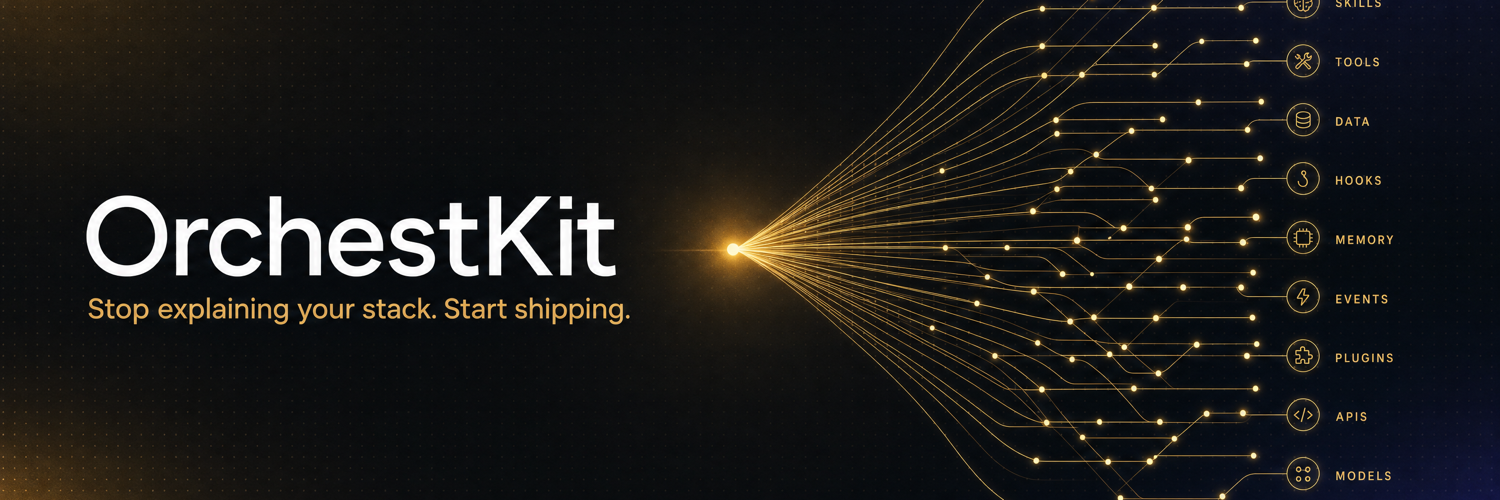
115 skills · 36 agents · 163 hooks







Start here
OrchestKit is free and open source (MIT, no account): skills and agents for Claude Code, Cursor, Codex and five more coding agents, plus hooks in Claude Code, for review, testing, security and memory. Where it runs.
claude plugin marketplace add yonatangross/orchestkit && claude plugin install ork@orchestkit
Docs · What's new in v10 · yonyon.ai
Explore the Docs → ·
OrchestKit Community →
Skill browser, demo gallery, setup wizard
Contents
- Quick Start
- Why OrchestKit?
- What You Get
- Key Commands
- Configuration
- What OrchestKit observes
- Install
- FAQ
- Development
- What's New
- Community
Quick Start
Pick the host you actually use. Claude Code is the full plugin (skills + agents + hooks). Cursor gets the same ork plugin minus Claude hook scripts. skills.sh is skills only — start with the 12 below, not the whole catalog.
Host support matrix
Measured 2026-09-08 on pi 0.85, Codex CLI and cursor-agent. Details, commands and the lane model: OrchestKit on pi, Codex and Cursor. Antigravity measured 2026-09-18 on agy 1.2.6; full evidence in docs/audits/agy-host-support-2026-09-18.md. Devin, Antigravity (1.5.14), OpenCode (1.19.6) and Muse Code (1.4.25) measured 2026-11-22; full evidence in docs/audits/host-support-2026-11-22.md.
| Host | Skills | Agents | Hooks | Install | Needs |
|---|---|---|---|---|---|
| Claude Code | 82 + 33 ork-extras | 36 | 163 | plugin (CLI) | Claude Code 2.1.328 or newer |
| Cursor | 82 + 33 ork-extras | 36 | not yet (#4004) | plugin (Settings) | |
| Codex | 9 | 4 roles | not yet (#4004) | ork-codex pack | |
| Devin | 82 | 36 | 58 of 103 | plugin (git) | |
| OpenCode | 12 | none | none | skills.sh | |
| Muse Code | 82 | none | none | plugin (muse) | |
| Pi | 82 | ? | not yet (#4004) | pi manifest | |
| Antigravity | 82 | 36 | none | plugin (claude-code) |
+ N ork-extras is the opt-in second plugin, installed on its own. ? means not measured yet, never zero. none is a measured zero: the host was read and the pack registers nothing there. not yet means a tracked issue will bring it. Devin hooks are the hooks.json entries that land on the events Devin fires.
How each host wires the rest (measured, see the dates above):
| Surface | Claude Code | Cursor | Codex | pi | Devin | Antigravity |
|---|---|---|---|---|---|---|
| Rules | repo convention | 14, plugin rules key | AGENTS.md | none | AGENTS.md, always on | AGENTS.md, per-directory |
| Commands | /ork:<skill> | 36 wrappers | $ork-<skill> | /skill:<name> | /ork:<skill> | /<skill-name>; ork:<skill> via plugin install |
| MCP config | .mcp.json | .cursor/mcp.json | plugin mcp.json | .pi/mcp.json | mcp.json / .mcp.json | ~/.gemini/config/mcp_config.json or plugin mcp_config.json; repo .mcp.json not read |
| Status | shipped | shipped | shipped | shipped | skills only, GH-4146 | skills only, measured agy 1.2.6 |
Claude Code
/plugin marketplace add yonatangross/orchestkit
/plugin install ork
Then /ork:setup. The wizard scans the repo, recommends skills, and writes MCP config.
CLI equivalent: claude plugin marketplace add yonatangross/orchestkit && claude plugin install ork@orchestkit.
Channels: ork is the stable channel, pinned to the latest release. ork-alpha is the same plugin tracking main, in the same marketplace (claude plugin install ork-alpha@orchestkit); use it only if you want changes before they are released.
Cursor
Settings → Plugins / marketplaces → add yonatangross/orchestkit → enable ork → open a new chat. Same plugin Claude Code installs, not a five-skill fork. See Install → Cursor.
skills.sh (Cursor, Codex, OpenCode, …)
Starter 12 from measured installs plus the ork skills we retain (full why table under Install):
npx skills add yonatangross/orchestkit -s devops-deployment -s responsive-patterns -s architecture-decision-record -s ui-components -s rag-retrieval -s agent-orchestration -s brainstorm -s expect -s auto -s review-pr -s fix-issue -s commit
Full catalog: npx skills add yonatangross/orchestkit (hundreds of SKILL.md files; do not treat that as unique users). Live install totals stay on the skills.sh badge above.
Why OrchestKit?
Every Claude Code session starts from zero. You explain your stack, patterns, preferences—again and again.
OrchestKit gives Claude persistent knowledge of production patterns that work automatically:
| Without | With OrchestKit |
|---|---|
| "Use FastAPI with async SQLAlchemy 2.0..." | "Create an API endpoint" → Done right |
| "Remember cursor pagination, not offset..." | Agents know your patterns |
| "Don't commit to main branch..." | Hooks block bad commits |
| "Run tests before committing..." | /ork:commit runs tests for you |
What You Get
Core ork, plus opt-in ork-extras reference skills, from one marketplace.
| Component | Details |
|---|---|
| 115 Skills | 82 in core ork (workflows, FastAPI, React 19, testing, security, database design) and 33 opt-in reference skills in ork-extras (RAG, LangGraph, MCP, accessibility), loaded on-demand with zero overhead |
| 36 Agents | Specialized personas (backend-architect, frontend-dev, security-auditor) — route tasks to the right expert |
| 163 Hooks | Pre-commit checks, git protection, quality gates, browser safety — ship with confidence |
/plugin install ork gives the core skills, every agent and every hook. Add the reference skills with /plugin install ork-extras@orchestkit (what moved). Skills load on-demand. Hooks work automatically.
Browse everything in the Docs →
Key Commands
/ork:auto         # Front door: describe a goal, it routes to the right skill
/ork:setup        # Personalized onboarding wizard
/ork:implement    # Full-stack implementation with parallel agents
/ork:expect       # Diff-aware AI browser testing
/ork:review-pr    # PR review with parallel agents
/ork:verify       # Multi-agent validation
/ork:commit       # Conventional commit with pre-checks
/ork:explore      # Analyze unfamiliar codebase
/ork:memory remember     # Save to persistent memory
/ork:doctor       # Health check
Configuration
/ork:setup detects your stack, recommends MCP servers, and writes the configuration for you.
Recommended MCP Servers
| Server | Purpose | Required? |
|---|---|---|
| Context7 | Up-to-date library docs | Prerequisite (22 of 36 agents grant its tools) |
| Memory | Knowledge graph persistence | Recommended |
| Sequential Thinking | Structured reasoning for subagents | Recommended |
| Tavily | Web search and extraction | Optional |
Set "alwaysLoad": true on the first three in your .mcp.json. It skips the per-skill tool probe and shaves ~150ms off cold starts.
Context7 is a prerequisite, and ork does not ship it. 22 agents grant
mcp__context7__* in their frontmatter, but .mcp.json is user-owned and project-scoped,
so the grant refers to a server you add. Skip it and those agents answer from training
data with no error raised. The recommended entry is the hosted HTTP server, which costs
no local process:
"context7": {
  "type": "http",
  "url": "https://mcp.context7.com/mcp"
}
Free tier: 1,000 requests, public repos, no account. Context7 Pro ($10 per seat per
month) raises that to 5,000 per seat and parses private repos; add
"headers": { "Authorization": "Bearer ${CONTEXT7_API_KEY}" } and export the ctx7sk-
key. Add the header only once the variable is exported: with it unset the unexpanded
literal is sent as the token and every query fails, and it does not fall back to the
anonymous free tier, so the keyless entry above is strictly better than a header with no
key behind it. The legacy stdio transport (npx -y @upstash/context7-mcp@4.0.2) is the fallback
when the hosted endpoint is unreachable, but it spawns one child process per Claude Code
session, so the fan-out scales with how many sessions you keep open.
Optional companion for web-platform questions: Chrome's Modern Web Guidance (Apache-2.0) is a separate tool that checks a site against current web-platform guidance; pin a version when you run it, for example npx modern-web-guidance@1.0.0.
Customizing skills
Skills install as files on your disk, but don't hand-edit the installed copy — it gets overwritten on update and silently diverges from the canonical playbook. The supported ways to extend (user-level skills, project skills, upstream PRs, or disabling a bundled skill) are in docs/extending-skills.md.
What OrchestKit observes
OrchestKit is a quality-gate plugin, so its hooks are the product rather than an add-on. This section states plainly what they see, where it goes, and how to turn each piece off.
Scope: broad and intentional. OrchestKit registers 163 hooks across 32
lifecycle events, including SessionStart, UserPromptSubmit, PreToolUse,
PostToolUse, and Stop. They are not gated to a particular framework or
project type, because the gates they enforce (secret-write blocking, protected-file
guards, git safety, file-size limits, agent status protocol) apply to any codebase.
If you only want gates on some projects, enable the plugin per-project rather than
globally.
Where data goes: a local file on your own disk.
| What | Destination | Notes |
|---|---|---|
| Lifecycle events (session end, PR merged, goal converged, chain phase) | ~/.local/state/orchestkit/events.jsonl | Written unconditionally, rotated at 10 MB. ORK_EVENTS_LOG redirects the path (used by the test suite) |
| Hook metrics: event name, tool name, payload size, duration | same local file | Size-capped metrics only |
| Hook telemetry log: event, tool name, session id, branch, timestamp, and tool inputs and outputs | telemetry/events.jsonl in the plugin data folder (or .claude/telemetry/ in the project) | Secrets redacted, every string cut to 500 characters. Rotated at 10 MB at session end; rotated files deleted after 7 days |
| Prompt text | Not recorded in either log | Hooks read it to make an allow/deny decision, then discard it |
| Remote sync | Off | No endpoint is compiled in; see below |
There is deliberately no global kill switch for the local write, because the
gates depend on that state (the git-safety and chain-staleness hooks read their
own prior events). To stop it entirely, disable the plugin. Individual noisy hooks
have their own opt-outs: ORK_DISABLE_DEBT_TRACKER, ORK_DISABLE_WORKTREE_VERIFIER,
ORK_DISABLE_COORDINATION_METRICS, ORK_NO_NOTIFY, ORK_NO_STALE_SWEEP, and
ORCHESTKIT_SKIP_SLOW_HOOKS among others.
Network access from the hooks themselves is opt-in and unset by default. The
only remote host compiled into the shipped hook bundles is api.typesafe.ai,
used solely by the two opt-in TypeSafe settings below (grep -o 'https\?://[A-Za-z0-9.-]*' plugins/ork/hooks/dist/*.mjs
also lists github.com, which appears only in printed links). By default some
hooks run CLIs you already have, which use your own credentials and network:
claude -p --model haikuon the first prompt of a session, to title and color it. It sends the git branch name and the first 600 characters of that prompt to Anthropic through your own Claude Code login, with no tools, MCP servers or hooks in the child.ORK_SESSION_IDENTITY=0turns it off.gh issue view <n>when a subagent starts on a branch named likeissue/<n>-...orfix/<n>-..., to add the issue title and body as context.gh pr viewandgh pr listwhen a Bash command runsgh pr mergewith--delete-branch, to warn before deleting a branch that open PRs are based on.
Any other outbound call happens only if you configure a destination yourself, via one of:
ORCHESTKIT_HOOK_URL+ORCHESTKIT_HOOK_TOKEN(or the plugin'swebhookUrlandhookTokenoptions), which enablehooks/bin/telemetry-sync.mjs. It POSTs your local JSONL to your own endpoint. ASessionEndhook runs it in the background; without a URL and token it exits at once and sends nothing. The same two settings enable the webhook forwarder, which streams hook events, HMAC signed, to that endpoint.telemetry.sinksentries in~/.claude/settings.local.jsonor in the plugin data folder'ssettings.local.json(user scope only, never read from a project), each anhttps:URL you choose.ORK_HQ_TELEMETRY_URL, which points the telemetry HTTP sink at your own collector.ORK_HQ_TELEMETRY_USE_HQ_API=1together withHQ_API_URL, the same sink aimed at a self-hosted HQ API.ORK_SESSION_CATEGORY_PROVIDER=jev(orshadow) together with the TypeSafe key variableORK_TYPESAFE_API_KEY, a second classifier for the session work category. The session-identity hook already asks a localclaude -p --model haikuprocess for a title and a category; with both variables set it also asks TypeSafe's Jev model (api.typesafe.ai, model pinned tojev-1.13.0) one typed Choice over the same eight categories and the same criteria text. This is the one exception to the "no hardcoded host" note above, and it is dormant unless both variables are set. What leaves your machine: the git branch name and the first 600 characters of the session's first prompt, sent to a third-party processor under its own data policy. What changes injevmode: when Jev answers at confidence 0.8 or above, its category decides the session color (held out on 150 sessions, that band is 93.5% correct); below 0.8, or on any error, haiku's category decides as before. The title and emoji always come from haiku. Inshadowmode nothing you see changes; Jev is only logged beside haiku. To turn it on locally, in the shell that launchesclaude:export ORK_TYPESAFE_API_KEY="$(<your secret manager> ...)"andexport ORK_SESSION_CATEGORY_PROVIDER=jev. Both outcomes are logged once per session in the hook log, ascategory jev: haiku=<cat> jev=<cat> agree=<bool> confidence=<n> decided_by=jev|haiku threshold=0.8 latency_ms=<n>, and assession-identity.shadow.jsonwith the same fields (labels, decision, timing; never prompt text) next to the raw answersession-identity.jev.jsonin the session data directory. Cost of opting in: the first prompt of a session waits for the call to settle, 1.1 to 1.7 s measured from a fresh hook process (the eval's 320 ms was a warm connection), 3 s at most before it gives up.ORK_ROUTE_JEV=shadow(orsteer) together withORK_TYPESAFE_API_KEY, the Jev routing seam for/ork:auto(#4233). Off by default. When set, every build-shaped prompt (the same test the once-per-session executor reminder uses: an imperative build or fix verb, 40 characters or more, no explicit/plugin:skill) is sent to the same TypeSafe endpoint and model as one typed Choice over nineteen route classes plus four side judgments (needs a worktree, needs a browser, mutation risk, needs the operator). What leaves your machine: the first 1,500 characters of the prompt after a redactor has replaced secrets, emails, Israeli phone numbers, nine digit ids,op://references and the names of directories underclients/with[SECRET],[EMAIL],[PHONE]and[CLIENT], plus the repository basename. The serialized request is scanned again before it leaves; anything that survives redaction refuses the call. Inshadowmode nothing you see changes; the verdict is logged. Insteermode, at confidenceORK_ROUTE_JEV_FLOOR(default 0.5) or above, the one-line executor reminder names the executor the class maps to (route: dev_fix -> /ork:fix-issue (conf 0.83)); the model still reads the/ork:autotable and says whether it agrees. Fallbacks are fail open: no key, timeout, non-2xx, malformed answer, below the floor, or the daily token budget (ORK_ROUTE_JEV_DAILY_TOKENS, default 2,000,000) spent all mean the existing path runs untouched; a 402 or 429 switches the seam off for 24 hours. One log line per prompt,route jev: intent=<class> conf=<n> top3=<a:p,b:p,c:p> worktree=<n> browser=<n> mutation=<n> operator=<n> floor=<n> decided_by=jev|table|off|budget|egress latency_ms=<n> input_tokens=<n> redacted=<n>, and one record per prompt injev-route.jsonlnext tosession-identity.jev.json(labels, timings and a sha256 of the redacted text; never prompt text). Offline replay:node scripts/eval/route-check.mjs --jevandnode scripts/eval/jev-route-score.mjs. The vendor's agent skill is a peer plugin installed from its own marketplace, never a copied directory:claude plugin marketplace add typesafe-ai/skillsthenclaude plugin install typesafe@typesafe-ai;/ork:doctorreports the installed version against the marketplace and prints the update commands.
The sink returns early when the URL or the token is missing, and
telemetry-sync.mjs prints No ORCHESTKIT_HOOK_URL or TOKEN configured. Nothing to sync. then exits 0. There is no analytics ping, no crash reporter, and no
feature-flag fetch.
What OrchestKit never reads. No OS keychain lookups, no ~/.aws/credentials,
no SSH private keys, no browser cookie or login stores, no clipboard. The one
place secret-shaped paths appear in the source is
plugins/ork/hooks/dist/pretool.mjs, where id_rsa, .pem, .env, and
credentials.json form a blocklist that stops Claude writing to them. That
code denies access; it does not read those files.
Third-party MCP servers are recommendations, not bundled dependencies. The
plugin ships no .mcp.json and declares no mcpServers. The table under
Configuration is advisory, and /ork:setup asks before writing
anything.
Install
/plugin install ork
No tiering. No version confusion. Just one powerful plugin.
Not on Claude Code? Pull a starter 12 into any agent (Cursor, Codex, OpenCode, …) via skills.sh — do not install the whole firehose on day one. Picked from measured skills.sh installs on our listing plus the ork skills we actually retain:
| skill | why |
|---|---|
devops-deployment | most-installed cloud skill on our listing |
responsive-patterns | most-installed design skill on our listing |
architecture-decision-record | writing-bucket install leader |
ui-components | design install co-leader |
rag-retrieval | SE install leader |
agent-orchestration | agent-workflow install leader |
brainstorm | our most-retained ork skill |
expect | browser verification we run day to day |
auto | front-door router we actually invoke |
review-pr | ship-loop review we use |
fix-issue | debug loop we use |
commit | ship-loop commit (has a with/without receipt) |
npx skills add yonatangross/orchestkit -s devops-deployment -s responsive-patterns -s architecture-decision-record -s ui-components -s rag-retrieval -s agent-orchestration -s brainstorm -s expect -s auto -s review-pr -s fix-issue -s commit
All skills: npx skills add yonatangross/orchestkit. Live install totals stay on the skills.sh badge above, not hard-coded here.
Cursor
Cursor loads Agent Plugins and Cursor plugins.
This repo already ships the Agent Plugins manifest at plugins/ork/plugin.json.
Add the GitHub repo as a Cursor marketplace (Settings → yonatangross/orchestkit),
enable ork, then open a new chat. That is the same plugin Claude Code
installs, not a five-skill fork.
It also ships 14 rules under the plugin's rules key, generated from
src/rules/ and src/shared/rules/. They are agent-fetched, so a rule costs
context only when its description matches the task.
Claude hook scripts are not registered for Cursor: they depend on
${CLAUDE_PLUGIN_ROOT} (orchestkit#293, closed). Cursor enforcement for HQ
repos stays in the consuming project's .cursor/hooks.json.
"Include third-party Plugins" can leak SKILL.md from ~/.claude/plugins. That
is not an install. Proof is the ork plugin id plus the full skill catalog.
Codex
Codex uses its own plugin format, skill picker, and standalone role configuration. Add OrchestKit's Codex marketplace, then install the small portable workflow pack:
codex plugin marketplace add yonatangross/orchestkit --ref main --sparse .agents/plugins --sparse plugins/ork-codex
codex plugin add ork-codex@orchestkit-codex
Restart Codex after installation. Invoke a workflow explicitly with
$ork-brainstorm, $ork-explore, $ork-implement, $ork-assess, $ork-verify,
or $ork-review-pr; their narrow descriptions also let Codex select the relevant
workflow automatically.
The plugin intentionally ships roles as templates because Codex loads custom
roles from ~/.codex/agents/, not from a plugin manifest. From an OrchestKit
checkout, run this one-time, non-overwriting install:
plugins/ork-codex/scripts/install-codex-roles.sh ~/.codex/agents
It installs ork_explorer, ork_implementer, ork_reviewer, and
ork_verifier; restart Codex before spawning them.
Unattended runs: the ork-mech profile
For mechanical work (renames, bumps, codemods, sweeps that end in a diff),
install the shipped profile and run codex exec against it:
plugins/ork-codex/scripts/install-codex-profile.sh ~/.codex
codex exec --profile ork-mech "<task>" </dev/null
The profile is a FILE, not a snippet you paste into config.toml. Measured on
codex-cli 0.153.4: --profile <name> layers $CODEX_HOME/<name>.config.toml
over the base config, and a legacy [profiles.<name>] table left inside
config.toml makes the same flag a hard config-load error. The installer
refuses to run next to that table, and refuses to overwrite a profile you
already have.
What it sets, as codex exec prints it in its own header:
approval: never
sandbox: workspace-write [workdir, /tmp, $TMPDIR] (network access enabled)
reasoning effort: high
It deliberately does not pin a model (pass -m) and does not use
--dangerously-bypass-approvals-and-sandbox, which drops the sandbox entirely.
Two contracts a TOML file cannot express, so they stay on the command line:
-
</dev/null.codex execreads stdin even when a prompt argument is given. An inherited open pipe blocks the run withReading additional input from stdin...and no timeout. -
--add-dirinside a git worktree. The writable roots are[workdir, /tmp, $TMPDIR]. A linked worktree's git common dir sits outside the workdir, so the first commit dies onindex.lock. Add it:bashcodex exec --profile ork-mech \ --add-dir "$(git rev-parse --path-format=absolute --git-common-dir)" \ "<task>" </dev/null
Keeping the install current
ref main in the marketplace source is a cached snapshot, not a tracker. On the
2026-09-08 audit machine codex plugin list showed 10.0.0-beta.5 while main
was three releases ahead. After an OrchestKit release, update and check:
codex plugin update
codex plugin list | grep ork-codex          # installed version
jq -r .version plugins/ork-codex/.codex-plugin/plugin.json   # what main ships
Documentation lookup (context7)
The plugin ships a context7 MCP server in its own
manifest (mcpServers in .codex-plugin/plugin.json, defined in mcp.json),
so installing the plugin registers it. Confirm with codex mcp get context7.
It is scoped to the only two tools context7 exposes, resolve-library-id and
query-docs, and it uses the hosted HTTP transport rather than an npx stdio
child, so it costs no extra process per Codex session.
Export a key before starting Codex. The plugin references the variable name
and never stores the value, so no token is written to ~/.codex/config.toml:
export CONTEXT7_API_KEY_CODEX="<your-context7-api-key>"
Put that in your shell profile so every Codex session inherits it. Get the
key from your own context7 account and keep the value out of the repository.
If you store it in a secret manager, substitute your own vault and item names
(with the 1Password CLI the reference is op://<vault>/<item>/credential), and
cache the resolved value instead of re-reading the vault in every shell: each
raw read is a separate unlock prompt.
Two behaviors worth knowing:
- A server you already define yourself under
[mcp_servers.context7]in~/.codex/config.tomlwins, and the plugin's definition is ignored entirely (including its tool scoping). That is intentional: your own configuration is never overridden. Remove your entry if you want the plugin's. - Without a valid key the server still connects and still lists its tools.
Only a real call fails, with
Invalid API key. A successful connection is therefore not proof of authentication.
pi
pi (0.85) reads the same SKILL.md format, and the repo now carries a pi
manifest, so the package installs directly:
pi install git:github.com/yonatangross/orchestkit
That registers every skill. Add -l to write .pi/settings.json in the
project instead of your user settings. Pointing pi at a checkout still works
and needs no install (pi --skill ./plugins/ork/skills).
The 29 skills marked disable-model-invocation stay reachable only as
/skill:<name>. Two measured caveats: --no-builtin-tools hides every skill
(pi lists skills only when a file-reading tool is enabled), and pi -p blocks
on an open stdin, so headless runs need </dev/null.
MCP servers for pi come from .pi/mcp.json, then .mcp.json, then
~/.config/mcp/mcp.json. Copy the shipped template to get the recommended
servers with a read-only includeTools allowlist per server:
cp .pi/mcp.json.example .pi/mcp.json
Full detail and the tracking epic: OrchestKit on pi, Codex and Cursor.
Devin
devin plugins install yonatangross/orchestkit
Devin checks a plugin root for a manifest in this order: .devin-plugin/plugin.json,
then .claude-plugin/plugin.json, then root plugin.json
(plugins reference).
The repo root only had the last one, the Agent Plugins
manifest, which fixes skills at a root skills/ directory this repo does not have,
so a bare install used to list 0 of 107 skills, 0 hooks, and only the AGENTS.md
rule (GH-4146). A root level .devin-plugin/plugin.json now maps skills to
./plugins/ork/skills, the same built tree Claude Code and Cursor already read.
devin plugins info ork lists 76 of 107 skills after that change (measured on
Devin CLI 3000.10.27). The other 31, auto, verify, help, brainstorm, and
similar router or workflow skills, declare a triggers: frontmatter key shaped
as an object (keywords, examples, anti-triggers). Devin's own triggers
field expects a flat [user, model] list, and the shape mismatch drops the
whole skill instead of warning. Renaming that key touches three other readers
(scripts/eval/eval-coverage.sh, tests/skills/triggering/test-trigger-keywords.sh,
and the SKILL_ONLY allowlist in tests/plugins/test-command-frontmatter-passthrough.sh),
so it stays tracked on GH-4146 instead of folded into this fix. Installing the
subpath directly, devin plugins install yonatangross/orchestkit#plugins/ork,
reaches the same 76 skills plus the plugin's 36 custom subagents, which neither
path surfaces through devin plugins info. That subpath is what this repo's own
.claude-plugin/marketplace.json already points Claude Code at.
OrchestKit's plugin hooks work under Claude Code only today; none of the 163
fire under Devin. Two reasons. Location: OrchestKit ships hooks at
plugins/ork/hooks/hooks.json, while Devin's own plugin format reads a bare
hooks.json at the plugin root instead. Shape and tool names: OrchestKit's
file matches Claude Code tool names such as Bash and Write|Edit and
expands ${CLAUDE_PLUGIN_ROOT} in command args, both Claude Code specific.
Devin's own
hooks.v1.json format
matches its own tool names instead, exec, write, edit and friends (see
lifecycle hooks),
inside the same {matcher, hooks:[{type, command}]} event map shape.
devin plugins info confirms Hooks (none) even once skills resolve.
PreToolUse and PostToolUse read the closest to what OrchestKit's own
pretool and posttool hooks already do, and are the first candidates for a
future Devin hook manifest once the tool name mapping is written deliberately
instead of guessed.
Pin a release instead of tracking main: release-please tags every release as
v10.0.0-beta.N. The single argument devin plugins install <source> command
has no ref pinning syntax of its own; pin through a requiredPlugins entry
(in this repo's own .devin/config.json, or a personal, org, or enterprise
manifest) instead:
{
  "requiredPlugins": [
    { "source": "github", "repo": "yonatangross/orchestkit", "ref": "v10.0.0-beta.30" }
  ]
}
Antigravity
npx skills add yonatangross/orchestkit -s devops-deployment -s responsive-patterns -s architecture-decision-record -s ui-components -s rag-retrieval -s agent-orchestration -s brainstorm -s expect -s auto -s review-pr -s fix-issue -s commit
Antigravity (agy, Google's agentic CLI) reads Agent Skills from a workspace
.agents/skills directory, so the shared skills.sh line above is the install
path and Antigravity is already in that installer's universal target list
(measured on agy 1.2.6; full evidence in
docs/audits/agy-host-support-2026-09-18.md). Verify from the repo root with
agy -p "/skills" --add-dir "$PWD": print mode only registers a workspace from
an absolute --add-dir, while the interactive TUI takes the launch directory
as the workspace and needs no flag.
Two honest gaps. npx skills add -g lands in ~/.agents/skills, which agy
does not read; user scope lives at ~/.gemini/config/skills (or
~/.gemini/skills). And none of ork's 163 hooks port: agy's hooks.json uses
its own event names and payload shape, and agy plugin validate plugins/ork
reports hooks skipped because ork keeps them at hooks/hooks.json, not the
plugin-root hooks.json agy looks for.
A fuller install exists but needs a local checkout:
agy plugin validate <checkout>/plugins/ork reports skills: 108 processed,
agents: 36 processed, and agy plugin install <checkout>/plugins/ork copies
them into ~/.gemini/config/plugins/ork/ namespaced ork:<name>, which matches
the /ork:<skill> spelling. Plugin-bundled mcp_config.json also works
(marker-verified end to end), but a repo-level .mcp.json is never read.
FAQ
Plugin not found?
/plugin list
/plugin uninstall ork && /plugin install ork
Hooks not firing?
Run /ork:doctor to diagnose.
Claude Code version?
Requires ≥2.1.328 (supported floor; Opus 5 as the default Opus, Opus 5.5 from 2.1.280, xhigh effort, dynamic workflows, sandbox.network.strictAllowlist, native binary, hardened Bash(rm:*)/Bash(find:*) rules). Check with claude --version.
Raising this floor is a breaking change and ships as a major release. See STABILITY.md for the full contract, and shared/cc-support.json for the authoritative window.
Superpowers vs OrchestKit?
Complementary, not a rival listing. Superpowers (official Anthropic marketplace) is process: how the agent works a task. OrchestKit is production patterns plus lifecycle hooks. Honest split: docs · yonyon.ai.
Development
The build requires Python 3.11 or newer as python3 on your PATH to generate the reference docs.
npm run build      # Build plugins from src/
npm test           # Run all tests
Edit src/ and manifests/, never plugins/ (generated).
See CONTRIBUTING.md for details.
What's New
v10.20.1 · 2026-11-26
- #5184: close six residual npm-ci-symlink-guard bypasses (#5465)
- ci: judge fork PRs in the standards gate like branches (#5460)
- glyph: keep the page section sidebar a thin index (#5457)
- hooks: drift gate nudges via additionalContext (#4684) (#5461)
- hooks: record the spawner, one start row per agent (#5171) (#5464)
- …and 3 more (see CHANGELOG.md)
v10.20.0 · 2026-11-26
- site: host support MCP app on the docs MCP (#5452)
v10.19.0 · 2026-11-25
- site: shared MCP view element, search results on it (#5448)
- site: skill card and install picker on the shared view element (#5449)
- bug: accept search result URLs in hosted docs MCP read (#5429)
- bug: add rate-limit headers to bare API discovery (#5438)
- bug: honor Markdown rejection in docs Accept headers (#5422)
- …and 33 more (see CHANGELOG.md)
v10.18.1 · 2026-11-24
- mcp: clarify Docs MCP tools by transport (#5404)
v10.18.0 · 2026-11-24
- cc: adopt Claude Code 2.1.331 (#5399)
- cli: accept full URLs and docs/ paths in read (#5391)
- cli: derive doctor exit code from check outcomes (#5400)
- docs: retain indexed URLs in the budgeted dump (#5402)
- hooks: limit task-tracking nudges to one per session (#5349)
- …and 6 more (see CHANGELOG.md)
v10.17.0 · 2026-11-23
- cc: adopt Claude Code 2.1.323 through 2.1.330 (#5350)
- ci: update fn-hooks canary for the 2.1.330 engine.create form (#5348)
- cli: strip #fragment before adding .md in readDoc (#5351)
- docs: preserve the full page index for Markdown clients (#5359)
- hooks: catch assistant-format edits in scope-audit (#5361)
- …and 18 more (see CHANGELOG.md)
v10.16.0 · 2026-11-22
- glyph: add the devin-safe profile for engines that render shade fills as slabs (#5323)
- agents: raise ci-cd and frontend maxTurns to 85 (#5299)
- build: preserve reference docs on generator failure (#5301)
- cli: ignore directories during host detection (#5319)
- cli: treat --help and --version as flags after a command (#5318)
- …and 16 more (see CHANGELOG.md)
v10.15.1 · 2026-11-19
- memory-lens: show no recall line, context to the model only (#5296)
- site,ci: redirect skill sub-URLs, retry dropped npm audit requests (#5295)
See CHANGELOG.md for the full release history.
Community
Join the Building with AI community for AI dev tips, OrchestKit support, and connecting with other builders:
| Room | Who it's for | Link |
|---|---|---|
| Building with AI | The umbrella community. One join, every room below. | Join |
| Builders | For people already building | Join |
| OrchestKit | For OrchestKit users | Join |
| AI for Business | For people leading AI adoption | Join |
Names and audiences match what yonyon.ai renders, so the two surfaces cannot drift. Every link resolves through yonyon.ai/go/*, so a rotated invite never needs a README change and no raw invite is published here.
OrchestKit family
- Tower: a macOS menu bar app for people who run several AI coding subscriptions: usage per account, room left, when to switch. Also an MCP server (
tower mcp).
Who builds this
OrchestKit is built and maintained by Yonatan Gross — Yonyon AI, an AI consulting practice. It is the toolkit extracted from real client work, not a side project: the patterns here are the ones that survived shipping.
It stays MIT and free. Nothing is gated, and none of the below changes that.
Working out where AI actually fits in your business? The AI readiness audit is a free assessment that maps your workflows and returns a prioritized report — the same diagnostic that opens a consulting engagement.
Want the toolkit running properly in your team? Setup, configuration, and a working agent loop tailored to your stack is something I do as a fixed-scope engagement. Start a discussion or reach out through the community.
Security policy and reporting: SECURITY.md.
Docs · Issues · Discussions · Community
MIT License · @yonatangross