Listed from the MCP registry; nobody on Odel publishes it.

Korea Data MCP
Korean public data: corporate filings, stock prices, apartments, statutes, economic statistics
Runs on your machine from its package; the steps are below.
What it does
- Reads
- Writes
- High impact
At most: only reads or looks up information.
What it costs
FreeOdel charges nothing per call. The publisher may charge for its own service.
Runs locally over stdio
This server isn't hosted — your MCP client launches it from a package registry. Use one of the commands below, or drop the config into your client (e.g. Claude Desktop).
Distributed as an MCP bundle (`https://github.com/YoungsoonLee/korea-data-mcp/releases/download/v0.1.11/korea-data-mcp.mcpb`) — download it and import the bundle in your MCP client.
English | 한국어



Pass Korean public APIs straight to an AI agent and it gets answers wrong. korea-data-mcp gives it the right ones.
An MCP server for Korean corporate filings, financials, dividends and major shareholders, stock prices, apartment sale prices and rents, business registration status, public holidays, statutes and court rulings, and Bank of Korea economic statistics, from the official free APIs of OpenDART, data.go.kr, law.go.kr and ECOS.
- Correct, with evidence. 104 traps found on the live APIs (wrong half-year revenue, laws not in force yet, cancelled deals, district codes that changed in 2026, and more) are handled, each covered by a test that uses the real response. The full list is public: What korea-data-mcp handles for you. In a small evaluation, agents with korea-data-mcp answered 10 of 10 questions with one call each; with the raw APIs they hit the traps, needed about 3x the calls, and missed one.
- Installs in one click. A single binary with nothing else to install. In Claude Desktop, open korea-data-mcp.mcpb and enter your keys. Also in the official MCP Registry.
- Private. It runs on your machine. Your keys and questions go only to the government APIs, never through a third-party server, and there is no telemetry.
- Focused. 26 tools with clear descriptions, so an agent picks the right one without filling its context with dozens of others.
News
- 2026-11-18 v0.1.11:
entity_get_profilegives one company in one call: overview, key figures from the latest annual report, stock price, 5% holders, recent filings and pension subscribers, each section with its source. Unlisted companies that file audit reports only (Samsung Display has no financials in OpenDART) get a link to the latest one, and a dissolved company's leftover registry figures are flagged.datagokr_get_corporationnow converts the average salary that about 1 in 70 records give in millions or thousands of won. - 2026-11-14 v0.1.10:
entity_resolve_companyidentifies a company from a name or any of its numbers and returns every identifier, former names, whether it is listed now and whether the business is still active. Many companies share a name (two(주)카카오file with DART; one closed in 2014), and DART keeps the stock codes of delisted companies, soopendart_search_companiesnow checkslistedwith each company's profile. - 2026-11-11 v0.1.9: National Pension Service workplaces (
datagokr_get_pension_workplaces): subscriber counts close to employee counts, unlisted companies included, with a 12-month history. Alsokorea-data-collect, which keeps the ownership reports and company list changes that OpenDART forgets (how). - 2026-11-08 v0.1.8: Full financial statements (
opendart_get_financialswithscope: "full") and stakes in other companies (opendart_get_investments). Lines come in the order printed in the filing, and amounts carry their real dates, including for companies whose fiscal year ends in March or June. Investees come with their DART company code. - 2026-11-04 v0.1.7: Major decisions (
opendart_list_corporate_actions: rights issues, capital reductions, convertible bonds, buybacks and disposals of treasury stock, mergers and splits) and reports by 5% holders and insiders (opendart_get_ownership_reports). - 2026-10-31 v0.1.6: Every financial amount comes with the period it covers. The output format changed.
- 2026-10-31 v0.1.5: Bank of Korea ECOS statistics (
ecos_get_series,ecos_search_series). - 2026-10-30 v0.1.4: Dividends (
opendart_get_dividends) and largest shareholders (opendart_get_major_shareholders). - 2026-10-30 v0.1.3: Apartment rents (
datagokr_list_apartment_rents).
All releases: Releases
Why it matters
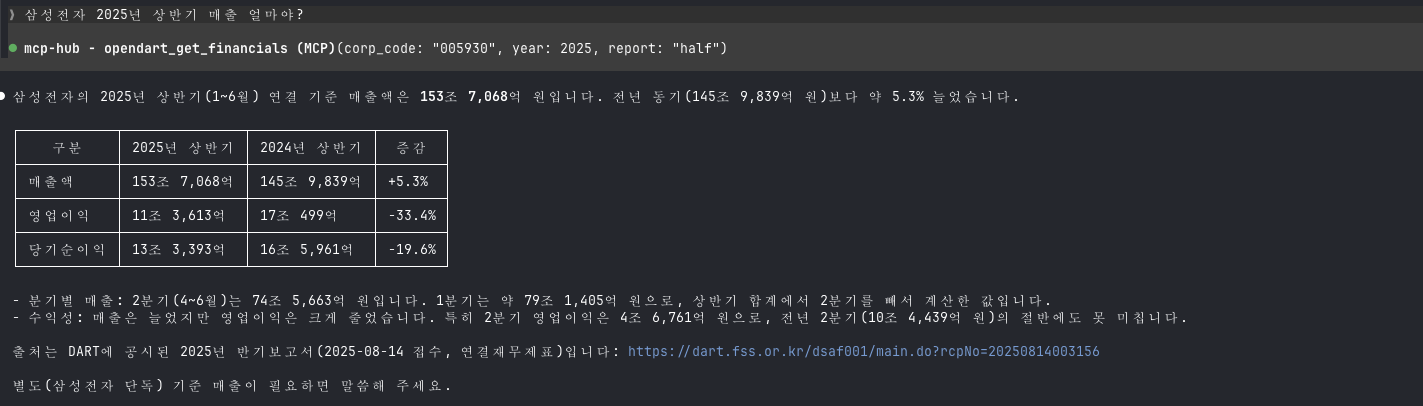
Example: "What was Samsung Electronics' revenue in the first half of 2025?" Here is what OpenDART actually returns:
{ "account_nm": "매출액", "thstrm_dt": "2025.01.01 ~ 2025.06.30",
  "thstrm_amount": "74,566,317,000,000", "thstrm_add_amount": "153,706,820,000,000" }
The period says January to June, so an agent reads thstrm_amount and answers ₩74.6 trillion. That is wrong: it is the second quarter only. The half-year figure, ₩153.7 trillion, is in a different field. Most Korean MCP servers pass this response on as is. korea-data-mcp returns:
{ "name": "매출액", "statement_type": "income_statement",
  "current":         { "start": "2025-01-01", "end": "2025-06-30", "amount": 153706820000000 },
  "current_quarter": { "start": "2025-04-01", "end": "2025-06-30", "amount": 74566317000000 } }
So the agent gets it right, and can even split out the second quarter:
Three more traps, each of which silently produces a wrong answer:
-
Law that is not law yet. Ask law.go.kr for the current Labor Standards Act (근로기준법) and the text includes 제44조의4, labeled as in effect since 2026-10-08. It actually takes effect on 2027-01-01; the official "current law" text already contains amendments that are only promulgated. korea-data-mcp returns the text in force on the date you ask for (today by default) and lists what is coming in
upcoming(tool output shortened):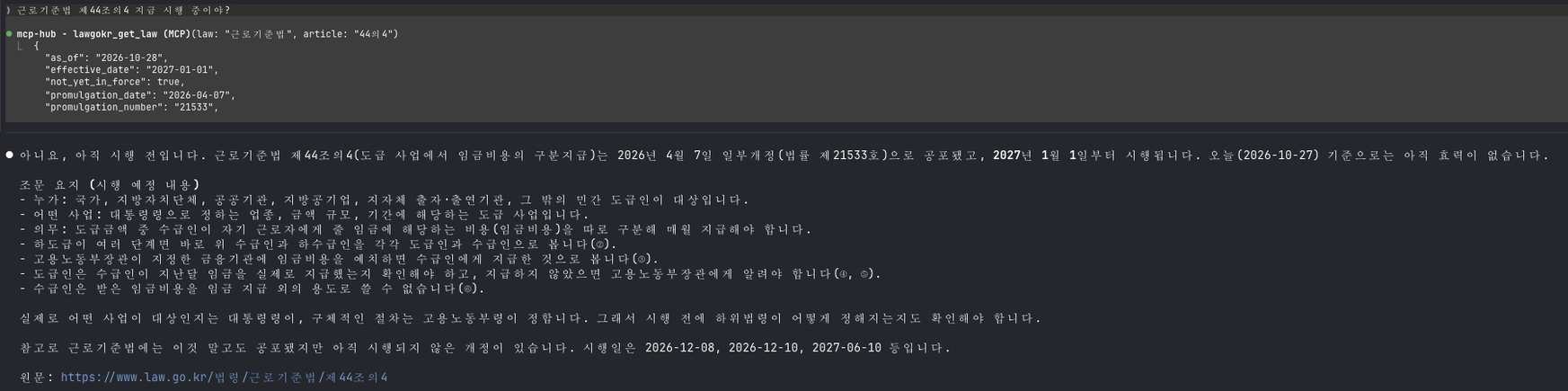
-
Deals that never happened. Apartment trade data keeps cancelled deals, marked only by a flag: 12 of 233 Gangnam trades in September 2025, including a ₩7.5 billion one. Averages that include them are wrong. korea-data-mcp leaves them out.
-
Codes that quietly stop working. In 2026, 광주광역시 and 전라남도 merged, 화성시 was split into four 구, and 인천 reorganized its districts. The old district codes, which most code tables still list, now return zero trades, even for past months. With korea-data-mcp, an agent just says
광주 북구or화성시.
There is more: errors returned as HTTP 200, stale records mixed with current ones, business numbers that fail when written with hyphens, stock history split by a company rename, and a TLS handshake that fails from Go. See all 104: What korea-data-mcp handles for you.
What you can ask
Connect korea-data-mcp to Claude (or any MCP client) and ask in English or Korean:
- "What was Samsung Electronics' revenue in the first half of 2025, and what has it disclosed recently?"
- "Who is SK hynix's largest shareholder, and how did its dividend per share change over the last three years?"
- "Who else holds 5% or more of SK hynix, and have any of them sold recently?"
- "How much did Samsung Electronics spend on buybacks in the last two years, and has 광진실업 diluted its shareholders?"
- "Which stakes did SK Square sell last year, and what is its largest holding now?"
- "Which listed companies does Samsung Electronics hold stakes in, and how did their shares move last month?"
- "Check whether our supplier Kakao Games is still in business, with its latest results and largest shareholder."
- "Which company is 대우조선해양 now, and is it the same company as before?"
- "Give me a one-page profile of 삼성디스플레이: what it does, how many people work there, and its latest audit report."
- "What was the median apartment sale price in 분당구 in September 2025?"
- "What was the median jeonse deposit for new contracts in 강남구 in September 2025?"
- "Is 제44조의4 of the Labor Standards Act (근로기준법) in force yet?"
- "Find recent Supreme Court rulings on unfair dismissal (부당해고) and summarize the holding of the latest one."
- "Is business registration number 124-81-00998 still active?"
- "How did NAVER's stock price move last month?"
- "Which public holidays are left in Korea this year?"
- "How have the Bank of Korea base rate and the won-dollar rate moved over the last two years?"
- "Show the base rate over the last year next to the median apartment sale price in 강남구."
| Source | What it covers | Key |
|---|---|---|
| OpenDART (전자공시) | Company profiles, disclosures, financial statements, dividends, shareholders, 5% holders, insider trades, stakes in other companies and major decisions (rights offerings, convertible bonds, buybacks, mergers) of ~120,000 companies | OPENDART_API_KEY |
| data.go.kr (공공데이터포털) | Holidays, corporation info, business status, apartment trades, stock prices | DATAGOKR_SERVICE_KEY |
| law.go.kr (국가법령정보) | Statutes as in force on any date, court rulings | LAWGOKR_OC |
| ECOS (한국은행 경제통계) | Interest and exchange rates, prices, GDP, employment, balance of payments and thousands of other series | ECOS_API_KEY |
All four keys are free. You can start with just one.
Quick start
Claude Desktop, in one click: download korea-data-mcp.mcpb, open it (or drag it into Settings → Extensions), and enter the keys you have (how to get them). Nothing else to install; skip to step 4.
1. Install
Download a binary for macOS, Linux or Windows (Intel or ARM) from Releases, extract it, and note the absolute path of korea-data-mcp (korea-data-mcp.exe on Windows). For example, on an Apple Silicon Mac:
curl -L https://github.com/YoungsoonLee/korea-data-mcp/releases/latest/download/korea-data-mcp_darwin_arm64.tar.gz | tar xz
./korea-data-mcp -version
On macOS, a binary downloaded with a browser is blocked as coming from an unidentified developer; run xattr -d com.apple.quarantine korea-data-mcp once. curl downloads are not affected.
Or with Go 1.26 or later (Go 1.21+ downloads the right toolchain automatically):
go install github.com/YoungsoonLee/korea-data-mcp/cmd/korea-data-mcp@latest
The binary is installed to $(go env GOPATH)/bin/korea-data-mcp.
2. Get a key
Start with OpenDART: sign up at opendart.fss.or.kr, request a key (인증키 신청), and it is issued right away. For all four, step by step with the Korean menu names: Getting API keys. Any subset works; tools whose key is missing are simply not offered.
Outside Korea? These portals usually require Korean identity verification (a Korean mobile number) to sign up, so getting keys from abroad can be hard or impossible. A hosted version that needs no keys of your own is planned: join the waitlist.
3. Connect your client
Use absolute paths. Leave out the keys you don't have.
Claude Code:
claude mcp add korea-data-mcp \
  -e OPENDART_API_KEY=... \
  -e DATAGOKR_SERVICE_KEY=... \
  -e LAWGOKR_OC=... \
  -e ECOS_API_KEY=... \
  -- /absolute/path/to/korea-data-mcp
Claude Desktop: edit ~/Library/Application Support/Claude/claude_desktop_config.json (macOS) or %APPDATA%\Claude\claude_desktop_config.json (Windows), then restart Claude Desktop:
{
  "mcpServers": {
    "korea-data-mcp": {
      "command": "/absolute/path/to/korea-data-mcp",
      "env": {
        "OPENDART_API_KEY": "...",
        "DATAGOKR_SERVICE_KEY": "...",
        "LAWGOKR_OC": "...",
        "ECOS_API_KEY": "..."
      }
    }
  }
}
Other MCP clients take the same command and environment variables.
To keep keys in one file instead, copy .env.example to .env, fill it in, and pass -env-file /absolute/path/to/.env as an argument. A variable set in the environment takes precedence over the file.
4. Check it
Ask your agent "Which korea-data-mcp providers are enabled?". It calls hub_list_providers, which lists the enabled providers and any missing keys. Then try one of the questions above.
API keys
Step-by-step instructions and troubleshooting: Getting API keys. All four are free, but signing up usually requires Korean identity verification. If you can't get them, join the hosted waitlist.
| Environment variable | Source | How to get it |
|---|---|---|
OPENDART_API_KEY | OpenDART | opendart.fss.or.kr → 인증키 신청 (request a key) |
DATAGOKR_SERVICE_KEY | data.go.kr | data.go.kr → sign up → apply for each API (활용신청; links in Tools) → My Page |
LAWGOKR_OC | law.go.kr | open.law.go.kr → OPEN API 신청 (apply) → 마이페이지 → API인증키관리 (OC) |
ECOS_API_KEY | ECOS | ecos.bok.or.kr/api → 인증키 신청 (request a key) |
data.go.kr: The portal issues two keys, Encoding and Decoding. Use the Decoding key. The Encoding key gets URL-encoded twice and fails with
SERVICE_KEY_IS_NOT_REGISTERED_ERROR. One key covers every API you apply for.
law.go.kr: The OC is a value you choose under 마이페이지 → API인증키관리. A wrong OC gives the error "사용자 정보 검증에 실패하였습니다". law.go.kr puts the OC in every link it returns, so don't reuse another key as the OC (korea-data-mcp never passes those links on).
Tools
OpenDART (OPENDART_API_KEY)
| Tool | What it does |
|---|---|
opendart_search_companies | Find a company's corp_code by Korean/English name, stock code, or corp_code. listed is checked with each company's profile, since DART keeps the stock codes of delisted companies |
opendart_get_company | Company profile (기업개황): CEO, market, registration numbers, address, fiscal year-end |
opendart_search_disclosures | Search disclosures (공시) by company, date range, type, and market |
opendart_get_financials | Key financial accounts (주요계정), or every line of the balance sheet, income statement, cash flow and equity statements (전체 재무제표) in printed order, each amount with its period and prior-period comparisons |
opendart_get_dividends | Dividends (배당): cash dividend per share, yield, total and payout ratio for common and preferred shares, with EPS and net income, for the report's period and the two prior years. Year-to-date and full-year periods are labeled, and the par value shows stock splits |
opendart_get_major_shareholders | The largest shareholder (최대주주) and related parties: common and preferred shares and stakes at the start and end of the period, with the group total |
opendart_get_investments | Stakes in other companies (타법인출자): subsidiaries, affiliates and investments with shares, percent and book value, stakes sold during the year, the investee's assets and net income, and its corp_code when the name identifies one company |
opendart_get_ownership_reports | Ownership reports: holders of 5% or more (대량보유) with each holder's latest stake and status, including holders whose last report is older than the API returns; or executives' and major shareholders' own trades (임원·주요주주), by reporter, date and direction |
opendart_list_corporate_actions | Major decisions (주요사항보고서) of a company: rights and bonus issues, capital reductions, convertible bonds, bonds with warrants and exchangeable bonds, buybacks (direct and through a trust), treasury stock disposals, mergers and splits, as numbers: implied issue price and dilution, bond reset floors and the shares at the floor, buyback totals across share classes |
Every OpenDART tool that takes corp_code also accepts a 6-character stock code (e.g. 005930).
data.go.kr (DATAGOKR_SERVICE_KEY). Each API needs its own application (활용신청) on data.go.kr; the links are below.
| Tool | What it does | API to apply for |
|---|---|---|
datagokr_list_holidays | Public holidays (공휴일) for a year or month, including substitute holidays, Seollal and Chuseok, and election days, with English names and weekdays. Also anniversaries, the 24 solar terms, and seasonal days. 2004 through two years ahead | 한국천문연구원_특일 정보 |
datagokr_search_corporations | Find Korean corporations by name, listed or not. Returns the corporate registration number (crno) and, for DART filers, dart_corp_code for opendart tools | 금융위원회_기업기본정보 |
datagokr_get_corporation | Current company profile by corporate or business registration number: former names, CEO, market, registration numbers, founding and listing dates, address, industry, employees, average tenure and salary, auditor and audit opinion | Same as above |
datagokr_check_business_status | Check up to 100 business registration numbers (사업자등록번호) with the National Tax Service: registered or not, active, suspended or closed (with date), and VAT type. Hyphens are fine | 국세청_사업자등록정보 진위확인 및 상태조회 |
datagokr_list_apartment_trades | Apartment sale transactions for a district and month, newest first, with a median/min/max price summary. Prices in KRW; cancelled deals excluded by default; filter by apartment name or neighborhood. The region is a name (강남구, 서울 중구, 분당구, 광주 북구) or a 5-digit code; a city with wards, such as 수원시 or 화성시, covers all of them | 국토교통부_아파트 매매 실거래가 자료 |
datagokr_list_apartment_rents | Apartment jeonse (전세) and monthly-rent (월세) contracts for a district and month, newest first, with deposit and rent medians for each. New contracts and renewals, which are often capped at +5%, are told apart and can be filtered. Amounts in KRW; same regions as above. Since 2011 | 국토교통부_아파트 전월세 실거래가 자료 |
datagokr_get_pension_workplaces | National Pension Service workplaces: subscribers (close to employees, unlisted companies too), contributions billed, hires and departures that month, industry, address, enrollment dates, and a 12-month subscriber history on request. Take the business registration number and name, since only the first 6 digits are published; short-term sites are told apart from the company's own workplaces | 국민연금공단_국민연금 가입 사업장 내역 |
datagokr_get_stock_prices | Daily prices of a KOSPI, KOSDAQ or KONEX stock: close, change, open/high/low, volume, trading value, market cap. The stock is a name (삼성전자, naver), a 6-digit code or an ISIN; history follows the code across renames. Since 2020 | 금융위원회_주식시세정보 |
law.go.kr (LAWGOKR_OC)
| Tool | What it does |
|---|---|
lawgokr_search_laws | Search statutes in force (acts, decrees, ordinances) by name or official abbreviation (민법, 중대재해처벌법), or by article text with in_text. Exact matches and acts first |
lawgokr_get_law | The text of a statute as in force on a date (default today), whole or one article (제50조, 43의2), with paragraphs, subparagraphs and items. Lists promulgated amendments that take effect later in upcoming; any past or future date works with as_of |
lawgokr_search_precedents | Search court rulings (판례), newest first, by case name, full text, case number (2020다296604, spaces are fine), court and decision date. Court records only by default, so every result can be read |
lawgokr_get_precedent | A ruling by id or case number: issues (판시사항), holding (판결요지), cited statutes and cases, and the full decision with include_full_text |
Bank of Korea ECOS (ECOS_API_KEY)
| Tool | What it does |
|---|---|
ecos_get_series | A time series by named indicator (base_rate, usd_krw, jpy_krw, eur_krw, cny_krw, treasury_3y, treasury_10y, cd_91d, corporate_bond_3y, kospi, kosdaq, cpi, gdp_growth, gdp_growth_yoy, gdp, gdp_per_capita_usd, unemployment_rate, employment_rate, current_account, house_price_index) or by any table's code, daily to annual. Each series says whether a period's value is an average, the end-of-period level or a total; amounts are in KRW or USD; index series add the change from a year earlier (in points for rates) |
ecos_search_series | Find tables by Korean or English words (수출물가, housing price), or list a table's items with their frequencies and date ranges |
Company resolution and profiles (no key of its own: uses OPENDART_API_KEY, DATAGOKR_SERVICE_KEY, or both)
| Tool | What it does |
|---|---|
entity_resolve_company | Identify a company from a name, DART corp_code, corporate or business registration number, stock code (preferred shares too) or ISIN. Returns every identifier the other tools take, the current and former names, whether it is listed now, and whether the business is active or closed. Every company with the name is returned, best match first: two (주)카카오 file with DART, and one closed in 2014 |
entity_get_profile | One company in one call: identifiers and status, an overview (address, industry, listing date, employees, auditor), key figures from the latest annual report, the latest stock price and market cap, 5% holders, major decisions of the last 12 months, filings of the last 30 days and National Pension Service subscribers. Every section names its source tool, and filings carry their receipt number. Companies that file audit reports only get a link to the latest one; a dissolved company's stale registry figures are flagged |
Hub: hub_list_providers lists the enabled providers and the keys that are missing.
Security, limits and freshness
- Your keys stay on your machine. korea-data-mcp runs locally and sends each key only to the service that issued it. There is no telemetry. Error messages never include keys or query strings.
- HTTP mode has no authentication.
-httpserves the tools to anyone who can reach the port, using your keys. Bind it to localhost (-http 127.0.0.1:8080) unless it is behind an authenticating proxy. The default stdio mode does not open a port. - Upstream quotas apply. A data.go.kr development account allows 10,000 calls per day for each API; OpenDART, law.go.kr and ECOS have their own limits. korea-data-mcp caches responses for 10 minutes and the DART company list for 24 hours.
- Data is as fresh as the source. Apartment deals can be reported up to 30 days after the contract, so the latest month fills in over time. Stock prices are daily, updated after each trading day.
Roadmap
- OpenDART: companies, disclosures, financials, dividends, shareholders, ownership reports, stakes in other companies, major decisions
- data.go.kr: holidays, corporation info, business status, apartment trades and rents, stock prices
- law.go.kr: statutes, court rulings
- Bank of Korea ECOS: rates, prices, GDP, employment and any other ECOS table
- Company resolution across OpenDART and data.go.kr: one company from any name or number, and its profile in one call
- KOSIS (Korean Statistical Information Service)
- A sibling server for Japan, starting with EDINET (corporate disclosures)
Want a data source added? Request it. Found an API behaving oddly? Open an issue. No Korean API keys? Join the hosted waitlist. To build, test or add a provider, see docs/DEVELOPMENT.md.
License
Apache License 2.0. Data returned by the tools comes from the upstream services and is subject to their terms of use.